⏱ 20 min read
Most decomposition stories begin with the wrong question.
Teams gather around a whiteboard and ask, “How should we split the monolith?” Then somebody sketches boxes around customer, order, inventory, payment, shipping, and everyone nods with the quiet relief that comes from drawing a diagram before doing the hard thinking. A few months later, the payment service is melting under peak traffic, order orchestration has become a distributed ball of mud, and inventory is both slow and wrong in ways that ruin weekends.
The problem wasn’t that the team chose microservices. The problem was that they decomposed by nouns alone. microservices architecture diagrams
Load has shape. It pools in odd places. It spikes where the business is nervous, where users click twice, where integrations retry, where compliance makes every write expensive, and where one innocent endpoint fans out into ten downstream calls. If you ignore that shape, your architecture will discover it the hard way—in production, at quarter close, on Black Friday, during payroll, or just after a mobile app release.
This is where service decomposition by load becomes useful. Not as a replacement for domain-driven design, but as a corrective to simplistic service boundaries. Domain semantics still matter most. The business meaning of an Order, a Policy, a Claim, or a Payment is what gives a service integrity. But load tells you where a boundary that is conceptually neat may be operationally disastrous. Good architecture sits in the tension between business language and runtime physics.
That tension is the real subject here.
Context
Microservices promised independent scaling, autonomous teams, faster delivery, and cleaner ownership. Sometimes they deliver exactly that. Sometimes they deliver twenty tiny systems all synchronized by fear.
The classic decomposition guidance—split by bounded context, align with business capabilities, own your data—remains sound. In fact, it is the only reliable starting point. A service boundary without domain meaning is just a deployment artifact with a pager attached.
But enterprises do not operate in toy conditions. They carry legacy systems, shared databases, reporting obligations, seasonal peaks, regional traffic asymmetry, old batch jobs, and integration contracts signed by people who have retired. The runtime profile of such systems is rarely symmetrical. One part of the domain may be mostly reads. Another may be write-heavy and latency-sensitive. Another may be low volume but carry expensive validation or fraud checks. Another may be bursty because an upstream ERP dumps files every hour. Another may be deceptively calm until end-of-month reconciliation arrives and turns the room red.
A useful architecture must face this unevenness.
Service decomposition by load means using load heatmaps, traffic patterns, write contention, fan-out, queue depth, and scaling asymmetry as first-class inputs when deciding where to split or refine service boundaries. Not instead of business boundaries. Alongside them.
That distinction matters. If you optimize only for load, you end up creating “read service,” “write service,” “search service,” and “validation service” with no coherent domain language. Those are not services. They are performance hacks wearing domain costumes. If you optimize only for domain purity, you can trap high-variance traffic and expensive workflows inside a single service that becomes impossible to scale sensibly.
The craft is in balancing both.
Problem
The usual failure pattern is familiar.
A team identifies a broad domain like Order Management and builds an Order Service. At first, this feels disciplined. It owns order creation, line-item updates, pricing snapshots, fulfillment status, customer-visible queries, and perhaps some audit history. All order-related concerns in one place. Nice and tidy.
Then reality arrives.
Customer apps hammer order status reads. The warehouse integration floods fulfillment updates. Pricing recalculations hit line changes. Fraud review adds long-running state transitions. Customer service performs ad hoc searches with ugly filters. Finance requires end-of-day extracts. Meanwhile, every order write triggers events for notifications, inventory reservation, invoice generation, and analytics.
The service is now not one load profile, but six.
Scale it vertically and you pay for CPU on read traffic that really needs cache and indexes. Scale it horizontally and write contention, hot keys, and transactional logic still bite. Split it badly and you create a distributed transaction factory. Keep it whole and the team becomes the bottleneck for every order-adjacent change.
The architecture problem is not “monolith versus microservices.” It is “where does load align with domain semantics, and where does it cut across them?”
That is where load heatmaps are valuable. A heatmap is not just an observability artifact. Used well, it becomes a decomposition aid. It shows endpoints, commands, events, data aggregates, customer journeys, and background jobs by volume, latency sensitivity, contention, and business criticality. You start to see what is merely popular, what is expensive, what is bursty, and what is dangerous.
Dangerous matters more than busy.
A rarely called operation that locks critical rows and blocks downstream flows can deserve more architectural attention than a high-volume cached query. Enterprises often miss this because they chase request count rather than operational impact.
Forces
Several forces pull in different directions.
Domain integrity
A service should mean something in the business. If the sales director, operations manager, and compliance lead cannot all roughly understand why a capability is grouped together, you probably do not have a bounded context. Domain-driven design gives us the right instinct here: preserve ubiquitous language, keep invariants close to the aggregate that owns them, and avoid splitting business concepts so finely that no one knows where decisions belong.
Independent scaling
Not all parts of a domain need the same hardware, storage strategy, or throughput profile. Catalog browsing wants one kind of scaling. Payment authorization wants another. Shipment tracking another again. Independent scaling is not a slogan. It is one of the few reasons microservices are worth the complexity.
Team ownership
Conway still wins. Services should map cleanly enough to teams that change does not require committee meetings. But if load hotspots force constant tuning across many capabilities, team autonomy disappears. A decomposition that looks elegant in a repository can still fail if one team owns all the hotspots.
Data consistency
High-load decomposition often pushes teams toward asynchronous messaging, event-driven updates, CQRS-style read models, and Kafka-backed propagation. This is powerful and dangerous. Every asynchronous boundary introduces lag, replay concerns, duplicate delivery, idempotency needs, and reconciliation work. There is no free lunch here. There is only lunch you pay for in a different department. event-driven architecture patterns
Migration risk
Most enterprises cannot stop and redraw the map. They need progressive strangler migration, side-by-side operation, controlled routing, contract stabilization, and selective extraction of the hottest or most unstable parts first. The migration path matters as much as the target state.
Operational visibility
A decomposition that cannot be observed is guesswork. If you cannot trace commands across services, inspect consumer lag, detect poison messages, visualize hotspot aggregates, and compare read/write heat by business function, then your architecture is flying blind.
These forces are why service decomposition by load is not a simple pattern. It is a decision discipline.
Solution
The practical approach is this: decompose first by domain semantics, then refine by load asymmetry.
Start with bounded contexts, not endpoints. Identify the business capabilities, aggregates, invariants, and event flows. Ask what must remain transactionally consistent, what can tolerate eventual consistency, and what language belongs together. This gives you a candidate service map with integrity.
Then overlay the load heatmap.
Look at:
- request volume by operation
- write contention by aggregate or key
- CPU and I/O cost by workflow
- fan-out depth
- retry storms
- cacheability
- tail latency sensitivity
- batch versus interactive traffic
- peak burst sources
- downstream dependency amplification
- reconciliation frequency and cost
Now ask a sharper question: where does runtime behavior justify refining a bounded context into separate deployable units, read models, processing lanes, or workflow services without breaking the domain model beyond repair?
Sometimes the answer is to split a service. Sometimes it is to keep the service whole but separate command and query paths. Sometimes it is to introduce Kafka and asynchronous processing for load shedding. Sometimes it is to carve out a high-cost subdomain like Search or Pricing Calculation because it behaves like a different animal. Sometimes it is to do none of these and simply fix bad indexes, add caching, or reduce chatty calls.
Architecture is often the art of refusing premature decomposition.
A useful rule
Separate by load only when one of these is true:
- The hotspot has materially different scaling characteristics.
- The hotspot causes unrelated functionality to scale unnecessarily.
- The hotspot changes at a different cadence and needs team autonomy.
- The hotspot introduces failure isolation concerns that justify a boundary.
- The hotspot can be separated without destroying critical domain invariants.
If none of these hold, keep the boundary where the domain says it belongs.
Architecture
The shape I prefer in enterprises is a domain-aligned core with load-oriented refinements around it.
That usually means:
- a command side that owns state transitions and invariants
- one or more query/read models optimized for heavy read traffic
- asynchronous event propagation for non-critical downstream effects
- explicit workflow orchestration only when state spans multiple bounded contexts
- reconciliation as a designed capability, not an afterthought
Here is a conceptual load heatmap over an order domain.
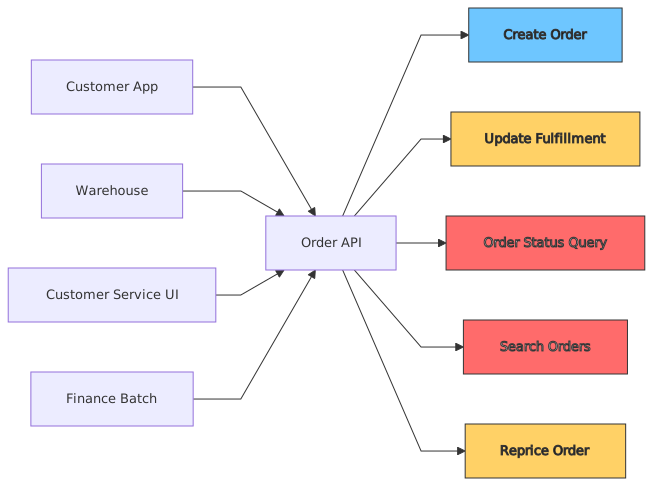
This is simplistic, but useful. It tells us status query and search are hot. That does not automatically mean they become separate bounded contexts. It usually means they deserve query-specific treatment—read replicas, cache, search index, denormalized projections, or CQRS-style models—before we split the order domain itself.
Now let’s refine the architecture.
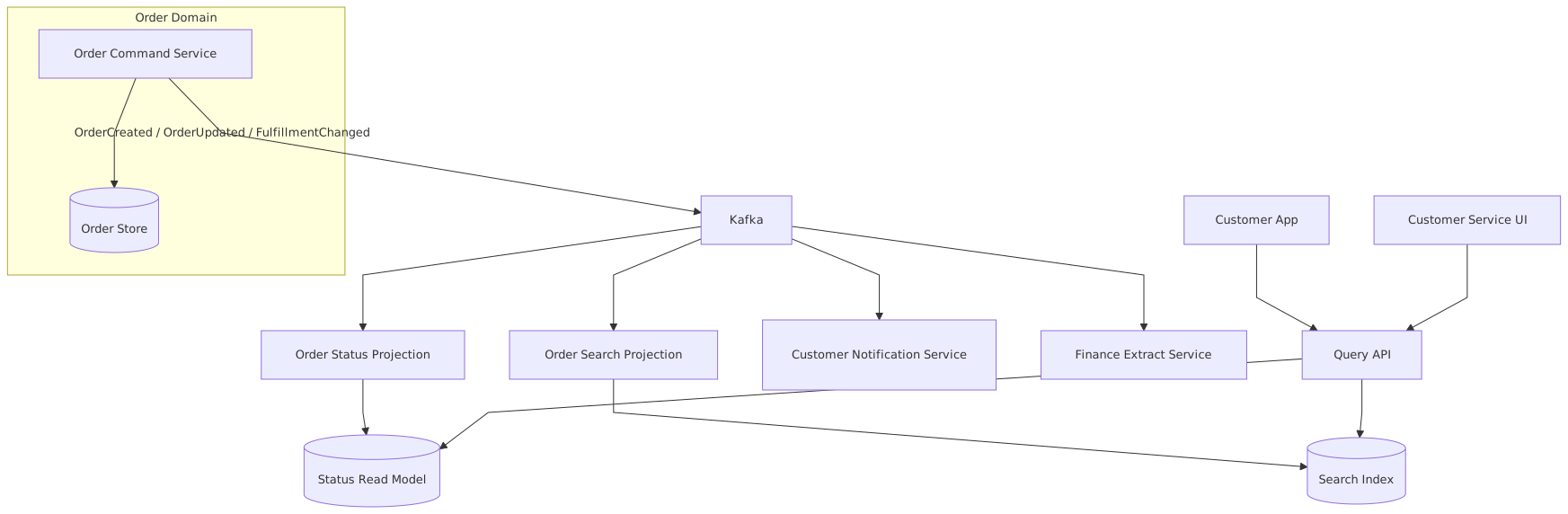
This is not decomposition by endpoint. It is decomposition by semantics plus load behavior. The Order Command Service remains the system of record for order invariants. Heavy reads move to projections. Search gets a specialized store because search is not the same problem as transactional state. Notifications and finance extracts consume events asynchronously because they should not sit on the user’s latency budget.
Kafka is relevant here not because Kafka is fashionable, but because it gives durable, replayable event distribution for high-throughput propagation and independent consumers. It allows read models and downstream services to scale differently from the command path. It also gives you the machinery for reprocessing when projections drift or a consumer bug corrupts state.
But Kafka does not solve semantics. If the events are poor, Kafka simply helps you spread poor semantics very efficiently.
Domain semantics discussion
This is the place where many teams go wrong. They decompose by load and accidentally split a domain concept into fragments that no longer own their business rules.
For example, if “Order Status Service” begins deciding whether an order is cancellable based on eventually consistent data, while “Order Command Service” owns the actual order lifecycle, you now have two truths. Customers will find the gap before your architecture review board does.
A better model is this:
- the command domain owns decisions and invariants
- read models answer questions quickly
- if a read model must express decision support, it does so as a hint, not as authority
- authoritative commands route back to the owning bounded context
That is DDD with operational discipline. The aggregate still matters. Load does not get to rewrite the business model just because graphs turn red.
Reconciliation is part of the design
Any architecture using asynchronous propagation must assume drift. Read models may lag. Consumers may fail. Messages may be duplicated. External systems may apply updates out of order. A projection may be rebuilt from an old schema. If you do not design reconciliation explicitly, your support team becomes the reconciliation engine.
I prefer three layers of reconciliation:
- consumer-level idempotency using event keys and offsets
- projection rebuild from Kafka replay or event store snapshots
- business reconciliation jobs comparing source-of-record state to downstream materialized views or partner systems
This is where enterprises earn their scars. Eventual consistency is tolerable only when recovery is boring.
Migration Strategy
Most organizations arrive here with a monolith or a coarse service already in place. They cannot replace it in one move. They need a progressive strangler migration.
Progressive strangler migration means extracting pressure points in an order that reduces risk and creates learning. Do not start with the most business-critical write path unless you enjoy incident bridges.
Start with the hottest reads.
Why? Because read extraction usually gives fast operational benefit with lower semantic risk. You can mirror change events from the monolith, build a projection for order status or search, route selected traffic to the new read API, and compare results. This creates your event contracts, observability patterns, replay discipline, and deployment muscle without immediately challenging the transactional heart of the business.
Then move to side effects and non-critical downstream processes. Notifications, extracts, audit pipelines, and analytics consumers are good candidates. They let you establish Kafka topics, schemas, DLQs, idempotent consumers, and backpressure handling.
Only after the ecosystem is stable should you consider extracting command logic with real invariants.
A typical migration path looks like this:
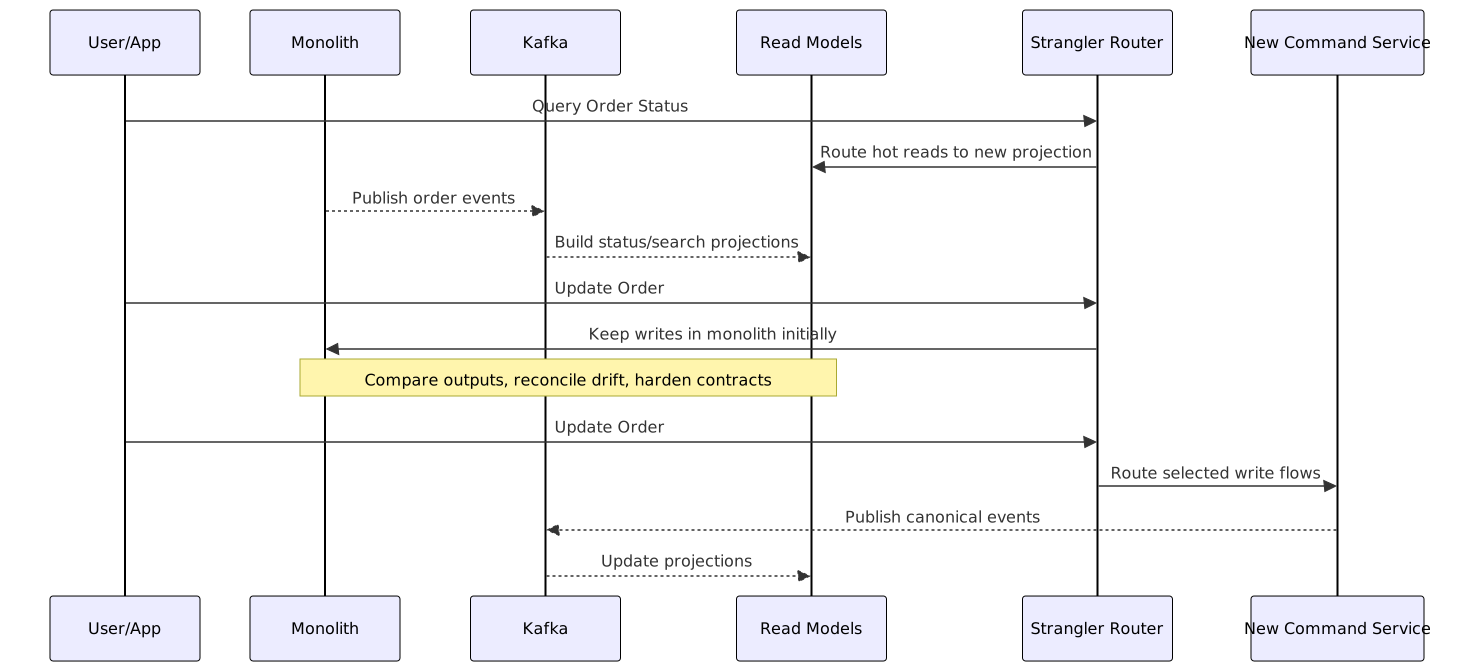
This is the sort of migration that works in real enterprises because it respects the asymmetry of risk.
Migration reasoning
A few opinionated rules:
- Extract reads before writes when load pressure is read-heavy.
- Introduce event publication before service extraction if you need stable contracts.
- Keep one source of truth for each business invariant during migration.
- Run dual-read or shadow-read comparisons before cutover.
- Do not dual-write unless you have no alternative, and if you must, wrap it in outbox-style discipline and reconciliation.
- Budget time for data correction tooling. You will need it.
The outbox pattern is especially useful during strangler migration. If the monolith remains source of truth, emit domain events reliably from the same transaction boundary as state change, then feed Kafka from the outbox. This avoids the classic “database committed but event was never published” mess.
Reconciliation during migration
Migration is where drift is most likely. Old and new representations will differ. Search indexes update late. Schemas evolve unevenly. Teams discover fields whose meanings were tribal knowledge rather than documented truth.
So build reconciliation as a first-class stream:
- compare counts by business date
- compare key state transitions
- compare derived totals and statuses
- produce exceptions for human review
- support replay and rehydration
Reconciliation is not bureaucracy. It is the difference between controlled modernization and confident self-deception.
Enterprise Example
Consider a large retail enterprise with e-commerce, stores, and third-party marketplace channels. They had an Order Management platform that began as a monolith and later became a coarse “Order Service.” It handled order placement, split shipments, returns initiation, fraud hold, status queries, customer service search, and partner updates.
Traffic was not evenly distributed:
- customer apps generated huge volumes of status checks after purchase
- customer service used complex search filters during promotions and delivery disruptions
- warehouse systems sent bursty fulfillment updates in batches
- marketplace partners retried callbacks aggressively
- finance required end-of-day extracts and reconciliation
The first instinct was to split into many services: order, fulfillment, returns, search, status, export, fraud. That looked modern. It would also have fragmented the order lifecycle into a committee of remote calls.
Instead, they mapped the order domain properly. “Order lifecycle and commercial commitments” remained one bounded context. Fulfillment execution was a related but separate context. Search was not treated as a domain authority; it was treated as a query capability. Customer-visible status became a read model. Finance extracts became event-driven downstream processing. Fraud hold remained a command-side decision because it affected lifecycle invariants.
Kafka became the event backbone, but only after the team stabilized a canonical event vocabulary: OrderPlaced, PaymentConfirmed, FulfillmentAllocated, ShipmentDispatched, ReturnRequested, RefundIssued, HoldApplied, HoldReleased. Those names mattered because they reflected business semantics, not database tables.
They extracted order status first. A Kafka-backed projection fed a low-latency status store tuned for the mobile app. That alone removed a huge read burden from the transactional database. Next they built a search projection in a search index optimized for customer service. They did not ask the transactional store to masquerade as a search engine anymore.
Only later did they split fulfillment execution into its own service because it had distinctly different load and release patterns, and because its operational model aligned with warehouse systems more than with commercial order decisions.
The result was not many small services. It was a few meaningful services with specialized read paths. That is often the right answer.
More importantly, they planned for failure. Consumer lag triggered routing fallbacks. Reconciliation jobs compared order states across command store, status model, and finance extracts. During one holiday incident, a projection consumer deployed with a schema bug and corrupted status updates for a subset of orders. Because events were replayable and the command service remained authoritative, they rebuilt the projection in hours rather than days.
This is what mature decomposition looks like: not prettier diagrams, but recoverable mistakes.
Operational Considerations
A load-aware decomposition lives or dies by operations.
Observability
You need metrics by business operation, not just infrastructure. CPU graphs don’t explain why “cancel order” is failing for partner channel traffic while “update shipping address” is fine. Instrument:
- command latency by aggregate type
- query latency by read model
- event publication delay
- Kafka consumer lag
- projection freshness
- retry rates
- dead-letter counts
- reconciliation mismatches
- hot partition and hot key behavior
Tracing matters too, especially where synchronous APIs hand off to asynchronous processing. The hardest incidents are often the ones where “the request succeeded” but the customer-facing status is wrong ten minutes later.
Partitioning and Kafka design
If you use Kafka, partition by a key that preserves ordering where it matters—often order ID, account ID, or policy ID. But understand the tradeoff. Good key choice preserves causality for an aggregate; bad key choice creates hotspot partitions.
Do not over-centralize topics around technical events. Prefer business-significant topics or well-governed event streams. Schema evolution must be disciplined. A “flexible” event with dozens of optional fields is usually a sign of semantic laziness.
Data storage choices
Use the right data store for the job:
- transactional store for command-side consistency
- key-value or document read model for status lookup
- search engine for rich querying
- columnar or warehouse feeds for analytics and finance
One service owning multiple storage models is acceptable if the domain remains coherent and ownership is clear. Purity contests about “one service, one database” often miss the point. The real question is whether data ownership and semantics remain clear.
Backpressure and load shedding
Not all load deserves equal treatment. Protect write paths and critical decisions. Let non-essential projections lag before you let order placement fail. Build backpressure and circuit-breaking intentionally. During a surge, it is often acceptable for search freshness to degrade by a minute. It is rarely acceptable for payment capture to time out because search indexing stole the database.
This is where service decomposition by load pays off. It lets you degrade gracefully instead of catastrophically.
Tradeoffs
This approach brings real benefits:
- independent scaling where it matters
- preserved domain integrity in command paths
- specialized read performance
- failure isolation for non-critical consumers
- cleaner migration path from monoliths
- improved observability of hotspots
But let’s not pretend this is free.
You increase architectural complexity. Event-driven propagation adds lag and failure modes. Reconciliation becomes mandatory. Teams must understand data contracts and schema evolution. Testing shifts from simple transactional tests to cross-service contract and replay scenarios. Support teams need better tooling. Auditors need explanations for eventual consistency.
There is also a social tradeoff. Some teams hear “load-based decomposition” and immediately ask for more services. Resist that instinct. More deployables are not the same thing as better architecture. If all you needed was caching, adding Kafka and three services is not modernization. It is overreaction.
Failure Modes
There are several ways this goes wrong.
Splitting by traffic without domain meaning
You carve out a “status service” that starts owning logic it should not. Soon it becomes authoritative by accident. Users see one state; commands enforce another. Confusion follows.
Eventual consistency without reconciliation
Teams say they are event-driven but cannot replay events, detect drift, or explain stale data. The architecture becomes probabilistic.
Kafka as a dumping ground
Every table change becomes an event. Topics multiply. Semantics decay. Consumers infer business meaning from technical noise. This is integration by archaeology.
Hot partitions and skew
A few keys or tenants dominate traffic. Kafka partitions, caches, or databases become unevenly loaded. The system scales in theory but not in practice.
Distributed transactions in disguise
You split command logic across too many services and then rebuild consistency with sagas that are really just distributed transactions plus sorrow.
Read model overreach
A query projection starts making decisions because it is fast and convenient. The command model is bypassed. Invariants erode.
These are not edge cases. They are the common diseases of enthusiastic microservice programs.
When Not To Use
Do not use service decomposition by load if your system is small, your traffic is moderate, and your monolith is not a bottleneck. A well-structured modular monolith can handle a surprising amount of business complexity and is often easier to evolve.
Do not use it when your primary issue is poor code quality rather than runtime asymmetry. Splitting bad code into services gives you bad code with network hops.
Do not use it if the domain is not yet understood. If you lack stable language and invariants, adding service boundaries just hardens confusion.
Do not use aggressive event-driven decomposition when the business cannot tolerate eventual consistency and you cannot afford the operational maturity needed for reconciliation, replay, and drift detection.
And do not use it because a platform team bought Kafka and now wants every problem to look like a topic.
Related Patterns
Several patterns commonly sit alongside this approach.
- Bounded Context: the starting point for meaningful service boundaries.
- CQRS: useful when read and write loads are very different, though often you need only a modest form of it.
- Event-Driven Architecture: helps decouple load and consumers, provided event semantics are good.
- Outbox Pattern: essential during migration and for reliable event publication.
- Strangler Fig Pattern: the practical migration path from monolith or coarse services.
- Saga: sometimes necessary for cross-context workflows, but use sparingly.
- Bulkhead and Circuit Breaker: operational protection for hotspots and downstream instability.
- Materialized Views / Projections: the workhorses of heavy-read decomposition.
- Reconciliation Jobs: not glamorous, but indispensable in enterprise systems.
These patterns are tools, not doctrine. The architecture should reflect the business and the load, not the trend report.
Summary
Service decomposition by load is useful because enterprise systems are not evenly stressed. Some capabilities are hot, some expensive, some bursty, some dangerous. Ignoring that shape leads to services that are tidy on paper and brittle in production.
But load alone is not enough. Domain-driven design still provides the spine. Bounded contexts, aggregates, and business invariants tell you what must stay coherent. Load heatmaps tell you where to refine that coherence into independently scalable read paths, asynchronous consumers, specialized processing lanes, or occasionally separate services.
The best designs keep command authority close to the domain, move heavy reads into projections, use Kafka where durable asynchronous propagation helps, and treat reconciliation as a product feature of the architecture rather than a cleanup task.
Migration should be progressive. Strangle hot reads first. Stabilize events. Reconcile relentlessly. Extract command paths only when you understand both the domain and the load well enough to avoid distributed confusion.
If there is a single memorable rule here, it is this:
Decompose by meaning first, by heat second.
Get that order right and microservices can scale like an engineered system. Get it wrong and they scale like an argument.
Frequently Asked Questions
What is a service mesh?
A service mesh is an infrastructure layer managing service-to-service communication. It provides mutual TLS, load balancing, circuit breaking, retries, and observability without each service implementing these capabilities. Istio and Linkerd are common implementations.
How do you document microservices architecture for governance?
Use ArchiMate Application Cooperation diagrams for the service landscape, UML Component diagrams for internal structure, UML Sequence diagrams for key flows, and UML Deployment diagrams for Kubernetes topology. All views can coexist in Sparx EA with full traceability.
What is the difference between choreography and orchestration in microservices?
Choreography has services react to events independently — no central coordinator. Orchestration uses a central workflow engine that calls services in sequence. Choreography scales better but is harder to debug; orchestration is easier to reason about but creates a central coupling point.