⏱ 21 min read
Most distributed systems do not fail with a bang. They fail by slow suffocation.
A downstream dependency gets a little slower. A mobile client retries too aggressively. A partner integration ignores the contract and bursts ten times harder than expected. Then the platform does what modern platforms always do under stress: it keeps accepting work just long enough to make everything worse. Queues swell, connection pools harden into bottlenecks, CPU burns on requests that should never have been admitted, and your expensive “elastic” architecture becomes a very efficient machine for spreading pain.
This is why rate limiting matters. Not as an API gateway checkbox. Not as a middleware plugin pasted in from a tutorial. But as a control surface for the business itself.
In microservices, rate limiting is not just about traffic shaping. It is about protecting bounded contexts, preserving service-level objectives, defending scarce capacity, and making sure one part of the enterprise cannot accidentally consume another part’s future. A token bucket is the most practical mental model here: tokens represent permission to consume a constrained resource; the bucket captures tolerated burst; refill encodes sustainable throughput. Simple. Powerful. Easy to misuse.
And misuse is common.
Teams often talk about “the rate limit” as if there were one. In real enterprises there are many topologies: edge gateway limits, service-local limits, shared distributed limits, tenant-aware quotas, event-consumer throttles, and hybrid patterns stitched together across synchronous APIs and asynchronous platforms like Kafka. Choosing among them is not a technical purity exercise. It is a domain decision. It says what you are protecting, who gets priority, where you want failure to surface, and how much inconsistency you can tolerate. event-driven architecture patterns
That is the real subject of this article: not merely token bucket flow, but where the bucket lives, who owns it, and what kind of system you get as a result.
Context
Microservices changed the shape of load.
In a monolith, overload tended to be local and visible. One deployment, one process space, maybe one database to blame. In a microservices landscape, load multiplies as calls fan out. A single customer request can touch authentication, profile, pricing, inventory, recommendations, fraud, payment orchestration, and notification services. If any upstream channel allows unbounded ingress, the downstream estate becomes the blast radius. microservices architecture diagrams
Now add Kafka, event-driven workflows, and external APIs. The system no longer has one front door. It has many.
A customer-facing API may receive 5,000 requests per second. Those requests may emit commands onto Kafka, which may trigger multiple consumers, which may in turn invoke internal services and SaaS providers. If you only rate limit at the edge, you have protected the front porch while leaving the rest of the building full of open windows.
This is why architecture discussions around rate limiting often feel strangely unsatisfying. The team asks, “Should we use token bucket?” and the answer is almost always “yes, probably.” But that is the easy part. The hard part is topology.
Where do tokens get checked?
- At the ingress gateway?
- In each service instance?
- In a centralized quota service?
- In the Kafka consumer loop?
- In all of them, for different semantics?
The right answer depends on the business domain and its capacity model.
If your Payments context is licensed for a fixed throughput with a card processor, your rate limit is not just technical protection. It is a reflection of commercial reality. If your Search context is designed for massive fan-out but can degrade gracefully, your token bucket may be permissive at the edge and stricter only around costly ranking operations. If your partner APIs have tiered contracts, then rate limiting is part entitlement, part billing, part fairness policy.
That is domain-driven design territory. Rate limiting belongs closer to domain semantics than most teams admit.
Problem
The naive architecture says: place an API gateway in front of microservices, configure token bucket limits per client, and call it done.
This helps. It does not solve the real problem.
The real problem is that demand and capacity are distributed unevenly across bounded contexts, channels, tenants, and time.
A few examples:
- A premium partner is allowed sustained high throughput but only for product lookup, not order placement.
- Fraud scoring is computationally expensive and has a lower safe throughput than customer profile reads.
- Kafka consumers can ingest faster than downstream settlement systems can handle.
- Retry storms from one mobile app version can starve internal administrative workflows.
- A “global” limit enforced centrally introduces latency and becomes its own bottleneck.
So the architecture challenge is bigger than just dropping requests after N per second. We need to answer several deeper questions:
- What resource are we protecting?
CPU, database connections, third-party calls, licensed transactions, queue depth, human operational capacity?
- What is the fairness policy?
Per user, per tenant, per API key, per region, per bounded context, or weighted priority?
- Where should overload be visible?
At the edge with a 429, at an internal service boundary, in a queue backlog, or in deferred processing?
- What consistency do we need?
Strongly coordinated limits across the fleet, or approximate local enforcement with occasional overshoot?
- How do synchronous and asynchronous channels reconcile?
The HTTP API may be limited differently from Kafka consumers processing the same business intent.
The ugly truth is that most enterprises need several forms of rate limiting at once. The topology is therefore not a single pattern. It is a composition.
Forces
Architecture is the art of choosing what pain you are willing to endure. Rate limiting makes that painfully concrete.
1. Burst tolerance versus steady-state protection
The token bucket is popular because it handles both. Refill rate defines sustainable throughput; bucket depth allows bursts. But burst tolerance is not free. If you allow a large bucket against a fragile dependency, you are effectively reserving the right to hurt yourself in spikes.
2. Local autonomy versus global fairness
A service-local limiter is fast, cheap, and resilient. But each instance only sees its own traffic. In horizontally scaled services, this means aggregate throughput can exceed policy unless coordinated. A centralized limiter offers global correctness but introduces network hops, operational dependency, and a single concentration of failure.
3. Domain semantics versus technical convenience
The easiest limits are per IP or per API key. The meaningful limits are usually per tenant, per entitlement plan, per workflow, or per business operation. “Create payment” and “check payment status” are not the same thing just because they both happen over HTTP.
4. Synchronous rejection versus asynchronous buffering
Sometimes the right response is 429 Too Many Requests. Sometimes the right response is accepting the command and processing later. If the domain expects immediate confirmation, buffering may violate user expectations. If the process is naturally deferred, hard rejection may be unnecessary self-harm.
5. Precision versus availability
A strongly consistent distributed counter gives precise enforcement until it becomes unavailable. Approximate distributed rate limiting tolerates partitions better but occasionally overshoots. In enterprise systems, “perfectly correct and down” is often worse than “approximately fair and still operating.”
6. Observability versus simplicity
A rate limiter you cannot explain under incident pressure is a liability. Complex stacked policies—edge + service + consumer + tenant weights—may be valid, but only if operations teams can understand which layer is dropping work and why.
Solution
The practical solution is a layered rate limiting topology, built around token bucket flow, where each layer protects a different concern.
The important move is to stop treating rate limiting as one decision. It is several.
At minimum, most mature microservice platforms end up with three layers:
- Edge admission control
Coarse-grained token bucket enforcement at the API gateway or ingress. This protects the platform from obvious overload and abusive clients.
- Domain or service protection
Finer-grained limits inside bounded contexts or service facades. These align with business operations and scarce internal resources.
- Consumer-side backpressure and throttling
Token bucket or concurrency limits around Kafka consumers and downstream integrations. This prevents asynchronous pipelines from outrunning dependencies.
A token bucket works well in each of these layers, but the semantics differ.
- At the edge, the bucket often means client fairness and DDoS-style protection.
- In the domain layer, the bucket means business capacity allocation.
- In consumers, the bucket means work admission to protect downstream systems.
That distinction matters. Same algorithm. Different responsibility.
Here is the simplest topology worth discussing.
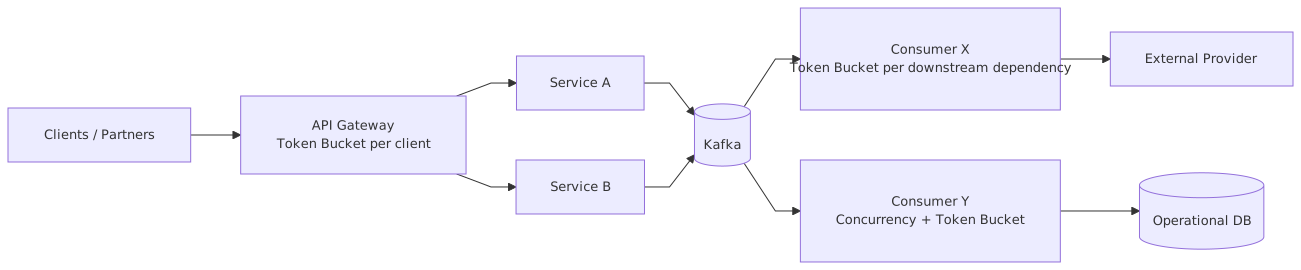
This design is not glamorous. It is effective.
The edge gate removes obviously excessive demand. Internal services still defend themselves because not all load comes from the edge; some comes from other services and asynchronous workflows. Kafka consumers apply their own admission policy because queues are not magical shock absorbers—they are time-shifted pressure vessels.
For more advanced scenarios, add a quota service for shared policy across instances and channels.
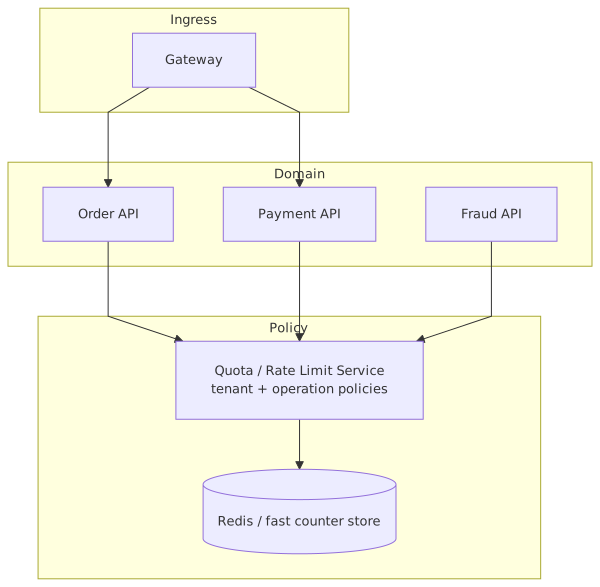
This topology makes sense when limits are contractual, monetized, or shared across multiple service instances and entry points. But it comes with a price: every protected call now depends on policy infrastructure. More on that later.
Domain semantics discussion
This is where design usually improves or collapses.
A rate limit should map to a domain concept, not just a transport concept. In domain-driven design terms, the limiter should respect bounded contexts and ubiquitous language. That means asking questions like:
- Is this limit about “orders submitted per seller per minute”?
- Or “payment authorizations per merchant account per second”?
- Or “fraud evaluations per region during batch catch-up”?
Those are not implementation details. They are policy definitions that business and technical teams can reason about together.
A common anti-pattern is enforcing one undifferentiated “requests per second” limit on an API that spans radically different business operations. That leads to absurd outcomes: a harmless read endpoint and a cost-heavy write endpoint compete for the same bucket, and your premium tenants end up throttled because someone spammed metadata fetches.
The better design is to classify operations according to domain value and resource impact. Separate buckets. Separate refill rates. Sometimes separate topologies.
Architecture
Let’s make the token bucket flow explicit.
A token bucket has:
- Refill rate: sustainable tokens added per interval.
- Capacity: maximum bucket depth, defining burst allowance.
- Consume rule: how many tokens an operation requires.
Most discussions stop there. Enterprise architecture cannot.
You also need:
- Key space: what identity the bucket is attached to.
- Scope: edge, service, consumer, tenant, global, per region.
- Degradation behavior: reject, queue, shed optional work, route to lower tier.
- Reconciliation model: how counters align across distributed nodes and channels.
- Operational ownership: who can change rates, under what governance.
Topology 1: Edge-only token bucket
This is the default platform setup.
Pros:
- Fast to introduce
- Central governance
- Immediate client-facing feedback
- Good for external abuse protection
Cons:
- Blind to internal traffic
- Too coarse for domain protection
- Does not protect Kafka consumers or service-to-service storms
- Can create false confidence
Use it, but do not stop there.
Topology 2: Service-local token bucket
Each service enforces its own local bucket, often in-process or sidecar-based.
Pros:
- Low latency
- No central dependency
- Can express operation-specific rules
- Great for protecting expensive code paths
Cons:
- Hard to enforce global quotas across replicas
- Aggregate overshoot under horizontal scale
- Policy duplication if unmanaged
This is excellent for self-protection. It is weak as a contractual quota system.
Topology 3: Shared distributed token bucket
A central policy service or shared store like Redis maintains counters for all instances.
Pros:
- Better global consistency
- Shared view across replicas and entry points
- Supports tenant quotas and monetized plans
Cons:
- Extra network hop
- Contention under high volume
- Store availability becomes part of the request path
- Badly designed keys become hotspots
This is the right move when rate limits are part of product policy, not just technical hygiene.
Topology 4: Hierarchical token buckets
A request must satisfy multiple buckets: global tenant limit, operation limit, and dependency-specific limit.
Pros:
- Models real enterprise constraints
- Supports priority and fairness
- Protects multiple layers at once
Cons:
- Harder to explain
- More tuning complexity
- Failure analysis gets messy fast
This is often the mature state of a platform, whether documented or not.
Topology 5: Event-consumer throttling
Kafka consumers use token buckets or concurrency control before calling downstream systems.
Pros:
- Prevents asynchronous overload
- Matches actual downstream capacity
- Allows controlled replay and catch-up
Cons:
- Increases lag
- Requires careful partition and consumer-group design
- Can create reconciliation issues with API expectations
This matters because Kafka does not remove capacity constraints. It changes where they appear.
A useful architecture for mixed synchronous and asynchronous domains looks like this:
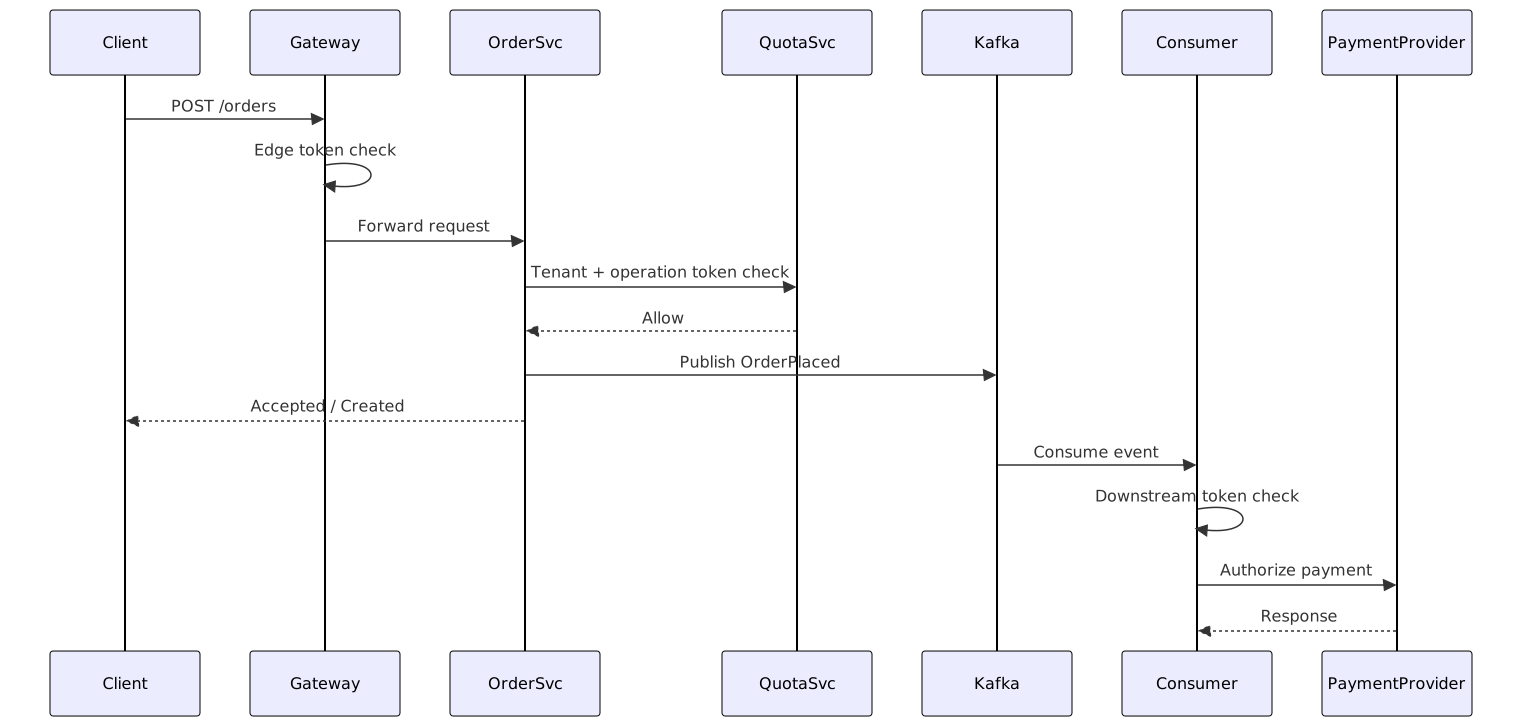
Notice the three separate controls. One request, three buckets, three meanings.
Migration Strategy
You do not replace rate limiting in one move. You strangle it.
Most enterprises begin with whatever their gateway product provides. Then they discover the gateway cannot express internal capacity semantics, premium tenant plans, event-driven backpressure, or per-operation cost models. The temptation is to rip everything out and build a grand centralized quota platform. Resist that temptation. Centralization done too early produces a beautiful bottleneck.
A better migration follows a progressive strangler pattern.
Stage 1: Stabilize at the edge
Start with coarse per-client or per-tenant limits at ingress. This buys safety quickly. Instrument 429 rates, burst patterns, and top consumers. Learn the traffic shape before designing refined policy.
Stage 2: Add service-local protection to fragile bounded contexts
Identify services with scarce resources:
- payment authorization
- fraud scoring
- pricing engines
- legacy ERP adapters
- search ranking pipelines
Put local token buckets around those hot paths. This is tactical and valuable. You are protecting the places where overload actually hurts.
Stage 3: Externalize policy for shared business quotas
Once the organization needs consistent tenant plans or operation-level entitlements across channels, introduce a shared quota service. Start with a narrow slice—one bounded context, one customer segment, one contract-driven API.
Do not make every service depend on it from day one.
Stage 4: Extend to Kafka consumers and replay tooling
As asynchronous load grows, move the same domain semantics into consumer throttling. A tenant who is limited on API submissions should not get unlimited replay pressure from backlog processing. This is where reconciliation becomes important.
Stage 5: Decommission obsolete limits carefully
Legacy gateway rules, hard-coded service limits, and ad hoc thread-pool throttles tend to linger. Remove only when observability proves the new topology behaves correctly. Otherwise you end up with accidental double-throttling and mysterious capacity loss.
Reconciliation discussion
Reconciliation is the part most teams forget until incident review.
In a distributed architecture, the same business action may pass through multiple channels. A customer submits an order via API. The order creates Kafka events. A retry worker or reconciliation batch may replay failed steps later. If each channel uses separate counters with no shared semantics, the system can violate business quotas in subtle ways.
Examples:
- API requests are throttled, but replay consumers are not, so a tenant still overwhelms payment processing.
- Kafka lag catch-up drains at full speed overnight, breaching third-party provider contracts.
- Service-local buckets allow short overshoot on each instance, causing aggregate budget exhaustion.
Reconciliation means deciding how these channels relate:
- Do API and async processing draw from the same tenant budget?
- Are retry flows charged differently from original requests?
- Does backlog replay have a dedicated lower-priority bucket?
- Can operations temporarily override limits during recovery?
These are domain policy decisions, not just traffic engineering.
A sensible enterprise pattern is to maintain:
- shared contractual quotas at the tenant/operation level
- local protective limits at the service/dependency level
- separate recovery budgets for replay and reconciliation jobs
That last one matters a lot. Recovery traffic should not look like normal business traffic.
Enterprise Example
Consider a global retail bank modernizing its payments platform.
The bank exposes APIs for merchants, mobile apps, branch systems, and internal batch channels. The old world was an ESB and a monolithic payment processor. The new world is a set of microservices: Payment Initiation, Fraud Decisioning, Ledger Posting, Notification, Merchant Entitlement, and Settlement. Kafka carries domain events between them.
At first, the bank uses only gateway rate limits:
- 500 requests/sec per merchant API key
- 50 requests/sec for mobile channels
- simple burst allowance
This works until Black Friday.
One large merchant uses its allowed burst to submit a flood of payment authorizations. The gateway sees this as compliant traffic. Fraud Decisioning, however, depends on a licensed third-party scoring engine capped at a much lower throughput. Fraud queues back up. Payment Initiation keeps accepting work. Kafka lag grows. Settlement windows start slipping. Customer support gets dragged into what looks, from the outside, like random slowness.
The problem was not lack of a token bucket. The problem was the wrong topology.
The bank redesigns in layers:
- Gateway limits remain for coarse merchant fairness.
- Payment Initiation checks tenant + operation quotas using a shared quota service. “Authorize payment” and “status lookup” now have different buckets.
- Fraud Decisioning applies its own dependency-specific bucket reflecting the third-party contract.
- Kafka consumers use lower-priority replay buckets so backlog recovery cannot starve real-time flows.
- Premium merchants get weighted plans tied to commercial agreements, not merely API keys.
This yields better control, but also exposes tradeoffs. During a partial outage of the quota service’s backing Redis cluster, the bank must choose between fail-open and fail-closed behavior. For premium payment flows, they choose fail-open with anomaly alerting for a brief interval. For lower-priority channels, they fail closed. Architecture is not math. It is policy under stress.
A DDD lens helps here. The Payments bounded context owns rules about merchant throughput entitlement. Fraud owns protection of its licensed scoring capacity. Settlement owns replay pacing during end-of-day catch-up. These are related, but they are not one giant “rate limiting module.” Each context protects its invariants while platform capabilities provide common mechanics.
That division of responsibility is what keeps enterprise systems governable.
Operational Considerations
A rate limiter that works in test but cannot be operated in production is just performance theater.
Metrics that matter
Track at least:
- tokens granted / denied
- effective throughput per key and per operation
- queue depth and consumer lag
- latency added by limiter checks
- fallback mode usage
- policy store saturation
- top rejected tenants and endpoints
Correlate 429s with downstream health. If rejections rise while downstream remains healthy, your policy may be too strict. If downstream degrades without rejections, your topology is too weak.
Configuration governance
Rate limits are production policy. Treat them like code with controlled change management, auditability, and rollback. In many enterprises, product, operations, and architecture all have a stake. That means clear ownership is essential.
Hot key management
Distributed limiters often collapse around hot tenants or popular operations. Key design matters. Avoid a single global counter for traffic that can be partitioned by region, tenant, or operation. Shard where the semantics allow it.
Time and clock issues
Some token bucket implementations rely on local clocks. Under skew or drift, refill calculations can behave oddly. Use monotonic time sources where possible and test for distributed time anomalies.
Load testing
Do not just test nominal throughput. Test:
- burst traffic
- retry storms
- cache misses in quota stores
- Redis failover
- Kafka replay catch-up
- region failover with doubled traffic
The failure modes are often in the transitions, not the steady state.
Tradeoffs
There is no “best” rate limiting topology. Only a best fit for your domain and tolerance for complexity.
Edge-only topologies are wonderfully simple and dangerously incomplete.
Service-local topologies are resilient and cheap but weak for global fairness.
Centralized shared quotas are powerful for product policy and tenant plans, but they can become the most fragile service in the platform if you are not disciplined.
Hierarchical limits match real-world enterprise constraints beautifully, right up until the incident commander asks, “Which bucket is dropping traffic?” and nobody can answer quickly.
There is also a human tradeoff. The more your limiter reflects genuine domain semantics, the more cross-functional coordination it requires. Product managers, commercial teams, and operations people suddenly care about refill rates and bucket capacity. Good. They should. The architecture has finally touched reality.
Failure Modes
Rate limiting fails in recognizable ways.
1. Fail-open overload
If the limiter or quota store becomes unavailable and the system defaults to allow, traffic surges into fragile dependencies. This is sometimes necessary for critical channels, but it must be deliberate and time-boxed.
2. Fail-closed outage
If the central limiter becomes unavailable and all traffic is denied, you have turned a protective mechanism into a platform outage. This is the classic “control plane broke the data plane” story.
3. Double-throttling
Gateway, service, and consumer all enforce similar limits without coordination. Throughput drops far below design expectations and teams blame the wrong layer.
4. Hot tenant starvation
One tenant or operation consumes a shared bucket, starving unrelated work. This usually means your bucket boundaries do not match domain boundaries.
5. Replay storms
Backlog reprocessing after incidents runs without separate pacing and crushes downstream dependencies harder than live traffic ever did.
6. Policy drift
Hard-coded service limits diverge from central quotas over time. Nobody knows which values are authoritative. Incidents become archaeology.
7. Misleading fairness
Per-instance local buckets appear fair in dashboards but overshoot globally at scale. Horizontal auto-scaling quietly multiplies allowed throughput.
These are not rare edge cases. They are the normal ways enterprise systems teach humility.
When Not To Use
Rate limiting is not the answer to every capacity problem.
Do not lean on token buckets when the real issue is:
- poor query design
- missing bulkheads
- absent circuit breakers
- unbounded retries
- no idempotency strategy
- incorrect Kafka partitioning
- weak priority models
- underprovisioned infrastructure for known load
Also, do not force highly coordinated distributed quotas into places that do not need them. If a service simply needs self-protection from expensive computations, a local concurrency limiter may be better than a globally synchronized token bucket.
And if your workload is pure internal batch where completion time matters more than request fairness, job scheduling and work queue management may be the more natural abstraction.
Not every pressure problem is an API problem.
Related Patterns
Rate limiting works best as part of a broader resilience toolkit.
- Circuit Breaker: stops calls to unhealthy dependencies after failures.
- Bulkhead: isolates resource pools so one workload cannot drown another.
- Backpressure: signals producers or slows consumers when capacity is constrained.
- Load Shedding: drops low-value work under pressure.
- Quota Management: ties usage to entitlements, plans, or contracts.
- Priority Queueing: reserves capacity for premium or critical flows.
- Idempotency Keys: reduce damage from retries and duplicate submissions.
- Strangler Fig Migration: introduces new rate limiting topology progressively without big-bang replacement.
The strongest architectures combine these patterns. Rate limiting alone cannot save a system designed to amplify load.
Summary
Rate limiting in microservices is not a middleware feature. It is a statement about what the business values and what the platform can safely sustain.
The token bucket remains the workhorse because it expresses a useful truth: steady capacity with bounded bursts. But the hard question is not whether to use token bucket flow. It is where to place the buckets, what they mean, and how they reconcile across synchronous APIs, Kafka-driven workflows, and bounded contexts.
Use edge limits for coarse protection. Add service-local limits where resources are fragile. Introduce shared quota services when business policy demands consistency. Throttle consumers because queues only move pressure around. Reconcile channels so retries and replay do not quietly violate the domain’s rules. Migrate progressively with a strangler approach. And never forget the old enterprise lesson: the control mechanism can become the failure mechanism if you centralize it carelessly.
Good rate limiting does not just protect systems from clients. It protects the enterprise from its own complexity.
That is the topology decision that matters.
Frequently Asked Questions
What is a service mesh?
A service mesh is an infrastructure layer managing service-to-service communication. It provides mutual TLS, load balancing, circuit breaking, retries, and observability without each service implementing these capabilities. Istio and Linkerd are common implementations.
How do you document microservices architecture for governance?
Use ArchiMate Application Cooperation diagrams for the service landscape, UML Component diagrams for internal structure, UML Sequence diagrams for key flows, and UML Deployment diagrams for Kubernetes topology. All views can coexist in Sparx EA with full traceability.
What is the difference between choreography and orchestration in microservices?
Choreography has services react to events independently — no central coordinator. Orchestration uses a central workflow engine that calls services in sequence. Choreography scales better but is harder to debug; orchestration is easier to reason about but creates a central coupling point.