⏱ 21 min read
Most microservices failures do not begin with Kubernetes, Kafka, or the API gateway. They begin much earlier, in a quieter place: in the moment a team draws a service boundary without deciding where a transaction truly ends. event-driven architecture patterns
That is the original sin.
Teams split a monolith into services, move data into separate stores, celebrate deployability, and then discover that the old transaction never really disappeared. It just leaked into the network. What was once a local ACID commit becomes a distributed argument between services, queues, retries, timeouts, and partial truth. The architecture still needs consistency. The business still needs an answer. But the boundary has moved, and nobody told the domain.
A transactional boundary is not a technical line around a database. It is a statement of business meaning. It says: within this zone, facts change together. Outside this zone, we coordinate, reconcile, and sometimes wait. If you get that wrong, you do not merely create complexity. You create a system that tells different parts of the business different stories.
That is why service boundaries and consistency zones belong in the same conversation. Domain-driven design gives us the language for the first. Enterprise integration gives us the scars for the second.
This article is about where to draw those lines, how to migrate toward them, and what happens when reality refuses to stay tidy.
Context
Microservices architecture promised a great bargain: smaller services, independent delivery, clear ownership, and systems that evolve with the business. In practice, the bargain only pays off when service boundaries align with domain semantics. If they do not, teams trade one large accidental monolith for a distributed one.
The hard part is not decomposition. Anybody can split a codebase. The hard part is deciding which business operations require strong consistency, which can tolerate asynchronous propagation, and which should be explicitly modeled as long-running workflows.
In the monolith, developers often rely on a single relational database transaction to enforce correctness. Updating an order, reserving inventory, charging a payment, and creating a shipment may all happen in one call stack, one transaction, one rollback model. Ugly perhaps, but coherent.
In microservices, that coherence fractures. Inventory has its own data. Payments have their own ledger. Shipping has its own process. The old “save everything or save nothing” model does not stretch naturally over network calls, event brokers, and independently deployed services. Two-phase commit can force that illusion, but usually at the cost of autonomy, operability, and survivability. Most enterprises that try it eventually regret it.
So we need a better framing.
The useful framing is this: each microservice should own a consistency zone, a place where it can make atomic promises about its own state. Cross-service business outcomes should be achieved through coordination, domain events, idempotent commands, and reconciliation. That sounds obvious when written down. It becomes much less obvious when the CFO asks why an order is “accepted” before payment is fully “settled,” or why inventory appears “reserved” in one dashboard and “available” in another.
Architecture lives in those verbs.
Problem
The typical problem appears as a contradiction between domain expectation and technical partitioning.
The business says:
- “Creating an order must reserve stock.”
- “Payment and order status must stay aligned.”
- “A customer must never be charged twice.”
- “The warehouse must not ship unpaid orders.”
- “Finance needs an auditable ledger.”
- “Customer service needs a single truthful screen.”
Meanwhile the technical architecture says:
- Orders, inventory, payments, shipping, and billing are separate services.
- Each service owns its own database.
- Communication happens over APIs and Kafka events.
- Services fail independently.
- Messages can be delayed, duplicated, or processed out of order.
- A deployment should not require coordinated release across domains.
Those two lists are both reasonable. They are also in tension.
What goes wrong is that teams often define service boundaries by organizational charts, UI pages, or data entities rather than by transactional semantics. They create an OrderService, PaymentService, and InventoryService, but never explicitly define which facts belong together and which facts only converge over time.
The result is familiar:
- synchronous chains of service calls pretending to be transactions
- brittle distributed locking
- ad hoc compensations scattered in application code
- duplicate writes to both a database and Kafka without atomicity
- reporting inconsistencies
- endless “stuck in pending” operational tickets
- a support organization forced to manually reconcile money, stock, and customer promises
The pathology is not “eventual consistency.” The pathology is unmodeled consistency.
Forces
Architectural decisions here are shaped by competing forces. There is no pattern worth discussing without naming the tensions it resolves.
1. Business invariants vs service autonomy
Some rules are hard invariants. A payment ledger entry must be correct. You cannot “eventually” fix a double charge without damage. Other rules are softer. Product availability shown on a search page can lag by a few seconds. A shipping ETA can update later.
The art is to separate hard invariants from operational preferences. Too many teams elevate every inconvenience into a reason for distributed transactions.
2. Domain semantics vs technical decomposition
DDD teaches that bounded contexts are not just data partitions. They are semantic boundaries. “Order accepted,” “payment authorized,” and “inventory allocated” may sound related, but they are not synonyms. Each belongs to a different part of the domain model and often to a different team.
When services collapse those distinctions, architecture starts lying.
3. Latency vs correctness
Synchronous orchestration gives fast, immediate answers—until a downstream dependency falters. Asynchronous messaging improves resilience and decoupling, but now the user may see an in-between state. Enterprises often want both. They rarely get both everywhere.
4. Auditability vs throughput
Financial and regulated domains need traceability, replayability, and clear source-of-truth models. This often pushes toward append-only logs, immutable events, and compensating actions rather than rollback. That can feel slower than direct updates, but it ages better under scrutiny.
5. Local simplicity vs global complexity
It is easy to make one service pure and elegant by pushing complexity into “integration.” It is much harder to run the enterprise afterward. Architecture should not optimize local code aesthetics at the expense of systemic confusion.
6. Organizational ownership
Service boundaries become team boundaries. If a transaction spans five teams, it is not merely a technical problem. It becomes a meeting schedule.
Solution
The solution is to define transactional boundaries as consistency zones aligned to domain boundaries.
Within a consistency zone:
- one service owns the authoritative state
- local ACID transactions are allowed and encouraged
- invariants that truly must hold together are enforced atomically
- events are emitted from committed state, typically using the outbox pattern
Across consistency zones:
- no assumption of immediate atomic consistency
- interactions are modeled as commands, events, and long-running business processes
- failures are handled by retries, idempotency, compensation, timeout policies, and reconciliation
This is not a technical trick. It is a domain decision.
A service boundary should answer a simple but brutal question: what facts must change together to preserve business meaning?
If the answer is “order line totals and order acceptance status,” those likely belong in one consistency zone. If the answer is “payment ledger and fraud decision,” perhaps not. If a shipping label can only exist after payment authorization, that may be a workflow dependency, not a single transaction.
The architecture pattern that emerges is usually a combination of:
- bounded contexts from domain-driven design
- local transactions per service
- domain events for state propagation
- Kafka or similar event streaming backbone for durable asynchronous communication
- outbox pattern to atomically persist business state and publishable events
- sagas or process managers for long-running cross-service workflows
- reconciliation processes to detect and repair inevitable gaps
The key move is to stop treating “eventual consistency” as a vague property and start defining specific consistency zones.
A practical rule
If a business rule can be violated for a short period without causing irreversible harm, it probably belongs across zones with reconciliation. If a violation creates legal, financial, or safety risk, it probably belongs inside one zone or requires a design that reserves, authorizes, or serializes decisions before externalization.
That rule is not perfect. It is useful.
Architecture
The baseline architecture looks like this:
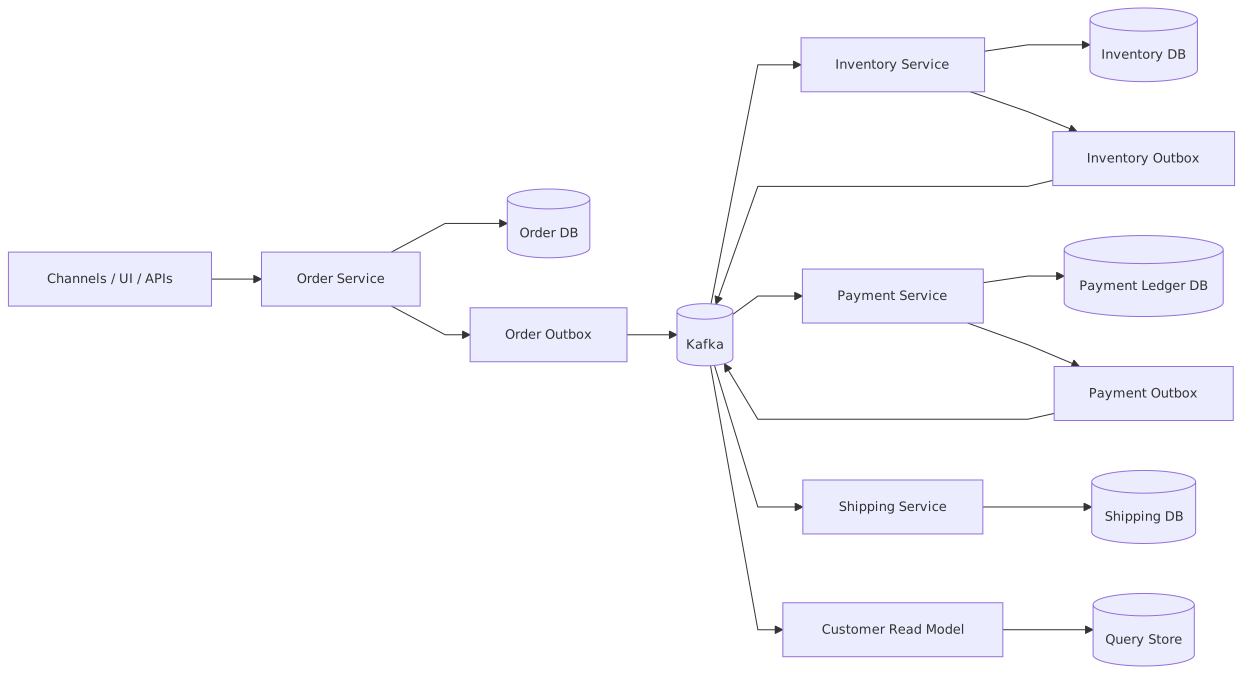
This is not glamorous. Good enterprise architecture rarely is. It is mostly about controlled boredom.
Each service commits its own state locally. It publishes domain events only after the local commit is durable, commonly via an outbox table captured by a relay. Kafka carries those events to interested consumers. Consumers update their own state idempotently. Read models aggregate data for customer support, portals, and reporting.
The important point is that Kafka is not the transaction manager. It is the backbone for propagation and coordination. The source of truth remains within each service’s consistency zone.
Consistency zones in domain terms
Consider an order domain in retail or manufacturing:
- Order Service owns order intent, order lines, pricing snapshot, lifecycle states such as Draft, Submitted, Accepted, Cancelled.
- Inventory Service owns stock position, reservation records, allocation logic, and release rules.
- Payment Service owns authorization, capture, refund, settlement references, and ledger integrity.
- Shipping Service owns fulfillment tasks, shipment creation, labels, and dispatch states.
Now ask where transactions really belong.
Inside Order:
- create order
- validate order line structure
- compute order totals from captured pricing inputs
- mark order as submitted
Inside Inventory:
- reserve quantity against a SKU and location
- expire reservations
- confirm or release allocations
Inside Payment:
- create payment attempt
- persist authorization response
- ensure idempotent capture
- maintain financial audit trail
Across them:
- “accepted order” may depend on inventory reservation and payment authorization
- “ready to ship” may depend on order acceptance plus payment status plus compliance checks
These are workflows, not local transactions. The mistake is to jam them into synchronous call chains and pretend they are one atomic unit.
Orchestration or choreography?
Both work. Both fail in different ways.
- Orchestration uses a process manager or saga coordinator to command services step by step.
- Choreography lets services react to events and advance state implicitly.
Use orchestration when:
- business flow is explicit and high-value
- timeout and exception handling matters
- auditors or operators need one place to inspect workflow state
Use choreography when:
- interactions are simpler
- teams are mature with event-driven design
- coupling through a central orchestrator would become a bottleneck
Most enterprises end up with both. Pure choreography tends to become folklore. Pure orchestration becomes bureaucracy.
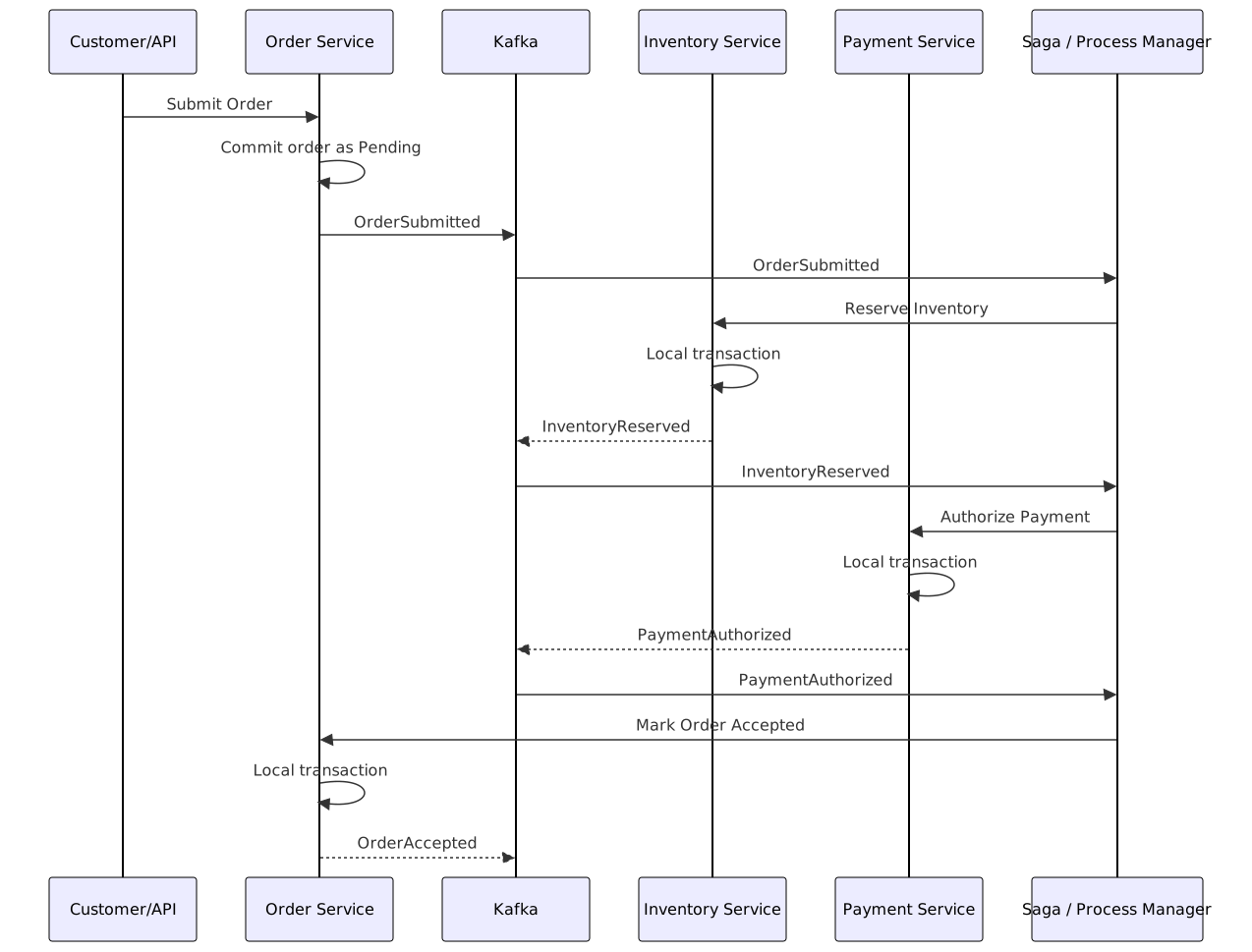
The sequence matters, but not because of technology. It matters because of domain semantics. In one business, payment authorization may come before inventory reservation. In another, scarce inventory must be reserved first. Architecture follows economics.
Read models and the myth of one true screen
Enterprises need a consolidated customer view. That does not imply a single transactional store. It implies a read model, often fed by Kafka topics or CDC streams, optimized for query and support workflows.
This is where many teams panic: “But the support screen might be briefly inconsistent.” Yes. Then design the screen to show freshness, source, and state transitions. A support platform that is honest about “Pending payment authorization” is superior to one that invents false certainty.
Migration Strategy
You do not redesign transactional boundaries by decree. You discover them while escaping the monolith.
The right migration is usually progressive strangler migration, done around business capabilities and consistency zones, not around tables alone.
Step 1: Map business invariants before splitting code
Before extracting a service, document:
- which business facts must be atomic
- which decisions can be provisional
- which states need reconciliation
- which users consume stale vs authoritative views
- what compensations are allowed
This is DDD work, not infrastructure work. Event storming often helps because it surfaces domain events, commands, and policy decisions in language the business recognizes.
Step 2: Extract stable ownership, not just endpoints
A service should own a coherent decision space. If you extract “customer address API” but pricing, order acceptance, and shipping all still update the same customer truth in conflicting ways, you have moved code without moving responsibility.
Start with capabilities where local ownership is clear:
- order intake
- catalog publishing
- stock reservation
- payment ledger
- shipment execution
Step 3: Introduce outbox and events while still in the monolith
This is an underrated move. Before fully splitting services, establish the pattern of:
- committing local state
- writing integration events to an outbox
- publishing asynchronously
- consuming idempotently
The monolith then begins to behave like a set of bounded contexts even before physical decomposition. This reduces migration shock.
Step 4: Carve out one consistency zone at a time
Extract the domain where autonomy gives immediate benefit and transactional seams are manageable. Inventory or payments are often strong candidates because they have distinct semantics and clear state ownership.
Step 5: Replace cross-module transactions with explicit workflows
As soon as a transaction crosses the new service boundary, model it as:
- command
- local commit
- event
- next command
- timeout/compensation path
Do not leave a synchronous RPC chain masquerading as a transaction for long. It will become architecture debt with a pager.
Step 6: Add reconciliation from day one
Reconciliation is not a cleanup hack. It is part of the design.
Examples:
- orders in Pending for more than 15 minutes with no payment outcome
- payment authorized but order not accepted
- inventory reserved but order cancelled
- shipment created without payment capture
- event publication lag beyond SLA
Reconciliation jobs, repair workflows, and exception queues make the difference between a resilient enterprise system and a distributed mystery novel.
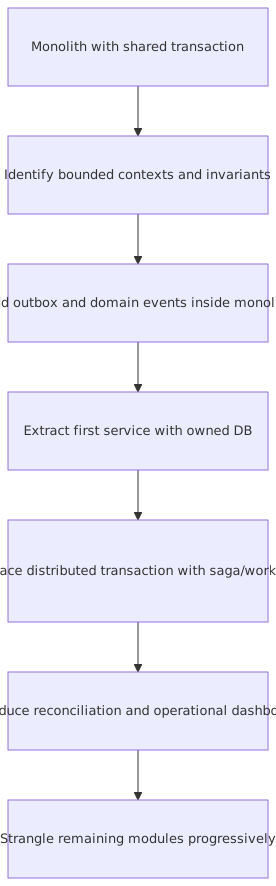
Step 7: Retire shared database shortcuts aggressively
Shared databases are comforting during migration because they preserve old transactional habits. They are also sticky. Leave them in place too long and the strangler grows around a concrete block.
Use transitional reporting replicas or CDC if needed, but put an end date on shared persistence.
Enterprise Example
Consider a global industrial distributor selling parts to manufacturers. It has e-commerce ordering, contract pricing, warehouse stock, credit terms, and carrier integration. The old SAP-adjacent monolith handled order entry, inventory checks, payment terms, fulfillment, and invoicing in one large transaction-rich platform.
The business wanted:
- faster release cycles for online ordering
- separate scaling for inventory lookup
- new payment options in some regions
- warehouse modernization
- better customer self-service
The first instinct was predictable: split by functions and keep synchronous APIs to preserve “real-time consistency.” That looked neat on PowerPoint. It fell apart in testing. Inventory spikes caused order submission timeouts. Payment provider slowness blocked order creation. Warehouses saw cancelled orders with lingering reservations. Support agents lost trust in the system.
The successful redesign came when the team reframed the problem around consistency zones.
Domain model
- Order Context: customer intent, commercial terms snapshot, line items, order lifecycle
- Inventory Context: available-to-promise, reservation, replenishment awareness
- Credit and Payment Context: credit approval, card auth, invoice terms, ledger
- Fulfillment Context: pick waves, pack, ship, dispatch exceptions
Transactional boundaries
Inside Order:
- submit order with frozen price and contract terms snapshot
- mark status as PendingAcceptance
Inside Inventory:
- reserve stock per line and warehouse
- issue reservation expiry
Inside Credit/Payment:
- approve on account or authorize card
- maintain auditable financial state
Across services:
- acceptance requires reservation plus commercial approval
- fulfillment release requires accepted order plus payment/credit clearance
- invoice creation follows shipment confirmation, not order creation
Kafka usage
Kafka carried events such as:
OrderSubmittedInventoryReservedInventoryReservationFailedCreditApprovedPaymentAuthorizedOrderAcceptedOrderRejectedShipmentDispatched
These events populated both downstream workflows and enterprise read models. The support portal showed exact lifecycle state with timestamps and event provenance. That mattered more than pretending every field was instantly current.
Reconciliation
The distributor learned an old enterprise lesson: every elegant asynchronous flow eventually meets an ugly edge case.
They implemented reconciliation services for:
- stale pending orders
- orphaned reservations
- duplicate provider callbacks
- shipment/payment mismatches
- event gaps caused by relay failures
Those jobs processed a tiny percentage of transactions, but they protected millions in revenue. In architecture, the path taken by 0.1% of transactions often determines whether your operators trust the whole system.
Result
Release velocity improved. Inventory spikes no longer took down order intake. Payment provider outages degraded order acceptance rather than the entire storefront. Finance got a cleaner audit trail. Support got better explanations for in-flight states.
What they did not get was perfect immediacy across every domain. That was the trade. It was a good one.
Operational Considerations
Transaction boundaries are only credible if operations can observe and repair the spaces between them.
Idempotency everywhere that matters
Commands and event consumers must tolerate duplicates. Payment capture in particular should be idempotent by business key, not just transport token. The network is not a gentleman.
Ordering assumptions
Kafka preserves order per partition, not globally. If a domain depends on ordered handling, partition by aggregate key such as orderId or paymentId. If you need global ordering, revisit the design. You probably want serialization around a smaller concept.
Timeout policies
A long-running process without explicit timeout is not a workflow. It is wishful thinking.
Examples:
- inventory reservation expires after 10 minutes
- unpaid order auto-cancels after 30 minutes
- shipment release blocked until payment confirmed or credit approved
- pending external provider callback escalates after SLA breach
Observability
Track:
- event publication lag
- consumer lag by topic and group
- age of pending workflow states
- reconciliation backlog
- compensation rate
- duplicate message rate
- ratio of stale read model views
- percentage of manually repaired transactions
A distributed system with no workflow telemetry is a haunted house.
Data retention and replay
Kafka enables replay, but replay without idempotent handlers and schema discipline is self-harm. Version events carefully. Treat event contracts as public architecture.
Human operations
Some failures need human judgment:
- fraud review
- credit override
- shipping split due to shortage
- customer-requested change while process in flight
Model operator actions as first-class commands. Do not let humans patch database rows behind the architecture’s back unless it is a declared break-glass path.
Tradeoffs
There is no free lunch here, only better bills.
Benefits
- stronger service autonomy
- clearer ownership of business truth
- improved resilience under partial failures
- better fit for high-scale or independently evolving domains
- auditability through explicit events and state transitions
- easier migration from monolith when done incrementally
Costs
- more complex workflow design
- eventual consistency across services
- need for reconciliation and operational tooling
- harder testing across asynchronous flows
- increased demand for domain modeling maturity
- user experience must acknowledge intermediate states
This is the central trade: you exchange invisible transactional coupling for visible process complexity. That is usually worth it in enterprise systems because visible complexity can be managed. Invisible coupling eventually detonates.
Failure Modes
This pattern fails in recognizable ways.
1. Bounded contexts drawn by database tables
If services are carved around CRUD entities instead of domain decisions, transactions spill everywhere. You end up with distributed joins and perpetual synchronous chatter.
2. Event-driven in name, RPC-driven in practice
Teams publish events, but core flows still depend on immediate downstream calls. Under pressure, they add retries until latency becomes a reliability issue. This is the distributed equivalent of holding a car together with tape.
3. No reconciliation strategy
Sooner or later:
- an event publish fails after DB commit
- a consumer is down
- a provider callback is duplicated
- a compensation arrives late
Without reconciliation, rare failures accumulate into accounting incidents.
4. Outbox omitted for convenience
Writing to the database and then publishing to Kafka in the same application flow without an outbox is a classic dual-write trap. It works perfectly until it matters.
5. One giant saga
A central orchestrator that knows every business rule across every domain becomes a new monolith, just slower and more fragile. Keep workflow ownership close to the domain process it represents.
6. Event semantics are vague
Events named OrderUpdated or StatusChanged are a smell. They hide business meaning and make consumers guess. Prefer semantically rich events like OrderSubmitted, InventoryReservationExpired, PaymentCaptureFailed.
7. Read models mistaken for source of truth
Aggregated views are useful. They are not authoritative for write decisions unless explicitly designed that way.
When Not To Use
This architecture is not always the right answer.
Do not use fine-grained transactional boundaries with consistency zones when:
The domain is simple and tightly coupled
If the system is basically CRUD with modest scale and one team, a well-structured modular monolith is often superior. A single database transaction is not a moral failure.
Strong atomic consistency across domains is mandatory and frequent
Some systems genuinely require synchronous serializable updates across data sets, and the cost of temporary divergence is unacceptable. In that case, keep those capabilities together, perhaps in a larger bounded context.
Team maturity is low
If teams are not yet comfortable with DDD, event contracts, idempotency, observability, and operational repair, asynchronous distributed workflows will produce chaos faster than value.
The business cannot tolerate intermediate states in user experience
If every workflow must appear instantly final and there is no appetite for “Pending,” “Awaiting confirmation,” or “Under review,” then either keep the transaction local or simplify the business process.
Regulatory architecture demands central transactionality
In some environments, a shared ledger or centralized system of record is the right design. Do not force microservices dogma onto domains that need a tighter core. microservices architecture diagrams
A modular monolith with explicit domain modules, internal events, and disciplined boundaries often beats microservices for years. The point is not to worship distribution. The point is to place it where it earns its keep.
Related Patterns
These patterns commonly sit alongside transactional boundaries in microservices:
- Bounded Context: defines semantic ownership and language
- Aggregate: enforces invariants within a transactional consistency boundary
- Saga / Process Manager: coordinates long-running multi-service workflows
- Transactional Outbox: avoids dual-write inconsistency between DB and broker
- CQRS: separates write-side authority from read-optimized projections
- Event Sourcing: sometimes useful when audit and replay are central, though not required
- Strangler Fig Pattern: incremental migration from monolith to services
- Inbox Pattern: tracks consumed messages for idempotency
- Compensating Transaction: reverses business effect rather than rolling back distributed state
- Reconciliation Process: detects and repairs drift between consistency zones
These are tools, not a religion. Use the ones that solve a real problem in your context.
Summary
Transactional boundaries in microservices architecture are where domain truth meets operational reality.
The important move is not “split the monolith.” It is to decide, with domain clarity, where the business requires atomic truth and where it can work with coordinated progress. Those decisions define service boundaries with consistency zones. Inside the zone, use local transactions and protect real invariants. Across zones, embrace explicit workflows, Kafka-backed events, idempotency, compensations, and reconciliation.
Domain-driven design provides the language. Migration strategy provides the path. Operations provide the honesty.
If you remember one line, make it this: a microservice boundary is credible only when the business can explain why facts must change together on one side of it, and tolerate delay on the other.
Everything else is implementation detail.
Frequently Asked Questions
What is a service mesh?
A service mesh is an infrastructure layer managing service-to-service communication. It provides mutual TLS, load balancing, circuit breaking, retries, and observability without each service implementing these capabilities. Istio and Linkerd are common implementations.
How do you document microservices architecture for governance?
Use ArchiMate Application Cooperation diagrams for the service landscape, UML Component diagrams for internal structure, UML Sequence diagrams for key flows, and UML Deployment diagrams for Kubernetes topology. All views can coexist in Sparx EA with full traceability.
What is the difference between choreography and orchestration in microservices?
Choreography has services react to events independently — no central coordinator. Orchestration uses a central workflow engine that calls services in sequence. Choreography scales better but is harder to debug; orchestration is easier to reason about but creates a central coupling point.