⏱ 21 min read
Distributed systems rarely fail with dignity. They fail sideways.
A recommendation engine slows down, and suddenly checkout starts timing out. A reporting query goes pathological, and customer onboarding stalls. One noisy tenant in a shared queue turns an otherwise healthy platform into a support incident. This is the shape of modern failure: not a dramatic explosion at the center, but a leak through the seams. In microservices, the seams are everywhere—threads, queues, connection pools, topics, rate limits, dependencies, tenants, and teams. If you don’t decide where one problem is allowed to die, the system will decide for you. It will spread. microservices architecture diagrams
That is why bulkheads matter.
The name comes from ships, and the metaphor survives because it is honest. Bulkheads are not about making the ocean calm. They are about accepting that water will get in and designing the vessel so one breach does not sink the whole thing. In resilient microservices, isolation compartments serve the same purpose. They limit blast radius. They turn cascading failure into contained degradation. They give architects a lever more practical than hope and more durable than incident heroics.
Too many architecture discussions treat resilience as a bag of patterns: retries, circuit breakers, backpressure, idempotency, dead-letter queues. All useful. None sufficient on their own. Bulkheads are different because they force a more uncomfortable question: what parts of the business are allowed to interfere with what other parts? That is not a purely technical question. It is a domain question, an operating model question, and often a political question. Which is why the pattern is more important—and more often neglected—than the code examples suggest.
This article looks at bulkheads not as a library feature, but as an architectural discipline for microservices, event-driven systems, and enterprise platforms using Kafka and related technologies. We will look at the forces that make isolation hard, the design choices that make it work, migration strategies that avoid rewriting the world, and the failure modes that appear when “resilience” is implemented with good intentions and bad boundaries. event-driven architecture patterns
Context
Microservices were sold, in part, as a way to localize change and failure. Split a monolith into bounded services, and a problem in one place should stay in one place. In practice, enterprises often replace one giant failure domain with dozens of small components tied together by shared infrastructure, synchronous calls, common databases, centralized identity providers, event brokers, and hidden operational couplings.
The result is familiar. A customer profile service degrades, then every downstream service with an eager dependency on customer enrichment starts to queue. Thread pools saturate. Retries amplify load. Kafka consumers fall behind. Timeouts trigger compensating logic that itself pounds the database. The incident report says “upstream dependency latency,” but the deeper truth is simpler: the architecture had no meaningful isolation compartments.
Bulkheads address this by separating workloads so one failing or overloaded path cannot consume all available capacity. That capacity may be technical—CPU, threads, connections, memory, partitions, consumers—or it may be logical—priority lanes, tenant quotas, domain-specific processing paths, or deployment units. Good bulkheads are not just fences. They are boundaries aligned to business semantics.
This is where domain-driven design matters. If your isolation strategy ignores the domain, it will protect the wrong things. “All API traffic shares the same thread pool” is a technical simplification, not an architectural decision. Orders, payments, fraud checks, catalog reads, and audit exports do not carry the same business criticality. Nor do they share the same consistency needs. A delayed audit export is annoying. A delayed payment authorization is revenue leakage. The architecture should know the difference.
Problem
The core problem is not failure. Systems fail. Dependencies become slow. Tenants become noisy. Releases go wrong. Batch jobs collide with daytime traffic. The real problem is uncontained interference.
In microservices, interference shows up in several ways:
- Shared execution pools where low-value work starves critical requests
- Shared Kafka topics or consumer groups where one poisoned stream blocks unrelated events
- Shared database schemas or connection pools where reporting traffic affects transactions
- Shared infrastructure quotas where one tenant or domain exhausts capacity
- Shared operational workflows where all incidents require platform-wide mitigation
Architects often underestimate how quickly local slowness becomes systemic collapse. Retries are the classic culprit. A service under stress gets slower, callers retry aggressively, queues deepen, thread pools fill, and the “self-healing” behavior becomes a load multiplier. Another culprit is convenience sharing: one generic worker fleet for all asynchronous jobs, one giant topic for “business events,” one gateway policy for every API. These choices look efficient during implementation and expensive during an outage.
Bulkheads are a response to this reality. But they work only if we are clear about what exactly we are isolating, and why.
Forces
The design of isolation compartments is shaped by competing forces. This is where the architecture earns its keep.
Availability versus utilization
Shared pools maximize average utilization. Dedicated pools maximize survivability. The former pleases finance dashboards; the latter survives Black Friday. Most enterprises need a deliberate middle ground: enough separation to prevent collapse, enough sharing to avoid waste.
Business criticality versus engineering simplicity
A single request path is easy to reason about. Separate queues, pools, rate limits, and failover rules per domain capability are not. Yet the business already distinguishes critical and non-critical flows. If the software does not, operations will do it manually during incidents.
Domain semantics versus platform standardization
Platform teams love uniformity. Domain teams need exceptions. A fraud check, a shipment notification, and a tax calculation may all be “service calls,” but they have wildly different latency tolerance, retry behavior, and consequence of failure. Standardize too hard and you erase meaning. Standardize too little and you get chaos.
Throughput versus fairness
High-throughput consumers can monopolize Kafka partitions or worker capacity. Fairness mechanisms—per-tenant quotas, topic segregation, weighted scheduling—reduce raw efficiency but improve platform stability. This is often the right trade.
Immediate consistency versus graceful degradation
Some capabilities must block when dependencies fail. Others should continue with stale data, deferred processing, or compensating actions. Bulkheads force that distinction into the design. If every dependency is treated as mandatory and synchronous, there is no room for graceful degradation.
Team autonomy versus operational coherence
Each service team can implement its own resilience logic, but the enterprise still operates one production estate. Isolation decisions need local ownership and platform-level observability. Otherwise you get fifty bespoke bulkheads and no coherent failure management.
Solution
Bulkheads in microservices are architectural partitions that reserve and constrain capacity for specific workloads so failures, overload, or pathological behavior in one area do not exhaust shared resources in another.
That sentence sounds clinical. In practice, it means things like:
- Separate thread pools for checkout versus recommendation calls
- Distinct Kafka topics or consumer groups for critical versus non-critical events
- Per-tenant quotas to stop a large customer from starving smaller ones
- Isolated connection pools for transactional writes versus reporting reads
- Dedicated worker fleets for payment processing versus document generation
- Bounded rate limits for expensive downstream dependencies
- Priority lanes so revenue-critical work survives background churn
The pattern is broader than code-level isolation. It can exist at multiple levels:
- In-process bulkheads
Separate thread pools, semaphores, connection pools, memory limits, or asynchronous executors within a service.
- Service-level bulkheads
Different deployment units, autoscaling policies, or dedicated instances for specific workloads.
- Messaging bulkheads
Topic separation, partition strategy, consumer group isolation, dead-letter routing, and replay boundaries in Kafka-based systems.
- Infrastructure bulkheads
Namespace quotas, cluster segmentation, network policies, and separate data stores or caches.
- Business bulkheads
Isolation by bounded context, customer segment, regulatory region, or capability criticality.
A useful rule: bulkheads should follow the contours of business damage. If a failure in one capability should not damage another, the architecture must not force them to share exhaustion paths.
Here is a simple microservices view.
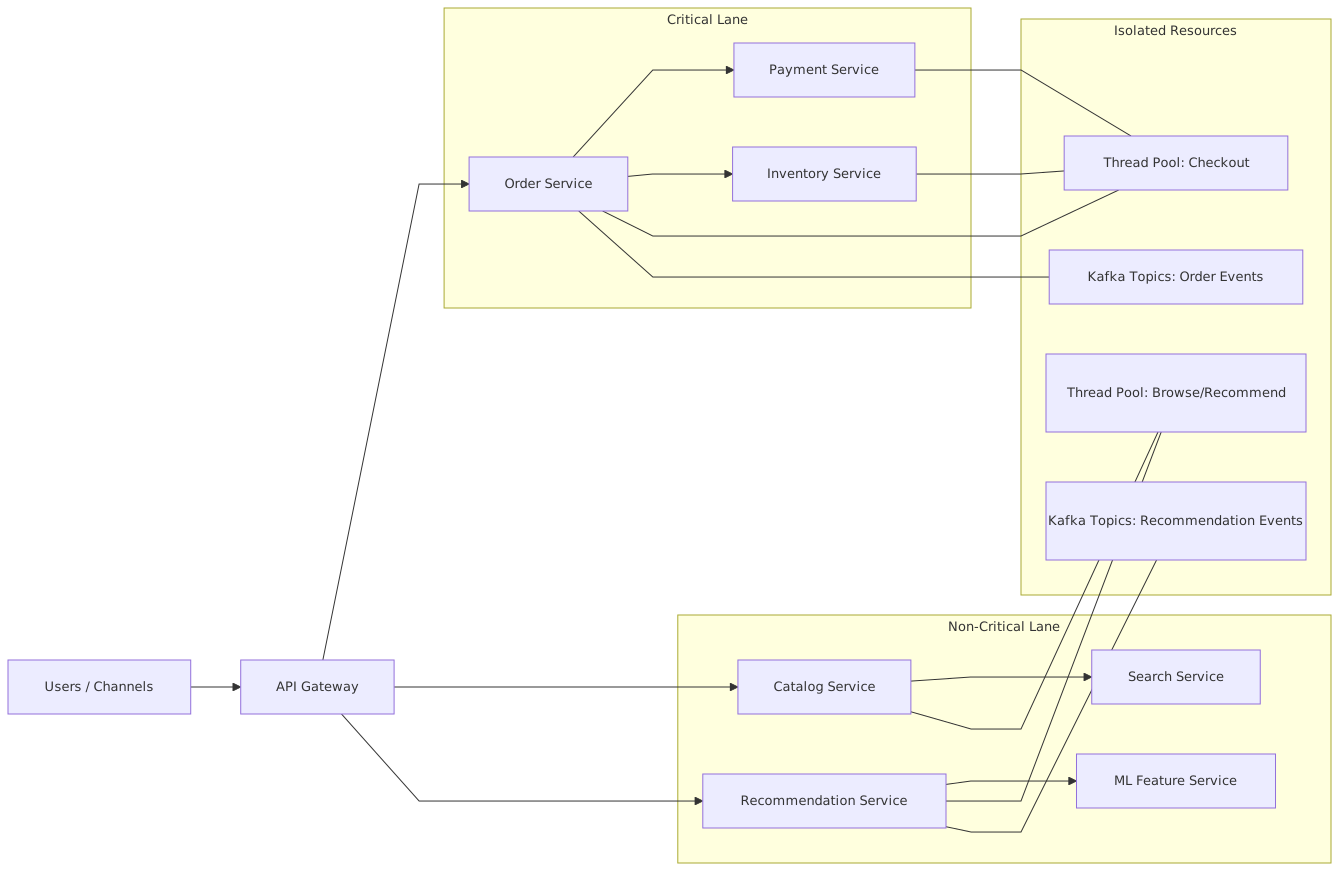
Notice what matters here: checkout and browsing are not simply different endpoints. They are different business lanes with different consequences of delay. That is a domain decision expressed technically.
Architecture
Bulkhead architecture becomes effective when it is designed across synchronous and asynchronous paths together. Many enterprises isolate APIs but then collapse everything back into shared event consumers, or vice versa. Cascading failure is quite happy to travel either route.
Synchronous isolation
For request-response interactions, the usual tools are separate thread pools, concurrency limits, connection pools, timeouts, and circuit breakers. But the architecture should not stop at technical isolation. You also want explicit service contracts about degradation behavior.
For example:
- Checkout may proceed without promotions if the promotions service is down
- Product detail pages may omit recommendations without affecting page render
- Customer support screens may fall back to cached profile snapshots
- Payment authorization must fail fast rather than queue indefinitely
Those are domain semantics. The bulkhead is not merely “another pool.” It is a promise that one kind of business work will not consume another kind’s survival budget.
Asynchronous isolation with Kafka
Kafka gives architects a powerful but dangerous abstraction: durable shared streams. Used well, they are natural bulkheads. Used lazily, they become giant pipes of coupled fate.
The first temptation is the “enterprise event topic”—one broad topic carrying many event types for many consumers. It looks elegant until one event class is malformed, arrives in a flood, or requires a slower schema evolution path than others. Then unrelated consumers lag or fail together.
Better practice is to isolate streams by bounded context, criticality, and processing profile:
order-eventsseparated fromrecommendation-events- high-priority operational commands separated from analytical or derived events
- tenant-sensitive workloads partitioned to preserve fairness and replay control
- distinct consumer groups for critical downstream workflows versus optional enrichments
A second temptation is to use one worker pool for all consumers. This defeats the point of stream isolation. If a slow deserialization path or downstream call blocks consumers for a non-critical stream, your “critical” events will still suffer if they share execution capacity.
Kafka bulkheads should consider:
- topic boundaries
- partitioning strategy
- consumer group isolation
- max poll and processing concurrency
- retry topics versus main topics
- dead-letter routing
- replay scope and time cost
- offset management during partial failure
Here is a more event-driven view.
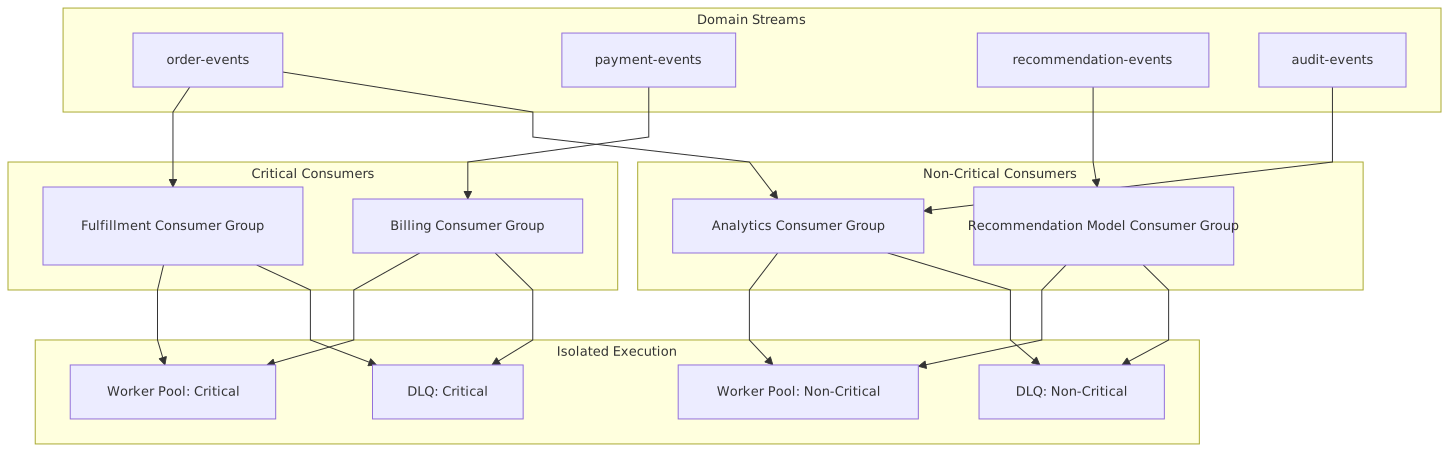
This is not just tidier plumbing. It changes incident behavior. A model training backlog becomes an analytics problem, not an order processing outage.
Bounded contexts as isolation compartments
Domain-driven design gives us a more principled way to choose bulkhead boundaries. A bounded context is not only a modeling boundary; it can be a resilience boundary.
If pricing, ordering, fulfillment, and customer support are separate bounded contexts, they likely deserve different:
- runtime priorities
- scaling policies
- consistency guarantees
- dependency tolerance
- replay mechanisms
- data freshness expectations
That does not mean every bounded context gets fully dedicated infrastructure. That way lies ruin by cloud invoice. But it does mean the architecture should resist false consolidation where contexts share failure paths despite having different business risks.
A memorable line worth keeping: if two capabilities should fail differently, they should not be forced to queue together.
Reconciliation as a first-class design element
Bulkheads inevitably create divergence. Work is deferred. Events are processed later. Some steps succeed while others wait behind isolated failures. That means reconciliation is not an operational afterthought; it is part of the architecture.
In practical terms:
- critical transactions may commit locally and emit events for later completion
- downstream read models may lag and need replay
- asynchronous compensation may correct temporary mismatches
- operators need tools to inspect, re-drive, and reconcile stuck flows
- idempotency keys become mandatory, not optional
An enterprise that embraces bulkheads but ignores reconciliation simply trades cascading failure for silent inconsistency.
Migration Strategy
Most enterprises do not start with elegant isolation compartments. They start with a monolith, or with first-generation microservices built around convenience: shared libraries, shared topics, shared worker pools, and shared databases wearing different service names. The migration to bulkheads therefore needs to be progressive.
A strangler approach works well.
Start by identifying the most damaging interference patterns. Not the noisiest. The most damaging. A reporting batch starving online traffic is usually more urgent than a mildly inefficient pool. A recommendation service affecting checkout is more urgent than duplicate code in two consumers.
Then carve isolation in stages.
Stage 1: Observe the real failure domains
Map where resource contention actually occurs:
- common thread pools
- shared ingress limits
- shared Kafka consumers
- shared database pools
- shared caches
- common autoscaling groups
- downstream dependencies with no quotas
Instrument queue depth, saturation, timeout rates, retry volume, and consumer lag by business capability, not just by service. Without this, teams isolate what is visible rather than what is harmful.
Stage 2: Separate critical and non-critical flows
This is usually the highest-value cut. Split request pools, queueing, topic handling, and scaling policies into at least two lanes:
- revenue or mission-critical
- best-effort or deferrable
Do not over-segment at first. Enterprises often jump from one shared pool to twenty tiny pools and then spend six months tuning starvation thresholds.
Stage 3: Introduce domain-aligned event boundaries
Refactor generic event streams into bounded-context streams. Kafka makes this easier than teams fear, provided schemas and consumers are versioned carefully. During migration, dual-publish where necessary, but keep the period short. Dual-publishing forever is just technical debt with a governance slide. EA governance checklist
Stage 4: Add reconciliation workflows
As more processing becomes isolated and asynchronous, build the operational machinery:
- outbox pattern for reliable publication
- idempotent consumers
- replay tools
- compensating commands
- dashboards for orphaned business flows
Stage 5: Retire shared choke points
Finally remove old worker fleets, giant shared topics, all-purpose gateways, and broad connection pools that continue to provide hidden coupling.
Here is a progressive migration view.
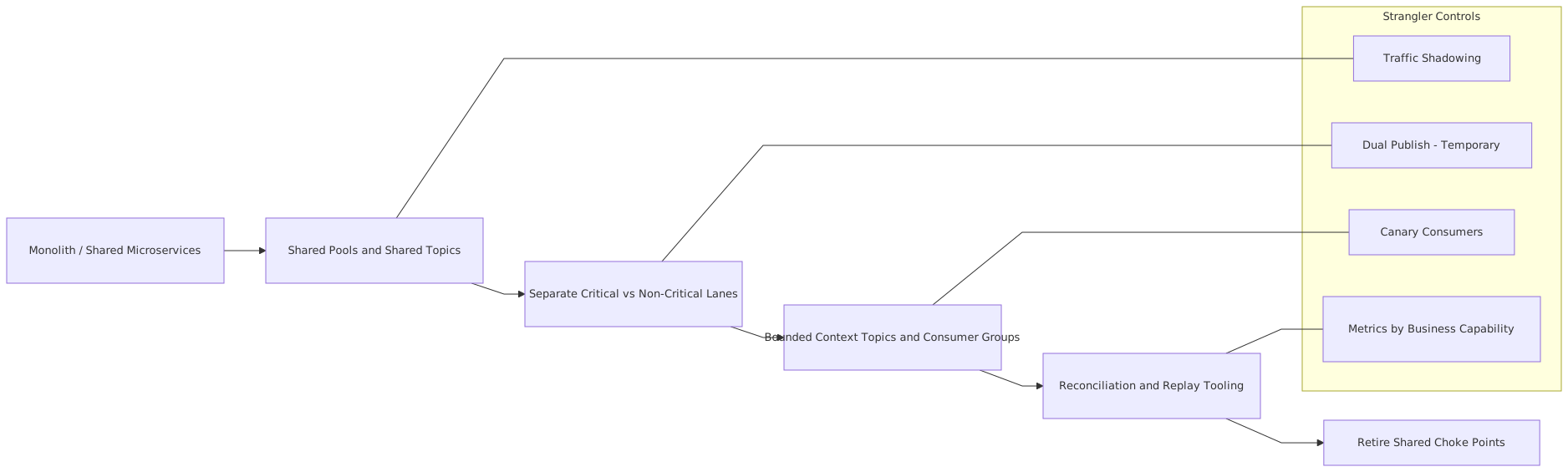
The migration reasoning is simple: isolate the most valuable work first, then make inconsistency manageable, then remove old couplings. Reverse that order and you will create outages in the name of resilience.
Enterprise Example
Consider a large retailer with digital commerce across web, mobile, and in-store kiosks. The platform had nominally modern microservices: catalog, pricing, promotions, checkout, payments, fulfillment, customer profile, recommendations, and analytics. Kafka connected everything. On paper, this was a success story.
In operation, it behaved like a shared nervous system with too many exposed endings.
The main problem surfaced during promotion-heavy sales events. Recommendation traffic surged, model feature lookups slowed, and API gateways saw increased latency. Checkout called promotions, customer profile, fraud, and inventory in sequence. Several of those services used shared connection pools and a common internal executor framework. Meanwhile, Kafka consumers for order events and recommendation events ran on the same autoscaled worker deployment because “they were all stateless consumers.”
During one major sale, recommendation lag triggered retries and backlog growth. Shared worker nodes saturated CPU and network. Order event processing slowed, fulfillment updates lagged, and customer support could not see current order state. The architecture had many services but only a handful of real failure domains.
The redesign did not start with more technology. It started with domain semantics.
The retailer classified capabilities into three resilience classes:
- Transaction-critical: checkout, payment authorization, order capture, inventory reservation
- Commercially important but deferrable: promotions enrichment, customer profile enrichment, shipment notifications
- Best-effort: recommendations, analytics, model training, long-tail reporting
That classification drove the bulkheads.
- Checkout and payment services received dedicated thread pools, connection pools, and stricter concurrency control.
- Recommendation and analytics traffic were routed to separate worker fleets and Kafka consumer groups.
order-events,payment-events, andinventory-eventswere separated from recommendation and analytical streams.- The checkout journey was redesigned so missing recommendations or profile enrichment no longer blocked transaction capture.
- An outbox pattern ensured orders were durably recorded before downstream publication.
- Reconciliation jobs identified orders captured without immediate promotion confirmation and settled them later using compensating rules.
- Support tooling exposed “accepted, pending enrichment” versus “fully confirmed” states so operations could distinguish temporary divergence from true failure.
The tradeoff was obvious: more moving parts, more operational dashboards, more explicit business states, and occasional delayed non-critical features. The payoff was also obvious: when recommendation processing melted down during the next seasonal event, conversion dipped slightly on browse pages, but checkout remained stable and order processing continued.
That is what bulkheads look like when they are done for business reasons rather than pattern-catalog compliance.
Operational Considerations
Bulkheads are not finished when the code compiles. They are operational assets and need operational discipline.
Measure saturation, not just errors
A bulkhead’s job is to prevent exhaustion. So watch the resource boundaries:
- thread pool utilization
- queue depth
- semaphore rejection rates
- Kafka consumer lag
- connection pool wait time
- partition skew
- per-tenant throughput and throttling
If you only monitor HTTP 500s, you are seeing the smoke, not the fire.
Make degradation explicit
Operators and product owners should know what happens when a lane is saturated. Does the service reject requests? Serve stale data? Queue work for later? Skip optional enrichment? These should be visible in dashboards and service contracts.
Rehearse partial failure
Chaos testing is useful here, but only if it reflects domain flows. Killing a pod proves less than throttling a downstream fraud service while simulating peak order traffic. The point is not destruction. The point is verifying that isolated compartments degrade the way the business expects.
Design replay safely
Kafka-based architectures often discover, too late, that replay is a shared blast radius of its own. Replaying a topic without isolation can flood downstream consumers and caches. Bulkheads should apply to replay workers too. Historical recovery must not take down live processing.
Handle schema evolution carefully
Topic separation by bounded context reduces schema coupling, but does not eliminate it. Consumer isolation helps, yet teams still need disciplined versioning and compatibility checks. Otherwise the bulkhead contains runtime overload but not semantic breakage.
Give operations levers
Good systems provide runtime controls:
- disable non-critical consumers
- reduce concurrency for a failing dependency
- reroute traffic to stale-cache mode
- pause replay lanes
- throttle noisy tenants
Architecture that cannot be steered during an incident is just a static diagram with delusions.
Tradeoffs
Bulkheads are one of those patterns everyone applauds in principle and resists in budgeting. That resistance is not irrational. The pattern has real costs.
First, isolation reduces resource pooling efficiency. Dedicated capacity sits idle some of the time. Shared capacity would be cheaper on average. If your workload is stable, your dependencies are local, and the cost of delay is low, strong bulkheads may be overkill.
Second, architecture gets more complex. More queues, more topics, more scaling rules, more dashboards, more policies. Teams need maturity to run this well. A poorly operated bulkhead architecture can become a graveyard of underused pools and inconsistent configurations.
Third, domain states become more explicit. “Order accepted pending enrichment” is more accurate than pretending everything is immediate, but it requires product and operational alignment. Enterprises that cannot tolerate nuanced states often retreat to brittle synchronous coupling.
Fourth, bulkheads can shift pain rather than remove it. A rejected non-critical workload is still a business decision. Someone owns the consequences. Isolation is not magic. It is prioritization made concrete.
Still, the trade is usually worth it when the cost of cascading failure is high. And in most enterprises, it is.
Failure Modes
Bulkheads fail too. Usually in depressingly predictable ways.
False isolation
The most common failure mode is believing workloads are isolated when they still share a hidden choke point: the same database, the same cache cluster, the same node pool, the same identity provider, the same NAT gateway, the same deployment pipeline. The diagram says compartments; production says one floodplain.
Over-fragmentation
Too many tiny pools and topics create chronic underutilization and operational fragility. One lane starves while another sits idle. Architects sometimes mistake granularity for control. It is not.
Misaligned boundaries
Isolation by technical layer instead of business semantics leads to absurd outcomes. You protect “all reads” from “all writes” while allowing loyalty-calculation traffic to interfere with payment authorization because both happen to be writes. The domain will punish this kind of abstraction.
Retry storms across bulkheads
If each compartment retries independently with no global policy, failures still amplify. Isolation of capacity does not excuse reckless retry behavior.
Reconciliation debt
Teams isolate processing, allow deferred work, and then never build the tools to inspect and correct divergence. Incidents become archaeology.
Shared governance bottlenecks
Sometimes the runtime is isolated but the organization is not. Every topic creation, rate-limit change, or pool adjustment requires a central approval board. Resilience delayed is resilience denied.
When Not To Use
Bulkheads are not a universal answer.
If you are building a small system with a handful of services, low concurrency, and no meaningful difference in workload criticality, the extra machinery may not pay for itself. A modest monolith with clear module boundaries can often be made resilient enough with careful resource management and simpler failure handling.
Likewise, if the dominant failure mode is not resource contention but data correctness, then bulkheads are secondary. You may need stronger transaction design, better validation, or clearer bounded contexts before isolation compartments matter.
And if your organization cannot operate asynchronous reconciliation, be cautious. Bulkheads often imply graceful degradation and deferred completion. If the business or support model cannot live with temporary inconsistency, isolating through asynchronous pathways may cause more confusion than benefit.
One more blunt point: do not use bulkheads as camouflage for bad service boundaries. If your “microservices” are really a distributed monolith with chatty synchronous calls and no autonomous domain ownership, adding semaphores and extra topics will not rescue the design.
Related Patterns
Bulkheads live in a family of resilience patterns, and they are strongest when combined sensibly.
- Circuit Breaker: stops repeated calls to a failing dependency. Useful, but without bulkheads it does not prevent unrelated workloads from sharing exhaustion.
- Timeouts: essential for bounding wait time. A bulkhead without aggressive timeouts simply fills more slowly.
- Retry with Backoff: helps transient faults; harms overloaded systems if misused. Must be constrained within compartments.
- Rate Limiting and Quotas: often the outer wall of a bulkhead, especially for tenants or channels.
- Backpressure: critical for messaging systems. Kafka consumers and producers need bounded processing and overflow behavior.
- Outbox Pattern: supports reliable event publication during isolation and migration.
- Idempotent Consumer: mandatory for replay, re-drive, and reconciliation.
- Saga / Process Manager: coordinates multi-step business flows across isolated services, especially when compensations are needed.
- Strangler Fig Pattern: practical migration path from shared choke points to domain-aligned compartments.
- CQRS: sometimes useful where read-heavy and write-critical workloads need distinct scaling and isolation semantics.
The point is not to collect patterns like stamps. The point is to make them work together around a clear understanding of business criticality and failure containment.
Summary
Bulkheads are one of the few resilience patterns that force architectural honesty. They ask a hard question: what work matters enough to protect from everything else?
That question cannot be answered by infrastructure alone. It needs domain-driven design thinking. It needs bounded contexts, business criticality, and explicit degradation semantics. It needs migration discipline, because most enterprises begin with shared choke points and hidden coupling. It needs reconciliation, because isolated systems do not always move in lockstep. And in Kafka-based event-driven estates, it needs topic, consumer, and replay design that respects real failure domains rather than fantasy ones.
The pattern’s value is straightforward. Bulkheads limit blast radius. They stop local trouble becoming systemic collapse. They let recommendation engines fail without taking payments with them, analytics backlogs grow without delaying order capture, and noisy tenants exhaust their own lane instead of everybody’s.
But the pattern is not free. It costs capacity, complexity, and operational maturity. Done badly, it creates false confidence. Done well, it gives the enterprise something rarer than uptime metrics: controlled damage.
And that is what resilient architecture is really about. Not preventing every breach. Building the compartments that keep one breach from becoming the story of the whole ship.
Frequently Asked Questions
What is a service mesh?
A service mesh is an infrastructure layer managing service-to-service communication. It provides mutual TLS, load balancing, circuit breaking, retries, and observability without each service implementing these capabilities. Istio and Linkerd are common implementations.
How do you document microservices architecture for governance?
Use ArchiMate Application Cooperation diagrams for the service landscape, UML Component diagrams for internal structure, UML Sequence diagrams for key flows, and UML Deployment diagrams for Kubernetes topology. All views can coexist in Sparx EA with full traceability.
What is the difference between choreography and orchestration in microservices?
Choreography has services react to events independently — no central coordinator. Orchestration uses a central workflow engine that calls services in sequence. Choreography scales better but is harder to debug; orchestration is easier to reason about but creates a central coupling point.