⏱ 20 min read
Every platform team eventually learns the same hard lesson: the first service template is never the last one.
What begins as a tidy “golden path” quickly turns into an archaeological site. Version 1 was built for speed. Version 2 added observability. Version 3 patched security holes nobody predicted. Version 4 tried to standardize CI/CD, secrets, runtime policies, and event contracts. Then the organization changed, teams diversified, and the once-clean template became an awkward compromise between what the platform wanted and what the business actually needed.
That is the real story of service template evolution in platform engineering. Not a story about scaffolding code generators, but about managing organizational intent over time. Templates are not static artifacts. They are executable policy, embedded architecture, and cultural memory disguised as boilerplate.
The problem is not creating a template. Any competent team can do that in a sprint. The problem is evolving templates without breaking a fleet of services, alienating product teams, or freezing delivery while the platform group chases architectural purity.
And this is where enterprise architecture matters.
A good architect does not ask, “What is the best service template?” That question is too neat for the mess of real systems. The better question is: how do we evolve service templates as the domain, technology landscape, risk posture, and delivery model change? Once you ask it that way, the discussion shifts from code generation to bounded contexts, migration paths, event contracts, operational reconciliation, and the economics of standardization.
Templates are a form of leverage. But leverage cuts both ways.
Context
In modern platform engineering, service templates sit at the intersection of developer experience, governance, and distributed system design. They are the mechanism through which a platform team encodes preferred runtime stacks, deployment pipelines, API conventions, telemetry defaults, infrastructure bindings, and security controls into something development teams can adopt with low friction. EA governance checklist
At their best, templates reduce accidental complexity. A team starting a new microservice should not have to rediscover how to expose health checks, emit metrics, subscribe to Kafka topics, validate JWT tokens, rotate secrets, or structure deployment manifests. The platform should make the common case easy. event-driven architecture patterns
But templates are not merely technical conveniences. They shape service boundaries, influence domain modeling, and create institutional momentum. If a template assumes synchronous REST interactions, teams will model systems around request-response. If it makes event-driven messaging first-class, teams will naturally consider asynchronous workflows, sagas, and eventual consistency. If it enforces a canonical folder structure and contract testing setup, that becomes part of the organization’s operational grammar.
This is why template evolution deserves more seriousness than it usually gets. In enterprise settings, hundreds of services may inherit assumptions from a template. A weak decision gets multiplied at scale. A strong decision compounds in your favor.
Domain-driven design is especially relevant here. Templates should not erase domain semantics under a blanket of technical sameness. A payments service, a customer profile service, and a ledger service may all share delivery mechanics, but they do not share the same truth model, lifecycle constraints, or integration pressures. Platform engineering should standardize the plumbing while respecting bounded contexts. If the template starts forcing a false uniformity onto domain models, the platform is no longer helping. It is colonizing.
Problem
The central problem is simple to state and difficult to solve:
How do you evolve service templates over time while preserving delivery speed, domain autonomy, and operational reliability?
Most organizations fail in one of three ways.
First, they treat templates as one-time scaffolding. Once a service is created, it diverges forever. Improvements to security, telemetry, dependency management, runtime configuration, or messaging conventions never flow back into existing services. The result is template drift across the estate. New services look polished; old ones become expensive liabilities.
Second, they overcorrect and try to make templates centrally managed and fully enforced. Every service must conform. Every deviation requires approval. This often creates brittle standardization, where teams wrap domain-specific needs in awkward abstractions just to satisfy the template. Governance wins on paper and loses in production. ArchiMate for governance
Third, they underestimate migration. They produce a shiny new template and announce that all teams should “move over time.” This is not a strategy. It is a wish. Without a migration model, compatibility rules, and explicit reconciliation mechanisms, the new template becomes one more branch in the organizational family tree.
The architecture challenge is not authoring templates. It is managing template lineage.
Forces
Several forces pull against each other.
1. Standardization vs domain autonomy
Platform teams want consistency. Product teams want freedom. Both are right.
A common service template lowers onboarding time, simplifies support, and reduces operational variance. But domain teams need room to model their bounded context properly. A fraud detection service may need a streaming-first architecture with Kafka consumers and stateful processors. A reference data service may remain mostly CRUD. Forcing both through the same assumptions creates design debt.
2. Governance vs usability
A template that encodes policy poorly becomes a bureaucratic artifact. Developers copy around it, bypass it, or fork it.
Usable templates hide complexity without hiding important choices. They provide opinionated defaults, not invisible mandates.
3. Evolution speed vs backward compatibility
Security baselines change. Regulatory requirements change. Runtime versions change. Messaging conventions change. Platform teams need to move quickly.
But if every template update demands wholesale rework of existing services, adoption stalls. This is why template evolution must be thought of as a compatibility problem, not just a tooling problem.
4. Infrastructure consistency vs application reality
A platform can standardize build pipelines, secret stores, service mesh integration, observability agents, and deployment descriptors. It cannot wish away the fact that some services are stateful, some are latency-sensitive, some handle regulated data, and some are fundamentally batch-oriented.
Real architecture starts when you admit the estate is heterogeneous.
5. Drift vs lockstep
If services are allowed to drift indefinitely, the platform loses influence. If they are forced into lockstep upgrades, delivery stops.
The answer lies in managed divergence: a model where services can evolve independently but still reconcile periodically with a template lineage and policy baseline.
Solution
The pattern I recommend is this:
Treat service templates as versioned product lines, not static generators.
That means four things.
- Model the template explicitly as architecture policy plus extension points.
Separate what is mandatory from what is optional. Security headers, base telemetry, supply-chain controls, and deployment metadata might be mandatory. Persistence style, API protocol, messaging adapters, and internal module layout may be variable by domain need.
- Version template capabilities, not just code.
Do not say “Template v4.” Say “supports async event publishing with outbox,” “uses OpenTelemetry standard,” “requires workload identity,” “supports progressive delivery hooks,” “includes reconciler contract.” Capability language is more useful than folder diff language.
- Adopt progressive strangler migration for template evolution.
Existing services should not be rewritten wholesale to fit the new template. Instead, evolve them in slices: runtime bootstrap first, telemetry next, CI/CD policy after that, then messaging conventions, and so on. Migrate the shell before the core.
- Introduce reconciliation as a first-class operational mechanism.
Reconciliation is how you continuously compare intended template state with actual service state. This may be implemented through policy-as-code checks, generated manifests, dependency baselines, contract conformance tests, or service scorecards. Without reconciliation, template evolution is theatre.
A template that cannot be reconciled is just a suggestion.
Architecture
A practical architecture for service template evolution has several layers.
Template control plane
This is where the platform team defines template modules, versions, policies, upgrade paths, and compatibility rules. Think of it as the product management layer for templates.
It should maintain:
- template families
- version metadata
- capability matrix
- policy rules
- migration guides
- compatibility assertions
- deprecation timelines
Service instantiation layer
This is how teams consume templates. It may be based on Backstage software templates, internal CLI generators, repository starters, or Git-based composition. The mechanism matters less than the contract.
The key is that instantiation should produce not only code, but also machine-readable metadata: template lineage, enabled capabilities, policy profile, runtime assumptions, domain ownership, and integration type.
Reconciliation layer
This continuously assesses whether a service still conforms to the expected baseline for its declared template lineage.
Reconciliation can check:
- dependency versions
- OpenTelemetry instrumentation presence
- Kubernetes manifest policies
- secret management patterns
- Kafka consumer configuration standards
- API contract governance
- deployment readiness probes
- SLO declaration presence
- SBOM and supply chain controls
This layer should not always block delivery. Some checks are advisory, some are warning-level, and some are hard gates.
Runtime integration layer
This is where template assumptions meet production. For microservices, this usually includes: microservices architecture diagrams
- HTTP or gRPC service exposure
- Kafka producers and consumers
- outbox/inbox patterns
- OpenTelemetry traces, logs, metrics
- secret and config injection
- health endpoints
- resilience patterns such as retry, timeout, circuit breaking
- deployment descriptors and progressive rollout support
The point is not to impose the same runtime shape on every service. The point is to provide tested, supportable building blocks with known operational behavior.
Domain alignment layer
This is the piece many platform teams neglect.
A service template should acknowledge bounded contexts. For example:
- domain event publishing rules differ from integration event publishing
- entity identifiers differ across contexts
- consistency requirements differ by domain
- retention and audit patterns differ by regulatory domain
- write paths and read paths may differ in event-driven services
A “generic service template” that ignores this is usually generic in all the wrong places.
Here is a simplified view of template evolution architecture:
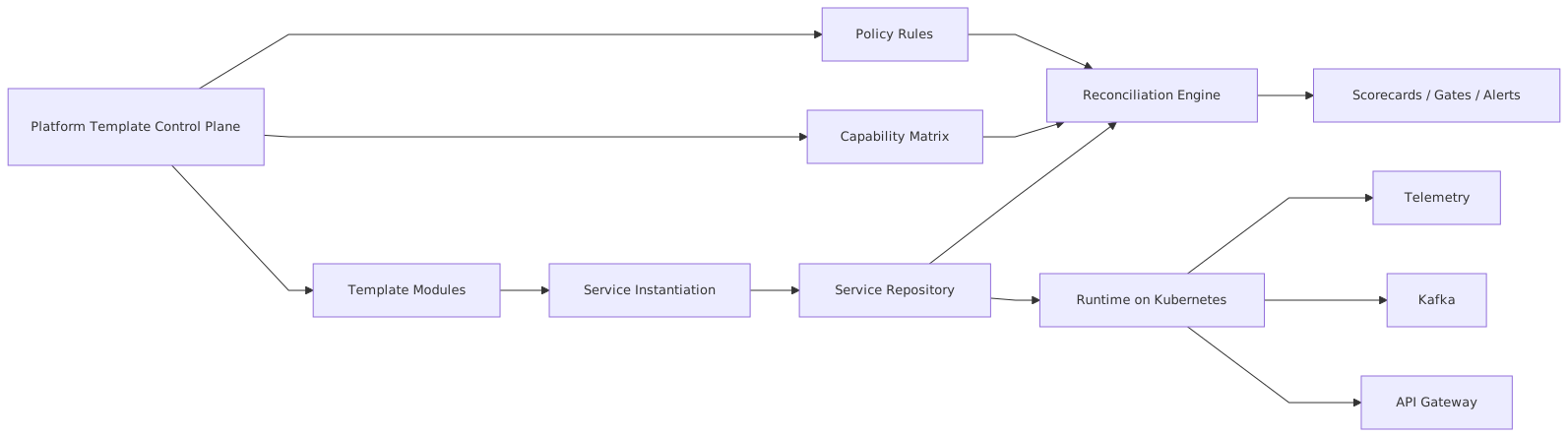
This arrangement creates a healthy separation. Instantiation creates services. Reconciliation governs evolution. Runtime standards provide supportable building blocks. Domain teams remain responsible for business semantics.
Domain semantics and template design
This is where architecture gets interesting.
One of the laziest moves in platform engineering is to confuse technical consistency with semantic consistency. They are not the same thing.
In domain-driven design, a service boundary exists to protect a model. That means a template should help preserve semantic clarity, not flatten it. Consider the difference between:
- a domain event such as
PaymentCaptured - an integration event such as
PaymentSettlementRequested - a technical event such as
RetryScheduled
If your service template gives all three the same naming, transport, versioning, and publishing conventions, you have made things simpler for the platform and more confusing for everyone else.
Templates should provide scaffolding for semantic distinction:
- separate modules or packages for domain events and integration events
- contract versioning conventions for external consumers
- outbox support where transactional boundaries matter
- inbox/idempotency support for Kafka consumers
- metadata standards for tracing causation and correlation
- explicit ownership of schemas by bounded context
That is platform engineering with respect for the domain.
It also matters during migration. When evolving a template from synchronous APIs toward event-driven collaboration, teams should not simply “add Kafka.” They need a language for what events mean, where they originate, and how consistency is handled. Otherwise they end up publishing database-change-shaped messages and calling it architecture.
Template timeline and progressive evolution
Service templates evolve in waves, not leaps. A realistic timeline might look like this:
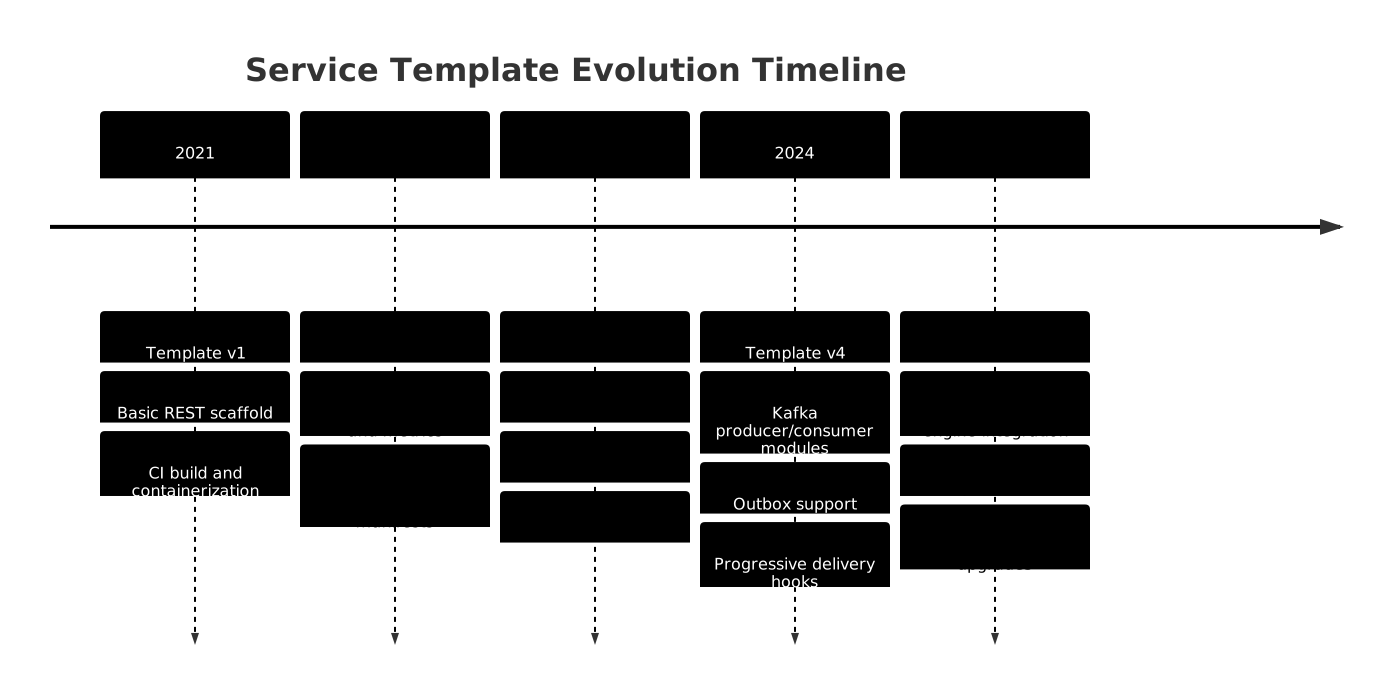
This is the timeline many organizations live through, whether they document it or not. The mistake is pretending the move from one stage to the next is only a tooling upgrade. It is often an architectural shift.
Adding Kafka support is not “just another library.” It changes coupling, failure behavior, observability needs, data consistency models, and support patterns. Adding reconciliation is not “just another dashboard.” It changes governance from occasional review to continuous feedback.
Migration Strategy
Template evolution without migration strategy is fantasy architecture.
The right migration approach is usually a progressive strangler model. Instead of replacing a service wholesale, you peel away old template assumptions and introduce new capabilities incrementally.
A sensible migration sequence looks like this:
- Establish lineage metadata
First identify what each service actually is: template origin, stack, owner, runtime, dependencies, policy profile, criticality, and domain classification. You cannot migrate what you cannot see.
- Decouple business logic from bootstrap concerns
Move startup wiring, configuration loading, observability initialization, and deployment descriptors into template-aligned modules without touching domain code.
- Introduce reconciliation visibility
Before enforcing anything, show teams where they differ from the target baseline. Start with scorecards and recommendations.
- Migrate operational capabilities first
Telemetry, security, identity, container base images, CI/CD controls, and deployment policies should come before invasive application rewrites.
- Migrate integration mechanisms next
Introduce Kafka adapters, outbox patterns, API gateway policies, or contract testing in a way that can coexist with existing service logic.
- Refactor domain interactions only where there is business value
Do not rewrite a stable CRUD service into an event-driven one just because the new template supports Kafka. Architecture should follow domain need, not template enthusiasm.
- Deprecate old template families with explicit timelines
Some old patterns must eventually die. Publish dates, support scope, and risk implications.
Here is the core migration shape:
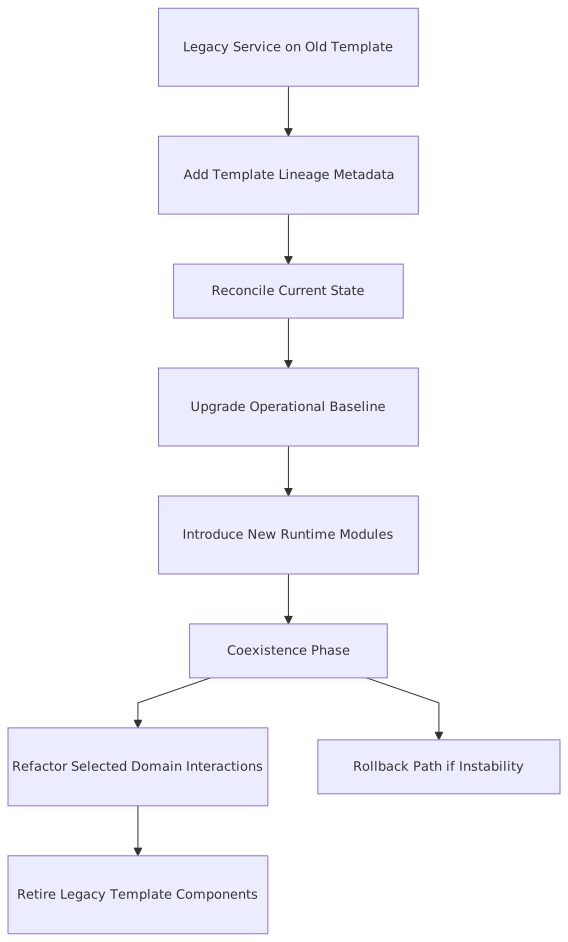
The coexistence phase matters. In enterprise systems, a service often needs to run partly in the old world and partly in the new one for months. This is normal. The migration path should support mixed operation, not treat it as failure.
Reconciliation discussion
Reconciliation is the unsung hero of template evolution.
In Kubernetes, people understand reconciliation instinctively: desired state and actual state are compared continuously. But many platform teams stop at infrastructure. They do not apply the same idea to service templates.
They should.
For templates, reconciliation means maintaining a declared target architecture profile per service and continuously evaluating conformance. This may include:
- Is the service on an approved Java or .NET runtime?
- Does it emit required traces and metrics?
- Does it use workload identity rather than static credentials?
- Are Kafka consumers configured with idempotency and dead-letter handling?
- Does the service expose standard readiness and liveness endpoints?
- Has the team adopted the required API deprecation headers?
- Are critical dependencies within support windows?
This creates a living contract between platform and product teams.
The trick is to make reconciliation useful rather than punitive. If every mismatch blocks deployment, teams stop trusting the platform. Better to classify findings:
- critical: blocks deployment
- required soon: time-bound remediation
- advisory: visible but not enforced
- waived: documented exception with expiry
Done well, reconciliation turns template evolution into a managed portfolio process rather than a sequence of mass migrations.
Enterprise Example
Consider a global retail bank with more than 400 microservices across payments, customer onboarding, fraud, ledger, and servicing domains.
The platform team began with a Java Spring Boot service template. It included REST controllers, basic Docker packaging, a Jenkins pipeline, and Kubernetes manifests. It was enough for the first wave of digital delivery.
Three years later, the cracks were obvious.
Payments needed Kafka-based event streaming to support settlement workflows and reconciliation. Fraud required low-latency consumers with robust replay handling. Customer onboarding remained largely API-driven but needed stronger auditability and identity controls. Ledger services could not tolerate the loose assumptions some CRUD-oriented templates made around transactional boundaries.
The platform team initially tried a big-bang replacement: a new template with OpenTelemetry, Kafka modules, Vault integration, GitHub Actions, and policy checks. Adoption was slow. Product teams saw it as a rewrite disguised as an upgrade.
The strategy changed.
They split the template into capability modules:
- core runtime bootstrap
- observability baseline
- security and identity
- HTTP service profile
- Kafka producer profile
- Kafka consumer profile
- outbox module
- deployment policy module
Then they introduced service scorecards with reconciliation. Every service declared:
- owning domain and subdomain
- criticality tier
- integration style
- template lineage
- target capability profile
This changed the conversation completely.
Onboarding services adopted new identity and audit modules but stayed mostly REST-based. Payments introduced the outbox module and Kafka producer profile first, then later moved certain settlement interactions to asynchronous events. Fraud services adopted consumer templates with replay-safe handling, dead-letter routing, and tracing conventions. Ledger services remained conservative and accepted only the observability and security baseline from the new template family, avoiding messaging modules that did not fit their consistency model.
Within 18 months, the bank had not “migrated to one template.” It had done something more mature: it had evolved from one rigid template to a governed template ecosystem aligned to bounded contexts.
That is what good enterprise architecture looks like. Not uniformity. Coherent variation.
Operational Considerations
Template evolution is won or lost in operations.
Telemetry
Every template generation should improve observability, not just syntax. Traces must flow across HTTP and Kafka boundaries. Correlation IDs should be standardized. Log formats should support central query. Metrics should capture both platform-level and domain-level health.
A template that only scaffolds endpoints but ignores trace context propagation is unfinished work.
Release engineering
Templates should integrate with progressive delivery: canary, blue-green, and rollback mechanisms. If the new template introduces sidecars, mesh policies, or startup behavior changes, rollout strategies must account for them.
Security posture
Identity, secret management, dependency baselines, and supply chain controls belong in templates because teams will otherwise solve them inconsistently. But remember the tradeoff: over-embedding security logic in generated code can make upgrades painful. Prefer centrally managed controls where possible, and thin service-level adapters where necessary.
Kafka operations
Where Kafka is relevant, templates should include sensible defaults for:
- retry strategy
- dead-letter topics
- idempotent publishing
- offset handling
- schema validation
- consumer group naming
- poison message treatment
- observability for lag and rebalance behavior
A Kafka-enabled service template without operational guidance is like handing someone a chainsaw with no manual.
Support model
Platform teams should publish support matrices:
- supported template families
- supported runtime versions
- deprecation dates
- mandatory upgrade windows
- approved exceptions
Without this, service templates become folklore.
Tradeoffs
There is no perfect approach here. Only informed compromise.
Centralized templates reduce variance but can suppress innovation
This is useful when the organization has too much entropy. It is harmful when the platform starts blocking valid domain-specific needs.
Capability-based templates are flexible but harder to govern
They better reflect enterprise reality, yet they demand stronger metadata, reconciliation, and support discipline.
Progressive migration lowers risk but extends coexistence
You avoid big-bang trauma, but you live longer with mixed operational patterns. Support teams must cope with old and new simultaneously.
Reconciliation improves visibility but can create dashboard fatigue
If every service gets a long list of findings with unclear priority, teams ignore the system.
Kafka-first templates enable decoupling but increase failure complexity
Asynchronous systems shift pain, they do not eliminate it. Retries, duplicate events, ordering issues, consumer lag, and eventual consistency all become operational concerns.
Templates should expose these tradeoffs openly. Mature platforms do not sell silver bullets.
Failure Modes
This pattern fails in recognizable ways.
Template as framework prison
The platform team over-engineers the template until teams cannot work around it. Adoption falls. Shadow platforms appear.
Template drift with no reconciliation
Services fork the template and never return. Security and operational posture fragment across the estate.
Versioning by folder copy
Each template release is a new repository snapshot with no capability model, no lineage, and no upgrade path. This scales badly.
Semantic blindness
The template standardizes technical structure while ignoring domain semantics. Teams publish meaningless events, couple through shared schemas, and mistake transport choices for business design.
Big-bang migration mandates
Leadership declares “all services must move to v5 by Q3.” Teams miss deadlines, create dangerous shortcuts, and resentment hardens.
Kafka cargo culting
The organization adopts event-driven modules because they look modern, not because the domain needs them. The result is distributed complexity with no business payoff.
Reconciliation as punishment
If scorecards become a compliance weapon rather than a planning tool, teams game the system instead of improving the platform.
When Not To Use
Not every environment needs sophisticated service template evolution.
Do not invest heavily in this pattern when:
- you have a small estate with fewer than a dozen services
- your systems are mostly monolithic and should remain so for now
- your platform team is too small to support a template product lifecycle
- your domains are unstable and service boundaries are still being discovered
- your organization lacks the discipline to maintain reconciliation metadata
- the main issue is poor engineering practice, not template capability
In those cases, a simpler starter template and good engineering guidance may be enough.
Also, do not use service templates as a substitute for architecture thinking. If bounded contexts are unclear, if ownership is fuzzy, or if integration patterns are accidental, no template strategy will save you.
Related Patterns
Several related patterns fit naturally here.
- Golden paths: useful as a developer experience concept, but should be backed by versioned capabilities rather than static examples.
- Backstage software templates: good for instantiation, but not sufficient for reconciliation by themselves.
- Strangler fig migration: the right mental model for phased template upgrades at service and estate level.
- Policy as code: essential for machine-verifiable conformance.
- Outbox and inbox patterns: important when evolving templates toward Kafka and event-driven interactions.
- Contract testing: valuable for preserving compatibility during template-driven API evolution.
- Cell-based or domain-aligned platform models: useful where different business domains require different service profiles under shared governance.
The broader lesson is this: template evolution belongs inside enterprise architecture, not outside it. It touches delivery, governance, runtime operations, and domain boundaries all at once.
Summary
Service templates are not boilerplate generators. They are architecture instruments.
They encode the platform’s opinion about how services should be built, run, observed, secured, and integrated. That opinion will change. It should change. Enterprises evolve, technology stacks shift, and domains reveal needs the first template never imagined.
The challenge is not creating a new template every year. The challenge is evolving templates without turning the estate into a museum of abandoned standards or a dictatorship of centralized abstraction.
The practical answer is to treat templates as versioned product lines, organize them around capabilities, align them with bounded contexts, migrate them progressively using strangler-style techniques, and continuously reconcile actual service state with intended architectural policy.
That gives you a platform that can move without forcing every service into lockstep. It gives product teams room to respect domain semantics while still benefiting from common operational foundations. And it gives architecture something too many enterprises lack: a way to make standards evolve in the real world.
Because in the end, the best service template is not the one that looks clean on day one.
It is the one that can survive year five.
Frequently Asked Questions
What is cloud architecture?
Cloud architecture describes how technology components — compute, storage, networking, security, and services — are structured and connected to deliver a system in a cloud environment. It covers decisions on scalability, resilience, cost, and operational model.
What is the difference between availability and resilience?
Availability is the percentage of time a system is operational. Resilience is the ability to recover from failures — absorbing disruption and returning to normal. A system can be highly available through redundancy but still lack resilience if it cannot handle unexpected failure modes gracefully.
How do you model cloud architecture in ArchiMate?
Cloud services (EC2, S3, Lambda, etc.) are Technology Services or Nodes in the Technology layer. Application Components are assigned to these nodes. Multi-region or multi-cloud dependencies appear as Serving and Flow relationships. Data residency constraints go in the Motivation layer.