⏱ 19 min read
Most outages do not begin with a bang. They begin with a cold start, a cache miss, a timid service instance that has technically “started” but is still useless.
That gap between process alive and system ready is where many cloud microservices quietly betray us. Kubernetes says the pod is running. The load balancer sees a healthy target. Metrics trickle in. And then the first real customer request hits a service that has not loaded reference data, has not established Kafka consumer state, has not primed connection pools, has not rebuilt in-memory indexes, and has certainly not reconciled what happened while it was asleep. We call this “startup.” In production, it is better understood as a liability.
Warmup strategy is the discipline of closing that gap.
In mature enterprise systems, warmup is not a technical footnote. It is architecture. It sits at the seam between deployment and runtime semantics, between elasticity and correctness, between domain truth and infrastructure optimism. A service that starts fast but becomes trustworthy slowly is not actually ready. That distinction matters more in distributed systems than most teams admit.
This is especially true in cloud microservices built around Kafka, asynchronous messaging, and independent scaling. In these environments, a service often depends on a mesh of remote contracts, read models, caches, policy rules, and event history. If those are cold, stale, or only partially reconstructed, the service can return the wrong answer with perfect confidence. And wrong answers are more dangerous than obvious failures.
So let’s treat warmup properly: as a first-class architectural concern.
Context
Cloud microservices promised speed, resilience, and independent evolution. They delivered all three, but also introduced a new kind of fragility: services that are operationally alive before they are semantically safe.
In a monolith, startup was usually a singular event. The process loaded configuration, opened database connections, maybe hydrated a few caches, and then the application became available. There was complexity, certainly, but it was concentrated in one place and one deployment unit.
In microservices, startup is fragmented. One service may need to load product catalogs into memory. Another may need to rebuild customer entitlements from Kafka compacted topics. A third may have to precompute fraud thresholds, initialize model artifacts, and validate connectivity to a half-dozen downstream platforms. Each service has its own notion of “ready,” and those notions are often deeply rooted in domain semantics. event-driven architecture patterns
That last point is the one teams miss.
Warmup is not just technical initialization. It is the establishment of domain capability. A Pricing service is not ready because its HTTP port is open; it is ready when it can produce trustworthy prices according to current pricing rules, tax tables, promotions, and contract entitlements. An Order Allocation service is not ready because its pod passes a liveness probe; it is ready when inventory snapshots, reservation policies, and event offsets are coherent enough to make allocation decisions without corrupting the business.
This is why domain-driven design matters here. Readiness is bounded by business meaning. The warmup flow for a fraud scoring service is not the same as the warmup flow for a shipment tracking service, because the invariants they protect are different.
A good architecture names those semantics explicitly.
Problem
The problem sounds deceptively simple: how do we make a service safe to receive production traffic after startup, scaling, failover, or deployment?
But underneath that question are several harder ones:
- What must be true before a service is considered ready?
- Which dependencies must be fully available, and which can degrade gracefully?
- How should a service restore working state after downtime?
- How do we reconcile missed events or stale local views?
- How do we avoid the thundering herd of every instance warming at once?
- How do we prevent warmup logic from becoming a hidden distributed monolith?
Without a strategy, teams usually fall into one of three bad habits.
First, they equate process health with business readiness. This is the classic “it passed the probe” mistake.
Second, they defer warmup into live traffic. The first user request triggers cache population, downstream authentication, lazy metadata loads, schema introspection, and expensive queries. This gives the illusion of fast startup while outsourcing latency and risk to customers.
Third, they attempt to preload everything. Every service fetches every reference dataset, backfills every materialized view, rebuilds every index, and blocks readiness until all possible state is local. That can turn deployment into a ritual of self-inflicted denial-of-service.
Warmup done badly creates long startup times, cascading dependency spikes, stale decisioning, duplicate Kafka consumption, and split-brain style behavior where some instances act on fresh state and others operate from the archaeological record.
The core problem is not initialization. It is controlled restoration of service semantics.
Forces
Architecture is the art of balancing forces, not pretending they don’t exist. Warmup strategies live in the middle of several tensions.
Fast elasticity vs semantic readiness
Cloud platforms reward rapid scale-out. But many domains punish half-ready behavior. The more aggressively you autoscale, the more often you create cold instances, and the more valuable a deliberate warmup flow becomes.
Stateless ideals vs stateful reality
We like to say microservices are stateless. Most useful ones are not. They may externalize durable state, but they still rely on ephemeral local state: caches, indexes, rule engines, consumer offsets, token pools, model artifacts, and precomputed aggregates. Warmup must manage that state honestly. microservices architecture diagrams
Availability vs correctness
Some services can answer partially. Others must refuse until coherent. A recommendation engine can degrade. A payment authorization service generally should not “best effort” its way through missing risk rules. Domain semantics decide where to draw that line.
Event-driven consistency vs immediate readiness
Kafka helps decouple services, but it introduces another startup question: is the service sufficiently caught up with its event streams to make current decisions? Being connected to Kafka is not the same as being synchronized.
Shared infrastructure efficiency vs startup storms
If every new instance loads gigabytes of data and opens hundreds of connections at once, the “self-healing” platform becomes a stampede generator. Warmup must be rate-aware and dependency-aware.
Team autonomy vs platform consistency
Every team wants custom warmup logic because each domain is different. They are not wrong. But if every team invents its own readiness semantics, operations becomes folklore. There needs to be a platform pattern with domain-specific hooks.
That is the real shape of the problem: standardize the mechanism, not the meaning.
Solution
The most effective warmup strategy is usually a multi-phase readiness model with explicit domain checkpoints, controlled dependency initialization, and reconciliation before traffic admission.
A service should move through states deliberately, not magically:
- Process Started – application booted, configuration loaded.
- Technical Initialized – core dependencies reachable, connection pools established, security context available.
- Domain Warmed – critical reference data, policy artifacts, caches, or local indexes loaded.
- Reconciled – missed events, lagging projections, or state divergence checked and corrected.
- Traffic Ready – safe for production traffic.
- Fully Primed – optional enhancements complete; non-critical warmup can continue in background.
This sounds obvious. It rarely appears in code.
The pattern I recommend is to treat warmup as an orchestrated internal workflow, not a pile of startup callbacks. Give it a named component, explicit phases, metrics, deadlines, failure paths, and domain-owned criteria for completion. If your service has a meaningful domain model, the warmup logic belongs close to that model, not buried in framework glue.
Here is the broad shape.
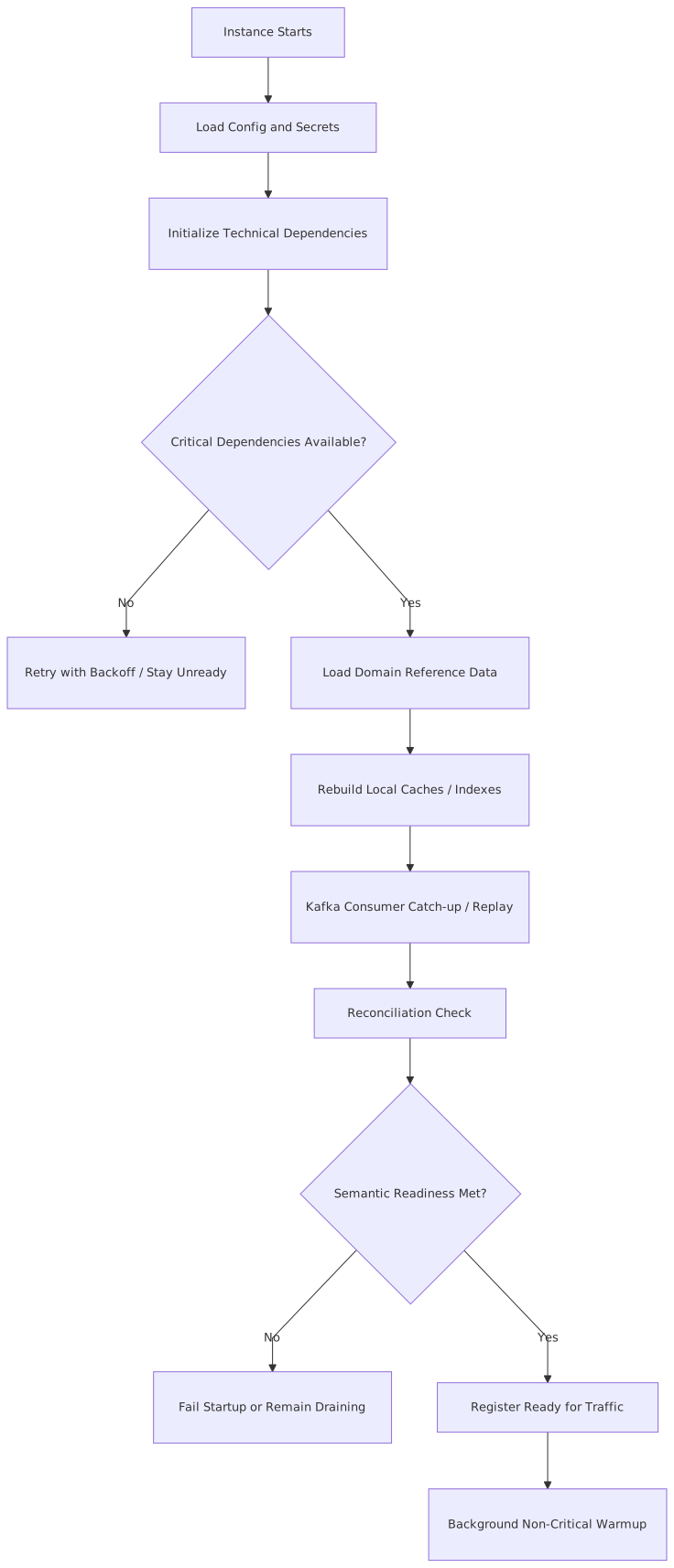
A few opinions, stated plainly:
- Do not hide domain warmup behind lazy loading unless latency spikes and stale answers are acceptable by design.
- Do not block on non-critical data just to feel complete. Readiness should protect business invariants, not satisfy developer neatness.
- Do not let infrastructure probes define business readiness. They can reflect it, but they cannot invent it.
- Do not assume Kafka replay equals reconciliation. Replay restores event-derived state; reconciliation verifies that state is actually sufficient and correct.
The service should expose separate health signals for liveness, technical readiness, and semantic readiness. This distinction matters operationally and politically. It gives SREs something real to monitor and gives product teams a way to discuss acceptable degradation in business terms.
Architecture
A practical warmup architecture usually has five collaborating parts.
1. Readiness state machine
This is the central control point. It tracks startup phase, durations, blockers, retries, and final readiness decision. It should be observable and boring.
2. Dependency classification
Dependencies should be classified as:
- Critical: without them, the service must not serve traffic.
- Required soon: service can start with limited capability but must warm quickly.
- Optional: enhance performance or completeness but do not gate readiness.
This is where domain-driven design earns its keep. A Customer Profile service may classify the identity store as critical, recommendation features as optional, and marketing preferences as required soon. A Claims Adjudication service will draw those lines differently.
3. State hydration pipeline
This loads what the service needs to act coherently:
- reference data
- rules and policy versions
- local projections
- compacted Kafka topics
- machine learning artifacts
- authorization matrices
- tenant configuration
Hydration should be incremental where possible. Full rebuilds are expensive and often unnecessary.
4. Reconciliation engine
This is the grown-up part. If the service was down, scaled from zero, or rolled during upstream changes, it may have missed events or inherited stale snapshots. Reconciliation compares local understanding to system-of-record or event-log truth and repairs the gap.
This can take several forms:
- offset catch-up from Kafka
- point-in-time snapshot + event replay
- periodic compare-and-correct with source systems
- checksum or version validation across bounded contexts
Reconciliation is the difference between “we loaded state” and “we trust state.”
5. Admission control
Only after semantic readiness should the instance receive full traffic. Even then, traffic can be ramped:
- internal synthetic requests first
- canary subset next
- full admission last
This is especially useful when warmup success depends on dynamic behavior not visible through static checks.
Here is a more detailed architecture view.
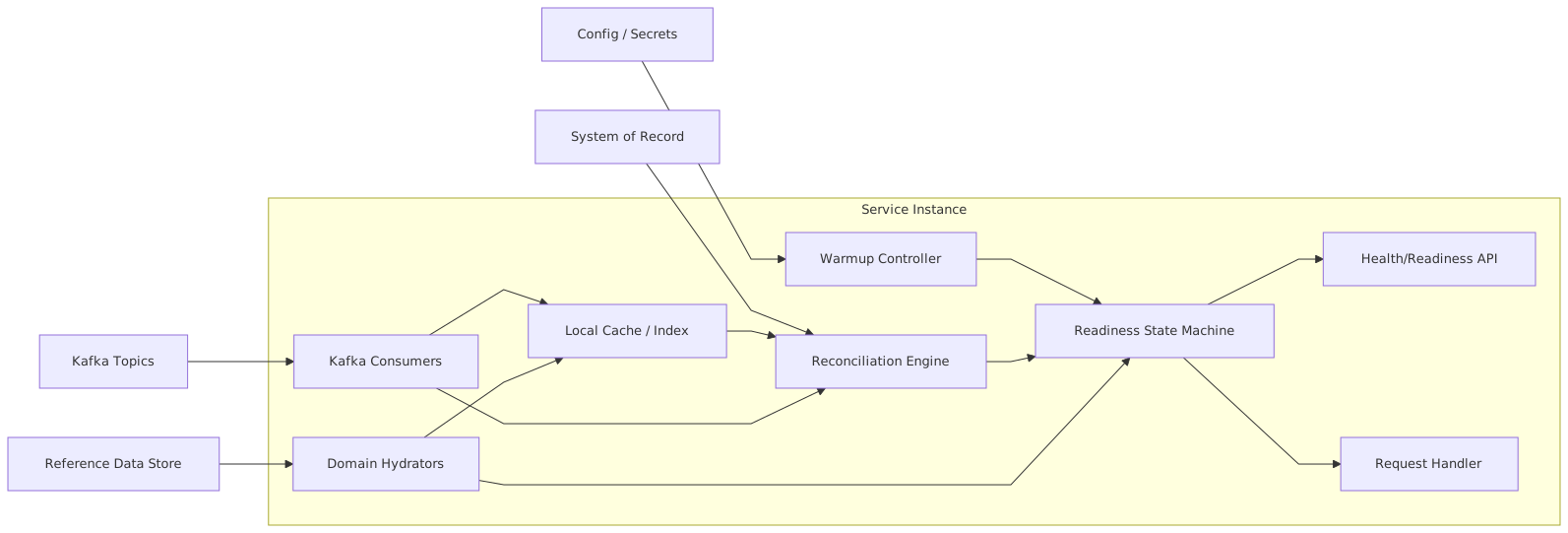
Notice what this avoids: startup logic scattered across random repositories, message listeners, and HTTP filters. Warmup is a subsystem. Treat it that way.
Domain semantics discussion
The architecture changes depending on domain semantics.
If the domain is decision-heavy—pricing, fraud, entitlement, underwriting—the service must often gate readiness on policy correctness and reference data freshness.
If the domain is workflow-heavy—ticketing, fulfillment, case management—the service may be able to accept commands earlier and resolve non-critical projections later, provided command invariants are preserved.
If the domain is query-heavy—catalog browse, search, analytics—warmup often centers on index hydration, cache priming, and stale-read tolerance.
These are not implementation details. They are business choices masquerading as startup mechanics.
Migration Strategy
Most enterprises do not get to design warmup cleanly from day one. They inherit services with ad hoc startup logic, giant shared caches, and brittle dependencies. The migration path matters.
This is a good place for a progressive strangler migration.
Start by wrapping existing startup behavior in an explicit readiness model without changing business logic. Name the phases. Emit metrics. Separate liveness from readiness. This gives visibility first.
Then progressively pull startup responsibilities into dedicated warmup components:
- extract cache loading into hydrators
- isolate Kafka replay into recoverable consumers
- move dependency checks into classified gates
- add reconciliation where assumptions were previously implicit
Do not attempt to redesign every service at once. Warmup strategy spreads best as a platform capability with service-specific semantics.
A practical migration sequence looks like this:
- Instrument current startup
- time to process start
- time to first successful request
- time to cache warm
- Kafka lag after startup
- downstream saturation caused by warmup
- Introduce phased readiness
- liveness = process health
- readiness = technical and semantic gates
- optional “primed” metric = performance optimizations complete
- Classify dependencies
- challenge every “critical” label
- ask what business harm occurs if this dependency is cold
- Add reconciliation
- especially for event-driven projections and stale local views
- Adopt traffic ramping
- canary admission beats binary readiness in many systems
- Strangle lazy startup behavior
- move expensive first-request work into pre-admission warmup
Here is the migration flow.
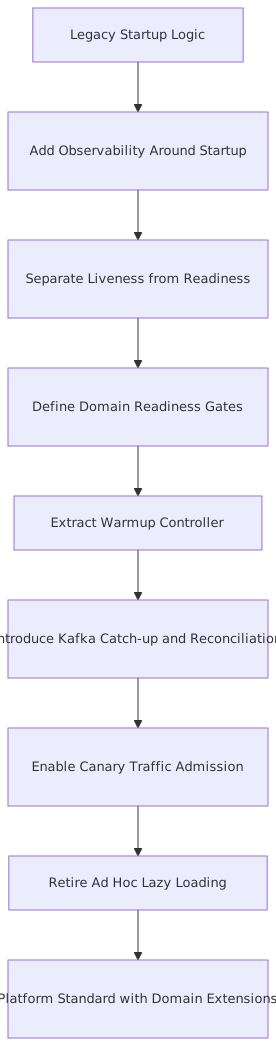
The strangler part is important. You do not replace startup behavior in one cut. You put a disciplined shell around it, then gradually move logic into explicit warmup phases until the old tangle withers.
Enterprise Example
Consider a global insurance company modernizing its claims platform.
The legacy system was a large policy and claims core running on-premises. As part of digital transformation, the company split capabilities into microservices: Policy Coverage, Customer Identity, Claims Intake, Fraud Assessment, Provider Network, and Payment Authorization. Kafka was introduced as the event backbone for policy changes, claims events, and provider updates.
The Fraud Assessment service looked healthy on paper. It was containerized, horizontally scalable, and consumed Kafka topics to maintain local risk features. It also loaded fraud rules from a rules repository, provider risk scores from a compacted topic, customer claim histories from a projection store, and geolocation reference data from a managed cache.
Then they hit a failure pattern that is common and rarely documented honestly.
During regional failover testing, new Fraud Assessment instances came up quickly and were marked ready by Kubernetes in under 20 seconds. But Kafka replay of provider risk scores took several minutes. Claim history projections were stale because the projection store itself lagged after failover. Meanwhile, live claims traffic was routed immediately. The service made risk decisions from partial state, under-scoring suspicious claims and over-scoring legitimate ones. There was no dramatic outage. Just quiet business damage.
That is the nastiest kind.
The fix was architectural, not operational.
They introduced a warmup controller with domain-defined readiness semantics:
- fraud rules version must match approved production policy
- provider risk topic lag must be below threshold
- customer history projection freshness must be within five minutes
- geolocation reference load must succeed or degrade into explicit “manual review” path
- reconciliation job must sample source-of-record claims against local features before readiness
They also split readiness into two levels:
- Decision Ready: may process low-risk and standard claims
- Full Ready: may process high-value or cross-border claims requiring enriched features
That distinction came directly from domain semantics. Not all claims needed the same level of warmup. So they used routing policy to admit simpler claim types first while deeper enrichment completed in the background.
The result was not merely fewer incidents. It was better business behavior under stress.
This is what enterprise architecture should do: shape technical startup around operational business truth.
Operational Considerations
Warmup strategy only works if it is visible and governable.
Observability
You need startup telemetry with phase-level timings:
- process boot duration
- dependency initialization latency
- hydration completion time
- Kafka consumer lag at admission
- reconciliation duration and discrepancy rate
- time to first safe traffic
- time to fully primed
A single “startup took 90 seconds” metric is useless. Warmup needs a timeline.
Probes and signals
Use separate endpoints or statuses for:
- liveness
- technical readiness
- semantic readiness
- degraded mode
- fully primed
Do not force everything into one green light. Real systems deserve more nuance.
Backpressure and storm control
If a deployment spins up fifty instances and all of them warm from the same sources, you can melt your dependencies. Use:
- staggered rollout
- warmup concurrency limits
- shared snapshot distribution
- prebuilt cache artifacts where appropriate
- consumer group coordination for replay-heavy services
Kafka-specific concerns
For Kafka-based services, warmup often depends on offset and projection state:
- detect lag before admitting traffic
- decide whether startup requires full catch-up or bounded lag tolerance
- use compacted topics for reference state where suitable
- consider snapshot-plus-replay for large state rebuilds
- avoid duplicate side effects while consumer state is recovering
One subtle but important rule: if a service both consumes Kafka and serves synchronous requests based on event-derived state, its readiness must include event synchronization semantics. Otherwise you are serving answers from yesterday while claiming to be online today.
Reconciliation cadence
Startup reconciliation is not enough. Drift happens during normal runtime too. Periodic reconcile-and-repair protects against:
- missed events
- poison messages
- projection bugs
- schema evolution mishaps
- silent dependency corruption
Warmup should reuse those reconciliation mechanisms, not invent a separate one-off repair path.
Tradeoffs
There is no free lunch here. Warmup strategies improve safety by spending time, complexity, and sometimes money.
Longer startup times
The obvious cost. If semantic readiness takes minutes, elasticity becomes less immediate. This may be acceptable for critical domains and painful for spiky workloads.
Higher implementation complexity
A proper warmup controller, hydrators, and reconciliation engine add moving parts. But hidden startup behavior is also complexity; it is simply unaccounted complexity, which is the worst kind.
Increased dependency on domain clarity
You cannot define semantic readiness if nobody agrees what “safe” means. Teams with weak domain models struggle here. That is not a reason to avoid the work. It is a reason to do domain modeling.
Potential underutilization during ramp-up
Canary admission and phased readiness may keep capacity partially unused for a while. This is the right inefficiency when correctness matters.
Snapshot staleness vs replay cost
Precomputed snapshots speed warmup but risk stale state. Full replay improves freshness but increases startup time and infrastructure load. Most enterprises need a hybrid: recent snapshot plus bounded replay plus reconciliation.
The key tradeoff is this: warmup strategy does not remove complexity; it chooses where to place it. I would rather place it in explicit architecture than in customer-facing randomness.
Failure Modes
Warmup logic can fail in ways that are distinct from normal runtime failures.
False readiness
The worst failure. Probes go green, but critical state is stale, partial, or corrupt. Usually caused by readiness checks that test connectivity but not semantic sufficiency.
Infinite warming
The service never becomes ready because one optional dependency was accidentally treated as mandatory, or replay lag can never reach zero under active traffic. This is why readiness thresholds must be realistic and business-driven.
Warmup storms
A deployment, failover, or autoscaling event causes many instances to hit the same data sources, creating self-inflicted outages. Classic cloud irony.
Stale snapshot trust
Services warm quickly from snapshots that are old or incompatible with current schemas. They become “ready” on poisoned assumptions.
Reconciliation side effects
Poorly designed reconciliation can duplicate work, emit duplicate events, or overwrite correct state with stale source data. Reconciliation is not a toy batch job. It needs idempotency and clear authority rules.
Hidden degraded mode
The service quietly serves with partial data without telling anyone. This often happens when warmup failures are downgraded to warnings. If degradation is acceptable, make it explicit in metrics and routing policy.
A good architecture plans for these failure modes, not just the happy path.
When Not To Use
Not every service needs heavy warmup orchestration.
Do not use an elaborate warmup strategy when:
- the service is truly stateless and delegates all real work to reliable downstreams
- stale or first-request initialization is acceptable
- the domain has low correctness sensitivity
- startup overhead would outweigh business risk
- scale-from-zero latency is more important than local optimization
- the service is essentially a thin CRUD façade over a database
For example, a simple Notification Preference API that performs straightforward reads and writes to a managed datastore may only need basic connection checks and schema compatibility validation. Building replay pipelines and reconciliation engines there would be architecture cosplay.
Warmup sophistication should match domain consequence. A service that recommends a movie is not a service that authorizes a claim payment. Know the difference.
Related Patterns
Several patterns often sit beside warmup strategy.
Health Check Segregation
Separate liveness, readiness, and deeper semantic checks. This is table stakes.
Circuit Breaker
Warmup does not eliminate dependency failures after startup. Circuit breakers still matter, especially for “required soon” dependencies.
Bulkhead
Warmup tasks should not starve request processing resources or vice versa.
Cache-Aside and Read-Through Cache
Useful, but dangerous if they become accidental warmup-by-customer.
CQRS and Materialized Views
Many warmup flows are really about restoring read models. That makes CQRS highly relevant, particularly in Kafka-centric systems.
Snapshot and Replay
A common tactic for reducing startup cost in event-driven services.
Strangler Fig Pattern
Vital for migrating legacy startup logic into explicit readiness architecture progressively.
Saga and Compensation
Relevant where warmup affects command acceptance and deferred processing.
These patterns help, but none of them replace the need to define what the service must mean before it is allowed to serve.
Summary
Service warmup is one of those topics that sounds operational until it hurts the business. Then everyone discovers it was architectural all along.
In cloud microservices, especially those using Kafka and event-driven projections, a running instance is not the same thing as a ready service. Readiness must be defined in domain terms, implemented through explicit warmup phases, and verified through reconciliation. Otherwise the platform will route traffic into semantic uncertainty and call it resilience.
The better approach is disciplined and pragmatic:
- model readiness as a state machine
- classify dependencies by business importance
- hydrate only what matters for correctness
- reconcile event-derived state before admission
- use progressive strangler migration to tame legacy startup logic
- expose nuanced operational signals
- plan for startup storms, false readiness, and stale snapshots
The memorable line here is simple: software does not become trustworthy because it is awake.
A good warmup strategy turns startup from an accident into a contract. In enterprise systems, that contract is worth more than another green health check.
Frequently Asked Questions
What is a service mesh?
A service mesh is an infrastructure layer managing service-to-service communication. It provides mutual TLS, load balancing, circuit breaking, retries, and observability without each service implementing these capabilities. Istio and Linkerd are common implementations.
How do you document microservices architecture for governance?
Use ArchiMate Application Cooperation diagrams for the service landscape, UML Component diagrams for internal structure, UML Sequence diagrams for key flows, and UML Deployment diagrams for Kubernetes topology. All views can coexist in Sparx EA with full traceability.
What is the difference between choreography and orchestration in microservices?
Choreography has services react to events independently — no central coordinator. Orchestration uses a central workflow engine that calls services in sequence. Choreography scales better but is harder to debug; orchestration is easier to reason about but creates a central coupling point.