⏱ 21 min read
Most microservice disasters do not start with Kubernetes, Kafka, or the cloud bill. They start much earlier, in modeling. Or more precisely, in the absence of modeling discipline disguised as “agility.”
That is the uncomfortable truth.
A lot of teams say they have moved beyond UML. They call it heavyweight, old-school, too enterprise, too slow. Then they spend 18 months rebuilding a distributed monolith because nobody agreed on what a service is, what a boundary means, what an event represents, or who owns customer identity. They did not escape modeling. They just did it badly, in PowerPoint, Jira tickets, and tribal memory.
Here’s the strong opinion: if you design microservices without understanding the UML metamodel, you are probably making architecture decisions with fuzzy concepts and inconsistent semantics. And in enterprise work, fuzzy concepts become outages, audit findings, IAM sprawl, Kafka topic chaos, and expensive platform rewrites.
Now, to keep this practical and not drift into methodology theater, let’s make this simple early.
The simple explanation
The UML metamodel is basically the model behind the model. It defines what a “component,” “interface,” “dependency,” “artifact,” “deployment,” “interaction,” and “state” actually mean and how they relate.
Why does that matter for microservices?
Because microservice architecture is not just code split into smaller repositories. It is a set of structural and behavioral contracts:
- what a service owns
- what it exposes
- how it depends on others
- what events mean
- where identity is enforced
- what gets deployed where
- what lifecycle rules apply
The UML metamodel gives you a disciplined way to think about those things. Not because you need to produce 70 UML diagrams. You do not. But because good architecture depends on stable abstractions, and the metamodel is one of the few mature ways to reason about structure and behavior without hand-waving.
So yes, this topic matters in real architecture work.
If you are designing microservices in banking, integrating with Kafka, federating IAM, and deploying across cloud platforms, the UML metamodel quietly shapes your decisions whether you admit it or not. EA governance checklist
Why architects should care, even if they hate UML
I get it. Many architects have a scar tissue relationship with UML. UML modeling best practices
They remember giant class diagrams nobody maintained. They remember Rational-era process overhead. They remember model repositories that became museums of dead intention. Fair criticism. A lot of UML usage deserved to die. UML for microservices
But the metamodel is not the same as drawing every box and arrow in a formal CASE tool.
The useful part is this: the metamodel forces explicitness.
And explicitness is exactly what microservice design needs.
When architects skip that discipline, they usually create one of these messes:
- services defined by team boundaries, not business capability
- APIs that leak internal data models
- Kafka topics treated as shared databases
- IAM bolted on after service decomposition
- deployment topology confused with logical service boundaries
- “domain events” that are really CRUD notifications
- interfaces with no ownership semantics
- sync and async interactions mixed without state or failure modeling
That is not a tooling problem. That is a conceptual problem.
The UML metamodel helps because it separates concerns that many teams blur together:
- Classifier vs instance
- Interface vs implementation
- Component vs deployment artifact
- Logical dependency vs runtime communication
- State transition vs message exchange
- Ownership vs usage
- Type vs realization
That sounds abstract. In practice, it is the difference between a clean service landscape and an enterprise hairball.
The metamodel lens: what actually matters for microservices
Let’s not over-romanticize this. You do not need the entire UML specification on your desk. For microservices, a few metamodel ideas are disproportionately useful.
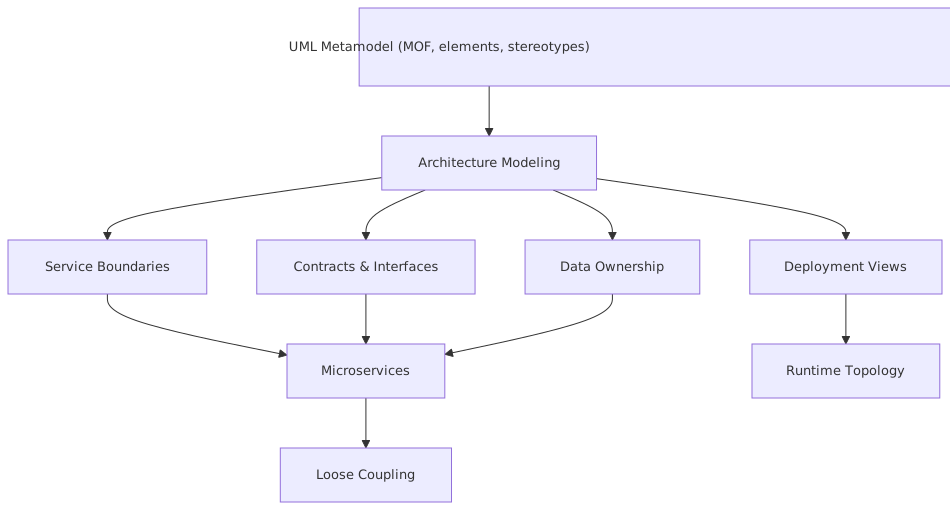
1. Component semantics shape service boundaries
In UML, a component is not just a code package. It is a modular unit with replaceable parts and explicit provided/required interfaces.
That maps surprisingly well to microservices.
A microservice should be thought of as:
- a component
- with provided interfaces: REST APIs, gRPC contracts, event publications
- with required interfaces: upstream IAM, payment gateway, customer profile service, Kafka broker, fraud engine
- with internal realization hidden behind those interfaces
This matters because many architects draw services as boxes but never define the interfaces with enough precision. The result is pseudo-service design: nice boundaries on slides, hidden coupling in implementation.
If a service has no explicit provided and required interfaces, it is not really designed. It is just named.
2. Interface modeling clarifies ownership
This is where the metamodel earns its keep.
In enterprise microservices, the hardest arguments are not usually about code. They are about ownership:
- Who owns customer identity?
- Who defines account status?
- Who can publish “payment settled”?
- Who is allowed to enrich a fraud event?
- Which service is the source of truth for entitlements?
UML interface and realization semantics force a useful distinction:
- an interface is a contract
- a component realizes it
- other components depend on it, but do not own it
That sounds obvious. It isn’t, apparently.
In many organizations, teams publish Kafka events from multiple services using the same business term with slightly different meanings. “CustomerUpdated” from CRM means profile changes. “CustomerUpdated” from IAM means credential changes. “CustomerUpdated” from onboarding means KYC completion. Then downstream consumers infer semantics from payload shape and hope for the best. This is architecture by folklore.
A metamodel-driven mindset says: stop. Define the contract, define the owner, define who realizes it, define who consumes it.
3. Behavioral models expose distributed failure better than static diagrams
This is another contrarian thought: most microservice architecture diagrams are too structural and not behavioral enough.
People love service maps. Fine. But distributed systems fail in time, not in boxes.
The UML metamodel supports sequence, activity, and state concepts. These are not academic extras. They are how you answer real questions like:
- What happens when IAM token introspection times out?
- What if Kafka publishes but downstream processing fails?
- Which state transitions are valid for a loan application?
- When does a payment become irreversible?
- What compensates if the fraud service rejects after account reservation?
If you never model behavior, your architecture is optimistic fiction.
In banking especially, service design without state thinking is reckless. Regulatory processes, transaction stages, approval workflows, and exception handling all depend on explicit lifecycle semantics. A service boundary that looks clean structurally can still be broken behaviorally.
4. Deployment is not architecture, but it still matters
Cloud-native teams often collapse architecture into deployment:
- one container = one service
- one Helm chart = one bounded context
- one namespace = one domain
That is lazy thinking.
The UML metamodel distinguishes logical design from deployment design. Good. Because a microservice is not defined by where it runs. It is defined by what it owns and how it behaves.
Still, deployment matters:
- latency
- resilience
- fault domains
- IAM trust boundaries
- data residency
- cloud network segmentation
- Kafka cluster placement
So yes, deployment diagrams still have a place. Not because they are fashionable. Because enterprise systems live under physical and operational constraints.
A payment orchestration service deployed across two cloud regions with active-active Kafka replication is not the same design as a customer preference service in one region with eventual sync. If your model does not capture that distinction somewhere, your architecture review is mostly decorative.
Where UML metamodel thinking changes real architecture work
Let’s move from theory to actual enterprise practice.
When I work with architecture teams, the UML metamodel influences microservice design in five concrete ways.
1. It improves service decomposition workshops
Most decomposition workshops go wrong in one of two ways:
- they are too business-only and ignore technical interaction semantics
- or too technical and split services by existing system modules
A metamodel-informed workshop asks better questions:
- What is the component?
- What interface does it provide?
- What interfaces does it require?
- What information is internal state versus public contract?
- What events are observations versus commands?
- What behavior is synchronous, asynchronous, or state-driven?
- What deployment constraints affect the design?
That structure prevents the classic mistake of defining a “Customer Service” that owns everything from profile data to IAM credentials to marketing preferences to onboarding status. That is not a service. That is a political compromise.
In practice, decompositions get better when architects force explicit contract and ownership modeling before discussing technology.
2. It reduces Kafka topic chaos
Kafka is where weak architecture gets exposed fast.
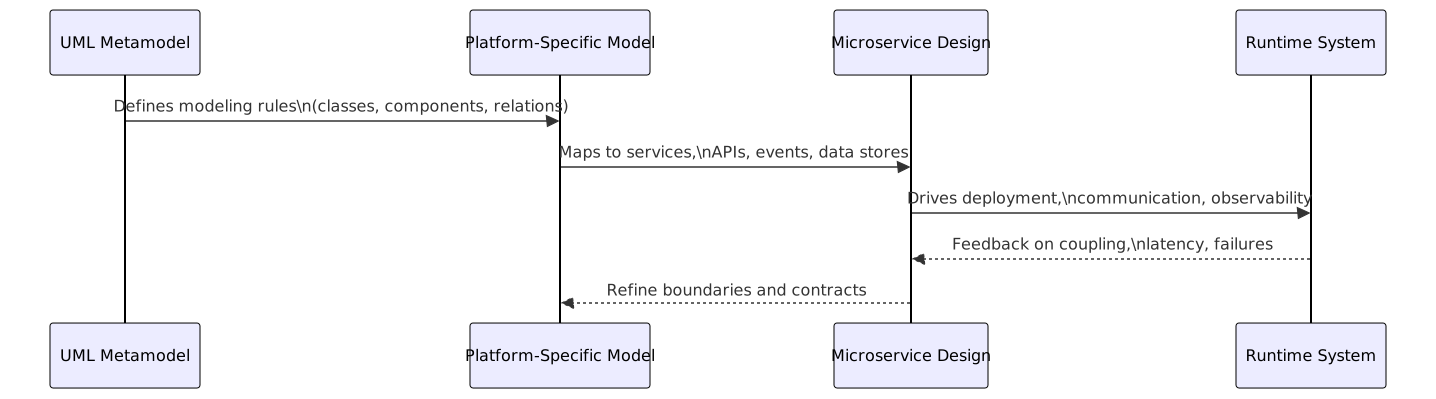
Teams say they are event-driven, but what they often mean is “we have many topics and nobody agrees on semantics.”
The UML metamodel helps because it encourages typed, owned interactions rather than generic message dumping. In architecture terms, that means:
- model event types explicitly
- distinguish command-like interactions from true domain events
- define which component publishes which event
- define whether consumers depend on the event contract or on payload internals
- model sequencing and state implications
A lot of Kafka pain comes from one bad assumption: that every useful data change should be published as an event. Wrong.
Some changes are internal state transitions. Some are integration notifications. Some are audit records. Some are commands pretending to be events because teams are scared of synchronous APIs.
If you do not classify those interactions properly, your event backbone becomes a garbage belt.
3. It forces IAM into the architecture early
IAM is one of the most under-modeled parts of microservice design.
Architects often treat identity and access management as an external platform concern:
- “We’ll use OAuth”
- “We’ll put API Gateway in front”
- “We have Keycloak/Entra/Okta”
- “The platform team handles auth”
That is incomplete at best.
In UML metamodel terms, IAM is not just infrastructure. It participates as a set of components and interfaces:
- token issuance
- authentication
- authorization decision
- policy administration
- claims propagation
- identity federation
- service-to-service trust
This matters because IAM shapes service boundaries and interaction patterns.
For example:
- Should a service trust JWT claims directly, or call a policy decision point?
- Is customer identity separate from workforce identity?
- Are entitlements owned centrally or by domain services?
- Does Kafka consumer authorization map to application roles or service principals?
- How are machine identities rotated in cloud runtime?
These are architecture questions, not afterthoughts.
The metamodel mindset helps architects avoid mixing identity semantics into every service in inconsistent ways.
4. It helps separate domain model from integration model
This is a huge one.
Many microservice programs fail because architects confuse:
- the internal domain model of a service
- the API contract
- the event schema
- the reporting model
- the canonical enterprise model
These are not the same thing. They should not be the same thing.
The UML metamodel is useful here because it naturally distinguishes representation, interface, and realization. A service can realize a business capability without exposing its internal object model. ArchiMate capability map
Yet teams still do this all the time:
- they expose persistence entities through APIs
- they publish internal state changes directly to Kafka
- they force all services into a “canonical customer model”
- they leak IAM provider fields into business APIs
- they tie cloud deployment metadata to business semantics
That creates brittle coupling and makes change expensive.
Good architects use metamodel discipline to say: internal model stays internal unless there is a deliberate contract reason to expose part of it.
5. It gives architecture governance something real to review
Architecture governance is often mocked, and often deservedly so. Too much of it is checklist theater.
But governance becomes useful when it reviews model integrity, not slide aesthetics.
Using a UML metamodel lens, an architecture review can ask:
- Are service boundaries aligned to owned capabilities?
- Are provided and required interfaces explicit?
- Are event contracts owned and versioned?
- Are state transitions modeled where business risk requires it?
- Are IAM trust relationships explicit?
- Are deployment decisions traceable to non-functional requirements?
- Are dependencies acyclic at the logical level, even if runtime interactions are richer?
That is a better review than “show me your C4 diagram and NFR spreadsheet.”
Common mistakes architects make
Let’s be blunt. These are the mistakes I see repeatedly.
Mistake 1: Treating microservices as just smaller applications
This is the root mistake. A microservice is not just a shrunken monolith module with a REST wrapper.
Without explicit interface semantics, state ownership, and dependency definition, you just get distributed coupling.
The metamodel helps because it reminds you that a component exists in relation to contracts, dependencies, and realizations—not just code size.
Mistake 2: Modeling only structure, never behavior
A service catalog is not architecture. It is inventory.
If you do not model sequences, states, and failure paths, you are not designing a distributed system. You are naming endpoints.
In banking systems, this becomes dangerous fast. Payment initiation, sanctions screening, fraud review, settlement, reversal, and ledger posting all have behavioral meaning. You cannot solve that with boxes alone.
Mistake 3: Publishing every data change to Kafka
This is event-driven cargo cult.
Not every row update deserves a topic. Not every event is a domain event. Not every consumer should be allowed to infer business truth from low-level change feeds.
Architects need stronger opinions here. Kafka is a powerful backbone, not a substitute for interface design.
Mistake 4: Ignoring IAM until implementation
Then comes the panic:
- which service validates tokens?
- how do service accounts work?
- where are roles mapped?
- how do B2B partners federate?
- what happens with delegated access?
- how do you secure Kafka producers and consumers?
- what about cloud-native workload identity?
By then, service boundaries are already set badly. IAM gets smeared across the landscape.
Mistake 5: Confusing deployment topology with domain boundaries
A service should not exist just because the cloud platform makes it easy to deploy one. Container count is not architecture maturity.
Some teams create dozens of “services” that are really just deployment fragments of one tightly coupled capability. Then they need synchronous chatter, shared schemas, and release coordination. They call it “fine-grained.” It is usually just fragmented.
Mistake 6: Pretending the canonical model problem is solved
It never is. It just changes shape.
Many enterprises claim they abandoned canonical models, but then recreate them through shared Kafka event schemas, shared IAM claim taxonomies, shared API standards, and enterprise data products.
The trick is not to eliminate shared semantics. The trick is to be intentional about where standardization is useful and where local autonomy matters.
That is exactly where metamodel thinking helps.
A real enterprise example: retail banking modernization
Let’s ground this in something realistic.
A regional bank I worked with was modernizing its retail banking platform. Legacy core systems handled accounts, payments, cards, customer onboarding, and entitlements. The target architecture was cloud-based, event-driven, and API-led. Kafka was the integration backbone. IAM used a central identity provider for workforce and customer federation, with cloud workload identities for service-to-service trust.
The initial microservice decomposition looked reasonable on slides:
- Customer Service
- Account Service
- Payment Service
- Notification Service
- Fraud Service
- IAM Service
It was wrong in several ways.
What was wrong
Customer Service had become a dumping ground:
- profile data
- KYC status
- onboarding workflow
- contact preferences
- digital channel identity references
That mixed business identity with authentication identity and process state.
Payment Service mixed:
- payment initiation
- orchestration
- sanctions check coordination
- settlement status
- transaction history query
That created excessive internal complexity and messy API semantics.
IAM Service was treated as a business service, as if identity were just another domain capability owned by an app team. In reality, IAM was a cross-cutting platform capability with domain integration points, not a generic domain service.
Kafka topics were being proposed around entities:
- customer-updated
- account-updated
- payment-updated
Classic mistake. No one had defined event semantics.
How metamodel thinking changed it
We reframed the architecture using a more disciplined model.
Logical components
- Customer Profile Component
- Customer Onboarding Component
- Account Lifecycle Component
- Payment Initiation Component
- Payment Orchestration Component
- Fraud Decision Component
- Notification Component
- IAM Platform Component
- Entitlement Decision Component
Already, that was better. It separated owned capabilities and behavioral concerns.
Provided interfaces
Examples:
- Customer Profile API
- Onboarding Status API
- Payment Initiation API
- Fraud Assessment API
- Entitlement Decision API
- Events: OnboardingCompleted, PaymentSubmitted, PaymentScreened, PaymentSettled
Required interfaces
Examples:
- IAM token validation/introspection
- sanctions screening provider
- core ledger posting API
- Kafka publish/subscribe contracts
- cloud secret management/workload identity
State models
We explicitly modeled:
- onboarding states
- payment states
- fraud review states
- account lifecycle states
That exposed business rules that were previously hidden in code assumptions.
Deployment model
We then mapped these logical components to cloud deployment units, with some components deployed independently and others grouped based on latency and operational coupling. That was a key point: logical service boundary first, deployment choice second.
The useful result
The bank avoided three major traps:
- Identity leakage into domain services
Customer profile no longer owned authentication semantics. IAM remained a platform component with clear integration contracts.
- Kafka as entity replication mechanism
Instead of generic “updated” topics, the bank used event contracts tied to meaningful business transitions.
- Payment orchestration collapse
Payment initiation and payment orchestration were separated, reducing consumer confusion and clarifying failure handling.
Here is a simplified view of the difference.
This was not just cleaner on paper. It changed delivery.
The teams reduced cross-team API disputes. Kafka topic creation slowed down, which was good. IAM integration became more consistent. Most importantly, business stakeholders could reason about payment and onboarding behavior without diving into implementation details.
That is what good architectural modeling should do.
Contrarian view: sometimes UML is too much, but the metamodel still matters
I am not arguing that every microservice initiative should produce formal UML artifacts for everything.
That would be silly.
In many fast-moving teams, lightweight models are enough:
- service context maps
- sequence views
- state diagrams for risky flows
- deployment views for cloud/runtime concerns
- contract catalogs for APIs and events
The contrarian point is this: you can reject heavyweight UML usage without rejecting metamodel discipline.
That distinction matters.
A lot of modern architecture methods quietly borrow metamodel ideas while pretending they are post-UML:
- C4 model abstractions
- DDD context boundaries
- event storming outcomes
- API-first contracts
- platform topology models
- policy and trust relationship mapping
All of these benefit from the same thing: explicit semantics.
So no, I am not saying “bring back giant UML repositories.”
I am saying this: if your microservice architecture has no clear notion of component, interface, dependency, state, interaction, and deployment mapping, then you are operating below the level of architectural seriousness required in enterprise systems.
Practical guidance for architects
If you want to apply this without turning your team into a modeling bureaucracy, do this.
Use five model lenses only
For each important domain area, create and maintain:
- Capability/component view
What each service or component owns.
- Interface view
APIs, events, and required dependencies.
- Behavior view
Key sequences and failure paths.
- State view
Lifecycle of important business entities or processes.
- Deployment/trust view
Cloud placement, IAM boundaries, Kafka connectivity, resilience zones.
That is enough for most enterprise microservice work.
Be strict about event semantics
For Kafka:
- define owner
- define business meaning
- define publication trigger
- define schema and versioning policy
- define whether replay is valid
- define whether event is fact, notification, or command-like request
If you skip those, your platform team will eventually become a cleanup crew for semantic debt.
Model IAM as architecture, not plumbing
At minimum, make these explicit:
- human identity flows
- machine identity flows
- authorization decision points
- token/claim propagation
- federation boundaries
- trust between cloud workloads
- Kafka producer/consumer auth model
A lot of security incidents are really architecture omissions.
Do not let deployment drive decomposition
Use cloud primitives to implement service boundaries, not to invent them.
Serverless, containers, service mesh, managed Kafka, cloud IAM—use them, absolutely. But do not let platform convenience define business architecture.
Review semantics, not just diagrams
In architecture boards, ask:
- what does this service own?
- what contract does it provide?
- what state transitions matter?
- what event semantics are guaranteed?
- where is authorization decided?
- what happens when dependencies fail?
Those questions reveal quality. Pretty diagrams do not.
Final thought
Microservice design is often discussed as if the hard part were technology selection. It usually isn’t. The hard part is semantic discipline.
That is why the UML metamodel still matters.
Not because architects need nostalgia. Not because enterprises need more documentation. But because distributed systems punish ambiguity, and the metamodel is one of the clearest ways to think about structure, behavior, ownership, and interaction.
If you ignore it entirely, you may still succeed—but usually only if your teams are unusually strong and your domain is forgiving.
Most enterprises are not that lucky.
In banking, where Kafka events trigger downstream decisions, where IAM boundaries affect customer access and auditability, and where cloud deployment choices impact resilience and compliance, you need more than boxes and enthusiasm. You need explicit semantics. EA governance checklist
Call it UML metamodel thinking, call it modeling discipline, call it architectural rigor. I do not care much about the label.
But if your microservice design has weak concepts underneath, the cloud will not save you. Kafka will not save you. IAM will not save you.
They will just make the consequences arrive faster.
FAQ
1. Do I need to use formal UML diagrams to benefit from the UML metamodel?
No. You need the thinking more than the notation. Lightweight component, sequence, state, and deployment views are usually enough. The key is explicit semantics.
2. How does this help specifically with Kafka-based architectures?
It helps you distinguish events from commands, define ownership, avoid entity-change topic sprawl, and model sequencing and failure behavior. In short, it reduces semantic chaos.
3. Where does IAM fit in microservice modeling?
IAM should be modeled as a set of platform capabilities and trust interfaces, not as an afterthought. Authentication, authorization, federation, machine identity, and token propagation all influence service design.
4. Isn’t domain-driven design enough without UML?
DDD is valuable, but not sufficient by itself. DDD helps with domain boundaries and language. The UML metamodel adds useful rigor around interfaces, dependencies, behavior, deployment, and realization.
5. What is the biggest mistake architects make when designing microservices?
They confuse naming services with designing services. Real design requires clear ownership, contracts, state semantics, dependency modeling, and trust boundaries. Without that, you just get a distributed monolith with better branding.
Frequently Asked Questions
What is a UML metamodel?
A UML metamodel is a model that defines UML itself — it specifies what element types exist (Class, Interface, Association, etc.), what relationships are valid between them, and what constraints apply. It uses the Meta Object Facility (MOF) standard, meaning UML is defined using the same modeling concepts it uses to define other systems.
Why does the UML metamodel matter for enterprise architects?
The UML metamodel determines what is and isn't expressible in UML models. Understanding it helps architects choose the right diagram types, apply constraints correctly, use UML profiles to extend the language for specific domains, and validate that models are internally consistent.
How does the UML metamodel relate to Sparx EA?
Sparx EA implements the UML metamodel — every element type, relationship type, and constraint in Sparx EA corresponds to a metamodel definition. Architects can extend it through UML profiles and MDG Technologies, adding domain-specific stereotypes and tagged values while staying within the formal metamodel structure.