⏱ 23 min read
Throttle too late and your platform melts in public. Throttle too early and the business starts filing complaints with the architecture team.
That is the uncomfortable truth behind distributed throttling in microservices. It sounds like a technical control—some counters, some quotas, maybe Redis, maybe an API gateway. But in real enterprises, throttling is not really about requests per second. It is about power, fairness, customer promises, cost ceilings, regulatory posture, and survival under stress. It is one of those cross-cutting concerns that looks simple on a whiteboard and turns feral the moment you split a monolith into twenty services, three channels, and a stream processing backbone.
A monolith can cheat. It can keep a single in-memory counter, make one local decision, and call it governance. A microservices estate cannot. The moment you distribute traffic handling across API gateways, regionally deployed services, event consumers, background workers, and partner-facing APIs, you no longer have “a throttle.” You have a network of partial decisions trying to preserve a global business invariant. microservices architecture diagrams
That is where architecture begins.
Distributed throttling is best treated as a domain problem wrapped in infrastructure mechanics. If you model it only as a rate-limiting utility, you will get the mechanics right and the business wrong. If you model it only as a business policy, you will drown in implementation complexity. The craft lies in connecting the domain semantics—tenant plans, customer entitlements, fraud controls, fairness, service protection—to the distributed systems realities of eventual consistency, retries, duplicate delivery, partitioning, and lag.
This article lays out that terrain in practical terms: the problem, the forces, the architecture, migration strategy, failure modes, operational concerns, and the situations where you should resist the urge to distribute throttling at all.
Context
Microservices changed the shape of overload.
In a traditional enterprise platform, traffic arrived through a small set of entry points. Capacity management was coarse, and protection mechanisms were centralized. One reverse proxy might apply request limits. One application server cluster might enforce session quotas. One database bottleneck made itself known quickly.
In a microservices architecture, traffic fans out. A single customer action can trigger an API call, a chain of synchronous downstream calls, several Kafka events, a set of consumer groups, and delayed work in batch processors. Load no longer moves in straight lines. It splashes through the estate. event-driven architecture patterns
Worse, not all load is equal.
A “check balance” request is not the same as “generate quarterly compliance report.” A premium tenant is not the same as a free-tier partner sandbox. A fraud investigation workflow deserves different treatment than a bulk catalog sync. Enterprises do not throttle traffic; they throttle demand according to business meaning.
That is classic domain-driven design territory. The domain is not “requests.” The domain is “consumption rights under constrained capacity.” Once you see that, things get clearer. Bounded contexts emerge naturally:
- Commercial policy context defines plans, quotas, burst allowances, and contractual limits.
- Traffic protection context makes real-time allow/deny/defer decisions.
- Billing and reconciliation context determines chargeable usage and dispute resolution.
- Platform operations context watches saturation, abuse, and system health.
- Product domain contexts attach semantics to operations: read, write, settlement, onboarding, reporting.
If these are muddled together, throttling becomes a hard-coded tangle. If they are separated, you can evolve the policy without rewriting the enforcement engine every quarter.
This matters because most enterprises do not fail on the basic algorithm. They fail on semantics drift. Sales sells one promise. The gateway enforces another. Kafka consumers bypass the gateway entirely. Billing reports a third number. Operations manually disables limits during an incident and no one reconciles the consequences. What was meant to protect the platform instead erodes trust.
Distributed throttling is the discipline of keeping those worlds aligned enough to stay safe.
Problem
The problem can be stated simply:
How do you enforce usage limits and backpressure consistently across multiple independently deployed services, channels, and asynchronous flows without creating a fragile centralized bottleneck?
That single sentence hides several sub-problems:
- Global versus local knowledge
Each service sees only part of the traffic. But a customer’s entitlement often spans the whole estate.
- Real-time enforcement versus eventual consistency
Decisions often need to happen in milliseconds, while reliable aggregate state may only converge later.
- Fairness versus utilization
Strict quotas protect fairness. Soft quotas improve throughput. Enterprises need both, selectively.
- Synchronous and asynchronous paths
API gateways can throttle inbound calls. They cannot alone govern Kafka consumers, replay jobs, ETL processes, and scheduled workloads.
- Business semantics versus technical units
Limiting “100 requests per second” is easy. Limiting “500 invoice submissions per hour across API and batch upload, excluding retries and internal compensations” is not.
- Regional distribution
In multi-region systems, a global hard counter is often too slow. Regional counters are faster but introduce overshoot.
- Operational failure
When the throttling store is degraded, should traffic fail open or fail closed? There is no universally right answer.
A lot of architecture articles skip the hard part here and jump straight to token bucket diagrams. That is like explaining city traffic management by drawing a traffic light. True, but not useful enough.
Forces
Architectural forces are where design gets honest. Distributed throttling sits in the middle of several competing demands.
Business fairness
Enterprises care about fairness because customers notice unfairness before they notice elegant architecture. If one noisy tenant consumes shared capacity and degrades everyone else, the platform loses credibility. Multi-tenant SaaS systems, partner APIs, and internal shared platforms all live under this pressure.
Contractual entitlements
Some limits are promises, not technical conveniences. A customer may be entitled to 10,000 document conversions per day with burst capacity of 500 per minute. That is not a nice-to-have implementation detail. It is part of the product.
Protection of fragile downstream systems
Not every service can scale linearly. Legacy mainframes, payment gateways, underwriting engines, and reporting databases often have ugly, fixed ceilings. Modern microservices frequently exist to shield older systems from chaos. Distributed throttling becomes the protective membrane.
Cost control
Cloud-native systems can scale, but not infinitely and not cheaply. Unbounded event consumption, fan-out storms, and retry loops can turn into invoices that trigger executive interest. Throttling is often cost governance in disguise. EA governance checklist
Latency
Centralized decisioning improves consistency but adds round trips. Local decisioning is fast but approximate. This tradeoff is unavoidable.
Consistency
A perfectly consistent global throttle is hard to achieve at scale without sacrificing availability and performance. In many cases, approximate consistency with bounded error is the practical choice.
Operability
Throttling systems become critical during incidents—the exact moment when they are hardest to trust. Any design that cannot be understood by on-call engineers at 2 a.m. is too clever.
Domain evolution
Plans change. Products launch. New channels appear. Regulatory carve-outs emerge. If every policy change requires redeploying half the stack, the architecture is brittle.
These forces push against each other. Good architecture does not eliminate the tension. It chooses where to spend it.
Solution
My preferred approach is straightforward in principle:
Treat throttling as a domain capability with centralized policy and decentralized enforcement.
That means:
- Define throttling semantics in business terms.
- Make policy versioned, explicit, and independently managed.
- Enforce decisions as close to the source of load as practical.
- Accept that some decisions are local approximations.
- Reconcile actual usage asynchronously to maintain correctness, auditability, and billing integrity.
This is not one pattern but a stack of patterns.
1. Model the domain first
Before choosing Redis, Kafka, Envoy, or API gateway plugins, define the domain language. Questions that matter:
- What is being limited: requests, commands, transactions, records, bytes, CPU-heavy operations?
- Who owns the quota: tenant, user, application, region, contract, channel?
- Over what period: second, minute, rolling hour, day, billing cycle?
- Is the limit hard or soft?
- Is bursting allowed?
- Are internal retries counted?
- Are compensating actions counted?
- How are asynchronous jobs attributed?
- What happens when one flow fans out into several downstream actions?
This is why domain-driven design matters. “Throttle” is too broad a concept. In one bounded context, you may have ConsumptionAllowance. In another, CapacityGuard. In another, UsageLedger. Same ecosystem, different responsibilities.
2. Separate policy from enforcement
Policy answers “what should happen.” Enforcement answers “can this request proceed right now.”
Keep these apart. Product teams should be able to change plan definitions and quota tiers without editing infrastructure code. Likewise, platform teams should improve enforcement algorithms without redefining commercial contracts.
3. Apply layered throttling
Do not rely on a single control point. Use layers:
- Edge throttling at API gateway or ingress for coarse protection.
- Service-level throttling for domain-sensitive enforcement.
- Consumer throttling for Kafka or queue-based workloads.
- Downstream protection throttling around fragile dependencies.
- Work scheduler throttling for background jobs and batch.
Each layer protects a different boundary. The mistake is to expect the gateway to govern the whole estate.
4. Prefer local fast decisions with bounded global coordination
For high-volume workloads, every request should not need a globally serialized transaction. Use techniques like token buckets, leaky buckets, sliding windows, or pre-allocated quota slices. Regional or service-local caches can make fast decisions. A central state store and event stream can coordinate replenishment and reconcile drift.
5. Reconcile asynchronously
This is the part many teams postpone until an audit arrives.
Real-time enforcement will always have edge cases: retries, duplicates, regional overshoot, consumer rebalances, out-of-order events. You need a usage ledger and reconciliation process that computes authoritative consumption after the fact. Not because the runtime system is wrong, but because distributed systems leak ambiguity.
Reconciliation is not an embarrassing patch. It is a first-class architectural component.
Architecture
A practical distributed throttling architecture usually combines a policy service, a fast decision path, and a ledger for reconciliation.
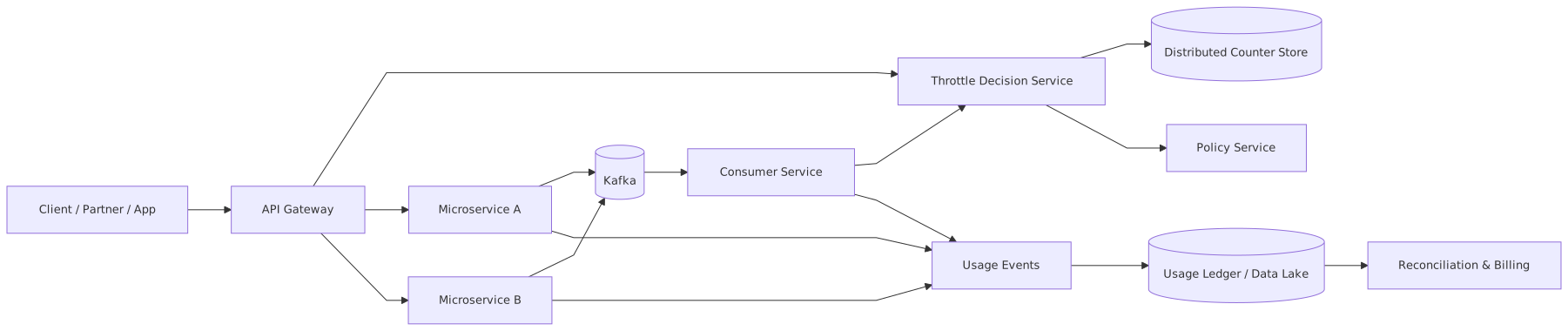
At first glance, this looks centralized because there is a throttle decision service. In reality, the service should be logically centralized, not physically singular. Think of it as the authoritative policy interpreter with horizontally scalable decision nodes and distributed state.
Core components
Policy Service
This owns throttle policies:
- tenant plans
- operation classes
- burst rules
- exemptions
- grace thresholds
- channel-specific limits
- downstream dependency caps
Policies should be versioned. Every decision should ideally include the policy version used. That small detail becomes gold during disputes and incident reviews.
Throttle Decision Service
This evaluates requests against policies and available allowance. It may expose APIs such as:
authorizeConsumption(tenant, operation, cost, attributes)reserveTokens(...)releaseReservation(...)queryRemainingAllowance(...)
For Kafka consumers and async jobs, the same capability can be embedded in workers or exposed via a sidecar/library. The point is consistent semantics, not one network hop in every case.
Counter Store
This is the fast state layer. Redis is a common choice. So are Aerospike, Hazelcast, DynamoDB with careful design, or region-local in-memory stores with replication. The choice depends on throughput, latency, and failure tolerance.
Use this store for near-real-time counters, buckets, windows, and quota reservations. Do not confuse it with the authoritative usage ledger.
Usage Ledger
An immutable event log or analytical store records accepted, rejected, retried, deferred, and reconciled usage. Kafka is often the transport here. Consumers project events into a durable ledger for reporting, billing, and audit.
This ledger is where you resolve “what actually happened,” not merely “what was tentatively allowed.”
Reconciliation Engine
This compares decision-time counters with actual consumption events. It handles:
- duplicate suppression
- refunding abandoned reservations
- correcting overcounted retries
- attributing async fan-out to original tenant/account
- generating compensation adjustments
- feeding billing and compliance reports
That sounds unglamorous. It is also the difference between a controlled platform and a monthly argument.
Synchronous throttling flow
For inbound APIs:
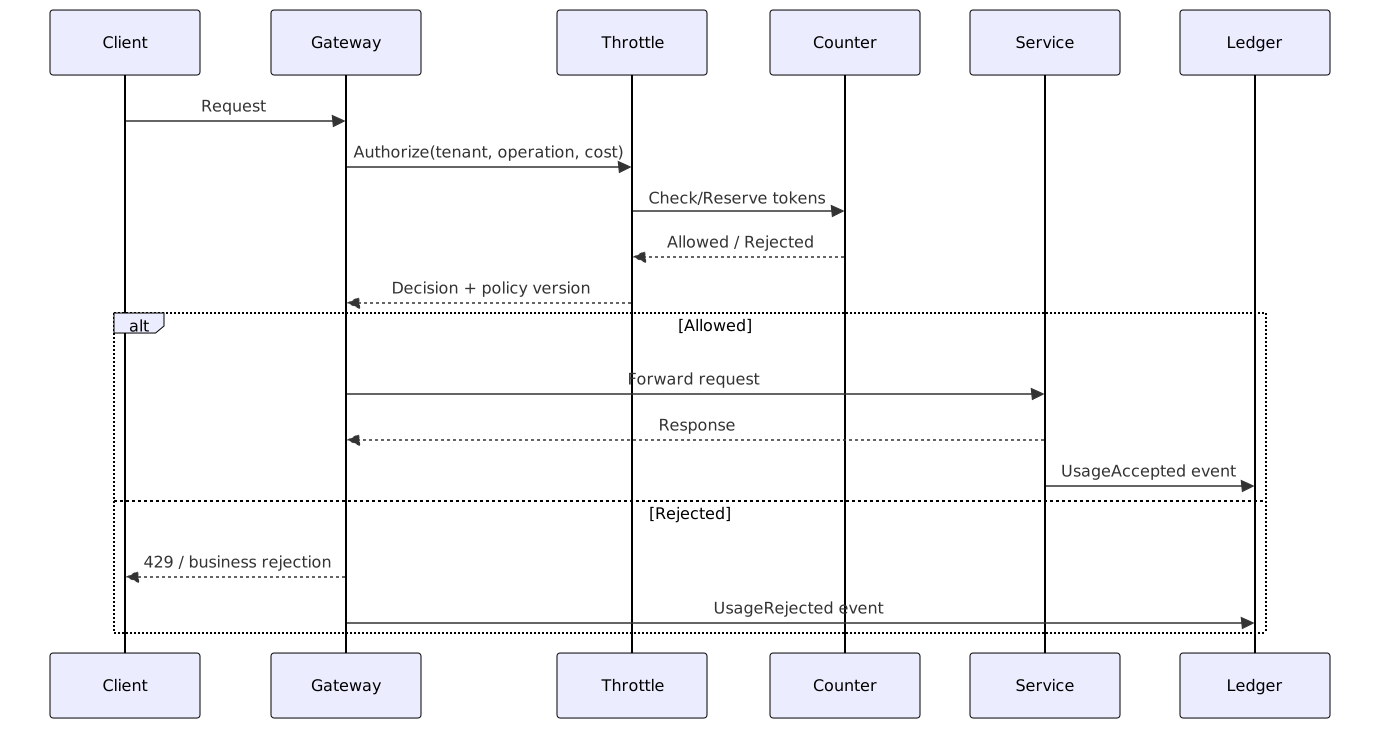
The key design choice here is whether you count at admission time, completion time, or both. Admission-time counting protects capacity. Completion-time counting improves billing correctness. In many enterprises you need both: reserve on admission, settle on completion.
Kafka and asynchronous flows
Microservices rarely stop at synchronous APIs. That is where naive throttling breaks down.
Suppose an order API accepts a request and publishes OrderCreated to Kafka. Three consumer groups process it: fraud, fulfillment, analytics. Which part of that consumption counts against the tenant? Is the internal fan-out free? Is analytics exempt? Do retries count? What about replaying a topic after a consumer bug fix?
These are domain questions, not infrastructure questions.
A useful pattern is to distinguish:
- Client-attributable consumption: what the customer should be charged or limited for.
- Internal processing load: what the platform must protect operationally.
- Recovery and replay traffic: what should be throttled for safety but excluded from contractual usage.
Then build separate policies.
For Kafka consumers, throttling often means controlling poll rates, concurrency, partition consumption, or downstream dispatch volume. The consumer may ask the throttle capability before processing a message or before invoking a scarce downstream dependency.
A common architecture is to emit usage intent and completion events into Kafka, then let stream processors maintain near-real-time aggregate views. This gives a path toward distributed global awareness without forcing every runtime decision through a single serialized bottleneck.
Domain semantics discussion
Here is the architectural line that matters: throttling units must match business meaning.
If your pricing model is “per invoice submitted,” then counting HTTP requests is wrong. One bulk API call may contain 10,000 invoices. If your entitlement is “per settlement batch,” throttling at endpoint level may either over-limit or under-protect. If your fraud service has a limit “per account under investigation,” tenant-wide quotas are semantically poor.
This is why I prefer introducing domain concepts such as:
ConsumptionUnitAllowancePolicyBurstWindowReservationSettlementExemptionRuleUsageAdjustment
Those names are not decoration. They stop infrastructure concerns from swallowing the language of the business.
Migration Strategy
Nobody sensible introduces fully distributed throttling in one heroic release. This is strangler fig work: incremental, defensive, and boring in the best way.
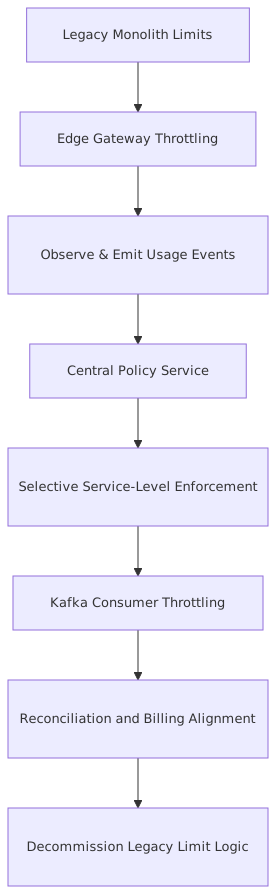
Step 1: Start at the edge
Introduce coarse throttling at the API gateway or ingress controller. Do not aim for perfect semantics yet. Aim for blast-radius reduction. Tenant-level burst protection, IP abuse control, and broad endpoint classes are enough to begin.
Step 2: Emit usage events before enforcing deeply
Many teams skip observability and jump into hard enforcement. That is reckless.
First, instrument services and gateways to emit usage events with the attributes you will later need:
- tenant
- operation type
- channel
- request id / correlation id
- policy candidate
- cost units
- outcome
- retry marker
- region
Build dashboards. Compare perceived versus actual usage. You will discover hidden traffic paths, duplicate retries, and weird partner behavior.
Step 3: Externalize policy
Move plan definitions and limits out of service code. Introduce a policy service, even if enforcement still happens mostly at the gateway. This creates a seam for future strangling.
Step 4: Introduce service-level throttling for high-value domains
Do not blanket every service. Target where semantics matter most:
- expensive operations
- noisy multi-tenant workloads
- downstream legacy protections
- premium entitlements
This is where domain-level cost models can replace crude request counts.
Step 5: Add Kafka consumer throttling
Once your async topology matters operationally, add controls in consumers, workers, and schedulers. Limit concurrency and dispatch to fragile dependencies. Track replay and recovery traffic separately.
Step 6: Add reconciliation
Only after event instrumentation is reliable should you put reconciliation in place for allowances, billing, or compliance reporting. This phase often uncovers mismatches between “allowed” and “completed” usage. Good. Better in migration than in a contract dispute.
Step 7: Retire duplicated legacy logic
Monoliths often have hidden throttles in code, DB procedures, job schedulers, and support scripts. Remove them carefully. The most dangerous architecture is one with three overlapping throttling systems that disagree.
Migration reasoning
The reason for progressive migration is simple: throttling changes customer experience under stress. It is not merely internal refactoring. Hard cutovers create false positives, support escalations, and executive attention.
A strangler approach lets you compare old and new decisions in shadow mode. You can log “legacy allowed, new would reject” and “legacy rejected, new would allow” long before customers feel it. That comparison is the architecture’s conscience.
Enterprise Example
Consider a large retail bank modernizing its payments platform.
The bank exposes payment initiation APIs to mobile apps, branch systems, corporate channels, and third-party partners. Behind the APIs sits a mix of microservices and older assets: a mainframe-based ledger, a sanctions screening engine, and a payments hub with fixed throughput characteristics. Kafka is used heavily for event propagation, audit, and workflow orchestration.
The first-generation throttling design lived at the API gateway: requests per minute per client application. It looked sensible. It also failed almost immediately.
Why?
Because the business did not care about “requests.” It cared about:
- payments per corporate customer
- sanctions checks per legal entity
- file uploads containing thousands of payments
- urgent versus non-urgent payment classes
- branch-originated traffic exempt from some partner controls
- replay traffic after downstream outages
- premium corporate contracts with guaranteed burst windows
Worse, asynchronous flow changed the load profile. One payment submission could generate sanctions screening, fraud scoring, notification events, reconciliation entries, and reporting updates. Gateway throttling protected the front door while the building caught fire in the back.
The bank reorganized the design around bounded contexts.
- A Commercial Entitlements context defined customer plans, partner contracts, premium burst rights, and channel exemptions.
- A Traffic Governance context made real-time admission decisions at API and worker boundaries.
- A Usage Ledger context recorded chargeable and non-chargeable consumption.
- A Settlement & Reconciliation context corrected reservations and handled disputes.
At runtime, the API gateway performed coarse admission checks. Payment service performed semantic checks based on payment count and type, not request count. Kafka consumers for sanctions and fraud used local concurrency controls and dependency-specific quotas. The mainframe ledger sat behind a protective throttle with regional token allocation to avoid one region starving another.
The bank accepted an important tradeoff: hard global consistency was impossible at the latency target. So each region received quota slices for short intervals. Small overshoots were tolerated and reconciled later. This was not a bug. It was an explicit design decision with known error bounds.
The result was better than the original gateway-only model in three ways:
- premium corporate customers got predictable service,
- downstream legacy systems stopped being overwhelmed by bursty fan-out,
- billing and operational reporting finally used the same usage facts.
That last one mattered more than anyone expected. Once finance, operations, and product management were reading from the same usage ledger, arguments got shorter.
Operational Considerations
A throttling system is production gear. Treat it like one.
Metrics that matter
Do not stop at “requests rejected.”
Track:
- allowed, rejected, deferred counts by tenant and operation
- decision latency
- counter store latency and error rates
- token bucket fill levels
- policy cache hit rates
- Kafka consumer lag under throttled conditions
- reservation-to-completion settlement ratios
- reconciliation adjustments over time
- fail-open versus fail-closed incidents
- top noisy tenants and top expensive operations
Runbooks
Your operators need explicit playbooks for:
- counter store degradation
- regional partition or network split
- policy rollout rollback
- accidental over-throttling of premium tenants
- Kafka replay storms
- downstream dependency saturation
- stale policy caches
- reservation leaks after service crashes
If the runbook says “consult engineering,” the architecture is unfinished.
Fail-open or fail-closed
This decision must be per domain.
- Fail-closed makes sense for costly, regulated, or dangerous operations: payments, fraud-sensitive actions, expensive AI inference, partner abuse prevention.
- Fail-open may be acceptable for low-risk reads, internal telemetry, or customer-facing flows where availability is prioritized over precise control.
A single global choice is usually wrong.
Policy rollout
Version your policies and roll them out gradually. A bad throttling policy is effectively a production outage with legal overtones. Canary releases are not optional here.
Time windows and clocks
Sliding windows and time-based quotas depend on clocks. Cross-region skew, daylight savings surprises in reporting layers, and inconsistent time truncation can cause ugly bugs. Standardize on UTC and test boundary conditions obsessively.
Reconciliation cadence
Not every system needs real-time financial-grade settlement. Some need hourly corrections, others daily, others end-of-billing-cycle. Choose cadence based on business risk, not technical elegance.
Tradeoffs
There is no free lunch in distributed throttling. Only better bills.
Centralized accuracy vs decentralized speed
A central quota store improves consistency and simplicity of reasoning. It also becomes a latency tax and potential hotspot. Local quotas and caches improve speed and resilience but introduce drift.
Hard limits vs soft limits
Hard limits are safer and fairer. They also create brittle customer experiences around boundaries. Soft limits with grace bands improve usability but can overshoot capacity if not monitored.
Uniform platform capability vs domain-specific logic
A generic throttling platform is reusable. It is also often semantically weak. Domain-specific throttles fit the business better but can fragment. The sweet spot is shared infrastructure with domain-specific cost models and policy vocabularies.
Real-time enforcement vs after-the-fact correction
Real-time control protects systems. Reconciliation protects truth. Mature enterprises use both. Teams that insist on only one usually end up improvising the other later under stress.
Simplicity vs completeness
You can build a simple token bucket in a week. You can build enterprise-grade distributed throttling over months. The trick is knowing when the week-long solution is enough.
Failure Modes
This is where the architecture earns its keep.
Counter store outage
If Redis or equivalent is down, decisioning stalls or becomes unreliable. If everything depends on one store with no degraded mode, throttling turns from protection into outage amplifier.
Split-brain regional quotas
Regions may continue making local decisions during a partition and overshoot the intended global limit. If overshoot is intolerable, your design must pay the latency cost of stronger coordination. Most teams only realize this after production.
Retry storms
Clients and services often retry rejected or timed-out requests aggressively. Without idempotency keys and retry-aware accounting, throttling can count the same intent multiple times and make the storm worse.
Reservation leaks
If you reserve tokens on admission but the service crashes before settlement, capacity can vanish into limbo. Reclaiming stale reservations is essential.
Kafka replay miscounting
Topic replays for recovery or reprocessing can be mistaken for fresh business usage. If replay markers and attribution are weak, both throttling and billing become fiction.
Policy drift
Gateway policy, service policy, and billing rules diverge over time. This is the organizational failure mode, and it is common. Bounded contexts help, but only if ownership is clear.
Noisy observability pipelines
Ironically, the telemetry for usage and throttling can itself create load. If every decision emits verbose events synchronously, your control system becomes a source of pressure.
When Not To Use
Not every architecture needs distributed throttling.
Do not use it when:
- you have a small number of services behind one reliable gateway and simple limits,
- your traffic volumes are modest and a centralized limiter is sufficient,
- your domain semantics do not justify anything beyond coarse rate limiting,
- the cost of occasional overload is lower than the complexity of distributed control,
- your organization lacks the operational maturity to run policy, telemetry, reconciliation, and on-call support coherently.
In those cases, keep it simple. A gateway-based limiter plus queue backpressure and autoscaling may be entirely adequate.
Also, do not use distributed throttling as a substitute for capacity planning, bad client behavior management, or poor service design. If one endpoint performs five seconds of CPU work per call, the answer may be redesign, not more elaborate throttles.
A memorable rule: never build a quota trading system to avoid fixing a bad API.
Related Patterns
Distributed throttling rarely stands alone. It fits with a family of patterns:
- Bulkhead: isolate capacity pools so one workload cannot drown another.
- Circuit Breaker: stop calling unhealthy dependencies; throttling and circuit breaking often cooperate.
- Backpressure: especially in streaming and reactive systems, signal upstream to slow down.
- Queue-based load leveling: absorb bursts asynchronously rather than reject immediately.
- Token Bucket / Leaky Bucket / Sliding Window: classic enforcement algorithms.
- Idempotency Keys: crucial for retries and duplicate suppression.
- Saga / Compensation: useful when admitted work later fails and usage adjustments are needed.
- Strangler Fig Migration: the right way to move from monolithic limits to distributed governance.
- CQRS and Event Sourcing concepts: helpful when separating decision-time state from authoritative usage ledger.
- Policy as Code: useful, but only if it remains understandable to the domain owners.
These patterns are complementary. Together they form a practical language for handling overload without reducing the system to guesswork.
Summary
Distributed throttling in microservices is not a fancy rate limiter. It is a distributed business control system.
That distinction matters.
The successful architectures start with domain semantics: who is consuming what right, under which contract, against which constrained capacity. They separate policy from enforcement. They use layered controls across gateways, services, consumers, and schedulers. They accept local approximation where latency demands it. And they invest in reconciliation because distributed systems always leave a residue of ambiguity.
The migration path should be progressive, not heroic. Start at the edge. Observe first. Externalize policy. Introduce service-level and Kafka consumer controls where the domain demands them. Reconcile. Then retire legacy logic carefully.
The tradeoffs are real: speed versus consistency, fairness versus utilization, simplicity versus semantic correctness. There is no universal answer. But there is a reliable architectural posture: be explicit about the invariants, design for failure, and keep the business language visible in the model.
If there is one line worth remembering, it is this:
In a distributed estate, throttling is how the system says “not now” without forgetting what it owes.
That is the difference between a platform that survives growth and one that merely postpones collapse.
Frequently Asked Questions
What is a service mesh?
A service mesh is an infrastructure layer managing service-to-service communication. It provides mutual TLS, load balancing, circuit breaking, retries, and observability without each service implementing these capabilities. Istio and Linkerd are common implementations.
How do you document microservices architecture for governance?
Use ArchiMate Application Cooperation diagrams for the service landscape, UML Component diagrams for internal structure, UML Sequence diagrams for key flows, and UML Deployment diagrams for Kubernetes topology. All views can coexist in Sparx EA with full traceability.
What is the difference between choreography and orchestration in microservices?
Choreography has services react to events independently — no central coordinator. Orchestration uses a central workflow engine that calls services in sequence. Choreography scales better but is harder to debug; orchestration is easier to reason about but creates a central coupling point.