⏱ 20 min read
Microservices fail in surprisingly ordinary ways. Not because teams cannot write code. Not because Kubernetes is too hard. Usually they fail because the seams between services become a junk drawer of half-decided communication patterns: a little REST here, some Kafka there, a webhook nobody owns, a cron job pretending to be integration, and eventually a distributed system held together by politeness and retries. event-driven architecture patterns
Communication style is not plumbing. It is architecture. It determines how business facts move, how decisions are made, where latency shows up, how failures spread, and whether a domain model remains coherent or dissolves into a gossip network. The choice between synchronous calls, asynchronous messaging, event streaming, and workflow orchestration is not a technical afterthought. It is a statement about business time, coupling, and truth.
This is where many microservices programs drift off course. Teams decompose applications into services but keep the communication model implicit. They draw boxes and arrows, but the arrows all mean different things. A payment authorization request is not the same kind of interaction as “order placed” being published for downstream consumers, yet both often appear as the same line on an architecture diagram. That ambiguity is expensive. It leaks into code, operations, and most painfully into the business.
So let’s be blunt: if you cannot explain why one interaction is synchronous and another is event-driven, you do not yet have a service architecture. You have networked code.
This article lays out the major service communication styles in microservices, explains where each fits, and shows how to reason about them with domain-driven design, migration strategy, and operational reality in mind. We will cover synchronous request-response, asynchronous commands, events, stream processing, and orchestrated workflows. We will also look at reconciliation, progressive strangler migration, Kafka-centered integration, and the very real failure modes that show up once the slide deck meets production.
Context
Microservices are often sold as a modularity story. They are really a coordination story.
A monolith coordinates in memory. A distributed architecture coordinates over time and over failure. Once you split a system into services, every business process becomes a conversation. Inventory reserves stock. Payments authorize funds. Fulfillment books shipment. Notifications tell the customer what happened. The architecture is no longer just about code structure; it is about the shape of those conversations.
This is why domain semantics matter so much. In domain-driven design terms, service boundaries should reflect bounded contexts, not technical layers. If the domain says “pricing calculates an offer,” “ordering captures customer intent,” and “payments authorizes money movement,” then communication between those services must preserve the meaning of those actions.
That last point gets overlooked. People speak loosely about “messages” as if all inter-service traffic were the same. It is not.
- A query asks for information now.
- A command asks another service to do something.
- An event says something already happened.
- A workflow step coordinates multiple actions to reach an outcome.
Those are different beasts. They carry different expectations about timing, ownership, and side effects. A query needs a fresh answer. A command expects one responsible handler. An event may have many consumers and no immediate response. A workflow often needs retries, compensations, timeouts, and a memory of progress.
Once you see communication in domain terms, architecture gets clearer. You stop asking “Should we use Kafka or REST?” and start asking “What is the business interaction here? What timing does it require? Who owns the decision? Can this be eventually consistent? What happens if the receiver is down?”
That is the right conversation.
Problem
The central problem is simple: microservices need to collaborate without becoming entangled. microservices architecture diagrams
That sounds obvious, but the tension is brutal. Business capabilities span multiple services. Customers expect coherent outcomes. Finance expects consistency. Operations expects resilience. Teams expect autonomy. Yet each communication style optimizes for some of these forces and compromises others.
Synchronous APIs are straightforward but couple availability and response time across services. Messaging improves resilience but introduces eventual consistency and operational complexity. Event-driven models scale elegantly for propagation of business facts but can create semantic chaos if events become unstable contracts. Workflow engines offer visibility and coordination but can centralize too much knowledge and create orchestration bottlenecks.
The hard part is not choosing one style. The hard part is composing several styles without creating a distributed mess.
In real enterprises, that mess shows up in familiar symptoms:
- cascading failures caused by service-to-service REST chains
- duplicate business actions due to retries without idempotency
- “event-driven” systems that still rely on hidden synchronous lookups
- Kafka topics used as a dumping ground without clear domain ownership
- integration logic duplicated in multiple consumers
- business reconciliation done manually because no one trusts the data flow
- migration projects that split the monolith but preserve all its coupling over the network
The architecture challenge, then, is to create a communication model that aligns with domain boundaries, tolerates failure, supports evolution, and remains understandable to the people who must run it.
Forces
A useful architecture starts by admitting the forces at play rather than pretending there is one best pattern.
1. Domain semantics
Some interactions are inherently conversational and immediate. A checkout page needs pricing and availability now. Others are naturally asynchronous. “Shipment dispatched” is a business fact that downstream systems can process later.
The domain should drive the style.
2. Temporal coupling
Synchronous communication requires both sides to be alive at the same moment. That is expensive in distributed systems. Asynchronous communication relaxes temporal coupling but shifts complexity into state management and reconciliation.
3. Consistency expectations
Not every business process needs immediate consistency. In fact, many do not. But some decisions are time-sensitive and cannot be deferred. Payment authorization and fraud decisioning often need immediate outcomes. Ledger posting may require durable sequencing. Customer profile updates may tolerate eventual propagation.
4. Team autonomy
If every change requires coordination across six teams because APIs are brittle or events are ambiguous, the microservices promise collapses. Communication styles should support independent evolution.
5. Observability and operability
The more asynchronous the system, the more you need correlation IDs, delivery metrics, dead-letter handling, replay strategy, and business-process observability. Messaging is not free resilience. It is operational debt unless managed deliberately.
6. Legacy migration
Very few enterprises start greenfield. They have monoliths, ESBs, batch interfaces, and vendor platforms. Communication choices must support progressive extraction, not just idealized end-state diagrams.
7. Data ownership
A service should own its data and expose behaviors or facts, not become a remote table. Communication style affects whether services collaborate by asking, by telling, or by publishing business events for others to consume.
Solution
The practical solution is not to standardize on a single communication mechanism. It is to build a style matrix: choose communication style by interaction type, domain semantics, and operational need.
Here is the simplest version of that matrix.
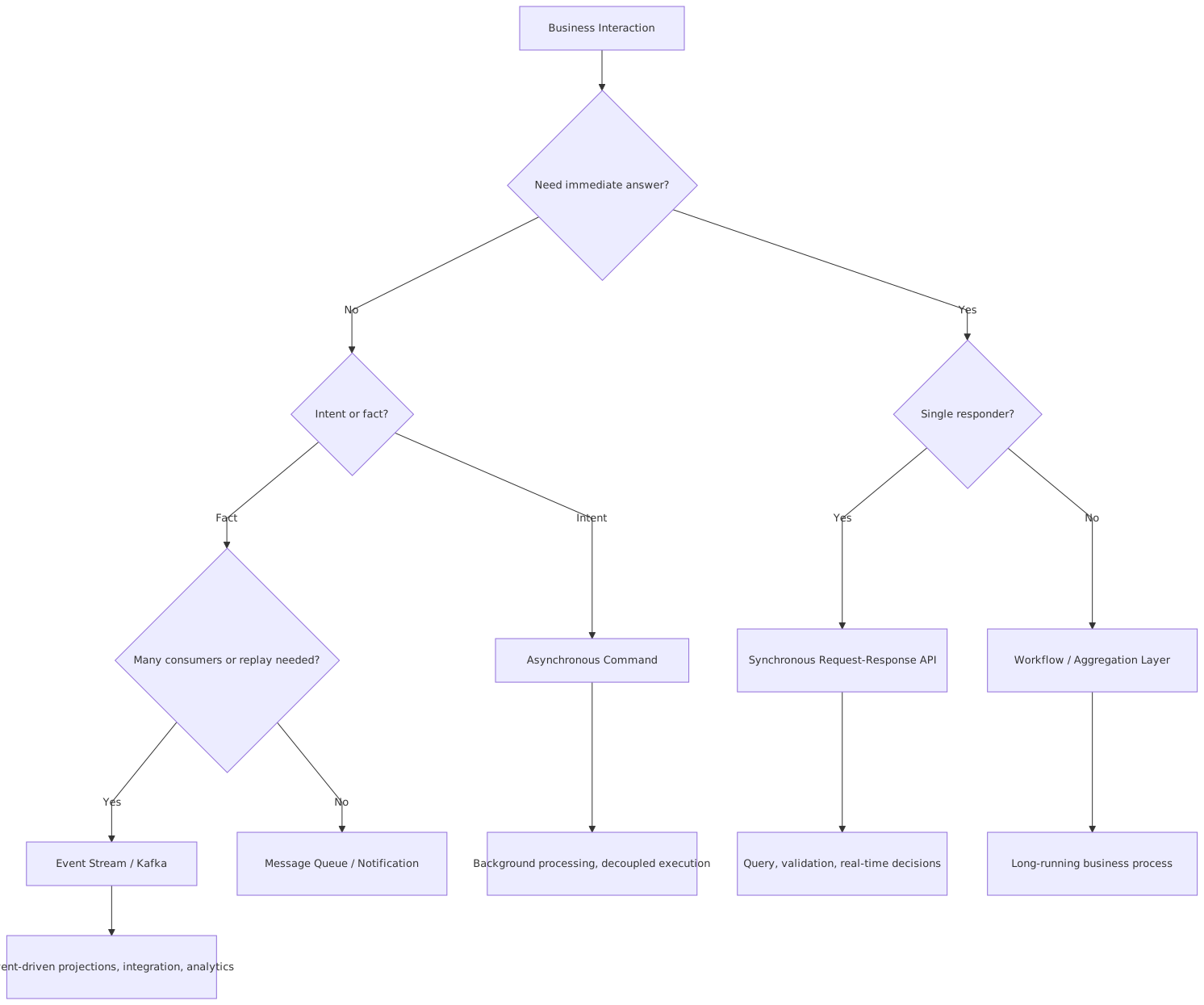
This is opinionated, because enterprise architecture should be.
- Use synchronous request-response for real-time queries and decisions that genuinely require immediate answers.
- Use asynchronous commands when one service wants another to perform work without blocking the caller.
- Use domain events when a service wants to publish facts about completed business state changes.
- Use event streams with Kafka when those facts have multiple consumers, retention value, replay needs, or stream-processing use cases.
- Use workflow orchestration or sagas when the business process spans several services and needs explicit coordination, timeout handling, and compensations.
The mistake is using one style everywhere because a platform team has strong opinions. Real systems are mixed economies.
Architecture
Let’s examine the main communication styles and where they belong.
Synchronous request-response
This is the cleanest pattern to explain and the easiest one to overuse.
A client sends a request, the service responds. Usually HTTP/REST or gRPC. The semantics are immediate: “tell me,” “validate this,” “calculate that,” “reserve now.” This is appropriate when the interaction is fundamentally synchronous from the business perspective.
Good examples:
- price quote at checkout
- fraud scoring during payment authorization
- customer identity validation during onboarding
- querying current account balance
Bad examples:
- notifying downstream systems that an order was placed
- triggering document generation that may take minutes
- cross-domain state propagation
The risk with synchronous communication is hidden dependency chains. Order calls Customer, Inventory, Pricing, Promotions, Tax, Payment, and suddenly one customer action depends on six services and two vendor APIs. This is how elegant diagrams become latency graphs.
Use synchronous APIs sparingly and intentionally. Favor shallow call chains. Keep the semantic contract tight. If a synchronous dependency does not require immediate interaction, it probably should not be synchronous.
Asynchronous command messaging
A command says, in effect, “please do this.” One logical consumer should own it.
Examples:
- “GenerateInvoice”
- “StartKYCReview”
- “AllocateWarehousePick”
- “RepricePortfolio”
This is useful when the caller does not need an immediate answer, or when processing may be slow or bursty. Command messaging decouples availability and smooths load. It also supports background execution and explicit retries.
But commands come with responsibility. They imply intent and ownership. If multiple consumers handle the same command, you are not really sending a command anymore; you are publishing a vague suggestion. That ambiguity hurts.
Domain events
Events are different. They are statements of fact: “OrderPlaced,” “PaymentAuthorized,” “StockReserved,” “PolicyIssued.” They describe something that already happened in the publisher’s bounded context.
This distinction matters deeply in domain-driven design. Events should use the publisher’s language and represent meaningful business occurrences, not technical record changes. “CustomerAddressUpdated” may be fine. “CustomerRowChanged” is architectural laziness.
Events are ideal for:
- propagating business facts
- updating read models
- notifying multiple downstream contexts
- integrating loosely coupled consumers
- driving near-real-time analytics or automation
They are poor for:
- asking for immediate action with a guaranteed response
- cross-service transaction semantics
- hiding a request-response interaction behind async wrappers
Event streaming with Kafka
Kafka fits when event flow becomes strategic rather than incidental.
It is particularly useful where:
- multiple consumers need the same business events
- retained history and replay matter
- throughput is high
- stream processing or materialized views are valuable
- integration spans operational and analytical use cases
- event ordering within a partition is useful
Kafka is not magic. It gives durable log-based transport, consumer independence, and replayability. In exchange, you inherit schema governance, topic design, consumer lag, retention policy, poison-message handling, and a strong need for semantic discipline. EA governance checklist
A Kafka topic should not be a random integration bucket. It should reflect domain intent. “orders.order-placed.v1” is respectable. “enterprise-events-final-2” is a cry for help.
Workflow orchestration and sagas
Some business processes are bigger than a single interaction. Order fulfillment, insurance claims, mortgage origination, telecom service activation—these are long-running, stateful, and full of external dependencies.
Here a saga or workflow engine can make sense. Either:
- orchestration: a central coordinator tells participants what step comes next
- choreography: participants react to events and collectively advance the process
Neither is universally superior. Choreography keeps services autonomous but can become opaque if process logic is scattered through event handlers. Orchestration improves visibility and control but can centralize too much process knowledge.
My rule of thumb: when the process is long-lived, regulated, timeout-heavy, or compensation-heavy, explicit orchestration earns its keep.
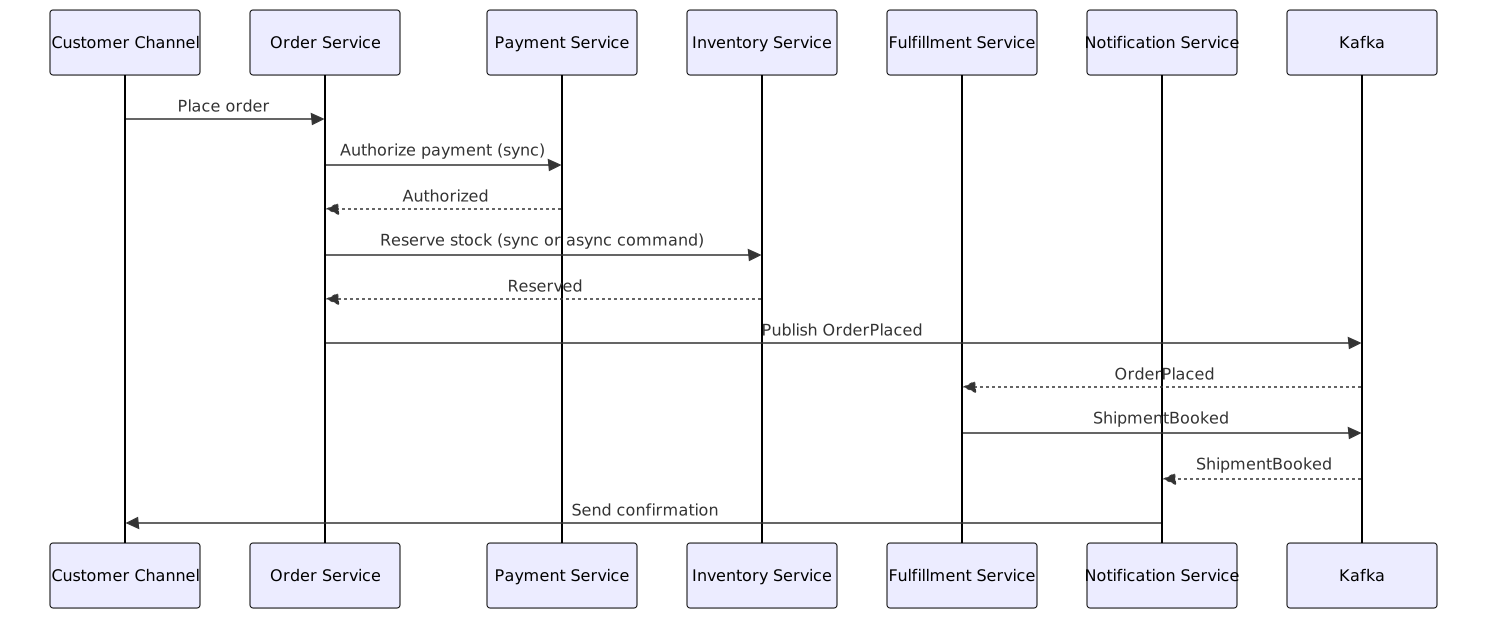
The diagram shows the mixed model that most healthy systems end up with: synchronous calls for immediate decisions, events for fact propagation, and asynchronous downstream handling for everything that does not belong in the customer’s critical path.
The style matrix
A concise way to reason about this in architecture reviews is to classify interactions by semantic type.
This matrix is not a standards document. It is a reasoning tool.
Migration Strategy
The hardest architecture decision is not the target state. It is how to get there without setting the building on fire.
For enterprises moving from monoliths or ESBs, progressive strangler migration is usually the sensible path. You do not replace every interaction style at once. You extract business capabilities gradually, preserve system behavior, and shift communication semantics one seam at a time.
Step 1: identify bounded contexts, not just modules
Do not begin with technical decomposition. Begin with domain mapping. Which parts of the business have distinct language, policies, data ownership, and rate of change? Order management, pricing, billing, customer profile, fraud, inventory—these are not just modules; they are candidate bounded contexts.
That matters because communication style follows ownership. If you carve services at the wrong seams, no protocol will save you.
Step 2: front the monolith with an anti-corruption layer
Expose a controlled facade around legacy behavior. This gives new services a stable contract while insulating them from the monolith’s internal data model.
Step 3: extract read-heavy capabilities first
Queries and read models are often the safest first move. Create APIs or materialized views that serve specific domain use cases. This reduces direct database sharing and begins to establish service contracts.
Step 4: publish events from the monolith carefully
This is where Kafka often becomes useful. Add an outbox pattern or change-driven publication mechanism so the monolith can emit stable business events such as OrderPlaced or InvoiceIssued. Do not publish raw table changes and call it event-driven architecture. That shortcut creates downstream semantic debt.
Step 5: move commands and ownership gradually
As new services become authoritative for a capability, redirect commands to them. During transition, the monolith and new services may coexist, with the anti-corruption layer routing requests based on business scope or tenant.
Step 6: introduce reconciliation early
This is not glamorous, but it is essential. In migration, dual writes, event delays, and partial failures happen. Build reconciliation jobs and dashboards from the beginning. If Order says shipped and Billing says not invoiced, someone needs to know before quarter close.
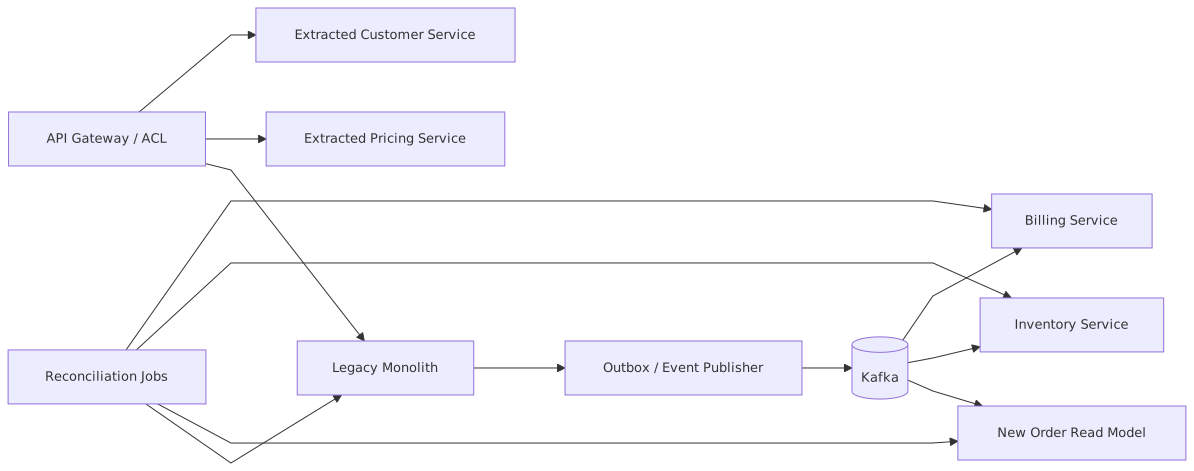
This is the real shape of migration: coexistence, translation, and verification.
Reconciliation is architecture, not housekeeping
Many teams treat reconciliation as an embarrassing afterthought. That is a mistake.
In asynchronous and event-driven systems, reconciliation is how you restore trust. Delivery can fail. Consumers can be down. Handlers can be buggy. External providers can return inconsistent results. Reconciliation closes the loop by periodically comparing authoritative sources and correcting divergence.
Typical reconciliation patterns:
- compare source-of-truth events with downstream projections
- detect missing state transitions
- rebuild read models by replaying Kafka topics
- issue compensating commands for orphaned processes
- flag business exceptions for manual review
If your architecture depends on eventual consistency, it must also define eventual certainty.
Enterprise Example
Consider a global retail bank modernizing its lending platform.
The legacy world is familiar: a large loan-origination system, nightly batch feeds to risk and finance, a customer master with brittle SOAP interfaces, and a reporting warehouse updated hours later. The business wants faster product launches, real-time application tracking, and better resilience during peak campaigns.
A simplistic microservices rewrite would be catastrophic. Lending is not one thing. It spans customer onboarding, application capture, credit decisioning, document generation, disbursement, repayment schedules, and finance posting. The domain is full of policy and regulation. Communication style matters because every interaction carries business meaning.
The bank begins by defining bounded contexts:
- Customer Profile
- Loan Application
- Credit Decisioning
- Document Management
- Disbursement
- Loan Account Servicing
- Finance Posting
Now the communication model becomes clearer.
- Application capture needs synchronous APIs for customer-facing journeys.
- Credit decisioning uses synchronous calls for instant decisions where possible, but falls back to asynchronous review commands for edge cases.
- When an application is submitted, the Loan Application service publishes
ApplicationSubmitted. - Kafka distributes that event to Document Management, analytics, fraud monitoring, and operational dashboards.
- Disbursement is initiated by an asynchronous command once underwriting and compliance checks are complete.
- Finance Posting consumes
LoanDisbursedevents and creates accounting entries, with strong idempotency and reconciliation against the core ledger. - A workflow engine coordinates long-running exceptions such as manual review, missing documents, and timeout escalation.
During migration, the old origination system remains in place. The new Loan Application service fronts portions of the journey while an anti-corruption layer translates to legacy SOAP operations when necessary. Events are published from both legacy and new paths through an outbox strategy, with schema governance to maintain stable domain contracts. ArchiMate for governance
This is where reconciliation becomes existential. A loan marked disbursed in the servicing domain but missing in finance is not a technical defect; it is a regulatory incident waiting to happen. The bank implements:
- daily and near-real-time reconciliation between
LoanDisbursedevents and ledger postings - replay capability from Kafka for failed finance consumers
- exception queues for manual financial control
- correlation IDs across customer, application, disbursement, and accounting flows
The result is not “everything event-driven.” It is a mixed communication model grounded in business semantics. And that is why it works.
Operational Considerations
Patterns on whiteboards are cheap. Operability is where architecture earns its keep.
Idempotency
Retries are inevitable. Every command handler and event consumer that can cause side effects should be idempotent. Otherwise a transient network fault becomes duplicate shipment, duplicate invoice, or duplicate payment attempt.
Correlation and tracing
Distributed communication must carry correlation IDs across sync and async boundaries. Without this, support teams cannot answer the most basic production question: “What happened to this customer’s order?”
Schema evolution
Event contracts and APIs evolve. Use versioning carefully. Prefer additive changes where possible. Breaking event consumers because one team renamed a field is an avoidable own goal.
Backpressure and consumer lag
Kafka gives you independence, but it also gives you lag. During traffic spikes, some consumers will fall behind. Design for that. Know which processes can tolerate delay and which need scaling or isolation.
Dead-letter and poison-message handling
Messages that repeatedly fail need quarantine and diagnostics. Do not let a single malformed payload silently stall a partition or flood the retry loop.
Security and compliance
Communication style affects security posture. Events may propagate sensitive data widely. Token propagation in synchronous chains creates its own hazards. Data minimization matters. So does auditability.
Observability at the business level
Technical metrics are not enough. You need process-level signals:
- orders placed vs shipped
- payments authorized vs captured
- loans disbursed vs posted to ledger
- claims approved vs paid
Architecture should make these flows visible.
Tradeoffs
There is no free lunch in distributed systems. Only differently priced lunches.
Synchronous APIs
Pros
- simple mental model
- immediate feedback
- easy for request/response use cases
Cons
- temporal coupling
- cascading latency
- availability dependency
- difficult to scale cross-service critical paths
Asynchronous commands
Pros
- decoupled timing
- load smoothing
- natural for background work
Cons
- harder debugging
- retries and idempotency required
- caller needs status tracking if outcome matters
Domain events
Pros
- loose coupling
- natural propagation of business facts
- multiple consumers possible
Cons
- eventual consistency
- semantic drift if events are poorly defined
- hidden dependencies if consumers start expecting synchronous guarantees
Kafka / event streams
Pros
- durable retention
- replay
- high throughput
- independent consumers
- good fit for stream processing and materialized views
Cons
- operational complexity
- topic sprawl
- partitioning and ordering constraints
- schema governance burden
Orchestration/workflows
Pros
- explicit process visibility
- timeout and compensation support
- better for long-running regulated flows
Cons
- central process coupling
- potential bottleneck
- risk of embedding too much domain logic in the orchestrator
A mature architecture uses these consciously, not ideologically.
Failure Modes
Distributed systems do not merely fail; they fail sideways.
The REST call chain disaster
A customer request triggers a deep synchronous chain. One slow dependency raises latency everywhere. Timeouts trigger retries. Retries amplify load. Soon a minor downstream issue becomes a visible outage.
Event soup
Teams publish events without clear domain semantics or ownership. Topics multiply. Consumers infer behavior from payload quirks. Nobody knows which events are canonical. Change becomes political.
Fake eventual consistency
An architecture is labeled asynchronous, but critical flows still depend on immediate downstream processing. The result is the worst of both worlds: operational complexity without true decoupling.
Duplicate side effects
At-least-once delivery meets non-idempotent handlers. Customers get duplicate emails at first, then duplicate shipments, then finance notices duplicate settlements. The mood deteriorates quickly.
Orphaned business processes
A long-running saga loses a message, times out badly, or misses compensation. The customer sees “processing,” operations sees nothing, and the business process is stranded between states.
Reconciliation-free optimism
Teams assume events are enough and skip reconciliation. Months later reporting, finance, and operations disagree about reality. Trust evaporates.
The point is not to fear these failures. The point is to design for them.
When Not To Use
Microservices communication patterns are powerful, but they are not always justified.
Do not adopt a rich palette of communication styles when:
- the domain is small and cohesive enough for a modular monolith
- team structure cannot support independent service ownership
- operational maturity is low
- the business does not need independent scaling or release cadence
- data consistency requirements strongly favor single-process transactions
- the organization is mainly chasing fashion
Likewise, do not use Kafka because “event-driven” sounds modern. If you have a handful of services, limited throughput, and no replay or stream-processing need, a simpler queue or even direct APIs may be entirely adequate.
And do not orchestrate every interaction. If a process is short, local, and naturally transactional within one service boundary, keep it there. Architecture is partly the art of not distributing what does not need to be distributed.
Related Patterns
Several patterns commonly travel with service communication decisions.
- API Gateway: useful at the edge for channel-specific composition and security, but not a substitute for proper service design.
- Backend for Frontend: helpful when different client experiences need tailored aggregation.
- Outbox Pattern: critical when publishing domain events reliably from transactional systems.
- Saga Pattern: coordinates multi-service business processes with compensations.
- CQRS: often paired with event-driven communication to build read models optimized for queries.
- Anti-Corruption Layer: essential in migration to isolate new services from legacy models.
- Bulkhead and Circuit Breaker: protect synchronous interactions from cascading failures.
- Materialized Views: common with Kafka and stream processing to avoid live fan-out query chains.
These patterns are not a bag of Lego bricks. They work when assembled around clear domain boundaries and communication semantics.
Summary
Communication style is one of the decisive design choices in microservices because it shapes coupling, consistency, resilience, and team autonomy. The right question is never simply “REST or Kafka?” The right question is: what is the business interaction, who owns it, how quickly must it complete, and what happens when part of the system is unavailable?
Use synchronous APIs for immediate queries and decisions. Use asynchronous commands for delegated work. Use domain events to publish facts. Use Kafka where event flow needs durable streaming, replay, and multiple consumers. Use workflows or sagas for long-running, compensating business processes.
Anchor those choices in domain-driven design. Let bounded contexts define who speaks and what they mean. During migration, use a progressive strangler approach, publish stable domain events through an outbox, and build reconciliation from the start. Because in enterprise systems, eventual consistency without eventual verification is just wishful thinking.
A good service architecture is not one where every arrow looks modern. It is one where every arrow means something precise.
That is the bar.
Frequently Asked Questions
What is a service mesh?
A service mesh is an infrastructure layer managing service-to-service communication. It provides mutual TLS, load balancing, circuit breaking, retries, and observability without each service implementing these capabilities. Istio and Linkerd are common implementations.
How do you document microservices architecture for governance?
Use ArchiMate Application Cooperation diagrams for the service landscape, UML Component diagrams for internal structure, UML Sequence diagrams for key flows, and UML Deployment diagrams for Kubernetes topology. All views can coexist in Sparx EA with full traceability.
What is the difference between choreography and orchestration in microservices?
Choreography has services react to events independently — no central coordinator. Orchestration uses a central workflow engine that calls services in sequence. Choreography scales better but is harder to debug; orchestration is easier to reason about but creates a central coupling point.