⏱ 19 min read
There is a particular kind of lie enterprise systems tell with a straight face.
A user changes an address, clicks save, gets a cheerful success message—and then opens another screen and sees the old address staring back at them. Nothing is technically broken. The write succeeded. The data is moving. Messages are in flight. Caches are warming. Projections are rebuilding. But from the user’s point of view, the system has lost its mind.
This is the reality of distributed reads in microservices. Not corruption. Not failure in the dramatic sense. Just delay with consequences. A write enters one bounded context, then takes a journey through brokers, outboxes, consumers, read models, caches, replicas, search indexes, and APIs before the whole estate agrees on what just happened. That gap is the consistency window.
Most teams discover this the hard way. They split a monolith, introduce Kafka, add read-optimized services, and congratulate themselves on decoupling. Then the support tickets arrive. “Why does billing show one thing and customer profile show another?” “Why did fraud approve based on stale status?” “Why does the portal take ten seconds to catch up after I press save?” The architecture works exactly as designed. The design just didn’t take the consistency window seriously enough.
This is not a theoretical concern. It is a domain concern. If a shipping address takes five seconds to appear everywhere, perhaps nobody cares. If a credit hold takes five seconds to propagate before order capture checks it, you have invented a financial control weakness. Architecture is not about moving boxes around a diagram. It is about deciding which delays are tolerable in which business moments.
That is the central question here: how do we design distributed read paths in microservices so that write propagation delay is explicit, bounded, observable, and aligned to domain semantics? microservices architecture diagrams
The answer is not “make everything strongly consistent.” That answer usually means “rebuild a monolith, but slower.” The answer is to understand where consistency matters, where staleness is acceptable, how propagation actually happens over time, and how to shape user journeys and service contracts around those truths.
Context
Microservice estates rarely read from a single source of truth. They read from many truths, each optimized for a purpose.
A customer change may be written in a Customer service, published via an outbox, distributed over Kafka, consumed by Billing, CRM, Fraud, Search, and Analytics, and then exposed through several APIs and UI composites. Along the way, the data might be denormalized into a document store, copied into a search index, projected into a dashboard table, cached at the edge, and replicated to a reporting database. Every hop adds latency. Every optimization creates another version of reality.
This is why “eventual consistency” is too soft a phrase. It sounds like a philosophical principle. Architects need something more operational: a write propagation timeline. When did the source commit? When was the event published? When did downstream consumers process it? When did the read model become queryable? When did the cache expire? When did the UI finally show the new state?
Once you view the system through that lens, consistency becomes a timed window, not a binary attribute. A service is not simply “eventually consistent”; it is “usually consistent within 800 milliseconds for profile updates, but up to 20 seconds during replay, and never guaranteed across this composite query.” That is architecture you can govern.
Domain-driven design helps here because it insists on respecting bounded contexts. The mistake is often not that data is delayed, but that teams expect one bounded context to mirror another in real time for no good domain reason. A Customer context and a Billing context may share identifiers and selected facts, but they do not share one universal state machine. Treating them as if they should instantly agree on every field is how teams build brittle coupling under the banner of consistency.
Problem
The core problem is simple to state and difficult to tame: a write committed in one service is read at different times, in different forms, by other services and users.
A distributed write path might look fast in happy-path demos:
- Command accepted
- Transaction committed
- Event emitted
- Consumers update projections
- Reads reflect new state
But real systems add friction at every step:
- the message broker may delay delivery
- consumers may lag
- projections may batch updates
- caches may still serve old responses
- replicas may be behind primaries
- search indexing may be asynchronous
- composite APIs may call services that are each at different points in the timeline
So the user sees a strange patchwork: one screen updated, another stale, a search result lagging, a report missing the change. In enterprise settings, this is not merely awkward. It can produce duplicate actions, false escalations, incorrect eligibility decisions, compliance breaches, and expensive manual reconciliation.
The architectural sin is pretending all reads are equal. They are not.
Some reads are decision reads. They drive commands, approvals, pricing, risk checks, and legal obligations. These need fresh-enough data, sometimes from the system of record, sometimes with explicit version checks.
Some reads are observational reads. Dashboards, activity feeds, search results, and summaries can tolerate lag if users understand it.
Some reads are collaborative reads. A user writes something and expects to see their own change reflected immediately, even if the rest of the estate is still catching up. Read-your-own-write matters because trust matters.
If you fail to classify reads by semantic importance, you end up overengineering the harmless and underprotecting the dangerous.
Forces
Several forces pull against each other.
Autonomy versus coherence
Microservices promise team autonomy, local data ownership, and independent deployment. That naturally creates asynchronous propagation and divergent read models. But the business still wants a coherent customer journey. The architecture must let services own their data without making the enterprise feel schizophrenic.
Throughput versus freshness
Kafka, event-driven processing, and materialized views are excellent for throughput and decoupling. They are less excellent at guaranteeing immediate cross-service visibility. You can reduce lag, but at a cost in infrastructure, coupling, and operational complexity.
Domain truth versus integration copies
In domain-driven design, each bounded context maintains its own model. Downstream services often store translated copies of upstream facts. Those copies are useful and dangerous. Useful because they enable local decisions and resilient reads. Dangerous because they become stale, semantically drift, and tempt teams into using borrowed data as if it were authoritative.
User trust versus system reality
People do not care that your outbox pattern is elegant. They care that they changed a limit, got confirmation, and then saw the old limit elsewhere. Systems that are technically correct but experientially inconsistent are still poor systems.
Recovery versus immediacy
Batching, replayable event streams, and asynchronous projections give superb recoverability. You can rebuild read models, backfill indexes, and recover consumers. But rebuildability often increases the consistency window. That’s a tradeoff worth making in many domains, provided it is intentional.
Solution
The practical solution is to make the consistency window a first-class architectural concept and design read behavior around domain semantics rather than infrastructure optimism.
That means five things.
1. Model propagation explicitly
Do not hide write propagation behind vague words like “async.” Map the timeline. Define the stages from command acceptance to query visibility. Measure each stage. Publish service-level objectives not just for API response times, but for projection freshness where it matters.
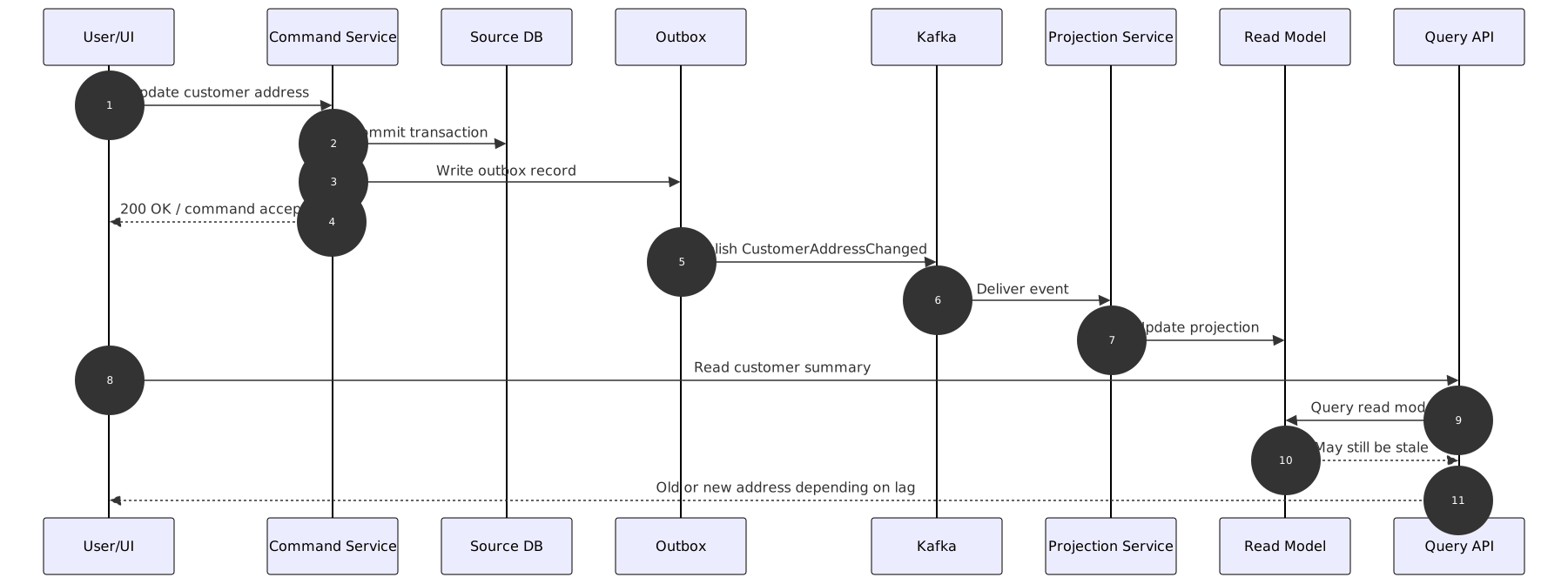
This is the write propagation timeline in one picture. The important point is brutal and obvious: “write committed” and “read updated” are different moments.
2. Separate read semantics by business criticality
Not every consumer deserves the same freshness guarantee. Create categories:
- Authoritative reads: must consult the source of record or a synchronously validated path
- Fresh-enough reads: can use projections if lag remains within a domain threshold
- Eventually consistent reads: dashboards, search, analytics, non-critical summaries
This is where domain-driven design earns its keep. The domain tells you which category a read belongs to. Architects should not make that call from infrastructure dogma alone.
For example:
- Available credit before order release is authoritative.
- Customer contact details in a CRM summary are fresh-enough.
- Search results for customer profiles are eventually consistent.
3. Design for read-your-own-write where trust matters
A user who just changed something often expects immediate local confirmation. This does not require global strong consistency. It requires a targeted pattern.
You can:
- route the user’s next read to the primary source for a short window
- return the new representation directly in the command response
- store a version token and prefer sources at or beyond that version
- show pending state in the UI until projections catch up
This small concession prevents a huge amount of confusion.
4. Bound the lag operationally
Consistency windows that are merely “eventual” become ungovernable. Set targets. Examples:
- Customer profile projection freshness: p95 under 2 seconds
- Search indexing delay: p95 under 15 seconds
- Credit hold propagation to order capture: under 500 milliseconds or fallback to source validation
If the window exceeds threshold, the system should degrade intentionally. That might mean bypassing a cache, querying an authoritative service, disabling a non-critical read model, or marking a result as stale.
5. Reconcile continuously
Distributed reads drift. Events get delayed, consumers fail, poison messages stall partitions, schemas evolve badly, and projections become inconsistent. Reconciliation is not a cleanup activity for after go-live. It is part of the design.
Reconciliation includes:
- replayable event streams
- projection rebuilds
- periodic comparison between source and read model
- semantic checks on critical fields
- dead-letter handling with domain-aware repair
Eventually consistent systems without reconciliation are simply eventually wrong.
Architecture
A solid pattern for distributed reads in microservices usually combines a transactional write, reliable event publication, local projections, and explicit freshness handling.
The write side should avoid dual writes. If a service updates its database and publishes to Kafka separately, you have built a race with no referee. Use the outbox pattern or equivalent transactional messaging. The source transaction commits business state and an integration event record together. Publication can be asynchronous because reliability matters more than immediate fan-out. event-driven architecture patterns
Downstream services consume events and update their own read stores. These read stores are not mini source systems; they are fit-for-purpose projections. They should contain the minimum data needed for local queries and decisions. Copy less. Translate carefully. Name borrowed concepts honestly.
This is where bounded contexts save you from semantic sludge. A Customer service might publish CustomerRelocated, but a Billing service should not necessarily store an exact clone of the customer aggregate. It may only need billing address and tax jurisdiction. If you flood downstream services with generic “entity changed” events and broad replicated payloads, you get accidental shared models dressed up as eventing.
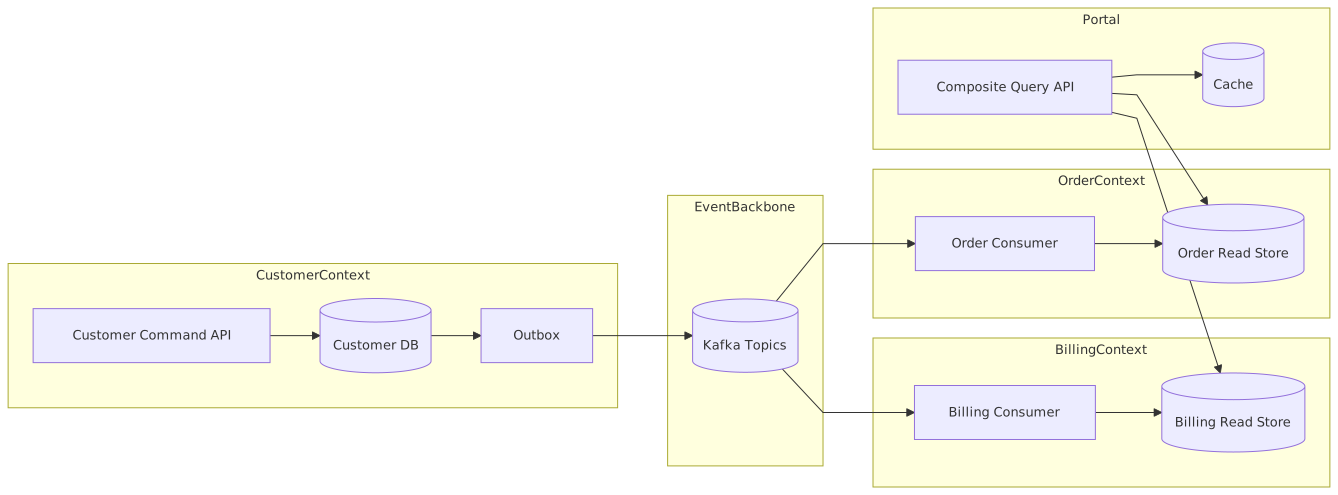
This kind of architecture works well because it keeps writes local and reads optimized. But it also creates multiple consistency windows:
- source to Kafka
- Kafka to consumer
- consumer to read store
- read store to cache
- cache to user
The architecture should make those windows visible.
A useful refinement is version-aware reads. Each event carries an aggregate version or logical timestamp. Read stores persist the latest seen version. Query APIs can then expose freshness metadata: version=42, updatedAt=.... If a command response returns expectedVersion=42, the client or API gateway can determine whether a projection has caught up.
This is an underused pattern. It turns hand-wavy consistency into something testable.
Migration Strategy
Most enterprises do not begin with this architecture. They begin with a monolith, a shared database, or a tangle of point-to-point integrations. The migration path matters as much as the target state.
The worst move is the heroic rewrite: break the monolith into services, declare everything event-driven, and discover six months later that half the estate depends on implicit in-transaction reads. A consistency window is tolerable only when the business journey has been redesigned for it.
A progressive strangler migration is safer.
Start by identifying domains where asynchronous propagation is acceptable. Customer preferences, product catalog enrichment, document metadata, notification preferences—these are often good candidates. Build the first service around a clear bounded context. Introduce an outbox. Publish domain events. Create one or two downstream projections. Measure the lag. Learn.
Keep decision-critical flows close to the monolith or source of record until you can redesign them. This is where migration reasoning must be sober, not ideological. If order release depends on immediate credit status, do not move that check to a lagging projection just because event-driven architecture is fashionable. Decouple where the business can absorb delay. Retain synchronous validation where it cannot.
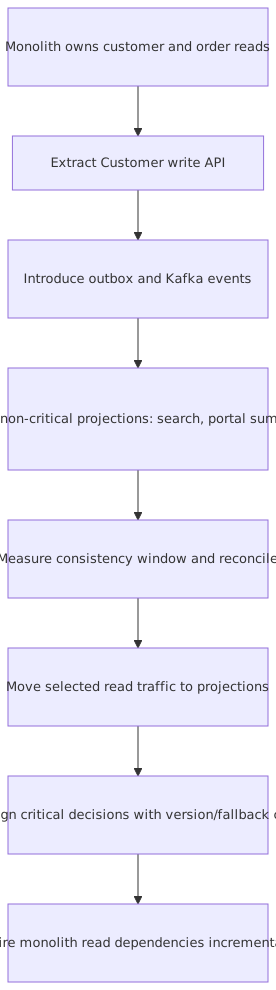
A sensible migration sequence often looks like this:
- Expose current truth cleanly
Create APIs around the monolith or existing core system rather than letting consumers query the database directly.
- Add reliable event publication
Use change data capture or an outbox to produce trustworthy domain events.
- Build observational read models first
Search, dashboards, and summaries are ideal proving grounds.
- Instrument lag and correctness
Before moving more reads, know how stale the projections are and how often they diverge.
- Introduce fallback for critical reads
Composite APIs can query the projection by default but call the source when freshness thresholds are not met.
- Redesign user journeys
Make pending changes visible. Avoid screens that imply impossible instantaneous convergence.
- Only then move decision flows
And only if the domain semantics support it.
Migration is not just carving software. It is renegotiating timing promises with the business.
Enterprise Example
Consider a global insurer modernizing customer and policy servicing.
Historically, a policy administration platform acted as the truth for customer details, policy status, billing instructions, and correspondence preferences. The web portal, call center system, billing engine, and document platform all read directly from replicated tables or nightly feeds. It was ugly, but consistency was mostly hidden because everything leaned on the same core database.
The insurer moved toward microservices with Kafka. A new Customer Profile service became the master for contact details and communication preferences. Changes were written there, then published to downstream services:
- Billing needed payment contact data
- Claims needed customer identifiers and selected contact channels
- Document services needed correspondence preferences
- Portal search indexed customer summaries
The first release looked successful. Then came the complaints.
Customers updated email addresses in the portal and immediately downloaded a policy document generated with the old address. Call center agents changed communication preference to paperless, but billing correspondence still printed overnight letters for a short period. Claims handlers saw stale mobile numbers during inbound calls. Nobody had data corruption. They had consistency windows with business consequences.
The architecture team responded by classifying reads semantically.
They decided:
- correspondence preference used during document generation was a decision read and had to check the authoritative Customer Profile service if the local projection lag exceeded 2 seconds
- portal search results were eventually consistent and could lag by up to 30 seconds
- the profile page itself required read-your-own-write, so after a successful update the portal showed the command response immediately and pinned reads to the source service for 10 seconds
- billing batch jobs consumed projections, but the batch start process validated that the latest relevant event offsets had been processed before issuing high-risk correspondence runs
They also introduced reconciliation. Every night, a job compared a subset of critical preference fields between the source service and downstream projections. Mismatches triggered replay or manual investigation. The number of customer-facing inconsistencies dropped sharply—not because the system became globally consistent, but because the important windows were managed and the unimportant ones were acknowledged.
That is what mature enterprise architecture looks like. Not the elimination of delay. The domestication of delay.
Operational Considerations
Distributed consistency lives or dies in operations.
Measure propagation lag
For each critical event flow, capture:
- source commit time
- publish time
- consume time
- projection update time
- query visibility time where possible
Then derive end-to-end lag. Do not rely solely on Kafka consumer lag. Consumer lag tells you something about topic processing, not whether the user can query the updated state.
Expose freshness metadata
Query APIs should return enough information to make staleness visible:
- last updated timestamp
- source version processed
- stale indicator if threshold breached
This is invaluable in debugging and in adaptive behavior.
Manage poison messages and replay
One bad event can stall a partition and silently widen the consistency window for everything behind it. Dead-letter queues are necessary but insufficient. You need procedures for triage, replay, and idempotent reprocessing. Rebuildable projections are not optional in serious estates.
Beware caches
Caches often become the last mile of inconsistency. Teams optimize the read path and forget that a CDN, API gateway cache, or local in-memory cache can happily serve obsolete data long after the projection has updated. If freshness matters, cache invalidation must be tied to domain events or conservative TTLs.
Support reconciliation
Reconciliation should be automated and domain-aware. Compare not just row counts, but critical facts and invariants. For example:
- if customer opted out of paper mail, no downstream channel should show print enabled beyond threshold
- if account is on fraud hold, order service must not expose “eligible for release”
Reconciliation is where architecture meets governance. EA governance checklist
Tradeoffs
There is no free lunch here. There isn’t even a cheap sandwich.
Using asynchronous propagation and local read models gives you scalability, autonomy, resilience, and the ability to shape data for local use. It also gives you temporary divergence, more moving parts, operational burden, and a permanent need for observability.
If you tighten consistency windows aggressively, you often reintroduce coupling:
- synchronous callbacks
- cross-service transactions
- chatty reads against sources of record
- reduced autonomy of downstream teams
If you loosen them too much, the business experiences the estate as inconsistent and untrustworthy.
Event-driven architecture with Kafka is powerful, but it can seduce teams into believing publication equals integration. It does not. Integration is complete only when the receiving context has interpreted the event, updated its model correctly, and made an appropriate decision about freshness.
The right tradeoff is domain-specific. There is no universal target state.
Failure Modes
The common failure modes are depressingly familiar.
Dual write inconsistency
A service writes its database and publishes separately. Database commit succeeds, publish fails. Downstream reads never catch up. This is the classic reason to use an outbox.
Semantic drift in copied data
A downstream read model stores upstream data without honoring its meaning. Over time the local interpretation diverges. Teams then make decisions on semantically stale or misused fields.
Invisible lag
No metrics, no freshness indicators, no thresholds. The business experiences stale reads as random defects because the architecture cannot explain itself.
Projection rebuild shock
A read model is rebuilt or replayed, causing lag to spike from seconds to hours. Critical consumers continue using the stale projection because nobody designed fallback paths.
Partition hot spots
A heavily used key or skewed partitioning causes certain aggregates to lag badly while averages look fine. Tail latency matters more than average freshness.
Cache betrayal
Everything downstream has updated, but the API cache still serves the old response. Users blame the wrong service because the edge lies last.
Assuming eventual means acceptable
This is the most dangerous failure mode. A team applies eventual consistency to a workflow that actually requires current truth. The bug is not technical. It is semantic.
When Not To Use
Do not use distributed asynchronous read propagation for everything.
If a workflow requires strict transactional correctness across a decision boundary, prefer a synchronous authoritative read or keep the logic co-located. Examples include:
- checking available credit before irrevocable fulfillment
- validating legal consent at the point of regulated communication
- confirming inventory for a scarce asset before commitment
- executing high-value financial transfers
Likewise, do not introduce local projections simply because they are fashionable. If a service has modest scale, a simple query to the source may be cheaper, clearer, and safer. Enterprise architecture has a bad habit of industrializing problems that don’t yet exist.
And if your teams are not prepared to operate Kafka, manage schemas, monitor lag, rebuild projections, and reconcile data, then event-driven distributed reads are a liability. A monolith with disciplined modular boundaries is often the better design than microservices with romantic assumptions.
Related Patterns
Several patterns often travel with consistency windows.
Transactional Outbox
Prevents dual writes by committing business change and event record atomically.
CQRS
Separates write models from read models. Helpful, but not a magic wand. It amplifies the need to manage read freshness.
Materialized View / Projection
Downstream read-optimized representation updated from events.
Strangler Fig
Progressive migration from monolith to services, especially useful when introducing event-driven reads incrementally.
Saga
Coordinates long-running distributed workflows. Relevant because sagas often rely on data that may be stale; they need explicit compensation and state handling.
Reconciliation Process
Periodic or continuous comparison and repair between source and derived data stores.
Read-your-own-write
A user sees their own recent update, even if the rest of the system remains eventually consistent.
These patterns complement each other, but they are not interchangeable. Architects should resist pattern bingo.
Summary
Consistency windows in distributed reads are not an implementation detail. They are part of the business contract of a microservice architecture.
A write does not become enterprise truth the moment a transaction commits. It becomes enterprise truth gradually, crossing service boundaries, message backbones, projections, caches, and user interfaces. That propagation timeline must be designed, measured, and governed.
The right move is not to demand strong consistency everywhere. That path usually ends in expensive coupling and disappointed teams. The right move is sharper:
- use domain-driven design to understand which reads truly need current truth
- model write propagation explicitly
- provide read-your-own-write where user trust depends on it
- bound and monitor freshness
- reconcile continuously
- migrate progressively with a strangler approach rather than by brute-force decomposition
In the end, distributed systems are like large organizations: nobody learns the news at the same moment. Good architecture does not pretend otherwise. It decides which people need to know immediately, which can wait a little, and how to keep everyone from making expensive decisions in the meantime.
Frequently Asked Questions
What is a service mesh?
A service mesh is an infrastructure layer managing service-to-service communication. It provides mutual TLS, load balancing, circuit breaking, retries, and observability without each service implementing these capabilities. Istio and Linkerd are common implementations.
How do you document microservices architecture for governance?
Use ArchiMate Application Cooperation diagrams for the service landscape, UML Component diagrams for internal structure, UML Sequence diagrams for key flows, and UML Deployment diagrams for Kubernetes topology. All views can coexist in Sparx EA with full traceability.
What is the difference between choreography and orchestration in microservices?
Choreography has services react to events independently — no central coordinator. Orchestration uses a central workflow engine that calls services in sequence. Choreography scales better but is harder to debug; orchestration is easier to reason about but creates a central coupling point.