⏱ 19 min read
Distributed systems rarely fail in the middle of a tidy whiteboard drawing. They fail on a Friday night, halfway through a customer refund, after one service wrote its data, another emitted the wrong event, and a third never heard about any of it. The trouble is not that microservices are hard. The trouble is that business processes do not care about service boundaries. An order, a payment, a shipment, a refund, a claim, a policy endorsement—these are business facts that move across multiple teams, databases, and runtimes. Yet we too often design as if each service can remain blissfully local.
That fantasy ends the moment the CFO asks a simple question: “Can you show me exactly what happened to this transaction across all systems?” Not approximately. Not by stitching five dashboards and three log aggregators together. Exactly.
This is where cross-service transaction logs enter the picture. Not as a fashionable append-only shrine, and not as an excuse to rebuild the enterprise around event sourcing, but as a practical architectural mechanism for tracking, reconciling, and governing business transactions that cross service boundaries. In a microservices estate, especially one using Kafka or similar event streaming platforms, a cross-service transaction log gives you something precious: a durable narrative of the business process itself. event-driven architecture patterns
It is not magic. It will not erase distributed systems complexity. But it gives that complexity a ledger.
Context
Modern enterprises split systems for sensible reasons: team autonomy, deployment independence, resilience, scaling, and domain ownership. We carve out Order, Payment, Inventory, Shipping, Pricing, Claims, Billing. We give each bounded context its own model and database. This is textbook domain-driven design, and when done well, it replaces giant fragile monoliths with systems that teams can actually evolve.
But bounded contexts are not isolated planets. They exchange business facts. An ecommerce checkout spans customer identity, cart pricing, payment authorization, stock allocation, order confirmation, fraud checks, and shipment initiation. In banking, a loan origination process spans customer verification, credit scoring, document collection, approval, account setup, and disbursement. In insurance, a claim crosses FNOL intake, policy validation, fraud screening, reserve updates, adjuster assignment, and payment.
These are not technical transactions. They are business transactions.
That distinction matters. A database transaction gives atomicity inside one datastore. A business transaction lives longer, crosses contexts, tolerates delay, and often requires compensation instead of rollback. Trying to force ACID semantics across independently deployed services is one of those ideas that sounds rigorous until it meets the real world. Then it becomes latency, lock contention, partial failures, and pain.
So enterprises do the sensible thing: they adopt asynchronous messaging, events, sagas, outbox patterns, and Kafka-based integration. This improves decoupling. It also creates a new problem. Business truth gets fragmented across local logs, local stores, local retries, and local interpretations of “done.”
A cross-service transaction log addresses that fragmentation.
Problem
The problem is not merely observability. Standard technical logs answer questions like “Did service A call service B?” Useful, yes. But business stakeholders ask different questions:
- Which business transaction is this event part of?
- Has the customer refund completed end-to-end?
- Which steps succeeded, failed, retried, or were compensated?
- Are downstream systems eventually consistent or permanently diverged?
- Can audit reconstruct the exact sequence of domain-relevant decisions?
If each service records only its own local state, the enterprise loses the thread. Correlation IDs help, but correlation by itself is not a model. Traces help, but traces are usually ephemeral operational telemetry, not durable business evidence. Message brokers preserve message order per partition, not a coherent business narrative across domains. Database tables preserve local intent, not cross-service meaning.
The result is familiar:
- duplicate processing with no authoritative reconciliation path
- customer support incidents requiring manual system-by-system investigation
- compliance gaps around auditability
- sagas that are theoretically complete but practically opaque
- brittle compensation flows because no single place captures transaction progression
- expensive “war room” debugging for what should have been ordinary transaction handling
Worse, teams start reinventing ad hoc solutions. One team stores workflow state in a saga table. Another relies on Kafka topics as the source of truth. A third writes an audit trail into Elasticsearch. A fourth adds a “status” API that lies by omission. Soon the enterprise has many partial logs and no trusted ledger.
Forces
Several forces pull in opposite directions.
Service autonomy versus transaction visibility
Each service should own its data and model. But the enterprise still needs a way to reason about a business transaction end-to-end. Centralizing all domain state destroys autonomy. Decentralizing everything destroys coherence.
Domain semantics versus infrastructure convenience
It is easy to log “message received” or “API call succeeded.” It is much harder—and much more valuable—to log domain facts such as PaymentAuthorized, InventoryReserved, ShipmentReleased, RefundCompensated. The log has to speak the business language, not merely the middleware dialect.
Eventual consistency versus operational confidence
Microservices live with eventual consistency. Executives and auditors do not enjoy hearing that phrase when money is missing. You need mechanisms for reconciliation, replay, and exception management that turn eventual consistency from a slogan into an operating model.
Throughput versus correctness
Kafka can move millions of events. That does not mean your transaction log should indiscriminately mirror every byte. A useful cross-service transaction log is selective. It captures meaningful transaction milestones and decisions, not every heartbeat and cache refresh.
Local bounded contexts versus cross-cutting process views
DDD teaches us to protect bounded contexts from a polluted shared model. Good. But some business processes are inherently cross-context. The challenge is to create a transaction log that preserves a process view without collapsing distinct domain models into a mushy enterprise schema.
That’s the hard line to walk.
Solution
The solution is to establish a cross-service transaction log: a durable, append-only record of business transaction milestones emitted by participating services, keyed by a transaction identity that reflects business semantics, not just technical request flow.
This is not one giant distributed transaction manager. It is closer to a ledger plus reconciliation engine.
At its best, the pattern works like this:
- A business transaction begins in one bounded context.
- A transaction identifier is created or mapped from a domain identifier.
- Each participating service emits transaction log entries when meaningful domain milestones occur.
- Entries are stored durably in a transaction log stream or store.
- A reconciliation component builds an end-to-end view, detects missing or contradictory steps, and triggers compensations or manual review where needed.
- Operational tooling, audit, support, and reporting use this log as the authoritative timeline of the business process.
The crucial design point is semantic discipline. Do not log “POST /payments returned 200.” Log “PaymentAuthorized for Order 123 in amount 49.99.” One tells you infrastructure behaved. The other tells you the business moved.
A cross-service transaction log usually sits alongside patterns such as:
- Saga orchestration or choreography
- Transactional outbox
- Kafka event streaming
- Idempotent consumers
- Reconciliation jobs
- Compensating transactions
- Process managers
- Audit trails
It is not a replacement for these. It is the connective tissue that lets them operate coherently.
Architecture
The architecture is usually composed of five elements.
1. Transaction identity
Every business transaction needs a stable identity. This may be:
- an order ID
- a payment session ID
- a claim ID
- a composite business process ID
- a generated transaction ID mapped to multiple domain IDs
Be careful here. A single HTTP correlation ID is often too narrow. A business transaction can span hours or days and involve many technical requests. Equally, a single domain entity ID may be too narrow if one process spans multiple entities. Choose an identity rooted in the business process.
2. Domain milestone events
Participating services emit append-only events to the transaction log when notable milestones occur. Examples:
OrderPlacedCreditCheckedPaymentAuthorizedInventoryReservationFailedShipmentCreatedRefundIssuedCompensationStartedManualReviewRequired
These are domain events or transaction-state events, not debug logs.
3. Durable log transport and storage
Kafka is often the right backbone here because it gives durable ordered streams, replay, consumer groups, and broad ecosystem support. But Kafka is transport, not your model. Some enterprises store the canonical transaction log in a read-optimized store fed from Kafka—perhaps PostgreSQL, Cassandra, Elasticsearch, or a purpose-built event store—depending on query needs and retention requirements.
4. Reconciliation and state projection
A transaction log by itself is just a diary. You also need a component that interprets the diary. This can be a stream processor or projection service that constructs the current transaction view, checks expected milestones, detects timeouts, and identifies inconsistencies.
5. Exception handling and compensation
When a transaction stalls or diverges, the system must do something. Maybe retry. Maybe compensate. Maybe raise an operational case. Maybe stop the line and involve a human. A transaction log without a failure-handling model is only half a pattern.
Here is a simple high-level view:
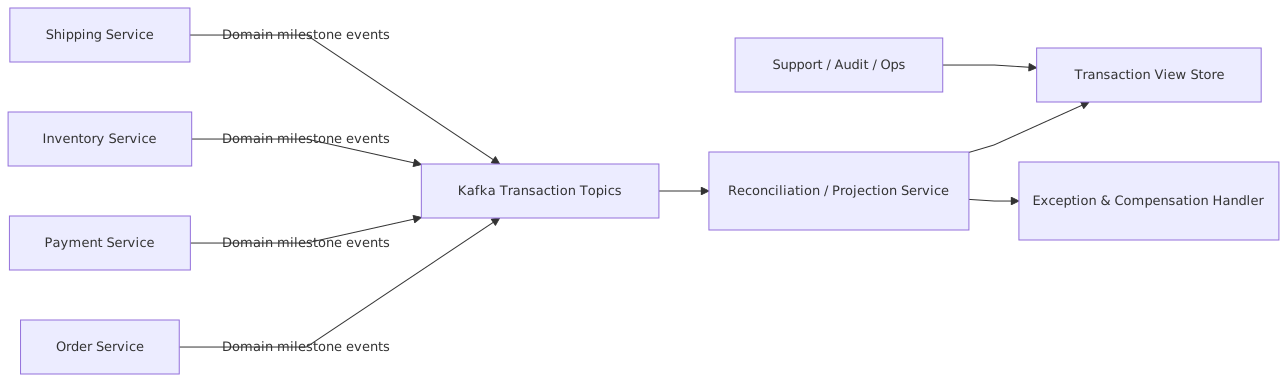
The transaction view store is often what support teams and auditors actually query. Kafka holds the immutable stream; the view store holds the current and historical projection.
Transaction log entry shape
A useful entry commonly contains:
- transaction ID
- domain context / service name
- event type
- business entity references
- timestamp
- causation ID
- correlation ID
- sequence or logical version if relevant
- payload with domain facts
- status or outcome
- metadata such as actor, source channel, region, tenant
But do not over-standardize payloads into an enterprise XML cemetery. Standardize envelope and governance. Let bounded contexts own their domain data. EA governance checklist
DDD implications
From a domain-driven design perspective, the transaction log should not become a “super-domain” that owns everyone else’s truth. That is a classic enterprise mistake. The log is a process evidence model, not a universal domain model.
Each bounded context still owns its own state transitions. The transaction log records notable facts exposed at context boundaries. The reconciliation service then builds a cross-context process view. That distinction keeps the architecture honest.
A good question to ask is: What must the rest of the enterprise know happened, without needing your internal model? That is what belongs in the transaction log.
Log flow and reconciliation
The heart of the pattern is reconciliation. Distributed systems don’t need more optimism. They need accounting.
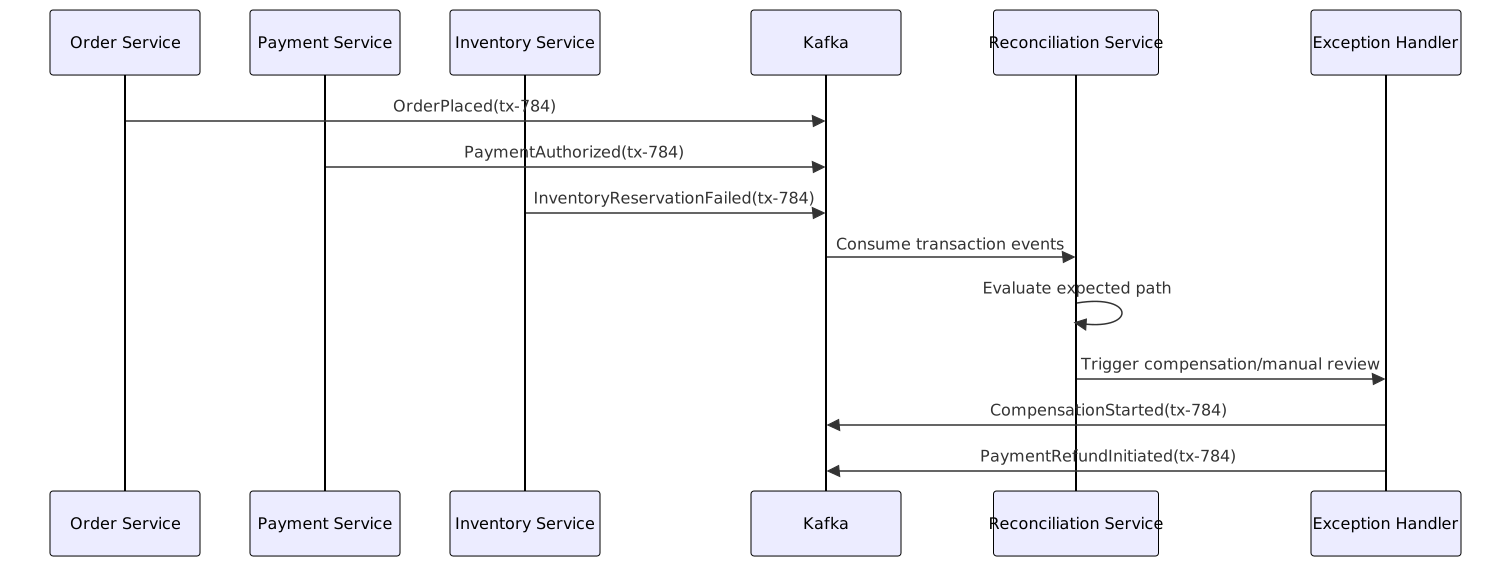
Without reconciliation, teams tend to pretend eventual consistency is self-healing. Sometimes it is. Sometimes it is just delayed failure.
Reconciliation can be synchronous in small systems, but in serious enterprises it is often asynchronous and policy-driven:
- expected milestones within time windows
- sequence validation
- duplicate detection
- contradictory event detection
- missing compensation detection
- stuck transaction escalation
This is the difference between “we publish events” and “we run a business.”
Migration Strategy
Most enterprises do not get to design this on a blank sheet. They inherit a monolith, batch integrations, point-to-point APIs, and maybe a Kafka platform with more enthusiasm than discipline. So the migration strategy matters.
The sensible path is a progressive strangler migration.
Start by identifying one business transaction that crosses multiple systems and hurts when it fails. Refunds are a good candidate. Claims are another. Avoid trying to boil the ocean. One transaction flow is enough to establish the pattern.
Step 1: Identify transaction boundaries and domain semantics
Map the business process in domain terms, not system calls. What are the milestones? Which bounded contexts participate? What does success look like? What compensations exist? Which inconsistencies matter operationally?
This is where DDD workshop techniques earn their keep: event storming, domain narratives, bounded context mapping. The aim is not just documentation. It is semantic alignment.
Step 2: Introduce a canonical transaction identity
Legacy systems often lack a stable cross-system identifier. Add one through an anti-corruption layer if needed. Do not wait for every system to be modernized.
Step 3: Add outbox-based publication in key services
For services with their own databases, use the transactional outbox pattern so local state change and event publication are atomically linked. Otherwise your “transaction log” becomes a fiction generated by best-effort event emission.
Step 4: Build the transaction log pipeline and projection
Use Kafka topics for transport, then project into a transaction view store. Keep the early model simple. You need visibility before perfection.
Step 5: Add reconciliation rules
Once you can see the flow, codify expected states and timeout rules. This is where business confidence starts to improve.
Step 6: Strangle legacy monitoring and manual tracking
Gradually shift support, audit, and operational processes to use the transaction view as the primary lens. Retire spreadsheet-based reconciliation and tribal-knowledge debugging.
Step 7: Expand to adjacent transaction types
Only after the first flow works should you replicate the approach. Reuse envelope standards and operational tooling, not domain payloads.
A migration view might look like this:
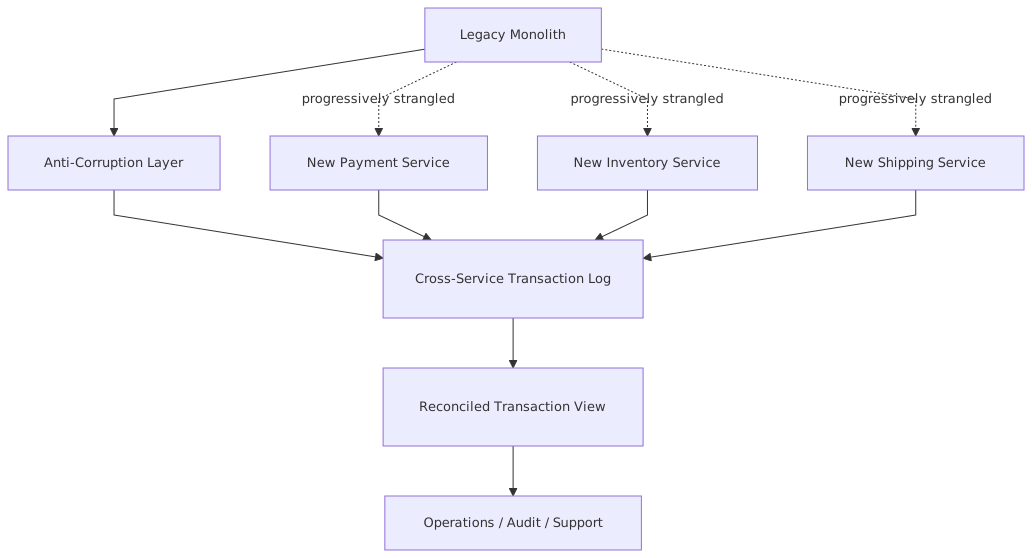
The migration logic is straightforward: first make the business flow visible across old and new worlds, then move behavior out of the monolith. Visibility before purity.
That order matters. Too many migration programs decompose systems first and only later realize they have lost operational coherence.
Enterprise Example
Consider a large retailer modernizing its order fulfillment landscape.
Originally, the retailer had a monolithic order management system with direct database writes into warehouse systems, nightly reconciliation jobs, and a customer service team trained in ritual rather than tooling. The modernization program introduced microservices for Order, Payment, Inventory, Fulfillment, and Returns, connected via Kafka. On paper, this looked excellent. In production, support calls rose. microservices architecture diagrams
Why? Because when a customer asked, “Why did I get charged but not receive confirmation?”, no one system could answer. Payment had authorized. Inventory had timed out waiting on a warehouse reservation response. The order service had marked the order as pending. Kafka had delivered events correctly, but one consumer had retried out of order after a deployment. Technically, several systems were healthy. Commercially, the transaction was sick.
The retailer introduced a cross-service transaction log focused first on checkout and refund flows.
Each service emitted milestone events through an outbox:
- Order Service:
OrderInitiated,OrderConfirmed,OrderCancelled - Payment Service:
PaymentAuthorized,PaymentCaptureFailed,PaymentRefunded - Inventory Service:
StockReserved,StockReservationExpired - Fulfillment Service:
PickReleased,ShipmentDispatched - Returns Service:
ReturnAccepted,RefundRequested
These flowed through Kafka into a reconciliation service that projected a single transaction timeline per order. Business rules classified transactions:
- healthy
- pending within SLA
- stalled
- contradictory
- compensated
- manual review
The effect was immediate.
Support agents could see a transaction-level timeline. Operations could identify rising failure patterns by milestone. Finance had a durable ledger of refund progression. Audit could reconstruct who knew what when. Most importantly, the business stopped guessing whether “eventual consistency” meant “still in progress” or “quietly broken.”
The retailer did not centralize all domain logic. Inventory still owned stock. Payment still owned authorization and capture. But the enterprise finally had a trustworthy process narrative.
That is the point of the pattern.
Operational Considerations
This pattern lives or dies in operations.
Retention and replay
A transaction log is useful because it is durable. Decide how long events must be retained for audit, support, chargebacks, claims, or regulatory needs. Kafka retention alone may not be enough; many organizations maintain a long-lived projection or archive.
Replay is equally important. You will need to rebuild projections, recover from bugs, or onboard new downstream consumers. Design for replay from day one.
Idempotency
Consumers will reprocess events. They will see duplicates. They will restart after partial work. If your transaction projection or compensation handler is not idempotent, your “ledger” becomes a machine for manufacturing new inconsistencies.
Ordering
Kafka gives ordering within a partition, not globally. Partition by transaction ID where possible. Even then, cross-topic ordering can still be tricky. Reconciliation logic should assume gaps, delays, and occasional apparent reversals.
Schema evolution
Domain milestones evolve. Additive changes are manageable. Semantically incompatible changes are not. Use versioned event schemas and disciplined contract governance. A transaction log becomes enterprise-critical very quickly; schema negligence spreads pain fast. ArchiMate for governance
Security and privacy
Transaction logs often contain sensitive data references. Avoid dumping raw PII or payment details into broad-access streams. Separate business evidence from confidential payloads. Apply data minimization, field-level protection, and access controls.
Observability
Do not confuse the transaction log with the full observability stack. You still need metrics, traces, and infrastructure logs. The transaction log answers business progression questions; observability tooling answers technical behavior questions. Good enterprises use both.
Human workflow
Some failures cannot be auto-compensated. Build manual review paths, case management hooks, and operator notes into the operational model. A clean architecture diagram that ignores call center reality is still a bad architecture.
Tradeoffs
This pattern is valuable, but let’s not romanticize it.
Benefits
- end-to-end business transaction visibility
- stronger auditability
- clearer reconciliation and compensation handling
- better support tooling
- reduced dependency on tribal knowledge
- improved migration path from monolith to microservices
- durable process history beyond transient tracing systems
Costs
- more events, more governance, more storage
- semantic design effort across teams
- reconciliation logic that can become complex
- temptation to centralize too much process intelligence
- new operational responsibilities around replay, retention, and schema evolution
- risk of creating a pseudo-monolith in the transaction layer
The sharpest tradeoff is this: you gain enterprise coherence by introducing a shared process ledger, but you must avoid turning that ledger into a central command-and-control brain.
That line is thin. Many organizations cross it.
Failure Modes
There are several common ways this pattern goes wrong.
Logging technical noise instead of business facts
If your transaction log is full of REST statuses and consumer offsets, you have built middleware exhaust, not business truth.
Missing transaction identity discipline
If different services use different IDs with inconsistent mapping, reconciliation collapses into probabilistic archaeology.
No outbox, no trust
If services emit events outside local transaction boundaries, the log can claim a business step happened when the source data says otherwise. That is fatal for audit and dangerous for operations.
Central over-modeling
Some architecture teams create a giant canonical transaction schema that every domain must conform to. This usually ends in slow change and semantic distortion. Shared envelope, yes. Shared everything, no.
Ignoring reconciliation
A passive log without exception policies is not enough. When transactions stall, someone or something must notice and act.
Assuming eventual consistency means no accountability
It still needs SLAs, monitoring, and ownership. “Eventually” is not a control framework.
Treating Kafka as the business source of truth by default
Kafka is excellent infrastructure. But retention, compaction, queryability, and audit needs may demand a separate transaction view or archive. Enterprises that skip this often regret it.
When Not To Use
This pattern is not universal.
Do not use it when:
- the transaction is entirely local to one service and one datastore
- you have a small system with limited cross-service business flow complexity
- the operational cost outweighs the business risk
- the domain does not need durable cross-service auditability
- synchronous orchestration with simple persistence is sufficient
- the team lacks basic eventing discipline and is still struggling with service boundaries
Also, do not use a cross-service transaction log as a substitute for proper domain design. If your bounded contexts are muddled, your transaction log will simply preserve muddle at scale.
And do not adopt it because “Kafka is strategic.” Enterprises have spent fortunes building ornate event backbones for processes that were better served with a simple workflow engine and a database.
Architecture should be driven by transactional risk and domain complexity, not by platform enthusiasm.
Related Patterns
This pattern sits near several others.
Saga
Sagas manage long-running distributed business processes through local transactions and compensations. The transaction log provides durable evidence and visibility for saga progression. A saga without a trustworthy log is often hard to reason about in production.
Transactional Outbox
Essential for reliable event publication from services with local datastores. Without it, the transaction log is vulnerable to write-publish gaps.
Event Sourcing
Related, but not the same. Event sourcing stores domain state as a sequence of events within a bounded context. A cross-service transaction log records business process milestones across bounded contexts. You can have one without the other.
Process Manager / Orchestrator
A process manager may actively coordinate steps. The transaction log is the durable narrative and evidence trail of what occurred. Sometimes the orchestrator writes to the transaction log; sometimes it derives state from it.
Audit Log
An audit log usually records who changed what for compliance. A cross-service transaction log records how a business process progressed across services. There is overlap, but they are not identical.
CQRS Projections
The reconciled transaction view is often implemented as a projection. This is a natural fit, especially when Kafka is in play.
Summary
Microservices give enterprises modularity, but they take away the easy illusion of one place where truth lives. Business transactions do not respect service boundaries. They wander through them, collecting delays, retries, duplicates, and contradictions. If you do not give those transactions a durable cross-service narrative, your organization ends up debugging commerce with guesswork.
A cross-service transaction log is that narrative.
Done well, it records domain milestones rather than technical chatter. It preserves bounded context ownership while enabling a transaction-level process view. It works naturally with Kafka, transactional outbox, sagas, and reconciliation services. It supports progressive strangler migration because it creates visibility across both legacy and modern estates. And in real enterprises, that visibility is often the difference between “we think it completed” and “we know exactly what happened.”
But it is not free. It demands semantic rigor, governance, idempotency, retention strategy, reconciliation rules, and operational maturity. Used carelessly, it becomes a centralized mess. Used well, it becomes a ledger for distributed business truth.
That is the real test of architecture in the enterprise. Not whether the boxes and arrows look modern, but whether the business can trust the story the system tells when things go wrong.
Frequently Asked Questions
What is a service mesh?
A service mesh is an infrastructure layer managing service-to-service communication. It provides mutual TLS, load balancing, circuit breaking, retries, and observability without each service implementing these capabilities. Istio and Linkerd are common implementations.
How do you document microservices architecture for governance?
Use ArchiMate Application Cooperation diagrams for the service landscape, UML Component diagrams for internal structure, UML Sequence diagrams for key flows, and UML Deployment diagrams for Kubernetes topology. All views can coexist in Sparx EA with full traceability.
What is the difference between choreography and orchestration in microservices?
Choreography has services react to events independently — no central coordinator. Orchestration uses a central workflow engine that calls services in sequence. Choreography scales better but is harder to debug; orchestration is easier to reason about but creates a central coupling point.