⏱ 20 min read
Most enterprise microservices diagrams are lies.
Not malicious lies. Just the usual kind: polished, colorful, and almost completely useless the moment you ask a serious question like, “Which services are actually critical to customer onboarding?” or “What breaks if Kafka is down in one region?” or “Where exactly does IAM enforcement happen?” That’s where the cheerful boxes-and-arrows mess collapses.
This is why ArchiMate still matters for microservices architecture.
Yes, I know the reaction. ArchiMate sounds heavy. Academic. A thing consultants bring into the room right before everyone stops making eye contact. And to be fair, a lot of ArchiMate work deserves that reputation. Too abstract, too complete, too detached from delivery reality. But when you use it properly, ArchiMate is one of the few modeling approaches that can connect business capability, application behavior, integration patterns, cloud deployment, and security controls in one architecture language.
For microservices, that matters a lot.
Because microservices are not hard mainly because of code. They are hard because of relationships. Service-to-service dependencies. Event flows. IAM boundaries. Data ownership. Platform assumptions. Regulatory obligations. Runtime placement. Team ownership. Failure modes. If your architecture notation cannot hold those concerns together, then you are not really modeling architecture. You are just drawing software.
So let’s say it simply, early, and clearly: ArchiMate for microservices architecture is a way to model services, events, APIs, infrastructure, and business impact in a consistent enterprise language. It helps architects show how microservices support business capabilities, communicate through APIs and Kafka, depend on IAM and cloud platforms, and are deployed across environments.
That’s the SEO answer. Fine.
The real answer is deeper: ArchiMate gives architects a disciplined way to make microservices understandable to more than just developers. And in an enterprise, that is the whole game. ArchiMate modeling guide
Why microservices architecture needs more than UML and cloud icons
If all you need is a developer-facing design for one bounded context, ArchiMate may be overkill. I’ll say that upfront. A C4 model, sequence diagrams, ADRs, and some deployment views may be enough. ArchiMate tutorial
But enterprise architecture is not one bounded context.
In real organizations, microservices sit inside a mess of legacy systems, audit requirements, identity providers, cloud landing zones, Kafka clusters, API gateways, data platforms, and organizational politics. The architecture questions are rarely “What class calls what?” They are more like:
- Which business processes depend on the Payments service?
- Which services can publish customer risk events to Kafka?
- Where is authorization enforced: API gateway, service mesh, application, or all three?
- Which workloads are cloud-native and which are still tied to on-prem core banking?
- What is the blast radius if the IAM token service degrades?
- Which domains own their own data, and which are pretending they do?
UML does not answer those questions very well. Cloud vendor reference diagrams don’t either. Neither do “microservices maps” with 87 little hexagons and no semantics.
ArchiMate can.
Not magically. Not by itself. But it gives you concepts for business, application, technology, and relationships between them. That is why it fits enterprise microservices better than people think.
What ArchiMate actually gives you for microservices
At its core, ArchiMate lets you describe architecture across layers:
- Business layer: capabilities, processes, products, actors
- Application layer: application components, application services, interfaces, data objects
- Technology layer: nodes, system software, networks, infrastructure services
- Strategy / motivation / implementation extensions: goals, requirements, work packages, roadmaps, outcomes
For microservices architecture, that means you can model things like:
- A Customer Onboarding capability
- Supported by an Onboarding process
- Realized by application services such as Identity Verification, Account Opening, Risk Screening
- Delivered through application components such as KYC Service, Customer Profile Service, Decisioning Service
- Exposed via REST APIs and event topics in Kafka
- Protected by IAM services, policies, and trust relationships
- Deployed on Kubernetes in cloud
- Integrated with core banking systems on-prem
- Governed by requirements such as PSD2 compliance, data residency, availability targets
That is already more useful than most microservices diagrams in circulation.
And importantly, ArchiMate lets you show different views for different audiences without changing the underlying meaning. That matters a lot. Executives do not want to see Kafka partitions. Platform engineers do not want a capability map with no runtime reality. Security teams need trust boundaries. Delivery teams need ownership and dependencies. ArchiMate can support all of those if the architect has discipline.
That last part matters. The notation is not the problem. Architect behavior usually is.
The first misconception: a microservice is not automatically an ArchiMate application component
This is one of the most common modeling mistakes.
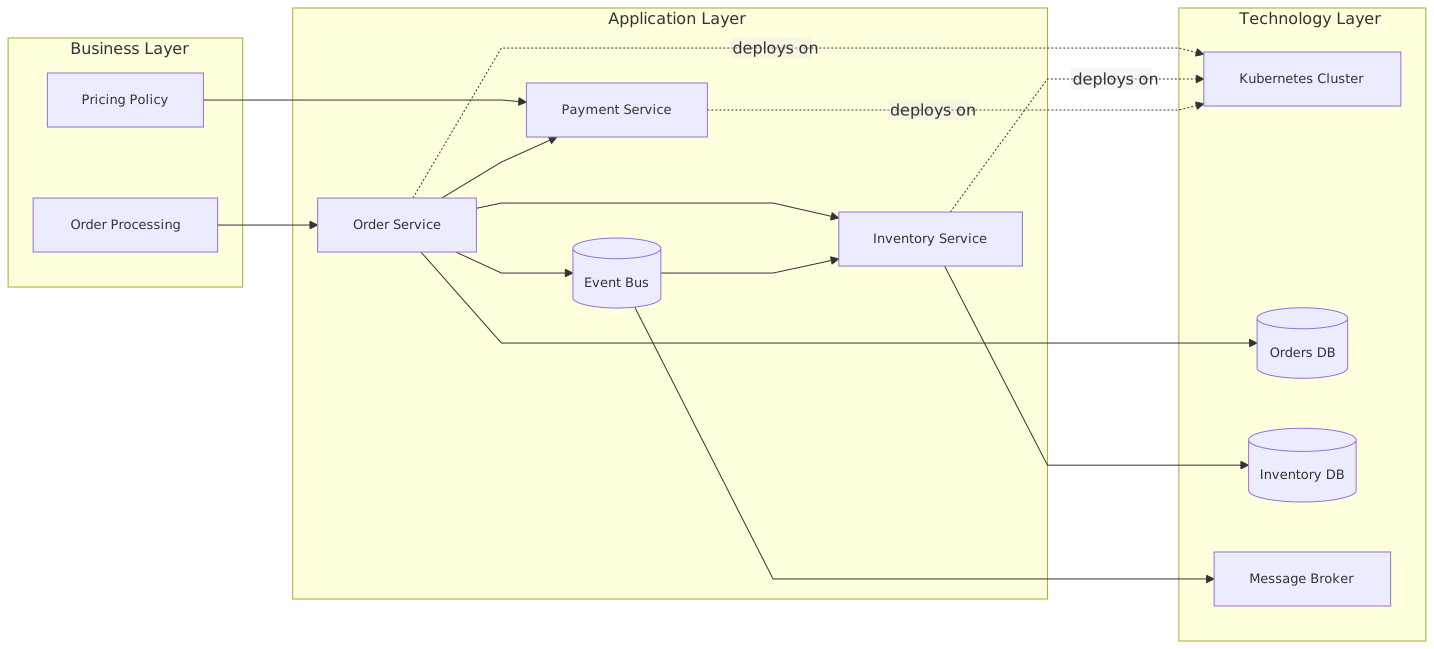
Architects discover ArchiMate and then map every microservice directly to an application component. Technically, that is often acceptable. Practically, it can become shallow very quickly.
A microservice in enterprise architecture is usually not just one thing. It has at least four distinct concerns:
- Its structural identity — the deployable or logical service unit
- Its behavior — the application services and functions it provides
- Its interfaces — APIs, event contracts, callbacks
- Its operational reality — runtime deployment, scaling, resilience, ownership
If you collapse all of that into one box labeled “Customer Service,” you have not modeled much.
A better pattern is usually:
- Model the microservice as an Application Component
- Model what it offers as one or more Application Services
- Model API endpoints or event interfaces as Application Interfaces
- Model business-relevant information as Data Objects
- Model runtime placement using Technology layer elements like nodes, system software, container platform, cloud region
That separation is not academic. It becomes useful immediately.
For example, a Payments Service may expose:
- a synchronous API for payment initiation
- an asynchronous event stream for payment status changes
- an internal administrative interface for reconciliation support
Those are not the same thing, and they do not belong to the same audience. ArchiMate gives you enough structure to make those distinctions visible.
How to model Kafka in ArchiMate without turning the diagram into nonsense
Kafka is where many microservices architecture models become either too vague or too technical.
On one side, architects draw a generic “event bus” and call it a day. That’s lazy. On the other side, they attempt to model brokers, topics, partitions, consumer groups, schemas, and stream processors all in one enterprise diagram. That’s not architecture either. That’s implementation leakage.
The right level depends on the decision you are trying to support.
In most enterprise architecture work, Kafka should be modeled at three levels:
1. Business significance
Show which business processes or capabilities depend on event-driven flows.
Example:
- Fraud Detection capability
- Served by events like Card Transaction Initiated
- Consumed by Risk Scoring Service
This matters because eventing is not just plumbing. In banking, event streams often become operationally critical.
2. Application interaction
Model producers, consumers, and interfaces.
Example:
- Card Authorization Service publishes transaction events
- Fraud Scoring Service consumes them
- Notification Service consumes approved/declined outcomes
- Kafka is represented as technology/application support depending on view purpose
3. Technology dependency
Show Kafka as part of the platform.
Example:
- Managed Kafka on cloud
- Multi-AZ deployment
- Dependency on IAM integration for service credentials
- Schema registry as supporting platform capability if relevant
What you usually should not do is put 40 topic names into a top-level architecture diagram. Nobody can reason with that. Topic-level details belong in integration catalogs or interface documentation, not everywhere.
Still, one contrarian point here: architects often under-model event ownership. They treat Kafka as neutral shared infrastructure. It isn’t. In healthy microservices architecture, event streams have domain ownership, lifecycle governance, and semantic contracts. If your ArchiMate model does not show who owns key event interfaces, you are hiding one of the biggest risks in the architecture. ArchiMate for governance
IAM is not a side note in microservices. It is part of the architecture spine
Another bad habit: architects treat IAM as a shared service floating off to one side of the diagram, as if identity magically happens before the “real” system starts.
In microservices, IAM is core architecture.
Every serious enterprise microservices landscape depends on identity and access management for:
- user authentication
- service-to-service authentication
- token issuance and validation
- authorization policy enforcement
- secrets and credentials handling
- federation with enterprise identity providers
- auditability
In banking, this is non-negotiable.
In ArchiMate, IAM should usually be modeled across layers:
- As an Application Service, such as token issuance or policy decision
- As an Application Component, such as an IAM platform or authorization engine
- As a Technology Service if you need to show platform-level identity capabilities
- As a Requirement / Constraint if access control obligations drive architecture decisions
A common pattern in cloud-native banking environments looks like this:
- Customer channels authenticate through enterprise IAM
- API gateway validates tokens and applies coarse-grained policies
- Microservices perform fine-grained authorization based on claims and domain rules
- Kafka producers/consumers authenticate using service identities
- Kubernetes workloads use workload identity or managed identity instead of long-lived secrets
That is architecture. Not just security detail.
And here is the contrarian bit: if your microservices architecture assumes “the gateway handles auth,” it is probably immature. The gateway handles some auth. Real enterprise authorization is distributed, contextual, and domain-aware. ArchiMate can help make that visible, which is one of its strongest uses.
A practical mapping: ArchiMate concepts for microservices
Here’s a simple table I’ve used variations of in architecture teams.
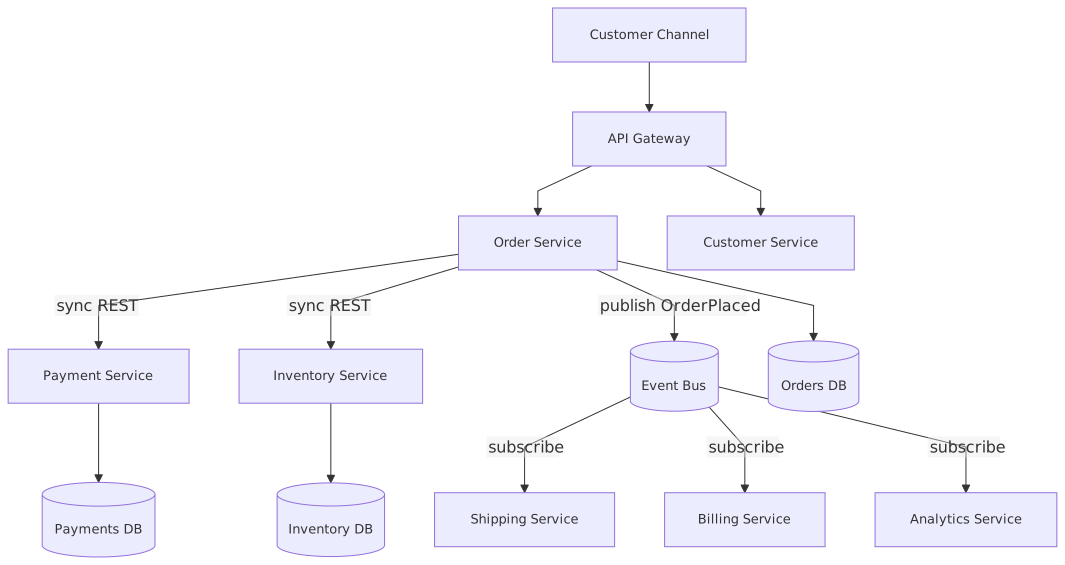
You do not need all of these in one view. Please don’t put all of them in one view.
How this applies in real architecture work
This is the part many articles skip. They praise the notation and avoid the work.
In real architecture work, ArchiMate for microservices helps with five things that matter.
1. Capability-to-service traceability
Executives fund capabilities, not microservices. If you cannot show how your microservices landscape supports onboarding, lending, collections, fraud, or payments, your architecture is disconnected from enterprise planning.
ArchiMate is good at linking:
- capabilities
- business processes
- application services
- application components
That lets you answer portfolio questions like:
- Which services are essential to mortgage origination?
- Which domains are over-coupled to the core banking platform?
- Where are we investing heavily but still dependent on legacy batch?
This is not theoretical. It is what architecture review boards, transformation offices, and CIO staff ask.
2. Dependency and blast-radius analysis
Microservices fail in chains. One service degrades, Kafka lags, token validation slows, retries spike, and suddenly your “resilient” architecture is a synchronized outage.
ArchiMate can support dependency views that show:
- upstream/downstream relationships
- shared infrastructure dependencies
- IAM centralization risks
- cloud regional concentration
- eventing critical paths
This is incredibly useful during resilience reviews and architecture risk assessments.
3. Security architecture communication
Security teams often receive either too little detail or far too much. ArchiMate gives a middle layer: enough semantics to show trust boundaries, IAM roles, enforcement points, and regulated data movement, without drowning in implementation specifics.
In banking, this matters for:
- customer data access
- privileged admin paths
- payment authorization controls
- event stream exposure
- third-party API access
4. Cloud migration and hybrid architecture planning
Most enterprise microservices are not born in a clean cloud-native world. They grow around legacy. You need to show what runs where, what still depends on on-prem systems, what uses managed cloud services, and what cannot move because of latency, licensing, or data rules.
ArchiMate works well for hybrid views:
- microservices on cloud Kubernetes
- Kafka managed in cloud
- IAM federated with enterprise directory
- core banking and payment ledger on-prem
- secure connectivity between them
This becomes especially important in phased migration planning.
5. Governance without killing delivery
Here’s another unpopular opinion: governance is not the enemy. Bad governance is the enemy.
ArchiMate can support lightweight governance by standardizing how architects describe services, dependencies, interfaces, and platform usage. That does not mean forcing every team into giant models. It means having enough consistency that enterprise decisions are possible.
A model that nobody updates is useless. A model that every team hates is also useless. The sweet spot is smaller than many architects admit. EA governance checklist
A real enterprise example: digital onboarding in a bank
Let’s make this concrete.
Imagine a mid-sized bank modernizing customer onboarding. The old process is fragmented:
- web and mobile channels submit applications
- identity checks happen through a vendor integration
- KYC and AML checks are partly synchronous, partly batch
- account creation depends on an on-prem core banking platform
- customer notifications go through a legacy messaging hub
- authentication is handled by enterprise IAM
- new domain services are being built on cloud Kubernetes
- Kafka is introduced for event-driven orchestration and downstream updates
A typical bad architecture diagram for this would show:
- Channel apps
- Some microservices
- Kafka
- Core banking
- IAM
- Cloud
Looks modern. Says almost nothing.
A better ArchiMate-based approach would create several related views.
View 1: business capability and process alignment
Show:
- Customer Onboarding capability
- Identity Verification capability
- Compliance Screening capability
- Account Opening capability
Map these to business processes:
- Capture application
- Verify identity
- Screen against sanctions/AML rules
- Open account
- Notify customer
Then link to application services:
- Application Intake Service
- KYC Verification Service
- Risk Screening Service
- Account Provisioning Service
- Notification Service
Now the business can actually see what is supporting what.
View 2: application cooperation view
Show the microservices as application components:
- Channel API
- Customer Profile Service
- KYC Service
- Screening Service
- Decisioning Service
- Account Opening Service
- Notification Service
Show interfaces:
- REST APIs from channels to intake/orchestration
- Event interfaces over Kafka for onboarding events:
- Application Submitted
- Identity Verified
- Screening Completed
- Account Opened
Show dependencies:
- KYC Service uses external identity vendor
- Account Opening Service depends on core banking API
- Notification Service consumes final status events
- IAM provides authentication and token services
Now engineering, security, and support teams can reason about flows.
View 3: deployment and technology view
Show:
- Kubernetes cluster in cloud
- managed Kafka service
- API gateway
- IAM integration
- secure network path to on-prem core banking
- region placement
- observability platform dependency
This reveals operational truth:
- cloud-native services are not independent of on-prem
- Kafka is a critical platform dependency
- IAM latency affects onboarding response times
- account creation remains constrained by core banking availability
View 4: risk and constraint view
Show:
- customer PII handling constraints
- audit logging requirement
- availability target for onboarding
- data residency controls
- segregation of duties for admin functions
Now compliance and architecture governance are tied to actual services and infrastructure.
This is how ArchiMate becomes useful. Not as one giant master diagram. As a set of coherent views answering real questions.
Common mistakes architects make with ArchiMate and microservices
Let’s be blunt. Most ArchiMate failures are self-inflicted.
Mistake 1: modeling everything
If your model contains every service, every topic, every API, every node, every pipeline, every secret store, and every environment, you have created a museum, not a working architecture asset.
Model only what supports decisions.
Mistake 2: using ArchiMate as a prettier inventory
A list of microservices with standard icons is not architecture. You need relationships, behavior, and business relevance. Otherwise it is just a CMDB with nicer colors.
Mistake 3: no separation between logical and physical views
Architects mix domain design, runtime deployment, and operational scaling into one picture. Then nobody knows whether “Payment Service” means a logical component, a codebase, a Kubernetes deployment, or a team.
Be disciplined. Separate concerns.
Mistake 4: pretending synchronous APIs are the whole story
In microservices, asynchronous interactions are often the real system. If your model includes APIs but ignores Kafka-based event flows, you are missing the architecture that actually drives behavior.
Mistake 5: treating IAM as a utility box
As I said earlier, this is a serious error. IAM shapes trust, access, failure modes, and compliance. Model it properly.
Mistake 6: no ownership shown
Microservices without ownership are fantasy. Show which domain or team owns which service, key event contracts, and critical data. Otherwise governance discussions become vague and political.
Mistake 7: over-abstracting cloud
A cloud icon is not deployment architecture. In enterprise work, region, tenancy, landing zone, connectivity, managed services, and resilience patterns matter. You do not need every subnet, but you do need meaningful placement.
Mistake 8: stale models
This one is fatal. A stale ArchiMate repository creates distrust very quickly. If teams know the model is wrong, they stop using it. Better a smaller accurate model than a grand dead one.
Contrarian view: sometimes ArchiMate is the wrong tool
It’s worth saying, because architects too often become notation evangelists.
If you are a product team designing 6 services in one domain, moving fast, with strong engineering discipline, ArchiMate may add little value beyond lightweight context and deployment views. Forcing full enterprise modeling on that team is usually bureaucratic vanity.
Also, ArchiMate does not replace:
- service contracts
- event schemas
- ADRs
- threat modeling
- sequence diagrams
- platform runbooks
- SLO definitions
It complements them.
Another contrarian point: many enterprise architects use ArchiMate to create the illusion of control over microservices they do not really understand. That is dangerous. Microservices architecture needs close engagement with engineering reality. If your model says “loosely coupled event-driven services” while every service shares the same database and release train, the notation is not helping you. It is helping you hide.
The best use of ArchiMate is not to make architecture look formal. It is to make enterprise complexity discussable.
A practical modeling approach that actually works
If I were setting this up in an enterprise architecture team, I would keep it simple.
Step 1: start from business capabilities
Pick a value stream or business domain: onboarding, payments, lending, fraud, servicing.
Map:
- capabilities
- core business processes
- outcomes or KPIs if relevant
Step 2: identify the key application services and components
Do not start with every code artifact. Start with meaningful service boundaries:
- Customer Profile
- Payment Initiation
- Fraud Scoring
- Account Opening
- Notification
- Consent Management
Step 3: model interaction styles
For each important interaction, decide:
- synchronous API
- asynchronous event
- batch/file
- human workflow
This is where Kafka should become visible where it matters.
Step 4: model shared platform dependencies
Include only the platform elements that affect architecture decisions:
- IAM
- API gateway
- Kafka
- Kubernetes
- service mesh if actually relevant
- cloud region / landing zone
- observability platform
- core legacy systems
Step 5: add constraints and risks
Tie in:
- regulatory requirements
- availability needs
- data classification
- residency rules
- resilience concerns
Step 6: create role-specific views
Do not force one diagram for everyone.
Use:
- business alignment view
- solution cooperation view
- security/dependency view
- deployment/hybrid view
- transition roadmap view
That’s enough for most organizations. More is usually self-indulgence.
What “good” looks like
A good ArchiMate model for microservices architecture has these qualities:
- It explains how services support business outcomes
- It distinguishes service behavior from runtime deployment
- It makes Kafka and IAM visible where they matter
- It shows hybrid reality honestly
- It reveals ownership and critical dependencies
- It is small enough to stay current
- It helps decisions happen faster
A bad one:
- is huge
- is abstract for the sake of appearing strategic
- hides security and operational dependence
- ignores events
- ignores legacy gravity
- is not trusted by engineering teams
That trust point is everything. If developers, platform teams, and security architects all quietly think the enterprise model is decorative, then it is decorative.
Final thought
Microservices architecture has a weird effect on enterprises. It makes people think they are becoming simpler because systems are broken into smaller parts. In reality, the complexity often just moves into interactions, platforms, policies, and organizational seams. Smaller boxes. Bigger system problem.
That is why ArchiMate still earns a place.
Not because it is elegant. Not because standards are exciting. But because enterprise architecture needs a language that can connect business capability, application services, Kafka eventing, IAM controls, cloud deployment, and legacy dependencies without collapsing into chaos.
Use it lightly. Use it honestly. And for the love of architecture, stop drawing microservices as isolated little hexagons floating in a governance-free cloud paradise. That architecture does not exist.
FAQ
1. Is ArchiMate too heavyweight for microservices architecture?
It can be, if you model everything. Used well, it is not heavyweight at all. The trick is to model decision-relevant elements only: business capability links, key services, interfaces, Kafka flows, IAM, cloud deployment, and major dependencies.
2. How do you represent Kafka in ArchiMate?
Usually at a meaningful abstraction level. Show producer/consumer relationships, event interfaces, and Kafka as a platform dependency. Do not clutter enterprise views with partition-level detail unless you are solving a very specific operational problem.
3. Should each microservice be one ArchiMate application component?
Often yes, but not always enough by itself. You should usually also model the application services it provides and the interfaces through which it interacts. Otherwise the model becomes too shallow to be useful.
4. How do you model IAM in a microservices landscape?
Model IAM as a real architectural dependency, not a side box. Show authentication services, authorization enforcement points, service identities, trust relationships, and relevant constraints. In banking especially, IAM belongs near the center of the architecture.
5. What is the biggest mistake architects make when using ArchiMate for microservices?
They either over-model or under-think. Over-modeling creates dead repositories. Under-thinking creates pretty diagrams with no semantics. The best models are selective, current, and tied to real business and engineering decisions.
Frequently Asked Questions
How are microservices modeled in ArchiMate?
Each microservice is an Application Component in the ArchiMate Application layer, exposing Application Services via Application Interfaces. Serving relationships show inter-service dependencies. Assignment to Technology Nodes models the deployment topology. Data Objects model the contracts and event schemas exchanged between services.
What is the difference between microservices and monolithic architecture?
A monolith packages all functionality into one deployable unit — simpler to develop initially but harder to scale and change independently. Microservices decompose the application into independently deployable services aligned to business domains. This enables team autonomy and independent scaling but introduces distributed system complexity.
How do you document microservices architecture for enterprise governance?
Use ArchiMate Application Cooperation diagrams for the service landscape, UML Component diagrams for internal service structure, UML Sequence diagrams for key interaction flows, and UML Deployment diagrams for container and infrastructure topology. In Sparx EA, all these views can exist in one repository with full traceability.