⏱ 21 min read
A health check is a tiny thing that carries a dangerous amount of authority.
One green endpoint can persuade an orchestrator to route traffic, keep a pod alive, suppress an alert, or reassure an executive looking at a dashboard five minutes before a board meeting. One red endpoint can trigger restarts, page an on-call engineer, and begin a chain reaction across a fleet. In a distributed system, this little “am I healthy?” question is not little at all. It is a governance mechanism. It is operational truth, or at least the nearest approximation we can afford. EA governance checklist
That is why distributed health checks in microservices are so often built badly. microservices architecture diagrams
Teams start with innocent intent: add /health, wire it to Kubernetes, maybe bolt on a dependency probe for the database. Then the landscape changes. Services call other services. Kafka enters the picture. One bounded context becomes twelve. Some workloads are synchronous, some event-driven, some batch, some half-retired but still business-critical. Suddenly “health” is no longer a scalar. It is a topology. It has semantics. It has business consequences.
A payment authorization service can be operationally alive while functionally useless because the card network adapter is timing out. An order service can be perfectly capable of serving reads while temporarily unable to emit events. A customer profile service may be “degraded” in a way that is acceptable for marketing operations but not for fraud checks. If we collapse all of this into one binary endpoint, we don’t get simplicity. We get lies with a nice JSON wrapper.
So the real architecture question is not whether microservices should have health checks. Of course they should. The real question is this: how do you model health in a distributed system without turning your platform into a self-inflicted denial-of-service engine or a dashboard full of false confidence?
That requires more than a ping endpoint. It needs domain-driven design thinking, careful topology design, migration discipline, and a very sharp sense of tradeoffs.
Context
In a monolith, health was often easy to fake. If the process responded and the database socket opened, people called it good enough. The monolith had one deployment unit, usually one data store, and operational boundaries mostly matched code boundaries.
Microservices break that alignment. They also expose where we were cheating.
Now each service has its own runtime profile, dependency chain, persistence model, and business role. Some services sit directly on customer traffic. Some are adapters to third-party systems. Some consume Kafka events and update read models. Some own critical domain decisions. Others are little more than anti-corruption layers preserving sanity between old and new worlds. event-driven architecture patterns
Health in this environment is not just “is the process running?” It includes questions like:
- Can the service do its primary business job?
- Can it safely accept traffic right now?
- Can it make progress on asynchronous work?
- Are its dependencies sufficiently available for its service-level objective?
- Is it consistent enough for downstream consumers?
- Is it operating inside its bounded context, or blocked at a context boundary?
That last point matters. Domain semantics shape health semantics. A stock allocation service and a customer newsletter service do not deserve the same failure thresholds. If both return "UP" or "DOWN" with no context, that is not architectural rigor. That is flattening the business into infrastructure convenience.
Problem
The naive pattern looks attractive:
- Every microservice exposes
/health. - The endpoint checks local dependencies.
- Kubernetes or a load balancer uses the result.
- Monitoring scrapes it.
- A central dashboard paints a sea of green.
Then reality arrives.
A service checks five dependencies. Each dependency checks four more. Polling fans out. Under incident load, the health system itself amplifies traffic. A slow downstream service causes upstream health timeouts. Those timeouts mark healthy instances unhealthy. Restart storms begin. Kafka consumers get rebalanced repeatedly. Lag increases. Recovery takes longer because the platform keeps “helping.”
This is the classic mistake: confusing observation with control. Health checks begin as observability signals and then become automated routing and lifecycle decisions. Once that happens, a sloppy health model is no longer cosmetic. It is operationally active.
There are four recurring pathologies.
First, binary thinking. Services are either “up” or “down,” when the truth is often “available for reads, unavailable for writes, degraded on enrichment, stale by seven minutes, safe for retryable operations, unsafe for settlement.”
Second, dependency recursion. Every service asks every other service if it is healthy. The graph becomes tightly coupled in the most fragile place possible: incident handling.
Third, technical health without business semantics. A consumer service may be running perfectly while ingesting malformed events and producing business nonsense. CPU is fine. Heap is fine. Domain truth is broken.
Fourth, static health in a dynamic topology. Event-driven systems, canary deployments, migration phases, and strangler patterns change what “healthy” means over time. If health contracts are hard-coded as static infrastructure checks, the architecture drifts away from reality.
This is where many enterprises discover an uncomfortable truth: distributed health checks are part platform pattern, part domain model, and part migration strategy.
Forces
Good architecture is usually tension management. Distributed health checks sit at the intersection of several forces that pull in opposite directions.
Fast, cheap checks vs meaningful checks
A liveness probe must be cheap. It should answer quickly and avoid deep dependency calls. But a meaningful readiness check often needs more than process existence. It may need to know whether the service can talk to its store, publish to Kafka, or fetch required configuration.
The temptation is to put everything in one endpoint. That is almost always wrong.
Local autonomy vs platform standardization
Each service team understands its bounded context best. They should define what healthy means in business terms. But enterprises need some standardization for tooling, dashboards, SRE operations, and governance. If every team invents a bespoke health schema, central operations gets chaos. ArchiMate for governance
You want local semantics inside a common contract.
Isolation vs topology awareness
A service should not need to recursively interrogate the whole estate to know whether it can function. That creates coupling and fragility. But neither can it operate in complete ignorance. An order orchestration service absolutely needs some awareness of payment, inventory, and shipping pathways.
The trick is to model critical dependencies, not every possible edge in the call graph.
Real-time confidence vs incident amplification
More frequent probing gives fresher status. It also creates more traffic, more load, and more opportunities for cascades during failures. A health system can become a panic machine.
Domain truth vs infrastructure convenience
Infrastructure wants generic signals: up, down, ready, not ready. The domain needs richer language: reconciling, stale, draining, catch-up, degraded, read-only, quarantined. If infrastructure wins entirely, operators lose meaning. If domain language wins entirely, automation becomes difficult.
Migration continuity vs architectural purity
Most enterprises don’t redesign health from a blank sheet. They evolve from a monolith, a service mesh retrofit, or a mixed estate with Kafka added halfway through modernization. You need a health topology that supports progressive strangler migration, coexistence, and reconciliation across old and new systems.
This is not an ivory-tower concern. It is the actual work.
Solution
The right answer is a distributed health model with three layers:
- Local runtime health
- Service capability health
- Topology health
Is the instance alive and internally sane?
Can this service perform its primary business capabilities?
What is the status of the service’s critical role in the larger system landscape?
These layers should not be collapsed into one boolean. They should be exposed through separate probes and aggregated carefully.
A practical model usually includes:
- Liveness: process viability only. No deep dependency checks.
- Readiness: can this instance safely receive work right now?
- Startup: useful for slow initializers, schema warmups, cache hydration.
- Capability health: business-oriented components such as
payment-network,inventory-reservation,event-publisher,read-model-catchup. - Topology health: optional aggregate view used by operators and dashboards, not by instance restart logic.
This distinction matters because the audience matters.
- Kubernetes needs liveness and readiness.
- Load balancers need traffic safety.
- Operators need degraded-state nuance.
- Incident responders need dependency visibility.
- Business stakeholders need domain-level service confidence.
- Automated orchestration needs narrowly scoped signals to avoid overreaction.
The most important design rule is simple:
> Never let a deep, recursive dependency graph decide whether a process should be killed.
Kill for local failure. Route based on near-local ability. Escalate and inform based on wider topology.
That one line prevents a surprising amount of pain.
Domain-driven design and health semantics
Health checks should reflect bounded contexts and domain capabilities, not just technical components.
If your Order Management bounded context owns order acceptance, fulfillment state, and event publication, then your capability health should be framed around those responsibilities:
accept-orderpersist-orderpublish-order-createdproject-order-status
Not just:
databasekafkaredis
Infrastructure checks are ingredients. Capability checks are what the business actually buys from the service.
This is where DDD helps. Bounded contexts tell you what matters. Aggregates suggest consistency boundaries. Domain events reveal critical asynchronous paths. Anti-corruption layers reveal brittle integration points. Ubiquitous language helps you expose health in terms the business and engineering can both understand.
A service that reports UP while publish-order-created is broken is not healthy in any meaningful sense if event publication is part of its contract.
Architecture
The architecture should separate probe execution, health state modeling, and health aggregation.
At the service level:
- each microservice maintains local probes;
- probes are categorized;
- probe results are cached briefly to avoid storm behavior;
- business capability states are derived from technical signals plus domain rules;
- health endpoints expose different views for different consumers.
At the platform level:
- a health aggregator collects service-published health summaries, or scrapes a constrained set of endpoints;
- topology views are built from declared critical dependencies, not discovered full recursion;
- alerts are based on service-level indicators and sustained degradation, not single failed probes.
Here is a useful topology.
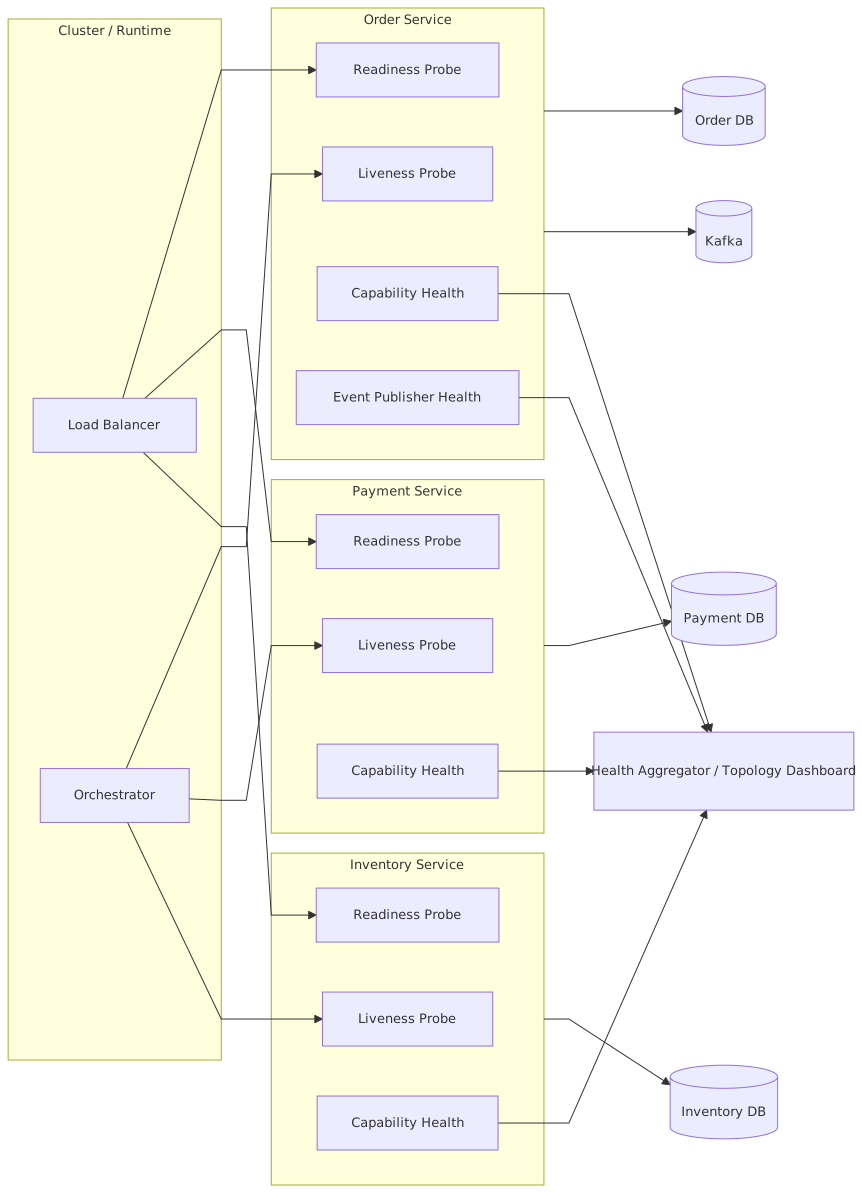
Notice what is absent: the orchestrator is not consulting the entire topology. It is making narrow decisions with narrow signals.
Health state taxonomy
A healthy architecture uses more than UP and DOWN. A practical taxonomy might include:
UPDEGRADEDDOWNSTARTINGDRAININGREAD_ONLYCATCHING_UPQUARANTINED
Not every state belongs in every endpoint. Readiness, for example, may still need a binary answer for infrastructure. But internal and operational APIs should carry richer state.
Push vs pull
There are two ways to gather distributed health:
- Pull: central system scrapes health endpoints.
- Push: services publish health state changes or heartbeats, often via Kafka or a monitoring pipeline.
Pull is simpler for small estates. Push is often more scalable and resilient at enterprise scale, especially for topology dashboards and historical incident analysis.
Kafka is useful here, but use it with restraint. Don’t turn health into another sprawling event domain with no ownership. Health events should be lightweight operational facts, not a substitute for traces, metrics, and logs.
A sensible approach:
- liveness/readiness remain local HTTP endpoints;
- capability and topology summaries are optionally emitted as events on state change;
- the aggregator consumes those events and stores a current view plus history;
- reconciliation processes compare reported health with observed metrics, consumer lag, and error rates to detect stale or dishonest health states.
That reconciliation step is underrated. Systems lie accidentally all the time.
Here is a state flow that illustrates local-to-topology progression.
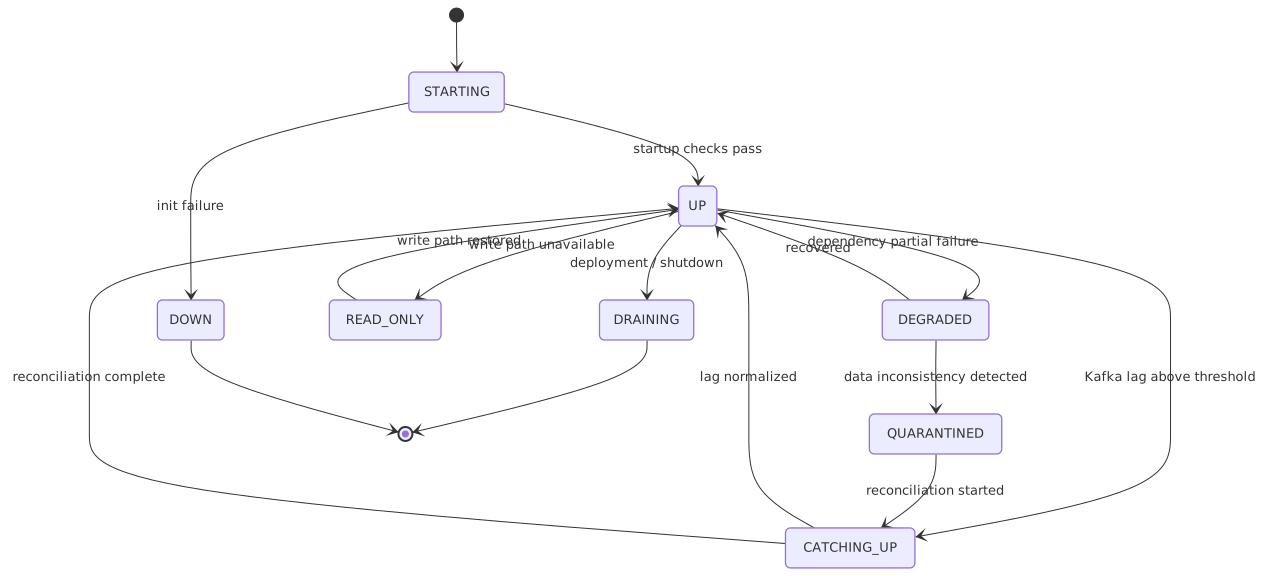
This is much closer to reality than pretending every service is simply alive or dead.
Migration Strategy
Most organizations arrive here with legacy probes that are too shallow, too deep, or both. Migration needs to be progressive. This is a good place for the strangler fig pattern, not just at the application layer but at the health model layer too.
Phase 1: Stabilize the basics
Before anything sophisticated, separate liveness and readiness. Remove deep dependency chains from liveness. If a pod is being restarted because a downstream service timed out, stop that first.
This alone can dramatically reduce restart storms.
Phase 2: Add capability-oriented health
Identify each service’s primary business capabilities. Express health for those capabilities using domain language. Keep these separate from orchestration probes.
A useful litmus test: can a product owner understand the component names in the health payload? If not, you are still too infrastructure-centric.
Phase 3: Introduce topology aggregation
Build a health aggregator that consumes constrained health summaries. Do not recursively scrape every transitive dependency. Ask each service to declare:
- critical dependencies,
- optional dependencies,
- degradation rules,
- recovery thresholds.
This creates a topological map of health without requiring every service to inspect the entire ecosystem.
Phase 4: Add event-driven health and reconciliation
For Kafka-based systems, publish health state changes or periodic summaries. Then reconcile that reported state against observed behavior:
- consumer lag,
- dead-letter queue rates,
- publish failure rates,
- end-to-end latency,
- reconciliation mismatches.
This is how you detect “green but wrong.”
Phase 5: Strangle legacy monitoring assumptions
Old dashboards and alerts often assume server-centric health: CPU, disk, process count. Keep them, but demote them. Replace “server alive” with “capability available” as the operational center of gravity.
Progressive strangler in mixed estates
During migration from a monolith, a common pattern is that the monolith remains the system of record while new microservices peel away capabilities. Health in this phase must acknowledge split authority.
An extracted service may be healthy locally but blocked because its synchronization feed from the monolith is stale. That is not a mere technical glitch. It is a health condition tied to the migration phase.
Here is a typical migration topology.
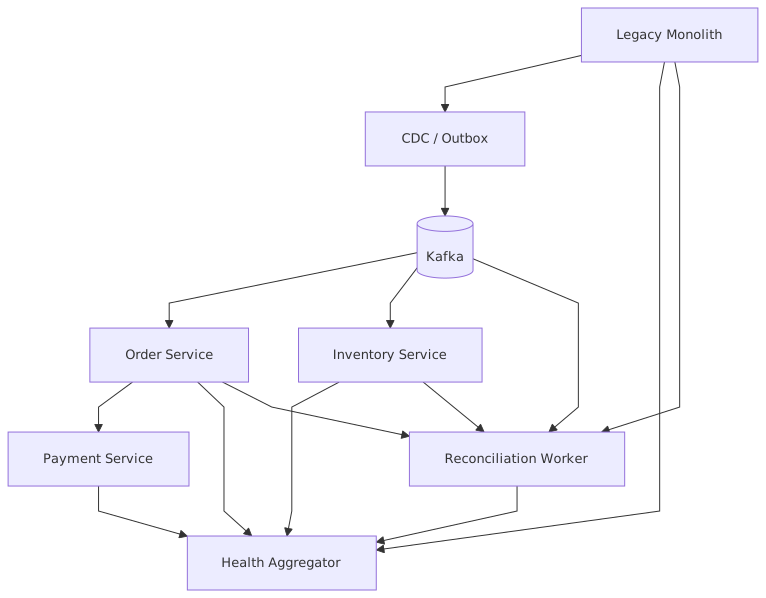
The migration insight is important: health must tell you not just whether the new service is running, but whether the old and new worlds are still in agreement.
Reconciliation during migration
Reconciliation is not optional in event-driven modernization. It is how you detect partial failure.
Suppose the monolith emits customer address changes to Kafka and the Customer Profile microservice consumes them. The consumer is running. Health endpoint says UP. But lag is rising and one malformed event schema has caused a hidden poison-message loop in a subset of partitions. Some customers are current, others are stale.
This is a reconciliation problem. Health should surface:
consumer-lag: DEGRADEDprofile-projection: CATCHING_UPsource-sync: STALE_BY_12M
That is the architecture behaving honestly.
Enterprise Example
Consider a large insurer modernizing claims processing.
The estate began with a central claims platform: one giant application, Oracle underneath, nightly batch jobs, and integrations to policy, payments, provider networks, fraud, and document management. The first modernization wave extracted microservices for claim intake, adjudication, payment instruction, and provider validation. Kafka was introduced as the event backbone because batch windows were no longer acceptable.
At first, every service implemented a standard /health endpoint. It checked JVM status, database connectivity, and maybe one external API. Operations loved the consistency. For three months, the dashboards looked clean.
Then a regional provider network started intermittently throttling requests. The provider validation service remained process-healthy and database-healthy, but its core business function degraded. Claim intake continued to accept submissions. Adjudication queued work. Payment instruction waited for provider verification. Kafka lag climbed, but slowly enough that the initial alerts did not fire.
The dashboard was green. The business was not.
Worse, one team had added downstream checks into readiness. As provider validation became slow, pods toggled in and out of ready state. The load balancer concentrated traffic on fewer instances, making latency worse. Kubernetes restarted some instances after compounded timeouts. Consumer groups rebalanced repeatedly. A manageable partial outage turned into a broad service incident.
The fix was architectural, not cosmetic.
They rebuilt health around domain capabilities:
- Claim Intake
- Provider Validation
- Adjudication
- Payment Instruction
- accept claim
- persist claim
- publish claim received
- validate provider eligibility
- refresh network reference data
- evaluate rules
- fetch policy coverage
- emit adjudication decision
- create payment instruction
- transmit to payment hub
They separated liveness from readiness. They stopped calling downstream services from liveness entirely. Readiness only considered whether the instance could safely handle its immediate work. Capability health tracked business functions. Topology health was built in a central dashboard using declared dependencies and Kafka lag.
Most importantly, they introduced reconciliation between claims accepted, claims validated, adjudication events, and payment instructions. This exposed where the flow was stalled even when individual services looked healthy in isolation.
The result was not magic. Incidents still happened. But they became intelligible. Provider throttling no longer looked like random pod instability. It appeared as Provider Validation: DEGRADED, Claim Intake: UP, Adjudication: CATCHING_UP, Payment Instruction: BLOCKED_ON_UPSTREAM. That is the kind of operational language that reduces mean time to innocence and mean time to recovery.
And that is enterprise architecture doing its actual job: making failure legible.
Operational Considerations
Distributed health checks live or die on operational discipline.
Timeouts and caching
Every check needs aggressive timeouts. A health endpoint should not become a long-running integration transaction. Cache results briefly where needed, especially for expensive checks. A stale-but-recent signal is often better than synchronized stampedes.
Thresholds and hysteresis
Do not flip states on single failures. Use windows, consecutive failures, and recovery hysteresis. Flapping is poison for automation and human trust alike.
Security
Health endpoints often leak topology, dependency names, or internal states. Expose minimal public probes and richer authenticated operational endpoints. A /health endpoint should not become an attacker’s architecture diagram.
Observability integration
Health is not a substitute for metrics, logs, or traces. It should be correlated with them. If health says UP while latency, error rates, or Kafka lag are exploding, the system needs reconciliation logic or a redesign.
Cardinality control
If every tenant, region, partition, and capability emits unique health dimensions, your observability platform will drown. Aggregate where possible. Reserve high-cardinality detail for drill-down, not default dashboards.
Deployment awareness
Support draining states during rollout. A service being deliberately removed from rotation should not appear “down.” Deployment transitions are part of health semantics.
Data quality and schema health
In event-driven architectures, technical transport success does not guarantee semantic success. Include checks for schema compatibility, poison-message handling, DLQ growth, and projection freshness.
Tradeoffs
There is no perfect distributed health model. There is only a set of informed compromises.
Richer health semantics improve diagnosis but increase implementation complexity and governance burden.
Topology-aware aggregation improves operational understanding but risks coupling and stale dependency maps.
Push-based health scales well but introduces event pipeline dependencies and eventual consistency in the health view itself.
Readiness checks with dependency awareness reduce bad traffic routing but can accidentally amplify incidents if they are too deep or too sensitive.
DDD-aligned capability health is meaningful but requires teams to actually understand their domain boundaries. Many organizations discover they are less clear on this than they thought.
And here is the hard truth: the more health drives automated decisions, the more conservative and local it should be. Humans can interpret nuance. Orchestrators cannot.
Failure Modes
Distributed health systems fail in their own distinctive ways.
Health check storm
A central monitor, service mesh, and orchestrator all poll aggressively. During degradation, response times increase, causing retries and more polling. The health system adds enough load to worsen the incident.
Recursive dependency collapse
Service A’s readiness depends on B, whose readiness depends on C, which checks A indirectly. One partial failure creates circular unavailability.
False green
The service process is alive and dependencies answer basic pings, but domain outcomes are failing due to bad data, schema drift, or asynchronous backlog.
False red
A non-critical dependency fails and the service marks itself unready even though it could serve a degraded but acceptable experience.
Restart storms
Readiness and liveness are confused. Downstream slowness causes liveness failures. Instances restart, lose warm caches, trigger rebalances, and deepen instability.
Stale topology view
An aggregator depends on manually declared service relationships that no longer reflect reality after a release. The dashboard tells yesterday’s truth.
Health pipeline dependency
If health events are sent over Kafka and Kafka is the thing that is degraded, the visibility path itself becomes suspect. This is why local probes and central topology mechanisms should not fully depend on the same channel.
When Not To Use
Not every system needs a sophisticated distributed health topology.
Do not build this pattern when:
- you have a small number of services with simple dependencies;
- the business impact of degradation is low;
- operational maturity is too low to maintain semantic health definitions;
- a monolith with strong modular boundaries would serve better than premature microservices;
- your platform team wants a grand health control plane before basic observability is working.
This is worth saying plainly: if your system is simple, keep health simple. A toy estate does not deserve an aerospace dashboard.
Likewise, if teams cannot clearly define service ownership, bounded contexts, or critical capabilities, a rich health model will just document confusion with more structure.
And in highly latency-sensitive systems, deep health calculations may cost more than they are worth. There, carefully scoped probes plus external SLO monitoring may be the better trade.
Related Patterns
Distributed health checks connect naturally to several architecture patterns:
- Strangler Fig Pattern
Useful when health semantics must span monolith and microservices during migration.
- Outbox Pattern
Helps distinguish between local transaction success and event publication health.
- Circuit Breaker
Prevents dependency failures from contaminating readiness and user-facing availability.
- Bulkhead
Supports partial degradation rather than total service collapse.
- Saga / Process Manager
Makes end-to-end business flow health visible across multiple services.
- CQRS and Read Models
Introduce freshness and projection health as first-class concerns.
- Anti-Corruption Layer
Often the right place to isolate brittle legacy dependency health from core domain services.
- Reconciliation Jobs
Essential in event-driven systems to validate eventual consistency and detect hidden divergence.
These patterns are not decorative neighbors. They are often what make health semantics truthful.
Summary
Distributed health checks in microservices are not an implementation detail. They are part of the operational contract of the architecture.
The wrong design treats health as a binary endpoint and lets deep dependency chains drive restarts and routing. That path leads to false confidence on good days and incident amplification on bad ones.
The better design separates concerns:
- liveness for process survival,
- readiness for safe traffic handling,
- capability health for domain-relevant function,
- topology health for operator understanding.
Use domain-driven design to define what healthy means inside each bounded context. Model capabilities, not just infrastructure. Distinguish critical from optional dependencies. Avoid recursive checks. Use Kafka or similar event streams to publish health state where useful, but reconcile reported health against observed outcomes. During migration, especially with strangler patterns, surface split authority and synchronization state honestly.
If there is one memorable rule to keep, let it be this:
A health check should tell the truth without making the situation worse.
That is the bar.
Meet it, and your health topology becomes a source of resilience and clarity. Miss it, and the thing meant to detect failure becomes one more way to manufacture it.
Frequently Asked Questions
What is a service mesh?
A service mesh is an infrastructure layer managing service-to-service communication. It provides mutual TLS, load balancing, circuit breaking, retries, and observability without each service implementing these capabilities. Istio and Linkerd are common implementations.
How do you document microservices architecture for governance?
Use ArchiMate Application Cooperation diagrams for the service landscape, UML Component diagrams for internal structure, UML Sequence diagrams for key flows, and UML Deployment diagrams for Kubernetes topology. All views can coexist in Sparx EA with full traceability.
What is the difference between choreography and orchestration in microservices?
Choreography has services react to events independently — no central coordinator. Orchestration uses a central workflow engine that calls services in sequence. Choreography scales better but is harder to debug; orchestration is easier to reason about but creates a central coupling point.