⏱ 20 min read
Resource allocation looks simple on a whiteboard. A request comes in, a service checks availability, a record is written, and everyone goes home happy. That fiction lasts right up until the first real enterprise shows up with partial inventory, competing channels, retries from flaky networks, and five teams each convinced their service owns the truth.
This is where architecture earns its keep.
Distributed resource allocation in microservices is not really about “allocating resources.” It is about managing promises under uncertainty. A seat, a VM quota, a warehouse slot, a truck appointment, a payment limit, a technician schedule—these are all promises the business makes to itself and to customers. In a monolith, those promises can be guarded by a single database transaction and a stern DBA. In microservices, the promise gets stretched across service boundaries, asynchronous messaging, delayed visibility, and independent failure. The allocation itself is often the easy part. Preserving business meaning when the system is under stress is the hard part. microservices architecture diagrams
A lot of teams discover this the expensive way. They split a monolith into services, push events through Kafka, and assume availability will “eventually” converge. Then they find double-booked inventory, phantom reservations, stuck holds, angry operators, and finance asking why the ERP says one thing while the order platform says another. This is not a tooling failure. It is usually a modeling failure. If you do not understand the domain semantics of allocation—what is reserved, what is committed, what expires, what can be oversubscribed, who is allowed to compensate—you cannot fix the problem with infrastructure.
So let’s talk about the architecture properly: with domain-driven design, migration discipline, and a healthy suspicion of anything that claims to make distributed consistency easy.
Context
Most enterprises do not allocate one thing in one place. They allocate scarce resources across channels, regions, and time. The resource may be tangible, like inventory in a fulfillment center, or intangible, like credit exposure for a customer account. But the shape of the problem is remarkably consistent:
- many consumers compete for limited capacity
- the business needs a fast answer
- the answer may change as downstream systems catch up
- failures happen in the middle of the flow
- reconciliation is not optional
In the monolith era, the standard answer was “put it in one database and lock rows.” Crude, effective, and often enough. But once the enterprise starts decomposing into microservices—Order, Inventory, Fulfillment, Billing, Capacity, Partner Gateway—that comfort disappears. Each service owns its own data. Each one evolves independently. Cross-service locking becomes either impossible or a performance disaster.
This is why distributed allocation is one of the first places where naïve microservice enthusiasm runs into real business physics.
The right response is not to wish for distributed transactions. The right response is to model the allocation lifecycle explicitly, isolate decision points, and accept that some truths are immediate while others are provisional.
Problem
The core problem is simple to state and awkward to solve:
How do you prevent over-allocation and preserve business intent when multiple microservices need to allocate the same scarce resource without a single transactional boundary?
That problem has several nasty variants:
- Competing demand
Web, mobile, call center, and partner APIs all want the same inventory or capacity.
- Partial visibility
One service sees “available,” another still processes a cancellation, a third has not consumed the Kafka event yet. event-driven architecture patterns
- Long-running workflows
Allocation is not the end of the business process. Payment, fraud checks, compliance, routing, or human approval may happen after the initial hold.
- Retries and duplicates
Networks fail. Clients retry. Consumers replay messages. Allocation requests must be idempotent.
- External system lag
ERP, warehouse management, mainframes, or vendor systems may be the system of record, but they are rarely fast enough to sit synchronously on the customer path.
The result is a tension every architect recognizes: the business wants real-time certainty, but the enterprise landscape offers only delayed and fragmented truth.
Forces
Good architecture is rarely about choosing the “best” pattern. It is about balancing forces that pull in opposite directions.
Consistency vs throughput
Strict consistency reduces errors but often serializes traffic and destroys throughput. If every allocation request must coordinate globally, you will eventually build a bottleneck with a nicer logo.
Business semantics vs technical simplification
Teams often flatten the domain into a single “allocated” flag. That works until the business asks the obvious questions:
- Is this a soft hold or a hard commitment?
- When does a hold expire?
- Can premium customers preempt standard demand?
- Is overbooking allowed for this resource type?
- Who can release or reassign an allocation?
The domain does not care that a Boolean was convenient.
Latency vs accuracy
Fast customer-facing decisions often rely on local projections or cached availability. Accurate decisions often require consultation with slower downstream systems. You cannot maximize both all the time.
Autonomy vs central control
Microservices want bounded contexts and local ownership. Allocation, however, often needs a central policy or at least a single decision authority per resource pool. Too much autonomy leads to inconsistent decisions. Too much centralization creates a distributed monolith.
Recovery vs elegance
The clean architecture sketch usually ignores repair. Real enterprises live on retries, replay, compensations, reconciliation jobs, operator tooling, and audit trails. If your design looks elegant only while everything succeeds, it is unfinished.
Solution
The best pattern in most enterprises is reservation-based allocation with explicit lifecycle states, backed by domain events and periodic reconciliation. Not glamorous. Very effective.
The key idea is this: stop pretending allocation is instantaneous final truth. Treat it as a state machine.
Typical states might include:
AvailableHeldConfirmedReleasedExpiredConsumedFailed
The exact names matter less than the semantics. A hold means “temporarily promise this resource while other checks complete.” A confirmation means “the business has committed.” A release means “the promise is revoked.” This vocabulary is not cosmetic. It is the backbone of the model.
This is where domain-driven design matters. The allocation domain should not be buried as plumbing inside Order or Inventory. It deserves its own bounded context when allocation rules are complex, cross-cutting, or strategic. In that bounded context, the aggregate is often not the order but the resource pool, allocation, or reservation ledger.
A useful mental model is a bank account, not a warehouse shelf. You do not just ask “how much is left?” You maintain a ledger of debits, credits, holds, expirations, and adjustments. The available amount is derived from those facts. This is more robust than trying to constantly maintain a single mutable quantity and hoping all writers behave.
In microservices, the architecture usually looks like this:
- a client or upstream workflow requests allocation
- an Allocation service evaluates policy and creates a reservation
- the service publishes an
AllocationHeldevent - downstream services complete their work
- on success, a
ConfirmAllocationcommand finalizes it - on failure or timeout, the reservation is released or expires
- reconciliation verifies that the ledger, projections, and external systems converge
This pattern works especially well with Kafka because event streams give you durable sequencing, auditability, replay, and a clean way to build availability projections. But Kafka is not the design. It is the transport and history. The design is the lifecycle model.
High-level allocation flow

The discipline here is important: one component should be authoritative for making allocation decisions for a given pool of resources. Many components may observe. Few should decide.
Architecture
Let’s get concrete.
1. Allocation as a bounded context
In domain-driven design terms, allocation is often a separate bounded context that translates commercial demand into constrained commitments against finite supply. Order Management cares about customer intent. Inventory cares about stock positions. Fulfillment cares about pickable reality. Allocation sits between them and arbitrates scarcity.
This bounded context typically owns:
- reservation lifecycle
- allocation policy
- prioritization rules
- expiration behavior
- overbooking rules
- audit trail of decisions
It should not own every inventory fact. That is a common mistake. Allocation needs the facts required to decide, not the whole world.
2. Ledger over mutable counters
A ledger model gives you traceability and safer recovery. Instead of one “available_quantity” field being hammered by many updates, you maintain facts:
- supply added
- supply removed
- reservation created
- reservation confirmed
- reservation released
- adjustment posted
Availability becomes a computation or projection.
This gives you something precious in enterprises: explainability. When an executive asks why a customer could not book a slot, you need more than “the row said zero.”
3. Command side and read side
Distributed allocation benefits from separating the command model from the read model. The command side protects invariants and writes the ledger. The read side projects availability for search, quoting, and dashboards.
That projection may be eventually consistent, which is fine as long as the command side remains authoritative. Search can say “likely available.” Confirmation must ask the authority.
4. Kafka as event backbone
Kafka fits naturally when:
- many services need allocation events
- replay is useful
- you need decoupled projections
- order matters within a resource partition
- you want durable event history
Partitioning matters. If resource allocations must be processed in order for a specific pool or SKU, partition by that key. Ignore this and you will manufacture race conditions with industrial efficiency.
5. Timeouts and expiration
Holds without expiration are just leaks with better branding. Every hold should have a time-to-live consistent with business reality. Payment authorization may justify minutes. Human approval may justify hours. A call-center draft order overnight may justify a different policy entirely.
Expiration should be explicit and observable, not hidden in ad hoc cleanup.
6. Reconciliation as first-class architecture
Reconciliation is not a patch for bad systems. In distributed allocation, it is part of the system.
You need jobs and tools that compare:
- ledger state vs read model
- allocation state vs order state
- allocation state vs ERP or WMS
- expected events vs consumed events
- expired holds vs actual releases
This is how large enterprises survive partial failure. They do not assume convergence; they verify it.
Detailed architecture view
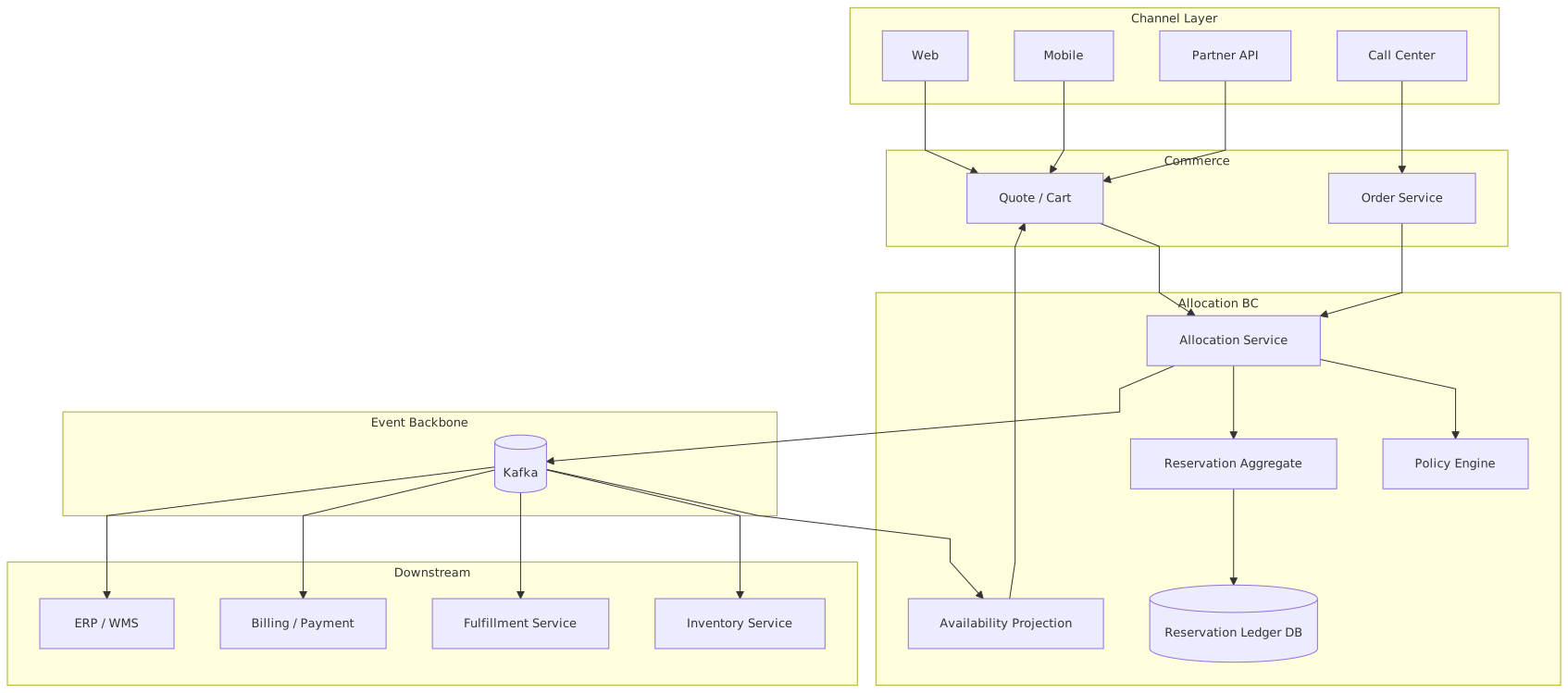
A policy engine can be useful, but do not over-romanticize it. If your policies are stable and simple, keep them in code. A policy engine earns its place when rules vary by product, region, customer tier, or channel and change frequently enough to justify explicit governance. EA governance checklist
Migration Strategy
This is where many architecture articles go soft. They draw the target state and mumble “migrate incrementally.” But migration is the architecture. If you cannot move there safely from the estate you actually have, the target design is theatre.
The usual starting point is a monolith or ERP-centric process where allocation is embedded in order capture or inventory tables. You do not rip that out. You strangle it progressively.
Step 1: Model the domain before extracting services
First define the semantics:
- what is a reservation?
- what is a commitment?
- what can expire?
- which resource pools are interchangeable?
- where is over-allocation acceptable?
- what is the source of truth during transition?
If the domain language is fuzzy, extraction will only spread confusion.
Step 2: Introduce an allocation API in front of the legacy logic
Keep the legacy engine behind a stable interface. New channels call the API, not the old schema or embedded monolith function. At this stage, behavior may still be implemented by the monolith. That is fine. The interface is the first seam.
Step 3: Emit allocation events
Even if the legacy engine still decides, begin publishing domain events such as AllocationHeld, AllocationConfirmed, AllocationReleased. Use these to build projections and downstream integrations. This creates observability and decouples consumers.
Step 4: Carve out one resource domain or channel
Do not migrate all allocation at once. Pick a bounded slice:
- one warehouse
- one market
- one appointment type
- one product family
- one partner channel
This reduces blast radius and exposes domain gaps early.
Step 5: Run shadow mode
The new Allocation service computes decisions in parallel without becoming authoritative. Compare its decisions to the legacy engine. Investigate drift. This step uncovers hidden rules, dirty data, and business exceptions that nobody documented because “the old batch job just handles it.”
Step 6: Move authority gradually
Once confidence is high, make the new service authoritative for the chosen slice. Keep reconciliation against the old system. Then expand scope.
Step 7: Retire direct legacy writes
One of the most dangerous intermediate states is dual authority. If both new and old paths can independently allocate the same pool, overbooking is not a risk; it is a certainty with a date pending. Eventually, all writes must go through one authority per pool.
Progressive strangler migration
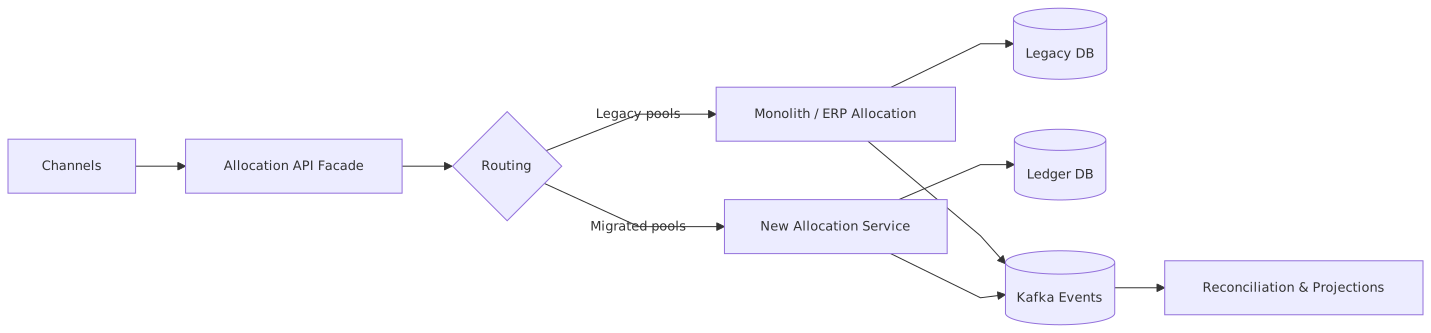
This is the practical shape of enterprise migration: an anti-corruption layer, selective routing, parallel run, and relentless reconciliation.
Enterprise Example
Consider a global manufacturer that sells spare parts through e-commerce, dealer networks, and field service. The same part inventory supports direct customer orders, warranty repairs, and technician van replenishment. The legacy ERP is the official stock system, but updates from regional warehouses arrive with delays. Service-level agreements differ by channel: field technicians fixing outages outrank standard web orders; premium dealer orders may outrank internal replenishment.
In the old world, allocation lived inside the ERP and a tangle of nightly batch adjustments. It worked as long as order volume was modest and channels were mostly human-mediated. Then the company launched same-day promises on the web and exposed APIs to dealer systems. Suddenly, allocation latency mattered. So did correctness.
The first attempt was classic modern enterprise optimism: create Inventory Service, Order Service, and Fulfillment Service, stream changes through Kafka, and let each service maintain its own availability view. It looked clean in PowerPoint. In production, it collapsed under race conditions. Dealer orders and web orders both saw stale availability. Technicians got dispatched with parts that had already been “soft allocated” elsewhere. Operators built spreadsheets to override the system. Architecture had been replaced by folk remedies.
The recovery started when the firm admitted that allocation was its own domain.
They created an Allocation service that owned reservation decisions for selected high-value part families. The ERP remained the long-term stock record, but the Allocation service became the decision authority for customer-facing commitments in those domains. It kept a reservation ledger, consumed stock updates, and published lifecycle events via Kafka. Reservations for web orders lasted 15 minutes pending payment; technician reservations lasted until route confirmation; dealer reservations had quota rules and customer-tier priority.
The migration was progressive. For one region and two warehouses, the new service ran in shadow mode for six weeks. Every mismatch with ERP behavior was classified:
- hidden business rule
- stale source data
- legacy defect
- deliberate policy change
That classification exercise was worth more than half the code. It turned institutional folklore into explicit policy.
Reconciliation became a daily discipline, not a back-office afterthought. A job compared ERP available stock, allocation ledger balances, and open order states. Most discrepancies were harmless timing gaps. Some were not: duplicate partner retries created repeated hold attempts; warehouse adjustments arrived out of order; one consumer group lagged for hours after a rebalance. Because the architecture assumed these failure modes would exist, the team had tools to identify and repair them.
The result was not “perfect consistency.” That phrase belongs in vendor brochures. The result was controlled inconsistency with clear authority, auditable decisions, and bounded repair procedures. Web oversell incidents fell sharply. Field service priority became enforceable in software instead of by shouting. And perhaps most importantly, business stakeholders finally had language for what the system was doing.
That is what good architecture often buys: not magic, but legibility.
Operational Considerations
Distributed allocation succeeds or fails operationally.
Idempotency
Every allocation request needs a business idempotency key. Not a vague correlation ID buried in logs. A real key tied to the business action: order line, cart hold, booking request, payment attempt. Without this, retries become duplicates and duplicates become incidents.
Partitioning and ordering
Kafka helps only if event ordering aligns with business invariants. If all reservations for the same resource pool must be evaluated sequentially, use the resource pool as the partition key. If you partition by customer because it was convenient for analytics, do not be surprised when stock gets oversold.
Observability
Track:
- hold creation rate
- confirmation latency
- expiration rate
- release failures
- projection lag
- reconciliation mismatch counts
- duplicate command rate
Allocation is a business control point. Treat its telemetry as business telemetry, not merely infrastructure metrics.
Operator tooling
Humans will need to inspect and sometimes repair allocations. Build tooling to:
- search reservations by order, resource, or customer
- view event history
- manually release stale holds with audit
- replay projections safely
- trigger reconciliation for a scope
The absence of these tools does not remove the need. It merely shifts repair into SQL consoles and panic.
SLA-aware design
Not every resource deserves the same strategy. If a failed allocation means a customer waits an extra second, eventual consistency may be fine. If it means a surgeon cannot book an operating room or a telecom outage crew lacks replacement parts, use tighter controls and maybe less distribution.
Tradeoffs
There is no free lunch here. Only better bills.
Benefits
- explicit domain semantics
- reduced over-allocation risk
- auditability and explainability
- better fit for long-running workflows
- safe asynchronous integration via Kafka
- independent scaling of reads and writes
Costs
- more states to manage
- eventual consistency in projections
- need for expiration and cleanup
- reconciliation complexity
- operational burden of event-driven systems
- difficult data migration from legacy systems
A central allocation service can become a hotspot. That is the price of concentrated decision authority. Sometimes that is absolutely the right trade. Scarcity needs a referee. But if every low-value request must line up at one gate, you may create a throughput ceiling. Partitioning by resource pool, region, or product family is often the practical answer.
Another tradeoff is between generic design and domain-specific modeling. Teams love building a reusable “resource allocation platform.” Usually too early. Different domains have different semantics. Seat assignment, credit exposure, and technician scheduling look similar only from altitude. Down at ground level, the rules diverge. Build for your core domain first. Generalize later, if reality permits.
Failure Modes
This topic deserves bluntness.
Dual writers
Two systems think they can allocate the same resource pool. This is the most dangerous migration failure. It creates invisible over-commitment that reconciliation discovers too late.
Stale projections
The read model says capacity exists; the command side rejects it. This is survivable if the customer experience handles “availability changed” gracefully. It is disastrous if your business promised certainty too early.
Zombie holds
Reservations are created but never confirmed or released because a downstream workflow crashed. Without expiration and cleanup, capacity quietly disappears.
Out-of-order events
A release arrives before the hold is visible, or a stock adjustment is processed after a later reservation. If the system cannot tolerate reordering or detect causality, state drifts.
Replay corruption
Consumers replay Kafka topics into projection stores without proper idempotency or version checks. Suddenly the dashboard says negative inventory and everyone blames Kafka. The broker was innocent; the design was not.
Reconciliation blindness
The architecture assumes periodic repair, but nobody defines thresholds, ownership, or runbooks. So mismatches accumulate until they become a quarter-end crisis.
Policy drift
Business rules are copied into multiple services “for convenience.” Soon partner allocation behaves differently from web allocation, and no one can explain why VIP customers lost priority in one channel.
Distributed systems fail in ordinary ways, not cinematic ones. Usually it is stale state, ambiguous ownership, missing idempotency, and absent repair procedures. Boring failures. Expensive consequences.
When Not To Use
You do not need this architecture for every problem that contains the word “allocation.”
Do not use a distributed reservation model when:
- resources are abundant and over-allocation has trivial cost
- the workflow is short and can stay inside one transactional boundary
- one database and one service are entirely sufficient
- the domain has weak business semantics around holds and commitments
- the team lacks operational maturity for event-driven systems
- reconciliation would be impossible due to missing source data
A small internal application assigning office desks does not need Kafka, a ledger, and a bounded context. Neither does a simple quota check that can be handled in a single service and relational transaction. Architecture should solve the problem you have, not advertise your cloud budget.
This is also not a good fit when the enterprise refuses to accept eventual consistency anywhere in the flow but also refuses centralized authority. That combination is a fantasy requirement. At some point, physics gets a vote.
Related Patterns
Several patterns commonly pair with distributed allocation.
Saga
Useful when allocation is one step in a larger workflow involving payment, shipping, fraud, or approval. But remember: a saga coordinates steps; it does not replace allocation semantics.
Outbox pattern
Critical when publishing allocation events reliably from the command side. If your ledger update and event publication can diverge, your architecture will eventually split reality in half.
CQRS
Helpful for separating authoritative reservation decisions from fast search and availability views.
Event sourcing
Sometimes a natural fit for the ledger. But not mandatory. If event sourcing becomes a religion rather than a practical tool, step back. A well-designed append-only ledger with projections often gives most of the value without turning every developer into a historian.
Anti-corruption layer
Essential during migration from ERP or monolith models into a cleaner allocation domain.
Competing consumers
Useful for scaling Kafka consumers, provided partitioning preserves the invariants you care about.
Summary
Distributed resource allocation in microservices is one of those subjects that punishes shallow thinking. It is not just an inventory problem, nor merely a workflow problem, nor simply an eventing problem. It is a domain problem shaped by scarcity, timing, and promises.
The architecture that works in enterprises tends to share a few traits:
- allocation is modeled explicitly as a bounded context
- reservations have clear lifecycle states
- one authority decides per resource pool
- Kafka carries facts, not wishful thinking
- projections are fast but not authoritative
- reconciliation is designed in, not bolted on
- migration follows a progressive strangler path
- failure is expected and repairable
If there is one line worth remembering, it is this: allocation is the management of promises under uncertainty. Once you see it that way, the design choices become clearer. You stop chasing fake simplicity. You start building systems that can make a promise, keep it when possible, and repair it honestly when the world intervenes.
That is what enterprise architecture is for. Not to make diagrams prettier, but to help the business survive reality.
Frequently Asked Questions
What is a service mesh?
A service mesh is an infrastructure layer managing service-to-service communication. It provides mutual TLS, load balancing, circuit breaking, retries, and observability without each service implementing these capabilities. Istio and Linkerd are common implementations.
How do you document microservices architecture for governance?
Use ArchiMate Application Cooperation diagrams for the service landscape, UML Component diagrams for internal structure, UML Sequence diagrams for key flows, and UML Deployment diagrams for Kubernetes topology. All views can coexist in Sparx EA with full traceability.
What is the difference between choreography and orchestration in microservices?
Choreography has services react to events independently — no central coordinator. Orchestration uses a central workflow engine that calls services in sequence. Choreography scales better but is harder to debug; orchestration is easier to reason about but creates a central coupling point.