⏱ 20 min read
Most distributed systems do not fail all at once. They fail sideways.
A recommendation engine slows down and suddenly checkout threads are exhausted. A fraud service starts timing out and customer support can no longer load account details. A reporting job bursts through the system at 9 a.m., and the mobile app looks “randomly unstable” even though nothing is technically down. This is the ordinary violence of modern microservices: not one dramatic collapse, but cascading impairment. A bad day in one corner becomes a bad week everywhere else. microservices architecture diagrams
That is why the bulkhead remains one of the most useful patterns in enterprise architecture. Not because it is fashionable, but because it is bluntly honest about how software behaves under pressure. Ships use bulkheads because water does not respect team boundaries. Microservices need them for the same reason. If one compartment floods, the vessel should still move.
In reactive systems, the idea gets sharper. We are not just partitioning infrastructure; we are partitioning demand, execution, flow control, and failure semantics. We are deciding, explicitly, which parts of the business deserve protection from each other. That is not a technical footnote. It is a domain decision.
A good bulkhead is never just “some thread pool tuning.” It encodes what the enterprise is willing to sacrifice in order to preserve what matters most.
This article digs into reactive bulkheads in resilient microservices from the perspective of enterprise architecture: how they fit into domain-driven design, why they matter in Kafka-heavy event-driven estates, how to migrate toward them without stopping the world, where reconciliation fits, and where the pattern becomes ceremony rather than help. event-driven architecture patterns
Context
Microservices changed the failure shape of enterprise systems. Monoliths tended to fail vertically: one process, one database, one blast radius. Microservices fail laterally. They exchange network calls, stream events, compete for shared CPU, consume from the same broker clusters, and often meet again at the customer journey.
The promise was autonomy. The reality is interdependence with better packaging.
Reactive architecture entered this picture for a reason. Once services communicate asynchronously, handle bursty loads, and operate at large concurrency, the old assumption that every request deserves immediate, equal treatment becomes dangerous. Backpressure, message flow control, bounded queues, and isolation policies stop being implementation detail and become survival mechanisms.
This is especially visible in event-driven systems built around Kafka. Kafka is excellent at absorbing spikes and decoupling producers from consumers. But it does not magically remove downstream constraints. If one consumer group lags because it is starved of processing threads, or because it depends on a slow external service, pressure moves. Lag grows. Retries amplify. Dead-letter queues fill. The system remains “up,” while the business capability is effectively degraded.
That distinction matters.
A resilient enterprise architecture does not ask, “Is the platform available?” It asks, “Can we still complete payment, fulfill the order, and answer the customer?” In domain-driven terms, resilience belongs to business capabilities and bounded contexts, not just to middleware. Bulkheads should be designed around those boundaries.
Too many organizations implement resilience patterns as infrastructure decorations: a circuit breaker library here, an API gateway policy there, a generic Kubernetes autoscaler somewhere else. Useful, yes. Sufficient, no. If the same compute budget, queue depth, connection pool, or consumer concurrency is shared across unrelated capabilities, one context can still poison another.
Reactive bulkheads are what you reach for when you decide that not all workloads should drown together.
Problem
The core problem is simple: shared execution resources create hidden coupling between services and workloads.
That coupling appears in many forms:
- Shared thread pools across unrelated outbound calls
- Shared Kafka consumer workers for different event types
- Shared connection pools to multiple downstream dependencies
- Shared rate limits across premium and standard customer flows
- Shared in-memory queues for operational and analytical tasks
- Shared autoscaling units that cannot distinguish critical from non-critical work
Under normal load, these compromises seem efficient. Under stress, they become channels for failure propagation.
Consider a common enterprise setup. An Order service handles customer checkout. It invokes Payment, Inventory, Pricing, and Fraud services, while also publishing domain events to Kafka for fulfillment and analytics. On paper these are separate services. In practice, if all outbound calls share the same reactive scheduler, if all event consumers share the same worker pool, and if retries are unconstrained, then one struggling dependency can consume the service’s entire execution budget.
Now the system is not merely slow. It becomes unfair.
Critical requests queue behind non-critical work. State transitions happen out of sequence. Timeouts trigger duplicate commands. Eventually teams say things like “Kafka is slow today” or “Kubernetes didn’t scale fast enough,” which usually means nobody designed isolation based on domain priority.
This is where many architectures confuse decoupling with resilience. Asynchronous messaging decouples time. It does not decouple contention unless you also isolate processing capacity, queue budgets, retry behavior, and admission control.
The reactive bulkhead addresses that gap.
Forces
Architectural patterns are interesting only when they resolve competing forces. Bulkheads are full of tradeoffs because they protect one thing by limiting another.
1. Throughput versus isolation
Shared pools maximize average utilization. Bulkheads reduce interference but can leave capacity stranded in one compartment while another is starved. This offends platform teams who worship aggregate efficiency. It should. Isolation is intentionally inefficient at the margin. That is the price of graceful degradation.
2. Simplicity versus business priority
A single work queue is easy. Separate pools for checkout, refunds, notifications, and reporting are not. But business value is not evenly distributed. The architecture must reflect that. If the queue for customer password reset can block payment authorization, your system is saying something absurd about the business.
3. Reactive flow control versus user expectations
Backpressure is healthy. Refusing excess work is better than pretending. But enterprises are uncomfortable with explicit shedding because it looks like failure. In truth, selective rejection is often what preserves the customer journey.
4. Domain autonomy versus platform consistency
Each bounded context may need different bulkhead policies. Fraud scoring may tolerate latency and asynchronous reconciliation. Payment authorization may require tiny queues and strict deadlines. Platform standardization is useful, but forcing every domain into one resilience profile is laziness disguised as governance. EA governance checklist
5. Immediate consistency versus eventual correctness
Bulkheads often push us toward asynchronous interactions. That introduces gaps: events arrive later, messages are retried, sagas stall, local views become stale. The answer is not to wish for synchronous certainty. The answer is to design reconciliation and compensating behaviors into the domain.
6. Recovery speed versus retry amplification
Retries can help transient faults. They can also create a self-inflicted denial of service. Without isolated retry budgets and bounded queues, bulkheads are perforated walls.
Solution
A reactive bulkhead isolates execution, demand, and failure around meaningful business flows so that overload or impairment in one workload does not cascade into others.
That sentence matters because many teams implement only half the pattern.
A proper reactive bulkhead usually combines several mechanisms:
- Dedicated execution resources for specific flows or downstream dependencies
Separate thread pools, schedulers, worker groups, or compute allocations.
- Bounded queues
Unlimited buffering is denial, not resilience. A queue must have a size and a policy.
- Admission control
Reject, defer, or reroute work when the compartment is full.
- Backpressure-aware messaging
Reactive streams, controlled Kafka consumer concurrency, and pull-based flow where possible.
- Independent timeout and retry policies
Fraud checks, search enrichment, and customer notifications should not all retry the same way.
- Fallback or degradation semantics
Preserve order placement without recommendations; preserve account inquiry without statement generation.
- Observability at compartment level
Pool saturation, queue depth, lag, reject rate, timeout rate, and compensation backlog must be visible by business flow.
The key idea is to isolate not just by service, but by purpose. In domain-driven design terms, the right unit of protection is often a bounded context or a high-value domain interaction. Sometimes it is even narrower: inside one service, checkout commands and analytical event enrichments should live in different bulkheads because they represent different business intent.
A bulkhead is therefore a policy boundary.
And policy should follow domain semantics.
If “Reserve Inventory” is part of the core order lifecycle, protect it differently from “Send Promotional Email.” If “Post Ledger Entry” is system-of-record behavior, it should not be queued behind customer activity stream fan-out. This is where architecture stops being plumbing and starts being language.
A conceptual view
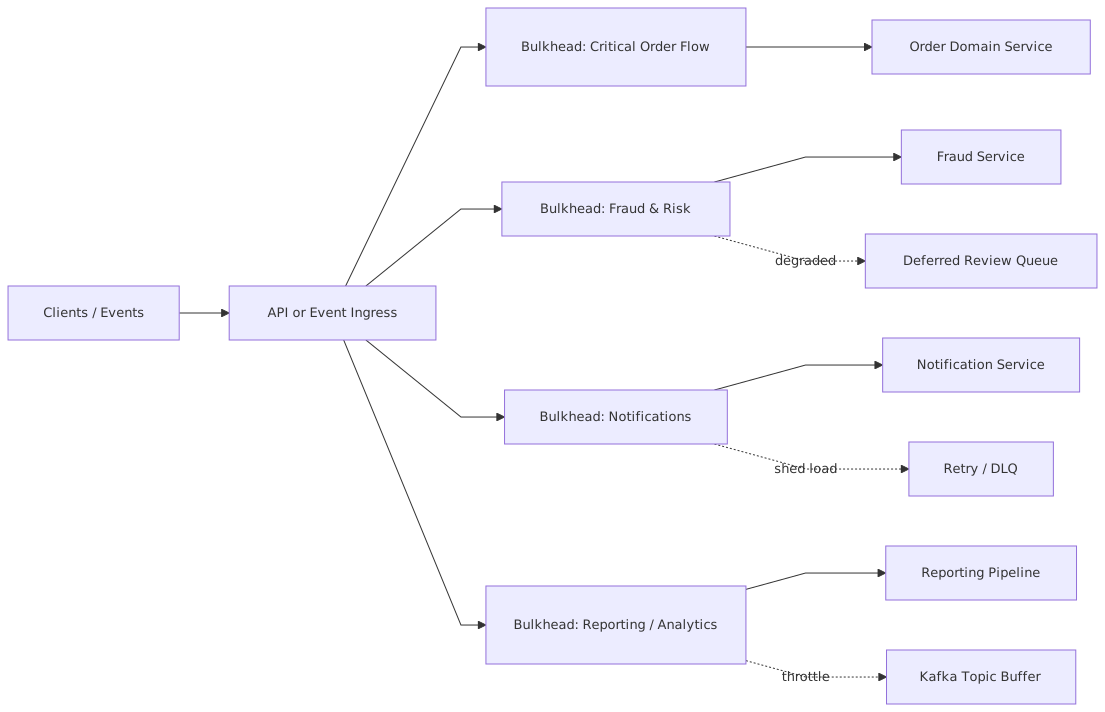
The point is not the boxes. The point is that each lane can saturate, degrade, or recover independently.
Architecture
Reactive bulkheads appear at several layers. Mature architectures use more than one.
1. Inbound bulkheads
These isolate incoming work by channel, tenant, command type, or priority. API gateways can enforce rate limits, but real isolation usually happens inside the service boundary where domain intent is known. Premium customer actions may get different concurrency than batch jobs. Commands may be separated from queries. Operational traffic may be protected from partner integrations.
If every request enters the same execution path before policy is applied, the bulkhead is already late.
2. Outbound dependency bulkheads
A classic case. Calls to Payment, Fraud, CRM, and Search should not share the same connection pool or scheduler. A stalled downstream dependency must not pin unrelated work. In reactive stacks, this means dedicated operator chains, bounded concurrency, and separate timeout budgets.
Do not hide all outbound calls behind one “resilience” wrapper. That creates standardization and removes judgment. Those dependencies are not the same.
3. Event processing bulkheads
This is where Kafka changes the conversation. Kafka gives durable decoupling, but consumers still need compartmentalized execution. If one service processes OrderPlaced, RefundRequested, and CustomerNotified events using the same listener container and worker pool, then backlog in one event type affects all others.
Separate consumer groups are sometimes warranted. More often, separate topics, partitions, handler pools, or priority-aware routing are enough. The exact mechanism matters less than the principle: event classes with different business criticality should not share fate.
4. Stateful workflow bulkheads
Long-running sagas and orchestrations deserve isolation of their own. A backlog in compensation workflows should not consume the same budget as forward-progress workflows. Reconciliation jobs should not monopolize the command path. This is routinely missed in enterprise estates, where “background processing” quietly becomes the system’s biggest bully.
5. Data access bulkheads
The database is often the final shared dependency. Read pools, write pools, reporting replicas, and dedicated connection budgets are all forms of bulkhead. If ad hoc reporting can starve transaction processing, your architecture is still monolithic where it counts.
Example reference architecture
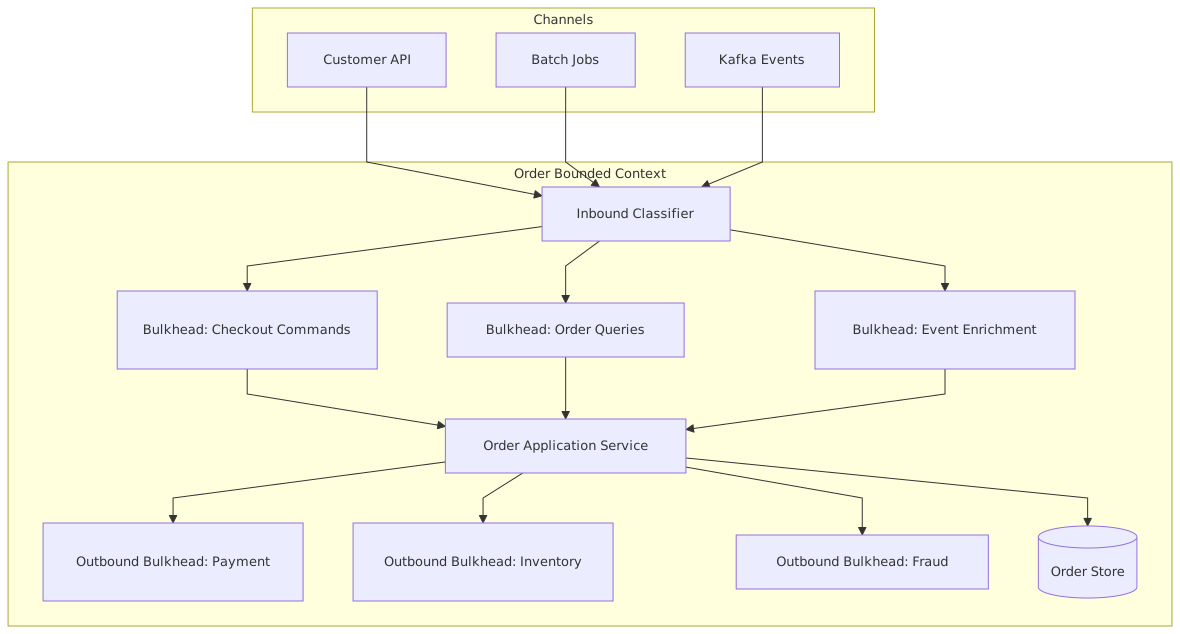
What matters in this diagram is the layering. You isolate before entering the application core, and again around risky outbound dependencies.
Domain semantics discussion
This is where many articles become mechanical and miss the point. Bulkheads are not merely resource partitions; they are statements about business semantics under stress.
Ask hard questions:
- What must continue during partial failure?
- What can be deferred and later reconciled?
- What can be approximated?
- What must fail fast to preserve integrity?
- Which interactions are commands, which are notifications, and which are projections?
- Which bounded contexts are upstream policies, and which are downstream consumers?
For example, in a retail order domain:
- Authorize payment is a command with strict timeliness and integrity requirements.
- Generate recommendation update is derivative and can lag.
- Issue loyalty points may be eventual, provided reconciliation is reliable.
- Fraud escalation may move from real-time to post-order review under degradation, but only if the business accepts that risk.
These are not infrastructure settings. They are domain choices. Good architecture names them out loud.
Migration Strategy
No enterprise starts with perfect reactive bulkheads. Most inherit a shared-everything service mesh of hopes and dashboards. So the practical question is migration.
Use a progressive strangler approach. Not because it is elegant, but because big-bang resilience rewrites usually fail the same way digital transformations fail: they preserve abstraction and lose cash.
Step 1: Find the real coupling
Do not begin with code. Begin with incidents.
Map customer-visible degradation to shared resources:
- Which thread pools saturated?
- Which Kafka consumers lagged?
- Which retries exploded?
- Which dependencies pinned all outbound calls?
- Which queue depths correlated with failed business journeys?
This gives you the first seams.
Step 2: Classify workloads by domain criticality
Partition flows into a small set:
- mission-critical transactional
- important but deferrable operational
- low-priority notification
- analytical/reporting
- reconciliation/repair
Do not create twelve priority classes because you can. Most organizations cannot operate that much nuance.
Step 3: Introduce internal bulkheads before service decomposition
If you have a modular monolith or coarse-grained service, start there. Separate executors, bounded queues, and policy per use case. This often delivers immediate resilience without a network hop tax. DDD helps here: bulkhead around application services aligned to aggregates and commands.
Step 4: Strangle hot paths outward
As capabilities are extracted into microservices, preserve the isolation policy. Do not decompose services and then re-couple them through a shared event handler pool or a generic integration service. The strangler pattern should move both functionality and resilience boundaries.
Step 5: Add Kafka-based decoupling selectively
Kafka is ideal where temporal decoupling helps absorb spikes or support eventual consistency. It is not a blanket answer. Use it where commands can become events, where consumers can process independently, and where reconciliation can restore correctness after delay.
Avoid turning every request into an event merely to call the architecture “reactive.”
Step 6: Build reconciliation early
This is the part teams postpone, and then they discover their resilient architecture has no memory. If a bulkhead defers work, sheds load, or reroutes flows, you need reconciliation to restore business truth:
- replay missed events
- detect inconsistent aggregates
- compare source-of-truth records to projections
- trigger compensating actions
- repair orphan workflows
Reconciliation is not a housekeeping script. It is the operational twin of eventual consistency.
Step 7: Move policy from code folklore into platform contracts
Once patterns stabilize, encode them in templates, libraries, and deployment blueprints. But only after domains have taught you what the right distinctions are. Centralized standards should capture proven semantics, not erase them.
Migration view

The migration is progressive, but not passive. You are intentionally moving from accidental coupling to deliberate compartments.
Enterprise Example
Consider a global insurance company modernizing claims processing.
The original platform looked familiar: a large claims system of record, several Java services around it, nightly integrations, and a growing Kafka backbone used by digital channels. New microservices handled FNOL (first notice of loss), document ingestion, fraud scoring, policy validation, and customer communication.
On paper, this was already “event-driven microservices.” In production, a spike in document submissions during a regional storm caused widespread degradation. OCR processing consumed shared worker pools. Kafka consumers for claim updates lagged. Fraud scoring calls timed out and retried aggressively. Customer self-service status checks piled into the same execution budget as claim registration. The entire estate remained technically alive. Customers simply could not complete claims reliably.
The architecture team did not solve this by adding more pods.
They re-segmented the workload around domain semantics:
- Claim registration became a protected critical flow with dedicated ingress limits, small bounded queues, and isolated workers.
- Policy validation kept synchronous behavior but used independent outbound bulkheads and aggressive fail-fast rules.
- Fraud scoring moved to a separate compartment with a business-approved degraded mode: low-risk claims could proceed to manual review queue if the fraud service was saturated.
- Document OCR became fully asynchronous on Kafka with strict consumer isolation from core claim lifecycle topics.
- Customer notifications were explicitly low priority and load-shed under stress.
- Reconciliation services compared claim state across the claims core, event log, and document store to repair drift after storm events.
The effect was not that failures disappeared. Storm surges still stressed the estate. But failures stopped spreading. Claims could be registered even when OCR lagged by hours. Fraud backlogs grew without freezing policy validation. Notification delays no longer harmed customer self-service. Business leaders finally got what resilience should have meant all along: important things still worked when less important things did not.
That is a real enterprise bulkhead story. Not elegance. Triage with intent.
Operational Considerations
Bulkheads live or die in operations.
Metrics that actually matter
Measure by compartment, not by service average:
- queue depth
- active concurrency
- reject count
- timeout rate
- retry rate
- saturation duration
- Kafka consumer lag
- dead-letter volume
- compensation backlog
- reconciliation age
A service-level “healthy” dashboard is meaningless if the checkout bulkhead is saturated and the reporting bulkhead is idle.
Capacity planning
Reactive bulkheads need capacity budgets. Decide:
- maximum concurrent requests per flow
- max queue sizes
- shed thresholds
- partition-to-consumer ratios in Kafka
- retry budgets per dependency
- CPU/memory reservations where required
This is one place where enterprise architecture must collaborate with SRE and platform engineering. Otherwise the design remains a PowerPoint with no teeth.
Alerting
Alert on sustained saturation and failed degradation, not on every transient timeout. The most dangerous condition is a bulkhead that fills silently while work appears accepted upstream.
Testing
Run game days with targeted impairment:
- slow Fraud, observe Payment and Checkout
- flood reporting topics, observe operational command latency
- force Kafka lag in one consumer group, verify others remain healthy
- disable reconciliation jobs, observe data drift accumulation
If you do not test isolation under pressure, you do not have isolation.
Governance
Architectural governance should ask:
- what business capability does this bulkhead protect?
- what is its explicit overflow policy?
- what is its reconciliation path?
- what data inconsistency is acceptable and for how long?
- who owns tuning and who approves degradation semantics?
Those are the right enterprise questions.
Tradeoffs
Bulkheads are powerful because they choose boundaries. And boundaries always cost.
First, they reduce peak efficiency. Shared resources smooth utilization; isolated resources create pockets of spare and shortage. This is not a flaw. It is the operating cost of resilience.
Second, they increase design complexity. More queues, more policies, more observability, more operational tuning. Teams that cannot manage basic service ownership should not pretend they can manage nuanced overload semantics.
Third, they expose business prioritization conflicts. Once you separate flows, somebody must decide which customer journeys deserve protection. That conversation can be politically harder than any technical change.
Fourth, they can create false confidence. A thread pool is not a strategy. If downstream systems share the same database, network path, or org chart bottleneck, your bulkheads may be cosmetic.
Fifth, they introduce eventual consistency more often. Once work is deferred or rerouted, the system requires reconciliation. The enterprise must accept that “correct eventually” is still correct only if repair is designed and operated seriously.
Failure Modes
Reactive bulkheads fail in recognizable ways.
1. Bulkheads in name only
Separate code paths, same database pool. Separate consumers, same worker executor. Separate services, same retry storm. This is theater.
2. Unbounded buffers
Teams isolate workers but allow queues to grow indefinitely. The system stops failing fast and starts failing late. Latency becomes unbounded, memory pressure rises, and recovery stretches for hours.
3. Retry amplification
A saturated compartment that blindly retries downstream work can become a multiplier of pain. Every bulkhead needs retry budgets and jittered backoff, and some need no retries at all.
4. Starvation of low-priority work
Protecting critical flows can permanently suppress lower-priority but still necessary work, such as notifications, audit projections, or reconciliation. If those backlogs never recover, the enterprise accumulates silent debt.
5. Incoherent degradation
The system sheds load, but the business process has no accepted fallback. Orders are placed without inventory policy. Claims proceed without fraud review where that was never approved. Architecture cannot invent governance after the incident. ArchiMate for governance
6. Reconciliation neglected
This is the big one. Deferred work without repair logic creates semantic drift. Read models diverge. compensations are missed. Customers see contradictory statuses. A resilient architecture without reconciliation is just a disciplined way to lose track of truth.
When Not To Use
Not every system needs reactive bulkheads.
Do not use them when:
- the application is small, low scale, and simple enough for straightforward vertical scaling
- the domain has uniform priority and low contention risk
- the team cannot operationally manage multiple compartments
- the main bottleneck is a single unavoidable shared resource, usually one legacy database, and no meaningful isolation can occur upstream
- consistency requirements are so strict that deferred or degraded modes are unacceptable and every path must remain synchronous and serialized
Also, do not over-apply the pattern inside every tiny microservice. Some services are so narrow that extra internal partitioning adds noise without protection. If one service only performs one business capability with one critical dependency, keep it simple. Use timeouts, circuit breakers, and sane queue limits. Not every dinghy needs watertight doors.
Bulkheads are for meaningful interference problems. If you do not have interference, do not manufacture architecture.
Related Patterns
Reactive bulkheads work best with neighboring resilience patterns.
- Circuit Breaker
Stops repeated calls to a failing dependency. Useful, but different: circuit breakers cut off bad paths; bulkheads isolate the rest from them.
- Timeouts
Essential companion. A bulkhead without deadlines becomes a waiting room.
- Rate Limiting and Load Shedding
Protect ingress and preserve capacity for higher-value work.
- Backpressure
Fundamental in reactive systems. Prevents downstream consumers from being overwhelmed.
- Saga / Process Manager
Coordinates long-running workflows where bulkheads introduce asynchronous progression.
- Outbox / Transactional Messaging
Helps ensure event publication consistency when decoupling commands from downstream effects.
- Strangler Fig Pattern
The practical migration path from shared, legacy execution models to domain-aligned isolation.
- Reconciliation and Repair Pipelines
Often ignored in pattern catalogs, but indispensable when deferred work and eventual consistency are part of the design.
These patterns are not interchangeable. Together, they form a resilience posture.
Summary
Reactive bulkheads are one of those patterns that sound obvious and are routinely implemented badly.
The superficial version says: create separate pools so failures do not spread. True, but thin. The real version is richer and more demanding: isolate execution and demand according to domain semantics, so the enterprise can degrade intentionally rather than collapse accidentally.
That means choosing what to protect. It means accepting bounded queues over infinite patience. It means using Kafka as a decoupling tool, not as a magical resilience blanket. It means planning migration through a progressive strangler strategy instead of waiting for a perfect greenfield rewrite. And above all, it means building reconciliation, because deferred truth still has to become actual truth.
The best bulkheads are not technical decorations. They are business decisions made executable.
If you remember one line, remember this: resilience is not keeping everything running. It is keeping the right things running when something inevitably does not.
That is what reactive bulkheads are for.
Frequently Asked Questions
What is a service mesh?
A service mesh is an infrastructure layer managing service-to-service communication. It provides mutual TLS, load balancing, circuit breaking, retries, and observability without each service implementing these capabilities. Istio and Linkerd are common implementations.
How do you document microservices architecture for governance?
Use ArchiMate Application Cooperation diagrams for the service landscape, UML Component diagrams for internal structure, UML Sequence diagrams for key flows, and UML Deployment diagrams for Kubernetes topology. All views can coexist in Sparx EA with full traceability.
What is the difference between choreography and orchestration in microservices?
Choreography has services react to events independently — no central coordinator. Orchestration uses a central workflow engine that calls services in sequence. Choreography scales better but is harder to debug; orchestration is easier to reason about but creates a central coupling point.