⏱ 20 min read
There is a moment in most enterprises when the architecture stops being a plan and starts becoming archaeology.
You can see it in the diagrams. A clean box marked “Core Platform” slowly turns into a knot of batch jobs, shared databases, APIs that lie about what they do, and one heroic integration team keeping the whole thing from collapsing every quarter-end. Then someone says, with admirable confidence and terrible timing, “We should move to microservices.” microservices architecture diagrams
That sentence is usually wrong. Not because microservices are wrong, but because “move to microservices” is not a strategy. It is a destination-shaped placeholder where real thinking should be. Systems do not improve because we split them into smaller deployables. They improve when we become sharper about business boundaries, data ownership, operational responsibility, and the sequence of change.
A service evolution roadmap is the discipline of making that sequence explicit.
This is not a prettified migration plan. It is an architectural argument about how a business capability should be teased apart from legacy structures, how domain semantics should be clarified before code is moved, and how the inevitable period of coexistence should be managed without turning the enterprise into a distributed hallucination. If you do it well, you get independent delivery, cleaner bounded contexts, better resilience, and a platform that can survive organizational change. If you do it badly, you get all the coupling of the monolith plus all the failure modes of distributed systems.
That is the real subject here: not microservices as fashion, but service evolution as an enterprise capability.
Context
Most large organizations did not choose their current architecture in one deliberate step. They accumulated it. Core order management sits beside a CRM package. Finance depends on nightly reconciliation feeds. Product data lives in three systems because each merger brought its own “golden source.” The front-end presents a neat digital experience while the back-end remains a relay race of calls, flat files, and tribal knowledge.
In that environment, pressure builds from several directions at once.
Business wants faster change. Product teams want autonomy. Operations wants fewer coordinated releases. Risk wants better traceability. Data teams want events instead of brittle extracts. Leadership wants cloud adoption to somehow reduce cost and increase speed at the same time.
Microservices often enter the conversation here because they promise local ownership and independent evolution. Those are real benefits. But they only materialize when service boundaries reflect the business, not the current shape of the database or the team chart from last year.
That is where domain-driven design matters. Service evolution is not a technical decomposition exercise. It is a semantic one. The first job is to understand the business language, the bounded contexts, the aggregates that protect invariants, and the upstream/downstream dependencies that reveal who can change without asking permission from whom.
If your domain language is vague, your service roadmap will be vague too. And vague boundaries create expensive systems.
A useful roadmap therefore starts by asking uncomfortable questions:
- What business capability are we actually trying to isolate?
- Which data is authoritative in that capability?
- Which actions require strong consistency, and which can tolerate delay?
- Where do terms mean different things in different contexts?
- Which dependencies are semantic, and which are just historical accidents?
Those questions matter more than the first Kubernetes cluster.
Problem
Enterprises usually try to evolve services while pretending the legacy world can stay still. It cannot.
The legacy platform keeps changing because the business keeps changing. Regulatory requirements arrive. Product rules drift. New channels appear. Teams continue to patch and extend the old system because it is still the system of record for critical operations. So the migration happens on moving ground.
That creates three persistent problems.
First, service boundaries are chosen too early and for the wrong reasons. Teams split by UI screens, database tables, or technology stacks. They call something a “Customer Service” when in reality they have mixed identity, profile, account relationship, contact preferences, and credit semantics into one box. The result is a service that is conceptually large, operationally central, and impossible to evolve independently.
Second, enterprises underestimate coexistence. They imagine a clean cutover from monolith to services, but real migrations spend most of their life in an in-between state. During that state, you need routing rules, data synchronization, event publication, anti-corruption layers, reconciliation processes, and operational visibility across old and new worlds. Coexistence is not a temporary annoyance. It is the main architectural challenge.
Third, they distribute before they decouple. A monolith split without semantic decoupling becomes a network of chatty calls, shared schemas, synchronized releases, and duplicated business rules. You have not escaped the monolith. You have aerosolized it.
This is why so many microservice migrations produce disappointment. They increase deployment count while preserving decision latency.
Forces
A good roadmap is shaped by forces, not slogans. Several forces pull in opposite directions.
Business agility vs. enterprise control
Product teams want local decision-making. Enterprise architecture wants consistency in security, observability, compliance, and integration standards. Both are right. The roadmap must allow domain teams to move independently without recreating identity, audit, and messaging infrastructure twenty times.
Domain purity vs. legacy gravity
In a perfect world, bounded contexts are discovered cleanly. In the real world, the ERP owns pricing, the mainframe owns billing, and customer identity is spread across five systems. The target service design should be domain-led, but migration steps must respect where truth currently lives.
Strong consistency vs. availability and autonomy
Some operations need transactional guarantees. Others merely need eventual correctness. The temptation is to demand strict consistency everywhere because it feels safer. In distributed systems that usually means centralization, lockstep integration, or shared databases. The opposite temptation is to throw events at everything and hope eventual consistency sorts it out. That is not architecture either. The roadmap has to decide, capability by capability, where to keep invariants tight and where to rely on asynchronous convergence and reconciliation.
Speed of delivery vs. cost of transition
A quick extraction of a service may deliver visible progress. It may also create years of integration debt if the service still depends on a legacy schema or requires dual writes. Sometimes the slower route—introducing a façade, publishing events, then moving command handling—actually reduces long-term cost.
Standard platforms vs. domain-specific needs
Kafka, service meshes, API gateways, workflow engines, CDC pipelines, and cloud data platforms all have a role. But platforms are multipliers, not substitutes for boundary decisions. A roadmap should exploit common infrastructure while avoiding the classic error of forcing every domain problem into the shape favored by the chosen platform.
Solution
The solution is a service evolution roadmap built around progressive extraction of business capabilities using bounded contexts, anti-corruption layers, event-driven integration where it makes sense, and explicit reconciliation for periods of dual operation.
The phrase “progressive strangler migration” is useful here, but people often misunderstand it. They imagine a simple proxy redirecting traffic from old to new. In enterprise systems, strangling is less about URL routing and more about moving responsibility. You are not just shifting requests. You are shifting meaning, authority, and operational ownership.
A practical roadmap usually follows five stages.
1. Identify candidate bounded contexts
Start with capabilities that have high business change, painful coupling, and relatively clear ownership. Avoid trying to extract the most entangled core capability first unless there is no alternative. Look for seams where business language is coherent and dependencies can be mediated.
Capabilities such as catalog, pricing recommendations, notification, customer preferences, or partner onboarding often make better early candidates than general ledger, policy servicing, or claims adjudication. This is not because they are less important, but because they usually have fewer hidden invariants.
2. Stabilize the legacy edge
Before extracting logic, create a stable interaction boundary around the legacy capability. That may be an API façade, an anti-corruption layer, or a command/query wrapper that translates between clean domain semantics and old procedural interfaces. The goal is to stop the rest of the estate from deepening direct dependence on legacy internals.
This step feels unglamorous. It is often the most valuable one.
3. Separate reads from writes where useful
Many migrations succeed by moving read models first. Build a service-owned view from legacy data, often via CDC, published events, or controlled replication. Let digital channels consume the new read model while writes still flow to the legacy system. This reduces user-facing dependency on the monolith and gives teams operational experience with the new bounded context.
Then move command handling for carefully chosen actions. Usually not all at once.
4. Introduce event-driven synchronization and reconciliation
Kafka is often relevant here because it gives a durable event backbone for domain events, integration events, and state-change propagation. But this must be done with discipline. Publish events that reflect business facts, not low-level table mutations disguised as architecture. Use contracts that encode domain meaning. Keep ownership clear.
During migration, some records will exist in both worlds. Some updates will race. Some consumers will lag. Therefore reconciliation is not optional. Build explicit processes that compare state, detect drift, resolve conflicts, and surface exceptions to operations. Eventual consistency without reconciliation is just deferred surprise.
5. Transfer system of record responsibility
The real milestone is not when a service exists. It is when that service becomes authoritative for a domain concept and the rest of the enterprise treats it that way. Only then can legacy responsibility be retired. Until that point, the architecture is transitional.
A roadmap should define this transfer explicitly: what data becomes owned, what APIs become mandatory, what legacy updates are blocked, and what fallback exists if the service degrades.
Architecture
A service evolution architecture for the enterprise usually has four layers of concern: channel access, domain services, integration/eventing, and legacy/core systems.
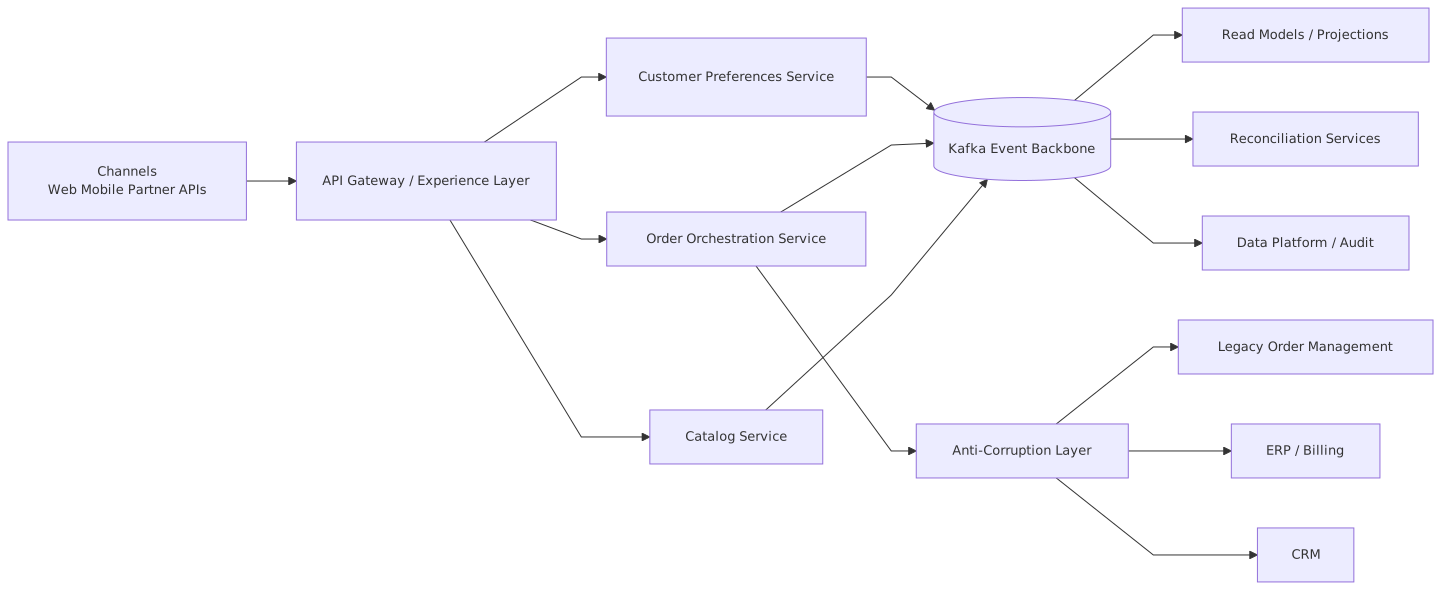
This is not a universal target architecture. It is a way of thinking.
The API gateway or experience layer should not contain core domain logic. Its role is channel shaping, security, and composition where necessary. Domain services own behavior and data for their bounded contexts. Kafka or another event backbone supports decoupled propagation, auditability, and asynchronous workflows. Anti-corruption layers prevent legacy models from contaminating new services. Reconciliation services watch for divergence between expected and actual state across systems. event-driven architecture patterns
A few points are worth being opinionated about.
Do not let services share operational databases. Shared databases erase service boundaries while preserving the fiction of independence.
Do not publish raw database change events as if they were domain events. CDC is useful, especially in migration, but downstream consumers should not infer business semantics from table updates unless they enjoy reverse-engineering as a career.
Do not over-orchestrate everything centrally. Some business processes need orchestration. Others are better modeled as domain events and local reactions. Use orchestration when the business wants an explicit controlling process with clear progress state and compensation rules. Use choreography when interactions are naturally decoupled and ownership should remain local.
Bounded contexts and semantic boundaries
This is where many roadmaps either become real architecture or fall into diagram theater.
Take “customer” as an example. In a bank, “customer identity,” “customer profile,” “party relationship,” “KYC status,” and “marketing preferences” are different semantic areas with different lifecycle rules and data quality expectations. Calling them one Customer Service is the kind of simplification that makes slideware look elegant and production systems miserable.
A service boundary should align to a bounded context where terms have stable meaning and the model protects relevant invariants. If “account status” means legal eligibility in one context and operational fulfillment state in another, forcing them into one service because they share the word “status” is architectural laziness.
Microservices reward semantic honesty.
Migration Strategy
A roadmap without migration reasoning is just a target diagram with optimism.
The best migration strategies treat modernization as a sequence of reversible bets. Each step should produce local value, reduce dependence, and create evidence for the next step. You are trying to earn the right to continue.
Progressive strangler migration
The strangler pattern works best when applied to capabilities, not entire applications. You select a bounded context, place a façade in front of legacy interactions, route a subset of traffic or functionality to a new service, and expand authority over time.
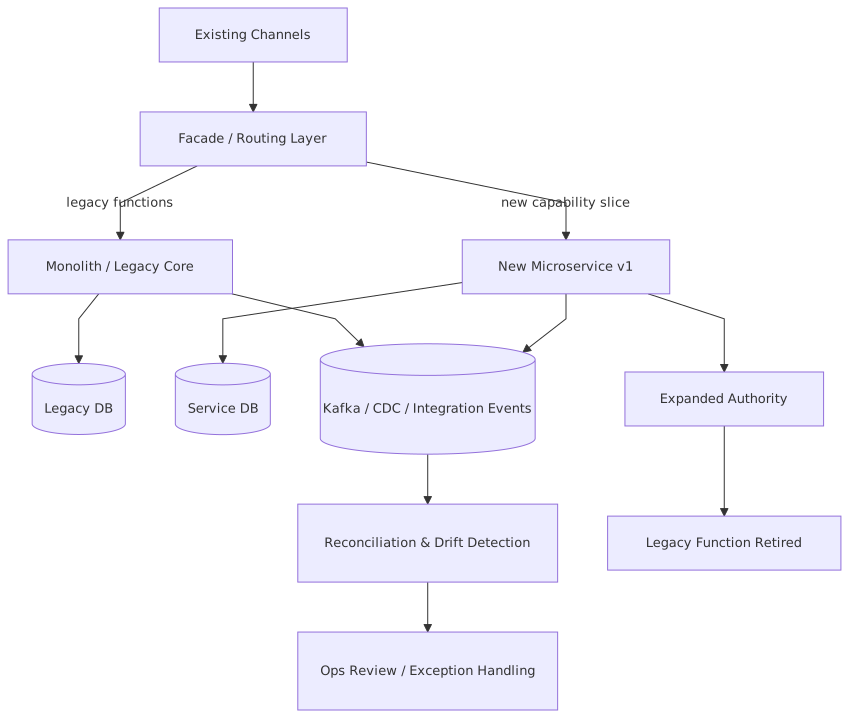
This sequence matters. The façade gives you traffic control and protocol stability. Kafka or CDC enables state propagation. Reconciliation detects mismatches while both worlds remain active. Only after confidence builds do you retire the legacy function.
Read-first, write-later extraction
This is an underused strategy. Start by building service-owned read models from legacy events or data capture. Let channels consume the new read models for search, inquiry, and personalization. Then introduce new write paths for selected commands.
Why does this work so often? Because reads usually tolerate staleness better than writes tolerate inconsistency. You can improve user experience and team autonomy without immediately taking on the hardest transactional responsibilities.
Command transfer by business subdomain
Do not migrate every command in a bounded context at once. Move commands according to business subdomain complexity.
For example, in order management:
- Change delivery preference may move early.
- Add line item might move later.
- Financial cancellation with refund and tax adjustment probably moves last.
This is migration by semantic difficulty, not by endpoint count.
Dual-write avoidance
The ugliest migration pattern in enterprise architecture is the casual dual write: update the new service database and the legacy database in the same application flow and hope they stay aligned. They will not. A network timeout or downstream partial failure will eventually leave systems inconsistent.
Prefer one authoritative write and asynchronous propagation. If both systems must accept changes during migration, design explicit conflict handling and reconciliation rather than pretending atomicity across independent systems.
Reconciliation as first-class architecture
Reconciliation deserves more respect than it gets. In finance, insurance, telecom, and retail, reconciliation is what turns distributed optimism into operational trust.
You need:
- record-level comparison rules
- tolerances for timing windows
- semantic match keys
- exception queues
- operator workflows
- replay capability
- audit trails
A migration that says “we are event-driven so eventual consistency is fine” without defining reconciliation is not mature enough for enterprise use.
Enterprise Example
Consider a large retail bank modernizing its customer servicing estate.
The bank has a 20-year-old core platform where customer profile, account relationships, channel preferences, alerts, and KYC markers are stored across a CRM package, a mainframe customer master, and several product-specific systems. Mobile and web channels call an aggregation layer that in turn calls all of them. Every release involves synchronized testing across a dozen teams. A simple change to notification preferences can take months because no one is sure which system is authoritative for which preference.
The bank’s first instinct is to build a single Customer Microservice. That would be a mistake. The domain is too broad, semantics differ, and migration would become a political war over ownership.
Instead, the architecture team applies domain-driven design and identifies a bounded context around Customer Preferences. This context owns communication opt-ins, preferred channels, language choice, notification settings, and consent timestamps. It does not own KYC status, legal identity, or account-party relationships.
That decision sounds modest. It is not. It creates a tractable seam.
The roadmap looks like this:
- Introduce a façade API for all channel preference operations.
- Build a new Customer Preferences Service with its own database.
- Use CDC and integration events from CRM and digital channels to create a consistent read model.
- Route preference reads for mobile and web to the new service.
- Move preference update commands from channels to the new service.
- Publish domain events such as
PreferenceChanged,ConsentCaptured, andChannelOptOutRegisteredto Kafka. - Propagate updates to downstream CRM and campaign systems asynchronously.
- Run reconciliation between service state and CRM until drift is within acceptable thresholds.
- Make the new service system of record for preferences and block direct writes to CRM for that domain.
The result is not a bank transformed overnight. It is something better: a real shift in authority for a clear business capability.
Operationally, the bank discovers several useful truths. The mobile team can release preference features independently. Marketing systems consume clean events instead of polling extracts. Data governance improves because consent history now has explicit ownership and auditability. The core platform remains in place for harder domains while one bounded context becomes genuinely modern. EA governance checklist
And there are scars. During migration, a legacy batch job continued overwriting preference data in CRM, causing noisy divergence. Reconciliation caught it. A hidden dependency in call-center tooling bypassed the façade and updated the old system directly. That had to be remediated before authority could transfer. Kafka consumer lag during a peak period delayed downstream updates, which was acceptable for campaigns but not for regulatory consent display, so the channels had to read directly from the new service for authoritative views.
This is how real enterprise modernization works: not with a heroic rewrite, but with selective extraction, explicit coexistence, and stubborn attention to semantics.
Operational Considerations
Microservices live or die operationally. A roadmap that stops at service boundaries is incomplete.
Observability
You need distributed tracing, structured logs, correlation IDs, domain event audit trails, and business-level telemetry. Not just CPU and memory. If an order is delayed because an event was published but not consumed, operations should be able to see that as a business flow issue, not merely as a technical metric.
Contract management
APIs and events are products. Version them deliberately. Test compatibility continuously. Consumer-driven contracts can help for synchronous APIs; schema governance is essential for Kafka topics. The migration period is especially sensitive because both legacy and new consumers may coexist for longer than anyone planned. ArchiMate for governance
Data governance
Service-owned data is not data anarchy. Enterprises still need lineage, retention rules, privacy controls, and auditability. Domain ownership clarifies responsibility; it does not remove governance.
Security and compliance
Identity propagation, authorization boundaries, secrets handling, and audit trails become more complex in a distributed environment. A roadmap should define common guardrails so teams are autonomous without inventing bespoke security controls.
Reliability engineering
Plan for retries, idempotency, poison message handling, dead-letter topics where justified, backpressure, and replay processes. Kafka gives durability, but durability is not correctness. Consumers must handle duplicate delivery, ordering assumptions, and schema evolution.
Team topology
Architecture follows team responsibility more than people admit. If a service boundary spans three departments, it will not evolve cleanly. Roadmaps should consider whether the operating model can sustain the proposed bounded contexts. Sometimes the right move is to delay extraction until ownership is clearer.
Tradeoffs
Every roadmap is a tradeoff map.
Microservices increase team autonomy, but they also increase operational overhead. You gain deployability and local ownership while paying in observability, testing complexity, and platform engineering.
Event-driven integration reduces temporal coupling, but it introduces eventual consistency and demands stronger discipline around contracts, idempotency, and reconciliation.
Progressive strangler migration reduces big-bang risk, but it prolongs coexistence. That means duplicated logic, multiple sources of truth during transition, and more moving parts. The architecture becomes temporarily more complex so that it can become permanently simpler.
Domain purity is desirable, but migration sometimes requires transitional compromises. You may start with a service that still depends on legacy identifiers or upstream reference data because removing those dependencies all at once would stall progress. The trick is to know which compromises are tactical and which become permanent debt.
And then there is Kafka. It is immensely useful for service evolution, especially when you need decoupled propagation, durable integration, replay, and analytics consumption. But Kafka is not a domain model. If every change becomes an event whether or not anyone understands the business fact it represents, the event backbone becomes a faster way to spread confusion.
Failure Modes
Certain failure modes appear so regularly that they deserve to be called by name.
The distributed monolith
Services are deployed separately but must change together. Calls are synchronous and chatty. Shared databases remain. One service outage cascades everywhere. This usually comes from splitting code before splitting responsibility.
The fake bounded context
A service is named after a business noun but contains multiple conflicting models. “Customer,” “Order,” and “Product” are common offenders. The service becomes a semantic junk drawer.
Event soup
Teams publish too many low-value events, often derived directly from persistence changes. Consumers infer business meaning inconsistently. Topics proliferate. Replay becomes dangerous because event semantics were never stable.
The endless transition state
Legacy writes are never fully blocked. New services are never truly authoritative. Reconciliation runs forever because no one is empowered to retire the old path. This is not strangulation; it is architectural purgatory.
Hidden side doors
One overlooked batch job, reporting script, or call-center integration writes directly to legacy data and undermines the migration. These are common in large estates. They are why dependency discovery matters.
Central platform overreach
A well-meaning platform team imposes one integration model, one workflow engine, one service template, and one delivery pattern on all domains. Standardization helps until it starts erasing important domain differences.
When Not To Use
There are cases where a service evolution roadmap toward microservices is the wrong move.
Do not use this approach when the domain is small, stable, and owned by a single team that can move quickly within a modular monolith. A well-structured monolith is often the better architecture. Fewer moving parts. Fewer operational surprises. More transactional simplicity.
Do not force microservices when the organization lacks operational maturity. If you cannot yet manage CI/CD, observability, contract discipline, and incident response at scale, microservices will amplify weakness rather than solve it.
Do not begin with highly entangled, regulation-heavy core capabilities unless there is a compelling business driver and enough architectural leverage to support coexistence. Sometimes the right first step is modularization inside the legacy estate, not extraction out of it.
Do not use event-driven synchronization as a substitute for understanding your domain. Eventual consistency is tolerable only when the business can tolerate it and the reconciliation model is explicit.
And do not adopt Kafka because everyone else did. Use it where durable event streams, replay, decoupling, and integration scale are real needs. For simpler interactions, a straightforward API may be better.
Related Patterns
Several patterns work naturally with a service evolution roadmap.
- Strangler Fig Pattern: progressively redirect capability from legacy to new services.
- Anti-Corruption Layer: shield new domain models from legacy semantics.
- Bounded Context: define service boundaries around coherent language and rules.
- CQRS: useful when separating read migration from write migration.
- Saga / Process Manager: coordinate long-running cross-service business processes.
- Outbox Pattern: publish reliable integration events from service transactions.
- CDC: bootstrap read models and migration synchronization from legacy stores.
- Backend for Frontend: adapt channel needs without pushing composition into domains.
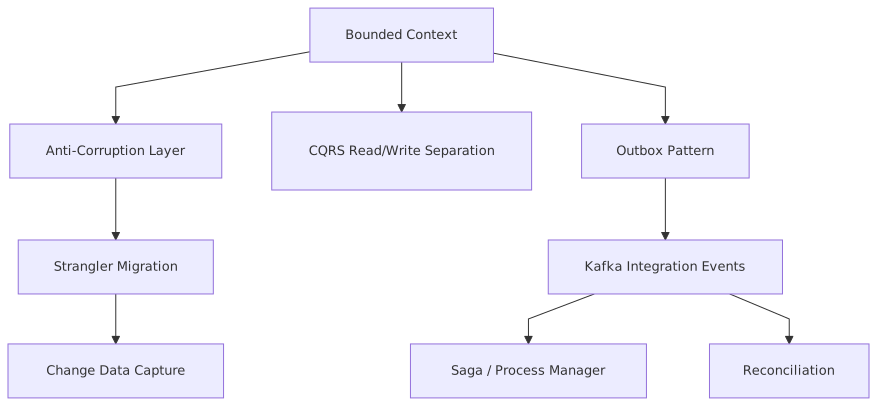
These patterns are not a menu to order all at once. They are tools. Use the fewest that let you preserve domain clarity and migration safety.
Summary
A service evolution roadmap is not about carving a monolith into smaller boxes and calling that progress. It is about moving business responsibility, carefully and deliberately, from legacy structures into bounded contexts that can evolve independently.
That requires domain-driven design thinking because service boundaries are semantic boundaries before they are technical ones. It requires migration reasoning because coexistence lasts longer than anyone expects. It requires reconciliation because distributed systems drift. And it benefits from Kafka and event-driven integration when those tools are used to carry meaningful business facts rather than technical noise.
The strongest roadmap is incremental, opinionated, and honest about tradeoffs. It starts where the domain seam is real. It stabilizes the legacy edge. It often moves reads before writes. It treats reconciliation as part of the architecture, not an operational afterthought. It defines the moment when a new service becomes authoritative. And it knows when not to use microservices at all.
The memorable line is this: modernization succeeds not when new services appear, but when old responsibilities disappear.
That is the difference between motion and evolution.
Frequently Asked Questions
What is a service mesh?
A service mesh is an infrastructure layer managing service-to-service communication. It provides mutual TLS, load balancing, circuit breaking, retries, and observability without each service implementing these capabilities. Istio and Linkerd are common implementations.
How do you document microservices architecture for governance?
Use ArchiMate Application Cooperation diagrams for the service landscape, UML Component diagrams for internal structure, UML Sequence diagrams for key flows, and UML Deployment diagrams for Kubernetes topology. All views can coexist in Sparx EA with full traceability.
What is the difference between choreography and orchestration in microservices?
Choreography has services react to events independently — no central coordinator. Orchestration uses a central workflow engine that calls services in sequence. Choreography scales better but is harder to debug; orchestration is easier to reason about but creates a central coupling point.