⏱ 20 min read
Microservice estates rarely fail because the boxes on the architecture diagram are wrong. They fail because the lines are lies.
That’s the quiet scandal in enterprise architecture. We draw neat service boundaries, label APIs, perhaps add Kafka in the middle, and tell ourselves we understand the system. But production has no respect for our slideware. At runtime, services fan out, retry, enrich, compensate, publish events nobody remembers, and depend on identity, pricing, inventory, feature flags, policy engines, search clusters, and that one “temporary” adapter built three years ago. The actual system is not a set of services. It is a living graph of interactions.
If you run microservices at scale, the runtime service graph becomes more important than the static system landscape. A static diagram says what should happen. A runtime graph says what did happen, what is happening now, and what is likely to fail next. One is architecture as intent. The other is architecture as fact.
And facts are stubborn things.
This is where many teams get trapped. They embrace service decomposition, event-driven architecture, and domain-driven design, but they still reason about the estate as if each service were an island. It isn’t. A customer checkout, insurance quote, payment authorization, or supply-chain replenishment crosses domains and technology styles. Some edges are synchronous HTTP calls. Some are Kafka topics. Some are scheduled jobs. Some are reconciliation processes cleaning up yesterday’s damage. The graph is not merely technical topology. It is the executable shape of business behavior. event-driven architecture patterns
That distinction matters. If your runtime graph is disconnected from domain semantics, it becomes an observability toy. Pretty traces, little value. If it is grounded in bounded contexts, aggregates, capabilities, and business outcomes, it becomes a management instrument. You can see where coupling has crept in. You can locate brittle paths. You can reason about migration. You can decide where choreography is sensible and where orchestration is safer. You can detect where eventual consistency is honest and where it is just negligence with a better brand.
So let’s treat the runtime service graph seriously: not as a monitoring artifact, but as an architectural model for microservices in motion. microservices architecture diagrams
Context
In a modern enterprise, the same business transaction often traverses multiple bounded contexts. An order placement might touch Customer, Catalog, Pricing, Promotions, Inventory, Payment, Fraud, Fulfillment, Notification, and Ledger. Some of these are core domain capabilities. Some are supporting. Some are generic but still operationally essential.
Domain-driven design gives us language for separating these concerns. Bounded contexts protect meaning. The Order context speaks in reservations and commitments. The Payment context speaks in authorizations, captures, and settlements. The Ledger context speaks in postings and balances. These words may all relate to “the same” business event, but they are not synonyms. They are distinct models with distinct invariants.
A runtime service graph makes these transitions visible. It shows not only which service called which, but which domain concept crossed a context boundary, in what form, with what latency, with what retries, and with what outcomes. That is the difference between a service map and an architectural graph.
In enterprises, this matters because the estate is never greenfield. There is always a legacy policy admin platform, a monolithic order manager, a mainframe claims engine, a central ERP, a CRM suite, and several integration layers that predate the current strategy by a decade. Microservices do not replace this reality; they coexist with it. Any architecture worth using must explain how runtime interactions cut across old and new systems during migration.
This is why the runtime graph becomes so powerful during transformation. It is the only artifact that can show the coexistence period honestly.
Problem
Teams usually design service landscapes statically and operate them dynamically. That gap is where trouble lives.
Static architecture diagrams show intended dependencies. Runtime behavior introduces hidden edges:
- fan-out calls added for enrichment
- retries that amplify load
- asynchronous subscribers created by downstream teams
- compensations that trigger secondary workflows
- cache misses that turn local reads into remote dependencies
- fallback paths that become primary under failure
- reconciliation jobs that quietly preserve business correctness
Over time, these hidden edges create accidental architecture.
A service that looked autonomous turns out to block on three downstream APIs. An event-driven flow that seemed loosely coupled actually depends on strict ordering from Kafka partitions and a consumer group that cannot keep up. A supposedly eventual-consistent workflow only works because a nightly reconciliation job repairs missing updates. A migration thought to be “service by service” turns out to require coexistence across dozens of runtime paths.
The problem is not just visibility. It is decision-making. Without a runtime graph, architects reason from intention while operators live with consequences.
And there is a second, subtler problem. Most runtime dependency tools are technically rich and semantically poor. They can tell you that checkout-service called pricing-service, published to order-events, and then received a callback from fraud-service. Useful, but not enough. What was the business interaction? Was this a quote, a reservation, a commitment, a compensation, a ledger posting? Which bounded context owned truth at each step? Which edges were mandatory, optional, or advisory? Which failures were acceptable for eventual recovery, and which violated a business invariant immediately?
In other words: if the graph cannot speak the domain, it cannot guide architecture.
Forces
Several competing forces shape this problem.
Autonomy versus end-to-end flow
Microservices promise team autonomy, but businesses care about complete journeys. An order is not “done” because one service persisted its own state. The graph must reveal end-to-end paths without destroying bounded context ownership.
Synchronous certainty versus asynchronous resilience
A direct API call provides immediate feedback and simpler causality. Kafka-based eventing provides decoupling, buffering, replay, and temporal independence. Neither is universally superior. Runtime graphs need to represent both styles and the seams between them.
Domain purity versus enterprise reality
DDD encourages clear models and explicit boundaries. Enterprises inherit shared databases, canonical schemas, ESBs, batch files, and SaaS platforms. The graph must capture ideal boundaries and compromised ones.
Consistency versus throughput
Business invariants do not disappear because the system is distributed. Some interactions require immediate validation. Others can be reconciled later. The runtime graph should identify where you rely on immediate consistency, where you accept eventual consistency, and where reconciliation is doing the heavy lifting.
Migration speed versus operational risk
A progressive strangler migration moves capability gradually, reducing delivery risk. But partial migrations create temporary duplicate paths, shadow writes, translation layers, and split sources of truth. The graph becomes more complex before it gets simpler.
That is not a sign of failure. It is the price of civilised change.
Solution
The core idea is straightforward: model and operate microservices as a runtime service graph enriched with domain semantics.
At its simplest, a runtime graph is a directed graph where nodes represent runtime participants and edges represent interactions. But in a useful enterprise implementation, both nodes and edges carry meaning.
Nodes
- business services aligned to bounded contexts
- shared platforms such as Kafka, API gateways, identity providers, caches, workflow engines
- legacy systems participating in business flow
- reconciliation and batch components when they materially affect correctness
Edges
- synchronous request/response calls
- asynchronous event publication and subscription
- scheduled or triggered reconciliation flows
- data replication or CDC paths
- compensation and recovery actions
- control-plane interactions where they affect runtime behavior
Then add the missing piece: annotate the graph with domain semantics.
Each edge should tell you:
- business action or event name
- contract type: command, query, event, notification, replication
- consistency expectation
- idempotency requirement
- retry policy
- ownership of truth before and after the interaction
- business criticality and blast radius
Now the graph becomes architecturally useful. It can answer:
- Which customer journeys cross too many synchronous hops?
- Where has a supporting domain become an operational choke point?
- Which Kafka topics act as hidden shared databases?
- Which invariants depend on reconciliation rather than transactionality?
- Which legacy dependencies still sit on critical paths?
- Which migration slices genuinely reduce risk?
Here is the conceptual shape.
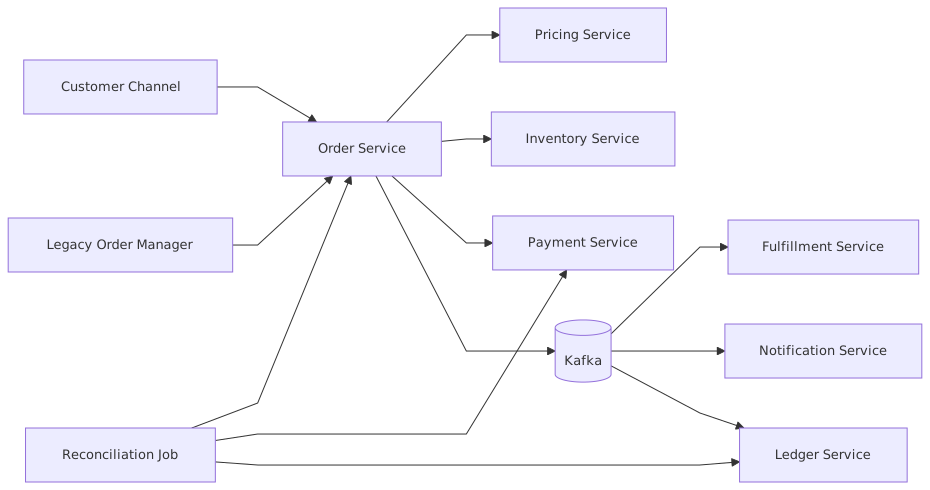
This is not just a dependency map. It is the runtime story of an order capability. Some interactions are synchronous because the domain needs a decision now. Others are asynchronous because downstream domains can process after commitment. Reconciliation exists because distributed systems leak. Legacy still participates because migration is gradual.
That is a real architecture.
Architecture
A runtime service graph architecture typically has four layers.
1. Domain layer
Start from bounded contexts, not services. This is the point many teams skip. If you build the graph from deployment units alone, you will capture infrastructure without meaning. The domain layer defines capabilities, context ownership, core aggregates, and business events.
For example:
- Order owns order intent and lifecycle state.
- Inventory owns stock reservation and allocation.
- Payment owns authorization and settlement intent.
- Fulfillment owns shipment creation and dispatch.
- Ledger owns financial postings, not customer-facing payment status.
These distinctions shape what should be synchronous and what should be evented. Order may synchronously request a payment authorization because checkout cannot complete without it. Ledger posting can happen asynchronously because the business can tolerate slight delay as long as eventual correctness is guaranteed.
2. Interaction layer
This is the executable graph itself.
Synchronous edges belong where the caller needs an immediate decision to preserve a business invariant or a user interaction. Asynchronous edges belong where decoupling, scalability, resilience, or independent timing make more sense.
A common pattern looks like this:
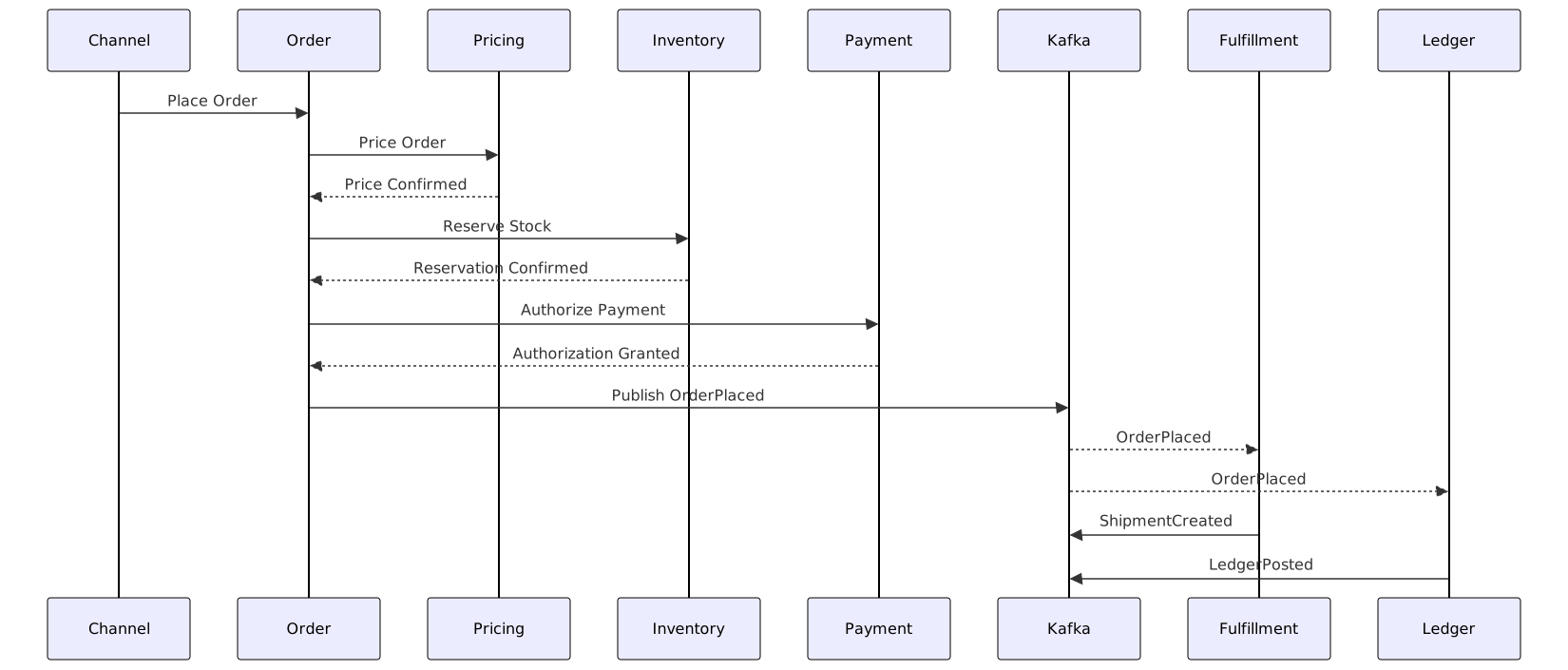
This kind of flow is common because it aligns with domain semantics:
- quote and reservation are immediate decisions
- fulfillment and ledger are downstream consequences
- Kafka provides fan-out and replay
- the initial transaction is not waiting for every participant in the enterprise
3. Observation layer
To build a runtime graph in practice, you need telemetry stitched across protocols:
- distributed tracing for sync calls
- Kafka headers or equivalent correlation IDs for event chains
- logs and metrics tied back to business keys
- topology metadata from service registry, gateway, mesh, and brokers
- semantic tagging such as
business_event=OrderPlaced,bounded_context=Order
This is where many implementations become over-engineered. You do not need perfect omniscience on day one. You need enough correlation to understand critical paths and high-risk domains.
4. Governance layer
A runtime graph without governance becomes decorative. Governance here does not mean committee paperwork. It means executable policy: EA governance checklist
- contract ownership for APIs and events
- schema evolution rules
- topic lifecycle management in Kafka
- limits on synchronous chain depth
- clear definitions of source of truth
- mandatory idempotency for event consumers
- explicit reconciliation for critical eventual-consistency gaps
A memorable rule I like: if a downstream consumer cannot disappear for four hours without ruining your day, your design is not as asynchronous as you think.
Migration Strategy
This is where runtime graphs earn their keep.
A progressive strangler migration is not simply “move feature X from the monolith to service Y.” Real migration is about moving runtime edges safely. You replace behaviors in slices, re-route interactions, and maintain business continuity while two worlds coexist.
The runtime graph is the migration map.
Start by identifying business journeys and their current runtime paths. Not module boundaries. Not team aspirations. Actual runtime behavior. Which paths are on the critical path? Which interactions are synchronous today? Which data movements are batch-based? Which consumers depend on the monolith as source of truth?
Then define migration slices around domain seams. Good slices tend to be:
- clear in business meaning
- operationally observable
- low in cross-context write complexity
- reversible when things go wrong
In many enterprises, the first extraction is not the core transaction service. It is often a supporting capability with clear boundaries, such as pricing rules, notification, or fraud screening. This teaches the organization how to operate runtime edges before attacking the core domain.
As migration progresses, the graph often passes through three phases:
Phase 1: Observe and annotate
Instrument the existing system, including the monolith and integration middleware. Build a current-state runtime graph. You are learning where the blood actually flows.
Phase 2: Divert selected edges
Introduce new services and route selected calls or events to them. This may involve anti-corruption layers, event translation, CDC into Kafka, or API façade patterns. During this phase, duplicate paths are normal.
Phase 3: Re-home truth
Move source-of-truth responsibility for selected domain concepts. This is the hardest step. Until ownership changes, migration is mostly plumbing. Once ownership moves, reconciliation, cutover, and rollback become serious design concerns.
Here is a simplified strangler view.
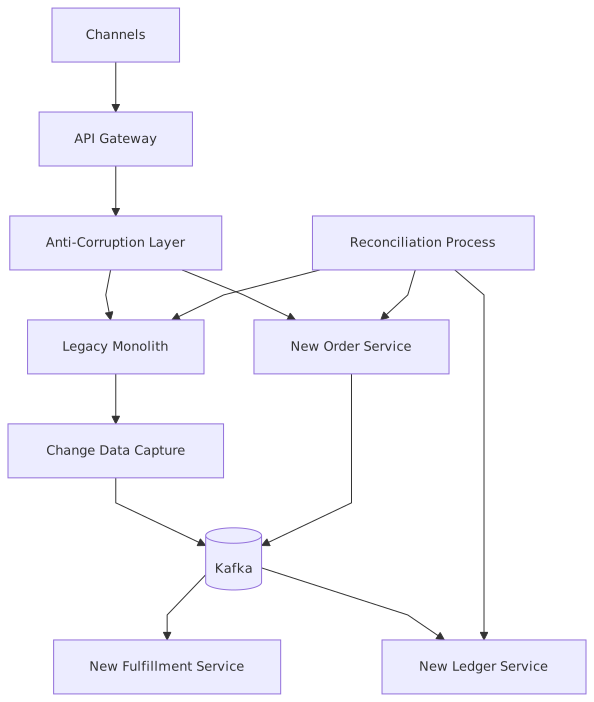
This diagram matters because it shows the uncomfortable middle:
- legacy still handles some flows
- new services own some outcomes
- CDC propagates change events
- reconciliation checks for drift
- the anti-corruption layer shields the new domain model from old semantics
That shielding is essential. A migration that drags legacy language directly into new services is not strangling the monolith. It is embalming it in smaller containers.
Reconciliation in migration
Reconciliation deserves special attention because architects too often treat it like an embarrassing operational patch. It is not. In distributed enterprise systems, reconciliation is a first-class business safety mechanism.
Use reconciliation when:
- events may be missed or delayed
- source and target systems temporarily dual-write
- downstream systems can recover from delayed correction
- legal or financial correctness matters more than immediate cosmetic consistency
A reconciliation process should be explicit about:
- the business entity it reconciles
- authoritative source for each field
- tolerance window
- repair action
- audit trail
For example, after moving order creation into a new service while payment settlement still originates in a legacy back office, a reconciliation job may compare orders authorized in Payment against orders marked confirmed in Order, then issue compensating actions or recovery commands. That is architecture, not housekeeping.
Enterprise Example
Consider a global retailer modernising its order management platform.
The starting point is familiar. A large monolith handles cart checkout, order creation, stock allocation, payment handoff, invoicing, and fulfillment initiation. Around it sit an ERP, a warehouse management system, a CRM platform, and various custom services. Architects draw the estate as domains, but production behaves like an overgrown vine: API calls, MQ messages, database extracts, and nightly jobs intertwined.
The retailer wants to move to microservices and Kafka. Fair enough. But the interesting part is not decomposition. It is runtime graph management.
Step 1: Identify bounded contexts
The team defines:
- Cart and Checkout
- Order Management
- Pricing and Promotions
- Inventory
- Payment
- Fulfillment
- Customer Communication
- Financial Ledger
They resist the common mistake of creating a “Shared Order Event Model” to rule them all. Instead, each context publishes events in its own language, with explicit translation where needed.
Step 2: Build a runtime graph
Instrumentation shows that checkout currently triggers:
- synchronous pricing and tax calculations
- a payment pre-auth via external gateway
- stock reservation in the monolith
- asynchronous handoff to warehouse
- nightly invoice posting to finance
- exception queues for failed customer notifications
- manual reconciliation for payment/order mismatches
This visibility changes the migration plan. The team had assumed fulfillment was the biggest risk. The graph reveals payment-order consistency is more dangerous because hidden compensations have accumulated over years.
Step 3: First migration slice
They extract Pricing and Promotions first. Why? Clear bounded context, high business change rate, and manageable write ownership. Checkout calls the new pricing service synchronously. Kafka carries PriceCalculated for analytics and audit, but no downstream domain depends on that event to complete checkout.
This is a good migration slice because failure is visible and contained.
Step 4: Order service with strangler façade
Next, they introduce a new Order service behind an API gateway and anti-corruption layer. New digital channels create orders through the new service; legacy channels continue using the monolith. Both publish order lifecycle events to Kafka. During coexistence, the warehouse still consumes a normalized feed derived from both sources.
That feed is not ideal. It is a temporary bridge. The team knows it. Good architects can tolerate ugliness if it has an expiry date.
Step 5: Reconciliation and ownership shift
When Payment remains split between old and new pathways, discrepancies emerge:
- payment authorized but order creation timed out
- duplicate retries causing multiple authorization attempts
- stock reservation succeeded but order event publication lagged
- customer cancellation races with warehouse release
The runtime graph exposes where these mismatches occur. Reconciliation compares:
- payment authorization records
- order states
- inventory reservations
- ledger postings
Repairs are automated where possible and escalated where not. Eventually, once the new Order service becomes source of truth for digital channels, the graph simplifies. Some edges disappear. Some compensations move from manual to systematic. Some nightly jobs can finally be retired.
That is a real enterprise architecture win: not more services, but fewer lies.
Operational Considerations
A runtime graph lives or dies by operational discipline.
Correlation
Every meaningful business journey needs a correlation strategy. Trace IDs are useful, but business keys matter more. orderId, paymentId, reservationId, customerId—these let operations and finance reason about the same incident.
Kafka hygiene
Kafka is excellent for expressing asynchronous edges, but it also enables lazy architecture. A topic can become a dumping ground for everything vaguely related to “orders.” That is how hidden coupling spreads.
Use Kafka with intent:
- topics aligned to event meaning, not generic data sync
- schemas versioned and governed
- retention and replay policies understood
- consumer lag monitored as business risk, not just infrastructure metric
- idempotent consumers by default
A topic is not a data lake with lower standards.
Runtime graph freshness
Graphs decay if they depend on manual curation. Build from telemetry and contract metadata, then enrich with architectural annotations. The operational view should update from runtime evidence; the semantic view should be maintained as part of design governance. ArchiMate for governance
SLOs on paths, not just services
Service-level objectives should cover critical journeys:
- checkout authorization path
- claim submission acceptance path
- payment settlement posting path
A service can meet its local latency target while the journey fails due to graph complexity. End-to-end path SLOs force honesty.
Security and policy edges
Identity providers, policy engines, secrets managers, and API gateways often sit on critical runtime paths. Treat them as first-class nodes. Ignoring them is how you discover that your “business outage” was really an authorization dependency bottleneck.
Tradeoffs
There is no free lunch here.
Benefit: Better architectural truth
A runtime service graph gives a more honest view of the system than static decomposition diagrams.
Cost: More complexity in the model
The graph can become noisy quickly. If you capture every metric stream, health check, and sidecar heartbeat, you drown in trivia. The discipline is to model business-significant interactions.
Benefit: Better migration decisions
You can cut migration slices based on real runtime dependencies and domain seams.
Cost: Instrumentation and governance overhead
Telemetry, correlation, event contracts, and reconciliation all require investment. Teams looking for a cheap shortcut will resent this. They are also the teams that end up with distributed ambiguity.
Benefit: Better handling of eventual consistency
By making asynchronous edges and recovery paths explicit, you can reason about reconciliation and compensation as design choices.
Cost: Exposes uncomfortable truths
A runtime graph often reveals that your architecture is more tightly coupled than leaders want to hear. This is politically expensive. Still worth it.
Failure Modes
The pattern itself can fail, and usually in predictable ways.
1. Graph without semantics
You build a dependency map but never tie it to bounded contexts, business events, or ownership. Result: operational dashboard, weak architectural value.
2. Semantic model without runtime evidence
You create elegant domain diagrams but they drift from production reality. Result: beautiful fiction.
3. Kafka as shared database
Teams publish state snapshots indiscriminately, multiple consumers depend on internal event structures, and topics become implicit integration contracts nobody owns. Result: distributed tight coupling.
4. Reconciliation as an afterthought
Event loss, duplicate processing, and dual-write drift occur, but nobody designed explicit reconciliation. Result: silent data divergence and manual operational heroics.
5. Excessive synchronous chains
A single customer action fans through six blocking service calls. A minor slowdown causes cascading latency and retries. Result: path collapse under peak load.
6. Migration without anti-corruption
New services inherit old data structures and ambiguous terms directly from the monolith. Result: local services, centralized confusion.
7. No expiry for temporary edges
Bridge adapters, duplicated topics, and transition services remain forever. Result: permanent migration tax.
When Not To Use
A runtime service graph is not universally necessary.
Do not invest heavily in this approach when:
- the system is a small, cohesive monolith with modest integration needs
- business flows are simple and mostly local to one deployment unit
- your team lacks basic observability and contract discipline
- you are still unclear on bounded contexts and domain ownership
- the scale of runtime interaction does not justify the governance cost
In these cases, a simpler module architecture, a well-structured monolith, or a limited service map may be enough. There is no virtue in drawing a cathedral map for a village.
Also, if your estate is mostly CRUD over a shared enterprise platform with little independent business behavior, a runtime graph may expose complexity but not reduce it. Sometimes the right answer is to simplify the operating model before investing in advanced architectural representation.
Related Patterns
Several patterns fit naturally with the runtime service graph.
Bounded Context Mapping
From DDD, this helps define semantic boundaries and identify translation points.
Strangler Fig Pattern
Critical for progressive migration from monoliths and packaged systems.
Anti-Corruption Layer
Protects new domain models from legacy semantics during coexistence.
Saga
Useful for long-running cross-context workflows, though often overused. Use it where business progress spans multiple local transactions and explicit compensation matters.
Event-Carried State Transfer
Appropriate for some asynchronous edges, dangerous when it becomes indiscriminate replication.
Change Data Capture
A pragmatic migration tool for exposing legacy changes into Kafka, especially when direct event publication is impossible.
Reconciliation Pattern
A first-class design for detecting and repairing state divergence across distributed systems.
Service Mesh and Distributed Tracing
Helpful implementation tools, but not substitutes for domain-aware modeling.
Summary
Microservices architecture is not a collection of boxes. It is a graph of runtime interactions shaped by domain meaning, migration constraints, and operational reality.
That is why the runtime service graph matters.
Used well, it gives architects and operators a shared picture of the enterprise as it actually behaves. It connects distributed tracing to bounded contexts. It connects Kafka topics to business events. It connects strangler migration to runtime dependencies. It elevates reconciliation from afterthought to design mechanism. And it exposes the hidden couplings, brittle paths, and transition-state compromises that static diagrams politely ignore.
Used badly, it becomes another dashboard no one trusts.
So be opinionated. Model the graph around domain semantics. Keep temporary migration edges visible. Make consistency assumptions explicit. Treat reconciliation as part of the architecture. Govern topics and contracts as carefully as APIs. And retire transitional complexity aggressively.
The best architecture diagrams are not the neatest ones. They are the ones that survive contact with production.
A runtime graph diagram, when done properly, does exactly that.
Frequently Asked Questions
What is a service mesh?
A service mesh is an infrastructure layer managing service-to-service communication. It provides mutual TLS, load balancing, circuit breaking, retries, and observability without each service implementing these capabilities. Istio and Linkerd are common implementations.
How do you document microservices architecture for governance?
Use ArchiMate Application Cooperation diagrams for the service landscape, UML Component diagrams for internal structure, UML Sequence diagrams for key flows, and UML Deployment diagrams for Kubernetes topology. All views can coexist in Sparx EA with full traceability.
What is the difference between choreography and orchestration in microservices?
Choreography has services react to events independently — no central coordinator. Orchestration uses a central workflow engine that calls services in sequence. Choreography scales better but is harder to debug; orchestration is easier to reason about but creates a central coupling point.