⏱ 22 min read
Every enterprise has that one job nobody talks about until it fails.
It sends invoices at midnight. Closes the accounting period. Rebuilds search indexes. Expires trial subscriptions. Nudges customers who abandoned carts. Calculates interest. Pushes data to regulators before dawn. In the old world, this lived on a single application server in a room nobody wanted to touch. A cron entry, a Quartz trigger, a Windows Scheduled Task. Ugly, but understandable. One box. One clock. One place to blame.
Then we “did microservices.”
We split the system into dozens or hundreds of independently deployable services, each with its own database, release cadence, and team. The neat certainty of one scheduler dissolved into a fog of distributed responsibility. Yet the business did not stop needing things to happen at 02:00, every hour, every five minutes, on the last working day of the month, or after seven days of inactivity. Time, unlike architecture diagrams, refuses simplification.
This is where many microservice programs get into trouble. Teams carry over monolithic scheduling habits into a distributed world. They embed cron expressions inside services. They let every replica run the same timer and hope idempotency saves them. They centralize all schedules into an “enterprise scheduler” that knows too much about every domain. Or they push everything into Kafka and pretend time has become an event. It has not. Time is not a business event. It is a forcing function. The business event is “premium expired,” “settlement window opened,” “statement generated.” That distinction matters. event-driven architecture patterns
A distributed cron strategy is not really about cron. It is about ownership, boundaries, coordination, and failure. In other words, it is a domain design problem wearing infrastructure clothes.
This article lays out practical distributed cron patterns for microservices, the scheduler topologies behind them, when to use each, and how to migrate from the old central job server without setting fire to the estate. We will look at Kafka-based orchestration where it helps, reconciliation where it is essential, and the tradeoffs no vendor brochure wants to mention. microservices architecture diagrams
Context
Scheduling in enterprise systems has always been a little deceptive. It looks like plumbing, but it rarely stays there.
A nightly batch that “updates accounts” sounds generic until you discover it actually encodes business promises: interest must be accrued before statements are cut; invoices must not issue before tax data is finalized; premium renewals must respect local time and grace periods; card settlement must align to processor windows. These are not mere timers. They are temporal policies inside the domain.
In a monolith, we often got away with blurring application scheduling and domain behavior. One codebase held all the logic, one database held all the state, and a scheduler thread woke up to run jobs against local tables. Coordination was implicit because everything was co-located.
Microservices break that convenience deliberately. A payment service should not reach into subscription tables. A billing service should not know how loyalty rewards are recalculated. A customer communications service should not directly open accounting periods. Yet all of them may need scheduled behavior.
This creates a tension:
- time-based triggers are cross-cutting,
- but business meaning is domain-specific,
- and distributed systems punish implicit coordination.
So the architecture question is not “Where do I put cron?” It is “How do I trigger time-based business capabilities while preserving service autonomy, operational clarity, and correctness?”
That is a different question, and it leads to different designs.
Problem
In microservices, scheduled work typically falls into four broad categories:
- Pure technical maintenance
Cache warmups, log rotation, data compaction, retention cleanup.
- Domain deadlines
Subscription renewals, payment retries, SLA breach escalation, policy expiry.
- Bulk processing windows
End-of-day settlement, pricing refreshes, statement generation, inventory snapshots.
- Reconciliation and repair
Rebuild projections, detect missed events, replay integrations, compensate partial failures.
The trap is treating all four as the same thing because they are “scheduled.” They are not.
A service-local cache cleanup can be safely owned inside one service. A payment retry workflow, by contrast, spans multiple domain concepts, downstream dependencies, and customer promises. A statement generation run may have regional calendars, cut-off times, legal constraints, and back-pressure issues. Reconciliation is often the safety net for when the first three fail.
Once systems are distributed, several nasty questions appear:
- Which instance should execute the job?
- How do we avoid duplicate execution?
- How do we preserve domain ownership?
- What happens when a service is down at the scheduled time?
- How do we recover missed runs?
- How do we make schedules visible and auditable?
- How do we scale from one timer to millions of due items?
- How do we handle local time zones and daylight saving changes?
- How do we separate “triggering work” from “doing work”?
That last one is the hinge. In mature architectures, the scheduler does not usually perform business logic. It emits intent, allocates work, or marks due items. The domain service still owns the business action.
A scheduler that knows too much becomes a second monolith.
Forces
Distributed cron design is driven by a handful of forces, and they pull against each other.
Service autonomy vs centralized control
Teams want to own their service lifecycle and behavior. Operations wants one place to see what runs at 2 AM. Both are rational. Too much autonomy and nobody can explain the estate. Too much centralization and every business change queues behind a scheduler team.
Correctness vs simplicity
A single scheduler process is simple to reason about, until it fails over in the middle of execution or clocks drift or retries duplicate external calls. Distributed correctness requires idempotency, deduplication, leases, state transitions, and audit trails. That is not free.
Domain semantics vs infrastructure abstraction
“Run every day at midnight” is infrastructure language. “Renew subscriptions at the customer’s local renewal boundary after grace rules and fraud checks” is domain language. Good architecture translates the former into the latter without losing the business meaning.
Throughput vs observability
A firehose of scheduled tasks can be pushed through Kafka, queues, or database polling. But the more asynchronous and high-volume the design, the harder it becomes to answer simple business questions: Did all invoices run? Which customer retries are late? What was skipped and why?
Loose coupling vs temporal coordination
Microservices are built to be loosely coupled. Time-based processes often require precise coordination. This is where eventual consistency becomes real, not theoretical. If one service publishes “renewal due” and another applies a payment three minutes later, what wins? The answer must be designed, not hoped for.
Compliance and audit
In many enterprises, schedule-driven actions are legally or financially material. “The job ran” is not enough. You need proof of what was due, what executed, under what version of rules, and what exceptions occurred.
These forces lead us to patterns rather than a single answer.
Solution
There are three core scheduler topologies that show up repeatedly in successful microservice estates.
1. Service-local scheduler
Each service owns its own timers and scans its own data for due work.
This is the simplest model, and it fits well when the scheduled work is tightly bounded to one service and one datastore. For example, a notification service can poll for messages due to send, or a retention service can purge expired objects.
The key idea is that the timer is local, but execution must still be coordinated across replicas using leader election, database row claiming, leases, or queue semantics.
Use this when:
- the domain boundary is clear,
- schedules are local to one service,
- volume is moderate,
- audit complexity is modest.
Do not use this for enterprise-wide business calendars or workflows spanning many bounded contexts.
2. Central trigger, distributed execution
A central scheduler owns when something is due. Domain services own what happens next.
This is the most common enterprise compromise. The scheduler emits a command or event like SubscriptionRenewalDue, SettlementWindowOpened, or GenerateStatementsRequested. Services consume those triggers and apply business rules.
This works well when you need visibility over schedule definitions but still want domain ownership. The trick is to keep the scheduler ignorant of domain internals. It should know temporal policies and target capabilities, not detailed orchestration logic.
Kafka is often a good fit here, especially for fan-out, buffering, and auditability. But Kafka should carry due work, not replace due state. If you need guarantees around “everything that should have happened,” you still need a durable record of due items or reconcilable source data.
3. Schedule as data, with work allocation
Instead of “run job X every hour,” you store due business items as explicit records. Workers claim due items and process them.
This is the grown-up model for high-volume, business-critical scheduling. Think millions of subscriptions, reminders, claims, policies, or payment retries, each with its own due time, state, retry count, and lifecycle.
Here, the scheduler is less a clock and more a due-work allocator. It scans an outbox or due-items table, publishes work, or lets workers claim rows in batches. This scales better and gives rich auditability.
Memorable rule: If the business cares about each individual due thing, model it as data. Don’t hide it behind cron.
Architecture
A robust distributed cron architecture usually separates four concerns:
- Schedule definition — recurring patterns, calendars, rules, local-time semantics.
- Due item generation — translating schedule definitions into actionable due records or trigger messages.
- Execution — workers or services performing business actions.
- Reconciliation — detecting misses, duplicates, late work, and drift.
The cleanest designs do not collapse these into one process.
Topology 1: Central trigger with event streaming
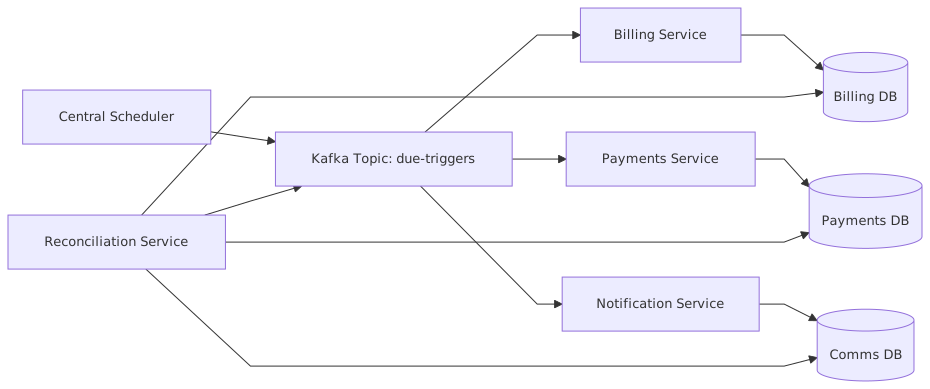
In this model, the central scheduler emits temporal triggers into Kafka. Consumers map them to domain actions. Reconciliation compares expected due work with actual outcomes.
This architecture is attractive because it decouples trigger production from execution and handles bursty workloads well. Kafka provides ordering within partitions, durable retention, replay, and operational familiarity.
But it comes with two caveats.
First, a trigger event alone is not proof of completion. It only proves that a trigger was emitted. You still need state transitions in the consuming service.
Second, central schedulers can become semantic dumping grounds. The moment teams start adding “if region is EU and customer is platinum then retry in 2 hours unless invoice pending,” the scheduler has crossed into domain logic and should be pushed back.
Topology 2: Schedule-as-data with claiming workers
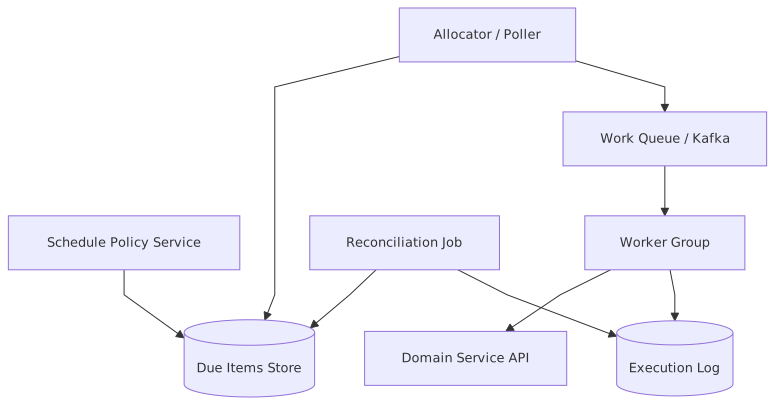
This is usually the better pattern for critical workloads. The policy service materializes due items with timestamps, tenant IDs, business keys, and state. An allocator polls due items, claims them, and pushes work onto Kafka or a queue. Workers invoke the domain service and write execution outcomes.
The power here is operational. You can answer:
- what was due,
- what was claimed,
- what succeeded,
- what failed,
- what needs retry,
- what is stuck.
You can also partition by tenant, region, or product line. You can replay. You can pause selectively. This is architecture with handles.
Topology 3: Service-local lease-based execution
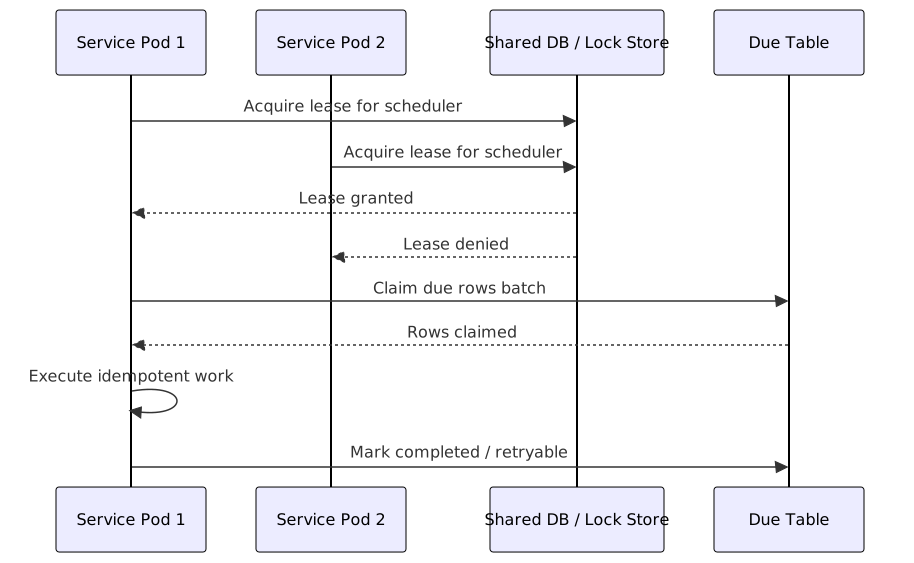
This is enough for many services. One pod acquires a lease. It claims batches of due rows. It executes idempotent work and updates status. It is straightforward, and often that matters more than elegance.
The non-negotiables are:
- a durable claim mechanism,
- lease expiry,
- idempotent execution,
- retry metadata,
- observability.
Without those, this pattern becomes “best effort” in the worst possible sense.
Domain semantics discussion
This is the part architects often skip because it sounds less technical. It is the part that decides whether the system will survive contact with the business.
A cron expression like 0 0 * is not a domain concept. “Close today’s ledger in the legal entity’s accounting timezone after all payment postings before cut-off are finalized” is.
That means schedule design belongs inside bounded contexts. Billing defines what “invoice due” means. Subscription defines what “renewal due” means. Claims defines what “SLA escalation due” means. A platform scheduler may host temporal infrastructure, but it must not invent domain meaning.
This is straight domain-driven design. Ubiquitous language should show up in the trigger names, due-item schema, and operational dashboards. Not job_1729. Say PolicyRenewalDue, StatementCycleOpened, PaymentRetryEligible. If the business cannot recognize the thing from its name, the architecture is already slipping.
There is another subtle point. Some “scheduled jobs” are actually delayed consequences of prior business events. A shipment reminder seven days after dispatch is best modeled from the ShipmentDispatched event, producing a due item for the future. That is more precise than a nightly scan over all shipments.
So ask two questions:
- Is this action caused by a recurring calendar?
- Or is it caused by a past business event with a future due date?
If it is the second, model due state at event time. That usually scales and audits better than repeated scans.
Migration Strategy
Nobody starts with a perfect distributed scheduler. They start with a monolith and a folder called jobs.
The sensible migration is progressive and boring. That is a compliment.
Step 1: Inventory the existing jobs
Classify each job by:
- domain owner,
- business criticality,
- frequency,
- data volume,
- dependencies,
- side effects,
- tolerance for duplicate execution,
- audit requirements.
You will find that half the jobs are technical maintenance, a quarter are batch integrations, and a handful are core business processes pretending to be housekeeping. Those few deserve the most attention.
Step 2: Separate triggering from business logic
Take the monolithic job and split:
- “decide what is due”
- from “perform the business action.”
This is the first strangler move. Keep the old scheduler if needed, but make it call a new service or emit a message instead of directly updating shared tables.
Step 3: Externalize due state for critical processes
For high-value flows, create an explicit due-items store or domain-owned scheduling table. This lets you migrate from opaque cron execution toward observable business state.
Step 4: Introduce event-driven handoff
Use Kafka or a queue to decouple due detection from execution. This reduces direct runtime coupling and allows replay, buffering, and scaling.
Step 5: Add reconciliation before you trust the new world
This is where teams cut corners and regret it. Reconciliation is not an afterthought. It is the bridge between old and new.
During migration, run the old and new paths in shadow mode where possible:
- old scheduler remains authoritative,
- new path computes or executes in parallel,
- compare outcomes,
- investigate drift,
- then switch authority gradually.
Step 6: Strangle domain by domain
Do not build “the enterprise scheduling platform” first. Migrate one bounded context at a time. Billing may need schedule-as-data. Notifications may be fine with service-local scheduling. Compliance reporting may keep a stronger central scheduler for audit reasons. Architecture should fit the workload, not force aesthetic uniformity.
A progressive strangler for scheduling often looks like this:
- monolith job triggers new service API,
- then monolith job publishes to Kafka,
- then due-state generation moves into the domain service,
- then monolith trigger is retired,
- reconciliation remains permanent.
That last part matters. Reconciliation is not just for migration. In distributed systems, it becomes part of the architecture.
Reconciliation discussion
Distributed cron without reconciliation is a prayer.
Clocks drift. Consumers lag. Deployments interrupt workers. Kafka topics get misconfigured. A lock holder crashes after side effects but before status update. A service is down during a settlement window. A DST transition creates ambiguous local times. Even if the architecture is sound, operations will still produce gaps.
Reconciliation is the systematic process of comparing what should have happened with what did happen.
That implies you need both sides:
- expected due work from schedules, source events, or due-item tables,
- actual execution evidence from logs, state transitions, outbox events, or domain records.
Good reconciliation runs independently of the primary execution path. It should identify:
- missed due items,
- duplicate execution,
- stuck in-progress items,
- late completion,
- partial downstream effects,
- divergence between trigger and outcome.
A common enterprise pattern is daily or hourly reconciliation jobs that query authoritative domain state and execution logs, then emit repair commands. For example:
- subscriptions due but not renewed,
- statements generated without delivery records,
- settlement windows opened without closing balances,
- reminders sent twice,
- payment retries marked complete without provider reference.
Reconciliation is not glamorous. It is what makes distributed scheduling survivable.
Enterprise Example
Consider a large insurer modernizing policy administration.
The legacy platform had a mainframe batch cycle plus a Java job server. Overnight jobs calculated renewals, issued policy documents, billed premiums, triggered broker notifications, and escalated underwriting cases. Everything assumed one central processing window. The business, however, was moving to digital channels, near-real-time endorsements, and country-specific rules across six regions.
At first, teams tried the obvious move: each new microservice got its own scheduler. The document service had cron. Billing had Quartz. Notifications had Kubernetes CronJobs. It looked autonomous. It was also chaos.
Why? Because policy renewal is not one service’s concern. It starts with product rules, checks payment standing, may trigger underwriting review, issues documents, updates broker channels, and records audit evidence. A timer inside one service could not own that meaning.
The architecture was changed in three waves.
Wave 1: Temporal triggers centralized, behavior distributed.
A renewal scheduler emitted PolicyRenewalDue events into Kafka based on region, product, and local timezone policy. Domain services consumed these events and performed bounded actions.
This improved decoupling but exposed another problem: Kafka events showed what was triggered, not what was actually renewed.
Wave 2: Due-item ledger introduced.
The renewal domain created a due-items ledger keyed by policy, renewal cycle, and effective date. Each item had states such as Scheduled, Claimed, Completed, RetryableFailure, ManualReview. Allocators published claimable work. Workers executed domain logic and updated status.
Now operations could see exactly which renewals were late or stuck.
Wave 3: Reconciliation institutionalized.
A reconciliation service compared active policies reaching renewal date with due-item ledger and issued policy records. It detected missed generations, duplicates, and documents issued without premium booking.
This was the turning point. The organization stopped debating where cron lived and started managing temporal business processes as first-class domain assets.
What did they keep centralized? Calendar policy, region cut-off definitions, and scheduler observability.
What stayed in domains? Renewal eligibility, underwriting rules, billing action, customer communication semantics.
That is the split to aim for.
Operational Considerations
Operational design matters as much as topology.
Idempotency
Every scheduled action should be safe to retry. If retries can double-charge, double-notify, or double-close a ledger, the design is broken. Use business keys, deduplication tokens, and state machines.
Time zones and daylight saving
Do not casually say “midnight.” Midnight where? On DST boundaries, some local times do not exist and some occur twice. Model schedule policy with explicit timezone handling and business rules for skipped or repeated times.
Back-pressure
A million due items at 00:00 is not a schedule. It is a denial-of-service attack you planned yourself. Smear work over windows where possible. Partition by tenant or region. Apply queue-based buffering and worker concurrency control.
Observability
Dashboards should show:
- due count,
- claimed count,
- success/failure rates,
- lag to due time,
- retry backlog,
- stuck in-progress items,
- reconciliation exceptions.
Business-facing metrics beat infrastructure metrics here. “Renewals overdue by region” is more useful than CPU on the scheduler pod.
Security and audit
Schedulers often invoke privileged actions. Use explicit service identities, audit trails, immutable execution records where required, and care with replay. A replay mechanism that resends regulatory filings is not a feature.
Deployment safety
Beware schema changes on due-item stores, consumer group rebalances at peak windows, and accidental duplicate schedulers after scaling events. Scheduled systems fail during ordinary operations, not just disasters.
Tradeoffs
There is no universally best distributed cron pattern. There are only tradeoffs you choose consciously or accidentally.
Central scheduler advantages
- strong visibility
- consistent schedule governance
- easier enterprise audit
- simpler calendar policy management
Central scheduler disadvantages
- risk of semantic overreach
- potential platform bottleneck
- slower domain change cycles
- single team becomes gatekeeper
Service-local scheduler advantages
- strong autonomy
- simple implementation
- close to data and logic
- fewer platform dependencies
Service-local scheduler disadvantages
- fragmented visibility
- duplicated scheduling infrastructure
- hard enterprise governance
- inconsistent operational controls
Schedule-as-data advantages
- excellent auditability
- fine-grained retries and repair
- scalable high-volume processing
- strong reconciliation support
Schedule-as-data disadvantages
- more moving parts
- higher design complexity
- requires mature state modeling
- can be overkill for simple technical jobs
The practical answer in enterprises is usually mixed topology. Keep technical housekeeping local. Centralize shared temporal policy. Model business-critical due work as data. Use Kafka where buffering and decoupling help. Add reconciliation everywhere it hurts to be wrong.
Failure Modes
Let’s be blunt. These systems do not fail in exotic ways first. They fail in boring ways.
Duplicate execution
A worker crashes after external side effect but before marking completion. Another worker retries. Result: double charge, duplicate email, repeated closure.
Lost triggers
Scheduler emits, but producer transaction fails after local state update. Or consumer group offset commits incorrectly. Or a partition outage delays processing beyond business tolerance.
Scheduler split-brain
Two instances believe they hold the lease and both execute. This happens more often than people admit.
Clock and timezone errors
One component uses UTC, another uses local time, and a third truncates to date. Suddenly “due today” means three different things.
Hidden coupling
A central scheduler calls five services in sequence and silently becomes an orchestrator. Now a deployment in one service breaks a supposedly independent scheduling flow.
Retry storms
Downstream dependency fails; allocator keeps publishing; workers keep retrying; queues explode; the system attacks its own weakest point.
Reconciliation blind spots
Teams assume Kafka retention equals audit. It does not. If you cannot reconstruct expected work and outcomes, you cannot reconcile properly.
The antidote is architectural humility: durable state, idempotency, leases, bounded retries, dead-letter handling, and independent reconciliation.
When Not To Use
Not every scheduled task deserves distributed sophistication.
Do not build a schedule-as-data platform when:
- the task is purely technical and local,
- duplicate execution is harmless,
- volume is tiny,
- audit needs are low,
- the domain does not care about each individual occurrence.
A Kubernetes CronJob rotating a cache or refreshing a reference file may be perfectly adequate.
Do not centralize every timer when:
- teams need fast independent change,
- the work is entirely local to one service,
- enterprise governance adds more friction than value.
Do not force Kafka into the design when:
- simple lease-based row claiming solves the problem,
- there is no need for fan-out or durable event replay,
- the organization lacks operational maturity for streaming.
And do not call it event-driven architecture if the real design is just a brittle batch job wearing a topic name.
Related Patterns
Several adjacent patterns work well with distributed cron.
- Outbox pattern
Reliable publication of due-trigger events after state changes.
- Saga / process manager
Useful when a scheduled trigger initiates a long-running, multi-step business process.
- Competing consumers
For scaling execution workers over queues or Kafka partitions.
- Leader election / lease pattern
Essential for service-local schedulers in replicated deployments.
- Strangler fig migration
The safest route off monolithic schedulers.
- Event sourcing or temporal ledgering
Valuable when due states and outcomes need rich auditability.
- Bulkhead and circuit breaker
To stop retry storms from turning a minor dependency outage into systemic failure.
The pattern to emphasize most is reconciliation. It deserves to be named alongside the others, because in distributed time-based processing it is not optional glue. It is structural.
Summary
Distributed cron in microservices is not about replacing cron with something more fashionable. It is about respecting domain boundaries while making time-based work reliable in a distributed system.
The core lessons are simple, though not easy:
- Treat scheduled behavior as domain semantics, not just infrastructure.
- Separate deciding what is due from doing the work.
- Keep central scheduling ignorant of domain internals.
- Model business-critical due work as explicit data.
- Use Kafka or queues to decouple and buffer, not to wish away state.
- Migrate progressively with a strangler approach.
- Build reconciliation in from the start.
- Design for duplicates, misses, delay, and recovery because they will happen.
If you remember one line, make it this:
In a distributed enterprise system, the scheduler should announce time. The domain should decide meaning. Reconciliation should keep them honest.
That is the architecture.
Frequently Asked Questions
What is a service mesh?
A service mesh is an infrastructure layer managing service-to-service communication. It provides mutual TLS, load balancing, circuit breaking, retries, and observability without each service implementing these capabilities. Istio and Linkerd are common implementations.
How do you document microservices architecture for governance?
Use ArchiMate Application Cooperation diagrams for the service landscape, UML Component diagrams for internal structure, UML Sequence diagrams for key flows, and UML Deployment diagrams for Kubernetes topology. All views can coexist in Sparx EA with full traceability.
What is the difference between choreography and orchestration in microservices?
Choreography has services react to events independently — no central coordinator. Orchestration uses a central workflow engine that calls services in sequence. Choreography scales better but is harder to debug; orchestration is easier to reason about but creates a central coupling point.