⏱ 19 min read
Versioning looks easy when you draw it on a whiteboard.
You put a v1 in a URL, maybe a v2 later, announce a deprecation window, and tell yourself the system is under control. But in a real enterprise, API versioning is not a numbering problem. It is a change-management problem wearing a technical costume. The numbers are the least interesting part. What matters is the meaning of the contract, who depends on it, how fast they can change, and what happens when one team’s “small cleanup” becomes another team’s production incident.
That is why semantic versioning for APIs in microservices deserves more respect than it usually gets. In a distributed estate, every service contract is a promise. And promises age badly when the business keeps moving. microservices architecture diagrams
The temptation is to treat API versioning as a publishing concern. It isn’t. It is a domain concern, an operational concern, and very often a migration concern. If you run microservices backed by Kafka, some synchronous HTTP APIs, a handful of BFFs, and several systems you wish were already retired, versioning becomes the seam where architecture meets organizational reality. event-driven architecture patterns
This article takes an opinionated position: semantic versioning is useful for APIs in microservices, but only if you anchor it in domain semantics, compatibility rules, and migration discipline. If you use semver as a labeling scheme without an architecture behind it, you get version theater. Plenty of motion. Very little control.
Context
Microservices split a large system into independently deployable parts. That promise only holds if the contracts between those parts are explicit and stable enough to support independent change. APIs are one kind of contract. Events are another. Schemas, message formats, idempotency guarantees, error semantics, pagination rules, and authorization behaviors are all part of the same broader contract surface.
The trouble starts when teams equate “API version” with “endpoint path.” In real systems, compatibility has many dimensions:
- request and response schema
- business meaning of fields
- ordering and timing guarantees
- error codes and retry behavior
- security scopes and authorization expectations
- event payload evolution
- side effects and transactional boundaries
Domain-driven design helps here because it gives us a sharper lens. Not every change is equal. A field rename in a reporting projection is different from redefining what “active customer” means inside the Customer bounded context. The first may be cosmetic. The second may be a semantic rupture that should trigger a major version even if the JSON shape barely changes.
A version is not just a technical marker. It is a statement about semantic continuity.
That is the heart of the matter.
Problem
Most enterprises do not suffer from too little versioning. They suffer from bad versioning.
You see it everywhere:
- teams add
/v2because they want cleaner names - event producers change payload meaning but keep the same topic contract
- consumers parse undocumented fields because “they happen to be there”
- shared DTO libraries leak internal models across bounded contexts
- Kafka schemas evolve but downstream analytics pipelines assume fixed semantics
- API gateways expose multiple versions with no retirement discipline
- every service has a version number, but no one can answer which clients are safe to upgrade
Then the estate starts to creak.
A mobile app still calls v1.
A partner integration only supports the old authentication flow.
An internal orchestration service depends on an enum value that “should never change.”
A data platform consumes events whose fields are syntactically compatible but semantically drifted six months ago.
This is how architecture debt accumulates: not as a dramatic collapse, but as a quiet pile of tolerated ambiguities.
At some point, the organization needs a version compatibility chart because nobody trusts intuition anymore.
Forces
Several forces push against clean API versioning in microservices.
Independent team delivery
Teams want to move at different speeds. That is the point of microservices. But independent delivery only works when contracts can evolve without synchronized releases. Semantic versioning tries to encode that promise, yet the organization must still define what counts as backward compatible.
Domain evolution
Business language changes. Products change. Regulatory models change. A “policy holder” becomes a “party.” An “order” is split into “quote,” “order,” and “fulfillment request.” These are not naming tweaks. They often indicate a domain model correction. When domain semantics shift, version numbers need to reflect that.
Consumer diversity
Not all consumers are equal. Public APIs, mobile apps, partner integrations, internal services, Kafka consumers, and batch jobs have wildly different upgrade cycles. The compatibility strategy for internal HTTP calls is usually not the same as for public APIs or event streams.
Operational cost
Supporting multiple versions is expensive. Every extra version increases:
- test matrix size
- observability complexity
- documentation burden
- routing logic
- security policy maintenance
- reconciliation workload during migration
Versioning buys change, but it also rents complexity.
Distributed data reality
In event-driven architectures, old and new versions can coexist in the same data landscape for a long time. Kafka topics retain history. Data lakes preserve old payloads. Replays happen. This means compatibility is not just about live request handling. It is also about historical interpretation.
Organizational ambiguity
Here is the ugly one: many enterprises have no explicit compatibility policy. Teams argue over whether adding a required response field is breaking. Someone claims query parameters are optional “by convention.” Another team insists changing error text is harmless even though a client regex depends on it.
Without policy, semantic versioning becomes folklore.
Solution
Use semantic versioning for APIs and event contracts, but define it in business terms, not only schema terms.
The classic semver model still helps:
- MAJOR: breaking change
- MINOR: backward-compatible addition
- PATCH: backward-compatible fix
But the enterprise architecture move is to make these categories concrete for your domain and platform.
A workable rule set looks like this:
Major version
Use a major version when consumers must change behavior, not merely regenerate code.
Examples:
- removing or renaming fields consumers rely on
- changing resource identity semantics
- altering validation rules that reject previously valid requests
- changing enum meanings
- replacing pagination or sorting rules in ways that alter result interpretation
- changing idempotency behavior
- redefining event meaning even if payload shape is similar
- splitting one business concept into multiple aggregates
If customerStatus=ACTIVE used to mean “eligible for trading” and now means “record not archived,” you made a breaking semantic change. Call it major.
Minor version
Use a minor version for additive, truly backward-compatible change.
Examples:
- adding optional fields
- adding new endpoints or resources
- adding new event fields with defaults or optional semantics
- supporting a new filter parameter while preserving old behavior
- expanding error detail without changing status code contract
- broadening enum values only if consumers are already required to ignore unknown values
That last clause matters. Teams often call enum expansion “non-breaking.” It is only non-breaking if consumers are built defensively.
Patch version
Use patch for corrective changes that preserve contract meaning.
Examples:
- documentation fixes
- performance improvements
- correcting an inaccurate field description when wire behavior is unchanged
- fixing a bug where implementation now matches the documented contract
Be careful. “Bug fix” is often a smuggled breaking change. If consumers adapted to the old behavior and now fail, you may have a major change hiding in a patch release. Production has no patience for architectural purity.
Architecture
A good versioning architecture separates contract evolution from implementation churn. You do not want every internal refactor to leak into your external API surface. That is where bounded contexts and anti-corruption layers earn their keep.
A service should own its domain model. Its published API contract should be a stable translation of that model for a particular audience. Public APIs, partner APIs, and internal APIs may need different representations because they serve different needs and have different change tolerances.
Here is the key: version the published contract, not the codebase.
API version placement
There is no universal winner, only context-sensitive choices.
- URI versioning (
/v1/orders) is explicit and easy to route. Good for public APIs. - Header or media type versioning keeps URIs stable, but many organizations struggle to operationalize it.
- Schema registry versioning is natural for Kafka and Avro/Protobuf ecosystems.
- Topic-per-version is sometimes justified for event streams with major semantic change, but it creates duplication and migration overhead.
My bias is straightforward:
- public APIs: explicit version in URL or media type
- internal synchronous APIs: prefer compatibility over proliferation of versions
- Kafka/event contracts: use schema evolution rules plus explicit semantic version governance; create new topics for major semantic breaks, not for every schema change
Compatibility layers
A compatibility layer can absorb differences between versions while keeping the core domain model cleaner.

This is not glamorous architecture, but it is practical. The adapter layer translates old contract expectations into the current domain behavior. It allows the domain model to evolve without dragging every historical representation around forever.
Still, don’t overdo it. If the compatibility layer becomes a museum of old business rules, you have not solved versioning. You have outsourced your indecision to code.
Version compatibility chart
Every enterprise doing serious API governance needs a compatibility chart. Not as a slide for a steering committee. As a living operational artifact. EA governance checklist
Here is a compact example:
That chart does more than guide teams. It prevents debates during release week when everyone suddenly becomes a philosopher.
API and event versioning together
Many enterprises split HTTP API governance from event governance. That is a mistake. If an API command writes to a Kafka event stream, and downstream services react to those events, compatibility must be reasoned end-to-end. ArchiMate for governance
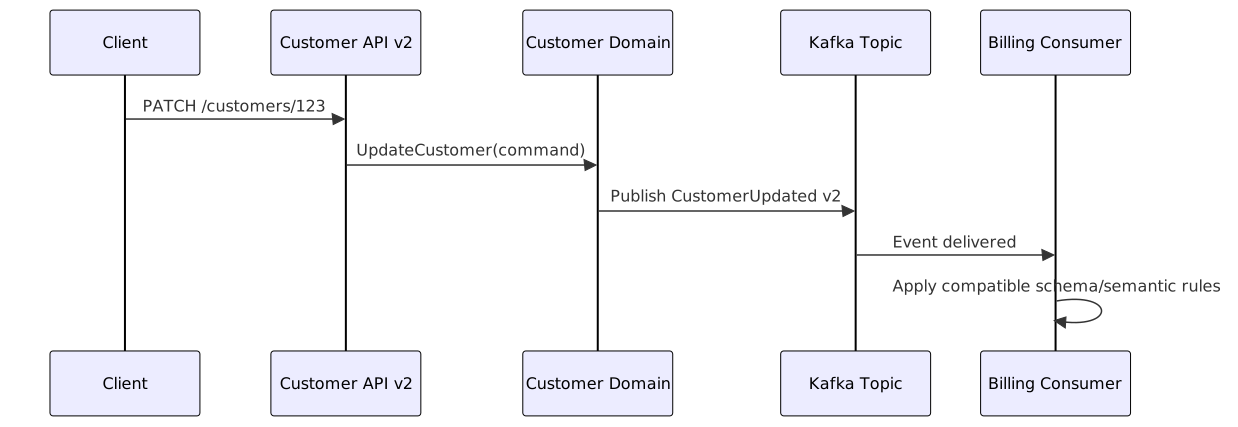
A minor API change can still trigger a major event change if the downstream semantic contract shifts. This is why version governance belongs at the domain boundary, not in isolated platform silos.
Migration Strategy
The best versioning strategy is the one that reduces the need for versioning. The second-best is the one that makes migration survivable.
In brownfield enterprises, migration is usually progressive and uneven. That means strangler patterns, coexistence, reconciliation, and a lot of patience.
Progressive strangler migration
Suppose you are moving from a legacy customer service whose API is tightly coupled to a CRM data model toward a domain-aligned Customer bounded context. You should not cut consumers over in one move unless you enjoy emergency change boards.
Use a strangler approach:
- introduce a new facade or gateway
- route selected capabilities to the new service
- maintain compatibility for existing consumers
- progressively migrate clients
- reconcile data and semantic differences
- retire old versions and old backends deliberately
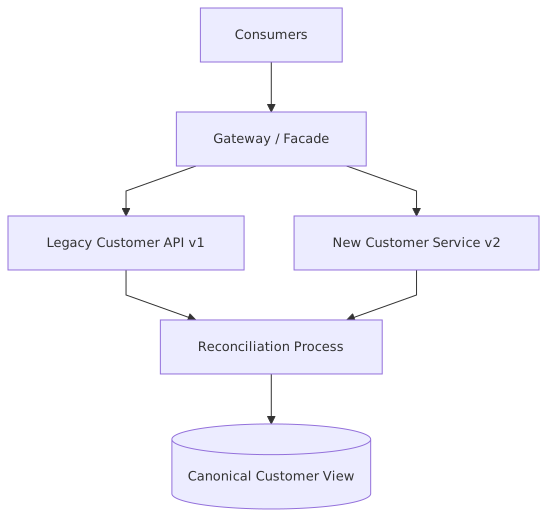
This is where many migrations get ugly. The old model and the new model are rarely isomorphic. Legacy may treat “customer” as a billing account record. The new domain may distinguish person, organization, account, and relationship. A compatibility facade can paper over some differences, but not forever.
Reconciliation
Reconciliation is not a side note. It is often the migration.
When old and new versions coexist, you must reconcile:
- data representations
- business identifiers
- event ordering
- duplicate updates
- conflicting business rules
- partial writes across services
A common pattern is dual-write avoidance through event-driven synchronization:
- old system emits change events
- new system emits its own events
- reconciliation service resolves differences into a canonical operational view
- consumers use version-aware mappings until migration completes
This is where Kafka helps. It gives you an append-only history, replay support, and a way to fan out contract evolution. But Kafka does not solve semantic mismatch. It just preserves it very efficiently.
A practical migration policy:
- minor changes: in-place evolution with compatibility tests
- major changes: parallel run old and new contracts
- high-risk domain meaning changes: dual-read, reconciliation dashboards, and explicit exit criteria
Sunset discipline
Every version needs:
- launch date
- support window
- deprecation date
- sunset date
- owner
- migration path
- observability dashboard
If you lack sunset discipline, versioning turns into archaeological preservation.
Enterprise Example
Consider a global insurer modernizing claims processing.
The legacy estate had a central claims platform exposing SOAP services and nightly file feeds. Over time, several microservices were introduced: Policy, Customer, Claims Intake, Fraud, Payments, and Document Management. Kafka connected the newer services, but partner APIs and internal channels still relied on older interfaces. Everyone said they had “service-oriented architecture.” What they really had was a diplomatic arrangement between decades.
The Claims Intake team launched a REST API:
POST /claimsGET /claims/{id}
Initially it was labeled v1, but there was no real compatibility policy. The request included policyNumber, customerId, lossDate, claimType, and description. Downstream, the service emitted ClaimCreated events to Kafka.
Then the business introduced a new operating model. A claim was no longer always attached to a policy at intake. Some claims began as incidents, later linked to policy and party after investigation. This was not a cosmetic tweak. It was a domain correction. The original API assumed the wrong aggregate semantics.
The team’s first instinct was to add optional fields and keep v1. Classic mistake.
What followed was predictable:
- consumers assumed
policyNumberwas always mandatory - fraud scoring logic used claim type semantics that no longer held
- analytics counted incidents as claims before adjudication
- payment service subscribed to events whose meaning had changed without a topic version break
The architects stepped in and reframed the issue with DDD. “Claim” at intake was actually an IncidentReport in the newer domain model. The old API was not merely missing fields; it embodied the wrong language.
So they did three things.
First, they introduced v2 as a new contract aligned to the domain:
POST /incident-reports- separate association endpoints for policy and claimant linkage
- explicit state transitions from intake to validated claim
Second, they created a compatibility adapter so major internal channels using v1 could continue sending old requests while the adapter translated them into the new model where possible.
Third, they versioned the Kafka stream semantically:
- existing
ClaimCreatedtopic kept for legacy support for a fixed sunset period - new
IncidentReportedandClaimRegisteredtopics introduced - downstream services migrated by bounded context, not by enterprise-wide big bang
This was not free. Fraud had to consume both event models for six months. Reporting needed reconciliation logic to avoid double counting. Payments ignored incident events entirely until claim registration. Partner teams needed a compatibility chart and explicit consumer test kits.
But the result was sane. The domain language improved. Teams could reason about change again. Most importantly, the organization stopped pretending that semantic breaks were harmless schema edits.
That is what good versioning buys you: not tidier URLs, but restored architectural honesty.
Operational Considerations
Versioning succeeds or fails in operations long before it succeeds or fails in design documents.
Contract testing
Consumer-driven contract tests are essential, especially for internal APIs and events. If you do not have automated checks for compatibility, your semver labels are just decorative. Kafka consumers should also validate schema compatibility and unknown-field tolerance.
Observability by version
Track traffic, latency, errors, and consumer identity by API version and event schema version. A deprecation plan without telemetry is wishful thinking.
You want dashboards that answer:
- who still calls
v1? - what payload shapes are still seen?
- which consumers fail on new enum values?
- can we prove sunset readiness?
Documentation and discoverability
Documentation must include:
- compatibility policy
- examples of major/minor/patch changes
- deprecation timelines
- migration guides
- event semantics, not only schemas
A schema tells you shape. A migration guide tells you survival.
Gateway and routing policy
If using an API gateway, centralize:
- version routing
- deprecation headers
- sunset notices
- authentication policy by version
- traffic shadowing for migration rehearsals
Replay and retention strategy for Kafka
For event-driven systems, think hard about replay. If you replay old topics into newer consumers, can they still interpret the semantics? If not, you may need:
- translation streams
- replay adapters
- version-aware consumers
- frozen compatibility libraries for historical topics
Historical data is where many elegant versioning strategies go to die.
Tradeoffs
Semantic versioning for APIs in microservices is useful, but it comes with costs.
The good
- clearer consumer expectations
- safer independent deployments
- explicit migration planning
- better domain governance
- improved auditability for regulated change
- more disciplined deprecation and retirement
The bad
- pressure to support too many active versions
- larger testing matrix
- added complexity in gateways and adapters
- temptation to version too early or too often
- semantic disagreements that numbers alone cannot resolve
The subtle
Semver creates the illusion of precision. Enterprises love that. But compatibility is contextual. Adding a field may be safe for one client and breaking for another. Tightening validation may be correct from a domain perspective and still catastrophic operationally.
Architecture lives in these tradeoffs. There is no versioning standard that exempts you from judgment.
Failure Modes
This is where systems reveal what they really are.
Version number without compatibility policy
The API says v2. Nobody knows what changed. Consumers reverse-engineer behavior in production.
Schema-compatible but semantically broken
JSON shape remains valid. Business meaning changes. Downstream decisions become wrong rather than obviously failed. These are dangerous failures because they are quiet.
Infinite support for old versions
No retirement discipline. Legacy clients linger forever. The organization pays compound interest on every contract decision.
Shared model contamination
Teams share DTO libraries or event classes across bounded contexts. One service’s internal refactor becomes everyone’s emergency dependency update.
Topic explosion in Kafka
Every small change creates a new topic. Consumers drown in subscriptions. Producers duplicate logic. Retention and replay become a maze.
Forced synchronized migration
A supposedly microservice architecture requires ten teams to coordinate one breaking change on one weekend. That is not autonomy. That is distributed monolith behavior with better branding.
Reconciliation ignored
Old and new versions coexist, but no one tracks mismatches, duplicates, or semantic divergence. Migration appears complete until finance notices totals do not align.
When Not To Use
Semantic versioning is not always the right hammer.
Do not lean on elaborate API semver schemes when:
The service is truly internal and tightly co-evolved
If one team owns both producer and consumer and deploys them together, heavy version management may be overkill. A simpler compatibility discipline plus synchronized deployment can be enough.
The interface is a thin CRUD shell over unstable discovery work
During early domain exploration, freezing public semantics too early can lock in the wrong language. Better to keep the audience narrow and the contract provisional.
You can evolve through tolerant readers and additive change only
Some event-driven systems can go a long time with additive schema evolution and robust consumer tolerance. If semantics remain stable, major versioning may be rare.
The real issue is bad bounded contexts
If teams keep versioning because their APIs expose internal models or muddled domain concepts, the answer is not more version machinery. The answer is better boundaries.
Versioning should not compensate for poor domain design. That is like buying a larger filing cabinet because your accounting is wrong.
Related Patterns
Several related patterns strengthen API versioning in microservices:
- Bounded Context: keeps semantics local and explicit
- Anti-Corruption Layer: translates between legacy and new models during migration
- Strangler Fig Pattern: supports progressive replacement of old APIs and services
- Consumer-Driven Contracts: validates real compatibility, not imagined compatibility
- Tolerant Reader: helps consumers survive additive change
- Schema Registry: governs event schema evolution in Kafka ecosystems
- Canonical Data Model: useful in moderation for reconciliation, dangerous if it becomes enterprise-wide dogma
- API Gateway: centralizes version routing, deprecation communication, and traffic shaping
- Event Upcasting: translates historical events for newer consumers during replay
These patterns matter because versioning is never solitary. It sits in a web of migration, domain boundaries, and runtime governance.
Summary
API versioning in microservices is not about slapping v1, v2, and v3 onto endpoints and calling it architecture. It is about preserving semantic trust while the system changes beneath your feet.
Semantic versioning helps, but only when you define compatibility in domain terms:
- major for semantic or behavioral breaks
- minor for additive compatible evolution
- patch for corrective, contract-preserving fixes
The real work is elsewhere:
- design contracts around bounded contexts
- separate published APIs from internal models
- govern API and Kafka event evolution together
- use progressive strangler migration for brownfield modernization
- reconcile old and new semantics explicitly
- measure version usage operationally
- retire old versions with discipline
And above all, be honest about tradeoffs. Supporting multiple versions buys flexibility at the cost of complexity. Pretending semantic changes are harmless buys short-term convenience at the cost of future disorder.
In enterprise architecture, numbers rarely save you. Clear semantics, explicit migration paths, and disciplined boundaries do.
That is the real version compatibility chart. Not the table in your documentation, but the one embedded in your architectural behavior.
Frequently Asked Questions
What is a service mesh?
A service mesh is an infrastructure layer managing service-to-service communication. It provides mutual TLS, load balancing, circuit breaking, retries, and observability without each service implementing these capabilities. Istio and Linkerd are common implementations.
How do you document microservices architecture for governance?
Use ArchiMate Application Cooperation diagrams for the service landscape, UML Component diagrams for internal structure, UML Sequence diagrams for key flows, and UML Deployment diagrams for Kubernetes topology. All views can coexist in Sparx EA with full traceability.
What is the difference between choreography and orchestration in microservices?
Choreography has services react to events independently — no central coordinator. Orchestration uses a central workflow engine that calls services in sequence. Choreography scales better but is harder to debug; orchestration is easier to reason about but creates a central coupling point.