⏱ 20 min read
Most architecture diagrams lie.
They lie politely, with neat boxes and arrows, and they lie because they pretend the interesting part of a distributed system is the application code. In most enterprises, it isn’t. The interesting part lives in the seams: retries, identity, timeouts, mTLS, partial failure, traffic shaping, policy drift, release blast radius, and the quiet terror of not knowing which service is talking to which. The application team thinks they built an order service. Operations knows they really built a negotiation with the network.
That is why service mesh matters. Not as fashionable infrastructure. Not as another CNCF badge to put on a slide. But as runtime architecture: a deliberate way to shape how services behave once they are deployed, particularly in Kubernetes where the platform encourages decomposition faster than most organizations can govern it.
A sidecar-based service mesh changes the topology of communication. It inserts a programmable participant into every conversation. That sounds intrusive because it is intrusive. But enterprise architecture is often the art of choosing the right intrusions. The old model let every team solve resilience, telemetry, and security in its own language stack, with its own bugs, its own defaults, and its own blind spots. The mesh centralizes those runtime concerns into the network path. Not perfectly. Not cheaply. But often usefully.
The critical mistake is to treat a service mesh as only transport plumbing. In a serious enterprise, runtime architecture has to reflect domain design. If the domain says an Order must not be charged before fraud screening completes, then the runtime should help enforce sequencing, trust boundaries, observability, and failure isolation around that flow. If the business says customer profile reads are soft real-time but ledger writes are sacred, then traffic policy should express that asymmetry. Good architecture makes domain semantics visible in the machinery. Bad architecture buries business meaning under generic middleware.
So let’s talk about service mesh in the grown-up way: as an architectural move with consequences.
Context
Kubernetes gave enterprises an operating model for running many small deployable units. That solved one class of problem and amplified another. Teams could package applications consistently, schedule them efficiently, and scale them elastically. Then they discovered that twenty services talking over a cluster network is not just “modular monolith but smaller.” It is a living organism with unreliable blood flow.
As systems fragment, runtime concerns stop being incidental. Every service needs transport security. Every service needs some notion of service identity. Every service needs retries, but not the same retries. Every service needs metrics, but metrics without correlation are wallpaper. And every production incident eventually asks the same humiliating question: what was this thing talking to at the time?
Before the mesh, organizations usually dealt with these concerns in one of three ways.
First, they embedded client libraries into application code. Resilience libraries, auth middleware, tracing SDKs, custom HTTP clients, Kafka wrappers. This works until it doesn’t. The implementation becomes uneven across Java, Go, Node.js, Python, .NET, and the two systems still running on a framework nobody admits to owning. event-driven architecture patterns
Second, they pushed concerns into the API gateway. That helps at the edge but does almost nothing for east-west traffic, which is where most failure and most enterprise complexity lives.
Third, they accepted inconsistency and called it team autonomy. That is not autonomy. That is entropy with a rebranding budget.
A service mesh emerged because organizations needed a runtime control plane for service-to-service communication. In Kubernetes, the sidecar pattern became the practical mechanism. Each pod gets a proxy. Traffic goes through the proxy. Policy, encryption, telemetry, and routing become configurable without recompiling application code.
The appeal is obvious. The danger is just as obvious: once the network becomes programmable, you have built a second distributed system next to the first one.
Problem
Microservices multiply operational choices. Every service call carries hidden decisions:
- How long should the caller wait?
- Should it retry?
- Which endpoint version should receive traffic?
- How is the peer authenticated?
- What telemetry is captured?
- What happens if certificates rotate mid-flight?
- How do we quarantine a misbehaving dependency?
- Can one noisy team saturate another team’s service?
- How do we enforce data residency or trust boundaries?
Without a coherent runtime architecture, those decisions are scattered. Some live in code. Some in ingress rules. Some in Helm values. Some in tribal memory. The result is a system that behaves differently depending on the language, framework, and competence of the local team.
And there is a deeper problem that rarely gets enough attention: domain semantics are lost in transport noise.
A customer profile lookup and a payment authorization are both HTTP calls, but they are not the same architectural event. One can be cached and retried with relative freedom. The other may require idempotency keys, transactional outbox patterns, compensations, and strict auditability. Treating all service calls as generic RPC is how enterprises accidentally encode business risk into a timeout setting.
A service mesh is attractive because it can standardize parts of this chaos. But if you standardize the wrong things, you create a more elegant mess. Runtime architecture should separate commodity concerns from domain concerns. mTLS is commodity. Whether an inventory reservation can be replayed is not.
This is especially important where Kafka and asynchronous collaboration enter the picture. Many enterprises are not purely request-response. A retail checkout flow might use synchronous APIs for cart pricing, asynchronous events for fulfillment, and reconciliation jobs to repair eventual consistency. The mesh can govern synchronous paths well. It cannot magically make asynchronous domain design go away. If anything, a mesh can lull teams into overusing sync calls because the path feels safer.
That is one of the recurring anti-patterns in modern platform engineering: better plumbing that encourages worse decomposition.
Forces
Several forces push enterprises toward a mesh, and several push back.
Standardization versus local optimization
Central platform teams want consistent security, telemetry, and traffic policy. Product teams want freedom to ship. A mesh promises both: common runtime behavior with limited code change. In reality, you are deciding where standardization ends and domain-specific behavior begins.
Security versus simplicity
Mutual TLS, workload identity, certificate rotation, and policy enforcement are easier with a mesh than with bespoke code in every service. But “easier” is not the same as “simple.” The control plane, certificate authority integration, and policy lifecycle all add moving parts.
Observability versus signal overload
A sidecar can emit uniform metrics, traces, and access logs. That is valuable. It is also a good way to produce a mountain of technically correct but operationally useless data unless the telemetry model aligns with bounded contexts, business capabilities, and critical user journeys.
Decoupling versus latency
The sidecar proxy introduces another hop and another process. Usually the overhead is acceptable. Sometimes it is not. For low-latency trading, ultra-high-throughput telemetry pipelines, or simple stateless services with minimal east-west complexity, the cost may outweigh the control.
Policy centralization versus hidden behavior
Architects love centralized policy because it feels governable. Developers hate hidden behavior because it violates locality. If a retry policy exists outside the code, then developers can trigger duplicate operations without realizing it. This matters a lot in domains where side effects are expensive or irreversible.
Synchronous convenience versus asynchronous truth
The mesh improves service-to-service calls. Kafka improves decoupled event collaboration. Enterprise systems need both. The force here is subtle: if request-response gets easier, teams may postpone event-driven refactoring, even where the domain screams for it. Runtime architecture can distort system design.
Solution
The sensible way to describe a service mesh is this: it is a distributed runtime layer that externalizes common communication concerns from application code and places them into a managed data plane and control plane.
In a sidecar network topology, each application pod gets a proxy sidecar. The sidecar intercepts inbound and outbound traffic. A control plane distributes configuration to the sidecars: routing rules, certificates, policy, telemetry settings, service discovery data, fault injection, and more. The mesh becomes the place where runtime communication behavior is governed.
That’s the mechanism. The architecture is more interesting.
A service mesh as runtime architecture should do four things well:
- Establish trust
Every workload gets an identity. East-west traffic is authenticated and encrypted. This is table stakes in a serious platform.
- Make communication visible
The mesh provides a common lens for service interactions: golden signals, service graphs, latency distributions, and trace propagation.
- Shape traffic intentionally
Canary releases, blue-green routing, circuit breaking, outlier detection, failover, rate limiting, and policy enforcement become first-class operational tools.
- Respect domain semantics
This is the part many mesh programs miss. Not every interaction should inherit the same timeout, retry, or fallback behavior. Runtime policy should map to domain criticality, bounded contexts, and consistency expectations.
A mature design distinguishes between transport-level guarantees and business-level guarantees.
The mesh can help with transport retries. It cannot decide whether retrying a payment capture is valid. The mesh can enforce mTLS between services. It cannot determine whether a customer aggregate is allowed to cross a domain boundary. The mesh can observe a saga. It cannot reconcile business invariants by itself.
That division of responsibility matters.
Core topology
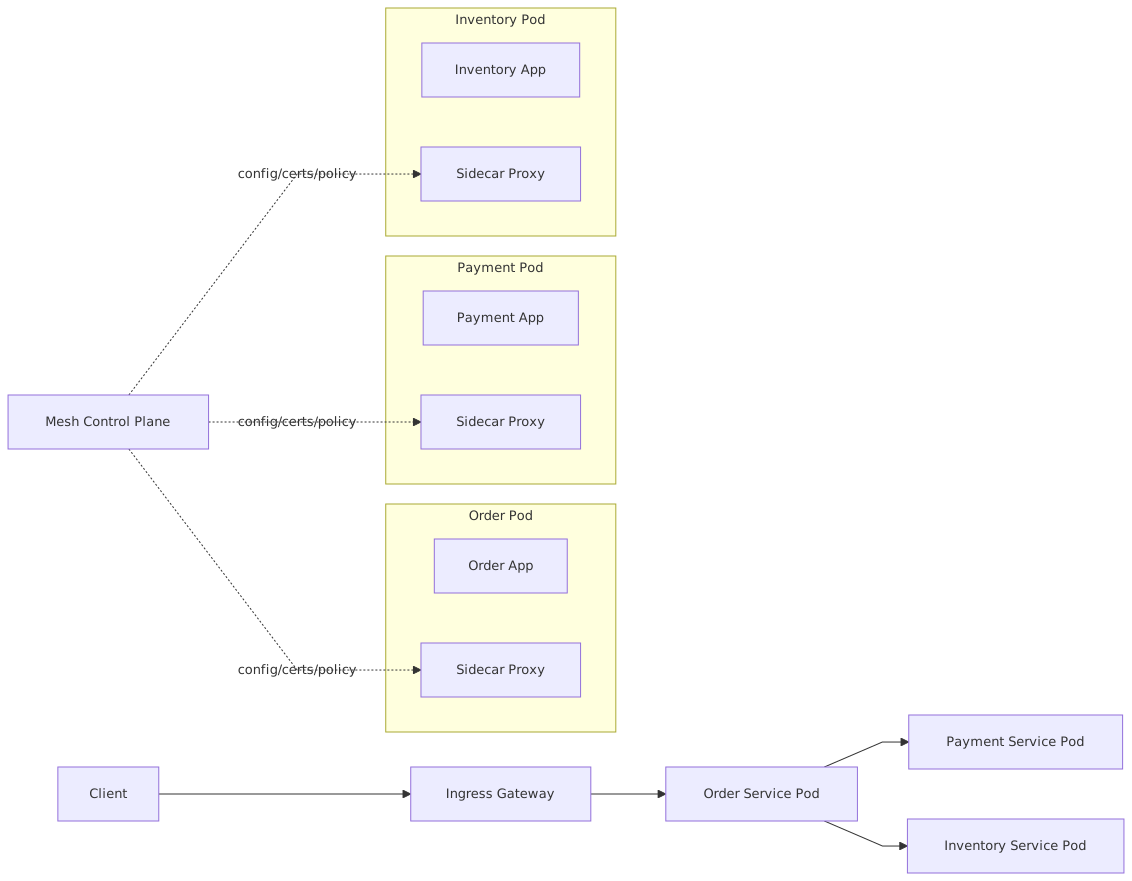
In practice, every service call now traverses proxy logic. That gives you leverage. It also means the proxy fleet is part of the critical path for the business.
Architecture
A good enterprise mesh architecture is not just “install Istio” or “enable Linkerd.” Tool choice matters, but architecture comes first.
1. Data plane as execution fabric
The sidecar proxies form a distributed execution fabric for network behavior. Requests are authenticated, routed, measured, and potentially retried or denied. This is where runtime policy becomes real.
Opinionated point: keep data-plane behavior boring. Do not turn the proxy layer into a mini application platform full of bespoke transformation logic. Once teams start hiding business behavior inside proxy configuration, debugging becomes archaeology.
2. Control plane as policy distributor
The control plane manages workload identities, route rules, certificate distribution, telemetry configuration, and policy propagation. It is effectively a compiler for runtime intent.
This introduces a new category of architecture work: configuration lifecycle governance. Who owns policies? How are they reviewed? How are they promoted between environments? What is the blast radius of a bad routing rule? Enterprises that are disciplined about source code but casual about control-plane config are asking for a midnight outage. EA governance checklist
3. Domain-aligned policy tiers
This is where domain-driven design becomes practical. Not every service should sit under identical runtime policies. Group policies around bounded contexts and business capabilities.
For example:
- Customer Profile context
Lower criticality reads, some caching tolerance, more permissive retry posture.
- Order Management context
Tight traceability, explicit timeouts, careful backpressure.
- Payments and Ledger context
Strict idempotency expectations, minimal transparent retries, heightened audit logging, stronger policy controls.
The runtime architecture should reflect these semantics. If your mesh policy model ignores bounded contexts, your platform is saying all domains are equal. They aren’t.
4. Synchronous and asynchronous coexistence
Most enterprises need both service mesh and Kafka. The trick is to use each for what it is good at.
- Use the mesh to control synchronous service calls where latency, security, and routing policy matter.
- Use Kafka for decoupled domain events, integration across bounded contexts, and workflows that tolerate eventual consistency.
The boundary between them should be explicit. A command that needs immediate validation might be synchronous. The publication of “OrderPlaced” should usually be asynchronous. Reconciliation then becomes the safety net when reality diverges from intent.
5. Reconciliation as architectural discipline
Reconciliation is not a workaround. It is the price of distributed truth.
In a mesh-enabled microservices estate, requests may time out after the downstream committed work. Events may be published but not consumed before a user refreshes a screen. A network partition may leave one context ahead of another. You cannot prevent all inconsistency; you can design to detect and repair it. microservices architecture diagrams
This is where runtime architecture and domain design meet. The mesh tells you what happened on the wire. Reconciliation tells you what happened in the business.
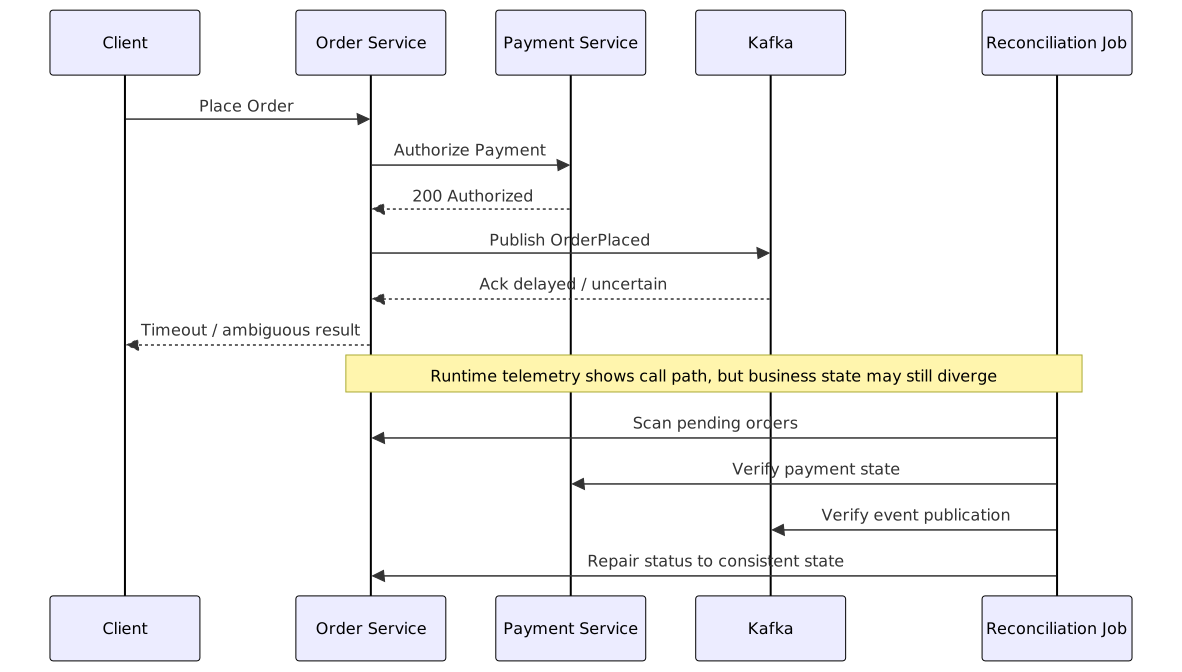
That is enterprise reality. Not elegance, but durability.
Migration Strategy
The worst way to adopt a service mesh is the big-bang model: inject sidecars everywhere, enforce mTLS overnight, migrate ingress, turn on traffic policy, and call it modernization. That is not architecture. That is a confidence trick played on your operations team.
A service mesh should be introduced with a progressive strangler migration strategy.
Step 1: Start with observability, not enforcement
Pick a limited set of non-critical services. Enable sidecars. Capture service graph, latency, and dependency data. Learn the actual topology before you regulate it. Enterprises are often surprised by hidden couplings, old clients, undocumented service consumers, and weird retries baked into SDKs.
Step 2: Add workload identity and permissive mTLS
Introduce service identity and certificate management in a mode that allows coexistence with non-mesh traffic. The goal is to validate trust chain behavior and understand integration points with existing PKI, secret rotation, and namespace boundaries.
Step 3: Migrate ingress and selected east-west routes
Move a small number of well-understood paths under mesh routing control. Canary deployment is usually the first convincing business value. Product teams understand “release to 5% safely” much faster than they understand “uniform xDS policy propagation.”
Step 4: Define domain-based policy classes
Now codify different runtime behaviors for different bounded contexts. Don’t just create “default retry policy.” Create classes tied to business semantics: read-mostly, command-oriented, financial-critical, bulk async gateway, and so on.
Step 5: Integrate with event-driven patterns
As the mesh expands, explicitly identify where synchronous calls should remain and where Kafka-based events should replace chatty service chains. Strangle synchronous dependencies where they create high coupling or fragile request cascades.
Step 6: Turn on enforcement gradually
Only after traffic patterns are understood should you tighten mTLS, authorization policy, rate limits, and egress controls. The enterprise habit of enabling policy before understanding dependencies is how shared platforms become hated.
Strangler migration view
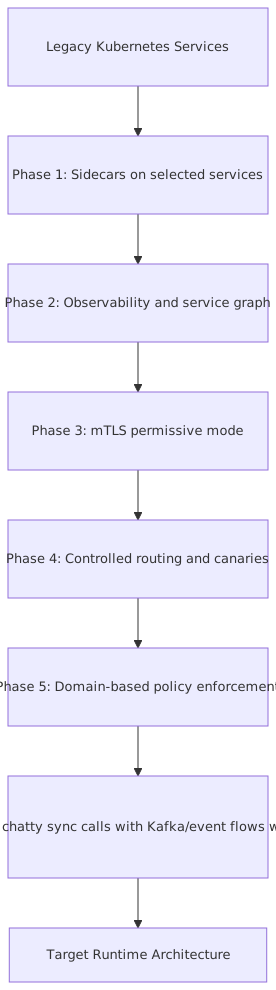
The key migration reasoning is simple: first reveal behavior, then standardize it, then restrict it. In that order. Anything else is theater.
Enterprise Example
Consider a global retailer modernizing its commerce platform. It has Kubernetes clusters in multiple regions, an e-commerce front end, order management, pricing, promotions, payment orchestration, customer profile, inventory, and fulfillment systems. Some services are new microservices. Some are wrappers over old estate. Kafka carries domain events between commerce and downstream ERP and warehouse platforms.
The retailer’s initial symptom was not security. It was release instability.
The promotions team could deploy a new service and accidentally spike latency for checkout because of aggressive retries against pricing. The order service depended on customer, inventory, promotions, tax, and payment in a single request path. On Black Friday, one slow downstream dependency became a request waterfall. Teams spent hours arguing whether a problem was in code, DNS, TLS, or the load balancer.
They adopted a service mesh in three bounded contexts first: checkout, order management, and payment orchestration.
What changed?
- Every workload got an identity.
- East-west calls were visible in a consistent service graph.
- Checkout-to-pricing traffic was tuned with explicit deadlines instead of inherited client defaults.
- Payment services had transparent retries disabled for mutation endpoints.
- Canary routing let the promotions team expose a new rules engine to 2% of traffic before full release.
- Authorization policies prevented non-commerce services from directly invoking payment internals.
- Kafka remained the backbone for “OrderPlaced,” “InventoryReserved,” and “ShipmentCreated” events.
The most important improvement wasn’t technical. It was semantic. The architecture team stopped talking about “all service traffic” and started talking about “customer reads,” “order commands,” “payment mutations,” and “event publication guarantees.” Once runtime policy was named in domain terms, arguments got clearer and outages got easier to diagnose.
They also learned the hard lesson. A platform engineer enabled generic retries on a path that ultimately caused duplicate reservation attempts in a downstream inventory adapter that lacked proper idempotency. The mesh didn’t create the domain bug. It amplified it. That is the central truth of service mesh adoption: runtime architecture makes your assumptions run faster.
Operational Considerations
A service mesh is operationally significant software. Treat it that way.
Capacity and overhead
Sidecars consume CPU and memory. At scale, that is not rounding error. Capacity planning must include proxy overhead, certificate rotation bursts, control-plane fanout, and telemetry export costs.
Control-plane resilience
If the control plane is unavailable, what happens to existing proxies? What configuration do they retain? How are certificates renewed? Enterprises need explicit degraded-mode assumptions, not hopeful ones.
Telemetry strategy
Collecting everything is the easiest way to understand nothing. Define telemetry around service level objectives, critical business journeys, and bounded contexts. Tie runtime signals to business events where possible.
Policy as code
Routing rules, authorization policies, mTLS modes, egress controls, and rate limits belong in versioned delivery pipelines with review, testing, and rollback. If application code goes through CI/CD but mesh config is edited manually, governance is fiction. ArchiMate for governance
Reconciliation workflows
Because partial failure is unavoidable, build reconciliation jobs and operational dashboards that compare domain states across services and Kafka topics. Runtime observability should feed reconciliation, not replace it.
Multi-cluster and multi-region design
In enterprises, one cluster is a toy problem. Cross-cluster identity federation, service discovery, failover semantics, and data gravity all become real concerns. Be especially careful with active-active assumptions. Routing traffic across regions is easy to configure and expensive to regret.
Tradeoffs
Here is the blunt version.
A service mesh gives you stronger runtime control, consistent security, and better observability. It also gives you more infrastructure, more operational complexity, and more places for misunderstanding to hide.
What you gain
- Uniform mTLS and workload identity
- Centralized traffic management
- Better service-level observability
- Safer progressive delivery
- Reduced need for duplicated client-side plumbing
- Clearer governance for east-west communication
What you pay
- Additional latency and resource overhead
- Another control plane to secure and operate
- More configuration complexity
- Harder local debugging
- Risk of hidden behavior outside the codebase
- Cultural friction between platform and product teams
The tradeoff is usually favorable in large, heterogeneous microservice environments with serious security and governance needs. It is often unfavorable in small systems, low-complexity domains, or organizations without the operational maturity to run a mesh well.
Failure Modes
Architects should always ask not only “how does it work?” but “how does it fail?”
1. Policy-induced outages
A bad route, certificate, or authorization policy can break many services at once. Centralization increases leverage and blast radius together.
2. Retry storms
Misconfigured retries can multiply load against a failing service and turn a slowdown into a collapse. This is especially dangerous for non-idempotent operations.
3. False confidence in security
mTLS secures transport identity. It does not solve overprivileged service accounts, broken domain authorization, or bad data handling. Enterprises often confuse cryptographic trust with business trust.
4. Telemetry saturation
Sidecars can generate huge volumes of logs and metrics. Under pressure, observability systems themselves become a bottleneck or cost problem.
5. Hidden coupling persists
A mesh makes dependencies visible, but it does not remove them. Organizations may keep tightly coupled service chains because the runtime now masks some of the pain.
6. Async blind spots
Teams may invest heavily in request tracing while neglecting Kafka consumer lag, dead-letter handling, replay strategy, and event contract drift. The result is an observability model that explains synchronous failures beautifully and asynchronous ones not at all.
7. Reconciliation ignored
This is the quiet killer. If teams rely on the mesh to make distributed calls “reliable enough,” they may underinvest in reconciliation logic. When edge cases occur, business state drifts and stays drifted.
When Not To Use
You do not need a service mesh because you use Kubernetes.
If you have a small number of services, one language stack, modest compliance requirements, and little need for advanced traffic shaping, a good ingress controller, standard libraries, and straightforward observability may be enough.
Do not use a service mesh when:
- your architecture is still mostly monolithic and communication complexity is low
- your teams cannot yet manage Kubernetes well, let alone another distributed control plane
- your major problems are domain boundaries and data ownership, not network policy
- your latency budget is extremely tight
- your system is primarily event-driven and has limited synchronous east-west traffic
- you are hoping the mesh will fix poor service design
A mesh is not a substitute for bounded contexts, idempotent APIs, transactional outbox patterns, consumer-driven contracts, or decent platform engineering. It is a force multiplier. If the underlying discipline is weak, it multiplies weakness.
Related Patterns
Several patterns sit naturally next to service mesh.
API Gateway
The gateway governs north-south traffic. The mesh governs east-west traffic. They solve adjacent, not identical, problems.
Sidecar Pattern
This is the deployment mechanism for many meshes: attach a helper container to the pod to intercept communication and provide supporting runtime functions.
Strangler Fig Pattern
Ideal for mesh adoption. Introduce the runtime layer around selected services and gradually expand while replacing old communication behaviors.
Saga
Useful where business workflows span services and rely on asynchronous coordination. The mesh can observe saga steps; it cannot implement business compensations for you.
Transactional Outbox
Essential when services emit Kafka events reliably after state changes. The mesh does not address atomicity between database writes and event publication.
Bulkhead and Circuit Breaker
These can be expressed at the mesh layer, but the domain impact of tripping them still belongs to application and business design.
Reconciliation
An underrated companion pattern. In a distributed enterprise platform, reconciliation is the operational expression of eventual consistency.
Summary
A service mesh in Kubernetes is not merely infrastructure. It is runtime architecture.
That phrase matters because it changes the conversation. We stop asking whether sidecars are fashionable and start asking whether the runtime behavior of our system reflects the domain, the risk model, and the operational reality of the enterprise. We stop pretending all service calls are equal. We stop pushing every resilience decision into local code. We acknowledge that the network is part of the application whether we like it or not.
Used well, a service mesh gives enterprises a programmable, observable, secure communication fabric. It makes sidecar network topology a tool for standardization without requiring every team to reinvent transport concerns. It improves release safety, trust establishment, and runtime governance.
Used badly, it creates a polished maze.
The winning approach is disciplined and incremental: adopt it with a strangler mindset, map policies to bounded contexts, preserve Kafka and asynchronous patterns where the domain demands decoupling, and build reconciliation because the wire never tells the whole business story.
Here is the memorable line worth keeping: the mesh can govern conversations, but it cannot decide what those conversations mean.
That is still architecture’s job.
Frequently Asked Questions
What is a service mesh?
A service mesh is an infrastructure layer managing service-to-service communication. It provides mutual TLS, load balancing, circuit breaking, retries, and observability without each service implementing these capabilities. Istio and Linkerd are common implementations.
How do you document microservices architecture for governance?
Use ArchiMate Application Cooperation diagrams for the service landscape, UML Component diagrams for internal structure, UML Sequence diagrams for key flows, and UML Deployment diagrams for Kubernetes topology. All views can coexist in Sparx EA with full traceability.
What is the difference between choreography and orchestration in microservices?
Choreography has services react to events independently — no central coordinator. Orchestration uses a central workflow engine that calls services in sequence. Choreography scales better but is harder to debug; orchestration is easier to reason about but creates a central coupling point.