⏱ 21 min read
Most service boundaries are not technical mistakes. They are organizational confessions.
A team says “this service owns customers,” another says “we also need customer data,” a third says “we only need a lightweight profile copy,” and before long the architecture diagram looks tidy while the operating model quietly rots underneath it. APIs are documented. Kafka topics exist. Dashboards glow green. Yet delivery slows, incidents bounce between teams, and every roadmap item begins with a dependency meeting. The system is not failing because microservices are hard. It is failing because ownership was drawn around software components instead of business meaning. microservices architecture diagrams
This is the central problem of service ownership boundaries in modern enterprises. Team Topologies gave us a useful vocabulary—stream-aligned teams, platform teams, enabling teams, complicated subsystem teams. But vocabulary is not architecture. The hard part is deciding where a team’s cognitive load ends, where a service’s authority begins, and how those two lines reinforce each other rather than contradict each other.
That is why service ownership boundaries matter so much. They are not just an org chart concern. They shape delivery speed, incident response, data consistency, coupling, migration cost, and ultimately whether a business can change without tearing up its foundations every quarter.
The best boundaries feel boring once they are in place. Teams know what they own. Upstream and downstream relationships are predictable. Domain language is stable. Events have meaning. Reconciliation is an exception, not a way of life. The worst boundaries create a permanent border dispute. Every bug is a customs issue. Every feature is diplomacy.
This article takes a firm position: service boundaries should be designed from domain semantics outward, and team ownership should map to those semantics with as little ambiguity as possible. Not one team per class of technology. Not one service per UI page. Not one bounded context per database schema because a committee liked the diagram. Domain-driven design gives the language. Team Topologies gives the operating model. Good enterprise architecture connects the two.
Context
In large organizations, architecture usually drifts toward one of two bad equilibria.
The first is the monolith with many teams. Everyone shares the same codebase, the same release train, and the same argument about who broke the build. Ownership becomes tribal rather than explicit. The second is the microservices sprawl: dozens or hundreds of deployables, each with a name ending in -service, but with no clear business authority. That looks decentralized. It often is not. It merely replaces source-code coupling with runtime and organizational coupling.
Team Topologies was a reaction against exactly this kind of mess. It says, correctly, that software architecture and team design are inseparable. Stream-aligned teams should own a flow of change close to business value. Platform teams should reduce cognitive load. Enabling teams should help teams adopt hard capabilities. Complicated subsystem teams should contain specialist complexity.
Useful. Necessary. Still incomplete.
Because once you agree on team types, you still have to answer harder questions:
- What does a team truly own?
- Which service is the system of record for a concept like Customer, Order, Policy, Claim, or Product?
- Which team publishes events, which team consumes them, and which team has the right to redefine the business meaning of those events?
- What gets copied?
- What gets queried synchronously?
- What gets reconciled after the fact?
- What must never be split, no matter how attractive the “independent service” story sounds?
This is where domain-driven design earns its keep. Bounded contexts are not just decomposition tools. They are ownership tools. They identify where a model is internally coherent and where language shifts. If the semantics of “customer” differ between Retail Banking, Credit Risk, and Collections, then pretending there is one universal Customer service is not simplification. It is denial.
The architecture game, then, is to align bounded contexts, service boundaries, and team responsibilities so that the organization can move quickly without turning every business change into a cross-team summit.
Problem
Enterprises often draw service boundaries too low in the stack and too late in the delivery cycle.
Too low means they split around technical layers—profile service, preferences service, notification service, document service—without asking whether the business sees those as coherent capabilities. Too late means they discover ownership only after teams have already built overlapping functionality, duplicated data, and published incompatible events.
The symptoms are familiar:
- Multiple teams can change the same business concept.
- Two services both claim to be the source of truth.
- Kafka topics encode implementation details instead of business events.
- Reporting teams build side stores because operational services cannot answer basic domain questions.
- “Temporary” reconciliation jobs become permanent architecture.
- Incidents require five teams on a bridge call because nobody owns the full outcome.
A classic failure looks like this: one team owns Order Placement, another owns Fulfillment, another owns Pricing, another owns Customer Promotions. On paper, each service is independent. In reality, every meaningful customer journey crosses all four. The teams do not own slices of business capability; they own moving parts of a machine. A simple pricing change now requires coordination across event contracts, cache invalidation rules, compensation logic, and SLA negotiations.
That is not autonomy. It is choreography mistaken for design.
The root cause is usually a mismatch between business boundaries and service ownership boundaries. Teams are organized to match local engineering convenience, while the domain cuts across them in different ways. Conway wins, but not in the way anyone wanted.
Forces
Several forces pull boundary design in opposing directions. Good architecture is not about eliminating these forces. It is about deciding which tension you are willing to live with.
1. Domain coherence vs delivery independence
A broad service boundary can preserve business meaning. It keeps transaction rules, invariants, and workflows in one place. But broad boundaries can grow cognitively heavy. A narrow boundary can enable faster local delivery, but may split an essential business concept and create endless integration overhead.
2. Source-of-truth authority vs local autonomy
Every domain concept needs an authoritative owner somewhere. But downstream teams often need local copies for performance, resilience, or contextual interpretation. This leads naturally to events, replication, and Kafka-backed materialized views. Useful, yes. Dangerous, too. Every copy is a semantic liability unless the ownership rule is explicit. event-driven architecture patterns
3. Team cognitive load vs platform leverage
A stream-aligned team should be able to own its slice without drowning in operational complexity. Platform teams help by standardizing observability, deployment, eventing, security, and service scaffolding. But too much platform abstraction can hide important boundary decisions under boilerplate. Teams then create services because the platform made them cheap, not because the domain required them.
Cheap service creation is like cheap credit. It stimulates behavior you may regret later.
4. Synchronous correctness vs asynchronous decoupling
Some interactions need immediate validation and strong consistency. Others can tolerate eventual consistency with Kafka events and reconciliation. The trap is ideological purity. “Everything async” is as naive as “just call the API.” Real enterprises need both. The art lies in choosing where inconsistency is survivable and where it is catastrophic.
5. Global enterprise standards vs local bounded contexts
Architecture teams often push for canonical models across domains. The intention is noble: reduce duplication, improve interoperability, standardize reporting. The cost is often semantic flattening. Bounded contexts exist because meaning changes. A canonical model can be a translation aid. It should not become a forced universal ontology.
Solution
The solution is to define service ownership boundaries around business authority, then align team topology to those boundaries so each team owns a coherent domain outcome rather than a technical fragment.
That sentence sounds clean. Doing it is not.
A practical rule helps: a service should own the lifecycle and invariants of a business concept within a bounded context, and a team should own the service when it can change that lifecycle without habitual cross-team negotiation.
That implies several design decisions.
First, identify bounded contexts using domain-driven design, not application modules. Ask where language changes, where rules differ, and where the business tolerates duplication because the meaning is not actually the same. “Customer” in onboarding is not always “customer” in risk, support, or marketing.
Second, establish a clear system-of-record rule. One team and one service own the authoritative state transitions for a concept in a given context. Other teams may consume events, hold derived copies, or maintain projections, but they do not redefine the core lifecycle casually.
Third, map stream-aligned teams to business flows that can be delivered with low coordination. This does not mean each team gets one service. It means each team gets clear domain responsibility. Sometimes one team owns several small services. Sometimes one larger service is better than five tiny ones. The point is not service count. The point is ownership clarity.
Fourth, use Kafka and event-driven integration where temporal decoupling makes sense, especially for propagation of facts, side-effect initiation, analytics feeds, and context-specific read models. But keep command authority explicit. Events announce what happened. They should not become an excuse for shared ownership.
Fifth, design reconciliation deliberately. In any enterprise with asynchronous propagation, data lags, failed consumers, out-of-order messages, duplicate events, and manual overrides will happen. Reconciliation is not evidence of bad architecture. Unplanned reconciliation is.
The result is an architecture where team boundaries and service boundaries reinforce each other instead of constantly leaking.
Architecture
A good team-to-service mapping starts with domain authority and then overlays team interactions.
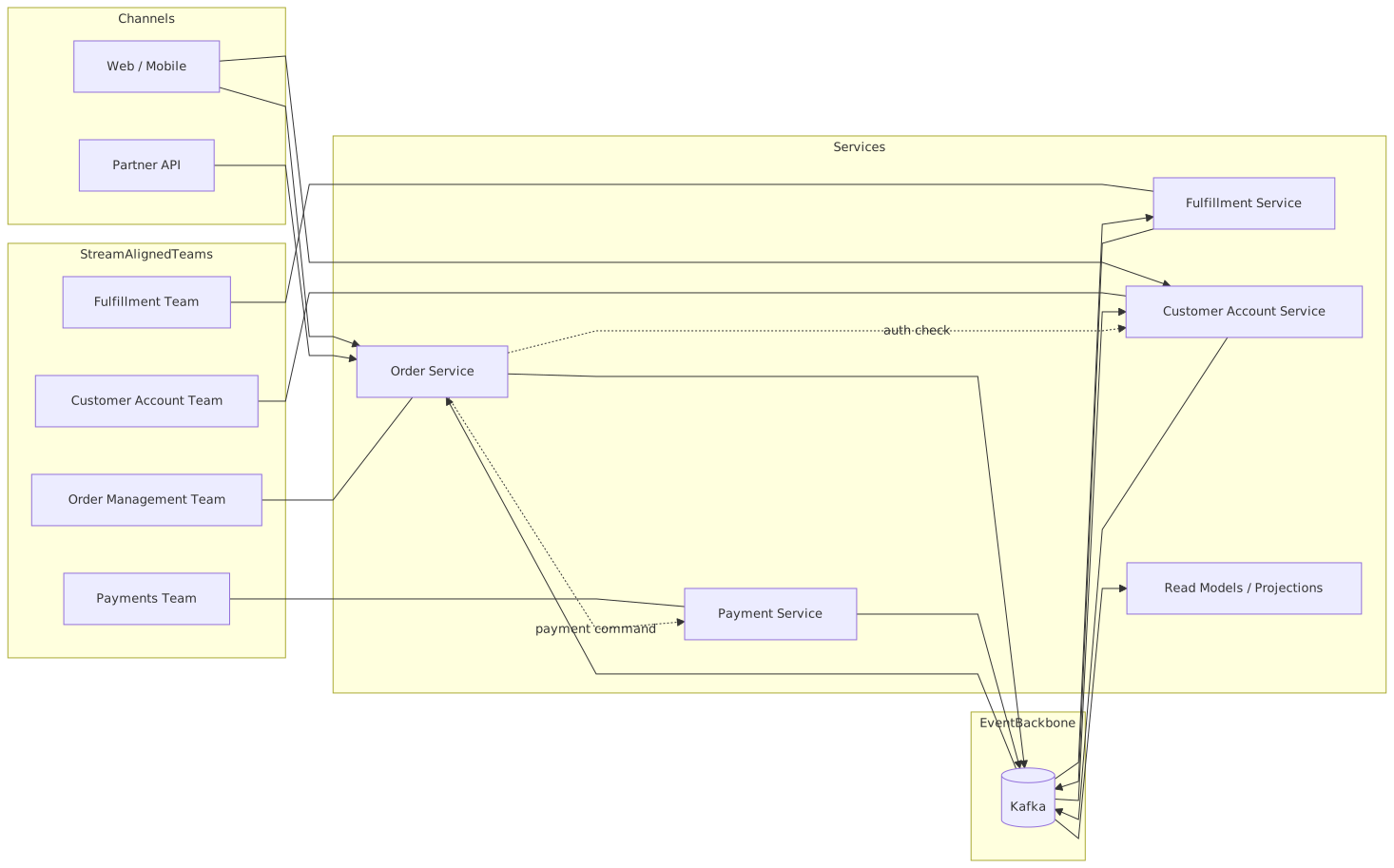
This is a healthy shape when the boundaries are semantic. Order Service owns the order lifecycle. Payment Service owns payment authorization, capture, and settlement semantics. Customer Account Service owns account state and identity-related rules. Fulfillment Service owns shipment and warehouse execution semantics. Kafka distributes business events—OrderPlaced, PaymentAuthorized, ShipmentDispatched—to downstream consumers and read models.
Notice what is not happening: nobody owns “status updates” as a service. Nobody split “order header” from “order line” because two squads needed separate backlogs. Nobody created a universal customer service that handles everything from login credentials to loyalty scoring to collections treatment.
That restraint matters.
Domain semantics before service count
Architects often ask, “How granular should our services be?” It is the wrong opening question. Start with semantics:
- What business concept changes here?
- What invariants must be enforced together?
- What language does the business use?
- Where would conflicting interpretations cause harm?
For example, in an insurance enterprise, Policy Administration and Claims both talk about a policy. But the semantics differ. Policy Administration owns issuance, endorsements, renewals, and cancellation rules. Claims uses policy data to determine coverage applicability at loss time. Claims should not own policy semantics just because it needs a copy of policy details. It should consume policy facts and maintain a context-specific projection.
That is textbook bounded context thinking, but in real life it prevents ugly organizational coupling.
Team interaction modes matter
Team Topologies reminds us that teams interact in different modes: collaboration, X-as-a-Service, and facilitating. These should appear in the boundary model.
- Stream-aligned to platform: X-as-a-Service for deployment, observability, Kafka provisioning, secrets, tracing.
- Stream-aligned to stream-aligned: mostly event/API contracts, occasional collaboration for major domain change.
- Enabling team to stream-aligned: facilitating for event modeling, decomposition, resilience patterns.
- Complicated subsystem team: only where specialist algorithms or regulated engines truly justify isolation.
If stream-aligned teams need constant collaboration just to complete ordinary domain change, your boundaries are probably wrong.
Context mapping and ownership
A useful ownership taxonomy in enterprise architecture looks like this:
- Authoritative owner: defines lifecycle and invariants.
- Publisher: emits business events from authoritative changes.
- Subscriber: consumes facts for local behavior.
- Projection owner: maintains local read model or cache.
- Reconciler: detects and repairs drift across contexts.
These roles should be explicit. If not, reconciliation ends up owned by operations, which is another way of saying owned by nobody.
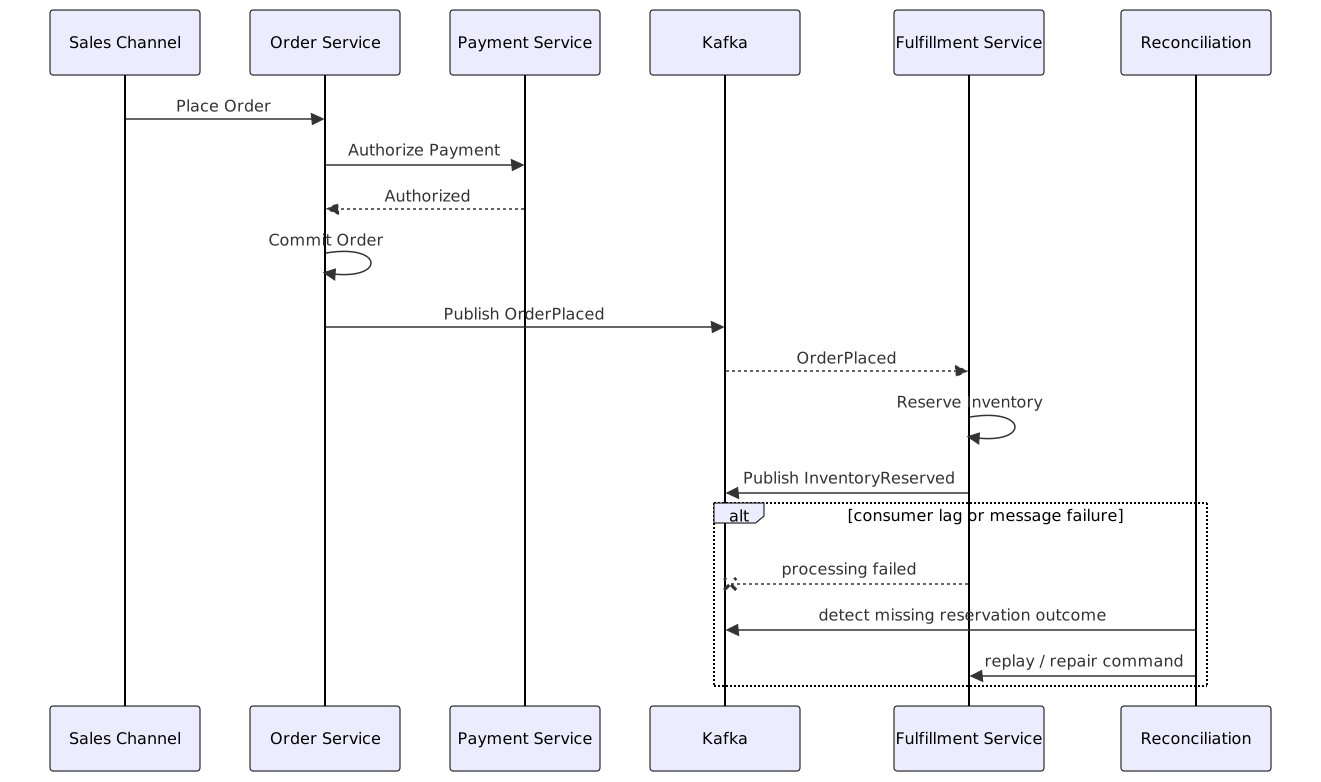
This is where progressive decoupling actually lives: a blend of synchronous command paths for immediate correctness and asynchronous event propagation for broader autonomy.
Migration Strategy
Nobody gets to redesign ownership boundaries from a blank sheet in a real enterprise. You inherit a monolith, a shared database, a pile of batch jobs, brittle ESB integrations, and three generations of half-finished “modernization.” The migration strategy must work with that reality.
The right pattern here is usually a progressive strangler migration, but done around domain seams, not technical endpoints.
Step 1: Find the seam of business authority
Start with one capability where ownership confusion is already painful but semantically understandable. Orders, policies, claims, billing accounts, product catalogs—pick a domain concept with visible business value and a tractable boundary.
Do not start with a generic utility domain unless that domain is truly stable and platform-like. “Notifications” is rarely the best first move. “Order lifecycle” often is.
Step 2: Establish explicit ownership before code extraction
The migration begins socially before it begins technically. Decide:
- Which team becomes authoritative owner?
- What data is in its control?
- Which upstream systems may still write temporarily?
- Which events become official business facts?
- Which consumers need projections or APIs?
If you skip this step and jump into service extraction, you merely create a distributed monolith with prettier logos.
Step 3: Build anti-corruption and translation
Legacy systems often use overloaded concepts. A “customer record” may mix identity, account preferences, billing contacts, and marketing consent. The new bounded context should not import that mess wholesale. Use anti-corruption layers to translate old semantics into the new model. If Kafka is introduced, publish events from the new context using business language, not table-change language.
Change Data Capture can help bootstrap migration, but CDC is plumbing, not domain design. If your Kafka topics are named after database tables, you are not modeling events. You are shipping schema leakage at scale.
Step 4: Introduce dual-running and reconciliation
During strangler migration, there will be periods where legacy and new services both hold overlapping representations. This is where many programs lose discipline. They treat overlap as temporary and therefore leave reconciliation vague.
Bad idea.
You need explicit reconciliation rules:
- Which system wins on conflict?
- Which attributes are mastered where?
- How are missed events replayed?
- How are out-of-order updates detected?
- What dashboards show divergence?
- What manual repair path exists for business operations?
Reconciliation is the tax you pay for staged migration. Pay it consciously.
Step 5: Shift writes, then reads, then decommission
A durable sequence is:
- New service observes legacy changes.
- New service builds its model and validates behavior.
- Read traffic shifts to new projections or APIs.
- Write authority shifts to the new service.
- Legacy integration remains as subscriber or facade.
- Legacy logic is retired.
This sequence reduces blast radius. It also surfaces semantic mismatches early, before the new service becomes operationally critical.
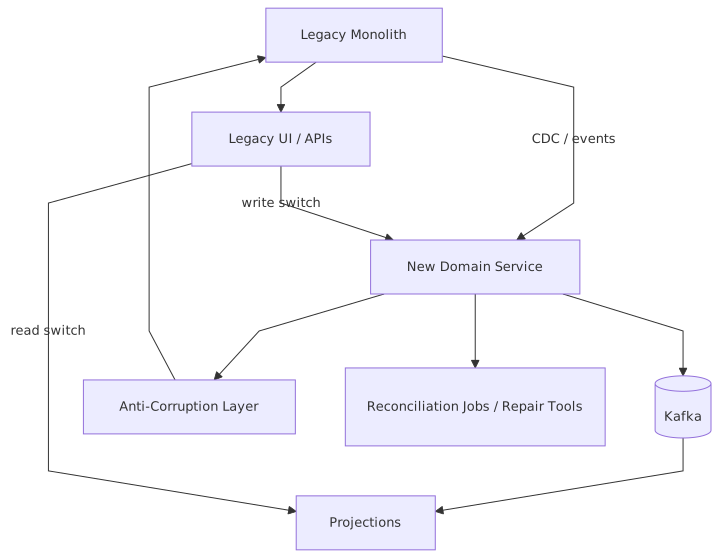
The strangler fig is a good metaphor here, but enterprises often forget the important part: the fig grows around a living tree slowly. If you cut too early, both die.
Enterprise Example
Consider a global retailer modernizing its commerce platform.
The original estate had a large e-commerce monolith backed by a shared Oracle schema. Different departments had formed around technical modules: cart, pricing, promotions, checkout, customer profile, warehouse, and customer service tooling. The company then attempted a microservices split. Predictably, they created cart-service, checkout-service, promotion-service, profile-service, and half a dozen others. Team ownership followed those names.
Delivery got worse.
Why? Because the actual business value stream was not aligned to those fragments. The “place order” flow required cart rules, promotion qualification, payment authorization, inventory reservation, tax calculation, fraud screening, and customer account checks. No single stream-aligned team could ship meaningful changes without assembling a traveling circus of dependencies.
The turnaround came when the architecture was redrawn around bounded contexts and service ownership authority.
- Customer Account Team owned customer identity, authentication-linked account state, and consent preferences.
- Order Management Team owned order lifecycle from submission through customer-visible order state.
- Pricing & Promotions Team owned offer calculation semantics and published pricing decisions rather than exposing internal rule machinery everywhere.
- Payments Team owned payment intent, authorization, capture, refund, and settlement states.
- Fulfillment Team owned reservation, pick-pack-ship, and shipment progression.
- Commerce Platform Team provided CI/CD templates, service mesh standards, Kafka tooling, observability, and developer portal capabilities.
The key change was conceptual: promotions no longer “reached into” orders to mutate data whenever they pleased. They produced offer decisions under their authority. Order Management consumed those decisions as inputs to order creation and became authoritative for order state. Likewise, Fulfillment stopped sharing warehouse status tables with Order Management and instead published fulfillment events. Order Management maintained a customer-facing order projection, fed by Kafka events and repaired by reconciliation jobs when downstream delays occurred.
This was not cleaner because it had more services. In fact, they merged several prematurely split services. It was cleaner because each team finally knew where its authority stopped.
The retailer also introduced a formal reconciliation function. Missing shipment events, duplicate payment callbacks, and late promotion reversals were no longer treated as rare anomalies. They were designed for. A reconciliation service compared authoritative ledgers across Order, Payment, and Fulfillment domains, opened repair tasks, and supported replay from Kafka offsets and idempotent compensations.
The operational impact was dramatic:
- Change lead time for order-related features dropped because the Order Management Team no longer negotiated every model change with three neighboring teams.
- Incident resolution improved because bridge calls involved authoritative owners, not every consumer of a shared schema.
- Data quality improved because local projections were treated as derived assets, not hidden systems of record.
- The platform team reduced cognitive load with standardized Kafka topic provisioning, schema compatibility checks, tracing, and replay tooling.
This is what enterprise architecture should do: not produce more boxes, but create fewer arguments.
Operational Considerations
Ownership boundaries live or die in operations.
Observability must reflect ownership
Dashboards should align to business capabilities and team responsibility, not just infrastructure layers. If an order fails because payment authorization timed out and fulfillment never received OrderPlaced, the telemetry should tell that story in domain terms. Distributed tracing helps, but only if spans and events carry business identifiers and meaningful names.
Event governance needs semantic discipline
Kafka is enormously useful here, but it is also a fast path to semantic entropy. Topic naming, schema evolution, retention, replay safety, partitioning strategy, and key choice are all architecture concerns.
A few practical rules:
- Publish business events, not row changes.
- Make events idempotent to consume where possible.
- Use versioned schemas with compatibility rules.
- Choose partition keys that preserve useful ordering for the aggregate in question.
- Keep event payloads expressive enough to be meaningful, but not so bloated they become shadow databases.
- Distinguish facts from commands.
Reconciliation is an operational capability
In asynchronous enterprises, reconciliation is as important as deployment pipelines. You need:
- divergence detection
- replay tooling
- dead-letter triage
- manual correction workflows
- auditability
- business-visible exception queues
If customer service cannot explain why an order shows “paid” but not “confirmed,” your ownership model is unfinished.
Security and compliance follow authority
Ownership boundaries affect data access, regulatory accountability, and retention obligations. The authoritative owner of payment data, customer consent, or policy terms carries more than operational responsibility; it carries compliance burden. This is another reason not to create vague, overlapping service ownership.
Tradeoffs
There is no free decomposition.
A strong ownership boundary improves autonomy but can increase duplication. Teams may maintain local copies of customer, product, or order-related facts. That is acceptable if the semantics are context-specific and the source-of-truth rule is explicit.
Event-driven integration reduces direct runtime coupling but introduces eventual consistency, replay complexity, and reconciliation costs. You gain resilience in one dimension and lose simplicity in another.
Broader service boundaries preserve invariants and reduce coordination, but they can become large enough to strain team cognitive load. Narrower boundaries may fit team size better but can slice across core business concepts and create transaction hell.
Platform standardization lowers friction, but over-standardization can freeze architecture into one decomposition style. If every problem looks like a Kafka-shaped nail because the platform made Kafka easy, you will misuse events.
And perhaps the biggest tradeoff: clear ownership means saying no. Teams cannot casually change “shared” domain concepts anymore. That may feel slower in the short term. It is faster over time because decisions stop ricocheting across the organization.
Failure Modes
The common failure modes are painfully consistent.
1. Shared ownership disguised as collaboration
If two teams can both change the lifecycle of the same business concept, you do not have collaboration. You have a governance bug. EA governance checklist
2. Canonical model overreach
A central architecture group defines one enterprise customer, product, order, and payment model for everyone. Integration looks neat. Domain truth gets flattened. Teams then invent side channels to recover missing nuance.
3. Event soup
Kafka topics multiply without semantic stewardship. Events become low-level notifications or schema dumps. Consumers infer business meaning differently. Reconciliation becomes detective work.
4. Service per team, regardless of domain
Organizations sometimes force a one-team-one-service pattern. That is performative architecture. Some domains warrant several services under one team. Others need a larger cohesive service because splitting would fracture invariants.
5. Ignoring migration overlap
Leaders demand a cutover date and downplay dual-running. The result is hidden write conflicts, unplanned operational fixes, and business distrust of the new estate.
6. Reconciliation as an afterthought
The architecture assumes “messages usually arrive.” In production, usually is not enough. Failed consumers, retries, out-of-order events, and manual interventions create drift. Without planned reconciliation, drift becomes normal.
When Not To Use
This approach is not universal doctrine.
Do not over-engineer service ownership boundaries in a small product team with a modest monolith and low coordination cost. If one team owns the whole system and moves quickly, forcing bounded-context services and Kafka eventing may create overhead with no business return.
Do not split aggressively when the domain is immature and semantics are still changing rapidly. In that case, a modular monolith with clear internal boundaries is often the wiser move. Learn the domain before freezing it into network calls and event contracts.
Do not use asynchronous propagation for workflows that require strict immediate consistency and where compensation is operationally unacceptable. Some financial postings, safety-critical controls, and regulated state transitions should remain tightly controlled and often transactional.
Do not create standalone services for generic support capabilities unless they truly have platform-like ownership and stable contracts. “Document service” and “notification service” are notorious dumping grounds.
And do not mistake Team Topologies for a target org chart. It is a design aid, not a religion.
Related Patterns
Several patterns pair naturally with service ownership boundaries:
- Bounded Contexts: the foundation for semantic separation.
- Context Mapping: clarifies upstream/downstream relationships and translation points.
- Anti-Corruption Layer: protects new domains from legacy semantic pollution.
- Strangler Fig Pattern: enables progressive replacement of legacy capabilities.
- CQRS and Materialized Views: useful for local read models fed by domain events.
- Event Sourcing: occasionally helpful where auditability and state reconstruction are central, though not required for good ownership.
- Outbox Pattern: improves reliable event publication from authoritative services.
- Saga / Process Manager: coordinates long-running workflows where no single service owns all steps.
- Platform as a Product: reduces cognitive load for stream-aligned teams through paved roads.
These are all useful. None substitute for the central act of deciding who owns what, semantically and operationally.
Summary
Service ownership boundaries are where enterprise architecture stops being theory and starts becoming organizational reality.
If you draw them around technical convenience, you will get elegant diagrams and miserable delivery. If you draw them around domain authority, bounded contexts, and team cognitive load, you have a chance to build a system that can evolve without constant internal negotiation.
The practical formula is straightforward, if not easy:
- start with domain semantics
- define authoritative ownership clearly
- align stream-aligned teams to coherent business outcomes
- use Kafka and events for propagation, not for fuzzy shared ownership
- plan reconciliation from day one
- migrate progressively with a strangler strategy
- standardize through platforms without standardizing away meaning
The memorable truth is this: a service boundary is a promise about who gets to say what a business fact means.
Break that promise, and no topology will save you. Keep it, and the architecture starts to feel lighter—not because the enterprise got simpler, but because the arguments got smaller.
Frequently Asked Questions
What is enterprise architecture?
Enterprise architecture aligns strategy, business processes, applications, and technology in a coherent model. It enables impact analysis, portfolio rationalisation, governance, and transformation planning across the organisation.
How does ArchiMate support architecture practice?
ArchiMate provides a standard language connecting strategy, business operations, applications, and technology. It enables traceability from strategic goals through capabilities and services to infrastructure — making architecture decisions explicit and reviewable.
What tools support enterprise architecture modeling?
The main tools are Sparx Enterprise Architect (ArchiMate, UML, BPMN, SysML), Archi (free, ArchiMate-only), and BiZZdesign. Sparx EA is the most feature-rich, supporting concurrent repositories, automation, scripting, and Jira integration.