⏱ 23 min read
Production systems do not usually fail because the code was “bad.” They fail because reality is rude.
Reality sends malformed requests from forgotten mobile app versions. It sends traffic spikes that only happen on payroll Friday. It sends race conditions, stale reads, duplicate events, partial retries, and business users who swear two screens show two different truths about the same customer. In architecture reviews, people talk about correctness as if it were a neat theorem. In production, correctness is a moving target dragged behind a truck.
That is why shadow traffic testing matters.
If you are modernizing a monolith, decomposing into microservices, or replacing a brittle legacy capability with a cleaner bounded context, the hardest question is not “does the new service work?” The hardest question is “does it behave like the business expects under the ugly, living pressure of real production demand?” Test environments lie. Synthetic load lies. Even carefully staged UAT lies. Real traffic is the only witness that doesn’t rehearse.
Shadow traffic testing—sometimes called mirrored traffic—lets you route a copy of production requests to a new service or platform without letting that new path affect the customer-facing response. It is one of the most practical safety rails in modern deployment architecture. Used well, it gives you empirical evidence before cutover. Used badly, it creates false confidence, duplicate side effects, and a very expensive distributed illusion.
This is not just a release engineering trick. It is an architectural pattern that sits at the intersection of domain-driven design, observability, migration strategy, and operational risk management. In a microservices estate, especially one with Kafka-based event flows and polyglot persistence, shadow testing becomes a way to interrogate your domain semantics. Are two implementations merely returning the same JSON shape, or are they actually honoring the same business meaning? That distinction is where most migrations live or die. event-driven architecture patterns
Context
Microservices adoption often begins with a healthy instinct and ends with a messy estate. Teams want autonomy, faster releases, clearer ownership, and a more modular architecture. So they carve services out of a monolith, introduce APIs, add event streams, split data stores, and move capabilities toward bounded contexts aligned with the business.
That is the aspiration.
The reality is less poetic. Enterprises rarely build greenfield platforms. They inherit customer masters that were “temporarily” duplicated across four systems. They deal with call centers using one truth, web channels using another, and back-office operations reconciling the two in spreadsheets. They replace synchronous call chains with asynchronous events and then discover the business process had hidden assumptions about ordering, timing, and consistency. A loyalty platform, for example, may appear to be a simple balance service until you learn that balance is not a number but an aggregate shaped by reversals, expiries, fraud holds, campaign boosts, and legal rules by region.
Shadow traffic testing emerges in exactly this kind of enterprise terrain. A team has built a new microservice—or a whole replacement service mesh path—and wants confidence before routing live customer interactions to it. The old path is trusted because it has survived the market, not because anyone loves it. The new path is better designed, but unproven where it counts. microservices architecture diagrams
In this context, mirrored traffic is not only about performance and correctness. It is about preserving domain behavior while changing the implementation. That is a subtler game.
Problem
The classic migration problem looks deceptively simple: replace component A with component B, then switch traffic.
But in enterprise systems, A is rarely just a component. It is an accumulation of quirks, compensations, silent assumptions, and business exceptions encoded over years. Some of these are defects. Some are accidental complexity. Some are, inconveniently, the actual business policy.
If you route all production traffic to B too early, you may trigger customer-facing errors, mismatched decisions, financial discrepancies, or broken downstream workflows. If you spend too long validating B only in lower environments, you will miss the things only production reveals: strange request combinations, uneven tenant distribution, bot traffic, retries from upstream gateways, and pathological data states.
So the architect is stuck between two bad options:
- Big-bang cutover, which is operationally dramatic and often politically appealing until it fails.
- Endless parallel delivery, where teams keep validating forever and never gain enough confidence to move.
Shadow traffic testing creates a third option: send real production requests to the new implementation in parallel, observe and compare outcomes, but keep the old implementation serving the customer.
That sounds straightforward. It is not.
The deeper problem is comparison. In a distributed system, “same result” is rarely literal sameness. One service may enrich data from Kafka-fed projections while another reads directly from a transactional store. One path may respond in 30 milliseconds, another in 120. One may emit domain events immediately, another after asynchronous validation. One may order line items differently in the payload but still preserve semantics. If you compare naively, you will drown in false differences. If you compare too loosely, you will miss genuine divergence.
Shadow testing is therefore not merely traffic duplication. It is semantic verification under production conditions.
Forces
Several forces shape the architecture.
1. Safety versus realism
The whole point of shadow traffic is realism. You want production-like load, timing, payload diversity, and edge cases. But realism is dangerous if the shadow path can mutate state, trigger emails, charge cards, update ledgers, or emit duplicate Kafka events. The more realistic the exercise, the more carefully you must contain side effects.
2. Domain semantics versus technical equivalence
A legacy order pricing engine and a new pricing microservice may produce responses with structurally different JSON while still agreeing on the payable amount, tax treatment, discount eligibility, and audit trail. The business cares about meaning, not formatting. Domain-driven design matters here because comparison has to be organized around domain concepts: order total, shipment promise, eligibility decision, policy status. If you compare at the wrong abstraction level, you will either panic unnecessarily or miss real defects.
3. Synchronous versus asynchronous behavior
Many enterprises modernize from request-response logic toward event-driven flows. A customer profile service may expose a synchronous read API while updates propagate through Kafka to search indexes, fraud engines, and CRM systems. Shadowing the API request alone tells only part of the story. You may also need to compare emitted events, state convergence, and downstream reactions. This turns a simple mirror into a reconciliation architecture.
4. Cost versus confidence
Mirroring traffic doubles some amount of processing. It adds comparison services, storage for diffs, observability overhead, and operational complexity. For high-volume systems, this can be expensive. Yet the cost of undetected divergence in billing, claims, payments, or entitlement systems is usually worse. The architect’s job is not to eliminate cost; it is to spend complexity where it buys down the right risk.
5. Speed of migration versus control
Teams want to move quickly. Business sponsors want measurable progress. Shadow testing supports progressive strangler migration by allowing traffic slices to be validated before cutover. But every stage requires instrumentation, acceptance criteria, and response plans. Fast migrations without this discipline become theater.
Solution
The core pattern is simple enough to sketch on a whiteboard.
Production requests continue flowing to the current, authoritative service path. At the gateway, service mesh, or edge proxy, a copy of selected requests is mirrored to the candidate service. The mirrored request is processed as if it were live, but its response is not returned to the customer. Instead, responses and domain outputs are captured and compared against the incumbent path using domain-aware rules.
When the comparison data shows acceptable convergence, you progressively increase confidence, then shift a controlled percentage of live traffic to the new service. This is where shadow traffic testing joins hands with the strangler fig pattern: first observe in parallel, then route selectively, then retire the old path capability by capability.
A practical architecture usually includes the following elements:
- Traffic duplication point: API gateway, ingress controller, service mesh, load balancer, or application-layer proxy.
- Authoritative path: the existing service that still serves end-user responses.
- Candidate path: the new service or replacement path.
- Side-effect controls: stubs, write suppression, sandbox connectors, or idempotency keys to prevent harmful duplicate actions.
- Comparison engine: evaluates outputs using canonical domain rules.
- Reconciliation store: records mismatches, missing responses, timing variance, and event divergence.
- Observability stack: tracing, logs, metrics, and business-level scorecards.
- Progressive routing controls: feature flags, weighted routing, canary release, or service mesh traffic policies.
The crucial design choice is this: do not compare raw technology artifacts unless the domain truly cares about them. Compare canonical business outcomes.
For example, in a policy administration migration, compare premium amount, policy status, effective dates, endorsements, and emitted policy-issued events. Do not obsess over internal identifiers, payload field ordering, or representation differences unless downstream systems depend on them.
Mirrored traffic at a high level

This diagram is tidy. Real systems are not. The difficult parts are hidden behind “Comparison & Reconciliation Engine.” That box is where architecture earns its salary.
Architecture
A robust shadow traffic architecture should be built around bounded contexts, not around infrastructure alone. This is where domain-driven design stops being a workshop exercise and starts becoming operationally useful.
If you mirror traffic for a “Customer” service, what exactly are you validating? Identity resolution? Contact preferences? Creditworthiness? Master data stewardship? “Customer” is often too broad a concept. In DDD terms, you want to align shadow testing with a bounded context whose language is stable enough to compare meaningfully. A profile read model is one thing; an onboarding decision engine is another. They may both mention “customer,” but they embody different business semantics and consistency requirements.
Domain-aware comparison
A comparison engine should establish a canonical model for the outcomes that matter in that context. Think of it as an anti-corruption layer for testing. Both legacy and new responses are normalized into a domain comparison schema:
- normalized identifiers
- business outcome fields
- tolerances and equivalence rules
- ignored technical metadata
- timing windows for asynchronous completion
For a payments authorization service, this might include:
- approved/declined decision
- decline reason category
- authorized amount
- currency
- fraud review flag
- ledger impact intent
- emitted events within a time window
For an inventory reservation service, it might include:
- reservation accepted/rejected
- reserved quantity
- reservation expiry
- fulfillment node chosen
- backorder flag
- inventory event emission
This is why shadow traffic should sit close to the domain model. Without that, teams compare implementation trivia and mistake noise for risk.
Synchronous and event-driven comparison
In microservices estates using Kafka, many important outcomes are not immediate HTTP responses. The service may respond 202 Accepted, then publish domain events that drive fulfillment, notification, billing, or analytics. A new service can appear correct at the API layer while emitting different event semantics downstream. That is how enterprises accidentally create split-brain behavior across channels.
So shadow testing for event-driven services should capture and compare:
- response code and payload
- emitted domain events
- event keys and partitioning behavior where significant
- sequencing expectations
- state convergence in read models
- downstream side effects, if safely simulated
Mirrored traffic with Kafka-based reconciliation
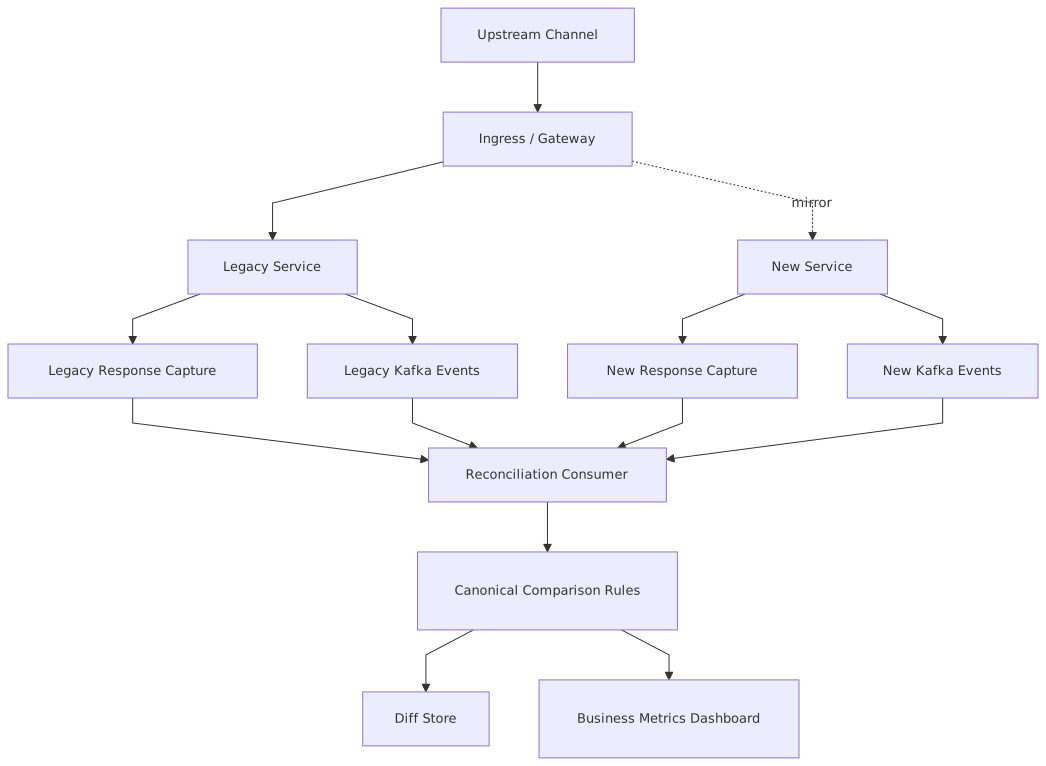
This pattern is especially useful when a service migration involves replacing direct database writes with event sourcing or choreographed updates. You need to know not just whether the API returned the right answer, but whether the downstream ecosystem receives compatible business signals.
Side-effect containment
Here lies the first serious trap. If mirrored requests trigger real writes, emails, external partner calls, or financial actions, your “safe test” is no longer safe.
There are several containment strategies:
- Read-only shadowing
Best for query services or deterministic decision services. Lowest risk.
- Write suppression
The new service executes logic but does not commit state changes. Useful, but may hide behavior dependent on persistence constraints, locking, triggers, or transaction boundaries.
- Isolated shadow resources
The new service writes to shadow databases, shadow Kafka topics, and sandbox downstreams. Better realism, more infrastructure cost.
- Idempotent duplicate handling
In rare cases, the system is deliberately built so mirrored writes are harmless because duplicate operations are detected via idempotency keys. This is advanced and often overestimated.
- Selective endpoint mirroring
Mirror only safe operations first: reads, quote generation, eligibility checks, search. Defer mutating commands until controls are stronger.
Architects should be skeptical of teams claiming “our writes are idempotent, so it’s fine.” Idempotency is usually narrower than the architecture slide suggests.
Control points
Mirroring can be implemented at different layers:
- API gateway or ingress: easiest for HTTP/REST and external traffic.
- Service mesh: useful in Kubernetes estates for consistent routing policy.
- Application code: allows richer context but increases coupling.
- Message broker duplication: useful for Kafka consumers and event-driven migrations.
Where possible, prefer infrastructure-level duplication for simplicity, but do not force everything there. If semantic correlation needs domain identifiers not present at the edge, application-level enrichment may be necessary.
Migration Strategy
Shadow traffic testing is not an isolated tactic. It works best as part of a progressive strangler migration.
The strangler fig pattern is often presented as an elegant vine wrapping around a monolith. In practice, it is more like replacing the engine of a moving truck one cylinder at a time while sales is promising faster delivery. The migration strategy needs staging, not heroics.
A sensible progression looks like this:
1. Establish bounded context and canonical comparison model
Before any traffic is mirrored, define what “equivalent enough” means in business language. This is where domain experts, product owners, and architects must be in the room together. If the new service intentionally changes behavior, document the difference explicitly. Shadow testing cannot validate a moving target.
2. Start with passive reads
Mirror low-risk read requests first. Validate latency, schema handling, edge-case payloads, null behaviors, and cache interactions. This phase often reveals surprising production realities: legacy clients sending undocumented parameters, weird casing, oversized headers, or traffic patterns hidden by lower environments.
3. Introduce asynchronous outcome comparison
If the service publishes Kafka events or updates read models, begin capturing those outputs. Build reconciliation jobs that compare state after a configurable window. This matters in eventually consistent designs, where immediate equality is not the right expectation.
4. Shadow selected write paths with suppression or isolation
Move cautiously into commands. Use write suppression, shadow topics, or isolated data stores. Compare business outcomes, validation failures, and event emissions without letting the candidate service affect production systems.
5. Canary live traffic
After shadow confidence is high, route a small percentage of real traffic to the new service as the authoritative path. Keep dual observation running. Roll forward gradually by tenant, geography, product line, or request cohort—not just by random percentage if the business domain has uneven risk profiles.
6. Reconcile and retire
Use reconciliation reports to close domain gaps, then progressively retire legacy capabilities. The final stage often includes backfill, event replay, and data ownership transfer. Do not leave “temporary” dual writes or dual reads in place indefinitely. Temporary architecture has a talent for becoming permanent.
Progressive strangler with shadowing and cutover

A migration should also include explicit reconciliation strategy. This is the part many teams skip because it sounds operational rather than architectural. That is a mistake.
If legacy and new services both process equivalent business activity during migration, how do you reconcile differences?
- compare canonical outputs
- identify mismatch classes
- assign tolerances
- define business owner review paths
- decide which system is authoritative during each phase
- support replay or compensating actions
Reconciliation is architecture in motion. It is the discipline that keeps “close enough” from becoming “nobody really knows.”
Enterprise Example
Consider a large retail bank replacing a legacy customer onboarding and KYC platform.
The original system is a monolithic application exposing a set of synchronous APIs to branch systems, mobile channels, and partner portals. It stores customer profiles, runs onboarding validations, checks sanctions and fraud connectors, and publishes batch extracts to downstream reporting systems. Over time, the bank decides to split this into bounded contexts: customer profile, onboarding workflow, KYC decisioning, document management, and notification services. Kafka becomes the event backbone for propagating onboarding milestones and customer state changes.
The bank’s temptation is obvious: rebuild the onboarding API as a new microservice and switch channels over one by one.
That would be reckless.
Why? Because onboarding is not just an API. It is a business process with legal, risk, and operational consequences. A single divergence in sanctions matching or document status can block account opening or, worse, allow a prohibited customer through. The old system is unpleasant, but it encodes years of regulatory edge cases.
So the bank adopts shadow traffic testing.
Branch and mobile onboarding requests continue to hit the legacy API. At the ingress layer, requests are mirrored to the new onboarding microservice. The new service executes the same workflow, calling sandboxed downstream connectors for document, fraud, and sanctions checks where necessary. Both systems normalize their outputs into a canonical onboarding decision model:
- applicant accepted / referred / rejected
- rejection category
- required documents
- risk review flag
- customer profile attributes derived
- emitted onboarding-started, onboarding-reviewed, onboarding-completed events
A Kafka-based reconciliation service consumes emitted domain events from both paths and compares not only whether events exist, but whether they carry matching business meaning. Because timing differs, comparison allows a five-minute convergence window for event arrival and downstream profile projection updates.
The first month is humbling. Shadowing reveals that the legacy system quietly trims special characters from names before sanctions checks, while the new service preserves them. The new behavior is arguably cleaner, but it produces different match results for a small set of applicants from specific geographies. That is not a bug in code. It is a domain semantics issue. The bank must decide which behavior is legally and operationally correct, then update the canonical rules and migration plan accordingly.
Later, shadowing uncovers another difference: the new service emits a customer-created event before document verification is complete, while downstream CRM systems assumed this event only meant a fully onboarded customer. Again, the response payload looked fine; the event semantics were not.
Only after several reconciliation cycles, policy clarifications, and downstream event contract adjustments does the bank canary 2% of mobile onboarding traffic to the new service. Then 10%. Then branch onboarding in one region. The cutover succeeds not because the new microservice was perfect, but because the bank learned where reality diverged before customers paid the price.
That is what mature enterprise architecture looks like: less applause, more evidence.
Operational Considerations
Shadow traffic testing is one of those patterns that seems architectural but succeeds or fails operationally.
Observability
You need end-to-end tracing that correlates original and mirrored requests. Correlation IDs must survive through services, async processing, and Kafka events. Logs need enough context to explain mismatches without exposing sensitive data carelessly. Metrics should include:
- request mirror rate
- mirror success/failure rate
- response latency deltas
- comparison pass/fail percentages
- mismatch categories by endpoint or domain scenario
- event convergence lag
- side-effect suppression failures
Business dashboards matter as much as technical ones. “2.3% mismatch rate” is not useful unless broken down into meaningful classes such as pricing variance, validation rule divergence, or missing notification event.
Sampling strategy
Mirroring 100% of traffic is not always necessary or affordable. Use risk-based sampling. High-value business flows, problematic client cohorts, and edge-case-heavy endpoints deserve more coverage than low-risk static reads. Some teams mirror everything at first, then move to targeted cohorts. Others start with selective traffic classes. Both can work if the rationale is explicit.
Data protection and compliance
Mirrored traffic may include personal data, payment details, medical information, or regulated records. Shadow stores, logs, and diff outputs must respect the same controls as production systems. Architects who treat shadow infrastructure as “just test plumbing” usually meet compliance the hard way.
Performance isolation
Mirroring should not degrade live customer performance. The mirror path must be asynchronous or low-impact from the perspective of the authoritative response path. Backpressure, queueing, and resource limits should prevent the candidate service or reconciliation engine from dragging down the primary route.
Retention and triage
Diff data accumulates quickly. Without triage workflows and retention policies, teams build a data swamp of mismatches no one can resolve. Classify mismatches, assign owners, and close loops. Shadow testing without active reconciliation becomes observability cosplay.
Tradeoffs
Shadow traffic testing is powerful, but it is not free.
The biggest advantage is confidence under real conditions. You learn from actual production inputs without exposing users directly to the new implementation. You can validate not just code paths, but assumptions about domain behavior, payload diversity, and downstream interaction.
The biggest cost is complexity. You are temporarily running two worlds in parallel and building machinery to compare them. This introduces extra infrastructure, more observability, more governance, and more cognitive load for delivery teams. EA governance checklist
There are also subtle tradeoffs:
- High realism, lower safety if side effects are insufficiently contained.
- High safety, lower realism if writes are suppressed too aggressively.
- Fast migration, weaker insight if comparison is shallow.
- Deep comparison, slower migration if every mismatch becomes a committee meeting.
- Broad mirroring, high cost versus targeted mirroring, risk of blind spots.
In short: shadow testing buys confidence by renting complexity.
That is often a good deal. But it is still a deal.
Failure Modes
Patterns fail in predictable ways. Shadow traffic is no exception.
1. Comparing syntax instead of semantics
Teams compare raw JSON and discover endless “differences” that do not matter, while missing actual business divergence. If the comparison model is not domain-driven, the exercise becomes noisy and politically exhausting.
2. Triggering duplicate side effects
The shadow path accidentally sends emails, updates CRM records, posts ledger entries, or emits production Kafka events consumed by downstream systems. This is the nightmare scenario: your “safe” test becomes a partial live incident.
3. Ignoring eventual consistency
A new service updates read models asynchronously, but the comparison engine expects immediate equivalence. False failures flood the dashboard. Teams lose trust in the data and eventually stop looking.
4. No authoritative decision on mismatches
Shadowing reveals differences, but nobody owns the domain decision about which behavior is correct. The program stalls between “legacy is weird” and “new is more elegant.” Architecture needs business authority here, not just technical tooling.
5. Shadow environment drift
The new service depends on shadow databases, mock connectors, or sandbox partners that do not behave like production. The test becomes less realistic than intended, and confidence is overstated.
6. Endless parallel running
The organization becomes comfortable with “almost ready.” Legacy and new systems run side by side for months or years because no crisp exit criteria were defined. This is expensive and corrosive. Dual-running without a retirement plan is not prudence; it is indecision with infrastructure.
When Not To Use
Shadow traffic testing is not a universal answer.
Do not use it when the main risk is already well controlled through simpler means. A stateless internal service with straightforward logic and strong automated contract and integration testing may not justify the overhead.
Avoid it when side effects cannot be safely contained and duplicate execution would be unacceptable. Some external partner integrations, irreversible workflows, or low-latency transactional systems are poor candidates unless deep isolation exists.
It is also a weak fit for radical business redesign. If the new service is intentionally changing domain behavior rather than preserving it, mirrored comparison can produce more confusion than clarity. In such cases, feature flags, controlled pilots, or explicit A/B business experiments may be better tools.
And if the organization lacks the discipline to define canonical business outcomes, triage mismatches, and act on evidence, shadow traffic will degrade into a dashboard cemetery. The pattern assumes operational maturity. Without that, it becomes expensive theater.
Related Patterns
Shadow traffic testing works well alongside several adjacent patterns.
- Strangler Fig Pattern: for progressive replacement of legacy capabilities.
- Canary Releases: after shadow confidence is established, route a small percentage of live traffic.
- Blue-Green Deployment: useful for infrastructure switchover, though typically less domain-observant than shadow comparison.
- Anti-Corruption Layer: normalize legacy and new outputs into canonical domain semantics.
- Event Sourcing and CQRS: especially when comparing command outcomes and read model convergence.
- Dual Run / Parallel Run: broader business operating model where old and new systems run together; shadow testing is the technical cousin, but safer because users still rely on one authoritative path.
- Reconciliation Pattern: essential for eventual consistency, financial control, and migration assurance.
In Kafka-heavy architectures, also consider topic mirroring, consumer group isolation, and event replay as supporting techniques. But remember: duplicating messages is easy. Understanding what they mean is the real work.
Summary
Shadow traffic testing is one of the few migration patterns that respects the basic truth of enterprise systems: production is the only honest environment.
By mirroring real traffic to a new microservice while keeping the legacy path authoritative, you can validate behavior under genuine load, data, and timing conditions. But the pattern only works when comparison is grounded in domain semantics, not superficial payload equality. This is where domain-driven design earns its keep. Bounded contexts define what should be compared. Canonical models express business meaning. Reconciliation handles eventual consistency and asynchronous outcomes, especially in Kafka-based architectures.
Used as part of a progressive strangler migration, shadow traffic becomes a bridge between legacy trust and modern service design. It allows teams to learn before they cut over. It exposes hidden assumptions in APIs, events, and business workflows. It surfaces not only technical defects, but semantic mismatches that would otherwise emerge as customer complaints, financial discrepancies, or regulatory pain.
The tradeoff is complexity. You are operating two paths, constraining side effects, comparing outcomes, and managing a disciplined migration program. This is not lightweight. Nor should it be. Replacing important enterprise capabilities safely was never going to be lightweight.
The mistake is to think mirrored traffic is just a deployment trick. It is more than that. It is an architectural instrument for telling whether your new system merely runs—or actually means the same thing as the old one where it matters.
And in enterprise architecture, meaning is the part that hurts when you get it wrong.
Frequently Asked Questions
What is a service mesh?
A service mesh is an infrastructure layer managing service-to-service communication. It provides mutual TLS, load balancing, circuit breaking, retries, and observability without each service implementing these capabilities. Istio and Linkerd are common implementations.
How do you document microservices architecture for governance?
Use ArchiMate Application Cooperation diagrams for the service landscape, UML Component diagrams for internal structure, UML Sequence diagrams for key flows, and UML Deployment diagrams for Kubernetes topology. All views can coexist in Sparx EA with full traceability.
What is the difference between choreography and orchestration in microservices?
Choreography has services react to events independently — no central coordinator. Orchestration uses a central workflow engine that calls services in sequence. Choreography scales better but is harder to debug; orchestration is easier to reason about but creates a central coupling point.