⏱ 22 min read
Most platform teams start with good intentions and end up running a bureaucracy.
It begins innocently enough. One team wants a better way to spin up services. Another wants security controls baked in. A third is tired of every new microservice inventing its own CI pipeline, observability stack, secret management approach, and deployment story. So the platform group does what seems sensible: they build a service template. microservices architecture diagrams
And then the template becomes law.
Soon every team is forced through the same narrow corridor, whether they are building a latency-sensitive pricing engine, a Kafka-driven reconciliation service, or a plain CRUD application that could have lived happily as a modular monolith. The template promises consistency but often delivers conformity. That distinction matters. Consistency reduces accidental complexity. Conformity often crushes domain fit. event-driven architecture patterns
This is the central architectural tension in service template architectures for platform engineering: how do you standardize the scaffolding without standardizing the business itself?
A good service template architecture is not a code generator with delusions of grandeur. It is an opinionated product for building services safely, quickly, and repeatedly, while preserving room for domain-driven design, operational differences, and migration realities. The template should reduce the cost of doing the right thing. It should not become a silent central planner that forces every bounded context into the same shape.
In large enterprises, the need is real. Hundreds of teams, dozens of regulatory controls, multiple cloud accounts, competing data integration patterns, and a long tail of inherited systems make “just let every team choose” a fantasy. But the opposite fantasy is just as dangerous: a universal golden path that magically fits every workload. Golden paths are useful. Golden cages are not.
This article takes a hard look at service template architectures in platform engineering: what they are, why enterprises need them, how to design them with domain semantics in mind, how to migrate toward them using a progressive strangler approach, and where they fail. I’ll also cover Kafka, reconciliation-heavy services, and the real operational tradeoffs that show up after the slide deck is gone and the support queue begins.
Context
Platform engineering has emerged as a correction to two older mistakes.
The first mistake was raw infrastructure self-service without enough guardrails. Teams were given cloud primitives, a wiki, and a prayer. Predictably, every squad assembled its own stack. Build systems varied. Logging varied. Secret handling varied. Deployment practices ranged from solid to terrifying. Security reviews became archaeology.
The second mistake was over-centralized shared services. A central architecture or middleware team tried to own the whole stack, effectively becoming a ticket-driven internal vendor. Delivery slowed to a crawl. Product teams routed around them where they could and waited resentfully where they could not.
Platform engineering, at its best, is the middle path. It treats internal capabilities as products. Teams consume paved roads rather than filing tickets. Service templates are one of the most visible manifestations of this model. They package a set of architectural defaults: runtime, build pipeline, deployment manifest, observability hooks, identity model, event contract conventions, and policy controls.
But the architecture of a service template is not merely technical plumbing. It expresses organizational choices. It shapes team autonomy. It codifies what the enterprise believes a “service” is.
That last point is often neglected. In domain-driven design, services exist within bounded contexts. A customer onboarding service is not just “a service written in Java with Kafka and Helm.” It is a business capability with its own language, invariants, and integration boundaries. If the platform template ignores that, it creates systems that look uniform from the outside and are semantically confused on the inside.
The best template architectures acknowledge two truths at once:
- Most teams should not reinvent operational foundations.
- No platform team should pretend all domains are operationally or semantically identical.
That is the game.
Problem
Enterprises usually arrive at service templates because of pain, not elegance.
They have too many services built too many ways. Audit findings reveal missing encryption standards, untracked dependencies, weak identity separation, or inconsistent logging of business-critical events. Operational incidents show that alerting is uneven and dashboards are tribal knowledge. New service creation takes weeks because every team rebuilds the basics from scratch. Engineering leadership sees waste everywhere and wants leverage.
So a platform team creates a template repository or an internal developer portal with starter kits. The idea is sound. The execution often is not.
The first failure pattern is shallow templating. The template generates code, but after day one, every service drifts. Pipelines diverge, manifests fork, and dependencies age differently. The organization congratulates itself on standardization while entropy quietly resumes command.
The second failure pattern is overreach. The template begins to prescribe architectural patterns that should remain domain decisions: whether to use synchronous APIs or event-driven workflows, whether persistence is relational or document-oriented, whether orchestration belongs in a process manager or should emerge from domain events. These are not “platform defaults” in the same way as standard logging or secret injection.
The third failure pattern is semantic blindness. Templates are defined in technical categories—REST service, Kafka consumer, batch worker—rather than business capability categories. This can lead teams to model systems around implementation style instead of bounded contexts. We get “consumer services” and “API services” rather than order management, settlement, claims adjudication, or pricing.
The fourth failure pattern is migration denial. Existing estates are full of mainframes, packaged applications, data hubs, and brittle integration layers. A fresh template is nice for greenfield work, but unless it supports progressive migration and coexistence, it becomes another island. Enterprises do not reboot. They accrete.
And that brings us to the real problem: most service template initiatives are conceived as standardization programs, when they should be conceived as architectural products that mediate between domain design, operational concerns, and evolutionary change.
Forces
A service template architecture sits in the crossfire of several competing forces.
Standardization vs domain fit
A platform team wants repeatability. Security wants policy baked in. SRE wants supportable runbooks and telemetry. Finance wants lower cognitive and operational cost. Product teams want freedom to shape services according to domain needs.
All of them are right.
The template should standardize the parts that are accidental: delivery mechanics, baseline security, runtime configuration, telemetry shape, identity federation, vulnerability scanning, and common libraries for policy enforcement. It should leave room in the essential parts: aggregate boundaries, event semantics, consistency choices, reconciliation rules, and workflow design.
Speed vs control
Templates promise faster service creation. But every additional opinion in the template carries a cost. Too little guidance and teams reassemble the world. Too much guidance and teams spend their time fighting the template rather than building software.
A platform that speeds up the median case by slowing down important edge cases has not really improved delivery. It has redistributed pain.
Uniform tooling vs varied workloads
A fraud scoring service, a customer profile service, a Kafka stream processor, and a nightly ledger reconciliation batch do not have identical runtime needs. They differ in latency profile, state model, deployment cadence, and observability requirements. One template may not fit all, and pretending otherwise usually ends with feature flags stapled onto a monolith of scaffolding.
This is why template architecture usually needs families of templates, not one.
Autonomy vs governance
Enterprises need traceability, policy compliance, access control, and data protection guarantees. But if governance only exists as central review boards, the platform has failed. Governance must be encoded as default behavior and automated checks. The trick is to make compliant paths easy and exceptional paths possible under explicit decision records. EA governance checklist
Event-driven integration vs operational simplicity
Kafka and asynchronous integration are often attractive in platform engineering because they decouple teams and support scale. But event-driven systems create their own obligations: schema evolution, outbox handling, idempotency, replay strategy, poison message management, and business reconciliation. They are not “free decoupling.” They are deferred complexity with a broker.
That complexity belongs in template support where it is generic, and in domain services where it is semantic.
Solution
The right answer is a layered service template architecture.
Not a single code template. Not a sprawling framework. A layered architecture with clear separations:
- Platform foundation layer for non-negotiable operational capabilities.
- Capability template layer for common workload shapes.
- Domain implementation layer where bounded contexts live.
- Extension and exception model for cases that do not fit the paved road.
This matters because many organizations mix these concerns and then wonder why every template turns into either a toy or a straitjacket.
At the foundation layer, the platform should provide capabilities that every service should inherit or consume with minimal effort: CI/CD scaffolding, policy checks, observability instrumentation, service identity, secret integration, standardized health semantics, runtime configuration, deployment baselines, and secure default networking.
At the capability template layer, the platform can define a small number of architectural starters aligned to workload patterns: synchronous API service, event-producing service, event-consuming service, workflow/reconciliation worker, and perhaps batch or data product templates. These are not business models. They are operational archetypes.
Then comes the domain layer. This is where teams shape aggregates, commands, events, APIs, and invariants according to domain-driven design. The template should help teams establish a bounded context, not erase it. A service should be easy to create, but not impossible to name properly, partition properly, or model properly.
Finally, there must be an extension model. Any enterprise platform that cannot say “this case does not fit the golden path, here is the controlled escape hatch” will end up driving exceptions underground.
A useful mental model is this: the template should own the shell of the service, not the soul.
Core architectural principle
The platform should standardize operational contracts and integration mechanics while preserving domain semantics and migration pathways.
That one sentence is more useful than most template governance documents. ArchiMate for governance
Architecture
A mature service template architecture usually looks something like this.
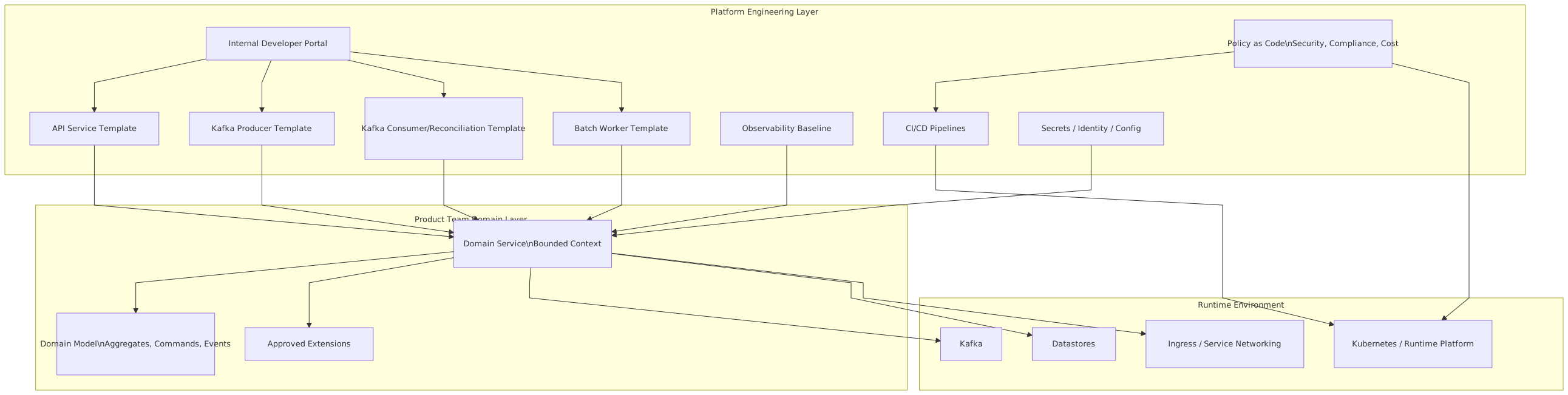
This diagram hides an important idea: a template is not just source code generation. It is the composition of scaffolding, policies, deployment conventions, and runtime integration.
Domain semantics in template design
This is where many platforms lose their footing.
A service template should ask for more than technical metadata. It should capture domain semantics early. Not to enforce business logic, but to improve architecture decisions and operational ownership.
For example, service creation should capture things like:
- bounded context
- business capability
- system of record or derived view
- command side, query side, or mixed
- event producer, consumer, or both
- data classification
- recovery and reconciliation expectations
- upstream/downstream dependencies
- business criticality and operational tier
These are not mere tags for a portal. They influence architecture. A reconciliation-heavy service that consumes Kafka events from multiple systems and repairs state drift needs different defaults than a customer-facing low-latency API.
This is where domain-driven design becomes practical, not ceremonial. Bounded contexts should inform template selection, integration style, naming, ownership boundaries, and event conventions. Platform teams should encourage this language. The alternative is an estate full of services that are mechanically consistent and conceptually muddled.
Kafka, events, and reconciliation
Kafka shows up in service template architectures for good reasons. It supports asynchronous integration, event distribution, buffering, and decoupling between teams. But Kafka is often introduced as a transport decision when it is really a system behavior decision.
If you provide Kafka-enabled templates, they should come with serious support for the things people usually forget:
- outbox or transactional event publication patterns
- schema versioning and compatibility checks
- dead-letter and retry handling
- idempotent consumption
- replay strategies
- lag and partition observability
- event trace correlation
- reconciliation support
Reconciliation deserves special attention. In enterprise systems, especially around finance, inventory, fulfillment, and customer state, eventual consistency is tolerable only if there is a clear mechanism to detect and repair divergence. Reconciliation is not a cleanup job you schedule when things go wrong. In many domains, it is part of the business architecture.
A good template for event-driven services should support not only event handling but also state verification and correction patterns. If a downstream service misses an event, receives one out of order, or encounters a poison message, how does it know? How does it recover? How does it prove correctness to the business?
A platform that hands teams Kafka and a serializer has not provided an architecture. It has provided a future incident.
Template composition model
The most sustainable pattern is composable templates with versioned modules rather than giant monolithic starter kits. For example:
- base runtime module
- API exposure module
- Kafka producer module
- Kafka consumer module
- scheduled reconciliation module
- persistence module
- observability module
- policy pack
- deployment profile
This allows controlled evolution. Teams can adopt improvements incrementally, and the platform can version modules independently.
Migration Strategy
Templates matter less in greenfield than people think. Their real value emerges in migration.
Most enterprises already have service-like things: ESB flows, scheduled jobs, mainframe transactions, shared libraries pretending to be platforms, and packaged application customizations hidden behind acronyms no one dares explain. A template architecture must help move this estate toward better operating models without demanding a big bang rewrite.
The migration strategy I recommend is progressive strangler migration, with templates acting as the landing zone.
Not every service should be rebuilt immediately. Not every domain should be decomposed aggressively. Start where there is a bounded context worth isolating, a measurable pain worth removing, and a realistic ability to own the service operationally.
Progressive strangler approach

The anti-corruption layer is crucial. It translates between legacy semantics and new bounded contexts. A service template should make this easy operationally, but the business translation must remain a domain design activity. Otherwise teams simply wrap bad legacy models in shiny new containers.
A sensible migration progression often looks like this:
- Expose or intercept legacy capability behind a stable facade.
- Create a new template-based service for one bounded context.
- Publish domain events from legacy or facade using an outbox or change data capture pattern.
- Build downstream consumers using Kafka-capable templates.
- Introduce reconciliation workers to compare old and new states.
- Gradually shift traffic or authority from legacy to new service.
- Retire legacy paths only after operational confidence is earned.
This is slower than slideware transformation plans promise. It is also how real systems survive.
Reconciliation as a migration tool
During migration, reconciliation is not optional. You will have partial data movement, parallel writes, asynchronous updates, stale reads, and hidden legacy rules. A reconciliation template or module is a practical platform asset for this reason.
For example, if a new customer profile service is built alongside a legacy CRM, there should be scheduled or event-triggered jobs that compare critical records, detect divergence, classify discrepancies, and either auto-repair or raise workflows for review. Reconciliation should be observable, auditable, and domain-aware. A record mismatch is not just a technical defect; it may have customer, financial, or regulatory meaning.
This is where platform and domain meet in a healthy way. The platform provides the mechanics of reconciliation execution, telemetry, and recovery. The domain team defines what “matching” means.
Enterprise Example
Consider a large retail bank modernizing its payments and settlements landscape.
The estate includes a core ledger on a mainframe, several Java applications handling payment initiation, a BPM tool managing exceptions, and nightly reconciliation jobs that compare posted transactions across systems. Every team has its own deployment conventions. Some services emit events. Others poll databases. Incidents are frequent because state drift is common and no one has a complete operational picture.
The bank creates a platform engineering group and decides to standardize service creation. The first instinct is a single Spring Boot template with Kubernetes manifests, standard logging, and Kafka dependencies. That helps a little, but not enough. Payment initiation services, settlement processors, exception handlers, and reconciliation workers have very different needs.
So the bank changes course and defines a template architecture with four core service types:
- API service for synchronous payment commands
- event producer service for posting payment lifecycle events
- consumer/processor service for settlement and status transitions
- reconciliation worker for ledger and transaction consistency checks
Each template includes baseline controls: identity, secret handling, audit logging, tracing, deployment policy, and observability. Kafka-enabled templates include outbox support, schema registry enforcement, idempotency helpers, and lag dashboards. Reconciliation templates include scheduling, comparison runners, discrepancy classification, replay tooling, and report generation.
But the most important shift is semantic. Teams are required to register each new service against a bounded context: payment initiation, settlement, dispute handling, fee calculation, liquidity control. The template portal captures whether the service is a source of truth, a projection, or a process participant. This affects data storage rules, API ownership, and event publishing responsibilities.
The migration proceeds using a strangler approach. The bank first wraps the legacy payment initiation flow behind a facade. New payment initiation APIs are implemented as template-based services, but they still rely on the old posting path initially. Domain events are emitted into Kafka. Downstream settlement consumers are built using the processing template. For months, a reconciliation worker compares legacy ledger postings against new event-derived settlement state. Failures are common at first: duplicate messages, hidden business rules, out-of-order updates. Because reconciliation is built in from the start, the team sees drift early and fixes semantics rather than blaming the broker.
Eventually, authority shifts. The new settlement context becomes the primary source for operational state while the mainframe remains the book of record for a transition period. Reconciliation becomes the safety net. When confidence rises and exception rates fall, legacy components are retired in slices.
This is what enterprise template architecture should do. Not just accelerate the first commit. It should create a repeatable path from inherited complexity to managed complexity.
Operational Considerations
A service template architecture lives or dies in operations.
The day-two concerns are where most platform efforts are judged, because nobody thanks the platform for generating code. They thank it, grudgingly, when incidents are easier to diagnose and compliance checks stop becoming a scavenger hunt.
Versioning and drift management
Templates must evolve, and services will drift. Pretending otherwise is self-deception. The answer is explicit versioning, upgrade guidance, and automated detection.
If the template generates files and then abandons them, drift is inevitable. Prefer generated starters plus shared modules, reusable pipeline components, and centrally managed policy packs over huge chunks of copied scaffolding. The more the platform can upgrade through composition instead of regeneration, the better.
Observability as a product feature
Every template should ship with dashboards, alert baselines, structured logging, trace propagation, and standard business event hooks. Not because observability is fashionable, but because operations need consistency.
For Kafka-based services, include consumer lag, rebalance churn, dead-letter rates, schema errors, retry behavior, and replay indicators. For reconciliation services, include drift counts, correction rates, aged discrepancies, and business severity classification.
This is where enterprise operations become real: business semantics must show up in telemetry. CPU graphs do not tell you whether settlements are diverging.
Policy and security integration
Security controls should be encoded into template architecture rather than reviewed after the fact. Dependency scanning, image signing, secret injection, least-privilege identity, network policies, and deployment checks should be part of the standard path.
But beware of over-centralized control loops that make every deviation a committee event. There must be a path for justified exceptions with clear ownership and expiry. Permanent exceptions are just undocumented architecture.
Runtime support model
Templates also imply a support contract. Who owns the shared modules? How quickly are vulnerabilities patched? What happens when a template deprecates a dependency? How do teams escalate incidents caused by platform components?
A template without a product support model is just a repository with branding.
Tradeoffs
There is no free architecture here. Service templates move complexity around. The point is to move it to places where it can be managed.
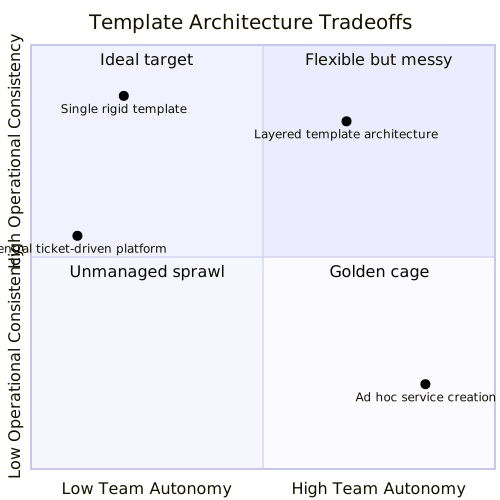
A rigid template improves consistency but can hurt domain fit and innovation. A loose template preserves autonomy but often degrades into support chaos. Layered template architecture is a compromise, and like all worthwhile compromises, it requires discipline.
Another tradeoff is cognitive load. Good templates reduce setup effort, but a platform with too many options becomes its own tax. This is why the capability layer should remain small and opinionated. If teams must choose among 19 service archetypes, the platform has become an architecture catalog, not a product.
There is also the cost of maintaining shared assets. Every module, policy pack, and internal abstraction becomes a thing that must be supported, documented, secured, and evolved. Enterprises routinely underestimate this. Internal platforms are products. Products need investment.
Finally, templates can delay architectural learning. Teams may adopt Kafka because the template makes it easy, not because asynchronous integration is right. Convenience is powerful. Platform teams should be careful what they make effortless.
Failure Modes
The most dangerous failure mode is the template that becomes a substitute for architecture thinking.
Teams generate a service, inherit some libraries, deploy to Kubernetes, and assume they are “doing microservices.” They are not. They are using containers. The hard questions remain: what is the bounded context, where is the source of truth, what consistency model is acceptable, what are the event semantics, and how will failures be reconciled?
Another common failure mode is template sprawl. Every exception becomes a new template until the platform has more archetypes than users can understand. This usually reflects weak modularity. If teams need small variations, support composition before creating a new template family.
There is also the governance backlash. If the platform is too rigid, teams create shadow templates, fork shared modules, or bypass the portal entirely. This is not developer immaturity. It is a market signal. Internal users route around products that make them slower.
Kafka-specific failures deserve direct mention:
- producing events without a clear ownership model
- relying on at-least-once delivery without idempotency
- assuming event order globally rather than per key
- skipping schema governance
- treating dead-letter topics as a solution rather than a symptom
- omitting reconciliation because “Kafka is durable”
Durability is not correctness. Enterprises learn this the expensive way.
Finally, migration programs fail when templates are introduced as a branding exercise without serious anti-corruption and coexistence planning. A new template does not erase a bad domain model or undocumented legacy rule. It just gives them YAML.
When Not To Use
Service template architectures are powerful, but not universal.
Do not use them as a forcing function for every piece of software in the estate. Some workloads do not justify a service abstraction at all. A straightforward internal application may be better as a modular monolith. A data science workflow may need a different platform entirely. A vendor product customization may belong outside the service template ecosystem except at integration boundaries.
Do not use a heavy template architecture when the organization is small, the number of services is modest, and teams already share practices effectively. Standardization has a carrying cost. If you have ten engineers and three services, an internal platform with multiple templates, policy packs, and portal workflows may be theater.
Do not use service templates to settle unresolved domain boundaries. If the business model is unclear, templating will only accelerate confusion. Domain discovery comes first.
And do not use Kafka-enabled templates simply because event-driven architecture is fashionable. If the use case is strongly synchronous, consistency-sensitive, and operationally simple, a well-designed API and transactional store may be the better choice. Asynchrony is not sophistication. Sometimes it is just postponed pain.
Related Patterns
Several adjacent patterns often work well with service template architectures.
Internal Developer Portal
This becomes the front door for templates, metadata capture, ownership registration, documentation, and operational links. Useful, but only if backed by real platform capabilities.
Golden Path
A curated default path for common service types. Healthy when it is voluntary-but-attractive. Dangerous when it becomes mandatory-and-wrong.
Backstage-style software catalog
Helpful for tracking service ownership, dependencies, operational status, and architectural metadata. Especially useful when combined with domain-oriented taxonomy.
Outbox Pattern
Essential for reliable publication of domain events from services that own transactional state.
Anti-Corruption Layer
Vital in migration to prevent legacy semantics from contaminating new bounded contexts.
Strangler Fig Pattern
The practical migration backbone for replacing legacy systems progressively rather than theatrically.
Policy as Code
The only scalable way to make governance part of the delivery path instead of an after-the-fact review ritual.
Cell-based or domain-aligned platform segmentation
In very large enterprises, a single central platform may not suffice. Federated platform capabilities aligned to business domains can work better, provided shared controls remain consistent.
Summary
Service template architectures are one of the most useful tools in modern platform engineering, and one of the easiest to get wrong.
Done badly, they create a sterile factory: every service looks the same, teams fight the platform, domain boundaries blur, and Kafka is sprinkled around like confetti. Done well, they provide a disciplined shell around services while leaving room for domain-driven design, migration realities, and operational nuance.
The winning architecture is usually layered. Standardize the operational substrate. Offer a small set of capability-based templates. Preserve domain semantics at the service level. Support migration through anti-corruption and progressive strangler patterns. Treat reconciliation as a first-class concern in event-driven and transitional architectures. And always provide an escape hatch with governance, not guilt.
A platform template should make the right thing easy, the dangerous thing visible, and the exceptional thing possible.
That is enough. It is also a lot.
Frequently Asked Questions
What is cloud architecture?
Cloud architecture describes how technology components — compute, storage, networking, security, and services — are structured and connected to deliver a system in a cloud environment. It covers decisions on scalability, resilience, cost, and operational model.
What is the difference between availability and resilience?
Availability is the percentage of time a system is operational. Resilience is the ability to recover from failures — absorbing disruption and returning to normal. A system can be highly available through redundancy but still lack resilience if it cannot handle unexpected failure modes gracefully.
How do you model cloud architecture in ArchiMate?
Cloud services (EC2, S3, Lambda, etc.) are Technology Services or Nodes in the Technology layer. Application Components are assigned to these nodes. Multi-region or multi-cloud dependencies appear as Serving and Flow relationships. Data residency constraints go in the Motivation layer.