⏱ 19 min read
Most integration estates don’t fail because teams can’t move bytes. They fail because they move meaning badly.
That is the central problem at the edge.
An enterprise rarely has the luxury of a clean boundary where every client speaks the same language, every backend exposes a tidy contract, and every domain agrees on what a “customer,” “order,” or “payment status” actually means. Real firms inherit channels, mergers, partner APIs, regional variants, mobile apps with long tails, and backends that were built in different decades by different tribes with different assumptions. The edge becomes a crowded customs checkpoint. Everyone is passing through it. Nobody speaks exactly the same language. And yet the business expects a smooth border crossing.
This is where API edge transformation enters. Not as a glorified mapping layer. Not as a dumping ground for every ugly integration compromise. And certainly not as a place to hide domain confusion. Done well, edge transformation is a deliberate architectural capability that reshapes inbound and outbound contracts at the boundary so that clients and internal services can evolve with less friction. Done badly, it turns the edge into a giant ball of procedural mud with headers.
The difference is architectural intent.
In this article, I’ll take a hard line: API edge transformation is useful when it protects domain boundaries, supports progressive migration, and reduces coupling between channels and internal services. It is dangerous when it becomes a surrogate domain model, a distributed ESB in disguise, or a place where teams solve organizational indecision with JSON contortions.
Let’s unpack it properly.
Context
Edge architecture sits where external consumers meet enterprise capabilities. In practice that means API gateways, BFFs, partner facades, GraphQL layers, mobile aggregators, security filters, policy enforcement points, and increasingly event-aware edge components that don’t just route requests but reshape them.
The old story was simple. Clients called an API gateway, the gateway authenticated, authorized, routed, and maybe throttled. Transformation was kept light: protocol conversion, perhaps minor field mapping.
That story no longer holds.
Today, enterprises are modernizing large application portfolios while simultaneously serving digital channels that need cleaner, faster, more stable contracts than the underlying systems can provide. A banking mobile app needs a consistent “account summary” even if balances live in a core banking platform, rewards sit in a SaaS system, and disputes belong to a separate servicing platform. A retailer wants a single product view, but inventory, pricing, fulfillment promises, and promotions all come from different bounded contexts. A manufacturer exposes partner APIs globally, yet country-specific ERP customizations make a canonical response impossible without some kind of adaptation.
Edge transformation emerges as the pressure valve.
But there is a trap here. Architects often confuse “the edge” with “the right place to normalize the enterprise.” It usually isn’t. The edge should adapt contracts, not invent a fantasy of universal truth. Domain-driven design matters because meaning belongs in domains. The edge can translate between representations, but it should not become the final court of business semantics for the whole firm.
That distinction sounds subtle. In implementation, it is everything.
Problem
The enterprise edge is under strain from three directions at once.
First, clients need stable APIs. Mobile apps, partner integrations, call-center desktops, and web front ends cannot be rewritten every quarter because backend teams decided to split a service, rename a field, or modernize a data model. Consumer-facing contracts need continuity.
Second, internal architecture is changing. Monoliths are being carved into microservices. Legacy SOA estates are being wrapped or retired. Event-driven platforms using Kafka are replacing synchronous point-to-point calls for many workflows. The internal topology is moving under the feet of the channel estate. event-driven architecture patterns
Third, the business language itself is inconsistent. “Order shipped” may mean physically dispatched in one system, invoiced in another, and merely allocated in a third. This is not a data formatting issue. It is a domain semantics issue.
Without edge transformation, clients get exposed directly to internal fragmentation. They become accidental archaeologists of backend history. The mobile team learns which service is old and which is new. The partner team discovers that customer identity works differently by region. Every channel accumulates compensating logic. Versioning multiplies. Simple releases become coordination exercises across half the portfolio.
With unmanaged transformation at the edge, a different failure appears. The gateway grows tentacles. It starts doing orchestration, joining data from six systems, embedding lifecycle rules, reconciling conflicting records, and applying business decisions that nobody can trace back to a domain owner. This is how integration layers become legacy systems in their own right.
So the problem isn’t whether transformation should happen. It will happen somewhere. The real architectural question is: what transformation belongs at the edge, what belongs in domain services, and how do we migrate without breaking channels?
Forces
A good architecture article should name the forces honestly, because tradeoffs are where architecture lives.
Stable external contracts vs evolving internal services
External APIs should change slower than internal implementations. That’s the whole point of a protective boundary. But this creates tension. If the edge shields too much, backend teams lose incentive to clean up semantics. If it shields too little, clients absorb internal churn.
Domain fidelity vs consumer convenience
Clients want convenience-oriented views: dashboard summaries, composite resources, simplified enumerations, flattened structures. Domains want semantic precision. These goals overlap, but not perfectly.
A BFF may legitimately expose availableBalance, but if the enterprise itself cannot define the calculation consistently, the edge must not pretend certainty. Transformation should clarify meaning, not blur it.
Synchronous UX needs vs asynchronous enterprise truth
A user expects immediate answers. Many enterprise facts arrive eventually: payments settle later, inventory updates through events, customer golden records reconcile overnight. The edge often fronts domains whose state is probabilistic in the short term. This is where reconciliation matters. If edge contracts imply atomic truth while the backend is eventually consistent, disappointment is guaranteed.
Migration speed vs operational simplicity
Edge transformation accelerates modernization by decoupling clients from backend rewiring. But every transform adds logic, observability needs, performance cost, and potential failure modes. The easiest migration path technically can become the hardest platform to operate.
Reuse vs bounded context integrity
The seductive move is to create a shared canonical model in the edge. It promises reuse. It usually delivers semantic compromise. In domain-driven design, bounded contexts exist because terms are not universal. The edge can mediate between contexts, but one size rarely fits all.
Solution
The pattern I recommend is API Edge Transformation as an anti-corruption and migration boundary, not as a universal enterprise abstraction layer.
In practice, this means the edge performs a narrow but valuable set of responsibilities:
- adapt channel-facing contracts from client-oriented representations to domain-oriented service calls
- shield clients from internal decomposition and service reshaping
- perform syntactic and representation-level mapping
- support coarse-grained aggregation where it improves client experience
- enforce policy, version mediation, routing, and backward compatibility during migration
- expose explicit semantics for uncertain or eventually consistent data
And just as importantly, it should avoid these responsibilities unless there is no alternative:
- becoming the source of core business rules
- owning master data truth
- implementing complex orchestration that belongs in domain process managers or workflow services
- inventing canonical meanings across bounded contexts
- hiding unresolved domain ambiguity with ad hoc transforms
The edge is a translator. It is not the novelist.
A useful mental model is to think of transformation in three layers:
- Representation transformation
Field renames, payload reshaping, protocol mediation, version mapping, envelope normalization.
- Experience transformation
Aggregating multiple service responses into a client-optimized contract. This is often valid in BFFs or channel APIs.
- Semantic transformation
Mapping between bounded contexts or legacy and modern domain models. This is the most dangerous layer and must be explicit, owned, and limited.
If you keep those categories distinct, the edge stays understandable. If you blur them together, you get inscrutable middleware logic that nobody can safely change.
Architecture
A workable edge architecture usually combines gateway capabilities with domain-aware adapter services. I prefer keeping heavyweight transformation out of the gateway product itself. Gateways are excellent at policy, routing, auth, quotas, and lightweight mediation. Once transformation starts depending on domain semantics, it deserves code, tests, owners, and deployment pipelines like any other service.
Here is a typical structure.
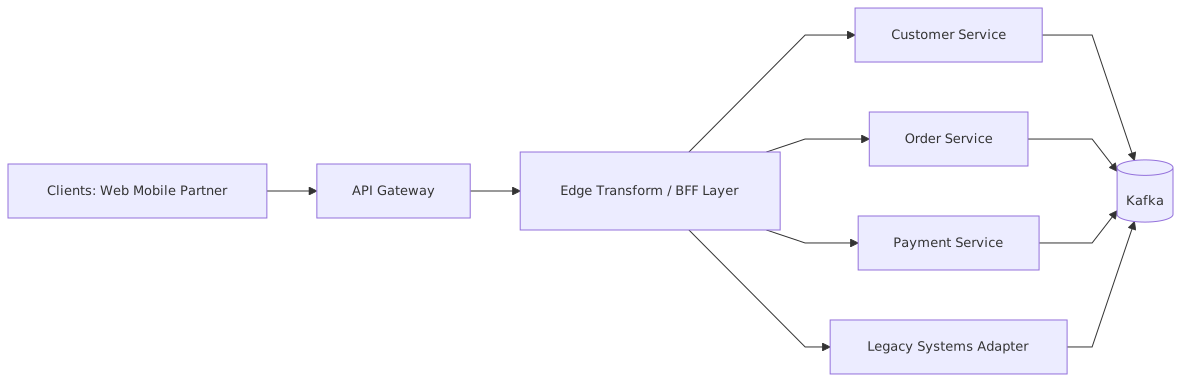
The gateway handles security, rate limiting, request validation, and coarse routing. The edge transform layer adapts client contracts, aggregates responses, and mediates versions. Behind it sit domain services and legacy adapters. Kafka supports event propagation, cache refresh, projections, and reconciliation workflows.
This architecture works because it respects boundaries. The edge knows enough to present a coherent API. The domain services still own business decisions. Legacy systems are wrapped rather than exposed directly. Events let downstream views and reconciliation processes catch up without forcing every interaction into a synchronous call chain.
Domain semantics at the edge
This is where architects need discipline.
Suppose a partner API expects orderStatus values like PLACED, FULFILLED, CANCELLED. Internally, the order domain may have Created, Reserved, Picked, Packed, Shipped, Completed, Voided. The edge can absolutely transform internal status to partner status. That is a legitimate published-language concern.
But if the edge starts deciding whether an order counts as FULFILLED based on warehouse rules, billing completion, and customer-notification timing, it is no longer just mapping. It is inventing a cross-domain business rule. That logic belongs in a domain service, policy component, or explicit read model owned by the business capability.
The litmus test is simple: if the transform requires business argument, business ownership, or exception policy, it is no longer “just an edge mapping.”
Edge transforms and Kafka
Kafka becomes relevant when the edge cannot safely compute everything synchronously, or when it needs stable consumer-facing views despite fragmented systems.
Common uses include:
- maintaining materialized read models for edge APIs
- publishing API interaction events for auditing and downstream enrichment
- reconciling legacy and modern state after strangler migrations
- decoupling writes from downstream propagation where immediate consistency is unnecessary
A read-optimized edge projection can be powerful. But again, semantics matter. If you build a customer profile projection from CRM, billing, onboarding, and support systems, someone must own conflict resolution rules. Which source wins for email? What happens when tax residency differs? How is freshness exposed to the client? Event-driven architecture doesn’t remove semantic conflict. It just moves it into time.
A more explicit edge transform view
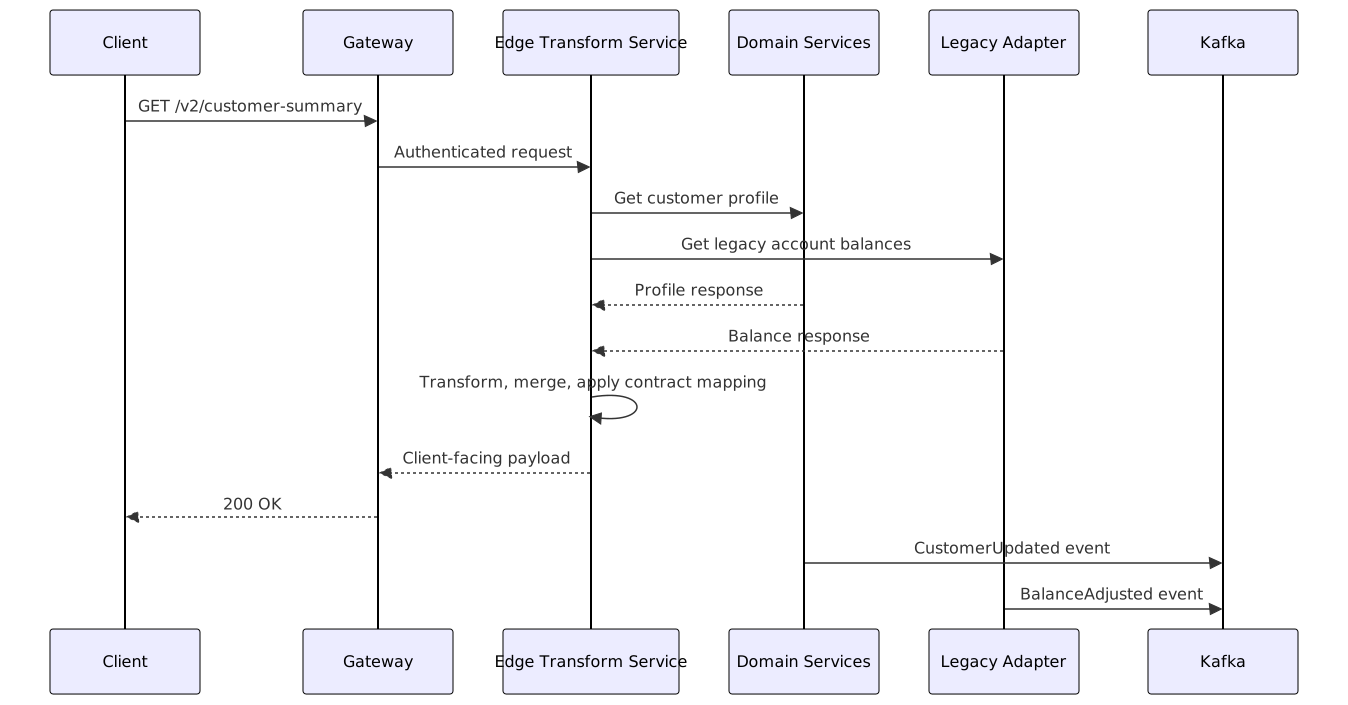
Notice the asymmetry. The API call is synchronous. The estate itself may not be. That gap is where many systems become dishonest. The edge must communicate freshness, partiality, and uncertainty if the underlying truth is assembled from mixed-timeliness sources.
Migration Strategy
This pattern really earns its keep during migration.
Most enterprises don’t modernize by replacement. They modernize by coexistence. Old and new systems run in parallel longer than anyone planned. During that period, client contracts must remain stable while the internal path of execution changes underneath them. The edge is the obvious lever.
The right migration strategy is usually a progressive strangler. Not a grand rewrite. Not a “big bang” cutover dressed up as confidence.
Start by putting a stable edge contract in front of the existing capability. Then progressively redirect slices of behavior, data retrieval, and writes to new services. The edge mediates versions, coordinates temporary dual paths, and isolates clients from the sequence of backend substitutions.
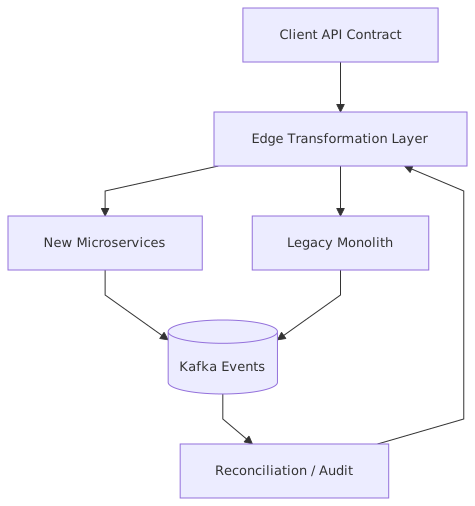
A practical migration path
- Stabilize the external contract
Freeze the channel-facing API shape where possible. Introduce explicit versioning if needed. Do not migrate internals while allowing every client to negotiate bespoke contracts.
- Wrap the legacy path
Put the edge in front of current systems first. Even if the first release adds little business value, it creates the seam you’ll need later.
- Extract one capability at a time
Move a subdomain or high-change capability behind the same edge contract. Order pricing. Customer preferences. Shipment tracking. Pick something bounded.
- Use dual reads carefully
During transition, the edge may read from both legacy and new services. This is useful, but dangerous. Dual read logic should be temporary and observable.
- Use dual writes only with explicit reconciliation
If both systems must be updated, assume they will diverge. Build reconciliation from the start. Hope is not a data consistency strategy.
- Promote new source of truth incrementally
Once confidence is high, switch the edge to prefer modern services. Keep fallbacks visible and removable.
- Retire transforms aggressively
Every migration transform should have an expiration plan. Otherwise “temporary” mappings survive for years and become untouchable.
Reconciliation is not optional
Architects often talk about strangler migration as if routing is the hard part. It rarely is. Data reconciliation is the hard part.
When old and new systems coexist, you get disagreement:
- customer records differ
- statuses arrive in different orders
- idempotency assumptions fail
- retries create duplicates
- event delivery lags
- one side rounds money differently
If the edge masks all of this and returns a neat payload, operations will still pay the bill later.
You need explicit reconciliation capabilities:
- correlation IDs across old and new paths
- deterministic merge rules
- drift detection dashboards
- compensating actions
- replay support from Kafka topics or audit logs
- clear business ownership for conflict resolution
The most common migration failure is not technical incompatibility. It is silent divergence hidden behind a successful API response.
Enterprise Example
Consider a global insurer modernizing its policy servicing platform.
The company has:
- a 20-year-old policy administration system by product line
- a web self-service portal
- mobile apps in three regions
- broker APIs used by external agencies
- new microservices for customer identity, billing, and claims notifications
- Kafka introduced as the integration backbone for modernization
The business wants a unified policy-summary API. Easy to say. Hard to mean.
In the legacy world, a policy summary is assembled from policy admin records, billing balances, endorsements, and customer correspondence flags. In the new world, identity and billing have moved to microservices, while policy data remains partially in the legacy system. Brokers need a terse status model. Mobile users need richer self-service metadata. Internal service semantics differ by product line. microservices architecture diagrams
A naïve edge design would create a giant canonical insurance model and map everything into it. That would be a mistake. Product lines already operate as different bounded contexts, and pretending otherwise simply moves inconsistency into a shared abstraction nobody fully trusts.
A better design creates:
- a gateway for security and partner policy enforcement
- channel-specific edge transform services
- domain-owned adapter APIs for policy, billing, identity, and notifications
- Kafka-fed read models for customer and billing summaries
- a reconciliation service that compares legacy and modern billing views during migration
The mobile app calls /policy-summary. The edge transform service fetches:
- policy header and coverage details from the legacy policy adapter
- billing status from the billing service or billing projection
- customer contact preferences from identity
- notification opt-ins from a communication service
It then returns a consumer-oriented payload. But crucially, business semantics remain owned by domains. For example:
- billing determines delinquency, not the edge
- policy determines active vs lapsed, not the edge
- identity determines verified contact channels, not the edge
During migration, billing is dual-run between old policy admin balances and the new billing platform. Kafka events feed a comparison process. Discrepancies above a threshold trigger operational review. The edge prefers the new billing status only after reconciliation metrics stabilize by product and region.
This is real enterprise architecture. Not because it is elegant. Because it accepts the mess and contains it.
Operational Considerations
Edge transformation introduces operational complexity that many teams underestimate.
Observability
You need more than latency graphs.
At minimum:
- end-to-end correlation IDs
- payload version tracing
- transform rule metrics
- backend contribution timings
- partial response indicators
- semantic error categories, not just HTTP codes
If a client gets the wrong answer, you must be able to tell whether the issue came from source systems, transformation logic, stale projections, schema mismatch, or reconciliation drift.
Performance
Every transform costs something. Aggregation multiplies network hops. Serialization and deserialization are not free. If the edge fans out to five services for every mobile request, you’ve built a distributed tax on user experience.
Use:
- response shaping with care
- caching where semantics allow
- precomputed projections for common views
- timeout budgets per dependency
- partial responses for non-critical enrichments
The fastest edge is the one that asks the fewest questions.
Schema and contract governance
Consumer-facing contracts should be governed explicitly. Backward compatibility rules matter. Field deprecation policy matters. Enum evolution matters. If the edge is mediating versions, the transform catalog itself becomes an architectural asset.
Treat mappings as code with tests, lineage, and ownership. “We’ll just update the config” is how critical semantics become invisible.
Security and data minimization
The edge sees everything. That makes it useful and dangerous.
Transform layers must respect:
- least privilege to downstream systems
- masking and tokenization
- regional data residency constraints
- contract-specific field suppression
- partner-specific redaction policies
It is common for transformation services to accidentally widen data exposure because they aggregate too broadly before filtering. Pull less. Not more.
Tradeoffs
There is no free lunch here.
Pros
- stabilizes external APIs during backend change
- reduces client coupling to internal topology
- supports strangler migration
- enables consumer-optimized contracts
- provides a controlled anti-corruption layer between legacy and modern domains
Cons
- adds another layer to operate and debug
- can become a semantic dumping ground
- may increase latency through fan-out aggregation
- risks duplicating logic across edge and domain services
- creates migration debt if “temporary” transforms never die
My opinionated view: these tradeoffs are worth it when the enterprise is actively modernizing or serving diverse clients with distinct contract needs. They are not worth it if your internal services are already clean, stable, and directly consumable.
Failure Modes
This pattern fails in predictable ways.
1. The edge becomes the new monolith
Teams keep adding “just one more rule.” Soon all meaningful behavior lives in a sprawling transform layer nobody owns end to end.
2. Canonical model fantasy
An enterprise creates a supposedly universal schema at the edge. In reality it encodes watered-down semantics and endless exceptions. Every domain resents it. Every client works around it.
3. Hidden inconsistency
The edge merges data from systems with different freshness and conflict rules but presents the result as if it were atomic truth. Users make decisions on stale or contradictory data.
4. Migration sediment
Old-to-new mappings accumulate. Fallback paths stay in place forever. Nobody knows whether the legacy call is still needed, so it never gets removed.
5. Observability blind spots
Transforms are applied dynamically, perhaps via policy engines or scripts, with weak tracing. Errors become impossible to localize.
6. Performance collapse by aggregation
One clean client API call turns into a storm of backend requests. Under load, the edge becomes the bottleneck and amplifies cascading failure.
The cure for most of these is boring but effective: explicit ownership, limited scope, strong telemetry, and ruthless retirement of temporary logic.
When Not To Use
Do not use API edge transformation as a default reflex.
It is the wrong pattern when:
- clients can reasonably consume domain APIs directly
- there is little contract diversity across channels
- backend services are already aligned with domain boundaries and stable contracts
- the transformation required is mostly orchestration of business workflow, which belongs elsewhere
- your organization lacks ownership discipline and will inevitably centralize all logic into the edge team
- low latency is paramount and fan-out aggregation would violate response budgets
- you are trying to use the edge to resolve unresolved domain modeling problems
That last one is worth repeating. If the enterprise cannot agree on what a customer or order means, the edge should not manufacture agreement with clever mapping. Fix the domain conversations first.
Related Patterns
This pattern sits near several others, and the distinctions matter.
API Gateway
Handles ingress concerns: auth, rate limiting, routing, quotas, coarse mediation. It may host light transforms, but should not carry heavy domain logic.
Backend for Frontend
A BFF is often the natural home for experience-oriented transformation. It shapes APIs for specific channels without pretending to define enterprise truth.
Anti-Corruption Layer
This is the closest cousin. Edge transformation can act as an anti-corruption layer between external consumers and messy internal models, or between modern APIs and legacy systems.
Strangler Fig Pattern
Essential for migration. The edge provides the seam through which legacy capabilities are replaced incrementally.
Materialized View / CQRS Read Model
Useful when edge APIs need fast, stable, aggregated reads built from asynchronous events, often delivered through Kafka-fed projections.
Process Manager / Saga
If the edge starts coordinating long-running business transactions, stop. That behavior likely belongs in a process manager or saga orchestrating domain workflows, not in the edge contract layer.
Summary
API edge transformation is one of those patterns that looks simple on a whiteboard and turns political in production.
Used well, it gives the enterprise room to breathe. It lets digital channels move faster than backend modernization. It protects clients from internal churn. It provides a pragmatic anti-corruption layer during strangler migrations. It acknowledges that old and new systems will coexist, and that reconciliation is a first-class concern, not an embarrassing afterthought.
Used badly, it becomes a bureaucratic border state: every request inspected, reshaped, enriched, delayed, and semantically compromised by a layer that knows too much and owns too little.
The essential discipline is this: let the edge transform contracts, not reality.
Keep business semantics anchored in bounded contexts. Use transformation to bridge representations and support consumer experience. Apply progressive strangler migration with explicit reconciliation. Bring Kafka in where asynchronous views and auditability help, not because event-driven architecture is fashionable. Observe everything. Retire temporary mappings before they fossilize.
In enterprise architecture, the edge is not just where systems connect. It is where meaning is negotiated. That is why this pattern matters. And that is why it must be handled with care.
Frequently Asked Questions
What is API-first design?
API-first means designing the API contract before writing implementation code. The API becomes the source of truth for how services interact, enabling parallel development, better governance, and stable consumer contracts even as implementations evolve.
When should you use gRPC instead of REST?
Use gRPC for internal service-to-service communication where you need high throughput, strict typing, bidirectional streaming, or low latency. Use REST for public APIs, browser clients, or when broad tooling compatibility matters more than performance.
How do you govern APIs at enterprise scale?
Enterprise API governance requires a portal/catalogue, design standards (naming, versioning, error handling), runtime controls (gateway policies, rate limiting, observability), and ownership accountability. Automated linting and compliance checking is essential beyond ~20 APIs.