⏱ 19 min read
Microservice programs rarely fail because teams forgot how HTTP works. They fail because the organization silently lost the plot on meaning.
One service says customer. Another says account holder. A third says party, because that sounded more enterprise. Events flow through Kafka. REST endpoints proliferate. GraphQL sneaks in at the edge. The estate looks modern, busy, and expensive. Yet every release still feels like carrying crystal across a gravel road.
This is where contract testing gets underestimated. People file it under “test automation,” next to build pipelines and code coverage dashboards. That is too small. In a serious microservices landscape, contract testing is architecture. It is one of the few practical tools that forces a distributed system to admit what it actually means, who depends on whom, and how change can happen without turning delivery into a hostage negotiation. microservices architecture diagrams
And once you see it that way, the idea of a consumer/provider contract graph becomes unavoidable. Not a cute visualization. A governing artifact. A map of business semantics and operational risk expressed through service interfaces, message schemas, and dependency edges.
A service portfolio without a contract graph is like a city without a street map. You can still drive around. You just shouldn’t be surprised when traffic becomes policy.
Context
Most enterprises didn’t arrive at microservices through pristine design. They arrived through pressure.
A monolith got too politically large. Delivery cadence slowed. Teams wanted autonomy. Data volume increased. Some channels needed real-time behavior. A digital program introduced APIs. Then Kafka entered the scene, often for good reasons: asynchronous integration, event-driven workflows, decoupling, replay. Before long, the architecture became a mixture of synchronous calls, event streams, file drops that no one wants to talk about, and a handful of legacy systems that still run the real business.
In that environment, architectural integrity doesn’t come from boxes on diagrams. It comes from controlling change at boundaries.
Domain-driven design gives us the language for this. Bounded contexts matter because language matters. Interfaces are not merely transport details; they are translations of domain concepts across team and system boundaries. If one bounded context publishes OrderSubmitted and another interprets it as OrderApproved, you do not have an integration. You have a future incident.
Contract testing sits precisely on that seam. It validates that a provider and its consumers agree not just on shape, but on behavior, assumptions, optionality, cardinality, and semantics. In event-driven systems, it extends to message contracts, schema compatibility, and temporal expectations around sequencing, duplication, and reconciliation.
The key shift is this: stop treating contracts as local artifacts owned by a single team. Start treating the web of contracts as an architectural model of the enterprise.
Problem
Traditional integration testing breaks down in microservices for boring reasons.
End-to-end tests are slow, brittle, and narrow. They often verify happy-path choreography through unstable environments. They catch obvious breakage late and leave teams with a false sense of safety. Shared test environments become the distributed equivalent of a communal kitchen: everyone depends on them, nobody trusts them, and they smell faintly of old failures.
The deeper problem is that service dependencies are often invisible until change collides with them.
A provider team modifies a field, tightens validation, changes default behavior, or republishes an event with altered semantics. Consumer teams discover the change after deployment. Sometimes they fail loudly. More often they fail in ways that are harder to detect: a field gets ignored, a downstream rule misclassifies something, an event consumer dead-letters messages, a reconciliation job suddenly spikes.
These failures are architectural, not merely technical:
- Hidden runtime coupling between supposedly autonomous teams
- Semantic drift across bounded contexts
- Version sprawl and duplicated compatibility logic
- Weak governance around event schemas and API evolution
- Inability to reason about blast radius before release
The usual response is more process: change boards, shared release calendars, API review committees, integration environments, “please notify consumers” rituals. These can help, but they don’t scale with complexity. Process can document uncertainty. It rarely removes it.
A contract graph does.
Forces
A good architecture article should admit the tension instead of pretending there is a silver bullet. Contract testing exists in the middle of several competing forces.
Team autonomy vs. ecosystem safety
Microservices promise independent delivery. Enterprises still need system stability. If every provider can change freely, consumers suffer. If every change requires central approval, you have reinvented the monolith with extra network hops.
Contract testing offers a middle path: teams can move independently within verified compatibility boundaries.
Domain evolution vs. interface stability
Business language changes. New products appear. Regulations add data. Old assumptions become wrong. Contracts cannot be frozen forever. But if interfaces churn as fast as internal models, consumers become accidental participants in every refactor.
This is a DDD problem. Bounded contexts should absorb internal change and expose intentional, stable language at their edges. Contracts enforce that discipline.
Synchronous certainty vs. asynchronous reality
Request/response contracts are relatively straightforward. Event contracts are not. With Kafka, the message shape is only part of the agreement. Ordering, duplication, retries, partitioning, idempotency, and replay behavior all shape the real contract. A schema registry alone is useful, but it is not enough. Structural compatibility is not semantic compatibility. event-driven architecture patterns
Local optimization vs. enterprise visibility
A team can write provider tests and feel productive. The enterprise, however, needs to know how all contracts connect. Which consumers rely on which provider fields? Which event versions are still active? Which changes would break critical business journeys? Without that graph, local correctness still produces systemic surprise.
Delivery speed vs. governance overhead
Architects love governance until they have to live with it. If contract practices are too heavy, teams bypass them. If they are too loose, they are decorative. The trick is to make the contract graph part of delivery flow, not a separate ceremony. EA governance checklist
Solution
The core idea is simple and powerful:
Treat every inter-service interface as an executable contract, and treat the network of those contracts as a first-class architectural graph.
That graph spans:
- API consumers and providers
- Event publishers and subscribers
- Schema versions and compatibility rules
- Domain terms crossing bounded contexts
- Operational dependencies such as retries, fallback behavior, and reconciliation paths
A contract is more than a payload example. It should capture enough of the interaction to express what the consumer relies on and what the provider guarantees.
For synchronous APIs, that usually includes:
- resource or endpoint shape
- required and optional fields
- response codes
- behavior under specific states
- validation expectations
- pagination, sorting, filtering semantics where relevant
For event-driven integration, it includes:
- event name and meaning
- schema shape and compatibility policy
- required invariants
- partitioning keys
- ordering assumptions
- duplicate handling expectations
- tombstones or delete semantics
- replay and retention implications
Consumer-driven contract testing is often the practical entry point. Consumers publish the interactions they depend on. Providers verify those contracts in CI. This prevents accidental breakage and reveals dependency edges. But architecture requires one more move: aggregate these contracts into a graph and govern the graph.
That graph becomes a strategic instrument. It answers real enterprise questions:
- Which consumers are coupled to this provider behavior?
- Which field changes will break production consumers?
- Which event versions can be retired?
- Which bounded contexts are leaking internal language?
- Where do we need anti-corruption layers?
- Which dependencies make a service too central to change safely?
This is where contract testing graduates from testing to architecture.
Architecture
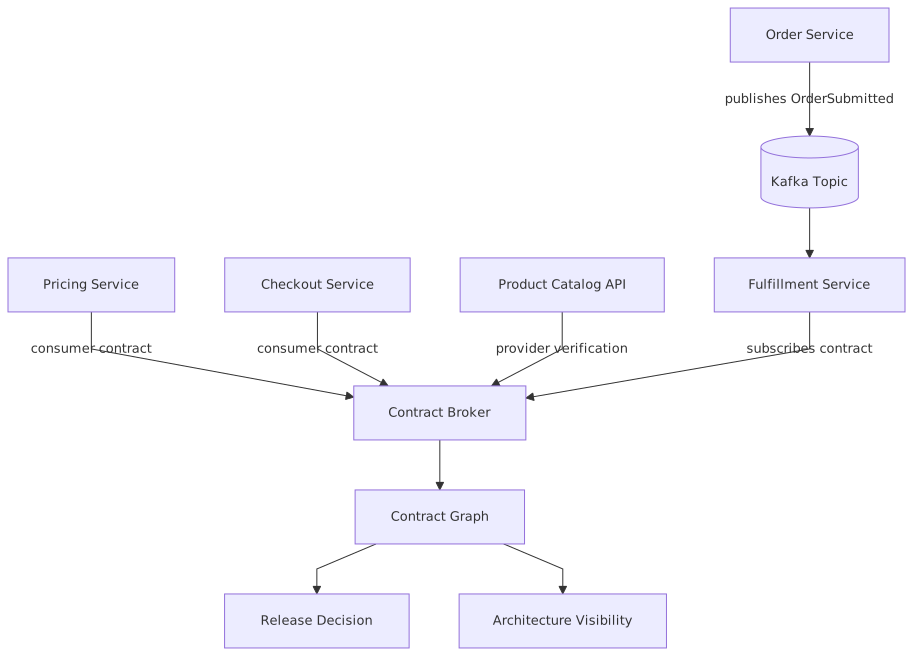
A contract graph architecture usually has five parts:
- Contract authoring
- Verification
- Broker or registry
- Graph construction and analysis
- Release decisioning
1. Contract authoring
Consumers define the interactions they rely on. Providers define the capabilities they expose and, in some organizations, provider-side assertions around invariants. Event publishers may define canonical schemas, while subscribers define semantic expectations and tolerated optionality.
The quality bar matters. Contracts should express business intent, not mirror internal implementation. If a consumer contract over-specifies irrelevant fields, it creates needless coupling. If it under-specifies key semantics, it gives false confidence.
This is where DDD helps. Ask: what domain promise is crossing this boundary?
Not “a JSON with 17 fields.”
But “a Credit Decision context promises a lending outcome with traceable reasons and an application correlation key.”
2. Verification
Providers verify they satisfy all relevant consumer contracts before release. Consumers verify that their code still works against provider contract stubs or generated mocks.
For Kafka, verification often combines schema compatibility checks with semantic tests:
- can the consumer read old and new versions?
- does the provider preserve required invariants?
- are duplicate events tolerated?
- does replay produce a safe result?
3. Broker or registry
You need a source of truth for contracts and versions. This may be a contract broker, schema registry, artifact repository, or a combination. The point is not tooling purity. The point is discoverability and traceability.
The broker should answer:
- who published this contract?
- which provider version verified it?
- which environments run compatible artifacts?
- which contracts are pending, deprecated, or retired?
4. Graph construction and analysis
Now the architectural part.
From broker data, build a graph:
- nodes: services, topics, contracts, versions, bounded contexts
- edges: consumes, provides, publishes, subscribes, verifies, depends-on
Enrich those edges with metadata:
- criticality
- domain capability
- environment status
- compatibility mode
- change frequency
- owner team
- runtime volume
- last verification timestamp
This turns a pile of test artifacts into an operating model.
5. Release decisioning
A mature implementation uses the graph in delivery pipelines. Before promoting a provider release, the platform checks whether all affected contracts are verified. Before retiring an event version, the platform checks whether any active subscribers still depend on it. Before allowing a schema change, the pipeline inspects downstream compatibility.
This is what “architecture as code” should mean in practice. Not more YAML for its own sake. Runtime change control, expressed in executable artifacts.
Domain semantics in the graph
The graph should not only track technical dependencies. It should expose semantic relationships.
For example:
Customerin CRM contextAccountHolderin Core Banking contextPartyin Enterprise Identity context
These may refer to related but different concepts. The graph should show whether contracts translate terms through anti-corruption layers or leak upstream language directly. A service that consumes ten variants of “customer” from ten domains is not flexible. It is semantically bankrupt.
A good contract model includes canonical descriptions, bounded context ownership, and mapping rules where translation occurs.

That picture matters because many integration failures are really language failures wearing technical clothes.
Migration Strategy
You do not impose a pristine contract graph on a messy estate in one quarter. If you try, the organization will politely ignore you.
Use a progressive strangler approach.
Start at the seams where change hurts most:
- a volatile provider with many consumers
- a Kafka topic with frequent schema incidents
- a channel API where downstream teams fear every release
- a domain split where terminology is already contested
Step 1: Inventory critical interactions
Catalog service interfaces and event flows for one value stream. Do not attempt enterprise-wide completeness on day one. Pick a meaningful business slice: onboarding, checkout, claims, payments, fulfillment.
Identify:
- producers and consumers
- transport types
- contract versions
- owners
- known breakages
- reconciliation jobs tied to these flows
Step 2: Introduce contract tests at the edge
For APIs, start with consumer-driven contracts for the top 3-5 consumers. For Kafka, combine schema registration with subscriber-focused tests around deserialization, idempotency, and semantic handling.
The first win is not elegance. It is preventing the next avoidable breaking change.
Step 3: Stand up a broker and lightweight graph
Even a basic graph built from CI metadata is enough to start. The mistake is waiting for a grand governance platform. Better a rough map than a perfect rumor. ArchiMate for governance
Step 4: Gate high-risk releases
Do not gate everything immediately. Gate changes to:
- externally consumed APIs
- high-volume event topics
- core domain providers
- regulated data interfaces
Selective enforcement builds trust.
Step 5: Add semantic stewardship
Once technical contracts are in place, review domain terms. Which contracts expose internal language? Where do field names encode implementation rather than business meaning? Where do consumers depend on fields that should be hidden?
This often leads to anti-corruption layers, façade APIs, or event redesign.
Step 6: Strangle legacy integration
As legacy systems are decomposed, use contracts to define the replacement boundary. New services should satisfy the old consumers through stable contracts while internal behavior migrates behind the seam.
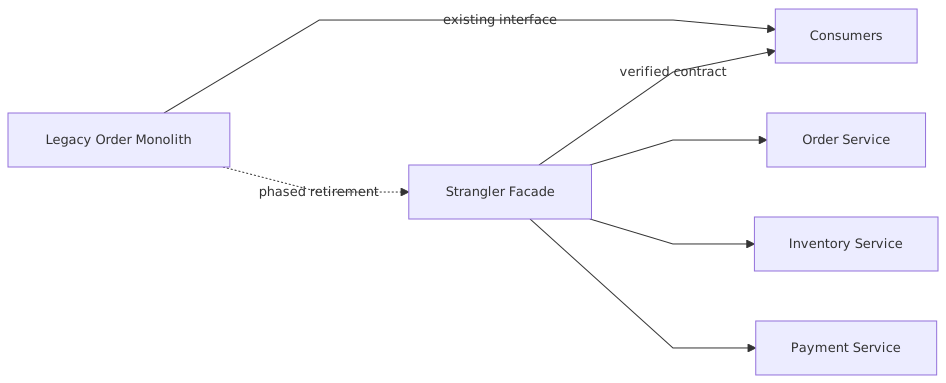
This is where contract testing earns its keep. It lets you replace internals while preserving consumer expectations. That is architecture in the only way executives really care about: changing the machine without stopping the business.
Enterprise Example
Consider a global retailer modernizing its commerce platform.
The estate had:
- a legacy order management suite
- a product catalog API used by web, mobile, and marketplace channels
- Kafka topics for inventory, pricing, and order state events
- regional fulfillment systems with local customizations
- a central customer platform, not actually central in any useful semantic sense
The initial symptom was familiar: every catalog API release caused downstream incidents. Mobile relied on fallback image behavior. The marketplace partner depended on a field marked “optional” but always populated. Checkout assumed inventory events were ordered by SKU globally, which was never guaranteed by Kafka partitioning strategy. Reconciliation batches ran nightly to repair mismatches between order status and fulfillment updates.
The first instinct from leadership was more integration testing. That would have failed. The problem was not lack of environments. It was invisible dependency.
The architecture team introduced contract testing around the Product Catalog API and the InventoryAdjusted topic.
What they found
The catalog service had 19 distinct consumer assumptions, only 7 of which were documented.
The inventory topic had three semantic interpretations:
- warehouse stock mutation
- available-to-promise adjustment
- reservation release notification
One event, three meanings. That is not decoupling. That is a multilingual fire alarm.
What they changed
- Consumer-driven contracts for web, mobile, marketplace, and checkout
- Provider verification in CI for the catalog service
- Topic-level schema compatibility rules in Kafka
- Subscriber semantic tests for inventory consumers
- A contract broker integrated with deployment metadata
- A graph dashboard showing consumer/provider dependencies by domain and region
Then came the hard DDD work.
They split inventory semantics into:
StockAdjustedReservationChangedAvailabilityProjected
They introduced an anti-corruption layer between customer and checkout domains because “customer eligibility” in marketing had drifted from “purchasing eligibility” in commerce. The old shared term had become a trap.
Reconciliation changes
This is crucial. Many event-driven programs quietly rely on reconciliation jobs as a substitute for clear contracts.
In the retailer’s case, nightly reconciliation was reduced but not eliminated. That was the right answer. Reconciliation is not evidence of architectural failure. It is evidence that distributed systems live in time.
They redesigned reconciliation as an explicit downstream safety mechanism:
- contract metadata identified authoritative sources
- events carried correlation IDs and version markers
- consumers recorded processing state
- reconciliation jobs compared derived state against source-of-truth snapshots
- mismatches triggered compensating workflows, not manual spreadsheet theater
This is the grown-up model. Contract tests prevent predictable breakage. Reconciliation repairs inevitable drift. You need both.
Results
Within two quarters:
- breaking API changes dropped sharply
- deployment coordination meetings were reduced
- event schema evolution became visible and governable
- consumer impact analysis before release became routine
- legacy order functions could be strangled behind stable contracts
Most importantly, the teams stopped debating whether “contract testing” belonged to QA, integration, or architecture. Reality settled the matter.
Operational Considerations
If the graph is to matter, it must live in operations, not just design decks.
CI/CD integration
Provider builds should fail when required contracts are unmet. Consumer builds should publish new contracts automatically. Promotion pipelines should use graph queries to validate compatibility in the target environment.
Environment drift
A common failure is verifying contracts in CI while production runs a different version mix. Track artifact versions by environment and relate them to verified contracts. Otherwise, you have paper safety.
Observability linkage
Connect contract edges to runtime signals:
- request error rates
- consumer lag
- schema rejection counts
- dead-letter queue volume
- replay frequency
- reconciliation discrepancy rates
A contract graph without production telemetry is a map without weather.
Kafka-specific concerns
For event contracts, watch for:
- partition key changes
- retention changes affecting replay assumptions
- compacted topic semantics
- duplicate production during retries
- out-of-order handling
- poison messages and DLQ strategy
- exactly-once mythology
Exactly-once is one of those phrases that causes architects to spend money and still end up writing reconciliation. Prefer idempotent consumers and explicit compensating logic over magical thinking.
Ownership and stewardship
Each contract edge needs an owner on both sides. Shared ownership is usually unowned ownership. For cross-domain semantics, appoint domain stewards who can decide whether a term is stable, translated, or leaking.
Tradeoffs
Contract testing as architecture is not free. Good. Things that matter rarely are.
Benefits
- Faster, safer independent delivery
- Better visibility into dependency topology
- Clearer interface evolution
- Reduced accidental coupling
- Improved migration safety during strangler decomposition
- Better domain boundary discipline
Costs
- Upfront effort to write useful contracts
- Tooling and platform integration work
- Graph maintenance and metadata quality demands
- Cultural friction when hidden dependencies are exposed
- Risk of over-specifying consumer expectations
The biggest tradeoff is precision versus flexibility. If contracts are too detailed, they freeze provider evolution. If too vague, they fail to protect consumers. The sweet spot is “only what the consumer truly depends on.” That sounds obvious. It is not easy.
Failure Modes
Most contract initiatives fail in predictable ways.
1. Treating structure as semantics
A schema passes compatibility checks, but the business meaning changed. This is common in event streams. A field still exists, but its interpretation shifted. Your tests go green. Your operations team goes red.
2. Over-coupled consumer contracts
Consumers specify every field and header because it is easy. Providers become unable to make harmless changes. Teams then bypass contract tests because they feel oppressive. That is not a tooling issue. It is bad contract design.
3. No contract graph, only local verification
Teams verify pairwise interactions, but nobody sees the ecosystem. This misses fan-out risk, retirement analysis, and centrality hotspots.
4. Ignoring reconciliation
Contract testing does not eliminate eventual consistency issues, missed events, duplicate processing, or temporal race conditions. Systems still drift. If you have no reconciliation strategy, your architecture is fragile.
5. Governance theater
An architecture board reviews contracts manually, slowly, and inconsistently. Teams route around it. The graph must be machine-readable and embedded in delivery.
6. Shared canonical model addiction
Some enterprises try to solve contract chaos with a giant enterprise schema. Usually this creates semantic compromise and organizational gridlock. Better to respect bounded contexts and use explicit translation where needed.
When Not To Use
Let’s be blunt. Not every system needs this level of machinery.
Do not lean hard into contract graph architecture when:
- you have a small system with one or two teams and limited interface volatility
- services are not actually independent and are released together intentionally
- a modular monolith would solve the problem more simply
- interfaces are internal implementation details with no long-lived consumers
- the organization lacks enough engineering maturity to maintain contracts honestly
There is a pattern here. If your system does not have meaningful distributed autonomy, the overhead may outweigh the gain.
Also, if your domain is still changing wildly at a conceptual level, premature contracts can calcify confusion. In that phase, invest first in domain discovery and bounded context clarity. Otherwise you will automate ambiguity.
Related Patterns
Contract testing as architecture fits alongside several other patterns.
Consumer-driven contracts
The obvious foundation. Useful for expressing consumer expectations explicitly and verifying provider compatibility.
Schema registry and compatibility checks
Particularly important for Kafka and event-driven systems. Necessary, not sufficient. Structure alone is not semantics.
Anti-corruption layer
Essential when contracts cross bounded contexts with different language. Prevents upstream models from infecting downstream domains.
Strangler fig migration
Contracts define stable external behavior while internals are replaced incrementally.
Backward-compatible API evolution
Additive changes, deprecation windows, and semantic versioning all work better when tied to executable contracts and an actual dependency graph.
Reconciliation and compensating processes
A critical companion in asynchronous systems. Contract tests reduce interface breakage; reconciliation repairs state divergence.
Fitness functions
A useful architectural framing. Contract verification can be treated as an architectural fitness function for interface compatibility and change safety.
Summary
Contract testing is often sold as a developer convenience. In enterprise microservices, it is far more important than that.
It is a way to make service boundaries real.
A way to force domain language into the light.
A way to replace tribal knowledge with executable agreements.
A way to migrate legacy systems without terrorizing downstream consumers.
A way to govern Kafka topics and APIs without building a bureaucracy that everyone resents.
And above all, a way to see the system you actually have.
The consumer/provider contract graph is the key move. Once contracts are aggregated into a graph, architecture stops being a static diagram and becomes a living model of dependency, semantics, and risk. You can reason about blast radius, guide strangler migration, expose semantic drift, and decide where reconciliation belongs. You can see which bounded contexts are healthy and which are bleeding language across their borders.
That is why this matters.
Distributed systems do not fall apart only because packets get lost. They fall apart because meaning gets lost. Contract testing, done properly, is one of the few practices that protects meaning at scale. And in microservices, protecting meaning is the architecture.
Frequently Asked Questions
What is a service mesh?
A service mesh is an infrastructure layer managing service-to-service communication. It provides mutual TLS, load balancing, circuit breaking, retries, and observability without each service implementing these capabilities. Istio and Linkerd are common implementations.
How do you document microservices architecture for governance?
Use ArchiMate Application Cooperation diagrams for the service landscape, UML Component diagrams for internal structure, UML Sequence diagrams for key flows, and UML Deployment diagrams for Kubernetes topology. All views can coexist in Sparx EA with full traceability.
What is the difference between choreography and orchestration in microservices?
Choreography has services react to events independently — no central coordinator. Orchestration uses a central workflow engine that calls services in sequence. Choreography scales better but is harder to debug; orchestration is easier to reason about but creates a central coupling point.