⏱ 20 min read
There is a particular kind of damage enterprise systems do to themselves. Not the dramatic kind, where everything catches fire and dashboards go red. The subtler kind. The kind where teams keep shipping, services keep multiplying, Kafka topics keep appearing, and somehow the architecture gets slower, harder to reason about, and more politically expensive every quarter. event-driven architecture patterns
At the center of that damage is a deceptively simple question: where do we place asynchronous boundaries?
This is not a plumbing decision. It is not a matter of “use Kafka because we have Kafka.” It is not solved by drawing a message bus in the middle of a slide and declaring the architecture event-driven. Async boundary placement is a domain decision disguised as an integration choice. Get it right, and your systems absorb load, decouple teams, and evolve safely. Get it wrong, and you build a distributed argument between services that should never have been separated in the first place.
The hard truth is this: most microservice pain is not caused by having too many services; it is caused by putting the wrong boundary between the wrong responsibilities, then making time itself someone else’s problem.
That is the subject here. We will look at how to place asynchronous boundaries in microservices using domain-driven design thinking, what forces shape the decision, how Kafka fits, where reconciliation belongs, how to migrate from synchronous legacy flows with a strangler strategy, and when not to use asynchronous messaging at all. microservices architecture diagrams
Context
Modern enterprises rarely start greenfield. They inherit a mix of core platforms, packaged systems, line-of-business applications, partner integrations, and a few heroic services written during an acquisition or a crisis. Then comes the modernization wave. The organization wants microservices, APIs, event streaming, and “real-time” everything. Kafka becomes the new shared infrastructure. Teams are told to decouple.
So they do what organizations do under pressure: they translate system boundaries into service boundaries and then stitch everything back together with events.
Order created. Inventory reserved. Payment authorized. Shipment planned. Customer notified.
It looks clean in a workshop. It often behaves terribly in production.
Why? Because asynchronous communication changes the shape of the business process. It introduces time gaps, retries, duplicate messages, out-of-order delivery, eventual consistency, delayed visibility, and the need for recovery logic. These are not implementation details. They are business semantics. A reservation that arrives late is not just “eventual”; it may be meaningless. A payment event replayed twice is not merely a technical glitch; it can become a financial incident.
This is where domain-driven design matters. Async boundaries should align with bounded contexts, domain ownership, and the points where delay is acceptable and state can diverge safely. If an interaction crosses a context boundary and the receiving context can make progress independently based on a published fact, asynchronous messaging is often a strong fit. If both sides need a shared, immediate decision to preserve a business invariant, forcing async often creates a mess you later call “reconciliation.”
A lot of architects discover this backwards. They build the event choreography first. Then they spend the next two years designing controls around the inconsistency they introduced.
Problem
The problem is not whether asynchronous messaging is good. It is. The problem is that teams often place async boundaries:
- at technical seams instead of domain seams
- between steps that require atomic agreement
- to hide latency rather than manage it
- because a platform standard says “all integration must be event-driven”
- without a recovery and reconciliation model
- without distinguishing commands, events, and state replication
That produces systems with familiar symptoms:
- Users do not know whether an action succeeded.
- Downstream services react to facts that may later be reversed.
- Multiple services independently model the same business state.
- Teams add synchronous “just checking” APIs around the event backbone.
- Kafka topics become a shadow data model.
- Incidents are resolved by manually editing databases and replaying messages.
The architecture still looks modern. The operating model does not.
At root, async boundary placement fails when we ignore one basic rule: a boundary is where one part of the business can responsibly say, “I’ve finished my part; the rest can happen later.” If nobody can say that, you do not have an async seam. You have a distributed transaction in denial.
Forces
Several forces pull in different directions, and good architecture is mostly the art of choosing which pain you prefer.
1. Business invariants versus autonomy
Some business rules demand immediate consistency. You cannot confirm a seat sale if inventory must be exact in that instant. You cannot post a general ledger entry with “we’ll settle the meaning later.” In such cases, the boundary should be inside a cohesive domain component, not between loosely coordinated services.
On the other hand, autonomy matters. Shipping does not need to block order capture. Customer notification does not need to be in the request path of payment. These are natural async candidates.
2. User experience and perceived completion
What does “done” mean to the user? This sounds obvious, but enterprises regularly dodge it.
If a customer clicks “Place Order,” does the business promise:
- the order is accepted,
- payment is authorized,
- inventory is reserved,
- all downstream systems have been updated,
- or only that processing has started?
Each of these implies a different boundary. Async works best when the business can honestly say: “We have accepted responsibility for the request, even if all consequences are not complete yet.”
3. Throughput and resilience
Kafka and asynchronous processing are superb for absorbing bursts, isolating failures, and decoupling producer from consumer throughput. If demand spikes unpredictably, async boundaries can protect critical systems from becoming a chain of lockstep latency.
But resilience bought through asynchrony comes with semantic debt. You gain elasticity while giving up immediacy.
4. Domain ownership
In domain-driven design, each bounded context owns its model and language. Async boundaries are often healthiest where one context publishes a business fact and another interprets it according to its own model. “Order Placed” means one thing in Sales, another in Fulfillment, and another in Finance.
The key phrase is business fact, not database change. Publishing row-level mutations as events is not domain-driven design. It is distributed table watching.
5. Auditability and compliance
In regulated environments, event trails are powerful. They provide chronology, causality, and replay capability. But replay is only valuable if consumers are idempotent and semantics are stable. Otherwise replay becomes a high-speed method of repeating old mistakes.
6. Legacy gravity
Existing systems often force awkward boundaries. Mainframes batch. ERPs own critical records. Packaged applications expose limited APIs. Migration strategy matters because the ideal boundary on a whiteboard may be impossible in phase one.
Architecture in enterprises is not the search for purity. It is the search for sane compromises that can survive contact with procurement, quarter-end close, and a 20-year-old policy admin system.
Solution
The practical solution is to place asynchronous boundaries at domain handoff points where delayed completion is acceptable, ownership is clear, and recovery is explicit.
That sounds abstract, so let’s make it concrete.
Use asynchronous communication when all of the following are true:
- The producing context can commit a meaningful business fact independently.
Example: Order Management can say, “We accepted the order.”
- The consuming context owns its reaction.
Example: Fulfillment decides how and when to allocate stock based on that fact.
- Temporary divergence is acceptable.
Example: The order exists before shipment planning completes.
- The process has a reconciliation model.
Example: If inventory reservation fails later, the order can move to backorder or exception handling.
- The event is stable enough to be part of a published language.
Example: OrderAccepted is durable business vocabulary; orders_table_updated is not.
Conversely, avoid async at points where the business needs a single immediate decision. If creating a booking requires exact, real-time validation and exclusive allocation, keep that logic inside one consistency boundary or one strongly coordinated domain component. You may still publish events after the decision, but do not spread the decision itself across asynchronous services.
A simple heuristic helps:
- Inside a bounded context: favor synchronous orchestration or transactional consistency where invariants matter.
- Across bounded contexts: favor asynchronous events where facts are handed off and each context proceeds independently.
- For user queries: consider materialized views, CQRS projections, or direct query APIs depending on freshness needs.
- For side effects: prefer async unless the side effect defines completion.
This usually leads to a hybrid architecture, not a doctrinaire one. Good. Hybrids are what honest systems look like.
Architecture
The pattern is easiest to understand in layers of commitment.
- A client makes a request.
- A domain service validates and commits the primary business decision inside its own consistency boundary.
- The service writes both state and an integration event atomically, typically with an outbox pattern.
- Kafka distributes the event to interested bounded contexts.
- Each downstream context processes independently, maintains its own model, and emits further events if needed.
- Cross-context inconsistencies are handled by domain-specific reconciliation flows, not hidden retries alone.
Here is the shape.
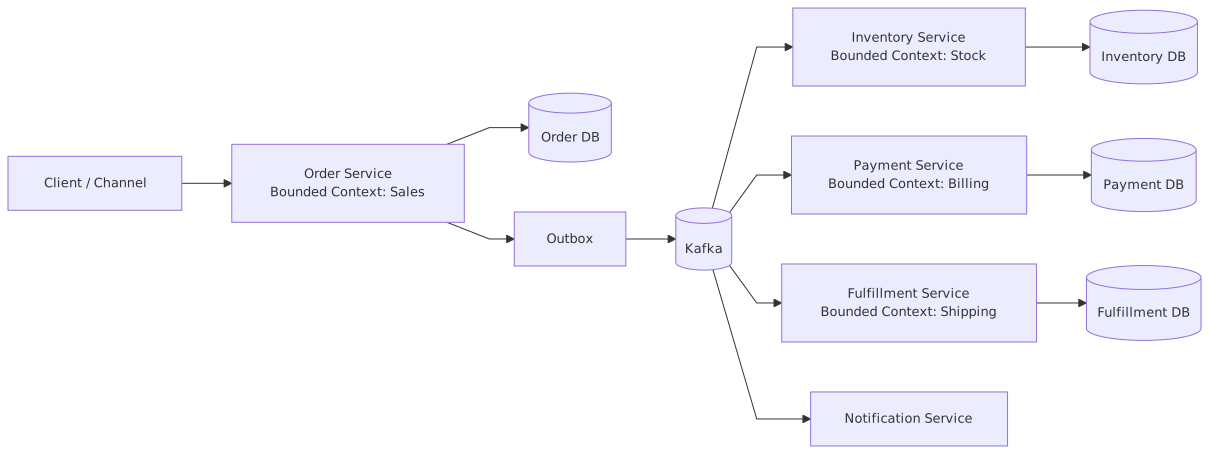
Notice what is not happening. The order service is not synchronously calling four downstream systems to decide whether an order “really” exists. It decides what it owns. Then it publishes that fact. That is proper autonomy.
But this only works if the domain semantics are honest. An OrderAccepted event must mean the business has truly accepted responsibility for that order, not merely “we got the HTTP request and hope payment works out.”
Commands, events, and state transfer
Many designs collapse these into one stream and then wonder why consumers become brittle.
- Commands ask a known service to do something.
- Events announce that something has happened.
- State transfer / replication distributes data for read models or local processing.
Kafka can support all three, but they are not the same thing. Async boundary placement depends on preserving that distinction. If Order publishes ReserveInventory, that is really a command and implies directed responsibility. If it publishes OrderAccepted, Inventory may choose to reserve stock as its own reaction. Those are different coupling models.
Domain semantics before topic design
One of the first mistakes in event-driven microservices is designing topics before designing language. Topics named by technical ownership—customer-updates, db-changes, sync-events—usually predict trouble. Better to start from bounded contexts and domain events with stable meaning.
A useful boundary question is:
What fact can leave this context without carrying internal decision logic with it?
If the answer is unclear, the boundary is probably wrong.
Orchestration versus choreography
Choreography is fashionable because it sounds decoupled. In reality, many business processes deserve explicit orchestration, especially when compensations, timeouts, and human interventions matter. You do not earn architectural points by making a payment dispute process “emergent.”
Use choreography when downstream reactions are relatively independent. Use orchestration when the business flow needs explicit coordination and visibility. The async boundary can still exist; orchestration simply makes the policy visible.
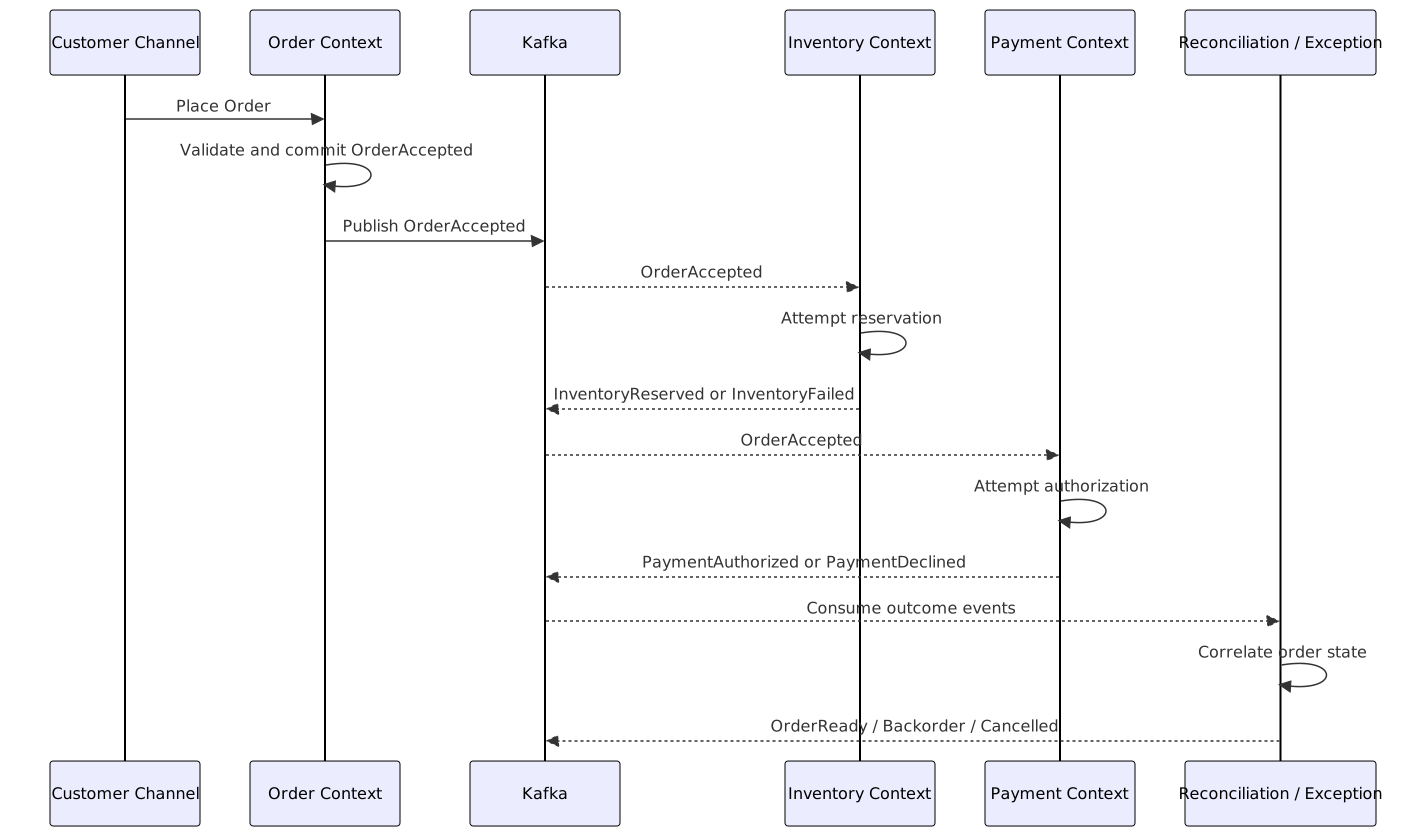
This diagram is where reality enters. Async boundaries are not just publish-and-pray. They require correlation and reconciliation. Somebody must understand the aggregate outcome of related asynchronous steps.
Migration Strategy
No enterprise replaces synchronous end-to-end flows in one move. Nor should it. The safer pattern is a progressive strangler migration, where async boundaries are introduced where they create immediate value without forcing a wholesale rewrite.
A sensible sequence often looks like this:
Step 1: Stabilize the core transaction
First identify the true system of record and the minimum consistency boundary. Keep that part intact. If the monolith today performs order creation, payment check, and inventory validation in one transaction, resist the urge to explode all three at once. Begin by clarifying which business decision must remain atomic.
Step 2: Publish facts from the legacy core
Introduce an outbox or change-data-capture bridge so the legacy transaction can emit reliable domain events. This lets downstream capabilities decouple without destabilizing the core. The event model may initially be thin, but it should still speak business language.
Step 3: Peel off non-critical downstream reactions
Notifications, analytics, fraud enrichment, document generation, customer communications, and some fulfillment steps are often good first candidates. They are valuable, operationally visible, and tolerant of eventual consistency.
Step 4: Move bounded contexts, not endpoints
Teams often strangler-migrate by API route. That is a trap. Move a coherent bounded context when possible. For example, carve out Fulfillment as a context with its own policy and data, fed by order events. Do not merely create a thin service that forwards to the monolith and call it decomposition.
Step 5: Introduce reconciliation before removing sync dependencies
This part is routinely skipped. Before you cut synchronous checks, build the exception workflows, dashboarding, correlation IDs, replay controls, and compensation rules. Otherwise your architecture only works on sunny days.
Step 6: Revisit boundaries after observing production behavior
Async boundaries are hypotheses. Production teaches you where latency hurts, which failures are routine, and where the domain semantics were vague. Mature architecture expects a second pass.
A migration view often looks like this:
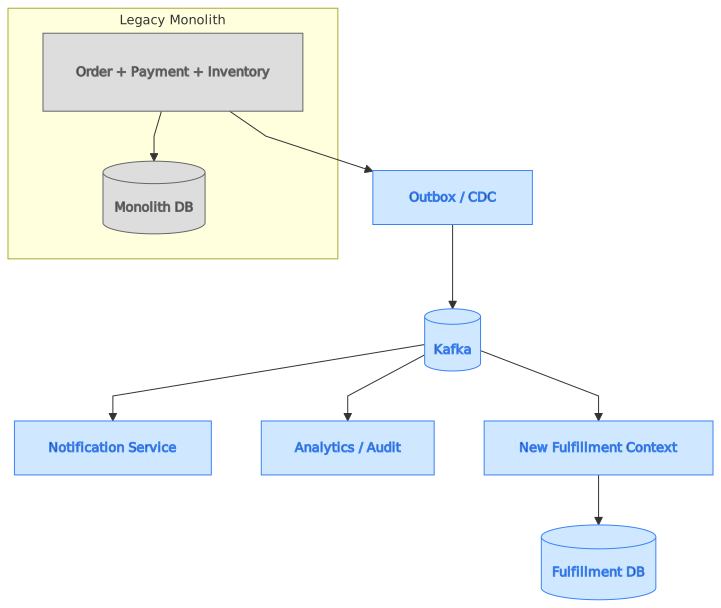
This is strangler done sensibly. The monolith remains authoritative for the core decision while event-driven capabilities grow around it. Over time, once the target contexts have enough domain behavior and operational maturity, the core transaction can itself be re-cut.
Reconciliation in migration
Reconciliation is not a cleanup activity. It is a first-class migration capability.
When you split legacy transactions into asynchronous flows, records will drift:
- orders accepted without stock reservation
- payments authorized but fulfillment blocked
- duplicate events after retries
- stale customer snapshots in downstream systems
You need both online reconciliation and offline reconciliation.
- Online reconciliation correlates events and drives operational states such as
Pending,AwaitingPayment,Backorder,Exception. - Offline reconciliation compares systems of record, identifies drift, and supports controlled repair.
A common enterprise mistake is to assume Kafka replay is the reconciliation strategy. It is not. Replay only reprocesses history. Reconciliation answers whether systems now agree on business truth and what to do when they do not.
Enterprise Example
Consider a global retailer modernizing order processing across e-commerce, stores, and regional warehouses.
The legacy landscape had an order management platform tightly coupled to payment checks and a nightly inventory allocation batch from the ERP. Customer notifications were bolted on through direct database polling. During peak season, every change request became a negotiation between the digital channel team, ERP team, and warehouse IT. They wanted microservices and Kafka.
The first design proposal was predictable: separate Order, Payment, Inventory, Pricing, Promotion, Tax, Fulfillment, Notification, and Customer services, all reacting to events. It looked impressive. It would also have been a disaster.
The real domain analysis showed something more grounded:
- Order acceptance belonged to the Sales context.
- Payment authorization belonged to Billing but had strong influence on sales completion.
- Inventory allocation was not one thing. “Availability promise” during checkout differed from warehouse allocation during fulfillment.
- Shipment planning belonged to Fulfillment and could happen later.
- Customer communication was purely downstream.
That distinction changed the architecture.
Instead of placing an async boundary between every step, they kept checkout promise logic and order acceptance inside a tight consistency boundary in the Sales context. Sales used a near-real-time inventory view, not warehouse allocation itself, to make the customer promise. Once the order was accepted, Sales published OrderAccepted to Kafka. Billing, Fulfillment, Fraud, and Notification consumed that event independently.
Fulfillment later emitted AllocationConfirmed, Backordered, or SplitShipmentPlanned. Billing emitted PaymentAuthorized or PaymentDeclined. A reconciliation service correlated these outcomes and updated an order status projection consumed by customer service and digital channels.
This avoided the worst trap: trying to make the user-facing promise depend on a fully asynchronous chain that crossed ERP, payment gateway, and warehouse systems. The promise was made by one context using the information it owned. The slower realities of fulfillment were handled downstream.
Operationally, the retailer gained:
- resilience during peak traffic because downstream processing buffered in Kafka
- team autonomy for notification and fulfillment enhancements
- better observability through correlated event flows
- controlled exception handling for inventory and payment divergence
But they also paid a price:
- more explicit lifecycle states
- investment in idempotency and replay safety
- a dedicated reconciliation capability
- harder testing of cross-context scenarios
That is the trade. Real architecture is not magic. It is choosing where to concentrate complexity so the business can live with it.
Operational Considerations
Asynchronous boundaries move complexity from call stacks into operations. You must design for that on purpose.
Idempotency
Every consumer must tolerate duplicates. Not “ideally.” Necessarily. Kafka delivery, retries, replay, and consumer restarts make duplicates routine. Use business keys, processed-message tracking, or naturally idempotent state transitions.
Ordering
Ordering is often overestimated globally and underestimated locally. You rarely need total order across the enterprise. You often need per-aggregate ordering, such as events for one order ID. Partition and key topics accordingly. If consumers quietly assume stronger guarantees than Kafka actually gives, failure will eventually educate them.
Schema evolution
Published events are contracts. Version them carefully. Prefer additive changes. Avoid leaking internal models. If every internal refactor becomes a breaking event change, the architecture is not decoupled; it is merely asynchronous.
Dead-letter queues and poison messages
DLQs are useful, but they can become graveyards where unresolved domain problems go to die. A message failing repeatedly may indicate a semantic mismatch, missing reference data, or a true business exception. Someone must own triage and repair.
Observability
Tracing across async boundaries requires correlation IDs, event lineage, timestamp discipline, and domain-level dashboards. Technical telemetry is not enough. Operations need to see business flow states: orders pending payment, payments authorized awaiting allocation, stale exceptions older than SLA.
Backpressure and lag
One of Kafka’s gifts is absorbing load. One of its dangers is normalizing lag until the business notices. If inventory updates are six hours behind, the system is not resilient; it is misleading. Monitor lag in business terms, not just partition offsets.
Replay controls
Replay is powerful but dangerous. Replaying from the beginning can retrigger side effects unless consumers separate pure state rebuild from external actions. Payment capture, customer email, and partner calls need guardrails. Not everything should happen again just because history is replayed.
Tradeoffs
There is no universal “right” async boundary. There are only good tradeoffs for a given domain.
Benefits
- Better decoupling across bounded contexts
- Independent scaling and failure isolation
- Natural support for event-driven integration
- Improved audit trail and temporal visibility
- Easier progressive strangler migration
Costs
- Eventual consistency
- More states and exception paths
- Harder debugging across services
- Operational overhead for replay, lag, and dead letters
- Greater need for domain clarity and ownership discipline
One memorable rule of thumb: async buys freedom by spending certainty.
That can be absolutely worth it. But only where the business can afford the certainty you are giving away.
Failure Modes
Architectures fail in patterns. Async boundary placement has some especially common ones.
1. Event-driven distributed monolith
Services are nominally separate, but every business flow requires a tightly ordered sequence of reactions across many services. Any change ripples through topics, schemas, and timing assumptions. You have not decoupled; you have hidden coupling in time.
2. Boundary at the wrong semantic level
Teams emit low-level technical events like CustomerRowChanged and expect downstream domains to infer business meaning. This creates semantic leakage, brittle consumers, and accidental data coupling.
3. No owner for reconciliation
When outcomes diverge, nobody owns the aggregate truth. Operations are left comparing databases and asking which system is correct. This is not a tooling problem. It is a responsibility problem.
4. Synchronous checks creep back in
A service publishes events but also adds synchronous callbacks to “make sure” downstream state is ready. Before long, the request path is full of hidden dependencies and timeouts, while the event stream still exists. You now have both complexities.
5. Compensation theater
People invoke sagas and compensation as if every action can be neatly undone. Many business actions cannot be reversed cleanly: emails sent, shipments dispatched, partner notifications delivered, legal documents issued. Compensation must be grounded in business reality, not pattern vocabulary.
6. Kafka as shared database
Consumers subscribe to raw state events and build critical logic on fields the producer never intended as public contract. Topic ownership erodes. Evolution stops. Kafka becomes the new integration spaghetti, just with better retention.
When Not To Use
Asynchronous boundaries are not a badge of maturity. Sometimes the best architecture is a simpler one.
Do not use async boundaries when:
- A strict business invariant requires immediate atomic agreement.
- The user cannot tolerate ambiguous completion.
- The flow volume is low and the operational overhead is unjustified.
- The organization lacks the operational discipline for event contracts, idempotency, and reconciliation.
- The domain model is still unstable and teams have not agreed on language or ownership.
- The proposed event boundary exists only to satisfy a technology mandate.
If your system has three teams, moderate traffic, and a coherent domain model that fits in a well-structured modular monolith, use that. A modular monolith with clear bounded contexts often beats immature microservices by a wide margin. You can still introduce events internally or at the edges later.
Architecture should solve the business’ hardest coordination problems, not create new ones in the name of style.
Related Patterns
Async boundary placement sits alongside several patterns that matter in practice:
- Bounded Context: the primary guide for deciding where autonomy and language differ.
- Outbox Pattern: ensures state change and event publication happen reliably.
- Saga / Process Manager: coordinates long-running multi-step flows when explicit policy is needed.
- CQRS: supports separate read models for user queries and operational status.
- Event Sourcing: useful in some domains, but not required for event-driven integration.
- Strangler Fig Pattern: essential for incremental migration from legacy systems.
- Anti-Corruption Layer: protects new bounded contexts from legacy semantics.
- Materialized View: supports fast, eventually consistent read models for cross-context visibility.
These patterns are complementary, not compulsory. If you find yourself deploying all of them at once just to submit a simple order, you may be compensating for poor boundaries with architecture vocabulary.
Summary
Async boundary placement in microservices is one of those decisions that looks technical until production arrives. Then it reveals itself as what it always was: a domain decision about responsibility, timing, and truth.
Place asynchronous boundaries where a bounded context can publish a meaningful business fact, where downstream contexts can react independently, where temporary inconsistency is acceptable, and where reconciliation is designed in from the start. Keep immediate invariants inside a stronger consistency boundary. Use Kafka as a transport for domain events and integration, not as a substitute for domain thinking.
Migrate progressively. Strangle around the edges first. Publish facts from the legacy core. Build reconciliation before cutting critical synchronous ties. Expect to revise boundaries after observing real behavior.
And remember the memorable line because it is the one that saves the most projects:
A good async boundary is not where systems stop talking. It is where the business can safely wait.
That is the diagram worth drawing. That is also the architecture worth running.
Frequently Asked Questions
What is a service mesh?
A service mesh is an infrastructure layer managing service-to-service communication. It provides mutual TLS, load balancing, circuit breaking, retries, and observability without each service implementing these capabilities. Istio and Linkerd are common implementations.
How do you document microservices architecture for governance?
Use ArchiMate Application Cooperation diagrams for the service landscape, UML Component diagrams for internal structure, UML Sequence diagrams for key flows, and UML Deployment diagrams for Kubernetes topology. All views can coexist in Sparx EA with full traceability.
What is the difference between choreography and orchestration in microservices?
Choreography has services react to events independently — no central coordinator. Orchestration uses a central workflow engine that calls services in sequence. Choreography scales better but is harder to debug; orchestration is easier to reason about but creates a central coupling point.