⏱ 20 min read
Most API routing discussions start in the wrong place. They start with gateways, load balancers, path rules, and YAML. That is like explaining a city by describing its traffic lights. Useful, yes. But it misses the point.
Policy routing in microservices is not really about moving HTTP requests from one box to another. It is about making business intent executable at the edge and throughout the call path. It is about deciding, with discipline, which requests should go where, under what conditions, with what consequences, and who gets to change those rules. The routing layer becomes a quiet governor of the system’s behavior. If you get it right, your architecture gains resilience, flexibility, and a cleaner separation of concerns. If you get it wrong, you have built a maze with a dashboard.
And enterprises do get it wrong. They put every decision in the API gateway until the gateway becomes a second application. Or they spread routing logic across services, sidecars, event consumers, and mobile apps until nobody can answer a basic question: why did this customer request go to that implementation?
That is the real subject here: policy routing for APIs in a microservices estate, with domain-driven thinking, migration strategy, operational reality, and the ugly tradeoffs that appear the moment this hits production. microservices architecture diagrams
Context
Microservices gave us independent deployability, bounded contexts, and the freedom to align software with business domains. They also gave us a new class of distributed decisions. In a monolith, the call path was often implicit. A method call happened because code said so. In a microservices environment, the path itself becomes architectural.
An API request may need to be routed differently based on:
- customer segment
- product line
- geography
- tenant
- compliance regime
- experiment cohort
- API version
- migration state
- service health
- feature eligibility
- channel, such as web, mobile, partner, or internal systems
At first, teams encode these decisions as ordinary routing rules: /v2/payments goes here, /legacy/claims goes there. That works until the business starts asking for more nuanced behavior.
A bank wants premium customers to use a new underwriting service, but only in two regions. An insurer wants policy renewal requests for broker channels to remain on a legacy platform while direct digital channels move to a new quote engine. A retailer wants orders from marketplace partners to pass through a fraud scoring service that direct web orders do not require. A global enterprise wants to support sovereign cloud routing for regulated tenants while preserving a unified API contract.
These are not just technical routing rules. They are policy decisions wrapped in transport mechanics.
That distinction matters because once routing carries business semantics, it enters the domain conversation. The routing layer is no longer a neutral piece of plumbing. It becomes part of how the enterprise enforces capability boundaries, migration sequencing, and risk controls.
Problem
The core problem is simple to state and hard to solve well:
How do you route API requests in a microservices architecture according to business and operational policy, without turning the routing layer into a brittle, opaque control tower?
Most organizations face one or more of these conditions:
- Multiple implementations of the same capability exist at once.
Legacy and modern services coexist during migration. Sometimes there are even two new implementations: one optimized for a region, another for premium customers.
- The same API contract must serve different execution paths.
Consumers want one stable interface. The enterprise needs different internal behavior.
- Routing decisions depend on domain meaning, not just protocol metadata.
“Gold customer in regulated market” is a business fact. It may require domain data lookup, not just URL matching.
- Asynchronous and synchronous paths must agree.
You route an API request to one service, but Kafka events later trigger processing in another path. Without reconciliation, the system fragments. event-driven architecture patterns
- Policy changes more often than code.
Pricing experiments, migration waves, compliance changes, and feature rollouts happen on business timelines. Hardcoded routing becomes an anchor.
- Observability is weak.
Production incidents turn into archaeology. Teams cannot explain the policy that led to a route, only the endpoint that received traffic.
This is where many systems drift into accidental complexity. They start with an API gateway, then add a service mesh, then add feature flags, then a rules engine, then event filtering, then custom middleware. The result is not architecture. It is sediment.
Forces
Policy routing sits at the intersection of several forces. Ignore any one of them and the design weakens.
Stable external contracts vs internal evolution
Consumers want stable APIs. Enterprises need to evolve implementations. Routing is often the seam between the two.
Domain semantics vs infrastructure simplicity
The more routing depends on business meaning, the less it fits neatly into plain edge infrastructure. But moving all policy into domain services can produce duplication and inconsistency.
Central governance vs team autonomy
Platform teams want consistency and control. Domain teams want local ownership. Routing policy touches both, which makes governance political as much as technical. EA governance checklist
Low latency vs rich decision-making
Simple path-based routing is fast. Policy-based routing may require tenant resolution, entitlement lookup, market rules, or fraud posture. Every lookup adds latency and fragility.
Deterministic execution vs progressive delivery
Enterprises want predictable behavior. Product teams want canary releases, A/B testing, and phased migrations. The routing model must support both without turning every request into a roulette wheel.
Synchronous APIs vs event-driven consistency
A request-response path may be routed one way, but the downstream state changes often happen via Kafka or other event streams. If the event side does not share the same policy model, consistency degrades.
Compliance vs operational flexibility
Regulatory boundaries, data residency, and audit requirements demand explicit control over where requests go and why. Policy routing can satisfy that need, but only if decisioning is traceable and enforceable.
Solution
The right answer is to treat policy routing as a first-class architectural capability, not a pile of proxy rules.
That means three things.
1. Separate routing mechanics from routing policy
Mechanics are the means: gateway rules, service mesh, reverse proxy, sidecar, Kafka consumer group selection.
Policy is the reason: customer tier, market, migration stage, jurisdiction, product capability, outage posture.
Do not bury policy intent inside mechanical configuration if you can avoid it. Express policy in business terms and compile or translate it into executable routing behavior.
2. Keep policy close to domain semantics, but not inside every domain service
This is the balancing act. Routing policy often depends on domain concepts: tenant type, policy status, account portfolio, order risk class. These concepts belong in bounded contexts. But if every service independently decides routing, behavior diverges.
A better pattern is to establish a policy decision layer that can resolve relevant domain facts and produce a routing decision. Think of it as an architectural service, not a business capability. It should understand domain language without becoming a replacement for domain models.
3. Design for coexistence, especially during migration
In real enterprises, policy routing is often most valuable when old and new implementations must run side by side. The architecture should assume coexistence, selective diversion, and eventual strangling of legacy paths.
A useful mental model is this:
- API contract defines what consumers ask for.
- Policy decision determines how the enterprise wants to handle it.
- Route execution sends the request to the right capability.
- Event reconciliation ensures state remains coherent across sync and async paths.
That sequence is more robust than simple gateway routing because it acknowledges the distributed nature of enterprise systems.
Architecture
A practical architecture for policy routing usually contains five elements:
- API Gateway or Edge Router
Terminates client traffic, authenticates, enriches context, and invokes policy decisioning.
- Policy Decision Service
Evaluates routing policy using request metadata, identity, tenant, product, market, migration state, and health signals.
- Capability Router or Orchestration Layer
Executes the decision by forwarding to the appropriate service or workflow.
- Domain Services and Legacy Adapters
The actual implementation targets. During migration, both modern microservices and legacy systems may sit behind the same logical route.
- Event Backbone and Reconciliation Services
Kafka or equivalent event infrastructure propagates state changes, supports compensations, and aligns asynchronous processing with synchronous routing outcomes.
Here is a baseline view.
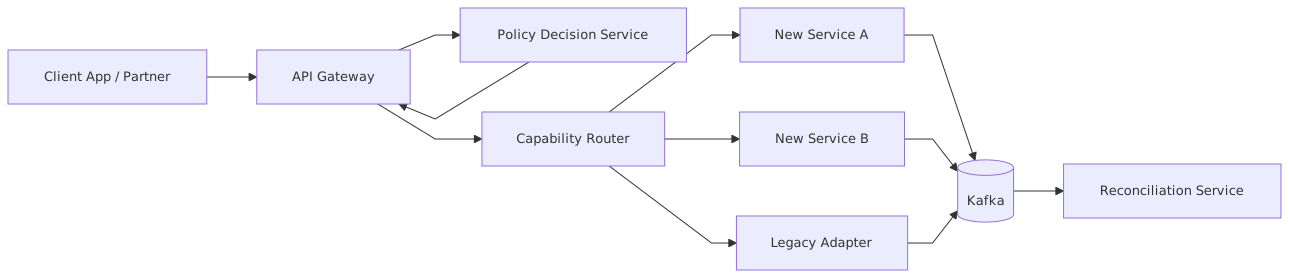
This diagram is intentionally plain. The elegance is not in the boxes. It is in what is allowed to happen where.
Where domain-driven design fits
Domain-driven design is critical here because policy routing should not be organized around technical endpoints alone. It should reflect bounded contexts and capability ownership.
Suppose an insurance enterprise has these domains:
- Customer
- Policy Administration
- Underwriting
- Billing
- Claims
- Compliance
A renewal API might look simple to the consumer. But routing it may depend on bounded context knowledge:
- Customer context tells you segment and channel eligibility.
- Policy context tells you policy type and lifecycle state.
- Compliance context tells you jurisdiction constraints.
- Migration context tells you whether this product line is already on the new platform.
That is domain semantics driving architecture. If you ignore those semantics, the gateway becomes full of half-understood rules like if broker && CA && commercial then route cluster-7. That is not policy. That is folklore encoded in JSON.
A better approach is to define policy using domain language:
- Route commercial renewals in California through regulated policy engine.
- Route direct consumer auto renewals to the new renewal service when product migration phase is “wave-3”.
- Route broker-assisted amendments to legacy until reconciliation accuracy exceeds threshold.
These statements have meaning. They can be reviewed by architects, domain leads, and even risk teams. That is the sign of a healthy architecture.
Decisioning styles
There are several styles for policy decisioning.
Declarative rules
Good for explicit business and migration policy. Easy to audit. Risk: rule sprawl.
Feature flag based routing
Good for rollout control and experiments. Risk: not expressive enough for domain-rich conditions.
Code-based policy service
Good when routing depends on nontrivial domain resolution and dynamic conditions. Risk: policy changes now require deployment.
Hybrid approach
Usually best in enterprises. Keep stable structural logic in code, expose controlled declarative policies for business and migration variation.
Request enrichment
The policy layer often needs more context than the request contains. You may enrich with:
- authenticated user claims
- tenant profile
- customer tier
- market and regulatory zone
- migration phase
- service health and degradation posture
This enrichment should be bounded. If every request requires five backend lookups before routing, latency and failure rates will become your teacher.
A good rule: enrich with slow-changing, cacheable facts at the edge; defer volatile business decisions to domain workflows.
Policy routing and Kafka
The moment synchronous APIs touch asynchronous workflows, things get interesting.
A request routed to a new service may emit events consumed by old downstream processors. Or a legacy route may still publish events that the new reporting platform expects. If policy routing only exists on the API path, your architecture forks into two truths.
Kafka is often the bridge here, but only if you treat event routing and API routing as part of the same operating model.
For example:
- API request for order creation is routed to new Order Service for premium tenants.
- Order Service emits
OrderCreated. - Legacy fulfillment still processes standard tenants only.
- New fulfillment processes premium tenants.
If the event consumers do not apply equivalent policy semantics, the order may be acknowledged by one path and fulfilled by another. That is not innovation. That is a lawsuit waiting for a season.
A sound design shares policy context through event metadata or derives it deterministically from domain data. It also uses reconciliation to catch divergence.
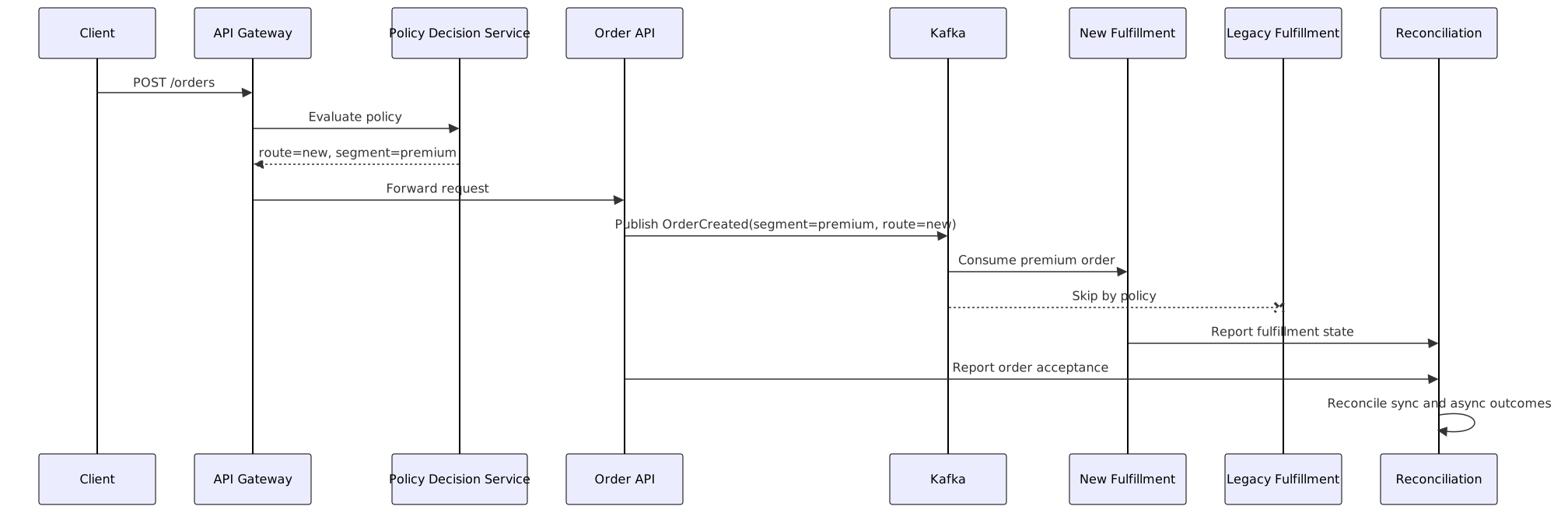
The crucial point is that policy is not just a front-door concern. It is part of the transaction narrative across a distributed system.
Migration Strategy
This is where policy routing earns its keep.
Microservice migrations in enterprises are rarely clean rewrites. They are negotiated retreats from old systems. Some products move first. Some geographies cannot move yet. Some channels need special handling. Progressive strangler migration works because it accepts this mess and gives it structure.
Policy routing is the steering wheel for that journey.
Progressive strangler approach
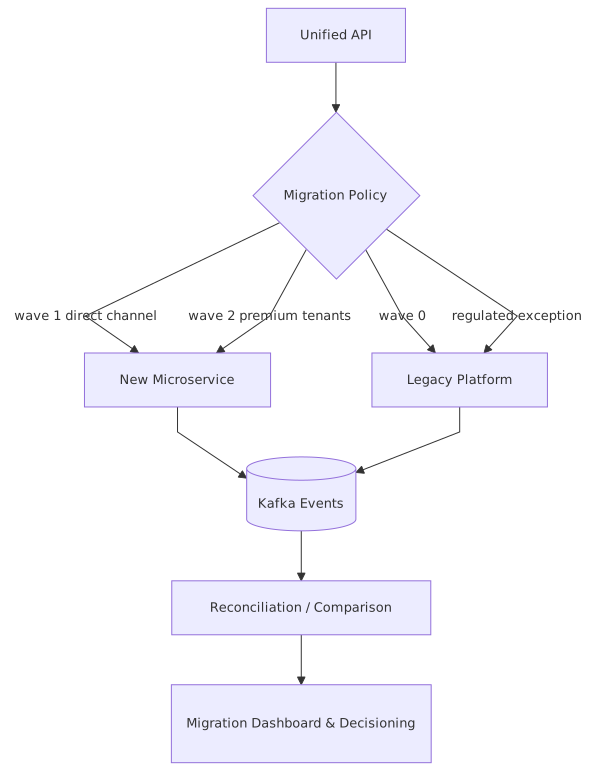
Start with a stable external API contract. Behind it, route traffic based on explicit migration policy.
A common progression looks like this:
- Facade over legacy
Unified API fronting the old system. No behavioral change yet.
- Selective diversion by low-risk segment
Route one product, channel, or tenant group to the new service.
- Dual run with reconciliation
New system handles live traffic, legacy may still shadow or receive mirrored events for comparison.
- Expand policy cohorts
Broaden the population as confidence grows.
- Retire legacy path
Remove the policy branch only when operational and data confidence justify it.
The trap is trying to route too finely too early. Enterprises love control, and policy routing can tempt architects into creating a thousand cohorts. Resist that urge. Use the smallest number of meaningful migration slices.
Here is a migration view.
Reconciliation is not optional
During migration, reconciliation is the difference between confidence and theater.
If the new route and old route can produce different answers, you need a way to detect, classify, and act on discrepancies. Reconciliation can happen at several levels:
- response parity during shadow traffic
- event parity for downstream processing
- state parity in operational stores
- financial or contractual parity in business outcomes
In banking, insurance, telecom, and healthcare, migration without reconciliation is often reckless. Systems that calculate money, coverage, entitlements, or compliance obligations deserve more than blind cutover optimism.
Reconciliation should answer:
- Did the new path produce the same business outcome?
- If not, is the difference expected, tolerable, or a defect?
- Which policy cohort is safe to expand?
- Can we roll back this segment without data corruption?
Data migration and route ownership
Policy routing does not eliminate data migration complexity. It simply lets you sequence it.
A new service should only receive traffic when it owns or can reliably resolve the data needed to execute. Sometimes ownership is by tenant. Sometimes by product line. Sometimes by lifecycle stage. Align routing cohorts with data ownership boundaries where possible. This is classic domain-driven design discipline.
If you route requests into a service that still depends heavily on legacy data side effects, you are not strangling the monolith. You are putting lipstick on a distributed dependency.
Enterprise Example
Consider a multinational insurer modernizing policy servicing across auto, home, and commercial products.
The legacy platform manages all policy amendments and renewals. It is stable but rigid. The enterprise wants new microservices for customer-facing digital channels, but broker-assisted workflows and certain regulated markets must remain on the legacy core for now.
Domains
- Customer Domain
- Policy Domain
- Product Domain
- Channel Domain
- Compliance Domain
- Billing Domain
Business requirement
Expose a single Policy Service API for all channels. Route requests according to customer, product, geography, channel, and migration phase.
Policy examples
- Direct digital auto policy renewal in UK goes to
Renewal Service. - Broker-assisted commercial policy amendment in Germany stays on legacy.
- Home insurance endorsements for premium customers in US are handled by
Servicing Serviceexcept for flood coverage riders, which remain legacy. - If the new servicing platform is degraded, route low-priority endorsement traffic back to legacy but keep regulated audit trail.
Implementation shape
The insurer uses an API gateway for authentication and coarse request handling. A policy decision service evaluates route policy using JWT claims, tenant and channel metadata, product classification, and migration registry. The gateway forwards to either:
- new policy servicing microservices
- a legacy adapter façade over the policy administration platform
All state changes emit Kafka events. A reconciliation service compares:
- policy state changes
- premium recalculation outputs
- document generation outcomes
- billing adjustments
This is the key lesson from the enterprise example: routing policy was governed as part of the business modernization program, not as gateway plumbing. Product owners, compliance officers, and architects all reviewed the routing cohorts. That is exactly right. Routing here determines customer experience, legal behavior, and migration risk.
The team also learned two hard lessons.
First, they initially put too much logic into the gateway. Product-specific endorsements, rider exceptions, and billing subtleties made the config unreadable. They moved policy evaluation into a dedicated service with a clear domain vocabulary and versioned policy definitions.
Second, they underestimated event-side divergence. The API route moved home insurance endorsements to the new platform, but downstream document generation still consumed legacy-oriented events. Documents were inconsistent for a subset of riders. Reconciliation exposed the issue before broad rollout. Without that layer, the migration would have produced customer-visible defects that were hard to trace.
Operational Considerations
Policy routing becomes an operational system whether you admit it or not. Treat it accordingly.
Observability
Every routing decision should be explainable. Log or trace:
- request identifier
- policy version
- evaluated attributes
- selected route
- fallback reason
- downstream target
- reconciliation correlation id
In production, “why did this request go there?” must be answerable in minutes, not after a week of Slack archaeology.
Auditability
If routing affects regulated behavior, it must be auditable. This is especially true for finance, healthcare, and public sector systems. Decision logs need retention, immutability expectations, and a clear relation to policy versions.
Performance
Policy evaluation must be cheap enough to sit in the request path. Cache slow-changing facts. Avoid deep dependency chains. If policy lookup becomes a mini-orchestration, your p99 latency will tell the story before the postmortem does.
Resilience
Have a degradation strategy:
- fail closed for high-risk or regulated operations
- fail open only where business accepts fallback
- support default route behavior for policy service outages
- preserve route reason in traces, especially during fallback
Governance
Who is allowed to change policy? Platform team? Domain team? Release managers? This needs explicit operating boundaries. Policy routing is too powerful to leave as a free-for-all.
Testing
You need more than API tests. You need:
- policy unit tests
- route contract tests
- cohort simulation tests
- shadow traffic analysis
- reconciliation threshold monitoring
- failover behavior tests
Tradeoffs
Policy routing is useful, but it is not free.
Benefits
- stable API surface during internal change
- controlled migration and strangler sequencing
- fine-grained rollout by business cohort
- better resilience and selective fallback
- support for regulatory and tenant-aware routing
- explicit architectural control over coexistence
Costs
- more moving parts in the request path
- decision latency
- governance overhead
- risk of centralizing too much logic
- duplicated semantics if event-driven paths diverge
- difficult debugging if observability is poor
The biggest tradeoff is this: policy routing buys flexibility by introducing another decision layer. If that layer is well-designed, it becomes leverage. If it is vague or overgrown, it becomes bureaucracy in software form.
Failure Modes
This pattern has very predictable ways to fail.
The gateway becomes a god object
Every business exception gets added at the edge. Soon the gateway knows product details, compliance nuances, migration quirks, and customer segmentation logic. At that point you have rebuilt a monolith in policy configuration.
Policy drift between sync and async paths
The API says one thing, Kafka consumers do another. Eventually reconciliation reveals inconsistent state, customer confusion, or financial mismatch.
Hidden domain coupling
Routing depends on domain data from too many contexts. A simple request now fans out to customer, product, entitlement, and compliance lookups before it can move. Latency and cascading failure follow.
Cohort explosion
Every team wants a special case. Routing policy becomes a patchwork of segments nobody can reason about. Migration slows because no one trusts the cohorts.
Rollback without data strategy
Traffic is routed to a new service, which mutates data in ways legacy cannot safely consume. Rollback becomes logically impossible even if routing can be switched back.
Missing reconciliation
The enterprise assumes route correctness because requests succeed. Meanwhile downstream outcomes diverge quietly. This is perhaps the most common migration failure in event-heavy systems.
When Not To Use
Do not use policy routing just because you have an API gateway and a taste for architecture diagrams.
It is a bad fit when:
- routing is simple and static, with no meaningful domain or migration variation
- a clean versioned API is enough
- there is only one implementation of the capability
- the policy conditions would require expensive real-time domain resolution on every request
- the organization lacks discipline to govern policy changes
- teams are trying to use routing to compensate for unclear bounded contexts
And here is the blunt version: if you are using policy routing to hide unresolved domain ownership, stop. Fix the model first. Routing can help manage evolution, but it is not a substitute for proper service boundaries.
Related Patterns
Policy routing sits near several other patterns, but it is not identical to them.
API Gateway
Provides entry-point concerns like authentication, rate limiting, and coarse routing. Policy routing may use the gateway, but should not be reduced to it.
Service Mesh Traffic Shaping
Useful for operational routing, canary, retries, and resilience. Less suitable for rich domain-aware business policy on its own.
Strangler Fig Pattern
Policy routing is one of the best execution tools for a progressive strangler migration because it lets old and new implementations coexist behind one contract.
Backend for Frontend
May influence routing by channel, but BFFs solve consumer-specific composition, not enterprise policy decisioning.
Saga and Process Manager
Relevant when routing leads into long-running workflows. Policy may decide which saga implementation or process path to invoke.
Rules Engine
Can host policy logic, but be careful. A rules engine can bring flexibility or chaos depending on governance and domain clarity. ArchiMate for governance
Event Routing and Content-Based Routing
In Kafka or messaging architectures, similar ideas apply to event consumers. This is where consistency with API-side policy matters most.
Summary
Policy routing for APIs in microservices is not about clever proxies. It is about making business and migration intent executable without poisoning your service boundaries.
The pattern works best when you treat routing policy as a first-class capability:
- expressed in domain language
- separated from transport mechanics
- aligned with bounded contexts
- designed for progressive strangler migration
- backed by Kafka-aware event consistency
- guarded by reconciliation
- observable, auditable, and governable
Used well, policy routing gives an enterprise a controlled way to evolve. It lets one API present a stable face while the organization changes the machinery behind it. That is not glamourous architecture. It is the kind that survives budgets, compliance reviews, platform outages, and three overlapping transformation programs.
Used poorly, it becomes an opaque maze where every exception lives forever.
That is the choice. A routing layer can be a disciplined policy instrument. Or it can be a junk drawer with SSL.
Frequently Asked Questions
What is a service mesh?
A service mesh is an infrastructure layer managing service-to-service communication. It provides mutual TLS, load balancing, circuit breaking, retries, and observability without each service implementing these capabilities. Istio and Linkerd are common implementations.
How do you document microservices architecture for governance?
Use ArchiMate Application Cooperation diagrams for the service landscape, UML Component diagrams for internal structure, UML Sequence diagrams for key flows, and UML Deployment diagrams for Kubernetes topology. All views can coexist in Sparx EA with full traceability.
What is the difference between choreography and orchestration in microservices?
Choreography has services react to events independently — no central coordinator. Orchestration uses a central workflow engine that calls services in sequence. Choreography scales better but is harder to debug; orchestration is easier to reason about but creates a central coupling point.