⏱ 21 min read
Integration architecture usually starts with optimism and ends with archaeology.
At the beginning, every team says roughly the same thing: we just need a few APIs between systems. A billing platform needs customer data. A fulfillment service needs order state. A CRM needs shipping status. Someone draws a couple of arrows, maybe provisions an API gateway, and the whole thing feels refreshingly modern. Then the enterprise happens. Systems evolve at different speeds. Teams rename concepts. One platform thinks a “customer” is a legal entity, another thinks it is a household, a third thinks it is whoever owns the current subscription. Workflows sprawl across synchronous calls, Kafka topics, file drops, and nightly reconciliation jobs. Before long, the arrows aren’t arrows anymore. They’re fault lines.
This is where the API mediation layer earns its keep.
A mediation layer is not just plumbing. It is not a glorified proxy. And it is certainly not a place to hide bad domain design. Done well, it becomes a deliberate architectural boundary that absorbs protocol mismatch, semantic drift, version churn, and integration policy without contaminating every consuming service. Done badly, it becomes the enterprise’s new monolith wearing an API-shaped hat.
That distinction matters.
In most large organizations, integration problems are not caused by transport protocols. HTTP versus messaging is rarely the hard part. The hard part is that domains do not line up cleanly across systems built by different teams, at different times, for different purposes. The mediation layer sits in that uncomfortable middle ground between domains. It translates, orchestrates, shields, validates, enriches, and sometimes reconciles. It exists because reality is messier than the diagrams we like to present to steering committees.
This article looks at API mediation layers as a serious integration pattern: where they fit, why enterprises adopt them, what they cost, how they fail, and how to migrate toward them without creating another centralized bottleneck. We’ll cover domain semantics, progressive strangler migration, reconciliation, Kafka and microservices, and the tradeoffs that experienced architects learn to respect. event-driven architecture patterns
Context
An enterprise integration landscape is rarely greenfield. It is a layered sediment of decisions: packaged applications, custom platforms, SaaS products, departmental databases, event brokers, batch integrations, and a long tail of “temporary” adapters that survived five budget cycles.
In that landscape, APIs become the common language, but not a common understanding.
One system exposes REST endpoints around policies. Another emits Kafka events around accounts. A third still produces XML over MQ. A fourth is a SaaS platform with rate limits and an object model that reflects the vendor’s worldview, not yours. Teams building customer journeys or operational workflows are forced to stitch these together. If they integrate directly with every source system, they inherit every inconsistency, every release cadence, every authentication scheme, every model quirk.
That is the breeding ground for mediation.
The mediation layer is an architectural component, or sometimes a set of components, that sits between consumers and provider systems. Its job is to make interactions stable enough for the enterprise to move faster than its slowest core platform. It can expose a canonical or consumer-aligned API, invoke multiple downstream services, map between domain concepts, apply policies, transform payloads, coordinate synchronous and asynchronous interactions, and support reconciliation when systems disagree.
There are several forms this can take:
- an API composition layer
- a service facade over legacy systems
- an anti-corruption layer in Domain-Driven Design terms
- a mediation service that bridges APIs and events
- a BFF-style edge mediator for channels
- an integration domain service that owns cross-system workflows
The label matters less than the intent. The intent is to stop consumers from becoming amateur archaeologists of downstream systems.
Problem
Without mediation, direct integration scales linearly in all the wrong dimensions.
Every consumer must know which system is authoritative for which data. Every team reimplements transformations. Every mobile app and microservice learns the strange rituals of legacy APIs. Error handling becomes tribal knowledge. Semantic mismatches leak outward. If one provider changes a field, deprecates an endpoint, or redefines state transitions, dozens of consumers scramble. microservices architecture diagrams
Worse, direct integration usually pushes domain confusion to the edge. A downstream ERP may expose Account, a CRM may expose Customer, a subscription platform may expose Subscriber, and the digital channel team glues them together under “user profile.” The result looks integrated until a real business event arrives: a customer merges accounts, changes legal name, disputes an invoice, or gets partially shipped across multiple warehouses. Then the seams show.
A mediation layer addresses several recurring problems:
- Provider volatility
Core systems change more often than enterprises admit. Mediation localizes that change.
- Protocol mismatch
Consumers want HTTP/JSON; providers may speak SOAP, MQ, gRPC, files, or Kafka.
- Semantic mismatch
The same word means different things. Different words mean the same thing. This is the real problem.
- Cross-system orchestration
A business interaction often requires calls to multiple services and event correlation.
- Policy centralization
Security, throttling, audit, redaction, and compliance logic often need a common place to live.
- Migration pressure
Enterprises need to modernize legacy platforms without breaking every consumer during transition.
The pattern becomes attractive when those forces converge. And in large enterprises, they almost always do.
Forces
Architecture is tradeoffs under pressure. Mediation layers emerge because several forces pull in opposite directions.
Stability versus speed
Consumer teams want a stable contract. Provider teams need freedom to evolve. A mediation layer can decouple those release cadences, but every layer of decoupling also introduces indirection, latency, and operational complexity.
Domain purity versus enterprise pragmatism
Domain-Driven Design teaches us to protect bounded contexts and avoid forcing one model to dominate everywhere. Good. That’s a useful instinct. But enterprises still need integrated experiences. Mediation often becomes the place where context boundaries meet. The danger is turning it into a fake universal model that satisfies nobody.
A useful rule: mediation should translate between bounded contexts, not erase them.
Synchronous user needs versus asynchronous enterprise reality
Customers and employees expect immediate answers. But the underlying business may complete over minutes or hours through Kafka events, back-office processing, and external partner interactions. The mediation layer often has to bridge these worlds: immediate acknowledgment now, eventual consistency later.
Reuse versus autonomy
A shared mediation layer promises reuse. Shared things in enterprises always promise reuse. Sometimes they deliver. Often they become a coordination tax. The more central the mediator, the more likely every change needs a committee, a CAB meeting, and a release train.
Canonical model versus fit-for-purpose contracts
The classic integration instinct is to create a canonical enterprise schema. It sounds tidy. It usually becomes overgeneralized and politically negotiated into uselessness. A better pattern is a constrained mediation model: stable where needed, explicit about source semantics, and aligned to specific interaction use cases rather than to dreams of universal truth.
Governance versus bottleneck
Central security, observability, compliance, and traffic management are good reasons to mediate. Central ownership of every mapping and every endpoint is not.
This is why mediation is attractive and dangerous in equal measure.
Solution
The API mediation layer acts as a controlled buffer between consumers and provider systems. It offers fit-for-purpose interfaces while encapsulating provider-specific behavior. Depending on the use case, it may do some or all of the following:
- route requests to the right downstream systems
- compose multiple APIs into a single business-facing interaction
- translate protocols and data formats
- map semantics between bounded contexts
- validate input and enforce policy
- enrich responses with reference or cached data
- publish and consume Kafka events to coordinate eventual consistency
- maintain correlation IDs and audit trails
- trigger reconciliation flows when systems diverge
At a conceptual level, this looks simple:
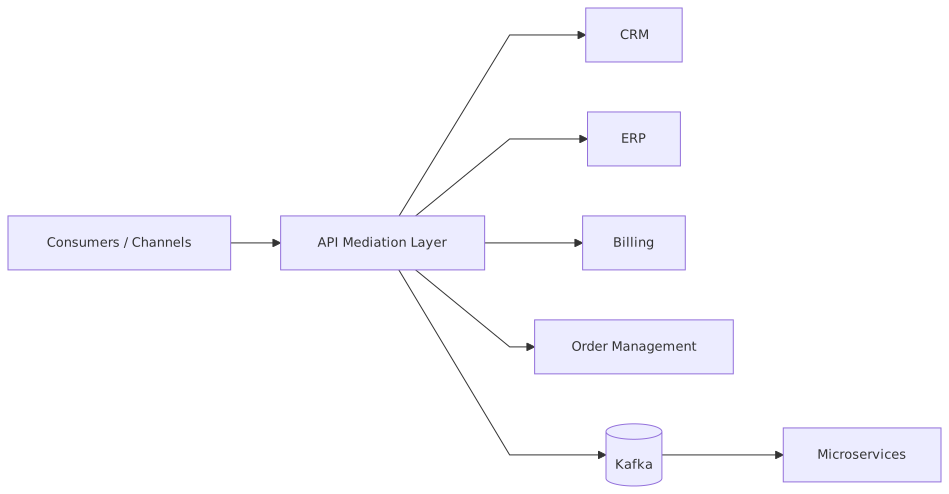
The point of the mediator is not merely to reduce the number of arrows. The point is to concentrate integration knowledge in a deliberate place rather than letting it leak randomly into every consuming application.
But there is an important design choice here: what kind of knowledge belongs in the mediator?
My view is opinionated. Put integration knowledge there. Put semantic translation there when crossing bounded contexts. Put cross-cutting policy there. Be cautious with business decision logic. If the mediator starts owning the core business rules of order pricing, claims adjudication, eligibility, or credit risk, you have stopped mediating and started building a distributed monolith in disguise.
A good mediation layer knows how to ask systems the right questions and assemble coherent answers. It should not become the place where all enterprise behavior goes to die.
Architecture
There are several architectural shapes for API mediation. Most real enterprises use a blend.
1. Facade mediation
This exposes a stable consumer-facing API over one or more volatile provider systems. It is especially useful over legacy platforms or packaged applications.
Example: a Customer Profile API that hides whether profile data comes from CRM, identity platform, marketing cloud, or customer master.
2. Composition mediation
This aggregates data from several downstream APIs into one response tailored to a channel or process. It reduces chatty front ends and centralizes correlation logic.
Example: an order-tracking endpoint that combines order state, shipment status, invoice status, and returns information.
3. Semantic mediation
This is the most subtle and the most valuable. It translates meanings across bounded contexts. In DDD terms, it often behaves like an anti-corruption layer.
Suppose the billing platform treats a customer as a billable account, while the digital platform treats a customer as an authenticated person. A mediation layer can explicitly map between Person, Account, Party, and SubscriptionHolder rather than pretending they are interchangeable.
That explicitness is architecture, not bureaucracy.
4. Event/API bridge
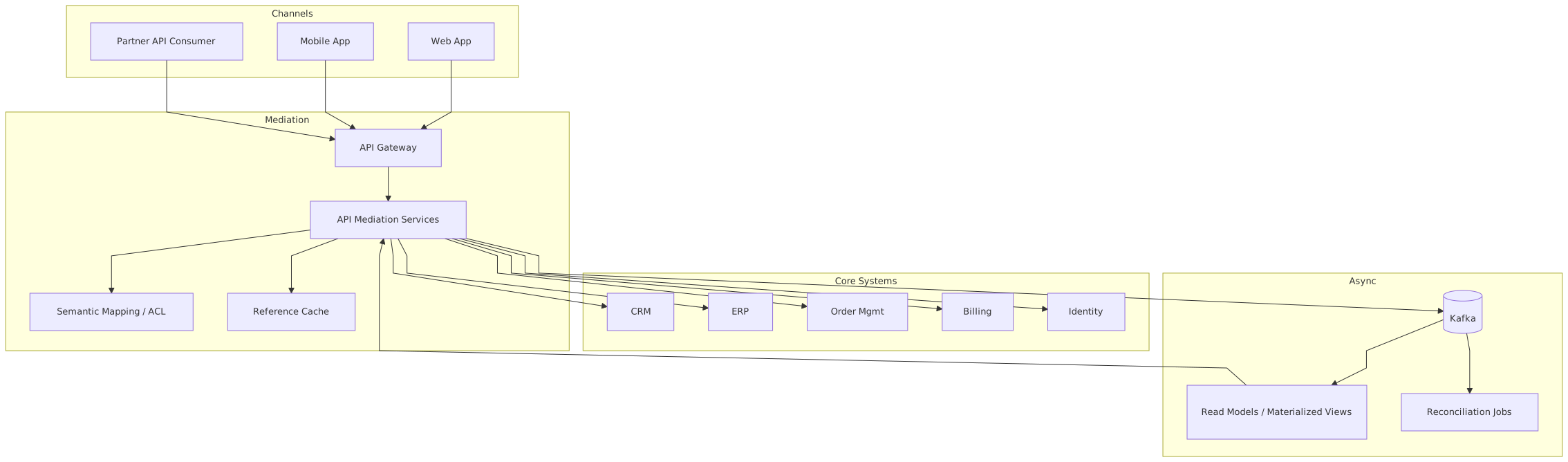
The mediator can receive synchronous requests, invoke downstream APIs, and also publish Kafka events for asynchronous completion. Or it can consume events and expose query APIs based on materialized views.
This is common when users need immediate confirmation but the enterprise process is eventually consistent.
5. Process mediation
Sometimes the layer coordinates a lightweight workflow across services. This is where discipline matters. A little process mediation is often necessary. Too much becomes a hidden orchestration engine.
Here is a more complete architecture view:
Domain semantics: the part many teams skip
If there is one thing enterprises consistently underinvest in, it is semantic clarity.
An API mediation layer should start by naming the bounded contexts involved and defining the translation rules between them. Not in a 200-page ontology document. In executable design decisions. What does “customer” mean in sales, service, billing, and identity? Which system is authoritative for which attributes? What are the lifecycle states? What are the invariants? What is allowed to be stale? What can be overridden manually?
These questions shape the mediator far more than technology choices.
For example:
- Identity context owns authentication credentials and digital profile.
- CRM context owns contact preferences and sales relationships.
- Billing context owns financial responsibility and invoice state.
- Order context owns fulfillment lifecycle and shipment events.
A mediation API for “customer summary” may compose all four, but it should not pretend that one downstream object model naturally represents them all. Explicit translation is healthier than accidental convergence.
Canonical models: useful servant, terrible master
I’m not against canonical models in principle. I’m against pretending they are free.
A narrow canonical model can help stabilize common interactions. A broad canonical model often becomes the enterprise Esperanto of integration: carefully designed, universally ignored, and resented by native speakers.
Prefer task-oriented mediation contracts and explicit source-aligned mappings over enterprise-wide abstractions no team actually recognizes.
Migration Strategy
Enterprises rarely get to introduce mediation in a clean sweep. The usual reality is a thicket of direct integrations, some newly built and some old enough to vote. So migration matters.
The right approach is almost always a progressive strangler migration.
Do not announce a giant “integration transformation program” and attempt to route everything through a new mediation platform by Q4. That way lies slideware, budget burn, and emergency exceptions. Instead, insert mediation at points of highest volatility or highest consumer pain, then expand deliberately.
A typical migration path looks like this:

Step 1: Identify unstable seams
Look for provider systems that cause repeated consumer breakage, require ugly transformations, or have unacceptable channel latency. These are ideal entry points for a facade mediator.
Step 2: Build mediation around use cases, not systems
Don’t start with “we will mediate SAP.” Start with “we will provide a stable order status API for channels” or “we will shield partner consumers from policy admin complexity.” Use cases produce better boundaries.
Step 3: Introduce anti-corruption mappings
As you move consumers behind the mediator, capture semantic differences explicitly. This is where DDD thinking matters. Migration is not only technical rerouting; it is an opportunity to stop spreading legacy concepts into modern services.
Step 4: Add event-driven synchronization where appropriate
Once mediation is stable for synchronous calls, add Kafka-based event publishing and consumption to support eventual consistency, projections, and downstream workflows. This is especially useful for read-heavy APIs and long-running processes.
Step 5: Reconcile, don’t fantasize
During migration, there will be periods where old and new paths both exist. Data will diverge. Events will arrive out of order. Side effects will duplicate. Build reconciliation into the plan from day one.
This means:
- correlation IDs across synchronous and asynchronous flows
- replayable event streams where possible
- idempotent command handling
- comparison jobs between source-of-truth and derived views
- clear operational ownership for discrepancy resolution
A strangler migration without reconciliation is just a polite way of accumulating hidden inconsistency.
Step 6: Retire direct paths aggressively
Every migration leaves “temporary” bypasses. Those bypasses become precedent. Then they become architecture. Sunset direct integrations with real deadlines and dependency tracking.
Enterprise Example
Consider a global retailer modernizing its order and customer interaction landscape.
The company has:
- a legacy ERP for financials and inventory
- a packaged OMS for orders and fulfillment
- a CRM for customer service
- a subscription billing engine for loyalty and premium memberships
- a growing set of microservices for digital commerce
- Kafka used for order events and inventory updates
The digital team wants a single API for “order journey” in web and mobile channels. The naive version of this solution is to let channel services call OMS, ERP, CRM, and billing directly. That works in sprint demos. It fails in production.
Why? Because each system has a different concept of order state.
- OMS says an order is
Allocated,Picked,Packed,Shipped. - ERP says it is
Released,Invoiced,Settled. - CRM uses
Open,Delayed,Resolved. - Billing introduces states around payment authorization and refund holds.
A customer does not care about any of those. They care about a simpler journey: confirmed, preparing, shipped, delivered, delayed, refunded. That is a mediated contract, not a native one.
So the retailer creates an API mediation layer with three responsibilities:
- Order journey API composition
It aggregates order line status, shipment tracking, payment status, and return/refund indicators.
- Semantic translation
It maps multiple internal status models into a channel-facing order journey model, with explicit rules and provenance.
- Event bridge
It consumes Kafka events from OMS and inventory services, updates a materialized read model, and exposes low-latency query APIs for channels.
This improves channel performance and shields consumers from downstream complexity. But the real value shows up during migration. As the retailer replaces parts of the OMS with microservices, the mediation contract stays stable. Consumer teams don’t rewrite every integration. The mediation layer absorbs the swap.
Now the hard bit: reconciliation.
Refunds can be initiated in CRM, settled in ERP, and displayed in digital channels. Event timing is messy. The team introduces nightly and intraday reconciliation jobs that compare refund state across ERP, billing, and the mediation read model. Exceptions go to an operational queue with trace IDs and source snapshots. It’s not glamorous. It’s what makes the architecture trustworthy.
That is real enterprise architecture: not just APIs that look clean, but systems that remain explainable when reality gets dirty.
Operational Considerations
A mediation layer changes your operational model. If you treat it like a stateless pass-through, you will underengineer it.
Observability
Mediators sit on critical paths and touch multiple downstream systems. You need:
- distributed tracing across synchronous calls and Kafka events
- structured logs with business identifiers, not just technical IDs
- downstream dependency timing breakdowns
- semantic error categorization
- dashboards by consumer API and downstream provider
If order lookup is slow, you need to know whether the bottleneck is the mediator, OMS, cache miss behavior, or Kafka projection lag.
Resilience
Mediation layers amplify downstream instability unless carefully designed. Use:
- timeouts tuned per dependency
- circuit breakers where sensible
- bulkheads for noisy consumers or flaky providers
- fallback strategies only when semantically safe
- caching for reference or slow-changing data
- backpressure for event consumers
Do not return stale or partial business data unless the contract explicitly allows it. “Fast but wrong” is not resilience.
Security and compliance
Mediation is often the right place for:
- token translation
- client authentication and authorization
- field-level redaction
- consent enforcement
- audit logging
- rate limiting and abuse control
But be careful not to centralize every security decision if domain services are still responsible for business authorization. The mediator can enforce access policy; it should not guess business entitlements owned elsewhere.
Versioning
A mediation layer can shield consumers from provider version churn, but it also becomes a versioned API product itself. Favor compatibility by addition where possible. Maintain mapping layers that let provider changes remain internal. Avoid leaking provider versions into consumer contracts.
Performance
Composition APIs are vulnerable to the “one slow dependency ruins the whole response” problem. Use precomputed read models where user journeys need fast, stable reads. Kafka-backed materialized views are often a better answer than calling five systems live on every page load.
Reconciliation operations
If your mediator supports eventual consistency, reconciliation is not a side concern. It is part of the operating model. Define:
- discrepancy detection thresholds
- replay procedures
- exception routing
- ownership by domain/support teams
- auditability of manual corrections
Nothing corrodes trust faster than a mediation API that occasionally tells the truth.
Tradeoffs
This pattern is powerful because it localizes pain. It is risky because pain localizes there.
Benefits
- protects consumers from provider churn
- reduces duplicate transformation logic
- clarifies integration semantics
- supports modernization and strangler migration
- centralizes policy and observability
- can improve channel performance with composition and read models
Costs
- adds another hop and another runtime dependency
- can become a bottleneck for change
- may accumulate too much orchestration logic
- introduces mapping maintenance overhead
- requires strong operational discipline
- can hide poor upstream domain design instead of fixing it
The biggest tradeoff is this: mediation buys local simplicity by concentrating global complexity. That can be a good bargain, but only if the mediator stays intentional and bounded.
Failure Modes
Most mediation failures are not caused by the wrong framework. They are caused by overreach, vagueness, or wishful thinking.
1. The enterprise brain anti-pattern
The mediation layer starts as a facade and ends up containing pricing rules, eligibility logic, exception workflows, customer segmentation, and half the company’s integration policy. At that point, every team depends on it, every release is risky, and no bounded context is intact.
If the mediator knows too much, it will eventually own too much.
2. Fake canonical model
A central team creates a universal schema that smooths over every domain distinction. It looks elegant in diagrams and causes endless edge-case mapping in code. Important semantics vanish. Consumers misinterpret data because it appears more uniform than it really is.
3. Hidden distributed transactions
The mediator calls multiple services synchronously and tries to simulate atomic outcomes. It cannot. Partial failure arrives. One side effect commits, another times out, a retry duplicates a command, and support teams spend days untangling the state.
Use sagas, compensations, and explicit eventual consistency where needed. Don’t pretend HTTP chaining is a transaction manager.
4. No reconciliation plan
Teams adopt Kafka and read models, then discover that delayed events, poison messages, replay bugs, and source corrections happen in real life. Without reconciliation, the mediation layer becomes a source of plausible fiction.
5. Central platform bottleneck
A shared mediation team requires tickets for every field addition and every transformation change. Product teams route around it by integrating directly. The architecture fragments again.
6. Semantic drift in slow motion
Mappings are created once and never revisited. Downstream systems evolve. Business meaning changes. The mediator keeps returning technically valid but conceptually stale responses. These are the hardest failures to detect because they don’t always break tests.
When Not To Use
Mediation is not default architecture. It is a pattern for specific conditions.
Do not use a mediation layer when:
- a consumer can interact cleanly with a single well-designed domain API
- there is little semantic mismatch and low provider volatility
- introducing a central layer would slow autonomous teams unnecessarily
- the use case is simple data access and can be handled by direct service ownership
- the “mediation” need is really a symptom that domain boundaries are wrong
- you are using it to postpone needed modernization forever
In a well-factored microservices environment with clear bounded contexts and stable contracts, adding mediation between every consumer and every service is cargo-cult architecture. You don’t need a translator between people already speaking the same language.
Likewise, if the primary problem is internal domain confusion, a mediator may mask the issue rather than solve it. Sometimes the right answer is not another layer. It is clarifying ownership and fixing the model at the source.
Related Patterns
API mediation sits near several adjacent patterns. They are related, but not interchangeable.
API Gateway
The gateway handles edge concerns like routing, auth, rate limiting, and sometimes coarse transformation. It is not usually the place for rich semantic mediation or cross-system composition logic.
Backend for Frontend (BFF)
A BFF tailors APIs to a channel experience. It may use mediation underneath. A BFF is channel-specific; a mediation layer is integration-specific.
Anti-Corruption Layer
This is a DDD pattern for protecting one bounded context from another’s model. Semantic mediation often includes anti-corruption behavior.
Service Mesh
A mesh handles network concerns between services. It does not solve domain semantics, composition, or reconciliation.
ESB
The old enterprise service bus often tried to be all things at once: transport hub, transformation engine, orchestration platform, policy store. Modern API mediation should learn from that history. Use the idea of mediation without recreating the centralized governance trap of the ESB era. EA governance checklist
Event Carried State Transfer / CQRS Read Models
When paired with Kafka, mediation often exposes query APIs backed by projections rather than live fan-out calls. This can dramatically improve latency and resilience for read-heavy scenarios.
Summary
An API mediation layer exists because enterprises are not tidy, and pretending otherwise is expensive.
Used well, it is a disciplined boundary that shields consumers from provider volatility, translates across bounded contexts, bridges synchronous APIs and asynchronous Kafka-driven workflows, and supports modernization through progressive strangler migration. It helps teams move without forcing every application to understand the private dialects of every core system.
But mediation is not free. It centralizes complexity. It can become a bottleneck, a dumping ground for business logic, or a fake canonical truth machine. The pattern works only when the architecture is explicit about domain semantics, honest about eventual consistency, and serious about reconciliation.
That last point deserves emphasis. In real enterprises, systems disagree. Events arrive late. Corrections happen outside the happy path. Reconciliation is not a cleanup activity; it is part of the design.
So my advice is simple. Use mediation where there is genuine mismatch, real volatility, and a clear need to stabilize interactions. Design it around use cases and bounded contexts, not around fantasies of universal models. Keep business ownership in the domains that should own it. Add Kafka and projections when they improve user-facing stability, not because event-driven architecture is fashionable. And migrate progressively, strangling old paths with intent.
A good mediation layer is like a skilled interpreter in a tense negotiation: precise, calm, invisible when things go well, invaluable when they do not.
Frequently Asked Questions
What is API-first design?
API-first means designing the API contract before writing implementation code. The API becomes the source of truth for how services interact, enabling parallel development, better governance, and stable consumer contracts even as implementations evolve.
When should you use gRPC instead of REST?
Use gRPC for internal service-to-service communication where you need high throughput, strict typing, bidirectional streaming, or low latency. Use REST for public APIs, browser clients, or when broad tooling compatibility matters more than performance.
How do you govern APIs at enterprise scale?
Enterprise API governance requires a portal/catalogue, design standards (naming, versioning, error handling), runtime controls (gateway policies, rate limiting, observability), and ownership accountability. Automated linting and compliance checking is essential beyond ~20 APIs.