⏱ 18 min read
Feature rollouts look deceptively simple on whiteboards. Draw a service, add a flag, route a little traffic, watch a dashboard, and declare victory. Then the real system arrives: twenty teams, forty services, Kafka in the middle, mobile clients that live forever, stale caches, duplicated business rules, and three definitions of what “enabled” actually means. The rollout stops being a toggle. It becomes an architectural problem. event-driven architecture patterns
That’s the part many teams miss.
In a monolith, feature release is usually a deployment concern with a bit of product management wrapped around it. In a distributed system, rollout is a domain concern, an operational concern, and a data consistency concern all at once. A feature can be visible in one service, partially honored in another, and completely ignored in a third. A customer sees an option in the UI, an order service accepts it, billing rejects it, and reporting happily records nonsense. The organization says “we did a progressive rollout.” The customer experiences a broken promise.
So the right question is not “how do we add feature flags to microservices?” It is: how do we preserve domain meaning while changing behavior gradually across distributed boundaries?
That is where architecture earns its keep.
Context
Modern enterprises want controlled change. They want canary releases, ring deployments, A/B experiments, regional rollout, tenant-specific enablement, and emergency kill switches. They also want independent teams, event-driven microservices, and bounded contexts with different release cadences. Those goals fit together poorly unless rollout itself is designed as a first-class capability. microservices architecture diagrams
This matters most in organizations that have already crossed the line from “a few services” to “service estate.” At that point, feature rollout is no longer just toggling UI visibility or branching code paths in a single application. It means coordinating behavior across APIs, asynchronous workflows, policy engines, and analytical downstreams. If the business says “enable deferred payment for enterprise customers in Germany only,” that instruction must survive the journey through customer eligibility, checkout, fraud, invoicing, fulfillment, and support systems.
Distributed feature rollout is really about controlled semantic change.
That phrase is worth holding onto. Enterprises often think they are rolling out code. In practice, they are rolling out new business rules, new decision rights, new data states, and new expectations. Code deployment is the mechanics. The architecture problem is preserving coherence while those meanings spread unevenly through the landscape.
Problem
The naive pattern is familiar: every service checks a centralized feature flag SDK and chooses a branch. It works in demos. It causes trouble in production.
Why? Because microservices do not simply share code paths; they collaborate to fulfill business capabilities. A “feature” is often not a single behavior. It is a chain of behaviors with domain-specific responsibilities.
Take “Split Shipment Commitments” in retail. Product thinks of it as one feature. The domain does not. Inventory must reserve differently. Pricing may alter promotions. Fulfillment calculates promises differently. Notifications tell the customer a new story. Customer care sees a new support state. Finance may need separate capture timing. If only half those bounded contexts understand the feature, then the rollout does not degrade gracefully. It creates contradictions.
This is where domain-driven design is useful, not fashionable. DDD forces a hard question: what exactly is changing in the domain, and which bounded contexts own pieces of that change? If you cannot answer that, your rollout plan is just optimism with dashboards.
Another common problem is coupling rollout decisions to synchronous request flows. Service A calls Service B, both independently evaluate a flag, and they disagree because of cache delay, SDK refresh lag, environment misconfiguration, or different targeting logic. Suddenly “same request” means different behavior in different places. That is one of the uglier distributed failure modes because it looks random to users and non-reproducible to engineers.
Kafka and event-driven architectures add a second trap. Teams often assume event consumers can “just adopt” the new behavior when ready. But events carry facts over time. If a producer emits a new semantic interpretation before all consumers can reconcile it, then some consumers process the fact under the old rules and some under the new. The event stream becomes a battlefield between versions of truth.
Forces
Several forces push against each other in distributed rollouts.
Autonomy versus consistency. Teams want independent deployability. The business wants one coherent feature behavior. Those are not the same thing.
Speed versus semantic safety. Product wants to expose value early. Architecture wants to avoid enabling a business promise before downstream obligations can be fulfilled.
Central control versus local domain ownership. A central platform can manage targeting, percentages, and audiences. But only the domain teams know whether “enabled” means visible, permissible, billable, fulfillable, auditable, or reversible.
Synchronous certainty versus asynchronous resilience. Real-time flag evaluation gives instant control. Propagated rollout states through events create decoupling and auditability. Each solves a different pain and introduces a different failure mode.
Experimentation versus compliance. In regulated enterprises, changing behavior by tenant, geography, or product line can trigger policy, legal, or audit implications. “It was just a feature flag” is not a defense.
These forces are why rollout architecture cannot be reduced to a vendor SDK decision.
Solution
The best pattern I’ve seen is to treat feature rollout as a domain capability with explicit policy and explicit state propagation, not as scattered boolean checks.
The core idea is simple:
- Model rollout decisions in business terms.
- Separate decision policy from service implementation.
- Propagate the resulting rollout state through workflows and events.
- Reconcile differences intentionally, rather than pretending they won’t happen.
This usually leads to three architectural elements:
- Rollout Control Plane: manages policies, audiences, percentages, tenant scope, regional scope, kill switches, approval workflow, and audit.
- Domain Rollout Adapters inside each bounded context: translate central rollout intent into domain-safe behavior.
- Workflow/Message Propagation: carries rollout decisions or effective feature context through requests and Kafka events so participating services don’t independently reinterpret the same business moment.
The important point is that the control plane should not own domain semantics. It owns targeting and policy administration. The bounded contexts own what the feature means.
A memorable rule here: centralize policy, localize meaning.
If your checkout service and billing service both read featureX=true and improvise, you have not built a rollout architecture. You have distributed ambiguity.
Rollout state is not a boolean
A mature architecture rarely uses a simple on/off model. Rollout often has richer states:
- hidden
- visible but not selectable
- selectable but not default
- enabled for create, disabled for update
- enabled for new tenants only
- enabled in read paths, shadowed in write paths
- dual-write active
- new decision engine authoritative, old still reconciled
- fully active
- rollback-only mode
That richer state model is where domain semantics live. For example, in an insurance platform, “new underwriting rules enabled” may mean quote generation uses the new rules, but policy issuance still requires old-rule validation until actuarial signoff completes. Calling that a boolean is how enterprises end up with expensive incident reviews.
Architecture
A practical architecture for distributed feature rollout in microservices has four layers.
1. Policy and governance layer
This layer defines rollout strategies by tenant, cohort, region, traffic percentage, product line, or channel. It is usually a platform capability, often backed by a commercial feature management system or an internal rules service. It provides audit, approvals, schedules, and kill switches.
But this layer should produce effective rollout decisions in business-facing terms, not raw implementation toggles.
2. Edge evaluation and request context
At the API gateway, BFF, or orchestration boundary, evaluate feature policy early and attach a rollout context to the request. This can include:
- feature states
- decision reason
- policy version
- cohort assignment
- tenant and region scope
- trace identifiers
That context becomes part of the business interaction. Downstream services consume it instead of each calling the flag service independently.
This is not dogma. Some internal services may still evaluate policy directly. But for end-to-end workflows, carrying context avoids split-brain decisions.
3. Domain adapters in bounded contexts
Each service maps rollout context to local behavior. That behavior should align to aggregate boundaries and domain invariants.
For example:
- Order Service may allow a new payment option only for orders in
Draft. - Billing Service may accept but queue transactions under the new path until ledger reconciliation is healthy.
- Fulfillment Service may ignore the feature entirely because it has no semantic role.
This is classic DDD thinking. Not every bounded context should know every feature. Only those whose ubiquitous language is affected need explicit behavior.
4. Event propagation and reconciliation
For asynchronous workflows, include rollout context or effective feature version in Kafka events where the business meaning depends on it. Consumers should know whether they are processing under the old or new semantic contract.
And because event-driven systems are honest systems, they force us to confront what everyone else hides: partial adoption. Some consumers will lag. Some will fail. Some will process both old and new models for weeks.
So the architecture needs reconciliation—jobs, compensations, compare pipelines, or dual-read verification—to detect divergence between old and new behavior during rollout.
Here’s the high-level flow.

The architecture only works if the event contracts are explicit about semantic versioning. “Schema compatible” is not enough. A JSON field can deserialize perfectly while meaning something entirely different.
Event-driven rollout in Kafka landscapes
Kafka is useful here for two reasons. First, it lets rollout-aware events flow independently from synchronous APIs. Second, it preserves a durable history of what effective feature state was applied to which business event.
That history is operational gold.
If a rollout causes incorrect pricing for 2% of tenants in one region, teams can replay, compare, and reconcile because the stream records the decision lineage. Without that, rollback becomes guesswork and remediation becomes a spreadsheet exercise.
A common pattern is to include:
featureContextVersioneffectiveFeatureStatespolicyDecisionIdoccurredAtdomainVersion
Not every event needs all of this. But critical business events affected by rollout should carry enough context for audit and replay.
Migration Strategy
Most enterprises do not start greenfield. They have a monolith, half a dozen legacy services, and a strategic slide claiming platform standardization by Q4. So the rollout architecture needs a migration path, not just a target picture.
The right migration is usually a progressive strangler, not a big-bang platform mandate.
Start by identifying one valuable, risky capability where rollout inconsistency already hurts. Build the rollout control plane and request context pattern around that. Keep the blast radius deliberate.
Then migrate in stages:
Stage 1: Centralized visibility, local enforcement
Keep existing local flags in services, but establish a central inventory of features, ownership, state definitions, and rollout policy. This gives governance and observability before deep integration. EA governance checklist
Stage 2: Edge-carried rollout context
For selected user journeys, evaluate rollout at the boundary and propagate context downstream. Services can still fall back to local flag checks, but the preferred path becomes request-carried decisions.
Stage 3: Event contract versioning
Add effective feature state to Kafka events for selected domains. Introduce consumer logic that can process both old and new semantics explicitly.
Stage 4: Reconciliation and shadowing
Before making the new path authoritative, run shadow processing or dual decisioning. Compare outputs, detect divergences, and define acceptable thresholds.
Stage 5: Strangle local ad hoc checks
Retire direct SDK checks where they cause inconsistency. Keep local kill switches where operationally necessary, but make them subordinate to the architecture rather than the architecture itself.
The migration looks like this.
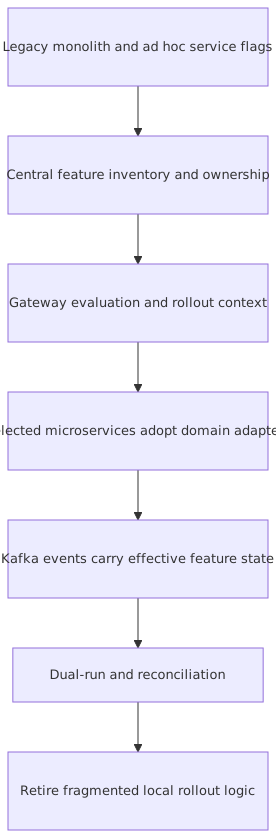
This is not just technical cleanup. It is organizational clarification. Teams must agree on feature semantics, ownership, and readiness criteria across bounded contexts. The strangler works because it forces those conversations incrementally instead of in one giant architecture ceremony.
Enterprise Example
Consider a global banking platform introducing real-time credit line adjustment for business customers.
Product sees one feature: let relationship managers and approved APIs request dynamic credit limit increases based on near-real-time risk scoring.
In reality, the feature touches at least seven bounded contexts:
- Customer Profile
- Credit Decisioning
- Exposure Management
- Account Servicing
- Ledger and Billing
- Regulatory Reporting
- Customer Notifications
The first instinct was to gate the UI and API endpoint with a feature flag. That would have been disastrous.
Why? Because a credit line increase is not a cosmetic change. It alters legal exposure, accounting treatment, available balance behavior, support workflows, and regulatory obligations. If Credit Decisioning says “yes” while Ledger still posts under the old exposure model, the bank has created an invisible control breach.
So the bank modeled rollout semantically:
VISIBLE_TO_MANAGERREQUEST_ACCEPTEDDECISION_SHADOW_ONLYDECISION_AUTHORITATIVELEDGER_POSTING_ENABLEDREG_REPORTING_CERTIFIED
Now the rollout could move in meaningful stages. Managers could see the option before they could submit it. Requests could be accepted while the new decision engine ran in shadow against the old engine. Ledger posting under the new semantics only activated after reconciliation thresholds were met. Regulatory reporting remained under old treatment until signoff.
Kafka carried decision context through the workflow: request accepted under policy version X, decision engine Y used, effective feature stage Z, and correlation IDs for reconciliation. A reconciliation pipeline compared old and new credit decisions, posting outcomes, and exposure records nightly and on demand.
The rollout uncovered a hidden domain mismatch. Exposure Management considered a pending increase effective at approval time. Account Servicing considered it effective at posting time. Under the old process this gap was masked by batch latency. Under real-time rollout it became visible immediately.
That is a perfect example of why distributed feature rollout is really domain discovery in disguise. The feature did not “break” the architecture. It revealed that two bounded contexts had different meanings for the same business moment.
The team fixed it by introducing an explicit domain event: CreditLineAdjustmentCommitted. Approval and commitment were separated. Rollout policy then controlled not just whether the feature was enabled, but which state transitions each context could honor.
That bank did not succeed because it had flags. It succeeded because it treated rollout as staged semantic authority.
Operational Considerations
This kind of architecture lives or dies in operations.
First, observability must be rollout-aware. Logs, traces, and metrics should include feature context, policy version, tenant, cohort, and effective state. If you cannot answer “which customers experienced the new billing path under policy version 14 between 09:00 and 10:00?” then your rollout is not controllable; it is merely hopeful.
Second, kill switches need scope. Global kill switches are blunt instruments. You also want tenant-level, region-level, and journey-level disablement. But be careful: every additional kill switch is another override path. Enterprises love emergency controls right until they discover six overlapping ones and no one knows precedence.
So define precedence rules. Write them down. Enforce them in code.
Third, rollout dashboards should be business-facing, not only technical. Show enablement by tenant group, order success under new path, reconciliation variance, compensation count, and customer-impacting errors. CPU graphs do not explain semantic drift.
Fourth, cache strategy matters. Policy evaluation cached too aggressively causes stale behavior. Cached too little causes latency and control-plane dependency. Usually the answer is a layered strategy: fast local cache for static targeting, short TTL for dynamic policies, and explicit invalidation for urgent switches.
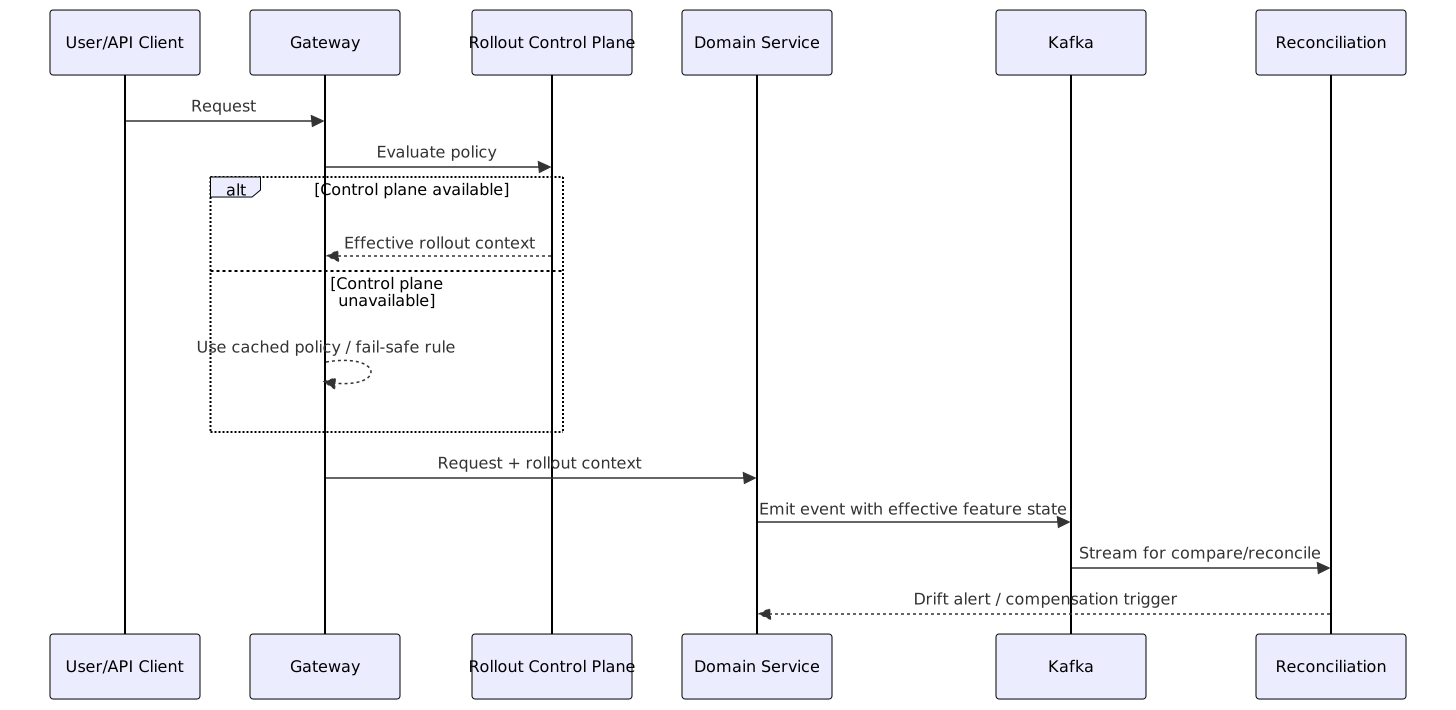
Fifth, treat the control plane as critical infrastructure. If rollout policy becomes a runtime dependency for every request, then control-plane outages become customer-facing outages. Good architectures degrade safely:
- continue with last known good policy
- fail closed for dangerous features
- fail open for low-risk experiences
- emit alerts when policy staleness exceeds thresholds
The degradation rule should be domain-specific. “Safe” in a recommendation engine and “safe” in payments are opposites.
Here is a useful operational model.
Tradeoffs
This architecture is better than ad hoc flags, but it is not free.
The biggest tradeoff is complexity. You are introducing a new conceptual layer—rollout as domain policy and propagated context. Teams must understand it, event contracts get richer, and the platform footprint grows.
You also give up some local simplicity. A service can no longer casually decide what enabled=true means. That is the point, but it will feel slower at first.
Another tradeoff is that explicit reconciliation surfaces problems that were previously hidden. This can make the system look worse before it gets better. Executives often misread that. They say, “we didn’t have these issues before.” Usually you did. You just lacked enough architecture to notice.
There is also a governance tradeoff. Centralizing policy can drift into centralizing decision-making. That is a mistake. Platform teams should own rollout mechanics and guardrails, not business meaning inside bounded contexts. ArchiMate for governance
Finally, richer rollout states create maintenance cost. If every feature gets ten lifecycle stages, teams drown in process. Reserve semantic rollout models for features that cross real domain boundaries or carry meaningful operational risk.
Failure Modes
Distributed rollouts fail in repeatable ways. Knowing them upfront is half the battle.
Split-brain evaluation. Different services evaluate the same feature differently for the same business interaction. Usually caused by local SDK checks, stale caches, or inconsistent targeting attributes.
Semantic mismatch across bounded contexts. One service interprets enablement as “allow selection,” another as “commit transaction.” Customers fall into invalid intermediate states.
Event consumers lagging semantic adoption. Producers emit new meaning before consumers are ready. Replay becomes dangerous because old events and new logic interact badly.
Irreversible side effects under partial rollout. A feature creates durable writes, ledger postings, or external calls that cannot be rolled back when the rollout is disabled.
Compensation gaps. Teams assume rollback equals safety, but asynchronous systems need explicit compensating actions and reconciliation logic.
Flag debt. Temporary rollout stages become permanent architecture scar tissue. No owner, no retirement date, no one sure if turning it off will break quarter-close.
Control-plane dependency outage. Runtime policy system fails and the production estate stalls or behaves inconsistently.
The antidote is not paranoia. It is discipline:
- explicit feature state models
- request and event propagation
- version-aware consumers
- reconciliation pipelines
- retirement plans for rollout artifacts
When Not To Use
Not every feature deserves this machinery.
If a change is strictly local to one service, has no externalized domain impact, and can be rolled back safely with routine deployment practices, then a simple internal toggle may be enough.
If the system is still a modest monolith with a single deployment cadence, adding distributed rollout infrastructure may be architecture cosplay. Use release-by-abstraction, dark launching, or conventional feature management first.
If the organization lacks basic observability, ownership boundaries, or event contract discipline, a sophisticated rollout architecture will likely become a decorative failure. It will look modern and behave chaotically.
And if the domain is heavily regulated but the enterprise cannot support audit, policy approval, and traceability, do not fake distributed rollout with hidden flags. That is how “temporary” controls become audit findings.
Use this architecture when rollout is genuinely cross-cutting, semantically meaningful, and operationally risky. Otherwise, keep it simpler.
Related Patterns
Several related patterns often travel with distributed feature rollouts.
Strangler Fig Pattern. Essential for migrating from monolith or fragmented service-local flags toward coherent rollout control. Rollout architecture is often one of the best forcing functions for strangling legacy behavior gradually.
Release by Abstraction. Useful when introducing a new implementation behind stable domain behavior. Especially important during dual-run or shadow phases.
Saga and process orchestration. Rollout context often needs to survive long-running workflows. Sagas provide the state model; rollout policy shapes which transitions are legal.
Outbox and CDC. Helpful for ensuring rollout-aware event publication is reliable and replayable.
Semantic versioning of events. Not just schema evolution, but meaning evolution. Critical in Kafka-based estates.
Reconciliation patterns. Compare jobs, drift detection, shadow reads, compensating transactions, and exception queues. These are not optional in serious distributed rollouts.
Policy decision point / policy enforcement point. Borrowed from security architecture, but very useful here. The control plane decides; the bounded context enforces according to domain rules.
Summary
Distributed feature rollouts in microservices are not a flag problem. They are a semantic coordination problem.
The architecture that works is not the one with the fanciest SDK. It is the one that respects bounded contexts, treats rollout as explicit policy, carries effective decisions through requests and events, and invests in reconciliation because partial adoption is normal, not exceptional.
If you remember one line, make it this: a rollout is safe only when the business meaning changes safely, not when the code path changes gradually.
That means:
- define feature states in domain language
- centralize policy but keep semantics in bounded contexts
- propagate rollout context instead of re-deciding everywhere
- version event meaning, not just schemas
- reconcile aggressively during migration
- use a progressive strangler, not a mandate
- know the failure modes before production teaches them to you
In enterprise architecture, feature rollout is where software delivery, domain modeling, and operational reality collide. Done casually, it creates inconsistency at scale. Done well, it becomes a mechanism for controlled evolution—a way to change the aircraft engine while keeping the aircraft flying, without pretending turbulence is optional.
Frequently Asked Questions
What is a service mesh?
A service mesh is an infrastructure layer managing service-to-service communication. It provides mutual TLS, load balancing, circuit breaking, retries, and observability without each service implementing these capabilities. Istio and Linkerd are common implementations.
How do you document microservices architecture for governance?
Use ArchiMate Application Cooperation diagrams for the service landscape, UML Component diagrams for internal structure, UML Sequence diagrams for key flows, and UML Deployment diagrams for Kubernetes topology. All views can coexist in Sparx EA with full traceability.
What is the difference between choreography and orchestration in microservices?
Choreography has services react to events independently — no central coordinator. Orchestration uses a central workflow engine that calls services in sequence. Choreography scales better but is harder to debug; orchestration is easier to reason about but creates a central coupling point.