⏱ 18 min read
Microservices rarely fail because teams cannot split code. They fail because teams split meaning.
That is the real architectural tax. Not network hops. Not container sprawl. Not even observability bills, painful as those become. The expensive problem is semantic drift: one service calls a customer “active,” another calls the same customer “verified,” a third treats “active” as “has logged in within 90 days,” and finance quietly assumes “active” means “billable.” Now the company has not just distributed systems, but distributed truth. And distributed truth is where enterprise architecture goes to bleed.
This is why model alignment across services matters. Not because all services should share the same domain model—they should not—but because services must align on the meaning of concepts they exchange. In a healthy microservices architecture, teams own bounded contexts, not fragments of a universal schema. Yet they still need to cooperate. That cooperation lives in contracts, events, policies, translation layers, and reconciliation processes. In other words: in architecture. microservices architecture diagrams
The temptation is always the same. Someone discovers duplication. Product, Order, Customer, Account, Subscription, Party—why do five services have different shapes for what looks like the same thing? So the organization reaches for a shared canonical model, usually wrapped in standards language and governance meetings. It feels tidy. It also usually fails. Shared models centralize coupling under the banner of consistency. Every team becomes hostage to every other team’s semantics. Change slows. Work queues form. The architecture looks aligned on slides and misaligned in production. EA governance checklist
The more durable answer is subtler and less glamorous: align where meaning crosses service boundaries, and allow divergence where local domain decisions deserve autonomy.
That is the game.
Context
Microservices are fundamentally about decomposing a system around business capabilities. Domain-driven design gave us the language for this years ago: bounded contexts, ubiquitous language, context maps, translation between models. Yet many organizations adopted microservices as a deployment style without adopting domain thinking as a design discipline. They got service meshes before they got semantic boundaries. Predictably, they now have hundreds of APIs and no shared understanding of what the data means.
In a monolith, semantic ambiguity can hide in code and still limp along. One database, one transaction boundary, one release train. In microservices, ambiguity becomes visible because data moves. Events are published. APIs are consumed. Read models are cached. Search indexes lag. Analytics pipelines reinterpret transactional fields. A term that was once sloppy naming becomes a production defect.
Model alignment is the practice of making these meaning boundaries explicit.
It does not mean forcing a single enterprise object model across all services. That is old-school integration architecture wearing a modern hoodie. It means understanding where concepts are shared, where they differ, and what translation or reconciliation is needed when they meet.
Consider a large retailer. Pricing, Catalog, Promotions, Checkout, Fulfillment, CRM, and Finance all care about “product.” But they do not care about the same product model.
- Catalog cares about descriptions, attributes, taxonomy, variants.
- Pricing cares about sellable units, regions, currencies, effective dates.
- Promotions cares about eligibility and campaign rules.
- Fulfillment cares about dimensions, hazardous handling, warehouse mappings.
- Finance cares about revenue recognition categories and tax classes.
If those teams share one universal Product object, they will spend their lives negotiating fields. If they keep completely unrelated models with no alignment strategy, integration will collapse into brittle point-to-point translation. The architecture needs a middle path.
That middle path is where serious enterprise architecture lives.
Problem
The core problem is simple to state and hard to solve: how do independently evolving services preserve local autonomy while maintaining consistent business meaning across interactions?
There are several recurring symptoms:
- The same entity appears in multiple services with different identifiers and lifecycle rules.
- Events with similar names mean different things in different contexts.
- APIs expose internal persistence models rather than explicit domain contracts.
- Teams assume eventual consistency will “just work,” but have no reconciliation design.
- Reporting and operational processes reveal contradictory states across systems.
- Governance efforts overcorrect and impose a shared canonical schema that freezes change.
A common anti-pattern is what I call distributed monolith semantics. Teams split codebases into services, but keep acting as if there is one system-wide object model. They add fields to shared events without versioning discipline. They let downstream consumers infer upstream intent. They use Kafka topics like database replication streams. Then, months later, one team changes the meaning of status = ACTIVE, and three other services quietly break.
Another anti-pattern is the opposite: semantic nihilism. Every team defines its own truth, and integration is left to downstream consumers. “Just consume the event and figure it out” is not architecture. It is outsourcing design to whoever is least equipped to absorb the mess.
Both fail for the same reason. They ignore bounded contexts while underestimating the cost of translation.
Forces
Good architecture is usually not about picking the “right” principle. It is about surviving competing truths.
Here are the forces at work.
1. Local autonomy vs enterprise consistency
Teams need freedom to evolve their internal models. That is one of the main reasons to adopt microservices. But the enterprise still needs coherent cross-process behavior: a canceled order should be canceled everywhere that matters, not just in the service that originated the change.
2. Bounded contexts vs shared business vocabulary
DDD is often misunderstood here. A bounded context does not mean words lose all shared meaning. It means meaning is contextual. “Customer,” “Account,” “User,” and “Party” may overlap, but they are not automatically interchangeable. Architects must decide what is translated, what is standardized, and what is intentionally distinct.
3. Event-driven integration vs operational truth
Kafka makes propagation easy. It does not make semantics easy. Publishing events can reduce coupling, but events are only useful if their business meaning is explicit, durable, versioned, and consumable. Otherwise Kafka becomes a high-speed conveyor belt for confusion. event-driven architecture patterns
4. Delivery speed vs semantic governance
Fast-moving teams hate central review boards. Fair enough. But no governance at all leads to entropy. The trick is lightweight semantic governance: clear ownership of domain terms, contract review at context boundaries, and compatibility rules that do not require a committee for every field. ArchiMate for governance
5. Eventual consistency vs business tolerance
A famous line in distributed systems is that eventual consistency is only acceptable if the business can tolerate “eventually.” Some domains can. Others absolutely cannot. Inventory can often reconcile. Regulatory reporting cannot casually drift. Payroll cannot “eventually” pay correctly.
6. Migration practicality
Most enterprises do not start greenfield. They start with a large application, several integration buses, data warehouses pretending to be source systems, and tribal knowledge hidden in batch jobs. Any alignment strategy has to work during migration, not after some mythical future rewrite.
Solution
The best approach is to align models through context mapping, explicit contracts, translation layers, and reconciliation loops.
That sounds neat on a whiteboard. In practice, it means four hard choices.
1. Define bounded contexts before defining interfaces
Services should be carved around business capabilities and decision-making boundaries, not nouns from a data dictionary. The model inside a service belongs to that service. Start by identifying where terminology changes meaning, where rules diverge, and where one part of the organization can make decisions without asking another.
This is classic domain-driven design, and it still matters because it prevents the worst integration mistake: sharing a model before understanding the domain.
2. Publish business facts, not database deltas
When a service emits an event, it should say something meaningful in domain language: OrderPlaced, PaymentAuthorized, ShipmentDispatched, CustomerEmailVerified.
It should not publish “row changed” streams as a substitute for domain events unless replication is truly the goal. Database change data capture can be useful, especially in migration, but CDC is not automatically a business contract. A changed row often lacks the intent consumers need.
3. Use translation at boundaries
Translation is not duplication. It is decoupling with discipline.
A downstream service should map incoming concepts into its own local model. An Anti-Corruption Layer remains one of the most useful patterns in modern enterprise systems. It protects the local domain from upstream leakage. Without it, one service’s internal semantics infect everyone else.
4. Reconcile explicitly
If two services represent related business state, design for mismatch. Assume messages are delayed, duplicated, reordered, or partially processed. Assume operators will need to compare representations and fix discrepancies. Reconciliation is not a patch for bad architecture; it is a first-class control for distributed reality.
Here is the core alignment picture.
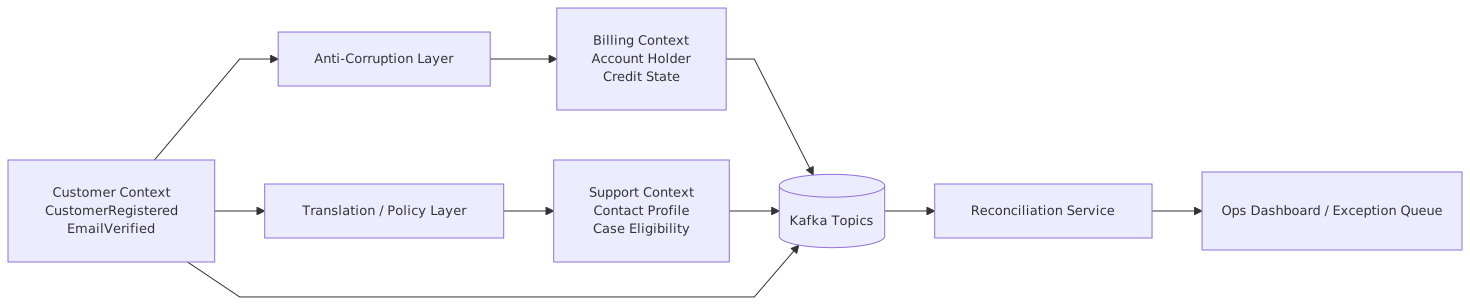
The point of this design is simple: contexts remain autonomous, integration happens through explicit semantics, and reconciliation handles inevitable drift.
Architecture
A robust model alignment architecture usually has six building blocks.
Context-owned models
Each service owns its internal schema, business rules, identifiers, and lifecycle. Its persistence model is not the enterprise contract. This is non-negotiable if you want independent evolution.
Context boundary contracts
At the boundary, expose APIs and events shaped for interaction, not storage. Contracts should represent stable business concepts and include versioning rules. If a consumer needs a field because your table happens to have it, stop and ask whether that field is truly part of the shared interaction.
Shared reference semantics, not shared aggregate models
There is often a small set of enterprise reference concepts that need stronger consistency: identifiers, legal entity codes, currency codes, country codes, maybe customer master identity. Fine. Standardize those carefully. But do not confuse shared references with a universal domain model. Shared keys are helpful. Shared aggregates are often poison.
Event backbone for propagation
Kafka fits well when many services need business events and eventual consistency is acceptable. Use topics by domain stream, retain schemas in a registry, and enforce compatibility. Prefer domain events over raw CDC for long-term contracts. Use CDC tactically during migration and where replication is intentional.
Read-model composition
Some cross-domain experiences, like customer 360 or order tracking, need combined views. Do not solve that by forcing all services into one model. Build composed read models, often from events, materialized for the user journey. Query models are where integration belongs; domain ownership should remain in the source contexts.
Reconciliation and exception handling
No distributed system gets this perfect. Build compare jobs, consistency checks, compensating workflows, and operator-visible exception queues. If your architecture depends on “messages never fail,” your architecture is fiction.
A practical view looks like this:
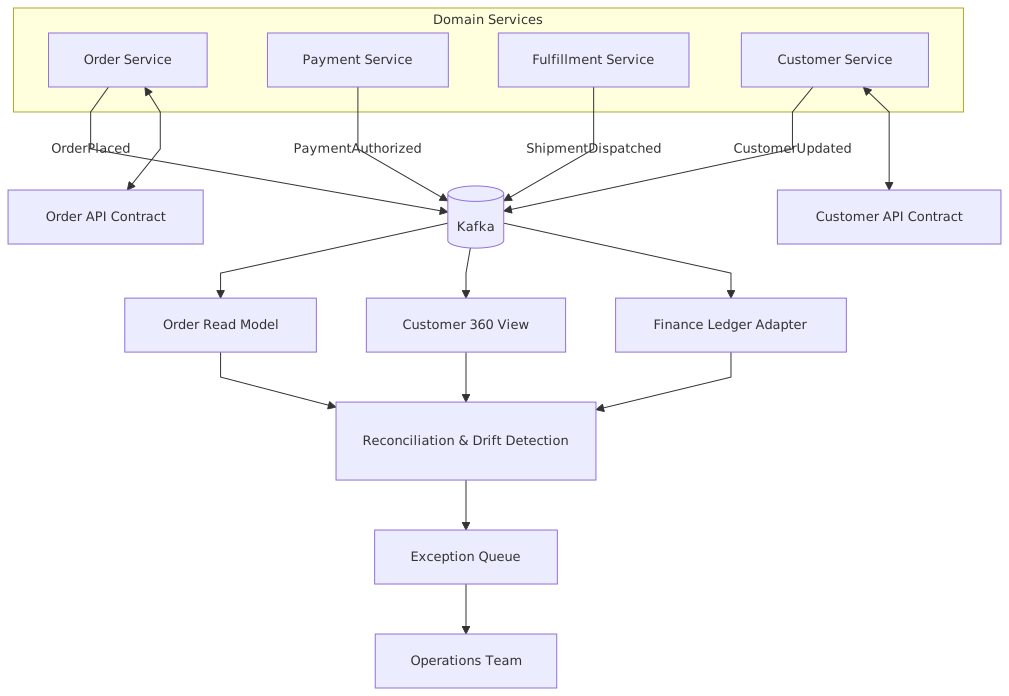
This is not “just event-driven architecture.” It is event-driven architecture with semantic ownership.
Migration Strategy
Most enterprises asking about model alignment are not building from scratch. They are disentangling legacy systems where one data model has been stretched across too many use cases. Migration therefore matters as much as target architecture.
The right strategy is usually a progressive strangler migration.
Start by identifying a bounded context that can be extracted with tolerable risk. Do not begin with the most central, politically loaded concept unless you enjoy organizational pain. Customer sounds obvious, but in many firms it is too overloaded to extract first. Billing Account, Product Availability, or Shipment Tracking may be better seams.
Then proceed in stages.
Stage 1: Discover semantics, not just interfaces
Map the current flows of meaning. Which systems publish, transform, and consume the concept? Where do terms diverge? Where are hidden business rules living in ETL, batch jobs, stored procedures, or middleware mappings? You are not cataloging APIs; you are uncovering the actual domain behavior.
Stage 2: Introduce an explicit boundary
Create a new service with a clearly owned model and a translation layer from the legacy representation. Keep the old world running. This is where CDC often helps: use it as a bridge, not as the final design. CDC can mirror changes out of a monolith while the new service begins to own specific behaviors.
Stage 3: Publish stable business events
Once the new service has authoritative logic for its capability, start publishing domain events. Downstream consumers should be encouraged to switch from legacy database coupling or ESB mappings to these contracts.
Stage 4: Build reconciliation before cutover
This is where many migrations get arrogant. They assume that because events exist, consistency exists. It does not. Before moving critical workflows, create reconciliation reports between legacy and new models. Measure drift. Understand the failure patterns. Dry-run operational recovery.
Stage 5: Shift command ownership
Move write responsibility into the new context. Reads may still be composite for a while. That is normal. The strangler pattern works best when command ownership becomes clear before every read-side dependency is modernized.
Stage 6: Retire transitional mappings slowly
Only after consumers have moved and reconciliation shows acceptable stability should you remove bridge logic, dual writes, or mirror pipelines.
A migration view often looks like this:

The key idea is that migration is not just moving code. It is moving semantic authority.
Enterprise Example
Take a multinational insurer modernizing claims and policy administration.
The legacy environment had a central customer master, a policy admin suite, a claims platform, a CRM package, and a finance system. Every one of them used the term “customer.” Every one meant something different.
- In policy administration, customer meant policyholder or insured party, with legal entity relationships.
- In claims, customer often meant claimant or participant in a loss event.
- In CRM, customer meant a contact profile with marketing consent and communication preferences.
- In finance, customer was effectively the billed party.
For years, integration had been managed with an ESB and a supposedly canonical customer XML schema. It was huge. Everyone hated it. Nobody could change it safely. Teams ended up stuffing context-specific flags into extension sections, which is just another way of saying the canonical model had failed but remained politically alive.
The modernization program moved to microservices and Kafka. The first instinct was to create a new enterprise Customer Service as the master for everything. That would have been a mistake. Instead, the architecture team reframed the problem with DDD.
They identified multiple bounded contexts:
- Party Identity Context for matching, deduplication, and enterprise identifiers.
- Policy Context for policyholder and insured relationships.
- Claims Context for participants in a claim.
- CRM Context for communication preferences and service interactions.
- Billing Context for responsible paying entities.
The Party Identity context became the source of enterprise identity references, not the owner of all customer semantics. It emitted events like PartyRegistered, PartyMerged, and PartyIdentifierCorrected. Other services mapped those identities into their own terms and life cycles.
Claims did not consume a universal Customer object. It consumed identity references and contact details it needed, then projected them into the claims model. CRM did likewise, but with consent and channel preferences. Billing maintained its own account-holder semantics.
A Kafka backbone distributed domain events. A schema registry enforced compatibility rules. More importantly, each event had explicit business definitions and ownership. The architecture repository included semantic annotations, examples, and known interpretation constraints. That sounds unglamorous. It saved the program.
Reconciliation was built from day one. A drift service compared identity links, addresses, and status transitions across contexts. Some mismatches were expected. Others triggered exception workflows. For example, if a party merge occurred in identity management but a claims participant remained unresolved after a threshold, an operational task was created.
The result was not a single aligned model. It was a governed network of related models. That is the right outcome in a real enterprise.
Operational Considerations
This architecture lives or dies in operations.
Schema governance
If you use Kafka, use a schema registry and compatibility rules. Backward compatibility should be the default. Breaking changes should be rare and deliberate. Event names and field definitions need stewardship. This is architecture work, not just platform plumbing.
Observability by business key
Tracing by technical correlation IDs is useful but insufficient. You also need observability by domain identifiers: customer ID, order ID, account ID, claim ID. Operators need to see how one business fact propagated across services and where it stalled.
Idempotency and ordering
Events will replay. Consumers must handle duplicates. Ordering may be partition-local, not global. Design event handlers so they tolerate reprocessing and out-of-order arrival where possible. If strict sequencing matters, make that explicit and constrained.
Data quality monitoring
Model alignment degrades quietly. Build metrics for null spikes, unmapped codes, stale projections, merge conflicts, reconciliation backlog, and contract version distribution. If nobody watches semantic quality, drift becomes normal.
Exception management
There must be a place where unresolved inconsistencies go. Not logs. Not dead-letter topics nobody owns. A real exception process with ownership, SLAs, and tooling. Enterprises run on exception handling more than architects like to admit.
Security and privacy boundaries
Alignment can accidentally over-share data. A service should not receive a broader model just because another service has it. This matters especially in customer, health, HR, and financial domains. Semantic alignment is not an excuse for data sprawl.
Tradeoffs
There is no free lunch here.
The biggest tradeoff is between local clarity and cross-domain convenience. Translation layers and context-specific models create work. Teams duplicate concepts. There are more mappings, more events, more operational checks. That is the price of autonomy.
A canonical enterprise model reduces visible duplication, at least initially. It can work in narrow integration domains with stable semantics. But across broad business domains it usually centralizes change and creates accidental coupling.
Event-driven alignment improves decoupling and scalability, but introduces eventual consistency and operational complexity. Synchronous APIs can be simpler for transactional interactions where immediate feedback matters. Use both where appropriate. Enterprises often need hybrid integration, not ideology.
Reconciliation adds resilience but also admits an uncomfortable truth: the system will disagree with itself sometimes. Good. Better to design for reality than pretend away failure.
Failure Modes
These systems fail in recognizable ways.
The accidental canonical model
A “common event schema” slowly becomes the de facto enterprise model. Every service depends on it. Changes become political. Innovation slows.
Thin events, thick assumptions
Events are too vague, so consumers infer missing meaning from context or historical behavior. Eventually one producer changes implementation details and consumers break silently.
Translation logic scattered everywhere
Instead of a clear ACL or policy layer, every consuming team writes its own mapping. The enterprise now has five interpretations of the same upstream concept.
No reconciliation path
When states diverge, there is no mechanism to compare, repair, or compensate. Operators fall back to database fixes and tribal knowledge. That is not resilience. It is organized panic.
Identity drift
Different services assign or merge identities differently. Soon the same real-world party is duplicated across contexts, or two distinct parties are collapsed incorrectly. Identity mistakes are expensive because they contaminate downstream systems.
Kafka used as a dumping ground
Topics become a landfill of raw changes, undocumented payloads, and half-owned consumers. Platform success can mask domain failure for a surprisingly long time.
When Not To Use
This approach is not always warranted.
Do not over-engineer model alignment if you have a small system, a tightly coupled team, and a domain with little semantic variation. A modular monolith is often the better answer. If one team owns the whole thing and can evolve a shared code model safely, introducing distributed translation and reconciliation is performative architecture.
Do not force event-driven eventual consistency into workflows that demand strong transactional guarantees and immediate correctness unless you have a very clear compensation model. Some domains need simpler, tighter boundaries.
Do not create elaborate bounded contexts for CRUD systems with trivial business rules. If “product” is just a reference table and not a source of competing policies, a single service and model may be enough.
And do not build a grand semantic governance program if the organization lacks the discipline to maintain it. Better a modest architecture with explicit boundaries than a majestic shelf of unused standards.
Related Patterns
Several patterns fit naturally with model alignment across services.
- Bounded Context: the foundation. Meaning is local and explicit.
- Context Map: defines upstream/downstream relationships and translation needs.
- Anti-Corruption Layer: protects local models from foreign semantics.
- Domain Events: communicate meaningful business facts across contexts.
- CQRS / Materialized Views: compose read models without collapsing domain ownership.
- Strangler Fig Pattern: migrate capability and semantic authority progressively.
- Outbox Pattern: publish reliable events from transactional boundaries.
- Saga / Process Manager: coordinate multi-step workflows when no single transaction exists.
- Master Data Management, used carefully: useful for identity and reference data, dangerous when stretched into universal domain ownership.
Notice the theme. None of these patterns says “make all services share the same model.” Quite the opposite. The good patterns assume difference and manage it deliberately.
Summary
Model alignment in microservices is not about getting everyone to agree on one schema. It is about ensuring services can disagree safely.
That is the architectural move. Keep bounded contexts honest. Publish explicit business events. Translate at boundaries. Reconcile where state can drift. Migrate progressively with strangler seams, not big-bang rewrites. Use Kafka as an event backbone where it helps, not as a substitute for domain thinking.
If there is one lesson worth remembering, it is this: shared data is cheap; shared meaning is expensive. Most enterprise integration failures come from pretending the opposite.
The strongest architectures accept that different services will model the world differently. They just refuse to let that difference become chaos.
Frequently Asked Questions
What is a service mesh?
A service mesh is an infrastructure layer managing service-to-service communication. It provides mutual TLS, load balancing, circuit breaking, retries, and observability without each service implementing these capabilities. Istio and Linkerd are common implementations.
How do you document microservices architecture for governance?
Use ArchiMate Application Cooperation diagrams for the service landscape, UML Component diagrams for internal structure, UML Sequence diagrams for key flows, and UML Deployment diagrams for Kubernetes topology. All views can coexist in Sparx EA with full traceability.
What is the difference between choreography and orchestration in microservices?
Choreography has services react to events independently — no central coordinator. Orchestration uses a central workflow engine that calls services in sequence. Choreography scales better but is harder to debug; orchestration is easier to reason about but creates a central coupling point.