⏱ 20 min read
There is a particular smell in enterprise systems that experienced architects learn to recognize early. It is the smell of coordination panic.
It appears the moment a business process that was once safely tucked inside a single database transaction gets broken apart into microservices, event streams, retries, caches, and regional deployments. Suddenly the old certainty is gone. Two services can update the same thing at once. Messages can arrive twice. A payment can be approved after inventory has already been reassigned. A customer can click the same button three times, and your architecture has to decide whether that is normal human behavior or a distributed systems attack.
The reflex is almost always the same: “We need a distributed lock.”
Sometimes that reflex is right. Often it is cargo cult architecture wearing a serious face.
Distributed locks are the sharp knives of microservices design. They can save you from race conditions, duplicate work, and state corruption. They can also quietly become a single point of contention, a throughput killer, and a false sense of safety in a world where the network lies and clocks drift. The trick is not to ask whether locks are good or bad. The trick is to ask a more useful question: what business invariant are we really protecting, and what is the cheapest reliable mechanism to protect it?
That is the heart of this topic. Not technology first. Domain first.
In practice, the best architecture rarely starts with “how do I lock this?” It starts with “what does the business mean by correctness?” Is it acceptable to oversell inventory briefly and reconcile later? Must an account balance never go negative under any circumstance? Can duplicate shipment commands be tolerated if fulfillment is idempotent? Is a seat reservation a hard guarantee or merely a hold with an expiration? These are domain questions, not infrastructure questions. And the answers determine whether you need a distributed lock, optimistic concurrency, partitioned sequencing, a saga, escrow semantics, idempotency keys, or plain old reconciliation.
This is where many microservice programs go wrong. They preserve the technical decomposition but lose the transactional semantics that used to be implicit in the monolith. The result is a mess of compensations, lock servers, and Kafka topics, all trying to recreate a guarantee no one bothered to state clearly. event-driven architecture patterns
So let’s state it clearly.
Distributed locking is one tool for coordinating work across independent nodes. But it competes with alternatives that are often simpler, faster, and more aligned with business boundaries: optimistic concurrency control, single-writer patterns, queue partitioning, lease-based ownership, escrow models, and reconciliation. A mature enterprise architecture knows the differences, understands the failure modes, and chooses deliberately.
This article walks through that choice.
Context
In a monolith, consistency is often purchased with a local database transaction. The code reads a row, changes it, commits, and the database does the hard work. We complain about coupling, but we benefit from the hidden gift of co-location. The lock manager, transaction log, and isolation engine are all in one place.
Microservices break that illusion. They do so for good reasons: team autonomy, scaling, deployment independence, domain decoupling, polyglot persistence, and clearer bounded contexts. But the moment data and behavior move into separate services, the old transaction boundary fractures. What used to be a single ACID operation becomes a sequence of network calls, event publications, asynchronous handlers, and eventually consistent state transitions.
That is not a bug in microservices. That is the price of admission. microservices architecture diagrams
Now add Kafka. Event-driven architecture improves decoupling and auditability, and it gives us durable sequencing within partitions. But Kafka does not magically solve concurrency. It narrows the problem if we use keys well. It amplifies the problem if we don’t. Messages can still be duplicated. Consumers can retry. Out-of-order behavior can appear across partitions or topics. State can diverge across services that project the same business concept differently.
At this point, teams reach for coordination patterns. Some add Redis-based locks. Others introduce ZooKeeper, etcd, or Consul. Others use database row versions and reject stale writes. Mature teams go further and redesign the workflow so the invariant is enforced by ownership and message flow rather than by a global lock.
That last part matters. Good distributed architecture is often less about adding coordination and more about removing the need for it.
Problem
The central problem is simple to say and painful to solve:
How do multiple services or nodes act on the same business fact without violating correctness?
A few examples make it concrete:
- Two checkout requests try to reserve the last unit of inventory.
- A customer submits the same payment twice because the UI timed out.
- A pricing engine recalculates discounts while an order service is finalizing totals.
- A claims service and a fraud service both try to transition the same case.
- A warehouse service receives duplicate ship commands after a retry storm.
- Multiple schedulers try to run the same month-end job in parallel.
These do not all require the same mechanism. That is where architecture earns its keep.
Some are really mutual exclusion problems: only one worker should execute this job.
Some are state transition integrity problems: only one legal transition can occur from a given state.
Some are uniqueness problems: the same business command should have at-most-once business effect even if delivered many times.
Some are allocation problems: a finite resource must not be consumed beyond a hard threshold.
Some are not coordination problems at all. They are workflow design problems disguised as lock problems.
If you solve all of them with a distributed lock, you will build a system that is more serialized than your business requires and less correct than you think.
Forces
Architectural decisions here are shaped by competing forces.
Correctness vs availability
A strict lock can preserve invariants, but when the lock service is unreachable, what happens? Do you block orders? Degrade gracefully? Allow local progress and reconcile later? Enterprise systems live inside business tolerances, not textbook purity.
Throughput vs serialization
A lock serializes work. That can be exactly what you want for one aggregate or poison for a high-volume flow. If every order update contends on a broad lock key, your horizontally scaled service becomes a single-file queue with extra network hops.
Latency vs confidence
Optimistic concurrency avoids lock roundtrips and performs well under low contention. Under high contention it degrades into retries, user-visible failures, and hot-spot records. The system remains correct, but not always pleasant.
Domain truth vs technical convenience
A “customer” in CRM is not always the same thing as a “customer” in billing. A lock key that spans bounded contexts is usually a smell. Coordination should align with aggregate boundaries and ownership rules from domain-driven design, not with whoever happened to know Redis.
Local autonomy vs global invariants
Microservices thrive when each service owns its model and can move independently. But some invariants cut across services. Credit exposure, stock levels, or regulatory holds do not care about your repo structure. Those need explicit design.
Immediate consistency vs reconciliation
Not every mismatch is a failure. Many businesses operate quite happily with temporary divergence if they have strong reconciliation processes. Airlines overbook. Retailers backorder. Finance teams post adjustments. The architecture should reflect those operating realities rather than pretending every domain needs atomic perfection.
Solution
The right solution is usually a portfolio, not a single pattern. But the decision starts with one principle:
Model the invariant in the domain, then choose the narrowest coordination mechanism that protects it.
That pushes us toward a hierarchy of choices.
1. Prefer single-writer ownership
If one service owns an aggregate and all state changes for that aggregate flow through it, you often do not need a distributed lock. You need proper ownership. In Kafka terms, if all commands for Order-123 are keyed to the same partition and processed by one consumer instance for that partition, you get ordered handling without introducing an external lock manager.
This is not magic. It is disciplined architecture.
2. Use optimistic concurrency for aggregate updates
For many business entities, the simplest correct mechanism is versioned writes.
Read current version.
Apply business rules.
Write only if version matches.
If not, reject or retry.
This works well when contention is moderate and conflicts are part of normal business behavior. It keeps services stateless, avoids centralized lock dependencies, and makes concurrent changes explicit.
3. Use idempotency for duplicate commands
A huge number of “lock” requests are really duplicate processing fears. If the command carries a business idempotency key and the receiving service records whether it has already applied that command, then duplicate delivery is harmless. No lock required.
4. Use reservations or escrow for scarce resources
For inventory, credit limits, and seat holds, reservation semantics often beat hard locking. Instead of “lock item globally,” create a reservation with expiry, reduce available-to-promise, and confirm or release later. This matches business language better and handles time naturally.
5. Use distributed locks only for narrow coordination cases
Distributed locks still have a place:
- leader election
- singleton job execution
- short critical sections around non-idempotent shared resources
- legacy integration where no better ownership model exists
- cross-node coordination for technical resources rather than core domain state
Even then, prefer leases with expiration, fencing tokens, and bounded critical sections. Never assume a lock is forever. In distributed systems, forever is another word for outage.
Architecture
A useful way to frame the architecture is to compare a lock-centric approach with optimistic and ownership-based alternatives.
Lock-based coordination

This pattern gives mutual exclusion, but at a price. The lock service becomes infrastructure you now have to trust during partitions, failovers, and latency spikes. If clients hold locks too long, your throughput collapses. If clients pause due to GC or node suspension and then resume, you can get split-brain behavior unless you use fencing tokens on the protected resource.
That last point is often missed. A lock alone is not enough. If client A acquires a lease, pauses, lease expires, client B acquires the lease, and then client A resumes and writes anyway, you have corruption. The protected resource must reject stale actors using monotonically increasing fencing tokens.
Optimistic concurrency on an aggregate
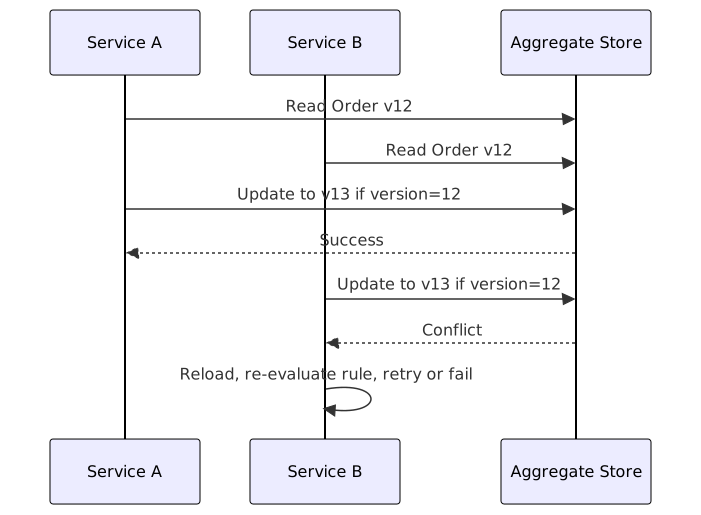
This is cleaner for domain state. Conflicts are explicit, and correctness lives at the aggregate boundary. It works especially well when aggregate invariants are local: one order, one claim, one policy, one account.
The key is not to hide the conflict. A conflict is business information. Someone else got there first. Your service should be able to say what that means.
Partitioned event processing as implicit serialization
Kafka gives a powerful alternative when events or commands can be keyed by aggregate identifier.
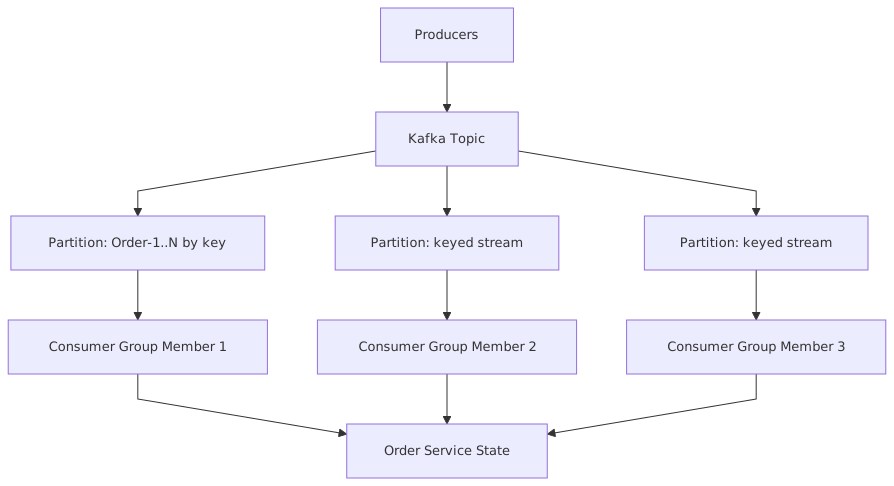
Within a partition, events are ordered and consumed by one group member at a time. Used properly, this can eliminate many distributed lock use cases. But there are tradeoffs. Partition hot spots emerge when one key is extremely active. Cross-aggregate invariants still require careful modeling. And once teams scatter related events across multiple topics with inconsistent keys, they lose the benefit.
The principle remains: if you can serialize naturally by ownership and keying, do that before introducing an external lock.
Domain Semantics: the part that decides everything
Locks are technical. Invariants are business. Confusing the two is how systems become brittle.
In domain-driven design terms, the first question is: what is the aggregate, and what invariants must be maintained inside it synchronously?
If “inventory item” is the aggregate and the invariant is “available quantity must never drop below zero,” then one approach is to funnel all reservations for that SKU through the inventory service as the single writer. That service may use optimistic concurrency on the inventory record. Or it may partition the command stream by SKU. The important part is not the choice of database trick. The important part is that inventory ownership is explicit.
But if the business semantics say “brief oversell is acceptable within tolerance because suppliers replenish hourly,” then a softer model may be better: accept orders, emit events, reconcile shortages, and trigger backorder workflows. Locking every checkout would be paying for certainty the business does not require.
Likewise in finance, an available balance may require strict protection while a rewards points balance can tolerate asynchronous correction. Same enterprise. Different semantics. Different architecture.
A memorable rule of thumb:
If the business cannot explain the invariant in plain language, do not solve it with distributed infrastructure. You are locking a rumor.
Migration Strategy
Most enterprises do not get to design this greenfield. They inherit a monolith with broad ACID transactions and move toward microservices over time. The migration question is not “how do we keep the old guarantees everywhere?” That way lies paralysis. The better question is “which guarantees must survive intact, and which can evolve into reservations, asynchronous flows, or reconciliation?”
This is where the strangler pattern earns its keep.
Step 1: identify transactional seams
Look for business operations currently hidden inside one database commit:
- place order
- allocate stock
- approve claim
- book payment
- issue refund
Then classify the invariants:
- hard synchronous invariant
- soft invariant with later reconciliation
- duplicate suppression need
- sequencing need
- reporting consistency only
Step 2: carve out ownership by bounded context
Do not split tables first. Split responsibilities first. Give one service the authority to decide a business fact. Ownership reduces coordination.
Step 3: keep strong consistency where truly needed
During migration, some hard invariants may remain in the monolith or a shared transactional core for longer than people like. That is fine. Architects should not break correctness for ideological neatness. A progressive strangler is progressive.
Step 4: introduce anti-corruption and event publication
As services peel away, publish domain events from the core. Let downstream services build projections and asynchronous workflows. Resist the urge to let multiple services update the same record directly.
Step 5: add reconciliation before you need it
This is one of the most underrated migration moves. If you know temporary divergence will appear, build reconciliation jobs, mismatch dashboards, replay capability, and repair workflows early. Reconciliation is not a sign of weakness. It is how grown-up distributed systems keep their promises.
Step 6: replace broad locks with narrower controls
A monolith may have effectively serialized everything through one database transaction. In the target architecture, replace that with:
- aggregate-level optimistic concurrency
- command idempotency
- Kafka key-based sequencing
- reservation and expiry
- lock services only for technical coordination
Migration is not just extraction. It is semantic refactoring.
Enterprise Example
Consider a global retailer modernizing its order management platform.
In the monolith, order placement did everything in one database transaction:
- validate basket
- reserve inventory
- authorize payment
- calculate promotions
- create shipment request
- persist order
That worked—until scale, region expansion, and team structure made the monolith a delivery bottleneck.
The first microservices attempt was naive. Inventory, payment, pricing, and order orchestration were separated quickly. To prevent oversell, the team added a Redis distributed lock around each SKU during checkout. It looked sensible in slides. In production, Black Friday had other opinions.
Hot SKUs became lock hot spots. Checkout latency spiked. Lock TTLs were tuned repeatedly. Under load, some clients timed out after acquiring the lock but before releasing it. Retry storms created duplicate reservation attempts. A regional failover caused lock service instability, and the business discovered an ugly truth: they had replaced one transactional core with a fragile coordination mesh.
The redesign was much better because it was domain-led.
Inventory became the authoritative bounded context for stock reservations. Reservation commands were keyed by SKU family in Kafka to preserve ordering where it mattered. The inventory service maintained available-to-promise and created time-boxed reservations with expiry. Order service no longer locked stock directly; it requested reservations and reacted to success or failure. Duplicate commands carried idempotency keys. Payment authorization was decoupled via saga orchestration, with compensating release of inventory if payment failed. Promotion calculation became versioned and re-runnable, because exact coupon totals were less critical than fulfillment correctness.
What changed was not just the plumbing. The business language changed:
- “lock stock” became “create reservation”
- “transaction rollback” became “compensate and reconcile”
- “prevent duplicates” became “idempotent command handling”
- “global consistency” became “authoritative ownership plus repair”
The result was not perfectly synchronous. It was better. Throughput increased dramatically, checkout latency stabilized, and reconciliation handled the rare mismatches. More importantly, the architecture now matched retail reality: holds expire, payments fail, stock counts drift, and operations teams need tools to repair edge cases.
That is enterprise architecture at its best. Less illusion. More truth.
Operational Considerations
Distributed coordination patterns succeed or fail operationally before they fail theoretically.
Observability
You need to see:
- lock acquisition latency
- contention rate by key
- conflict rate for optimistic writes
- duplicate command rate
- reservation expiry volume
- saga compensation frequency
- partition lag in Kafka
- reconciliation backlog and resolution time
If you cannot observe contention and divergence, you are flying blind.
Timeouts and leases
Every lock or reservation should expire. Infinite ownership is fantasy. But expiry values are business and technical decisions together. Too short, and healthy work gets interrupted. Too long, and failures hold the system hostage.
Fencing tokens
If you use leased locks, use fencing tokens at the resource boundary. Otherwise your “exclusive” lock is merely a polite suggestion.
Retry discipline
Retries without idempotency are duplication machines. Retries with broad lock contention are outage amplifiers. Always design retry behavior with backoff, jitter, and semantic safety.
Reconciliation
Reconciliation deserves first-class treatment:
- identify authoritative source
- compare projected state
- detect drift
- repair deterministically where possible
- escalate where human judgment is needed
In event-driven systems, replay is a superpower only if your events are complete and your handlers are deterministic enough.
Capacity planning
Lock managers, Kafka partitions, and hot aggregates all have scaling ceilings. One very popular product, one heavily updated customer record, or one giant account can dominate your concurrency model. Hot key analysis is not optional.
Tradeoffs
There is no free lunch here. There is only a better bill.
Distributed locks
Pros
- simple mental model
- explicit mutual exclusion
- useful for singleton tasks and technical coordination
Cons
- central dependency
- lease expiry hazards
- throughput bottlenecks
- hard to get right under partitions
- often too broad for domain state
Optimistic concurrency
Pros
- no central lock service
- high throughput under low contention
- good fit for aggregate updates
- conflicts are visible
Cons
- retry storms under hot contention
- poor UX if conflicts are frequent
- requires careful command handling
Kafka partitioned sequencing
Pros
- natural serialization by key
- good throughput and durability
- aligns with event-driven architecture
Cons
- hot partitions
- awkward for cross-key invariants
- requires discipline in topic design and keying
Reservation/escrow models
Pros
- fits business semantics for scarce resources
- avoids hard global locking
- handles time explicitly
Cons
- more domain complexity
- expiry and release logic required
- reconciliation needed
Reconciliation-first designs
Pros
- high availability
- scalable
- realistic for many enterprises
Cons
- temporary inconsistency
- more operational burden
- requires business acceptance
Failure Modes
This is the part teams skim and then rediscover at 2 a.m.
Split brain after lease expiry
Client A acquires lock, stalls, lease expires, client B acquires lock, client A resumes and writes stale state. Without fencing, both believe they were legitimate. Corruption follows.
Lock orphaning
A client crashes after acquiring a lock. If expiry is too long, progress halts. If expiry is too short, work may be duplicated.
Hot key collapse
A small number of entities absorb most traffic. Optimistic concurrency causes repeated conflicts. Locking causes queue buildup. Kafka creates partition imbalance.
Duplicate side effects
A message is retried after partial completion. If command processing is not idempotent, external side effects happen twice: payment charged twice, shipment created twice, email sent five times.
Compensation failure
Sagas are not magic. The forward path succeeds, the compensating action fails, and now your architecture has invented operational debt.
Reconciliation blind spots
Systems diverge silently because reconciliation only checks totals, not semantic mismatches. Finance balances, but customer status is wrong. The cost appears weeks later.
Wrong aggregate boundary
The service model cuts across a business invariant. Teams then layer distributed locks over a broken domain model. The system becomes both slow and fragile.
That last one is the classic enterprise mistake. The lock is blamed. The boundary is the real culprit.
When Not To Use
Do not use a distributed lock when:
- the problem is really duplicate message handling; use idempotency
- one service can be made the single writer
- aggregate versioning is enough
- the business tolerates temporary divergence with reconciliation
- Kafka key partitioning can provide sufficient ordering
- the lock would span multiple bounded contexts with unclear ownership
- the critical section includes remote calls or long-running workflows
- you cannot enforce fencing at the protected resource
- lock contention is expected to be high and persistent
A distributed lock around a long business process is usually a cry for redesign.
Likewise, do not use optimistic concurrency when conflicts are constant and user-facing failure rates become intolerable. And do not use eventual consistency as an excuse to avoid defining correctness. “We’ll reconcile it later” is not architecture unless someone can explain how.
Related Patterns
Several adjacent patterns matter here:
- Saga orchestration/choreography: coordinate long-running business processes with compensations
- Transactional outbox: publish events reliably with state changes
- Idempotent consumer: handle duplicate deliveries safely
- Single writer principle: one authority per aggregate
- Escrow/reservation pattern: allocate scarce resources with expiry
- Leader election: one active worker for technical tasks
- CQRS projections: maintain read models that may lag and be repaired
- Strangler fig migration: progressively move behavior from monolith to services
- Anti-corruption layer: protect new bounded contexts from legacy semantics
These patterns combine. Real systems are mixed economies.
Summary
Distributed locks are neither the villain nor the hero of microservices architecture. They are a specialized tool, often overused because they feel concrete in a world of uncertain consistency.
The real design question is always the same: what business invariant matters, who owns it, and how strict must it be?
If you answer that with domain-driven discipline, many lock problems disappear. Some become aggregate version checks. Some become Kafka keying decisions. Some become idempotent command handling. Some become reservations with expiry. Some become reconciliation workflows. And a small but important set remain true distributed lock cases—best handled with leases, fencing tokens, and healthy skepticism.
Microservices do not remove the need for consistency. They force you to become honest about where consistency belongs.
That honesty is architecture.
And in enterprise systems, honesty scales better than locks.
Frequently Asked Questions
What is a service mesh?
A service mesh is an infrastructure layer managing service-to-service communication. It provides mutual TLS, load balancing, circuit breaking, retries, and observability without each service implementing these capabilities. Istio and Linkerd are common implementations.
How do you document microservices architecture for governance?
Use ArchiMate Application Cooperation diagrams for the service landscape, UML Component diagrams for internal structure, UML Sequence diagrams for key flows, and UML Deployment diagrams for Kubernetes topology. All views can coexist in Sparx EA with full traceability.
What is the difference between choreography and orchestration in microservices?
Choreography has services react to events independently — no central coordinator. Orchestration uses a central workflow engine that calls services in sequence. Choreography scales better but is harder to debug; orchestration is easier to reason about but creates a central coupling point.