⏱ 21 min read
Microservices rarely fail because teams forgot how to draw boxes. They fail because one team’s box is secretly full of another team’s assumptions.
That is the real problem.
A service claims autonomy, but buried inside its code are direct calls to somebody else’s schema, somebody else’s enum values, somebody else’s error codes, somebody else’s release calendar, and often somebody else’s understanding of the business. It looks decoupled in the architecture deck. It behaves like a hostage in production.
This is where dependency isolation layers matter. Not as another fashionable layer in an already over-layered stack, but as a practical mechanism for preserving domain boundaries while systems evolve under stress. If microservices are supposed to let teams move independently, then dependency isolation is the set of architectural moves that stops integration from turning independence into fiction. microservices architecture diagrams
In enterprise systems, this becomes painfully obvious during migration. A new service is carved out of a monolith. The team proudly exposes an API. Six months later, every consumer has embedded the service’s internal quirks into their business logic. The old monolith is gone, but the dependency mess has simply moved into a distributed form. We replaced one big ball of mud with several smaller balls tied together by HTTP and Kafka. event-driven architecture patterns
Dependency isolation layers are how you prevent that outcome.
They sit between a service’s domain model and external dependencies—other services, legacy databases, third-party platforms, message brokers, shared platforms, even internal “enterprise” services that everybody is told are standard. The purpose is simple: absorb external volatility, translate semantics, stabilize contracts, and preserve the integrity of the local domain. They are not just technical adapters. Done well, they are semantic shock absorbers.
That distinction matters. In domain-driven design terms, every serious dependency crosses a boundary between bounded contexts. And bounded contexts are not merely namespaces for code ownership. They reflect different meanings. “Customer,” “Order,” “Payment,” “Account,” “Shipment,” and “Policy” sound universal until you discover they aren’t. Sales means prospect. Billing means legal entity. Support means caller. Identity means authentication principal. Fraud means risk subject. Same word. Different world.
If you do not isolate those meanings, your services will drift toward a shared conceptual mess. The damage doesn’t happen in one dramatic outage. It happens slowly, through convenience. A consumer starts depending on an upstream field because it is there. A producer leaks internal state because “someone needed it quickly.” A Kafka event includes workflow statuses that only make sense inside the publishing service. Then every downstream team begins to mirror those statuses. Integration gets easier for one quarter and harder forever after.
So let’s be opinionated: in any non-trivial microservice estate, dependency isolation layers should be a default move around unstable or semantically mismatched dependencies. Not everywhere. Not blindly. But in enough places that teams can evolve models without setting the organization on fire.
Context
Microservices live in tension between two goals: local autonomy and system-wide collaboration.
The sales pitch emphasizes independent deployment, team ownership, and aligned services around business capabilities. The operational reality introduces more difficult concerns: legacy estates, vendor systems, compliance rules, central identity, shared messaging infrastructure, data gravity, and organizational boundaries that are messier than the diagrams suggest.
In that world, dependencies come in several flavors:
- synchronous APIs between services
- asynchronous integration through Kafka or other event platforms
- direct reads into legacy databases
- file transfers and batch interfaces
- third-party SaaS APIs
- shared libraries that sneak domain assumptions across teams
- platform policies around security, observability, and governance
Every one of these can become a coupling vector. Some are obvious, like a direct synchronous call from Order to Payment. Some are more dangerous because they masquerade as standards: a canonical customer schema, an enterprise event format, a shared “common” SDK.
A common enterprise anti-pattern is believing that standardization removes semantic mismatch. It does not. It often hides it. A standard payload can still mean different things to different domains. In fact, broad enterprise standards often create accidental coupling because they invite teams to depend on fields and concepts irrelevant to their own bounded context.
Dependency isolation layers are the deliberate refusal to let those external assumptions bleed directly into domain logic.
Problem
Without isolation, microservices become integration-shaped rather than domain-shaped.
That phrase is worth dwelling on. A service should be shaped by its business capability and domain language. Instead, many services are shaped by the APIs they consume and the events they subscribe to. Their internal model becomes a collage of foreign concepts. Their change surface expands with every dependency. Their tests become integration-heavy. Their release confidence drops. Their teams lose the ability to reason locally.
Here are the most common symptoms:
- domain models polluted with upstream DTOs
- business rules branching on external system status codes
- orchestration logic tightly bound to vendor workflows
- Kafka consumers depending on event schemas that expose internal producer state
- direct database access to “temporarily” avoid API latency
- consumer teams blocked by producer deployment schedules
- migration efforts stalled because too many consumers depend on legacy semantics
This is especially brutal during a monolith-to-microservices migration.
The monolith often contains overloaded entities with years of accumulated compromise. Teams carve out a service and expose what they already have. Consumers bind to it directly. The new service cannot refactor because downstream teams have locked onto its current shape. The legacy model, instead of being retired, gets fossilized behind a REST endpoint or event topic.
So the core problem is not dependency itself. Services must depend on one another. The problem is unisolated dependency: when one service’s internal semantics, volatility, and implementation details become another service’s operating conditions.
Forces
Architecture is always a negotiation with reality. Dependency isolation layers emerge because several forces pull in opposite directions.
Need for domain integrity
Domain-driven design is not decorative here. If bounded contexts matter, then translation matters. You cannot preserve domain integrity while importing foreign models wholesale. Every external dependency needs a decision: adopt, translate, abstract, or reject.
Pressure for delivery speed
Teams under deadline will always prefer the short path: call the API directly, consume the event as-is, expose the existing database view. Sometimes that is rational. Often it creates future drag that nobody books on today’s project plan.
Legacy migration constraints
Large enterprises cannot stop the world and redesign all contracts. They migrate incrementally. Old and new systems coexist. During this period, semantic mismatch is unavoidable. Isolation layers let coexistence happen without contaminating every new service with legacy shape.
Operational reliability
Direct synchronous dependencies widen failure domains. Every upstream timeout becomes your timeout. Every schema drift becomes your incident. Isolation layers can’t remove distributed systems pain, but they can confine it and create controlled degradation paths.
Data consistency needs
Business processes crossing services often require eventual consistency. That means reconciliation, retries, idempotency, duplicate handling, and compensating actions. Isolation layers are often where these concerns belong, because they mediate between local intent and external confirmation.
Governance and security
Security controls, PII policies, and audit requirements often require mediation. Exposing internal models directly to consumers makes data minimization much harder. Isolation layers can enforce what should and should not cross boundaries.
Solution
A dependency isolation layer is a boundary component that separates a service’s core domain from external systems and contracts.
It does four jobs:
- Translate semantics
Convert external contracts into local domain language and back again.
- Absorb change
Shield the domain from schema churn, version drift, vendor quirks, and transport details.
- Manage interaction policies
Retries, timeouts, circuit breaking, idempotency, deduplication, caching, reconciliation, and fallback belong here when they are specifically about external dependency behavior.
- Constrain exposure
Prevent leakage of internal states and concepts into public APIs or event streams.
This is not a single technology pattern. It can take several forms:
- anti-corruption layer around a legacy system
- adapter/facade around a third-party API
- published language with internal translation
- event normalization layer between Kafka topics and local domain events
- backend-for-frontend style aggregator, though usually at the edge rather than inside a domain service
- data access isolation when reading from legacy stores during migration
- reconciliation component that aligns external outcomes with local intent
The simplest mental model is this: your domain should talk to ports that express your language, not the dependency’s language. The isolation layer sits on the other side of those ports and deals with the ugly world.
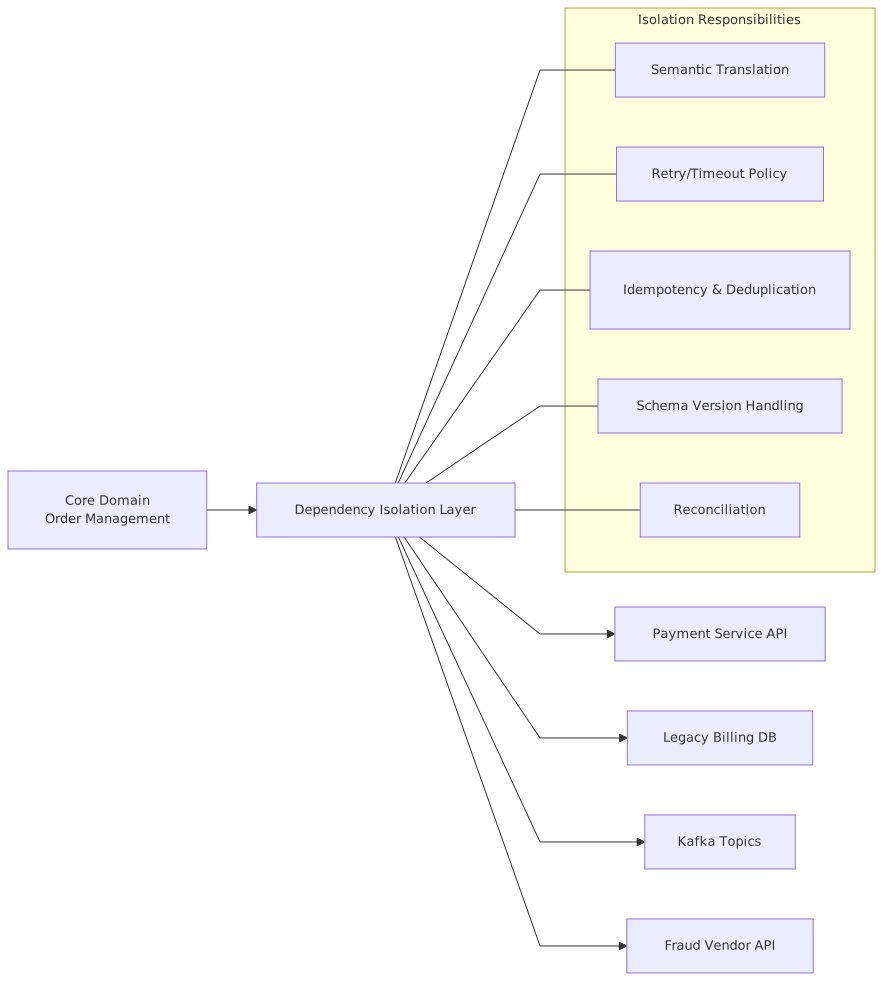
The important thing is not the extra box. It is the change in responsibility. Core domain code should decide what the business wants. Isolation code should deal with how the outside world behaves.
That line is easier to draw than to keep. Teams constantly blur it. But if you do not keep it, your domain model becomes a travel adapter collection.
Architecture
A useful architecture separates three concerns:
- domain core: aggregates, domain services, policies, invariants
- application/service layer: use case coordination
- dependency isolation layer: external interaction mediation
The isolation layer should be explicit, not accidental. Not a random package of clients and mappers nobody owns. It needs design attention because this is where semantics and operational resilience meet.
Internal shape
A practical internal structure often looks like this:
- ports/interfaces defined in local domain terms
- translators/mappers converting between external and internal models
- client adapters handling transport mechanics
- policy wrappers for retries, rate limiting, caching, circuit breakers
- state trackers for idempotency keys, correlation IDs, and replay markers
- reconciliation processors comparing local expectations with external facts
- outbox/inbox components for reliable event publishing and consumption
Synchronous dependencies
For request-response interactions, the isolation layer should present stable local operations such as:
authorizePayment(orderId, amount, paymentMethodRef)lookupCreditStanding(accountId)reserveInventory(sku, quantity, reservationContext)
Notice what is absent: raw vendor payloads, HTTP status assumptions, and foreign object graphs.
A well-designed operation returns outcomes meaningful to the local domain. Maybe PaymentAuthorized, PaymentDeclined, PaymentPendingReview, not vendorCode=2047.
Asynchronous dependencies with Kafka
Kafka often makes teams feel decoupled because nobody is calling anybody directly. But event coupling is still coupling.
In fact, event streams can create stronger long-term coupling because schemas linger and consumer assumptions become invisible. Dependency isolation is crucial here. A service should not let a producer’s event become its internal domain event by default.
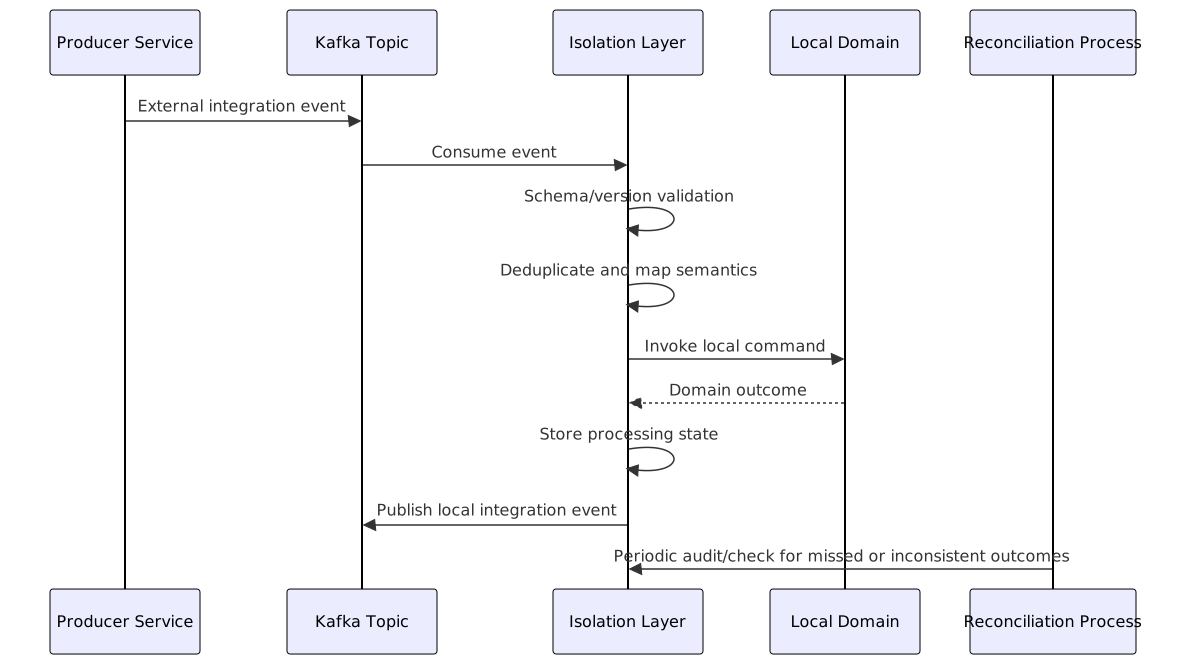
The pattern I prefer is:
- consume external integration events
- validate and normalize them
- map them into local commands or local domain events
- persist processing state for idempotency
- publish outward-facing events from local truth, not by forwarding payloads
This matters enormously in enterprises running event-driven architectures across dozens of domains. A Kafka topic is not a magical bounded context. It is merely a pipe. Semantics still need stewardship.
Reconciliation as a first-class concern
Reconciliation is often omitted from architecture diagrams because it looks like admitting weakness. In real systems, it is the thing that saves you on bad days.
If a payment provider times out after receiving your request, what happened? Maybe it succeeded. Maybe it failed. Maybe you will get a Kafka callback later. Maybe you won’t. If your architecture assumes clean request-response certainty, production will educate you.
Dependency isolation layers should often own reconciliation workflows:
- compare expected external outcomes with actual acknowledgements
- query dependency systems for missing confirmations
- detect and repair drifts
- trigger compensations or manual review
- produce audit evidence
This is especially important in financial services, insurance claims, order fulfilment, and any domain where eventual consistency is acceptable but silent inconsistency is not.
Data isolation during migration
Sometimes a new service still needs data that lives in a monolith database. Direct reads can be a useful transitional move, but only through an isolation layer. Never let domain logic depend directly on legacy schema tables. Legacy schemas encode historical accidents. If you import them directly, your new service is not new; it is merely remote.
The isolation layer can:
- encapsulate legacy queries
- reshape data into local concepts
- detect schema drift
- support gradual replacement with API or event-fed projections
Migration Strategy
This pattern earns its keep during migration.
The clean-slate version of microservices architecture is easy to admire and almost useless in a large enterprise. Most organizations migrate from something old, overloaded, and politically sensitive. The right strategy is usually progressive strangler migration: carve out capability by capability, route behavior gradually, and preserve business continuity while changing dependencies behind the scenes.
Dependency isolation layers are one of the practical tools that make the strangler pattern survivable.
Step 1: Identify semantic seams, not just technical seams
Do not start by asking, “What endpoint can we peel off?” Start by asking, “Where does the business language naturally separate?” This is classic domain-driven design: find bounded contexts, contested terms, and places where the monolith model already means too many things to too many people.
These seams tell you where isolation is necessary.
Step 2: Wrap legacy dependencies before extracting fully
A mistake I see repeatedly: teams extract a service but keep direct internal dependency logic all through the codebase. Then later they try to clean it up. That almost never happens.
Instead, create the isolation layer first, even inside the monolith if needed. Introduce ports and translators around the legacy function, database, or batch process. Once that interface exists, moving the capability into a separate service becomes much less traumatic.
Step 3: Dual-run and compare
During strangler migration, run old and new paths in parallel where feasible. Use the isolation layer to compare outputs, capture discrepancies, and feed reconciliation. This is one of the safest ways to migrate complex business rules without betting the quarter on a single cutover.
Step 4: Publish local contracts, not legacy contracts
When the new microservice is exposed, resist the urge to mirror the old monolith structure. Design a local published language around the service’s bounded context. Use the isolation layer internally to keep talking to legacy during transition if needed.
Step 5: Shift from read-through to event-fed models
A common progression is:
- initial direct legacy read through isolation
- introduce change events or CDC into Kafka
- build local projections
- cut synchronous reads
- finally retire legacy source dependency
That sequence lets you reduce runtime coupling gradually rather than forcing a single all-or-nothing migration event.
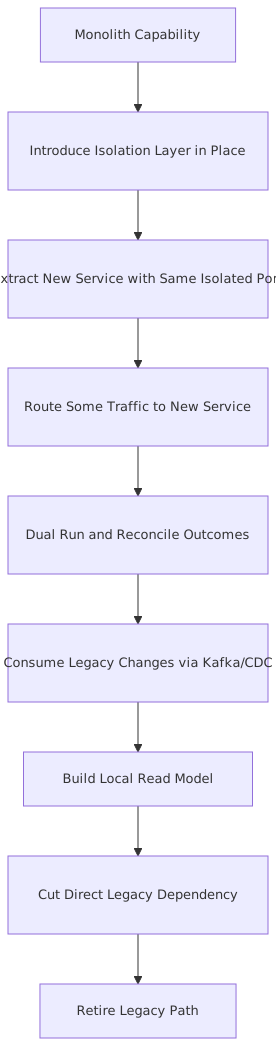
The strangler fig is a good metaphor because it grows around the old thing while slowly replacing its role. But unlike the fig, enterprise migration must leave an audit trail.
Enterprise Example
Consider a global insurer modernizing claims processing.
The legacy claims platform was a 20-year-old monolith. It owned policy data, payment instructions, adjuster workflows, fraud flags, and regulatory reporting. The company wanted separate services for Claims Intake, Coverage Decisioning, Payment Orchestration, Fraud Assessment, and Customer Communications. Kafka was chosen for integration. Everyone was excited. Then reality arrived.
The first extracted service, Claims Intake, consumed policy information directly from the monolith database because “the APIs weren’t ready.” It also published claim-created events carrying policy status codes copied directly from the legacy schema. Downstream teams used those codes because they were already available. Fraud Assessment added branching logic based on legacy product line indicators. Payment Orchestration relied on intake events to determine customer identity shape. Six months in, four new services were now semantically coupled to the old claims platform.
The organization paused and redesigned around dependency isolation layers.
What changed
Claims Intake introduced a policy dependency isolation layer. Instead of leaking monolith policy records, it translated them into local concepts such as:
- coverage snapshot
- claimant relationship
- policy eligibility status
- reporting obligations
The local domain stopped reasoning about legacy policy states entirely.
Kafka consumers were changed so external integration events were normalized before hitting domain workflows. Intake no longer forwarded producer payloads. It published events based on its own facts:
ClaimRegisteredCoverageVerificationRequestedClaimSubmissionFlagged
Payment Orchestration added an isolation layer around both the banking provider and the legacy finance system. This layer handled:
- payment instruction mapping
- provider-specific retry windows
- idempotency keys
- delayed confirmation reconciliation
- compensation for duplicate submissions
Reconciliation became a dedicated operational flow. Every expected payment confirmation had a reconciliation deadline. Missing confirmations triggered provider status checks, then manual review if unresolved.
What they gained
- teams could rename and reshape internal models without coordinating every change
- Kafka topics became more stable because events reflected local business facts instead of internal workflow data
- legacy database reads were progressively replaced with CDC-fed local projections
- production incidents moved from “mystery state mismatch” to “known recon queue with operational playbook”
What they paid
They wrote more code. Mapping logic is not free. Reconciliation tables are not glamorous. Some teams complained the architecture was “too indirect.” They were wrong in the short term and right in the local sense: yes, indirection slows the first integration. It speeds the next twenty.
That is the trade every enterprise eventually learns. Convenience is cheap on day one and expensive by year two.
Operational Considerations
Dependency isolation layers are not just design artifacts. They are operational control points.
Observability
Instrumentation should make dependency behavior visible:
- dependency latency by operation
- timeout rates
- retry counts and exhaustion
- schema validation failures
- dead-letter volume
- deduplication hits
- reconciliation backlog aging
- translation failures by source contract version
If you cannot see these, you are not isolating the dependency; you are merely hiding it.
Idempotency and duplicate handling
Kafka consumers, webhook receivers, and retried API calls all create duplicates. Isolation layers should own idempotency where duplicate risk comes from the dependency interaction rather than the domain rule itself.
Contract governance
You need versioning discipline:
- explicit schema compatibility rules
- consumer-driven contract tests where useful
- deprecation timelines
- topic evolution policies
- field-level data ownership
Without governance, the isolation layer turns into an archaeology site.
Security and compliance
Isolation layers are good places to enforce:
- token exchange and credential scoping
- PII redaction
- data minimization
- audit correlation
- encryption policy adaptation across dependencies
Performance
Translation and policy enforcement add latency. Usually this is acceptable. Sometimes it is not. For hot paths, optimize carefully:
- cache external lookups when semantics allow
- prefer asynchronous flows for uncertain dependencies
- precompute projections for read-heavy scenarios
- avoid chatty isolation interfaces that split one useful call into many tiny ones
Tradeoffs
This pattern is not free, and pretending otherwise is how architecture loses credibility.
Benefits
- stronger bounded contexts
- reduced semantic leakage
- safer change management
- better migration options
- clearer operational ownership of external interaction logic
- improved resilience through controlled failure handling
- easier replacement of vendors or legacy systems
Costs
- more components and code
- mapping maintenance overhead
- possible latency increase
- risk of over-abstraction
- teams may duplicate similar translation logic if governance is weak
- harder onboarding if boundaries are poorly documented
The trick is proportion.
A payment provider, a core legacy platform, and a semantically messy shared customer system usually deserve strong isolation. A simple internal utility service returning exchange rates may not. Use architectural weight where volatility and semantic mismatch justify it.
Failure Modes
Dependency isolation layers fail in recognizable ways.
1. The “just a mapper” trap
Teams reduce the layer to field-to-field mapping and ignore semantics, retries, idempotency, and reconciliation. The result is thin indirection with none of the protection.
2. Business logic leakage
Too much domain logic moves into the isolation layer because “it depends on what the provider does.” Then the layer becomes a shadow domain nobody understands. Keep business policy in the domain unless it is truly about dependency behavior.
3. Canonical model fantasy
An enterprise team creates a universal schema to avoid local translation. It becomes bloated, political, and semantically vague. Every team uses it differently. Local isolation would have been simpler.
4. Shared isolation library across domains
A central team builds one shared adapter package for everyone. This often reintroduces coupling because each domain has different semantics. Shared transport utilities are fine. Shared domain translation usually is not.
5. Reconciliation ignored until incident time
Teams assume retries are enough. Then a provider timeout creates uncertain state and nobody knows how to detect or repair it. If the dependency can acknowledge late, fail ambiguously, or drop callbacks, you need reconciliation by design.
6. Permanent migration scaffolding
Temporary legacy isolation code becomes permanent because nobody funds the final cut. This is common. Treat transitional dependencies as debt with named owners, target milestones, and visible reporting.
When Not To Use
Dependency isolation layers are powerful, but not universal.
Do not use a heavy isolation layer when:
- the dependency is trivial, stable, and semantically aligned
- the service is small and temporary
- the team is still exploring domain boundaries and needs speed over polish
- the cost of indirection outweighs likely change
- a single team owns both sides tightly and evolves them together
- latency requirements are so strict that every transformation must be justified
Also, do not use this pattern to avoid organizational problems. If teams cannot agree on ownership, SLAs, or event contracts, another layer will not save you. It may merely hide conflict until later.
And do not confuse isolation with duplication for its own sake. Translating every field into a differently named field is not architecture. It is theatre.
Related Patterns
Dependency isolation layers sit near several established patterns.
Anti-Corruption Layer
The closest relative from domain-driven design. Especially useful against legacy systems or external bounded contexts with incompatible models.
Hexagonal Architecture / Ports and Adapters
Provides the structural discipline to keep external dependencies away from the domain core.
Strangler Fig Pattern
A migration approach where isolation layers allow old and new systems to coexist while traffic and responsibilities move incrementally.
Outbox / Inbox Pattern
Supports reliable event publication and consumption, especially with Kafka and eventual consistency.
Saga / Process Manager
Useful for multi-step distributed workflows, though these should still use isolation around external participants.
Backend for Frontend
Similar in spirit at the edge: isolate client-specific needs from internal service contracts.
Canonical Data Model
Often proposed as an alternative. Sometimes helpful for limited enterprise integration. Frequently overused. I would choose local translation first unless there is a compelling, narrow reason for a canonical model.
Summary
Dependency isolation layers are one of those patterns that sound optional until the system gets large, old, or politically real.
Their job is not to make diagrams prettier. Their job is to preserve the meaning and maneuverability of a service in a world full of unstable dependencies. They protect bounded contexts from semantic leakage. They give migration a safer path. They provide a place to handle retries, idempotency, schema drift, and reconciliation without infecting domain logic. They make Kafka integrations less naïve. They reduce the blast radius of change.
Most importantly, they force an honest architectural question: whose language is this service speaking?
If the answer is “mostly everyone else’s,” then the service is not really autonomous, no matter how many containers it runs in.
Use dependency isolation layers when the dependency is volatile, semantically foreign, operationally uncertain, or central to a progressive strangler migration. Keep them thin where they can be thin, but not thinner than reality allows. Include reconciliation where the outside world can be ambiguous. Avoid universal models that flatten domain meaning. And remember the enterprise lesson that keeps repeating itself: coupling is easiest to create at the exact moment nobody feels it.
That is why the layer matters. Not because architecture loves indirection, but because the business eventually pays for every assumption that crosses a boundary unexamined.
Frequently Asked Questions
What is a service mesh?
A service mesh is an infrastructure layer managing service-to-service communication. It provides mutual TLS, load balancing, circuit breaking, retries, and observability without each service implementing these capabilities. Istio and Linkerd are common implementations.
How do you document microservices architecture for governance?
Use ArchiMate Application Cooperation diagrams for the service landscape, UML Component diagrams for internal structure, UML Sequence diagrams for key flows, and UML Deployment diagrams for Kubernetes topology. All views can coexist in Sparx EA with full traceability.
What is the difference between choreography and orchestration in microservices?
Choreography has services react to events independently — no central coordinator. Orchestration uses a central workflow engine that calls services in sequence. Choreography scales better but is harder to debug; orchestration is easier to reason about but creates a central coupling point.