⏱ 19 min read
Distributed systems do not fail because teams forget how to write if statements. They fail because the business believes one thing, one service believes another, and the data warehouse confidently reports a third version to the board on Monday morning.
That is the real problem with data synchronization in microservices. Not movement of bytes. Not APIs. Not brokers. Semantics. microservices architecture diagrams
In a monolith, we got away with the fiction of a single truth because everything hit the same database and the same transaction boundary. In microservices, that fiction collapses. Every service has its own model, its own persistence, its own release cadence, and—if we have done domain-driven design properly—its own language for what the data means. “Customer” in Billing is not “Customer” in CRM. “Order shipped” in Fulfillment is not the same event as “Order completed” in Commerce. The words may match. The business intent often does not.
So when architects ask, “How should these services stay in sync?”, the right answer is not “use Kafka” any more than “use cement” is a complete design for a bridge. Kafka may be part of the answer. Change Data Capture may be part of the answer. APIs, outbox, reconciliation jobs, materialized views, and even a blunt nightly batch may all have their place. Synchronization is a topology problem wrapped around a domain problem and paid for with operational complexity. event-driven architecture patterns
This article lays out the major data synchronization patterns for microservices, when they work, when they hurt, and how to migrate toward them without setting fire to the existing estate.
Context
Microservices break apart a large application into smaller services aligned to business capabilities. That is the theory. In practice, most enterprises arrive there carrying decades of shared schemas, integration middleware, nightly ETL, and applications that insist they are “service-oriented” because they once emitted XML.
Still, the move is usually worth making. Independent deployments matter. Team autonomy matters. The ability to evolve one part of the business model without issuing a database release train across seven departments matters a great deal.
But the moment each service owns its own data, synchronization becomes unavoidable.
A customer updates their address. Who must know?
- CRM, because the relationship changed
- Billing, because invoices must be correct
- Fraud, because a sudden address change might be suspicious
- Shipping, because a parcel is about to leave the warehouse
- Analytics, because the business wants cohort metrics by region
- Compliance, because retention and consent rules may differ by jurisdiction
Now add latency tolerance, auditability, retries, partial outages, legal controls, and the fact that none of these systems mean exactly the same thing by “address.”
This is why synchronization is architecture, not plumbing.
Problem
The core problem sounds simple:
> How do independently owned services maintain sufficiently consistent views of shared business facts without collapsing back into a distributed monolith?
That “sufficiently” matters. Perfect consistency across service boundaries is expensive, brittle, and usually unnecessary. The business often needs one of several different outcomes:
- immediate consistency for a critical decision
- eventual consistency within seconds for customer-facing workflows
- periodic consistency for reporting
- authoritative reconstruction for audit
- best-effort propagation plus reconciliation for operational support
The anti-pattern is equally clear: teams either centralize all data again in the name of consistency, or they scatter synchronization logic everywhere until the estate resembles a plate of enterprise spaghetti with observability dashboards on top.
The hard bit is not picking a mechanism. It is deciding what synchronization means in each bounded context.
Forces
Several forces pull against one another here.
1. Domain autonomy vs enterprise coherence
Domain-driven design tells us each bounded context should own its language, rules, and persistence. That is good design. But enterprises also need coherent business operations. Finance cannot close the books on “bounded contexts.” It closes the books on revenue.
So the architect must preserve domain autonomy while enabling enterprise-level flow.
2. Timeliness vs correctness
Real-time synchronization sounds attractive until you discover the upstream event was wrong, duplicated, or arrived out of order. Batch sounds unfashionable until you realize a nightly reconciliation can save an entire quarter-end process.
Speed and correctness are often in tension.
3. Coupling vs convenience
Synchronous APIs are easy to reason about. Service A asks Service B. Done. Until B is slow, then A degrades, then retries create pressure, then a transient fault becomes a cascading outage.
Asynchronous messaging reduces runtime coupling but increases temporal complexity. The message you needed may arrive late, twice, or not at all.
4. Local optimization vs global operability
A team can build a neat synchronization shortcut for itself. Ten teams doing that create a support nightmare. Enterprises need a small number of repeatable patterns, not fifty artisan integration styles.
5. Source of truth vs fit-for-purpose copies
Every service should own its authoritative data. Yet other services often need local projections or cached copies to function independently. Copies are not the problem. Unclear ownership is.
A useful rule: copy data freely, copy authority never.
Solution
There is no single data synchronization pattern for microservices. There is a portfolio. The sensible architecture uses different patterns for different semantic needs.
The most common patterns are:
- Synchronous query on demand
- Domain events for state change propagation
- Change Data Capture for legacy integration or broad fan-out
- Materialized read models / local projections
- Scheduled reconciliation
- Bulk or batch synchronization for analytics and downstream platforms
- Command/process orchestration for multi-step business flows
These are not mutually exclusive. Most real enterprises use several at once.
A good synchronization strategy starts by classifying data interactions into four categories:
- Reference lookups: fetch current data when needed
- Business facts: publish meaningful domain events
- Operational copies: maintain local projections
- Assurance flows: reconcile and repair drift
That last category is the one architects neglect. They should not. In distributed systems, drift is not a possibility. It is a certainty with a variable schedule.
Architecture
Let us be explicit about the topology choices.
Topology 1: Synchronous point-to-point
This is the simplest model. One service calls another over HTTP/gRPC to fetch data or execute logic.
Use it when:
- the request requires current authoritative data
- latency is acceptable
- the dependency is business-legitimate
- you can tolerate runtime coupling
Do not use it for broad state propagation. That path leads to chatter, fan-out, and a system where every request drags half the enterprise behind it.
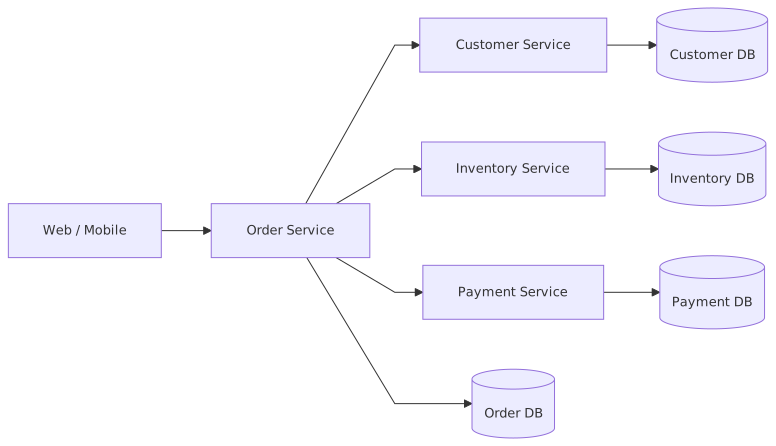
This topology works best for transactional decisions where stale data is unacceptable. Payment authorization is a good example. Credit limit checks may be another.
But it scales poorly as a synchronization model because every dependency becomes a live wire.
Topology 2: Event-driven propagation with local copies
Here a service publishes domain events when meaningful business facts change. Other services subscribe and update their own projections.
This is where Kafka often earns its keep. Not because it is fashionable, but because it handles durable event streams, consumer groups, replay, partitioning, and throughput at enterprise scale.
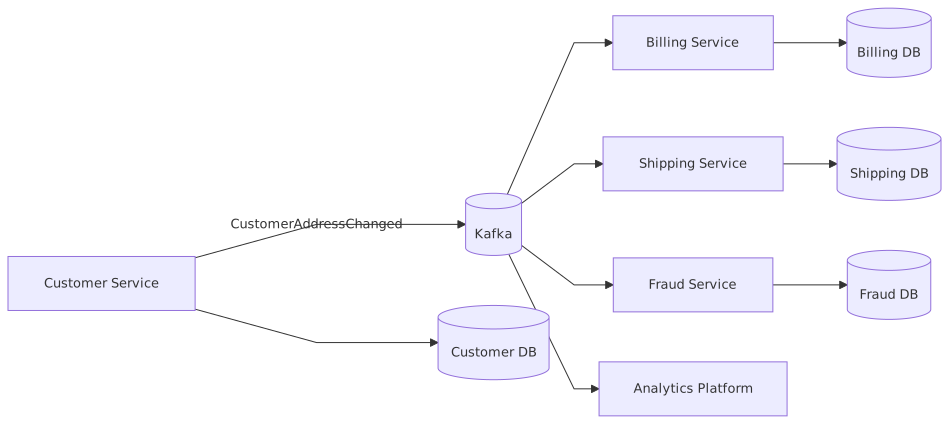
This topology supports autonomy. Billing can retain the customer details it needs, Shipping can reshape the event into its own model, and Analytics can consume the same stream for historical processing.
The trick is that the event must be a domain event, not a leaked database row. “CustomerAddressChanged” is useful. “CUSTOMER_TBL updated, field ADR_2 = X” is not architecture; it is accidental coupling dressed as integration.
Topology 3: Legacy coexistence with CDC and reconciliation
In migration scenarios, especially around large relational systems, Change Data Capture is often the pragmatic bridge. You capture committed database changes from the legacy estate, publish them to Kafka or another bus, and let new services consume them while you gradually replace the old system.
But CDC is an implementation signal, not a business language. It should be treated as transitional or infrastructural unless the data really is low-level technical replication.
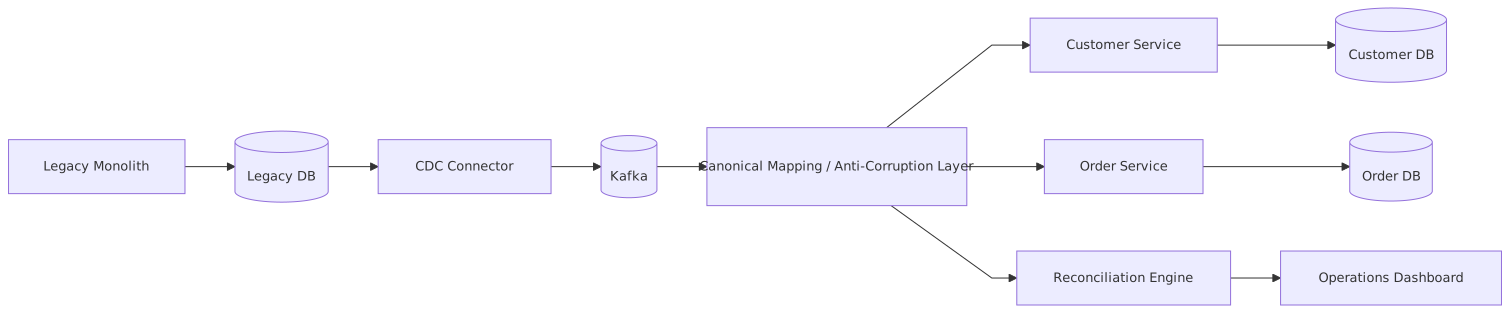
This pattern is common in enterprises because reality is common. You do not get to redesign the world in one release.
Domain semantics: the part people skip
Synchronization fails most often when teams confuse data shape with business meaning.
A row changed in a source table. Fine. What happened in the business?
- Did the customer really change address?
- Was the record corrected because of a failed enrichment process?
- Was it merged due to duplicate customer resolution?
- Did legal domicile change, or only shipping preference?
- Is this update final, pending verification, or system-generated noise?
A bounded context should publish events that reflect its language and intent. That is straight domain-driven design. If Customer Management owns customer identity and profile semantics, it should publish events from that ubiquitous language. Downstream services then translate into their own contexts.
For example:
- CRM publishes
CustomerAddressChanged - Billing maps that to
InvoiceContactUpdated - Shipping maps it to
DeliveryDestinationUpdated - Fraud interprets it as an input signal in a risk model
Same source fact. Different downstream semantics.
This is why a canonical enterprise data model rarely solves synchronization by itself. It can help with interoperability, yes. But if forced too hard, it turns every bounded context into a servant of a central committee. The result is stale design and angry teams.
A better pattern is published language plus anti-corruption layer. Let services publish meaningful events. Let consumers translate.
Migration Strategy
Most enterprises are not starting greenfield. They are leaving behind shared databases, nightly jobs, ESBs, and integration contracts older than some members of the team.
So migration needs to be progressive. The strangler pattern is the right instinct here, but in data synchronization it must be applied with discipline.
Step 1: Identify authoritative domains
Before moving any integration, define ownership.
Who owns:
- customer profile
- pricing rules
- inventory position
- order lifecycle
- payment status
If two systems both claim authority, synchronization will become a political issue masquerading as a technical one.
Step 2: Put an anti-corruption layer around the legacy core
Do not let every new microservice talk directly to the monolith database. That is not migration. That is a distributed monolith with a support budget.
Instead, introduce a layer that translates legacy structures into stable service contracts or event streams.
Step 3: Use CDC where necessary, but aim for domain events
CDC is excellent for bootstrapping and coexistence. It is less excellent as a permanent expression of the business. The migration path should move from:
- table changes
- to mapped technical events
- to true domain events emitted by the owning service
Step 4: Build local projections in new services
New services should maintain local stores for the data they need often. This reduces chatty dependencies and decouples read paths.
Step 5: Add reconciliation early
This is where experienced architects part company from enthusiastic framework users.
Do not wait until after go-live to think about reconciliation. Add it from day one.
You need:
- replay capability
- dead-letter handling
- drift detection
- compensating repairs
- operator-visible diagnostics
Step 6: Cut over business capability by business capability
Not by table. Not by package. By capability.
Move customer onboarding first, perhaps. Then profile maintenance. Then notification preferences. Keep the migration aligned to business seams.
A strangler sequence in practice
- Legacy customer updates remain in monolith
- CDC emits customer table changes
- New Customer Service subscribes and builds a clean model
- New channels write through Customer Service
- Customer Service becomes system of entry for selected journeys
- It begins publishing
CustomerCreated,CustomerAddressChanged,CustomerConsentUpdated - Downstream consumers switch from CDC-derived events to domain events
- Legacy update paths are retired incrementally
That is not glamorous. It is what works.
Enterprise Example
Consider a multinational insurer modernizing policy administration.
The starting point:
- a mainframe-backed policy system
- a CRM package
- a claims platform
- separate billing software
- nightly batch synchronization into an enterprise warehouse
- dozens of brittle point integrations
The business pain was not abstract. Customers changed address in CRM and still received policy documents at the old address. Billing had one view of policy holder identity, Claims another. Contact center staff compensated manually, which is enterprise language for “we are paying people to glue broken systems together.”
Target architecture
The insurer carved out bounded contexts:
- Customer Profile
- Policy Lifecycle
- Billing
- Claims
- Communications
Customer Profile became the authoritative owner of party identity and contact channels. Policy remained owner of policy state. Billing owned payment obligations. Claims owned incident and settlement data.
Kafka was introduced as the event backbone, not as a universal hammer but as the durable transport for business facts.
The team used Debezium-based CDC from the legacy policy database to bootstrap events into Kafka. An anti-corruption service translated low-level policy changes into higher-level event candidates. Meanwhile, the new Customer Profile service emitted true domain events from its own transaction boundary using the outbox pattern.
Downstream consumers maintained local projections:
- Communications cached mailing preferences and validated addresses
- Billing stored customer contact references relevant to invoicing
- Claims kept claimant communication details separate from policy-holder profile
Why this worked
Because they did not pretend every “customer” field meant the same thing.
A claimant in Claims was not always the same role as a policy holder in Policy. Billing needed legal invoice recipient semantics. Communications needed channel preferences and suppression rules. A shared customer master alone would not have solved that.
Instead, they synchronized around meaningful business facts and translated into local models.
Reconciliation in the real world
Despite all this, drift still happened.
- Kafka consumers fell behind during a regional failover
- one service version mishandled duplicate suppression
- CDC missed a subset of changes during a connector rebalance
- old batch jobs continued writing to a legacy field unexpectedly
The insurer avoided catastrophe because it had built reconciliation as a first-class capability:
- daily comparison jobs checked policy-contact alignment across key systems
- event lag dashboards showed stale projections
- replay tooling let operators rebuild local state from retained streams
- a repair workflow generated targeted correction commands instead of raw SQL
That is what mature microservice synchronization looks like. Not perfection. Recoverability.
Operational Considerations
Synchronization patterns live or die in operations.
Outbox pattern
If a service updates its database and publishes an event separately, it will eventually fail between the two steps. Then the database says one thing and the event log says nothing.
Use the outbox pattern:
- write state change and event record in one local transaction
- publish asynchronously from the outbox
- mark published safely
This is one of the few patterns I would call non-negotiable for event-driven microservices.
Idempotency
Consumers must tolerate duplicate events. Brokers retry. Producers retry. Networks lie.
A consumer should be able to process the same event more than once without corrupting state. This often means:
- stable event IDs
- version checks
- deduplication store
- upsert semantics rather than blind insert
Ordering
Kafka can preserve order within a partition, not across all partitions. That is enough if you partition by aggregate identity where needed. It is not enough if your design implicitly assumes global order across the business.
Do not build synchronization logic that requires omniscient sequencing of the universe.
Schema evolution
Events live a long time. Longer than your sprint board. Use versioning discipline:
- additive changes where possible
- consumer tolerance for unknown fields
- explicit deprecation periods
- schema registry if the platform supports it
Replay and bootstrap
Any serious synchronization architecture needs replay. New consumers must rebuild state. Corrupted consumers must recover. Audit questions will arise six months later.
If your event backbone cannot support replay, then your synchronization model is brittle by design.
Observability
You need more than CPU and memory charts. You need data movement observability:
- consumer lag
- dead-letter counts
- projection freshness
- reconciliation mismatches
- event publication failures
- outbox backlog
- semantic error rates
The dashboard that matters is not “broker healthy.” It is “shipping addresses in Shipping match customer-authoritative state for all active orders.”
Tradeoffs
No synchronization pattern comes free.
Synchronous APIs
Pros
- current authoritative data
- simple request-response flow
- easy to understand initially
Cons
- runtime coupling
- cascading failure risk
- latency amplification
- poor fit for broad distribution
Domain events
Pros
- loose runtime coupling
- natural fan-out
- audit-friendly history
- supports autonomous projections
Cons
- eventual consistency
- harder debugging
- duplicate/out-of-order handling
- semantic design required
CDC
Pros
- excellent for legacy coexistence
- low-friction source capture
- broad replication possibilities
Cons
- leaks persistence model
- weak business semantics
- can create hidden coupling to source schema
- dangerous as permanent architecture if used lazily
Reconciliation
Pros
- repairs drift
- improves confidence
- supports operational recovery
Cons
- extra complexity
- can hide design flaws if overused
- often neglected until late
A practical architecture usually combines:
- synchronous calls for immediate transactional decisions
- domain events for fact propagation
- local projections for read autonomy
- reconciliation for integrity
- CDC during migration or for low-level replication needs
That blend is often the sweet spot.
Failure Modes
Here are the failure modes that appear repeatedly in enterprise programs.
1. Shared database in disguise
Teams say they have microservices, but every service still reads the same core tables. Deployment independence evaporates. One schema change becomes an enterprise incident.
2. Event as table-change dump
The source service emits raw row updates and calls it event-driven architecture. Consumers become tightly coupled to internal schema details. Any refactoring ripples everywhere.
3. No explicit ownership
Two systems can update the same business field. Synchronization loops begin. Last-write-wins silently destroys intent.
4. Missing idempotency
Duplicate event delivery creates duplicate invoices, duplicate notifications, or broken balances. This one is painful because it often appears only under stress.
5. No reconciliation path
Teams assume events always flow. They do not. Backlogs happen. Corruption happens. Human fixes happen. Without reconciliation, small drift accumulates into operational mistrust.
6. Over-centralized canonical model
The enterprise integration team invents a grand universal schema. Every service must conform. Delivery slows. Domain nuance disappears. Workarounds multiply.
7. Under-modeled semantics
An “updated” event says too little. Consumers guess business meaning. Different teams implement different interpretations. Reports diverge.
8. Synchronous fan-out in customer journeys
One user action causes six live service calls, two timeouts, three retries, and one war room.
If a workflow must survive partial outage, design it asynchronously or with graceful degradation.
When Not To Use
Event-driven synchronization is powerful, but not always the right answer.
Do not use elaborate asynchronous synchronization when:
- the domain is small and cohesive enough for a modular monolith
- consistency must be immediate and cross-entity transactional
- operational maturity is weak and the team cannot support brokers, schema evolution, replay, and observability
- data sharing is minimal and simple APIs are enough
- the business process is fundamentally batch-oriented and gains little from real-time propagation
Likewise, do not force microservices where the real problem is poor modularity. A well-structured monolith with clear domain boundaries often beats a badly synchronized microservice estate.
And do not use CDC as your primary domain integration model if you already control the service code and can publish business events directly. CDC is often a bridge. Sometimes a useful permanent infrastructure feed. It is rarely the best expression of business intent.
Related Patterns
Several related patterns matter here.
Saga / process manager
Useful when synchronization is not just data copying but multi-step business coordination. A customer order, payment, stock reservation, and shipment may require orchestration or choreography with compensation.
CQRS
Helpful where read models differ significantly from write models. Local materialized views are often a practical CQRS tactic in synchronization-heavy domains.
Outbox / inbox
Essential patterns for reliable message publication and idempotent consumption.
Anti-corruption layer
Critical in migration and integration with legacy or vendor packages. Protects the bounded context from alien semantics.
Master data management
Sometimes relevant for enterprise-wide reference entities, but it should not replace bounded context ownership. MDM can govern identity and stewardship; it should not flatten all domain meaning into one watered-down model.
Data mesh and analytical synchronization
For analytics, event streams and data products may complement operational synchronization. But analytical sharing should not drive transactional design blindly.
Summary
Data synchronization in microservices is not a technical side quest. It is the architecture.
The central design question is not, “How do I copy data between services?” It is, “Which business facts must be shared, at what speed, with what authority, and how will we detect and repair drift when—not if—it occurs?”
The best microservice estates follow a few hard-earned rules:
- align synchronization with bounded contexts and domain language
- keep authority local to the owning service
- publish business events, not database gossip
- use Kafka and event streams where durable propagation and replay matter
- use synchronous calls sparingly for truly current decisions
- adopt CDC pragmatically during migration, not lazily as permanent semantics
- build reconciliation from the start
- migrate progressively with a strangler approach, capability by capability
And remember the most important line in this whole topic:
In distributed systems, consistency is not a state you buy. It is a discipline you practice.
If you treat synchronization as plumbing, the estate will drift into confusion. If you treat it as a domain problem with explicit tradeoffs, operational safeguards, and a migration path grounded in reality, microservices can stay independent without becoming incoherent. That is the balance worth designing for.
Frequently Asked Questions
What is a service mesh?
A service mesh is an infrastructure layer managing service-to-service communication. It provides mutual TLS, load balancing, circuit breaking, retries, and observability without each service implementing these capabilities. Istio and Linkerd are common implementations.
How do you document microservices architecture for governance?
Use ArchiMate Application Cooperation diagrams for the service landscape, UML Component diagrams for internal structure, UML Sequence diagrams for key flows, and UML Deployment diagrams for Kubernetes topology. All views can coexist in Sparx EA with full traceability.
What is the difference between choreography and orchestration in microservices?
Choreography has services react to events independently — no central coordinator. Orchestration uses a central workflow engine that calls services in sequence. Choreography scales better but is harder to debug; orchestration is easier to reason about but creates a central coupling point.