⏱ 20 min read
Microservices fail in surprisingly ordinary ways.
Not because the code is hard. Not because the teams are lazy. Not because Kubernetes wasn’t configured with enough YAML to blot out the sun. They fail because the architecture quietly turns every customer request into a scavenger hunt across the network.
A product page calls pricing. Pricing calls promotions. Promotions calls customer entitlements. Entitlements calls account status. Account status checks region restrictions. Then someone adds personalization, recommendations, and fraud screening for good measure. What looked elegant on a whiteboard becomes a distributed parade of tiny remote calls. Latency creeps in. Availability drops. Ownership blurs. Eventually, the business asks a fair question: why does fetching a shopping cart require more choreography than settling an insurance claim?
That is the real subject of data locality in microservices architecture. Not just where data physically sits, but whether the data needed to make a decision is available close to the service making that decision. Locality is the difference between a service acting with confidence and a service constantly asking permission from its neighbors. microservices architecture diagrams
In healthy systems, services are autonomous because their data is local enough to support their responsibilities. In unhealthy systems, services are merely fragmented. They look independent in deployment pipelines but remain tightly coupled in runtime behavior.
This is where architecture becomes less about boxes and arrows and more about domain semantics. You do not get locality by sprinkling caches around a bad model. You get locality by deciding, with some discipline, what a service is truly responsible for, which facts it must own, which facts it may replicate, and which facts are too volatile or too sensitive to duplicate. Domain-driven design matters here because locality is not a storage trick. It is a consequence of bounded contexts, aggregate boundaries, and clear ownership of business truth.
If you remember one line, make it this one: a microservice without local decision-making data is just a remote procedure with branding.
Context
The promise of microservices was straightforward: smaller services, independent teams, autonomous delivery, bounded blast radius, and faster change. In many enterprises, that promise collided with legacy realities.
Most large organizations begin with a shared database, a sprawling ERP, a core system of record, or a monolith that has earned its complexity over decades. The first wave of “microservices modernization” often carves APIs around existing tables rather than around real business capabilities. Teams expose thin service layers over centralized data, or worse, each service becomes a chatty facade over the same relational model.
This works just enough to get funded.
Then volume rises. More channels arrive. Mobile traffic behaves differently from desktop. Regional compliance rules differ. Customer expectations move from “eventual response” to “instant interaction.” Suddenly the architecture is dominated by network hops, not domain boundaries.
Data locality becomes the next hard problem.
There are several dimensions to locality:
- Physical locality: data stored near the compute that needs it.
- Logical locality: the relevant business facts are available within the service boundary.
- Temporal locality: recently used data is kept where it is likely needed again.
- Domain locality: information needed for a business capability is owned or replicated inside the right bounded context.
Physical locality matters for performance. Logical locality matters for autonomy. Domain locality matters for keeping the model honest.
In enterprise systems, these dimensions get tangled. A customer profile may live in a customer master system, but order fulfillment needs a local projection of shipping preferences. Fraud may require a copy of payment risk indicators, but not the full card data. Pricing may need product classification and market segment, but it should not depend synchronously on customer support history.
This is not duplication by accident. It is duplication in service of responsibility.
Problem
The core problem is simple to state and hard to solve: microservices need data they do not own in order to perform useful business work.
If every service reaches across the network whenever it needs context, the system becomes:
- chatty
- slow under load
- fragile under partial failure
- difficult to evolve
- unclear in ownership
The anti-pattern is common: a request enters Service A, which calls Service B and C; B calls D; C calls E; one of those calls retries; another times out; now the user sees a spinner and the operations team sees a storm.
The issue is not merely performance. It is semantic confusion. Services begin to depend on one another’s internal data structures and timing assumptions. The architecture loses the very decoupling it was meant to create.
Consider an order submission workflow:
- Order service needs customer eligibility.
- It also needs current price rules.
- It must check inventory allocation.
- It may need fraud score thresholds.
- It must enforce regulatory shipping restrictions.
If all of these are synchronous lookups to systems of record, order submission becomes a distributed join across business capabilities. Distributed joins are the tax you pay for weak service boundaries.
Here is what that looks like in practice.
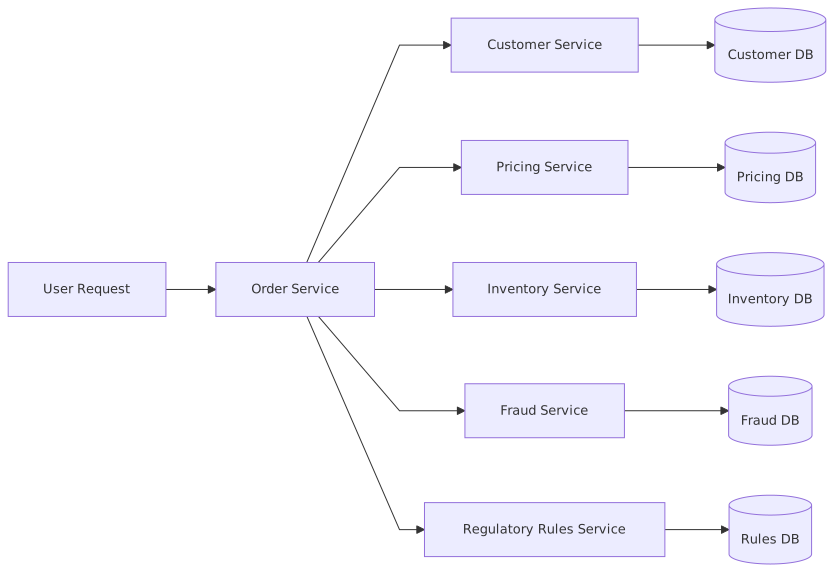
Every arrow is a latency contribution. Every dependency is a failure mode. Every service contract now carries hidden domain assumptions.
And because reality is rude, these dependencies do not remain static. The pricing service starts needing customer segment logic. The fraud service wants fulfillment patterns. Inventory wants promotion reservation context. Before long, the topology resembles a bowl of enterprise spaghetti with SSL certificates.
Forces
Architectural decisions around locality are shaped by competing forces. This is why simplistic advice fails.
1. Autonomy versus consistency
A service can move faster when the data it needs is local. But replicated data introduces consistency lag. Some decisions tolerate stale information. Others do not.
Shipping estimate calculations can usually tolerate slight delay in customer preference updates. Credit exposure checks probably cannot.
2. Performance versus duplication
Local data reduces network calls and improves latency. But duplication increases storage, synchronization logic, and governance effort. The organization must decide where duplication is strategic and where it is wasteful. EA governance checklist
3. Domain purity versus operational practicality
DDD encourages clear bounded contexts and ownership. Good. But enterprises also have reporting needs, legacy systems, and compliance constraints that care little for your elegant context map. Sometimes a service needs a denormalized read model because the business cannot wait for philosophical purity.
4. Freshness versus resilience
Synchronous reads give fresher data, in theory. Event-driven replication gives better resilience, in practice. The trade is not abstract. It is a choice between “always ask the owner” and “keep enough truth nearby to continue working.”
5. Team boundaries versus enterprise integration
Locality often improves when a team fully owns its capability and its data model. But large enterprises have cross-cutting concerns: master data, identity, legal retention, audit, and data lineage. Service autonomy does not erase enterprise obligations.
6. Write complexity versus read complexity
You can centralize writes and simplify authoritative updates, but then reads become expensive and distributed. Or you can materialize read models near consumers and accept the complexity of projections and reconciliation. Most customer-facing systems eventually choose to optimize reads.
Solution
The practical solution is this: align data locality with business decisions, not just data entities.
That sounds obvious. It rarely is.
A service should own the data required to fulfill its core responsibilities. For related facts owned elsewhere, it should prefer local projections, replicated views, caches, or event-driven materializations when those facts are needed frequently, are stable enough to replicate, and can tolerate bounded staleness.
This is where domain-driven design provides the grammar.
Bounded contexts first
Do not start by asking, “which tables should move?” Start by asking:
- What business capability does this service own?
- What decisions must it make independently?
- Which concepts mean something different across contexts?
- Which invariants must remain strongly consistent?
- Which facts are reference data, and which are transactional truth?
For example:
- Customer in CRM is a relationship and profile concept.
- Customer in billing is a legal and financial party.
- Customer in fulfillment is a ship-to and contact concept.
These are not the same model. Forcing one canonical schema everywhere destroys locality because every context drags every other context’s semantics into its own runtime.
Locality through owned data and replicated context
A healthy pattern is:
- The service owns authoritative transactional data for its capability.
- It subscribes to business events from adjacent contexts.
- It maintains a local read model or projection of the foreign facts it needs.
- It makes most operational decisions locally.
- It reconciles when discrepancies appear.
Kafka often fits well here because it provides durable event streams, replay capability, consumer isolation, and a natural way to publish domain events or integration events. But Kafka is not the architecture. The architecture is the set of bounded contexts and the replication choices. Kafka is only the road. event-driven architecture patterns
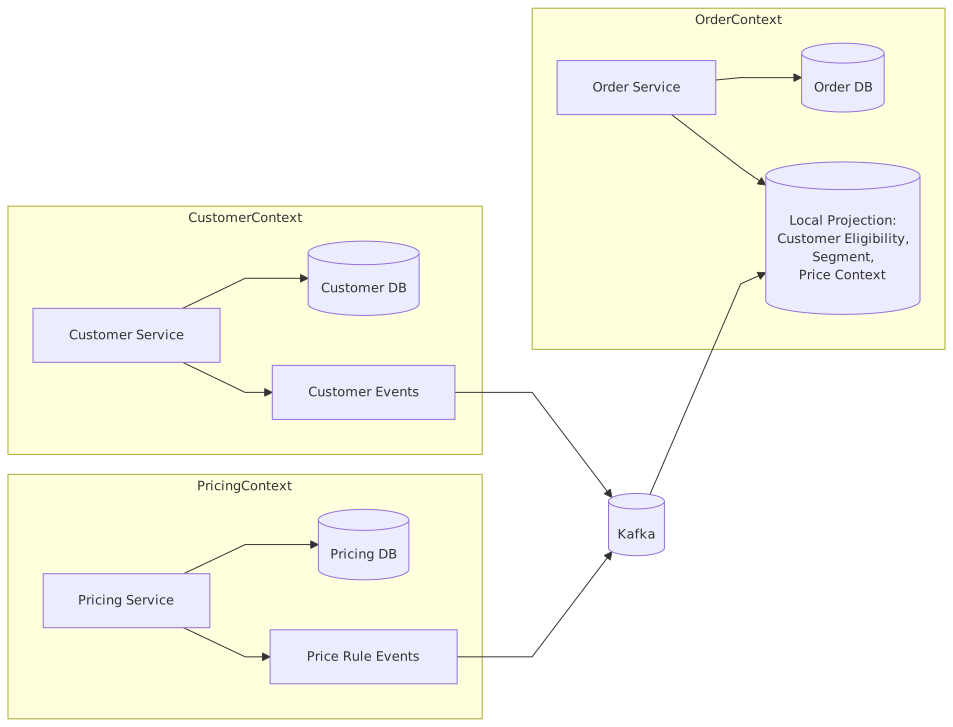
In this model, the order service does not ask customer service for every request. It consumes customer status changes, segment updates, and eligibility flags as events, then keeps a local projection. It also consumes pricing context events needed to quote or validate an order. The order service can process most requests without fan-out.
This is real locality. Not because all data is centralized inside one service, but because the service keeps the subset of truth it needs close to where work happens.
Reconciliation is part of the design
Architects often avoid talking about reconciliation because it sounds like admitting imperfection. That is exactly why it matters. Once you replicate data, you need a posture for drift.
Reconciliation can include:
- replaying event streams to rebuild projections
- periodic comparison jobs between source and consumer views
- outbox/inbox patterns to ensure delivery semantics
- compensating workflows when decisions were made on stale data
- business review queues for exceptions
Locality without reconciliation is denial.
Architecture
A locality-oriented microservices architecture usually contains four distinct data patterns.
1. System of record per bounded context
Each context has an authoritative store for the data it owns. That store is optimized for the context’s write semantics and invariants.
2. Local operational projections
Services maintain local denormalized views of foreign data required for runtime decisions. These are not canonical sources. They are purpose-built, contextual, and disposable in the sense that they can be rebuilt from source events.
3. Event backbone
Kafka or an equivalent event streaming platform distributes business changes. Events should be stable, meaningful, and coarse enough to avoid leaking internal persistence structures. Publishing raw table changes is a shortcut that usually ages badly.
4. Reconciliation and observability layer
You need metrics for projection lag, event processing health, drift rates, replay duration, and semantic mismatches. If the business depends on local copies, then the quality of those copies becomes an operational concern.
A useful mental model is to separate command truth from decision truth.
- Command truth is what the owning service writes and guarantees.
- Decision truth is the locally available context another service uses to make timely business decisions.
These may overlap. They are not identical.
Locality and aggregate design
DDD aggregates matter because locality often improves when aggregate boundaries are well chosen. If every business action requires touching many aggregates across contexts, your domain model is telling you that your service boundaries may be wrong.
For instance, a cart service that needs synchronous access to product, customer, promotion, and inventory internals to add a line item is not a cart service. It is a distributed transaction coordinator in disguise.
A better design is often to let the cart own the customer-facing shopping state and consume enough contextual data to price and validate probable outcomes locally, while final reservation or settlement happens in downstream contexts with explicit confirmation and compensation.
Read models are not a hack
Enterprises often resist denormalized read models because they look like duplication. That is the wrong instinct. In distributed systems, read models are one of the few sane ways to support low-latency user interactions without coupling every page render to five systems of record.
The rule is not “avoid duplication.” The rule is “duplicate with ownership, purpose, and rebuildability.”
Migration Strategy
The mistake many programs make is trying to redesign locality in one heroic step. That does not work in real enterprises, especially those carrying a monolith, shared databases, or package platforms.
Use a progressive strangler migration.
Start by identifying a business capability where runtime coupling is visibly hurting outcomes: checkout latency, claim adjudication, quote generation, policy endorsement, fulfillment planning. Then move in layers.
Phase 1: Observe the distributed join
Instrument the current request paths. Measure synchronous dependency chains, p95 latency, retry storms, stale reads, and dependency-driven incidents. You need hard evidence of where the locality problem lives.
Phase 2: Define bounded context and decision surface
Clarify what the target service must decide independently. Not every foreign datum should be copied. Only replicate what supports the local decision surface.
For example, an order service may need:
- customer eligibility status
- customer segment
- shipping preference
- tax classification
- product marketability flags
- current promotion context
It may not need:
- full marketing profile
- support tickets
- master customer golden record
- detailed price rule authoring history
Phase 3: Introduce event publication from source systems
Legacy systems rarely emit clean domain events on day one. Often you begin with integration events derived from change data capture, outbox tables, or application hooks. That is acceptable as an intermediate step, so long as you treat it as a migration stage, not the final architecture.
Phase 4: Build local projections in the target service
Create materialized views inside the new service boundary. Start by using them for reads, then gradually reduce synchronous calls. This is where Kafka consumers, projection processors, and idempotent handlers become central.
Phase 5: Strangle synchronous dependencies
Move high-volume, latency-sensitive paths to use local data first. Keep fallback mechanisms initially, but make them explicit and temporary. Hidden fallbacks become permanent crutches.
Phase 6: Add reconciliation and exception handling
Expect mismatches. Build dashboards for lag and drift. Define business rules for what happens when local context is stale or missing.
Phase 7: Retire old integration paths
Once confidence is high, remove old synchronous dependency chains and redundant schemas. Migration is not complete when the new path exists. It is complete when the old path is gone.
Here is the shape of that migration.
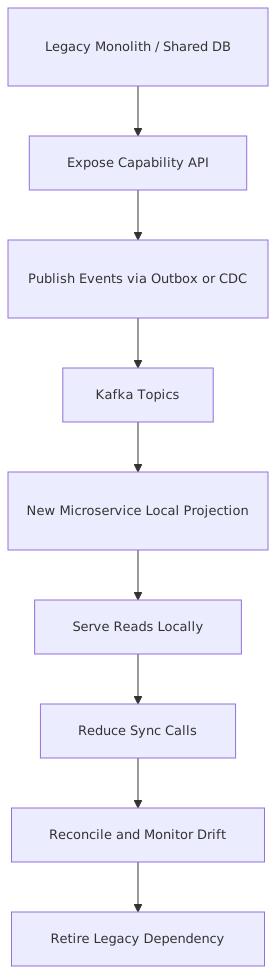
The strangler approach matters because locality is not only a target architecture concern. It is a migration concern. During transition, you will live in a mixed world of synchronous lookups, replicated data, and partial ownership. Design for that ambiguity.
Enterprise Example
Consider a large multi-region retailer modernizing its commerce platform.
The legacy estate had a central commerce monolith backed by an Oracle database. Pricing, customer profile, promotions, inventory availability, and order management all shared the same conceptual universe, even when their business owners disagreed on what terms meant. Checkout latency was unpredictable. Seasonal traffic caused lock contention. Teams were blocked by schema coordination meetings that felt longer than some product launches.
The retailer split the platform into domains:
- Catalog
- Pricing
- Customer
- Inventory
- Cart
- Order
- Fulfillment
The first implementation followed the common path: each service exposed APIs, but checkout still synchronously called pricing, customer eligibility, inventory, and promotions. Under holiday load, p95 latency ballooned, retries amplified Kafka lag in downstream fulfillment, and intermittent timeouts caused duplicate order submissions.
The architecture team changed course.
They redefined the order and cart contexts around local decision-making. Cart consumed:
- product sellability events
- market pricing snapshots
- promotion qualification indicators
- customer segment and loyalty status
Order consumed:
- final eligibility flags
- tax classification summaries
- fulfillment constraint events
- fraud threshold indicators
Pricing remained the system of record for rule authoring and effective price computation logic, but it also published stable market price events and promotion eligibility context. Customer remained the source of profile truth, but order did not need the whole profile. It needed a local eligibility view.
The result was not perfect consistency. A customer segment might take a few seconds to propagate. A promotion rule change might require projection replay. But checkout no longer depended on a chain of synchronous remote calls for every transaction. Throughput stabilized. Incident rates dropped. Teams could evolve pricing internals without breaking cart rendering. Most importantly, domain conversations improved because each context was forced to say what it actually needed rather than grabbing the whole customer or product object “just in case.”
That is a very enterprise lesson: better architecture often starts when teams stop sharing nouns casually.
Operational Considerations
Data locality changes operations. It reduces some runtime risks and introduces others.
Event lag is now a business metric
If the order service depends on local projections, projection lag is not just infrastructure trivia. It affects order acceptance, quote accuracy, and customer experience. Measure consumer lag, end-to-end event age, and projection freshness by context.
Idempotency is mandatory
Kafka consumers will retry. Events may be replayed. Duplicate delivery happens. Projection updates and command handlers must be idempotent. If not, your local copy becomes an amplifier of inconsistency.
Schema evolution matters
Published events become contracts. Version them carefully. Avoid leaking internal persistence schemas into topics. Integration events should reflect business meaning, not table anatomy.
Rebuildability is a design requirement
If a projection gets corrupted, can you replay from Kafka or rehydrate from source snapshots? If not, the projection is not operationally safe.
Data governance does not disappear
Replicating local views can create privacy, retention, and residency issues. If customer data crosses regions or contexts, you need clear rules about what is replicated, where it is stored, and how deletion requests propagate.
Cache versus projection
A cache is a performance convenience. A projection is a modeled local view with lifecycle, ownership, and operational semantics. Architects should not confuse the two. If a service truly relies on the data to make business decisions, treat it as a projection, not a casual cache.
Tradeoffs
There is no free lunch here. There is only choosing where to pay.
Benefits
- lower request latency
- reduced runtime coupling
- better resilience during partial outages
- clearer service autonomy
- easier scaling of read-heavy paths
- bounded context clarity
Costs
- data duplication
- eventual consistency
- eventing infrastructure complexity
- projection management
- reconciliation workflows
- more sophisticated observability
A common tradeoff appears around strong consistency. If two services must maintain a strict invariant together in real time, locality through asynchronous replication may be the wrong answer. Architects sometimes force eventual consistency into domains that cannot tolerate it, then call the resulting exception process “innovation.” It usually is not.
Another tradeoff is organizational. Locality works best when teams own their projections and understand the domain semantics of the data they replicate. If replication is managed by a central platform team with no domain accountability, the system drifts into generic data plumbing.
Failure Modes
Data locality helps, but it fails in specific and predictable ways.
1. Replicating everything
Some teams hear “local copies are good” and start replicating entire upstream entities. This creates bloated services, unclear ownership, and governance headaches. Locality should be intentional and minimal. ArchiMate for governance
2. Publishing database events as domain events
CDC is useful in migration. It is not a substitute for domain modeling. If downstream services consume raw row changes, you create semantic coupling to upstream schemas. That debt compounds.
3. Ignoring drift
If local projections can become stale and no one measures drift, the architecture is operating on hope. Hope is not a control.
4. Synchronous fallback becoming permanent
Teams often keep a sync call “just in case.” Months later, the service still depends on it for edge cases, outages, and missing data. You have built two architectures and retired neither.
5. Wrong bounded contexts
No amount of Kafka can save poor service boundaries. If the service decomposition ignores real business capabilities, locality work simply papers over a bad model.
6. Overusing distributed transactions
Trying to preserve old monolithic consistency guarantees across services leads to sagas, locks, retries, and compensation flows for trivial operations. Sometimes the right answer is to redraw boundaries so the invariant sits inside one context.
When Not To Use
Data locality is powerful. It is not universal.
Do not lean on replicated locality when:
- the domain requires strict real-time consistency for the decision
- the data changes too rapidly for useful local copies
- the consumer only rarely needs the data
- regulatory or privacy constraints prohibit replication
- the organization lacks event governance and operational maturity
- the system is still a small modular monolith where in-process calls are simpler and safer
This last point deserves emphasis. Many systems should not start with microservices at all. If one team owns the product, the scale is moderate, and the domain boundaries are still emerging, a modular monolith with clear module ownership often provides better locality than a premature distributed design. Splitting into services too early can turn a coherent codebase into a network of accidental dependencies.
Related Patterns
Several patterns sit close to data locality.
- Bounded Context: defines semantic and ownership boundaries.
- CQRS: separates write models from read models, often helping locality for reads.
- Event Sourcing: can support rebuildable state, though it is not required.
- Saga: coordinates long-running workflows across contexts when strong consistency is unavailable.
- Outbox Pattern: reliably publishes events alongside local state changes.
- Materialized View: creates denormalized local projections for fast queries.
- Strangler Fig Pattern: supports incremental migration from monolith to service-based architecture.
- Anti-Corruption Layer: shields new services from legacy semantics during migration.
These patterns are complementary. But do not collect them like architecture trading cards. Use them where the domain and migration path justify them.
Summary
Data locality in microservices architecture is not about placing databases near containers and calling it modern. It is about making sure services have the right information close enough to act responsibly.
The most effective microservices are not those with the most APIs. They are the ones that can make good business decisions without begging five neighbors for context.
That requires domain-driven design thinking. It requires bounded contexts with honest semantics. It requires deliberate replication of business facts, usually through event-driven integration such as Kafka. It requires reconciliation, because local views drift. It requires migration discipline, especially through progressive strangler approaches in enterprise estates. And it requires the humility to admit that sometimes the right answer is not another service, but a better boundary.
Locality is one of the quiet laws of distributed systems: if the data needed for a decision lives far away, the decision itself is fragile.
Good architecture shortens that distance.
Frequently Asked Questions
What is a service mesh?
A service mesh is an infrastructure layer managing service-to-service communication. It provides mutual TLS, load balancing, circuit breaking, retries, and observability without each service implementing these capabilities. Istio and Linkerd are common implementations.
How do you document microservices architecture for governance?
Use ArchiMate Application Cooperation diagrams for the service landscape, UML Component diagrams for internal structure, UML Sequence diagrams for key flows, and UML Deployment diagrams for Kubernetes topology. All views can coexist in Sparx EA with full traceability.
What is the difference between choreography and orchestration in microservices?
Choreography has services react to events independently — no central coordinator. Orchestration uses a central workflow engine that calls services in sequence. Choreography scales better but is harder to debug; orchestration is easier to reason about but creates a central coupling point.