⏱ 20 min read
Distributed systems fail the way cities do: not all at once, and rarely for one reason. A payment service slows down. An inventory event arrives late. A customer profile endpoint starts timing out under a load pattern nobody modelled because the business swore that campaign would never run in three regions at once. Then the architecture review deck says everything is “degraded but available,” which is often corporate language for “we are one unlucky retry storm away from a bad afternoon.”
This is where the Service Quarantine Pattern earns its keep.
Most teams know circuit breakers, bulkheads, retries, dead-letter queues, and graceful degradation. Those are important. But they mostly answer one question: how do I stop one failure from spreading instantly? Service quarantine answers a harder and more operationally honest question: what do I do with a service, capability, tenant, workflow, or message stream that has become unsafe to trust right now, without collapsing the rest of the business?
Quarantine is not simply “turning a service off.” It is a deliberate architectural boundary that isolates unstable behavior, suspicious data, or broken interactions while preserving the healthy parts of the domain. Done well, it allows the enterprise to continue trading while a bounded part of the system is cordoned off, observed, repaired, and reconciled. Done badly, it becomes a polite name for a pile of manual work and silent inconsistency.
The pattern matters because microservices are not just technical units. They carry domain meaning. A fulfillment service is not merely a container deployment. It is a business capability with policies, invariants, and consequences. When we quarantine something, we are not only redirecting traffic. We are making an explicit domain decision: “for now, this capability cannot participate in normal business flow.” That changes customer promises, operational procedures, event handling, and data stewardship.
This is why the pattern belongs in serious enterprise architecture conversations. It sits at the junction of resilience engineering, domain-driven design, and migration strategy. It is as much about bounded contexts, business semantics, and reconciliation as it is about network policy and Kafka topics. event-driven architecture patterns
Let’s get concrete.
Context
Microservices promised autonomy. In practice, they also introduced many more places for partial failure to hide. A monolith tends to fail loudly. A microservice estate often fails selectively, asynchronously, and just ambiguously enough to confuse both machines and people.
The modern enterprise stack usually includes:
- synchronous APIs for online journeys
- Kafka or another event backbone for integration
- domain services aligned, at least aspirationally, to bounded contexts
- legacy systems still responsible for a few uncomfortable truths
- cloud infrastructure that scales beautifully until a dependency becomes the bottleneck
- compliance requirements that do not care whether your architecture is elegant
In this world, resilience cannot mean only “retry harder.” A failing service may be returning stale data, violating invariants, processing duplicates, or emitting events in the wrong order. The danger is not merely downtime. The danger is corrupted business flow.
A resilient architecture therefore needs an explicit mechanism for separating healthy business processing from suspect processing. Not forever. Not as an excuse for poor design. But long enough to stop blast radius, preserve evidence, and allow controlled recovery.
That mechanism is quarantine.
Problem
A service begins to misbehave, but not enough to be obviously dead.
Maybe a pricing service computes discount tiers incorrectly after a rules deployment. Maybe an order orchestration service emits duplicate “ready-to-ship” events because consumer offsets were reset during a failover. Maybe a customer risk service is technically available but is using a stale model because its feature store fell behind. The system still responds. Metrics still glow mostly green. Yet the outputs are no longer trustworthy.
The common failure response is blunt-force mitigation:
- disable retries
- open a circuit breaker
- scale the failing service
- route around it if possible
- pause a consumer group
- drain traffic to another region
- ask operations to “monitor closely”
These tactics are useful, but they miss the structural issue. The enterprise often needs to continue processing unaffected domain workflows while preventing unsafe components from participating in transactions or event propagation.
Without quarantine, one of two bad outcomes usually follows:
- Overreaction: a broad shutdown that protects consistency but harms revenue and operations.
- Underreaction: the system keeps running, spreading bad data, duplicate events, or policy violations that become expensive to unwind later.
The Service Quarantine Pattern aims for a third way: isolate only what is unsafe, preserve what is healthy, and create a controlled path for reconciliation.
Forces
A good pattern exists because competing truths refuse to go away. Service quarantine is shaped by several forces.
Business continuity vs correctness
The business wants orders flowing, claims processed, trucks dispatched, and customers served. At the same time, some domain operations are too dangerous to continue when a dependency is unreliable. Enterprises do not merely need uptime. They need safe continuity.
Domain semantics matter
Not every capability can be quarantined equally. If the recommendation service goes odd, you can degrade gracefully. If the payment authorization service becomes untrustworthy, “best effort” becomes reckless. The architecture must reflect domain criticality and invariant sensitivity.
Coupling hides in workflows
Even in a well-cut microservice landscape, workflows connect bounded contexts. A defect in one service can taint another via APIs, emitted events, cached read models, or compensating processes. Quarantine must account for interaction paths, not just service ownership.
Event streams amplify both resilience and damage
Kafka helps decouple producers and consumers, but it also makes it easy to propagate bad state at scale. Once a poisoned event stream is consumed by downstream services, the cleanup is no longer local. Quarantine therefore often applies not only to services, but to topics, consumer groups, partitions, or message classes.
Human operations are part of the architecture
Someone will have to inspect, reroute, replay, reconcile, and explain. If quarantine depends on tribal knowledge, hidden scripts, and heroics, it is not a pattern. It is a ritual.
Migration realities
Most enterprises cannot redesign everything around quarantine from day one. The pattern usually emerges during modernization, often through a progressive strangler migration, where new services are introduced alongside legacy capabilities. This creates mixed trust zones and uneven resilience behavior. The migration path matters as much as the target state.
Solution
The Service Quarantine Pattern isolates a service or domain capability that is currently untrustworthy, then redirects affected interactions into controlled channels while allowing healthy capabilities to continue.
The core idea is simple:
- detect that a service, tenant segment, workflow, or message class is unsafe
- remove it from normal business paths
- prevent it from contaminating downstream systems
- capture impacted commands/events for later reconciliation
- provide degraded but explicit business behavior to upstream consumers
- reintroduce the capability only after verification and catch-up
This is not merely circuit breaking. Circuit breakers stop calls. Quarantine establishes an alternate operating mode.
A service in quarantine may:
- reject new commands for certain business operations
- accept requests but store them as pending review
- redirect events to a quarantine topic
- freeze publication to shared downstream streams
- mark aggregates as “awaiting reconciliation”
- switch read paths to a last-known-good model
- force manual approval for high-risk workflows
- operate only for a subset of tenants or products
The pattern works best when the quarantine boundary is defined in domain terms. Rather than saying, “inventory-service is quarantined,” a more useful statement is often: “stock reservation updates for warehouse region west are quarantined; catalog reads remain active.” That is architecture with business meaning.
Architecture
At a technical level, quarantine usually combines several mechanisms:
- health and trust assessment
- traffic or event routing controls
- state capture
- degraded domain behavior
- reconciliation pipelines
- governance and observability
Here is a conceptual view.

The crucial component is not the gateway. It is the trust policy. Availability alone is not enough. A service can be up but unsafe. Trust assessment may include:
- error rate and latency thresholds
- data validation failures
- domain invariant breaches
- drift between primary and replica data
- event lag beyond business tolerance
- model freshness for decisioning services
- fraud or compliance alerts
- release-health indicators after deployment
That trust assessment should trigger quarantine state transitions with explicit policies. Mature teams represent this as operational metadata, not improvised code branches.
Domain semantics and bounded contexts
Here is where domain-driven design matters.
Quarantine should be aligned to bounded contexts and aggregate invariants, not arbitrary technical slices. If a service spans multiple subdomains, quarantine gets clumsy because the architecture lacks a meaningful isolation unit. That is one reason broad “utility microservices” cause trouble: they collapse unrelated semantics into a single blast radius.
For example:
- In Order Management, you may quarantine shipment allocation while still allowing order capture.
- In Customer Management, you may quarantine profile enrichment while preserving identity verification results already confirmed.
- In Pricing, you may quarantine promotional price calculation while continuing base list price retrieval.
This distinction matters. The architecture should express whether operations are:
- safe to continue
- safe only with fallback
- unsafe and must be held
- unsafe but recoverable by replay
- unsafe and requiring manual adjudication
That categorization is not infrastructure design. It is domain design wearing operational clothes.
Quarantine in event-driven systems
Kafka changes the game because failure often arrives as suspect streams, not broken endpoints. Quarantine in Kafka-centric systems commonly includes:
- routing poisoned or suspect events to quarantine topics
- pausing consumer groups selectively
- tagging events with trust state or processing disposition
- preserving offsets and replay windows
- maintaining idempotent consumers for reprocessing
- using an outbox pattern to prevent half-published state
A typical event quarantine flow looks like this:
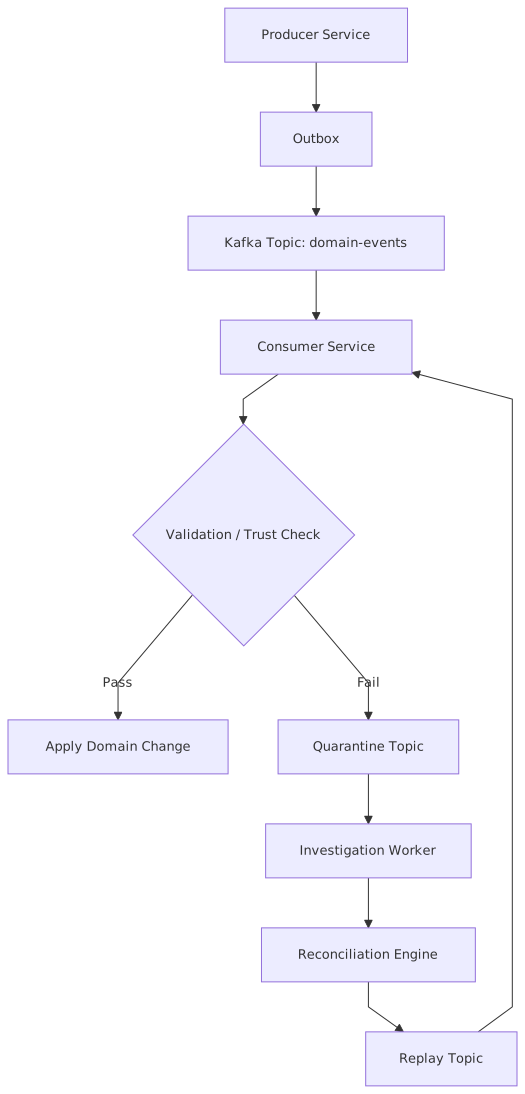
The trap here is to assume every problematic event belongs in a dead-letter queue. It does not. Dead-letter queues are often operational graveyards. Quarantine is different. It is a managed holding area with intent to inspect and recover. If the business process matters, the architecture must preserve lineage, causality, and replayability.
Command-side and query-side behavior
In systems using CQRS or simply separate operational and analytical read models, quarantine may affect writes and reads differently.
- Writes may be blocked, deferred, or accepted into a pending state.
- Reads may continue from a known-good projection, perhaps marked as stale.
- Derived views may be frozen to avoid compounding bad upstream state.
This is one of the pattern’s biggest practical values. Enterprises often can tolerate stale information better than incorrect commitments. Better to tell a user “inventory temporarily being verified” than to oversell 40,000 units during a synchronization defect.
Modes of quarantine
The pattern has several useful variants:
- Hard quarantine
No new commands are accepted for a capability. High consistency, high disruption.
- Soft quarantine
Commands are accepted but held for later processing or manual review.
- Tenant quarantine
Only a specific tenant, geography, business unit, or product line is isolated.
- Stream quarantine
Specific event classes, topics, or partitions are diverted.
- Workflow quarantine
A cross-service business process is paused at a safe checkpoint.
- Release quarantine
A newly deployed version is isolated from normal traffic while prior versions continue serving.
The best enterprises mix these deliberately. They do not reach for hard quarantine by default unless the domain risk demands it.
Migration Strategy
You rarely introduce service quarantine into a neat greenfield system. More often, you discover the need while modernizing a patchwork landscape where some failures are recoverable and others still trigger panicked conference calls.
The right migration approach is usually progressive strangler migration.
Start by wrapping a legacy or fragile service behind a stable contract. Add explicit trust evaluation and routing logic before you attempt complete decomposition. This lets you introduce quarantine behavior without waiting for perfect service boundaries.
A practical sequence looks like this:

Step 1: Identify domain-critical failure points
Do not start with “which service crashes most often.” Start with:
- which capabilities violate important business invariants when wrong
- which event streams are hardest to reconcile
- which services produce downstream contamination
- which workflows require explicit holding states
This is classic domain-driven design: model the business consequences before the technical controls.
Step 2: Introduce quarantine at the edge
Put quarantine controls in a façade, API gateway, workflow orchestrator, or event mediation layer. That gives you a place to:
- enforce trust policies
- redirect traffic
- record pending requests
- return explicit degraded responses
This is especially effective in strangler programs because the edge can front both old and new implementations.
Step 3: Add durable pending and replay stores
If quarantine just rejects requests, you will soon face business pressure to bypass it. Introduce durable stores for:
- deferred commands
- suspect events
- reconciliation metadata
- operator decisions
- replay history
This is where many teams discover they need better idempotency and event lineage than they currently have.
Step 4: Align new microservices to bounded contexts
As functionality is strangled out of the legacy system, design services around business boundaries that can be quarantined meaningfully. If a service owns unrelated capabilities, you inherit clumsy quarantine decisions later.
Step 5: Automate reconciliation before broadening usage
Do not expand quarantine usage if recovery depends on spreadsheets and midnight SQL. Build replay, compare, and correction pipelines early. Quarantine without reconciliation is just delayed chaos.
Step 6: Shift from coarse to fine-grained quarantine
At first, you may quarantine an entire service. Over time, mature into quarantining:
- specific command types
- product lines
- tenants
- event classes
- bounded sub-capabilities
That is the path from brute resilience to business-aware resilience.
Enterprise Example
Consider a large omnichannel retailer modernizing its commerce platform. The company had:
- a legacy order management system
- new microservices for cart, pricing, promotions, inventory, and fulfillment
- Kafka as the event backbone
- regional warehouse systems with uneven data quality
- seasonal traffic spikes that were both predictable and somehow always surprising
The critical issue appeared during flash-sale events. The inventory reservation service consumed stock updates from warehouse systems and published reservation-confirmed events. Under high load and delayed warehouse feeds, the service occasionally confirmed reservations against stale inventory snapshots. It did not fail visibly. It failed semantically.
The result was ugly:
- online orders confirmed stock that did not exist
- fulfillment generated cancellation waves hours later
- customer support traffic surged
- revenue reporting became distorted
- downstream planning models were fed false demand signals
The team first tried conventional tactics: retries, stronger caches, more partitions, scaling consumers, and a circuit breaker around warehouse APIs. It helped performance, but not trust. The service still sometimes made the wrong promise.
So they introduced quarantine.
How it worked
They defined trust rules around inventory freshness and reconciliation lag per warehouse region. If stock feeds for a region exceeded a threshold, the reservation capability for that region entered soft quarantine.
In soft quarantine:
- customers could still browse catalog and pricing
- carts could still be built
- reservation requests were accepted but marked pending verification
- no reservation-confirmed events were published to the main Kafka topic
- suspect reservation commands were stored in a pending queue with causality metadata
- the website changed messaging from “in stock” to “availability being confirmed”
- store pickup options for affected regions were hidden
Once warehouse feed freshness recovered, a reconciliation worker replayed pending reservations against the latest stock state. Valid reservations were confirmed and published. Invalid ones triggered alternative flows: backorder, substitute recommendation, or customer notification.
Why it worked
Because the quarantine boundary was defined in domain language:
- not “inventory-service is down”
- but “reservation confirmation in region west is not trustworthy”
This let the retailer preserve healthy journeys while isolating only the dangerous behavior.
The less glamorous truth
It was not cheap.
They had to build:
- idempotent replay into fulfillment
- reservation lineage across topics
- operator dashboards for pending stock decisions
- customer communication states in the order aggregate
- reconciliation metrics executives could understand
But compared to mass oversell events, this was money well spent. More importantly, it changed the architecture conversation. Reliability stopped being a pure SRE concern and became part of how the business capability was modelled.
Operational Considerations
Patterns live or die in operations.
Quarantine triggers
Triggers should combine technical and business signals. Good examples include:
- event lag beyond SLA and business tolerance
- invariant breach rates
- schema validation failures
- divergence between source-of-truth and projection counts
- elevated duplicate detection
- unusual compensation volume
- release-induced trust degradation
Avoid over-automating on noisy signals. Flapping between healthy and quarantined states is its own failure mode.
Observability
You need different telemetry for quarantine than for normal uptime.
Track:
- number of quarantined requests/events
- aging of pending work
- reconciliation success and failure rates
- blast radius by tenant, product, or region
- stale read durations
- customer-facing degradation impact
- manual intervention volume
A service can look healthy in CPU and latency while quarantine volume quietly explodes. That is a dangerous blind spot.
Reconciliation
Reconciliation is the sober partner in this pattern. Without it, quarantine simply stores trouble.
A robust reconciliation process should answer:
- which commands/events were impacted
- what was the intended business effect
- what actually happened
- what can be replayed safely
- what requires compensation
- what requires human decision
Reconciliation often involves comparing:
- current aggregate state
- authoritative external records
- event history
- pending commands
- customer commitments already made
This is where event sourcing can help, but it is not required. What is required is traceability.
Governance and roles
Quarantine state changes should have clear ownership:
- platform engineering may manage routing controls
- domain teams define trust thresholds and fallback behavior
- operations manage activation and recovery playbooks
- business stakeholders approve customer-impacting degradation policies
- data teams support reconciliation analytics
If nobody owns the semantics, quarantine devolves into infrastructure theater.
Tradeoffs
This is a useful pattern, not magic.
Benefits
- reduces blast radius from untrustworthy services
- preserves partial business continuity
- protects downstream systems from contamination
- makes degraded operation explicit
- creates a structured path to recovery
- fits well with Kafka, asynchronous workflows, and strangler migration
Costs
- increased architectural complexity
- more state machines, especially pending and reconciled states
- greater demand for idempotency and traceability
- operational burden in deciding when to quarantine and recover
- customer experience complexity due to deferred outcomes
- risk of accumulating pending work during prolonged incidents
There is no free lunch here. Quarantine trades simplicity for controlled ambiguity. That is often the right trade in a serious enterprise, but it must be chosen consciously.
Failure Modes
Patterns fail in predictable ways. This one is no exception.
Quarantine becomes a silent backlog
Teams divert commands and events into holding stores but lack capacity or tooling to process them. The system appears stable while business debt grows in the shadows.
Boundaries are too technical
If quarantine is defined around deployment units instead of domain capabilities, too much gets isolated or the wrong things continue. The result is either needless disruption or hidden corruption.
Replays create duplicates
Without idempotent consumers and clear replay markers, reconciliation can make things worse than the original incident.
Fallback behavior lies
A stale read model or estimated response may be acceptable if clearly labelled. If it masquerades as confirmed truth, the enterprise shifts from resilience to deception.
State flapping
An unstable trust trigger repeatedly moves a service in and out of quarantine, causing inconsistent handling and operator confusion.
Manual workarounds bypass controls
Under commercial pressure, people route around quarantine with scripts, direct DB updates, or temporary API exceptions. This usually produces the very contamination the pattern was meant to stop.
Quarantine becomes permanent architecture
The biggest smell of all. If a service is always “temporarily” quarantinable because it is fundamentally weak, the real need is redesign, not more elegant isolation.
When Not To Use
Do not use the Service Quarantine Pattern everywhere.
It is a poor fit when:
- the capability is non-critical and can simply fail fast
- the cost of delayed or pending states exceeds the benefit
- the domain does not support meaningful reconciliation
- the system is small enough that simpler controls suffice
- the service boundary is so poorly defined that quarantine would be arbitrary
- the organization lacks operational discipline to manage held work
For example, a low-value internal reporting service probably does not need quarantine. A simple retry policy, fallback cache, or temporary outage may be enough. Quarantine shines where the business needs continuity without blind trust.
Also, if your architecture cannot tell the difference between “temporarily stale” and “contractually committed,” then you are not ready for this pattern yet. Fix the domain model first.
Related Patterns
The Service Quarantine Pattern works alongside, not instead of, other patterns.
Circuit Breaker
Stops cascading failures in synchronous calls. Useful, but narrower. It prevents pressure propagation; it does not define pending states or recovery semantics.
Bulkhead
Limits resource contention. Helpful in keeping healthy workloads isolated, often complementary to quarantine zones.
Dead-Letter Queue
Captures failed messages. Quarantine differs by assuming managed inspection and possible replay rather than mere disposal.
Outbox Pattern
Critical when quarantining event publication. It prevents local state changes from escaping without controlled messaging.
Saga
Useful for long-running workflows where a quarantined step may need compensation or deferred continuation.
Strangler Fig Pattern
A natural migration vehicle for introducing quarantine around legacy capabilities.
Anti-Corruption Layer
Valuable when legacy semantics are unstable or ambiguous. It can become the first place where trust policies and quarantine routing live.
Graceful Degradation
The customer-facing sibling of quarantine. Quarantine isolates unsafe behavior; degradation defines what users experience instead.
Summary
The Service Quarantine Pattern is what mature microservice architectures use when they stop pretending failure is binary. microservices architecture diagrams
Services are not only up or down. They can be available but unsafe, responsive but stale, technically green but semantically wrong. In an enterprise, that distinction matters more than dashboard vanity. A resilient platform must be able to isolate suspect capabilities, preserve healthy business flow, and recover with discipline.
The pattern works best when built on domain-driven design principles:
- align quarantine boundaries to bounded contexts
- model degraded and pending states explicitly
- define trust in business terms, not just platform metrics
- design for reconciliation from the start
It also fits naturally with progressive strangler migration. You do not need a perfect target architecture before introducing it. Start at fragile boundaries, add trust-aware routing, durable pending stores, and replay pipelines, then refine quarantine from coarse service-level isolation to finer domain-aware control.
The essential tradeoff is straightforward: you accept more complexity in exchange for less systemic damage.
That is a fair bargain in most large enterprises. Because when a service goes bad, the real question is not whether you can keep the lights on. It is whether you can keep the business honest while the lights flicker.
Frequently Asked Questions
What is a service mesh?
A service mesh is an infrastructure layer managing service-to-service communication. It provides mutual TLS, load balancing, circuit breaking, retries, and observability without each service implementing these capabilities. Istio and Linkerd are common implementations.
How do you document microservices architecture for governance?
Use ArchiMate Application Cooperation diagrams for the service landscape, UML Component diagrams for internal structure, UML Sequence diagrams for key flows, and UML Deployment diagrams for Kubernetes topology. All views can coexist in Sparx EA with full traceability.
What is the difference between choreography and orchestration in microservices?
Choreography has services react to events independently — no central coordinator. Orchestration uses a central workflow engine that calls services in sequence. Choreography scales better but is harder to debug; orchestration is easier to reason about but creates a central coupling point.