⏱ 20 min read
Microservices were supposed to make change easier. Instead, in many enterprises, they made confusion easier.
That’s the uncomfortable truth. Teams split a large system into dozens of services, gave each one a Dockerfile and a backlog, and called it modern architecture. Six months later they discovered they had not built autonomy. They had built a distributed monolith with better branding.
The root problem is usually not technology. It is not Kubernetes, not Kafka, not REST, not gRPC. It is poor understanding of cohesion and coupling. People separate code before they separate responsibilities. They carve services around org charts, sprint boundaries, or whatever class diagram happened to be lying around. The result is predictable: every business change now walks through five services, three teams, and one emergency architecture review.
This is why service boundaries matter more than service count. A good microservice architecture is not a collection of small things. It is a collection of well-bounded business capabilities with clear ownership, strong internal cohesion, and deliberately managed coupling. Domain-driven design gives us the language for this. Enterprise architecture gives us the discipline to apply it in systems that are old, political, and very expensive to get wrong.
If you remember one line from this article, remember this: a microservice should be boring on the inside and selective about its dependencies on the outside.
That sounds simple. It isn’t. Enterprises rarely begin with clean domains, clean teams, or clean data. They begin with shared databases, contradictory business rules, and systems that have survived three CIOs. So the real question is not “what is cohesion versus coupling?” The real question is “how do we move from tangled enterprise reality to service boundaries that can survive production?”
That is the terrain we will cover.
Context
Microservices architecture emerged as a response to the pain of large monoliths: slow delivery, risky releases, and teams stepping on each other’s toes. The promise was compelling. Break the system into independently deployable services. Align them to business capabilities. Let teams move faster.
In practice, that promise only holds when service boundaries are right.
Cohesion is about how well the responsibilities inside a service belong together. A cohesive service encapsulates a meaningful domain capability and the rules that govern it. Its data, behavior, and invariants live in one place. Changes tend to stay within the service boundary.
Coupling is about the degree to which a service depends on others. A coupled service cannot do much without reaching across the network, waiting for another team, or coordinating state changes elsewhere. Changes spread. Failures spread. Delays spread.
The reason this matters so much in enterprise systems is that the network is not a method call. A remote dependency brings latency, retries, partial failure, versioning problems, and operational ownership questions. When architects ignore that, they accidentally turn internal collaboration into runtime dependency. Then every business transaction becomes a distributed negotiation.
Domain-driven design is the antidote. It asks a more grounded question: what are the bounded contexts in the business? Where do terms mean different things? Where do rules naturally cluster? The point is not just better modeling. The point is to create service boundaries where business meaning, data ownership, and team ownership line up.
When that alignment happens, a service can evolve. When it doesn’t, every integration becomes a tax.
Problem
Most poor microservice designs fail in one of two ways.
The first is low cohesion. Teams slice services too thinly or around technical layers. You see “Customer API Service,” “Customer Validation Service,” “Customer Persistence Service,” and “Customer Notification Service.” It looks modular on a slide. It is chaotic in production. A simple onboarding flow now traverses multiple services that all know fragments of the same business process. No service owns the outcome. Everyone owns a piece; no one owns the result.
The second is high coupling. Teams create services that are nominally separate but operationally inseparable. An Order service cannot create an order without calling Pricing, Inventory, Promotions, Customer Eligibility, Tax, Fraud, and Shipping in sequence. The business capability is fragmented across runtime calls. You can deploy services independently in theory, but not change the business safely in practice.
The damage shows up everywhere:
- end-to-end latency becomes unpredictable
- deployments require cross-team coordination
- incidents turn into blame archaeology
- data correctness depends on perfect sequencing
- local changes trigger enterprise-wide regression testing
- teams stop moving independently
This is the distributed monolith pattern, and it is more common than people admit.
At the center of the problem is a misunderstanding of domain semantics. Enterprises often use the same business word to mean different things in different contexts. “Customer” in billing is not the same as “customer” in identity, support, or marketing. “Order” in sales may mean a commercial commitment, while in fulfillment it means a logistics instruction. When teams force a single technical representation of these concepts across the estate, they increase coupling in the name of consistency.
That kind of consistency is expensive and usually fake.
Forces
Architecture is the art of managing forces, not eliminating them. Cohesion and coupling sit in the middle of several competing pressures.
Business capability alignment
The business wants services aligned to recognizable capabilities such as pricing, ordering, claims handling, subscription management, or payment settlement. This is the strongest source of cohesion because it follows real responsibility. A team can reason about changes if the service maps to something the business understands.
Data ownership
A service that does not own its data is not really a service. Shared databases create hidden coupling, bypass APIs, and destroy the possibility of independent evolution. Yet enterprises often inherit large schemas that several systems depend on. Untangling this is costly.
Transactional consistency
Business stakeholders often want immediate consistency across domains. Architects know that cross-service ACID transactions are a trap in most distributed systems. So we trade some immediacy for availability, scalability, and autonomy. That introduces reconciliation, event handling, idempotency, and compensation workflows.
Team topology
Conway’s Law always collects its debt. If three teams must change one feature together, the architecture is probably not aligned to team boundaries. But the reverse is also true: if the organization is fragmented, the architecture often mirrors that fragmentation. Good service design must account for how teams actually work, not how a slide says they should work.
Reporting and analytics
Central reporting pressures teams to normalize data and expose enterprise-wide views. This often encourages shared schemas and duplicate semantics. The right response is usually not shared operational models, but well-defined events, analytical pipelines, and read-optimized projections.
Legacy constraints
No enterprise starts from greenfield. There is an ERP package, a mainframe, a giant relational model, or a vendor platform that nobody wants to touch but everyone depends on. Migration strategy matters as much as target architecture.
These forces do not disappear. The architect’s job is to choose where to pay the price.
Solution
The practical solution is straightforward to say and hard to do:
- Design services around cohesive domain capabilities
- Minimize runtime coupling
- Prefer asynchronous collaboration where business semantics allow
- Keep data ownership local
- Use bounded contexts to clarify meaning
- Accept eventual consistency and design reconciliation explicitly
- Migrate progressively using a strangler pattern, not heroic rewrites
A cohesive microservice should encapsulate:
- a clear business purpose
- its own domain model
- its own invariants and rules
- its own persistence
- a small, stable public contract
It should not be a grab bag of utility endpoints, nor a thin wrapper over a shared database.
Coupling should be treated with suspicion. Not all coupling is bad; some is necessary. But coupling must be explicit and intentional. There is a difference between:
- semantic coupling: shared business understanding
- contract coupling: agreed interfaces or event schemas
- temporal coupling: needing another service to be up right now
- data coupling: sharing internal data structures or databases
- deployment coupling: needing coordinated releases
The dangerous forms are temporal, data, and deployment coupling. A good architecture reduces them aggressively.
That often means choosing asynchronous messaging. Kafka is particularly relevant here because it lets services publish domain events and maintain local autonomy while feeding downstream consumers. Used well, Kafka becomes an integration backbone for event-driven collaboration, read model propagation, and auditability. Used badly, it becomes a distributed shared database with topics instead of tables. event-driven architecture patterns
The rule is simple: events should announce facts from a bounded context, not leak internal implementation details.
Architecture
Let’s make this concrete with a comparison.
Poorly bounded, highly coupled services
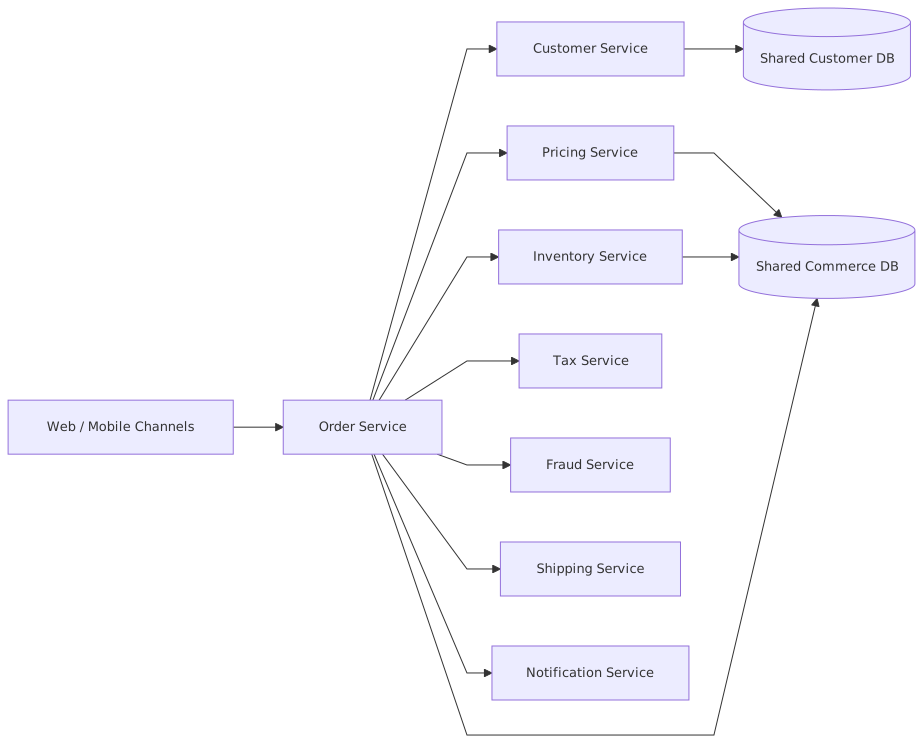
This is a familiar picture. The Order service looks central, but in reality it owns very little. To place an order, it orchestrates a chain of synchronous dependencies. Some services share databases. The business transaction is spread across multiple contexts. If Pricing is slow, ordering is slow. If Inventory changes schema, several consumers break. If one team wants to evolve order semantics, they need a summit meeting.
This is not service architecture. It is an integration dependency graph wearing a microservices costume. microservices architecture diagrams
Cohesive, bounded services with managed coupling
A better design starts by asking what the bounded contexts are. In a commerce enterprise, plausible contexts might include:
- Customer Identity
- Catalog
- Pricing
- Order Management
- Inventory Allocation
- Payment
- Fulfillment
Order Management should own order lifecycle semantics: creation, amendment rules, state transitions, and customer-facing commitments. It should not own every rule in every neighboring domain.
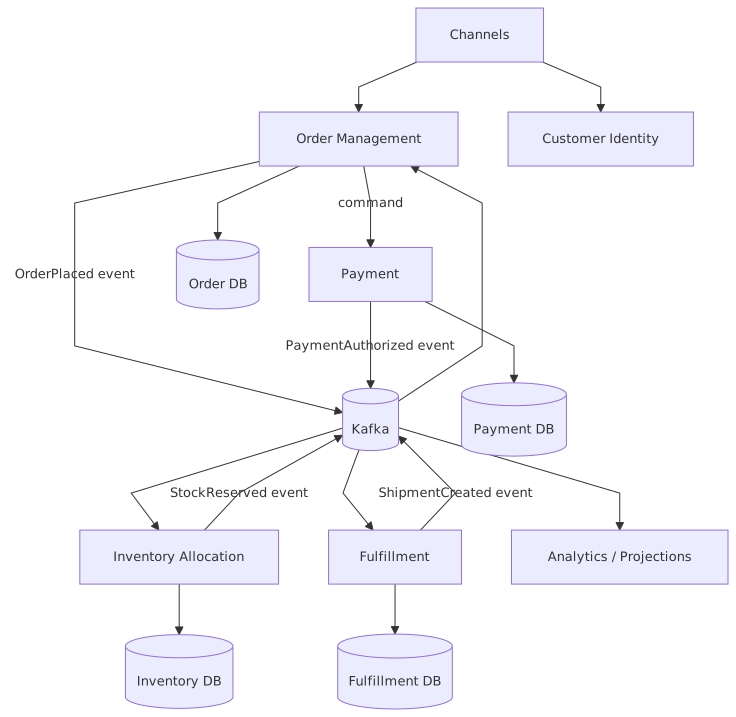
Notice the shift. Order Management still collaborates with other domains, but it owns its own model and database. Some interactions remain synchronous where there is a hard need, such as payment authorization during checkout. Others become event-driven. Kafka carries domain events between bounded contexts, allowing local processing, retries, replay, and downstream projections.
This architecture does not remove coupling. It changes its nature. Instead of hard runtime chains, we create contract-based collaboration around business facts.
Domain semantics matter more than endpoint shape
This is where domain-driven design earns its keep. If “OrderPlaced” means “commercial commitment accepted,” that event should not later be reinterpreted by fulfillment as “warehouse instruction issued.” Different contexts can derive their own meaning, but the source event must be semantically crisp.
Likewise, “Customer” should not be treated as a universal master entity in every service. Identity may care about credentials and authentication status. Billing may care about legal entity and account hierarchy. Marketing may care about segments and consent. These are related, not identical. A cohesive service model accepts that.
A common failure is trying to centralize all customer logic into one giant Customer service. That often creates low cohesion because the domain concept is too broad. Better to split by bounded context where semantics diverge.
Migration Strategy
Most enterprises do not get to redraw the system from scratch. They have a monolith, a package application, or a service estate already tangled by history. So migration strategy is architecture, not project management.
The best path is usually a progressive strangler migration.
Start by identifying seams where business capabilities can be extracted with minimal semantic confusion. Avoid the most entangled domain first unless there is no alternative. Pick a capability with clear ownership, visible business value, and manageable dependencies. Then:
- place an API or event façade in front of the legacy function
- redirect new behavior through that façade
- extract the domain logic into a new bounded service
- give the new service ownership of its own persistence
- publish domain events to synchronize or feed downstream consumers
- retire legacy paths gradually
This is not glamorous. It is disciplined.

During migration, there is often a period of dual reality. Legacy remains the system of record for some capabilities while new services begin owning others. This is where architects must think carefully about synchronization and reconciliation.
Reconciliation is not an afterthought
Event-driven migration introduces drift risk. Messages arrive late. Consumers fail. Legacy data and new data disagree. If you pretend this will not happen, operations will discover it for you at 2 a.m.
Reconciliation must be designed as a first-class capability:
- identify the authoritative source for each datum at each migration stage
- track correlation IDs and business keys
- support replay from Kafka or durable logs
- build comparison reports between legacy and new projections
- provide operational workflows for conflict resolution
- make handlers idempotent
For some domains, reconciliation can be automatic. For others, especially financial ones, it needs explicit business review. The key point is this: eventual consistency is only tolerable when eventual correctness is engineered.
When to use Kafka in migration
Kafka is particularly useful when you need:
- event distribution to multiple consumers
- decoupling from legacy release cycles
- durable event retention for replay
- integration with data pipelines and analytics
- propagation of domain facts into projections
But do not force every interaction through Kafka. Command-style interactions that require immediate acceptance or rejection may still need synchronous APIs. An architecture that is all events all the time is just as clumsy as one that is all request-response all the time.
Enterprise Example
Consider a global insurer modernizing its policy administration platform.
The legacy core was a twenty-year-old monolith handling quote, bind, policy issuance, endorsements, billing triggers, and claims notifications. It had one large relational schema and a frightening amount of stored procedure logic. The organization wanted microservices and Kafka because every conference deck said so.
The first attempt failed. Teams extracted thin services by technical concern: document generation, policy API, rating adapter, customer profile, and rule execution. The policy workflow now crossed seven services and still depended on the same database. Every release became coordinated. Policy issuance latency increased. Underwriters lost trust. The architecture was modern only in the sense that the incident reports mentioned containers.
The reset began with domain modeling workshops. Not the theatrical kind with too many sticky notes and too little accountability. Real ones, focused on language and invariants. The team identified distinct bounded contexts:
- Quote and Rating
- Policy Lifecycle
- Billing Account
- Claims Notification
- Customer Identity
- Document Production
This mattered because “policy” meant different things in different places. In Policy Lifecycle, a policy was a contractual artifact with endorsements and effective dates. In Billing, it was a source of billable obligations. In Claims Notification, it was coverage reference data. Once the team stopped pretending those were the same model, service boundaries became clearer.
They migrated progressively.
First, Quote and Rating was extracted because it had high business pressure for change and a relatively clean boundary. Kafka was used to publish QuoteCreated, QuoteRated, and PolicyBound events. Policy Lifecycle remained in the monolith initially, but consumed these events through a façade. Then Policy Lifecycle was carved out with its own persistence, gradually taking ownership of endorsements and renewal logic. Billing Account remained legacy-backed for longer because the downstream financial reconciliation complexity was higher.
The result was not instant purity. For a while, policy bind triggered both a legacy update and a new event stream. Reconciliation jobs compared bound policy state between the new Policy service and the monolith nightly, then near real-time for high-risk products. Some mismatches were data mapping bugs. Others exposed hidden business rules nobody had documented in fifteen years. That is another lesson: migration reveals the true system, not the one in Visio.
After eighteen months, they had fewer services than originally planned, not more. But each service had stronger cohesion. Policy changes mostly stayed in Policy Lifecycle. Rating changes stayed in Quote and Rating. Billing evolved at its own pace. Incident blast radius reduced. Delivery improved because teams no longer negotiated every release across a sprawling dependency chain.
That is what success looks like in a real enterprise: not elegance, but reduced coordination cost and clearer ownership.
Operational Considerations
A cohesive architecture still needs operational muscle.
Observability
When business flows cross multiple bounded contexts, tracing is essential. Use correlation IDs across HTTP calls, Kafka events, and background processing. Logs without business keys are noise. Metrics without context are vanity. Traces should answer a business question: “What happened to order 87432?” or “Why is policy issuance delayed?”
Contract governance
If services collaborate through APIs and events, contracts must be versioned and governed. Schema evolution in Kafka topics needs compatibility rules. Consumer-driven contracts can help for APIs. Avoid publishing raw internal entities as events; they change too often and bind consumers to internals.
Idempotency and duplicate handling
At-least-once delivery is normal in distributed systems. Event consumers must tolerate duplicates. Commands may be retried. Payment requests need idempotency keys. Stock reservations need deduplication strategies. If you skip this, your architecture will create money or lose inventory.
Back-pressure and retry strategy
Kafka gives buffering, not magic. Consumers can lag. Topics can build up. Dead-letter queues and retry policies should reflect business semantics. Some failures deserve immediate retry. Others need manual intervention. Blind retry loops are how small incidents become expensive ones.
Data projections
Many enterprise users need consolidated views: customer 360, order tracking, operational dashboards. Do not reintroduce coupling by asking every UI to fan out across ten services. Build read models and projections optimized for those use cases. Kafka can feed these projections well. Keep them read-only and disposable.
Security and compliance
As services split, identity, authorization, audit, and data classification become more complex. A cohesive service should still follow enterprise controls. Sensitive events may need encryption, masking, or restricted topics. The architecture should not accidentally spread regulated data further than necessary.
Tradeoffs
No serious architecture discussion is complete without tradeoffs. Cohesion and coupling are not moral categories. They are design pressures.
High cohesion often means some data duplication
If services own their data and models, some facts will be replicated through events or projections. That is acceptable when semantics are clear and ownership is explicit. The alternative is shared databases and hidden coupling.
Lower runtime coupling can increase consistency complexity
Asynchronous collaboration removes temporal dependence but introduces eventual consistency, retries, and reconciliation. You trade immediate certainty for autonomy and resilience. That is often worth it, but not free.
Fewer, larger services may be better than many tiny ones
This point deserves saying clearly. Many enterprises would improve their architecture by having fewer microservices with stronger domain cohesion. Tiny services often optimize for imagined reuse and produce real coordination overhead.
Synchronous flows are sometimes necessary
A checkout flow may need an immediate payment authorization decision. A fraud decision may be required before confirmation. Do not force event-driven patterns where the business demands immediate response. Just keep the synchronous core narrow and intentional.
Bounded contexts may frustrate enterprise data standardization efforts
Enterprise data teams often want one canonical definition for everything. That sounds tidy but often harms delivery. Canonical models can work at integration boundaries in limited ways, but they should not erase local semantics inside bounded contexts.
Failure Modes
Most microservice failures are boundary failures.
The entity service trap
Teams create services around nouns like Customer, Product, or Order without asking what business capability is actually being encapsulated. The service becomes a CRUD endpoint for a shared entity and everyone depends on it. Coupling rises immediately.
The shared database relapse
Teams expose APIs but keep writing directly into common tables “for convenience.” This destroys ownership and creates hidden change impact. Once this starts, service boundaries are decorative.
Event soup
Every service publishes too many fine-grained events with weak semantics: CustomerUpdated, OrderChanged, ItemModified. Consumers reverse-engineer meaning from payloads. Topics become unstable, noisy integration channels rather than domain fact streams.
Orchestration everywhere
A central workflow engine or “process service” begins coordinating every business action across every domain. This may be appropriate for some cross-domain processes, but overused it becomes the new monolith. If all decisions flow through one orchestrator, service autonomy is mostly fiction.
Ignoring reconciliation
Teams assume events will arrive and processing will succeed. They have no replay plan, no comparison report, no conflict resolution path. Data divergence accumulates until finance, compliance, or customers force a crisis.
Team boundary mismatch
A service is owned by multiple teams, or a team owns fragments of too many services. Ownership becomes fuzzy. Incidents linger because nobody can decide. Good architecture cannot survive bad ownership for long.
When Not To Use
Microservices are not the default answer.
Do not use a microservice split when:
- the domain is still poorly understood and changing rapidly at the conceptual level
- the team is too small to support operational overhead
- the system requires strong transactional consistency across most functions
- the workload is simple enough for a modular monolith
- your organization cannot yet manage contracts, observability, deployment automation, and runtime operations
- your main bottleneck is not codebase size but decision-making or process
A modular monolith is often a better starting point. It lets you develop bounded contexts, isolate modules, and sharpen domain semantics without paying the full tax of distributed systems. If cohesion is weak inside a monolith, splitting it into services will not improve it. It will just make the confusion remote.
That is worth repeating: distribution does not fix bad boundaries; it amplifies them.
Related Patterns
Several patterns commonly complement this approach.
Bounded Context
The core domain-driven design pattern for separating models by business meaning. Essential for deciding service boundaries.
Strangler Fig Pattern
A progressive migration pattern where new capabilities are introduced around and then over legacy functionality instead of replacing everything at once.
Saga
Useful for coordinating long-running business processes across services where distributed transactions are inappropriate. Good servant, dangerous master.
CQRS
Helpful when operational write models and read models need to diverge. Particularly relevant when Kafka feeds projections for reporting or search.
Anti-Corruption Layer
Crucial during migration from legacy or vendor platforms. Prevents old semantics from contaminating new bounded contexts.
Event Sourcing
Sometimes useful, but not a default choice. Strong fit for domains where full state history and temporal reconstruction are central. Overkill for many enterprise services.
Summary
Service cohesion versus coupling is not a theoretical distinction. It is the difference between architecture that compounds value and architecture that compounds meetings.
A cohesive microservice owns a real business capability, its rules, and its data. A coupled microservice depends too much on the rest of the estate to do useful work. The first creates autonomy. The second creates choreography, delay, and fragility.
Domain-driven design helps find better boundaries by focusing on semantics, invariants, and bounded contexts. Kafka and event-driven patterns help reduce temporal coupling and support scalable integration, but only when events represent meaningful business facts. Migration in the enterprise must be progressive, usually through a strangler approach, with reconciliation engineered from the start. There is no shortcut around this.
The best enterprise microservice architectures are not the ones with the most services. They are the ones where a business change has a natural home, where failures stay local, and where teams can move without negotiating with half the company.
That is the real goal.
Not smaller boxes on a diagram.
Better boundaries.
Frequently Asked Questions
What is a service mesh?
A service mesh is an infrastructure layer managing service-to-service communication. It provides mutual TLS, load balancing, circuit breaking, retries, and observability without each service implementing these capabilities. Istio and Linkerd are common implementations.
How do you document microservices architecture for governance?
Use ArchiMate Application Cooperation diagrams for the service landscape, UML Component diagrams for internal structure, UML Sequence diagrams for key flows, and UML Deployment diagrams for Kubernetes topology. All views can coexist in Sparx EA with full traceability.
What is the difference between choreography and orchestration in microservices?
Choreography has services react to events independently — no central coordinator. Orchestration uses a central workflow engine that calls services in sequence. Choreography scales better but is harder to debug; orchestration is easier to reason about but creates a central coupling point.