⏱ 19 min read
Most microservice failures do not begin with Kubernetes, Kafka, or some spectacular outage graph on a dashboard. They begin quietly, in design meetings, with one harmless sentence: “This service just needs to call two or three others.” event-driven architecture patterns
That is how dependency debt enters the building.
A microservice architecture does not collapse because teams split a monolith. It collapses because they replace one big ball of mud with a distributed ball of yarn, where every service tugs on three others, each one blocks on four more, and nobody can explain where a business capability actually starts or ends. The code may be small. The blast radius is not.
This is where the idea of a service dependency budget matters. Think of it as an architectural spending limit on runtime coupling. Every service is allowed only so many direct dependencies, so much synchronous chatter, so much semantic leakage from neighboring domains. Spend the budget carelessly and the system becomes slow, brittle, politically hard to change, and operationally expensive. Spend it wisely and microservices remain what they were supposed to be: independently changeable slices of business capability.
This is not a purity argument. Enterprises do not run on purity. They run on tradeoffs. Some services should orchestrate. Some should subscribe to events. Some need a read model fed from Kafka because the source of truth lives elsewhere. Some ugly transitional dependencies are acceptable during migration. But if you do not actively manage the dependency budget, your architecture will manage you.
The useful framing comes from domain-driven design. Services should not merely be small deployable units. They should be aligned with business domains, bounded contexts, and explicit ownership. A dependency is not just a network call. It is a statement about where one domain stops understanding its own business and starts borrowing somebody else’s. That is why dependency budgeting is as much about semantics as latency.
Context
Microservices are usually adopted for good reasons. A large enterprise wants faster delivery, clearer team ownership, safer deployments, and an architecture that reflects its business rather than the history of its release train. The monolith has become congested. Every change is a negotiation. Shared tables are the hidden constitution. One release can ruin everyone’s week.
So the organization decomposes.
Customer, pricing, inventory, fulfillment, fraud, billing, notification, entitlement, catalog, recommendation. The boxes appear. Repositories multiply. Teams get autonomy. CI/CD improves. For a while, it looks like progress because, in many ways, it is.
Then a second phase arrives. The easy boundaries were never the real challenge. The real challenge is interaction.
The pricing service needs customer tier. The checkout service needs inventory reservation, fraud screening, promotions, tax calculation, shipping options, and payment authorization. The order history page needs order status, shipment tracking, invoice data, refund state, and support case annotations. The customer service domain starts asking billing questions. The billing domain starts asking product entitlement questions. What looked like a set of clean bounded contexts becomes a mesh of operational and semantic dependencies.
This is the moment many architectures become accidental distributed monoliths.
A dependency budget is a practical governance mechanism for this phase. It says: not every dependency is free, not every synchronous request is justified, and not every piece of domain knowledge should leak across boundaries. You can spend dependency budget on things that truly matter. You cannot pretend it has no cost. EA governance checklist
Problem
Without explicit limits, service dependencies grow in a pattern that feels locally rational and globally disastrous.
A team wants to avoid duplicating data, so it calls another service at runtime. Another team wants “real-time accuracy,” so it chains a second call. A third team introduces an aggregator endpoint because the client should not fan out across five services. The aggregator now depends on six systems and has become a thinly disguised process manager without the discipline to match. One timeout in the chain drags down customer experience. One schema change creates a cross-team incident.
The problem is not dependency itself. Distributed systems need collaboration. The problem is unbudgeted dependency.
There are several symptoms:
- Services with too many synchronous downstream calls
- API composition becoming the default integration style
- Domain concepts bleeding across context boundaries
- “Shared” services turning into organizational bottlenecks
- Fragile deployments because compatibility spans many teams
- Excessive retries, timeouts, and circuit-breaker tuning just to survive
- Event streams that exist, but only after synchronous truth has already been demanded elsewhere
The result is familiar. Lead time rises. Reliability falls. Teams stop changing things they do not fully understand. Incidents become detective novels. Architects end up drawing spaghetti with better icons.
A dependency budget forces a harder conversation: which dependencies are core to the domain workflow, which are transitional, which should be replaced by events and local read models, and which should not exist at all?
Forces
A good architecture article should admit that the tension is real. Enterprises are not choosing between good and bad. They are choosing between competing forms of pain.
Force 1: Freshness versus autonomy
A direct call gives current data. It also creates runtime coupling. A local read model fed by Kafka gives autonomy and resilience, but introduces eventual consistency and reconciliation work. Freshness is seductive. Independence is strategic.
Force 2: Reuse versus ownership
A shared capability can reduce duplication. It can also become a pseudo-platform through which every team must negotiate change. Reuse sounds efficient on slides. In practice, over-centralization often creates queueing and semantic confusion.
Force 3: Process flow versus domain boundary
A business process like checkout spans many domains. That does not mean one service should understand them all. Process flow needs coordination, but domain logic still belongs inside bounded contexts. Otherwise, orchestration becomes business logic theft.
Force 4: Simplicity now versus complexity later
Adding a synchronous dependency is the fastest path in sprint planning. Building an event-driven integration with local persistence, replay, reconciliation, and observability takes more thought. But the “fast” path compounds hidden cost.
Force 5: Reporting and experience needs
Users want a single page that shows everything. Executives want enterprise views. Operations wants cross-domain visibility. That often pushes teams toward query-time aggregation. Sometimes that is fine. Sometimes it is the beginning of a brittle dependency web.
Force 6: Migration reality
Most enterprises are not starting greenfield. They are carving services out of a monolith, ERP, or legacy service bus. During migration, transitional dependencies are inevitable. The mistake is to normalize them as the permanent architecture.
Solution
A service dependency budget is an explicit architectural constraint that caps how much direct dependency a service may take on, especially at runtime.
The budget is not a single number applied blindly. It is a policy framework with several dimensions:
- Synchronous downstream dependency count
- Critical path depth for end-user transactions
- Cross-domain semantic coupling
- Dependency criticality to service availability
- Operational burden introduced by the dependency
- Transitional versus strategic lifespan
In plain language: how many other services do you need, how deeply are they chained, how much business knowledge do you borrow, how badly do you fail when they wobble, and is this dependency permanent or merely scaffolding during migration?
A practical dependency budget might say:
- Most domain services should have 0-2 synchronous dependencies
- A customer-facing transaction should have a bounded critical path, perhaps no more than 3 synchronous hops
- Cross-bounded-context calls must be justified by a domain need, not convenience
- Reference data should favor asynchronous propagation or cached read models
- Fan-out aggregators must be treated as distinct architecture components, not casual controllers
- Transitional dependencies must carry an expiry date and a replacement plan
This sounds strict because it should be. Architecture is not the art of drawing all the possibilities. It is the discipline of saying no before production says it for you.
Dependency budget categories
I find it useful to classify dependencies as follows:
- Core domain dependencies
Necessary to complete a business interaction and hard to avoid in the current design.
- Reference dependencies
Used to enrich or validate with relatively stable data. Often better served by event propagation, CDC, or local replicas.
- Process dependencies
Needed because a workflow spans contexts. Often better modeled with orchestration, choreography, saga patterns, and explicit state.
- Transitional dependencies
Temporary links to legacy systems during strangler migration. These must expire.
- Accidental dependencies
Introduced for convenience, premature normalization, or lack of domain clarity. These should be designed out.
A healthy architecture spends budget on the first three carefully, contains the fourth, and hunts the fifth aggressively.
Architecture
Dependency budgeting works best when combined with domain-driven design. The unit of architecture is not the Docker image. It is the bounded context.
If services are cut around technical layers or generic entities, budgeting becomes theater. A “CustomerService” that knows marketing preferences, support cases, payment risk, and identity verification is not a bounded context. It is a diplomatic crisis.
The goal is to align services with business semantics and then minimize runtime dependency between those semantics.
Domain semantics first
Suppose we are in retail commerce. “Order,” “Payment,” “Inventory,” and “Shipment” sound straightforward, but each has its own language.
- In Order, “confirmed” means the customer’s purchase intent is accepted.
- In Payment, “authorized” means funds are reserved, not captured.
- In Inventory, “reserved” means stock is allocated against competing demand.
- In Shipment, “dispatched” means a logistics handoff occurred.
These are not interchangeable truths. A service dependency becomes dangerous when one context starts using another context’s internal state as if it were its own domain fact. That is semantic leakage, and it is one of the fastest ways to overspend dependency budget.
Better architecture uses published events, anti-corruption layers, and local interpretations.
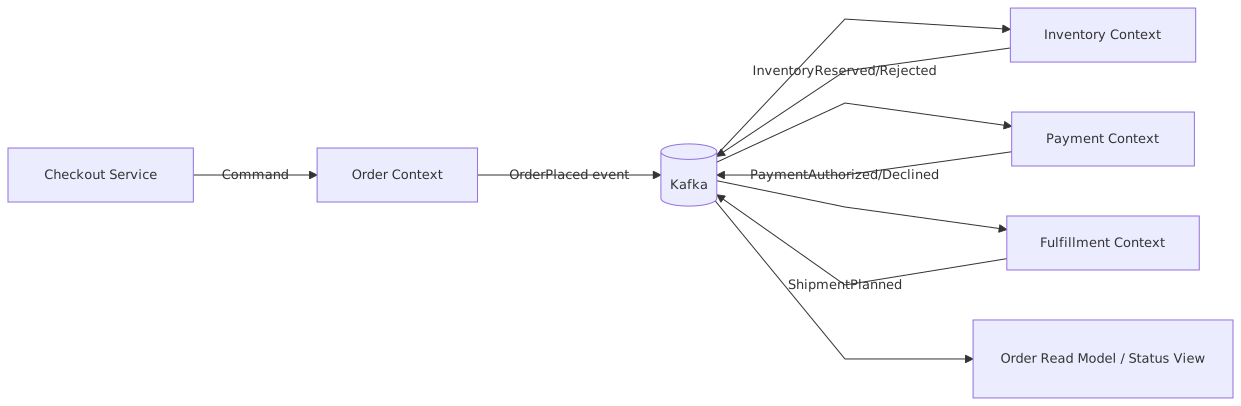
In this model, the order context does not synchronously interrogate every downstream concern at query time. Instead, it emits business facts, downstream services act in their own terms, and a status view is assembled asynchronously for operational and user-facing queries.
That is often the right place to spend less dependency budget.
Budgeting synchronous calls
Not all synchronous calls are bad. Some are entirely appropriate. Identity and access checks, payment authorization in checkout, or a small number of tightly justified policy decisions may need request-response semantics.
But make them count.
A useful design rule is this: synchronous dependencies should exist where the user or business process genuinely cannot proceed without an immediate answer. Everything else should be challenged.
That leads to a simple pattern:
- Use commands for intent
- Use events for facts
- Use local read models for most cross-domain queries
- Use orchestrators sparingly for business processes that require explicit coordination
- Use reconciliation as a first-class mechanism, not a shameful afterthought
Dependency budget diagram
Here is a simple way to visualize budget pressure.

That is not a service. That is a hostage situation.
A budgeted alternative looks more like this:
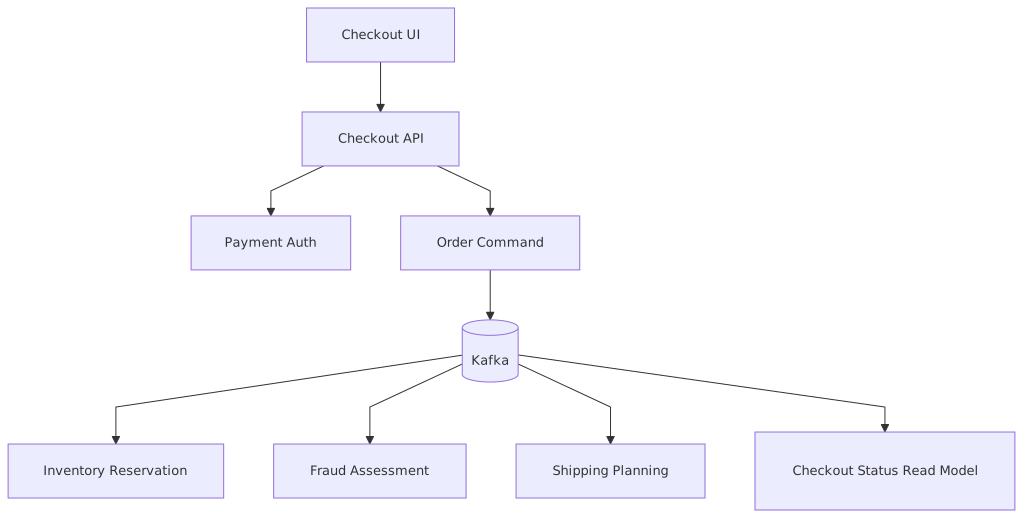
The second design may still be complex, but the runtime critical path is shorter. The dependencies are more intentional. The architecture distinguishes between immediate business gates and eventual downstream processing.
Migration Strategy
This is where theory meets the billing system from 2008.
Most enterprises do not get to redraw everything around ideal bounded contexts. They must migrate from a monolith, ERP package, shared database estate, or service bus with deeply embedded assumptions. That means dependency budgets need a migration story, not just a target-state sermon.
The right migration style is usually progressive strangler.
You identify a business capability, extract a seam, route new traffic through the new service, and gradually reduce reliance on the legacy implementation. During this journey, transitional dependencies are normal. What matters is that they remain visible, budgeted, and temporary.
A practical strangler path
- Identify a bounded context with strong business cohesion
Not a CRUD table cluster. A real capability.
- Create an anti-corruption layer
Shield the new service from legacy semantics and data structures.
- Duplicate writes carefully or emit events from the legacy estate
Use CDC if needed, but be honest that CDC transports data, not meaning.
- Build local read models in the new service
Avoid forcing runtime calls back into the monolith for every screen or validation.
- Introduce reconciliation early
During migration, states will drift. Design for detecting and repairing divergence.
- Set dependency expiry milestones
Every transitional call or shared table touchpoint should have a removal date.
- Measure budget burn-down
Dependency reduction is a migration KPI, not just a nice aspiration.
Reconciliation is not optional
Enterprises often talk confidently about event-driven architecture and then whisper about reconciliation, as if it were evidence of moral failure. It is not. Reconciliation is what responsible adults do in distributed systems.
If Kafka propagation lags, if a consumer misses a message, if a legacy adapter partially fails, if inventory was reserved but payment later declined, you need systematic ways to detect and repair inconsistent state. The dependency budget model actually strengthens the case for this. When you trade direct synchronous coupling for asynchronous autonomy, you are choosing to solve consistency with better operational mechanisms instead of brute-force runtime entanglement.
Reconciliation mechanisms may include:
- Periodic state comparison jobs
- Replay from Kafka topics
- Idempotent command reprocessing
- Compensating actions in sagas
- Dead-letter handling and triage
- Audit views keyed by business identifiers
- Time-based “stuck state” detectors
A mature architecture does not ask whether reconciliation is needed. It asks where it belongs and how it is observed.
Enterprise Example
Consider a global insurer modernizing policy administration.
The legacy platform handled policy issuance, endorsements, billing, claims references, customer records, and broker interactions in one giant estate. Every “service” initiative had initially wrapped chunks of this platform with APIs, but the wrappers mostly replayed existing coupling. The policy quote flow called underwriting, customer, pricing, eligibility, billing profile, document generation, and broker authorization synchronously. Response times were erratic. Every change crossed half a dozen teams. Incidents had no obvious owner because everyone depended on everyone else.
The organization introduced a dependency budget as part of its target architecture.
First, it re-centered around bounded contexts: Quote, Policy, Billing, Customer Party, Underwriting Decision, and Document. That sounds obvious, but the key was semantic discipline. “Customer” in policy servicing was not the same as “party” in legal identity. “Eligibility” was not “pricing.” “Policy status” was not “billing delinquency.”
Next, it set rules:
- No domain service could exceed two synchronous downstream dependencies without architectural review.
- Customer-facing critical flows could not exceed three synchronous hops.
- Reference data had to move through event propagation where feasible.
- Legacy dependencies needed a documented retirement milestone.
- Aggregators had to be explicit products with SLAs and ownership, not hidden controllers.
Quote creation remained synchronous with underwriting decision and pricing, because the business required immediate feedback. But billing profile lookup and document preview generation were moved out of the quote critical path. A Kafka-based event backbone distributed quote-created and policy-issued events. Billing and document contexts built their own views. A policy dashboard was powered by a read model assembled asynchronously rather than by live fan-out on every page load.
There were bumps. A billing consumer lag caused stale policy financial status on dashboards. The team added reconciliation against billing snapshots and exposed “status freshness” in the UI for operators. Some executives initially resisted eventual consistency, but they accepted it once shown that the previous “real-time” system was merely real-time fragility with no clear ownership.
The result was not architectural perfection. It was better than that. It was governable. Teams could explain dependencies, observe them, and reduce them over time. Lead time dropped. Incident containment improved. Legacy retirement became measurable because dependency burn-down was visible.
Operational Considerations
Dependency budgets are only useful if they affect runtime behavior and team decisions.
Observability by dependency path
Track not only service health, but dependency path health:
- Which user transactions traverse which services
- Critical path latency by hop
- Timeout and retry amplification
- Error propagation across downstream calls
- Kafka consumer lag for dependencies shifted asynchronous
- Reconciliation backlog and repair success rates
A service can look green while its dependency path is red. That is one of the oldest lies in distributed systems.
Contract management
As dependencies shrink, contracts matter more.
For synchronous APIs:
- Version consciously
- Prefer additive change
- Publish clear semantics, not just payload fields
- Test provider and consumer compatibility
For event streams:
- Treat event schemas as published contracts
- Preserve semantic intent
- Avoid leaking internal persistence structures
- Include correlation IDs and business keys for reconciliation
Resilience controls
Budgets do not replace resilience patterns; they make them more effective.
Use:
- Timeouts with discipline
- Circuit breakers where they actually help
- Bulkheads around expensive downstreams
- Backpressure-aware Kafka consumers
- Idempotency keys for retry-safe command handling
- Rate limits for unstable external dependencies
But do not use resilience libraries as decorative armor over bad dependency design. If a service needs fifteen circuit breakers, the architecture is already making a confession.
Tradeoffs
A dependency budget is not free. It shifts complexity.
You gain:
- Lower runtime coupling
- Better team autonomy
- Shorter critical paths
- Clearer ownership
- Safer independent evolution
- More durable domain boundaries
You pay with:
- More eventing infrastructure
- Eventual consistency
- Additional read model storage
- Reconciliation logic
- More explicit process design
- Greater need for observability and contract discipline
This is a good trade in many enterprise settings, especially where scale, team independence, and change frequency matter. It is a poor trade if the domain is tiny, the team is small, and the business process genuinely does not justify the machinery.
There is also a cultural tradeoff. Dependency budgets challenge teams that are used to optimizing locally. A team may feel slower when told not to call three neighboring services. In the short term, it often is slower. In the long term, it avoids becoming part of a dependency tax nobody voted for.
Failure Modes
Like any architectural idea, this one can be abused.
Failure mode 1: Turning the budget into dogma
If architects enforce a hard numeric rule without context, teams will game the metric. They may hide dependencies behind gateways or aggregators. You reduce counted calls while preserving actual coupling. That is accounting fraud, not architecture.
Failure mode 2: Ignoring domain semantics
A team may replace a clean synchronous call with asynchronous replication of the wrong data into the wrong context. The dependency count falls, but semantic coupling remains. This is common when people copy entire upstream entities “for convenience.”
Failure mode 3: Underinvesting in reconciliation
Asynchronous autonomy without reconciliation creates silent corruption. Things look decoupled until someone asks why invoices, orders, and shipments disagree.
Failure mode 4: Orchestrator bloat
To reduce direct peer-to-peer calls, teams sometimes create a super-orchestrator that centralizes every process. Congratulations: you have built a monolith with HTTP.
Failure mode 5: Platform overreach
A central architecture or platform team may impose budgets without understanding local business urgency. Then teams route around governance. Dependency budgeting should guide design, not replace judgment. ArchiMate for governance
Failure mode 6: Budgeting only runtime calls
Some of the worst coupling is hidden elsewhere: shared schemas, shared libraries with domain logic, shared database tables, shared “canonical models.” If you budget only REST calls and ignore everything else, you are measuring the smoke and missing the fire.
When Not To Use
Do not force a dependency budget regime everywhere.
You probably should not use it as a formal governance tool when:
- The system is small and will remain small
- A modular monolith would be the better design
- Team boundaries are not stable enough to justify service boundaries
- Domain volatility is low and deployment coupling is not a meaningful cost
- The operational maturity for Kafka, eventing, and reconciliation does not exist
- The organization is still learning basic service ownership and observability
In such cases, a modular monolith with clear domain modules and internal dependency rules is often the wiser move. It gives you many of the semantic and design benefits without the operational tax of distributed systems. This point matters. Microservices are not a sign of architectural seriousness. Sometimes they are just a more expensive way to avoid cleaning up a monolith. microservices architecture diagrams
Even in a microservices estate, not every service needs a formal budget scorecard. Focus on high-change domains, customer-critical paths, and systems where dependency growth is already harming reliability and autonomy.
Related Patterns
Several architecture patterns pair naturally with dependency budgeting.
Bounded Context
The foundational DDD pattern. Dependency budgets make sense only when boundaries reflect business semantics.
Anti-Corruption Layer
Essential during migration and whenever one domain must consume another without inheriting its language.
Strangler Fig Pattern
The practical migration model for retiring legacy dependencies incrementally.
Saga
Useful where workflows cross contexts and immediate consistency is neither feasible nor desirable.
CQRS and Read Models
Powerful for reducing query-time fan-out and supporting domain-specific projections.
Event-Driven Architecture
Often the backbone for spending less synchronous dependency budget, especially with Kafka.
Backend for Frontend
Can simplify client interactions, but it must not become a dumping ground for business orchestration and hidden dependency sprawl.
Modular Monolith
The pattern many organizations should adopt before, or instead of, microservices. Dependency budgeting ideas still apply inside modules.
Summary
A service dependency budget is a simple idea with sharp consequences: every dependency has a cost, so treat it like spending.
In microservices, the dangerous dependencies are not just technical calls. They are business assumptions made at runtime across bounded contexts. They create latency, fragility, deployment coordination, semantic confusion, and operational grief. Left unmanaged, they turn a promising service landscape into a distributed monolith.
The cure is not to ban collaboration. It is to make collaboration intentional.
Use domain-driven design to define boundaries around business meaning. Limit synchronous dependencies to what genuinely needs an immediate answer. Prefer events, Kafka-fed read models, and asynchronous propagation for the rest. Accept eventual consistency where it buys autonomy, but pair it with serious reconciliation. During migration, let transitional dependencies exist only with an expiry plan. Measure dependency burn-down as architecture progress.
Most of all, remember that architecture is not what services exist. It is what they are allowed to depend on.
That is the budget. Spend it where the business truly needs it. Save it everywhere else.
Frequently Asked Questions
What is a service mesh?
A service mesh is an infrastructure layer managing service-to-service communication. It provides mutual TLS, load balancing, circuit breaking, retries, and observability without each service implementing these capabilities. Istio and Linkerd are common implementations.
How do you document microservices architecture for governance?
Use ArchiMate Application Cooperation diagrams for the service landscape, UML Component diagrams for internal structure, UML Sequence diagrams for key flows, and UML Deployment diagrams for Kubernetes topology. All views can coexist in Sparx EA with full traceability.
What is the difference between choreography and orchestration in microservices?
Choreography has services react to events independently — no central coordinator. Orchestration uses a central workflow engine that calls services in sequence. Choreography scales better but is harder to debug; orchestration is easier to reason about but creates a central coupling point.