⏱ 19 min read
Consistency is where architecture stops being theory and starts costing money.
Most microservice failures are not dramatic. They do not arrive as a smoking crater in production. They show up as an order that exists in billing but not in fulfillment. A customer marked platinum in CRM and standard in pricing. A refund approved by support, silently ignored by finance, and rediscovered three weeks later by an angry auditor. The system is “up.” The dashboards are green. And the business is leaking trust.
That is the problem with consistency in distributed systems: the damage is often semantic before it is technical.
For years, enterprise teams tried to solve this with a simple instinct—centralize the truth. Put the data in one place, make everyone read from it, and preserve transactional integrity. That works, until the organization wants speed, autonomy, and bounded contexts. Then the monolith breaks apart, teams own services, Kafka appears in the architecture diagram, and consistency becomes a negotiation instead of a database feature. event-driven architecture patterns
This is where many microservice programs go wrong. They replace a single transactional system with a distributed argument. Every service owns its own data, but nobody owns the business invariants that cross them. Teams chant “eventual consistency” as if it were an architecture, rather than an admission that they have not finished the design.
A better approach is to treat consistency as a contract, not a side effect.
That leads to the idea of contract consistency zones: explicitly defined areas of the architecture where business semantics, data ownership, acceptable staleness, reconciliation rules, and failure handling are agreed upon up front. Not globally. Not vaguely. By contract, within a known zone of business behavior.
This is not about pretending distributed systems can behave like a single ACID database. They cannot. It is about being honest about which truths must align, when they must align, who is accountable when they do not, and how the system heals itself.
That difference sounds subtle. In practice, it is the line between a microservice estate that can scale with the business and one that turns into institutional folklore. microservices architecture diagrams
Context
Microservices changed the shape of enterprise architecture by aligning software boundaries with business capabilities. That is the good part. The harder part is what happens to data once those boundaries are real.
In a monolith, consistency is usually hidden inside a transaction manager and a relational database. Domain logic can span modules, but commit happens once. If a customer changes address while placing an order, one transaction can update customer, taxation, shipping, and risk records together. There are costs to that design—tight coupling, release friction, schema coordination—but there is no ambiguity about the final state.
In microservices, ambiguity is the default. Customer, Order, Billing, Inventory, and Fulfillment each own their own stores. They communicate through APIs, asynchronous messaging, event streams, or some painful combination of all three. Now consistency is temporal. One service knows something before another. Some services see facts as commands, others as events, and still others as read-model updates.
This is not a flaw in microservices. It is the price of autonomy.
The enterprise issue is that business stakeholders rarely think in terms of bounded contexts or asynchronous propagation. They think in terms of commitments. “If payment is authorized, stock should be reserved.” “If a contract is active, invoicing should reflect it.” “If a policy is cancelled, claims must stop.” Those are not technical statements. They are domain invariants. And they do not disappear because teams adopted Kafka.
Domain-driven design helps here because it gives us the right lens. A bounded context is not merely a codebase or a service boundary. It is a semantic boundary. Terms mean specific things inside it. “Customer” in marketing, billing, and compliance is often the same word carrying different obligations. Consistency failures often happen not because data arrived late, but because the receiving service interpreted the data using different semantics.
So before discussing tooling, we need to say something blunt: consistency problems in microservices are usually domain problems wearing infrastructure clothing.
Problem
The standard microservice advice is easy to state:
- each service owns its data
- services communicate via APIs and events
- avoid shared databases
- accept eventual consistency
Useful guidance, but incomplete.
The trouble starts when architects stop there. “Own your data” is not enough if nobody defines which service is authoritative for which business fact. “Publish events” is not enough if event schemas drift away from business meaning. “Accept eventual consistency” is not enough if no one specifies how eventual is acceptable for pricing, ledger updates, or compliance state.
Without explicit contracts, teams invent local truths:
- Billing treats an order as confirmed when it receives
PaymentAuthorized - Fulfillment treats it as confirmed when stock is reserved
- Customer Support treats it as confirmed when the UI read model says “Confirmed”
- Finance only cares when the invoice is posted
Now the enterprise has four definitions of the same milestone. The architecture diagram still looks clean. The business process is not.
A consistency incident in this world has a familiar anatomy:
- A business action spans multiple bounded contexts.
- State propagates asynchronously.
- One service fails, retries, or reorders messages.
- Another service acts on a partial truth.
- Humans discover the inconsistency through an exception path, not monitoring.
- A reconciliation team becomes the unofficial transaction manager.
That last step is more common than architects like to admit. In many large organizations, “manual reconciliation” is not an exception mechanism. It is the real architecture.
The root problem is that consistency has been treated as an implementation detail instead of a business contract.
Forces
Good architecture lives in the tension between forces, not in slogans. Contract consistency zones exist because several forces pull in opposite directions.
Autonomy versus invariants
Microservices promise team autonomy. Domains want end-to-end business invariants. The more independent services become, the harder cross-domain guarantees are to preserve.
Semantic ownership versus data duplication
A service should own its meaning. But downstream services often need local copies of upstream facts for performance, resilience, or process continuation. Data duplication is normal. Semantic drift is the danger.
Throughput versus coordination
Kafka, event-driven architecture, and asynchronous pipelines are excellent for scale and decoupling. They are terrible places to hide assumptions about synchronous business guarantees.
Local optimization versus enterprise accountability
A team can optimize its service for clean code, local transactions, and elegant event publishing. The enterprise suffers if no one accounts for the consistency of the overall business outcome.
Fast migration versus clean target state
Real enterprises do not rebuild from scratch. They strangle legacy systems progressively. During migration, the hardest consistency problems are often between old transaction-heavy platforms and new event-driven services.
Auditability versus eventuality
Regulated domains need explainable state transitions. “It will converge later” is not an audit strategy.
These forces do not go away. The job of architecture is not to eliminate them, but to shape them into explicit choices.
Solution
The core idea is simple: define contract consistency zones around business outcomes that require predictable semantic alignment across services.
A contract consistency zone is not a technical layer. It is a cross-service agreement containing five things:
- Authoritative business facts
Which bounded context is the source of truth for each fact.
- Consistency expectation
Strong, near-real-time, eventual-within-threshold, or reconciliation-only.
- Semantic contract
The exact meaning of states, events, identifiers, and transitions.
- Compensation and reconciliation rules
What happens when propagation fails, duplicates occur, or state diverges.
- Operational accountability
Who detects breaches, who owns repair, and what metrics define health.
That is the essence. A zone draws a bright line around a business process or subdomain where consistency requirements must be stated, measured, and enforced by contract.
For example:
- In an Order Commitment Zone, order acceptance, payment authorization, inventory reservation, and customer confirmation may need to converge within seconds.
- In a Customer Profile Zone, name and marketing preferences may tolerate minutes of staleness.
- In a Financial Posting Zone, ledger entries may require stronger sequencing, traceability, and deterministic reconciliation than surrounding services.
Not all zones need the same guarantees. That is the point.
Some zones are orchestration-heavy because the business outcome needs explicit coordination. Some are choreography-based because events are enough. Some depend on transactional outbox patterns and idempotent consumers. Some require sagas. Some need periodic reconciliation against a canonical ledger. A few genuinely justify a more centralized component.
Architecture gets better the moment we stop asking, “Is the whole system eventually consistent?” and instead ask, “Which contract consistency zone are we in, and what are its business rules?”
Architecture
A useful architecture for contract consistency zones usually combines domain-driven design, event-driven integration, and explicit reconciliation.
Start with bounded contexts. Each context owns its aggregate lifecycle and internal transactions. Cross-context consistency is handled through contracts, not shared schema access. Events represent domain facts, but only after their semantics are clear. That sounds obvious. It is often skipped.
Then classify interactions by consistency need:
- Command-style interactions for decisions that require immediate acceptance or rejection
- Domain events for facts that other contexts may react to asynchronously
- Read model replication for query convenience
- Reconciliation pipelines for healing divergence and proving convergence
Kafka fits well here, especially when zones rely on durable event streams, ordered partitions per aggregate key, replay, and downstream materialization. But Kafka is not the contract. It is the transport and log. The contract lives in the domain semantics, schemas, SLAs, and recovery rules.
A typical zone architecture looks like this:
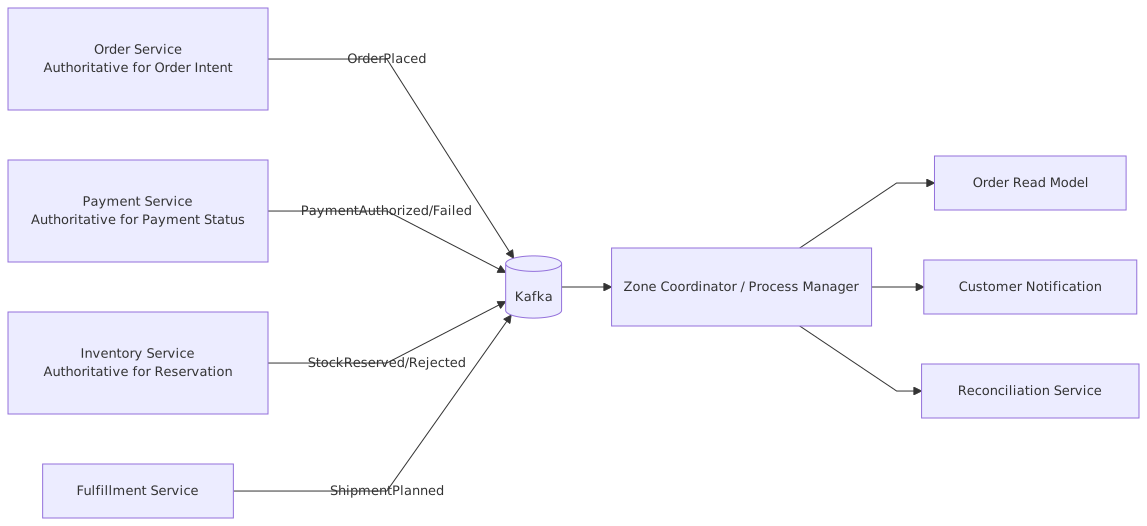
There are two important ideas hidden in that simple picture.
First, each service remains authoritative for its own facts. Payment decides payment. Inventory decides reservation. Order decides customer intent and order lifecycle. The zone contract does not erase bounded contexts. It coordinates them.
Second, the architecture includes a reconciliation service as a first-class component. That is not an embarrassing afterthought. It is part of the design. In large-scale enterprises, consistency is maintained through both forward processing and backward correction. Systems that ignore the second half are fragile.
Domain semantics matter more than event syntax
An event named OrderConfirmed is useless unless every consumer agrees what “confirmed” means. Does it mean payment succeeded? stock reserved? fraud checks passed? customer notified? Different teams often answer differently.
This is where domain-driven design earns its keep. Ubiquitous language must be explicit within the zone contract. Sometimes the answer is to avoid overloaded status labels and publish finer-grained facts instead:
OrderSubmittedPaymentAuthorizedInventoryReservedFraudClearedOrderCommitted
Now the process has semantic landmarks. A coordinator, saga, or downstream consumer can reason over facts rather than interpret ambiguous summaries.
Zone contract model

This model is lightweight enough to be practical and strong enough to stop hand-wavy integration design.
Patterns commonly used inside a zone
A contract consistency zone often combines several patterns:
- Transactional outbox to atomically persist state and publish events
- Idempotent consumers to survive duplicate delivery
- Saga or process manager for long-running distributed business processes
- CQRS read models for query-side materialization
- Dead letter and retry policies with domain-aware handling
- Periodic reconciliation jobs comparing authoritative facts to derived state
- Versioned schemas and contract testing for event evolution
The trick is not to use all of them everywhere. The trick is to use them where the zone contract says they matter.
Migration Strategy
Most enterprises are not designing consistency zones on a blank sheet. They are moving from a monolith, a package platform, or a web of shared databases. Migration matters because consistency is often weakest in the in-between state.
A progressive strangler migration is the right instinct, but it must be done with semantic discipline. Too many strangler programs focus on routing traffic while ignoring business truth. They carve APIs around old systems and call it modernization. The result is a distributed facade over monolithic assumptions.
A better migration sequence looks like this:
1. Map business invariants before extracting services
Identify the business outcomes where inconsistency is expensive: order commitment, policy issuance, invoice posting, entitlement activation, refund completion. These become candidate contract consistency zones.
Do not start with technical decomposition. Start with semantic risk.
2. Declare authoritative facts in the legacy estate
Before splitting systems, decide what the current source of truth is for each critical fact. During migration, a legacy system may remain authoritative for some facts while new services take ownership of others. Ambiguity here creates duplicate truth.
3. Introduce event publication from the monolith carefully
Use change data capture or transactional outbox patterns to emit reliable events from the legacy platform. But do not confuse database changes with business events. A row update is not necessarily a domain fact.
4. Extract one bounded context at a time
Move a capability where ownership can be made clean. Keep its consistency contract narrow at first. Resist broad cross-cutting extractions that create semantic tangles.
5. Add reconciliation before full cutover
This is the part teams skip because it feels unglamorous. During migration, run dual-state validation: compare the old source, the new service, and derived downstream projections. Build discrepancy reports early. The enterprise will need them.
6. Shift authority, not just traffic
A service is not truly extracted when it serves API calls. It is extracted when the organization recognizes it as the authority for specific business facts.
7. Retire transitional coupling deliberately
Shared database reads, synchronous callbacks into the monolith, and hidden side-effect tables can be tolerated temporarily. They should be visible, owned, and scheduled for removal.
Here is the migration shape:

The important architectural choice is that reconciliation is active during migration, not bolted on afterward.
Enterprise Example
Consider a large retailer modernizing its commerce platform. The legacy e-commerce suite handled cart, order, payment initiation, stock checks, and customer notifications inside one database-backed application. It was slow to change but operationally coherent. Then the retailer decomposed into microservices: Order, Payment, Inventory, Pricing, Fulfillment, and Customer Engagement, all integrated through Kafka.
On paper, it looked excellent.
In reality, “order confirmed” meant five different things. Payment published authorization quickly. Inventory sometimes lagged due to warehouse batch updates. Pricing adjustments arrived late for promotional orders. Customer notifications were triggered off the Order read model, which could show confirmed status before inventory reservation completed. Support agents saw one status, warehouses another, and finance a third.
This was not a message broker problem. It was a domain semantics problem.
The retailer introduced an Order Commitment Zone. The contract said:
- Order Service owns customer order intent
- Payment Service owns authorization truth
- Inventory Service owns reservation truth
OrderCommittedis a derived business fact, emitted only when payment is authorized and inventory is reserved- Customer confirmation emails may only be sent after
OrderCommitted - If payment succeeds and inventory fails, the system must compensate by voiding or refunding payment within five minutes
- All states must reconcile against authoritative facts every 15 minutes, with operations alerts on divergence above threshold
They implemented a process manager consuming Kafka events keyed by order ID, with deterministic state transitions and timeout handling. They also built a reconciliation job comparing order projections against payment and inventory authorities.
What changed was not just the plumbing. The business language changed. Support dashboards, warehouse tools, and customer comms were aligned to the same milestone definitions.
The retailer did not get perfect consistency. No distributed architecture does. But it got predictable consistency, and that is what the business needed.
A memorable lesson came from the finance lead: “I do not need every screen to update instantly. I need the company to agree on what happened.” That is the heart of contract consistency zones.
Operational Considerations
If a consistency model cannot be operated, it is fantasy.
A contract consistency zone needs observable health indicators, not just infrastructure metrics. CPU, broker lag, and pod restarts matter, but they do not tell you whether the business truth is converging.
Measure things like:
- divergence count by zone
- age of oldest unresolved inconsistency
- compensation success rate
- event processing latency by business key
- percentage of read models matching authoritative facts
- number of retries leading to semantic duplicates
- cutover drift during migration
This is where many teams discover they lack correlation IDs or stable business keys. Without them, cross-service tracing becomes archaeology.
Operational design should include:
- runbooks for known divergence scenarios
- replay procedures with idempotency guarantees
- poison message handling with domain review
- schema evolution controls
- dashboards by business process, not merely by service
- ownership mapped to teams for each zone contract
And yes, human workflows matter. In regulated or high-value domains, some reconciliation outcomes should create case management tasks rather than automatic repair. A good architecture knows where automation ends.
Tradeoffs
There is no free lunch here.
Contract consistency zones add explicitness, governance, and operational discipline. That is good. They also add design overhead and force teams to confront semantic ambiguity earlier than they might like. EA governance checklist
What you gain
- clearer accountability for business truth
- better alignment between bounded contexts
- fewer accidental semantics in event streams
- observable reconciliation and recovery
- safer strangler migration from legacy platforms
- more credible conversations with auditors and business owners
What you pay
- more upfront domain modeling
- additional artifacts: contracts, state models, reconciliation rules
- possible need for process managers or orchestration in some zones
- slower “just publish an event” integration paths
- increased operational maturity requirements
This pattern is opinionated in one important way: it rejects the lazy version of event-driven architecture where services emit vaguely named events and hope downstream teams sort it out.
Hope is not integration.
Failure Modes
If you adopt contract consistency zones poorly, you can still make a mess. Common failure modes include:
1. Mistaking transport contracts for semantic contracts
Avro schemas, topic names, and API specs are necessary. They are not the business contract. If semantics stay ambiguous, typed ambiguity is still ambiguity.
2. Over-centralizing with a giant coordinator
A process manager for one zone can be helpful. A universal enterprise orchestrator becomes a distributed monolith with extra latency.
3. Defining zones too broadly
A zone should capture a meaningful business outcome, not an entire enterprise capability. Big zones become governance theater. ArchiMate for governance
4. Ignoring reconciliation
Retries and sagas do not eliminate drift. They reduce it. Enterprises need periodic and event-triggered reconciliation because failures are messy: missing events, duplicate events, side effects that partially succeed, and historic backfills.
5. Weak idempotency
Kafka and other brokers can deliver duplicates. Replays happen. Consumer restarts happen. If actions like refunds, emails, or shipping requests are not idempotent, recovery creates new incidents.
6. No time boundary
“Eventually consistent” without a time threshold is management by wishful thinking. Every zone needs an acceptable convergence window.
7. Migration limbo
Temporary dual writes, hidden sync calls back to the monolith, or shadow ownership often persist for years. Transitional architecture becomes permanent architecture unless someone actively kills it.
When Not To Use
This pattern is not universal.
Do not use contract consistency zones for every data exchange. If the business impact of inconsistency is trivial and local repair is cheap, simpler event publication and consumer autonomy are usually enough.
Do not wrap low-value CRUD interactions in heavy consistency governance. That is how architecture becomes bureaucracy.
Do not force this model where a monolith or modular monolith is still the better answer. If a domain is tightly coupled, the team topology is stable, and transactional consistency is central to the problem, splitting into microservices may be the real mistake. A well-structured monolith often beats a badly justified distributed system.
And do not use this pattern as an excuse to avoid better domain boundaries. If everything needs a cross-service contract, the decomposition may be wrong.
Related Patterns
Contract consistency zones sit alongside several well-known patterns:
- Bounded Context: the core DDD boundary for semantics and ownership
- Saga: coordinates long-running business processes across services
- Transactional Outbox: ensures state change and event publication move together
- CQRS: separates write-side authority from read-side projections
- Event Sourcing: can strengthen traceability in some zones, though it is far from mandatory
- Anti-Corruption Layer: useful during strangler migration from legacy semantics
- Data Mesh product thinking: relevant for ownership and contracts, though operational data products are not the same as transactional consistency zones
- Master Data Management: sometimes adjacent, but MDM does not solve transactional business consistency by itself
The key distinction is this: these are patterns and mechanisms. Contract consistency zones provide the decision frame for where and why to apply them.
Summary
Distributed systems do not fail because architects forgot the CAP theorem. They fail because the enterprise never made its semantic commitments explicit.
Microservices push data consistency out of the database and into the architecture. Once that happens, “eventual consistency” is not enough as a design answer. The business needs to know which facts are authoritative, which outcomes must converge, how long convergence may take, what happens when it does not, and who is responsible for repair.
That is why consistency should be handled by contract.
Contract consistency zones give architects a practical way to bring domain-driven design into the hardest part of microservices: the places where business truth crosses bounded contexts. They force honest decisions about semantics, ownership, migration, compensation, and reconciliation. They support progressive strangler modernization without pretending the old and new worlds will agree automatically. And they give operations a fighting chance to detect and heal divergence before the business does it for them.
The final lesson is simple, and worth remembering: in enterprise architecture, the most dangerous inconsistency is not stale data. It is stale meaning.
Design the meaning first. Then make the systems converge around it.
Frequently Asked Questions
What is a service mesh?
A service mesh is an infrastructure layer managing service-to-service communication. It provides mutual TLS, load balancing, circuit breaking, retries, and observability without each service implementing these capabilities. Istio and Linkerd are common implementations.
How do you document microservices architecture for governance?
Use ArchiMate Application Cooperation diagrams for the service landscape, UML Component diagrams for internal structure, UML Sequence diagrams for key flows, and UML Deployment diagrams for Kubernetes topology. All views can coexist in Sparx EA with full traceability.
What is the difference between choreography and orchestration in microservices?
Choreography has services react to events independently — no central coordinator. Orchestration uses a central workflow engine that calls services in sequence. Choreography scales better but is harder to debug; orchestration is easier to reason about but creates a central coupling point.