⏱ 21 min read
Microservices promised speed. What they often delivered first was a more efficient way to break production.
That is the uncomfortable truth behind most modernization programs. Teams split a monolith, add Kubernetes, wire in Kafka, declare victory, and then discover that deployment risk did not disappear. It merely changed shape. In the monolith era, one bad release could take down the whole application. In the microservices era, one bad release can ripple across an estate through contracts, events, retries, caches, and automated scaling. Failure becomes less theatrical and more contagious. microservices architecture diagrams
This is why deployment safety nets matter. Not as a DevOps accessory. Not as a platform team vanity project. As core architecture.
A mature microservices architecture is not one that deploys fast. It is one that can survive its own deployments. It assumes partial failure, semantic drift, stale messages, old consumers, new producers, inconsistent read models, and operators making changes under pressure on a Friday afternoon. In other words, it is designed for real enterprises, not conference demos.
The best deployment safety nets are not a single mechanism. They are a layered system of protections: release strategies, backward-compatible contracts, event versioning, anti-corruption layers, reconciliation jobs, observability, rollback controls, and domain-aware invariants. They form the architectural equivalent of suspension bridges: no single cable saves you, but enough thoughtfully placed cables stop disaster becoming collapse.
And here is the part architects often miss: a deployment safety net is not only technical. It is deeply tied to domain semantics. If your Order service and Payment service disagree about what “authorized” means, no amount of canary rollout will save you. If a Customer profile update can be observed before consent changes propagate, your problem is not merely deployment mechanics. It is bounded context ambiguity showing up in production.
So let us be plain. Deployment safety in microservices is really about controlling change across distributed domain boundaries. The deployment itself is just the moment the truth becomes visible.
Context
Microservices live in a world of independent deployability, asynchronous communication, decentralized data, and autonomous teams. That sounds clean on a whiteboard. In production, it creates a mess of moving parts with very different clocks.
A service can deploy in seconds. Its downstream consumers may not update for months. Kafka can preserve events long enough for forgotten consumers to wake up and process history with code written against older assumptions. Feature flags can create four behavioral variants of the same endpoint. Schema registries can enforce syntax while letting semantic confusion stroll right through the front door. Meanwhile, business stakeholders continue to expect one thing: no broken customer journeys.
This is especially acute in enterprises that are halfway through migration. Most are not greenfield digital natives. They are insurers, retailers, banks, telcos, logistics firms, and public sector organizations trying to modernize while still carrying legacy systems that close books, calculate premiums, route parcels, or settle claims. These organizations do not get to pause the business while architecture catches up.
The result is an architecture landscape with:
- legacy systems still owning critical records
- newly extracted services owning slices of domain behavior
- Kafka or other event backbones carrying integration signals
- API gateways masking internal fragmentation
- data lakes and reporting platforms depending on old and new feeds
- multiple deployment cadences across teams and vendors
In such an environment, every deployment is also a negotiation between past and future. Safety nets are what make that negotiation survivable.
Problem
The textbook problem sounds simple: how do we reduce deployment risk in microservices? The real problem is nastier.
A service deployment can fail safely at the container level while still failing catastrophically at the business level.
Consider a simple case. The Order service starts emitting a new event field, fulfillmentPriority, and assumes downstream services will ignore what they do not understand. Most do. One old inventory consumer, however, uses a brittle deserializer and starts dead-lettering messages. Orders continue to be accepted, payments continue to be captured, but warehouse reservations stop. From the platform dashboard, the deployment is healthy. From the customer’s perspective, you are taking money for orders you cannot ship.
That is not a deployment bug. That is an architecture bug exposed by deployment.
The central problem has four dimensions:
- Technical compatibility risk
APIs, event schemas, infrastructure settings, routing rules, and configuration drift can break integrations.
- Semantic compatibility risk
A contract can remain syntactically valid while meaning changes underneath it. This is the more dangerous failure.
- Temporal inconsistency
Distributed systems update at different speeds. During deployment, old and new behaviors coexist.
- Operational detectability
Many deployment failures are not immediately visible. They emerge as lag, backlog, reconciliation gaps, or customer support tickets three hours later.
Architects who focus only on rollout mechanics usually build elegant delivery pipelines and still get hurt. The missing piece is that deployment safety must be designed into the domain interaction model itself.
Forces
Every serious architecture is shaped by tension. This one is no different.
Independent deployability versus coordinated correctness
Microservices promise autonomous teams and independent releases. Business processes, however, do not respect service boundaries. An insurance quote, a telecom activation, or an e-commerce order crosses multiple contexts. The more you optimize for team independence, the more you must invest in mechanisms that preserve end-to-end correctness without central coordination.
Speed versus semantic stability
Teams want to ship quickly. Domains want stable meaning. These are not enemies, but they are uneasy neighbors. If teams change contracts faster than shared domain language evolves, drift sets in. A field named status becomes a graveyard of assumptions.
Event-driven decoupling versus eventual consistency
Kafka is excellent at loosening runtime dependencies. It is equally excellent at making inconsistency normal. Events arrive late, out of order, duplicated, or replayed. Safety nets must therefore assume that any deployment can intersect with delayed or replayed history.
Local optimization versus enterprise resilience
A team can build a fine canary strategy for its own service. That is useful, but insufficient. Enterprise resilience depends on whether downstream systems, data platforms, batch jobs, and support processes can tolerate mixed-version behavior.
Domain purity versus migration reality
Domain-driven design tells us to protect bounded contexts and preserve ubiquitous language. Sensible advice. But migration programs happen in organizations where the monolith still owns customer, finance, pricing, or policy records. Architects need enough purity to create meaningful boundaries, and enough pragmatism to survive coexistence.
These forces are why deployment safety nets are layered rather than singular. There is no silver bullet. There is only disciplined redundancy.
Solution
The solution is to build deployment safety nets as a cross-cutting architectural capability, spanning delivery, contracts, runtime controls, data correctness, and domain governance.
At a practical level, that means combining several patterns:
- backward-compatible API and event evolution
- consumer-driven contract testing
- blue-green, canary, and progressive delivery
- feature flags that separate deployment from release
- idempotent consumers and replay-safe event handling
- outbox pattern for reliable event publication
- anti-corruption layers around legacy systems
- reconciliation processes for eventual consistency gaps
- observability tied to business outcomes, not just infrastructure
- kill switches and degradation modes
- domain-level invariants that define what must never be violated
This is not a platform feature list. It is an architecture position: you do not trust a distributed system to remain correct merely because components are individually healthy.
A useful mental model is to think of safety nets in three layers:
- Preventive nets
Reduce the chance of bad change entering production: versioning, contract tests, schema checks, CI/CD guardrails.
- Containment nets
Limit blast radius when change behaves unexpectedly: canaries, cell-based routing, feature flags, circuit breakers, fallbacks.
- Recovery nets
Restore correctness after inconsistency appears: reconciliation, replay, compensating workflows, manual intervention paths.
The strongest architectures use all three. Enterprises that rely only on prevention eventually learn that production is inventive. It will find the hole you did not test.
Architecture
A deployment safety net architecture should be explicit. If it is left to team folklore, it will fail under stress.
Below is a representative architecture for microservices using Kafka, with layered release protection and reconciliation. event-driven architecture patterns

There are a few things worth noticing here.
First, progressive delivery is not the first line of defense. It sits after compatibility checks. Too many organizations use canaries as a way to test whether they broke contracts. That is expensive and sloppy. Basic compatibility should fail in CI long before traffic is shifted.
Second, the outbox pattern matters. If a service updates its own database and publishes to Kafka in separate steps, deployments can expose timing windows where state changes without corresponding events. During migration, these mismatches become poison because both old and new systems may react differently. Reliable publication is not glamorous, but it is one of the true safety nets in event-driven systems.
Third, reconciliation is part of the architecture, not an apology for poor design. In distributed systems, correctness is often statistical in the moment and deterministic over time. Reconciliation is how you make that acceptable.
Domain semantics as a safety mechanism
Now the part many teams skip.
Deployment safety starts with domain semantics. A contract is not safe because fields are optional. It is safe because the receiving context can still interpret business meaning without ambiguity.
Suppose a retail organization has these bounded contexts:
- Ordering owns order lifecycle
- Payments owns authorization and capture
- Fulfillment owns picking, packing, shipment
- Customer Care owns support view and intervention actions
If Ordering emits OrderConfirmed, does that mean payment is authorized? Inventory reserved? Fraud passed? In one company, yes. In another, no. If the semantic meaning is muddy, downstream services and support teams invent their own interpretations. Then deployment changes simply expose those private assumptions.
A safer design is explicit semantic events:
OrderAcceptedPaymentAuthorizedInventoryReservedShipmentAllocated
This is domain-driven design doing real work. It reduces hidden coupling. It also makes progressive rollout and reconciliation more precise, because each event has a narrower business promise.
Mixed-version operation
During deployment, old and new code often run together. That means your architecture must tolerate mixed-version operation.
For APIs, this often means additive change and tolerant readers. For Kafka, it means consumers that can handle older and newer event versions, ideally through upcasters or translation layers where needed. For domain workflows, it means ensuring a process can complete even if one step was started under old logic and finished under new logic.
A good rule is this: every long-running business process should be deployable mid-flight. If your saga cannot survive a deployment halfway through, it is too fragile.
Safety net controls by interaction type
Not all service interactions need the same safety nets.
- Synchronous customer-facing APIs need canaries, fast rollback, and clear degradation modes.
- Asynchronous domain events need schema evolution, idempotency, replay handling, and lag monitoring.
- Batch and reporting feeds need cutover controls, dual-run validation, and reconciliation.
- Legacy integration points need anti-corruption layers and translation stability more than fancy mesh routing.
Architecture gets better when we stop pretending one deployment pattern fits all traffic.
Migration Strategy
The migration path is where theory meets mud.
Most enterprises cannot leap from monolith to perfectly safe microservices. They need a progressive strangler migration, where safety nets increase as responsibility moves outward from the legacy core.
The strangler pattern is often described as routing traffic from old to new. That is only half the story. In real enterprise systems, you must also strangle data ownership, event publication, operational process, and support understanding. Otherwise, the new service becomes a decorative façade over old risk.
A sensible migration strategy has five stages.
1. Wrap the legacy with stable seams
Start by introducing an anti-corruption layer or façade around legacy capabilities. Do not let every new service integrate directly with the monolith’s idiosyncratic APIs or database structures.
This gives you one place to normalize semantics and one place to enforce compatibility during migration.
2. Dual-read or shadow behavior before dual-write
Before moving ownership, let the new service observe production traffic and build its own model. This may involve consuming legacy-generated events, reading replicated data, or processing mirrored requests. The point is to validate behavior without becoming operationally critical.
3. Introduce event publication with outbox and version discipline
Once a service owns meaningful behavior, publish domain events reliably. During this phase, Kafka often becomes the backbone for distributing state changes to downstream capabilities. Keep versioning conservative. During migration, old consumers linger.
4. Dual-run and reconcile
Run old and new paths in parallel where feasible. Compare outcomes. Reconciliation is essential here, especially for financial, inventory, or policy domains. If the new service computes discounts, premiums, or eligibility differently, you need a formal process for detecting and triaging discrepancies.
5. Shift authority, then remove dependency
Only after outcomes are trustworthy should the new service become the system of record for its bounded context. Even then, keep rollback and fallback options until operational confidence is earned, not merely declared.
Here is the migration shape in one picture.

A few opinions, since architecture without opinions is just diagramming.
Do not start migration by carving out the easiest technical service. Start with a domain slice that has coherent language and tolerable transaction boundaries. The right first extraction is rarely “customer” or “product” because those concepts are usually shared by everybody and owned by nobody. Better to extract something with real behavioral cohesion: quoting, returns, shipment booking, claims intake, credit decisioning. Small kingdoms are easier to govern than giant empires.
And do not underestimate reconciliation. During migration, it is your truth serum.
Enterprise Example
Consider a large retailer modernizing its order platform.
The legacy estate had a monolithic commerce application handling cart, checkout, order management, payment orchestration, and customer notification. It had survived for years because all the ugly coupling was internal. Releases were painful, but the semantics were at least locally consistent.
The modernization program introduced microservices for Checkout, Orders, Payments, Inventory, Fulfillment, and Notifications, with Kafka as the event backbone. The initial architecture looked textbook-perfect. Services were neatly separated. Teams had CI/CD pipelines. Kubernetes was humming. Everyone felt modern.
Then the incidents began.
A deployment to Orders changed the meaning of OrderCreated. Previously, the event was published only after payment authorization and stock reservation. The new implementation emitted it immediately after checkout submission, because the team wanted to model the process more accurately and reduce latency. They were not wrong from a domain perspective. They were wrong in assuming the rest of the enterprise was ready.
Notifications started sending “your order is confirmed” emails before payment failure checks completed. Customer Care screens showed orders that warehouse systems had never reserved. Finance reports counted demand that never became revenue. The service deployment itself was healthy. The enterprise was not.
The architecture was corrected in several ways.
First, the event model was rewritten around explicit domain semantics:
OrderSubmittedPaymentAuthorizedStockReservedOrderConfirmed
Second, consumer-driven contract tests were added for critical consumers, not just schema compatibility tests. Syntax had not been the problem; implied meaning had.
Third, deployment strategy was tied to business telemetry. A canary release was no longer judged only by HTTP errors and latency. It was judged by metrics like payment success correlation, inventory reservation lag, and notification misfire rates.
Fourth, a reconciliation service compared order states across Orders, Payments, and Fulfillment. Any order stuck in an impossible combination—such as confirmed without stock, or captured without shipment allocation—was flagged for automated remediation or manual review.
Fifth, the migration from monolith-owned order state to service-owned order state became progressive instead of abrupt. For a period, the monolith remained the reporting source of truth while the new services ran in dual mode and discrepancies were measured.
This is what serious enterprise architecture looks like. Less heroics. More humility.
Operational Considerations
Operations is where deployment safety stops being a design principle and becomes muscle memory.
Observe business invariants, not just technical symptoms
CPU, memory, and request latency are necessary. They are not enough. Every safety net architecture should monitor a handful of business invariants.
Examples:
- orders captured but not fulfilled within threshold
- payments authorized without corresponding order confirmation
- inventory reserved but abandoned
- customer profile changes not propagated within SLA
- Kafka consumer lag for critical topics beyond safe replay window
These are the signals that tell you whether a deployment is harming the business, not merely the pods.
Build reconciliation as an always-on capability
Reconciliation is not just for migration. It is the long-term hedge against eventual consistency and operational mishaps. If your architecture relies on asynchronous propagation, then some form of reconciliation is part of the cost of admission.
This can take several forms:
- scheduled comparison jobs
- streaming validators consuming multiple topics
- materialized “truth views” for exception detection
- operator work queues for unresolved mismatches
The key is to be explicit about authority. Reconciliation must know which system is authoritative for which domain concept.
Kafka-specific deployment concerns
Kafka adds power and risk in equal measure.
For deployment safety:
- use schema evolution rules that support additive change
- prefer explicit event versioning when semantics change
- design consumers to be idempotent
- monitor lag, dead-letter rates, retry storms, and rebalances
- be careful with replay after code changes; new code may reinterpret old events
- use partitioning strategies that preserve domain ordering where needed
The subtle trap with Kafka is replay. Teams treat it as a safety feature, which it is, until they discover the code handling replay is not semantically compatible with historical events. Replay is safe only when event meaning is durable.
Kill switches and graceful degradation
Some capabilities should be disable-able without taking down the whole customer journey.
Examples:
- suppress nonessential notifications
- pause recommendation enrichment
- route low-value workflows to delayed processing
- degrade to read-only support views
- stop event publication to a noncritical downstream while preserving source transactions through outbox buffering
Graceful degradation is often more valuable than rollback. Not every bad deployment needs reversal if blast radius can be contained while a fix is shipped.
Tradeoffs
There is no free lunch here. Safety nets cost money, time, and cognitive load.
More controls mean slower change at first
Contract testing, schema governance, and progressive rollout all add friction. Teams accustomed to direct deployment may complain. They are not entirely wrong. The answer is not to dismiss the cost, but to compare it with the cost of production incidents spreading through a distributed estate. EA governance checklist
Reconciliation can mask deeper design problems
If overused, reconciliation becomes a mop for architecture debt. You start fixing in the back office what should have been prevented in the interaction model. Reconciliation is necessary. It should not become your primary integration pattern.
Backward compatibility can slow domain evolution
Supporting old consumers for too long traps you in timid models. Sometimes semantics really do need to change. The discipline is to make those changes explicitly, versioned and communicated, rather than sneaking them through “compatible” contracts.
Feature flags add complexity
Flags are useful, but they create combinatorial behavior. Every flag is a branch in production logic. If unmanaged, they become their own failure mode.
Canarying is less useful for low-volume asynchronous paths
For event-driven workflows with delayed outcomes, canaries may not reveal semantic issues quickly enough. In those cases, shadowing, dual-run, and reconciliation are often stronger safety nets.
Failure Modes
Safety nets fail too. Better to admit it than pretend otherwise.
Here are the common ones.
False confidence from green pipelines
Your CI pipeline can be spotless while semantic incompatibility still lurks. Schema compatibility is not semantic compatibility.
Canary passes, backlog grows
A service handles a small amount of traffic fine, but under wider rollout, downstream consumers accumulate lag or dead letters. Canary metrics were too local.
Reconciliation floods operations
A new service goes live and discrepancy volumes overwhelm support teams. This usually means the exception path was never designed as a product in its own right.
Replay corrupts derived state
A consumer reprocesses historical Kafka events using new code and creates duplicate or semantically incorrect projections. Idempotency was assumed, not proven.
Feature flag drift
Different environments and tenants have different flag combinations, making incidents hard to reproduce and rollback uncertain.
Legacy source of truth ambiguity
During migration, teams are unclear whether legacy or new service is authoritative. Reconciliation then becomes political rather than technical.
A compact view helps.
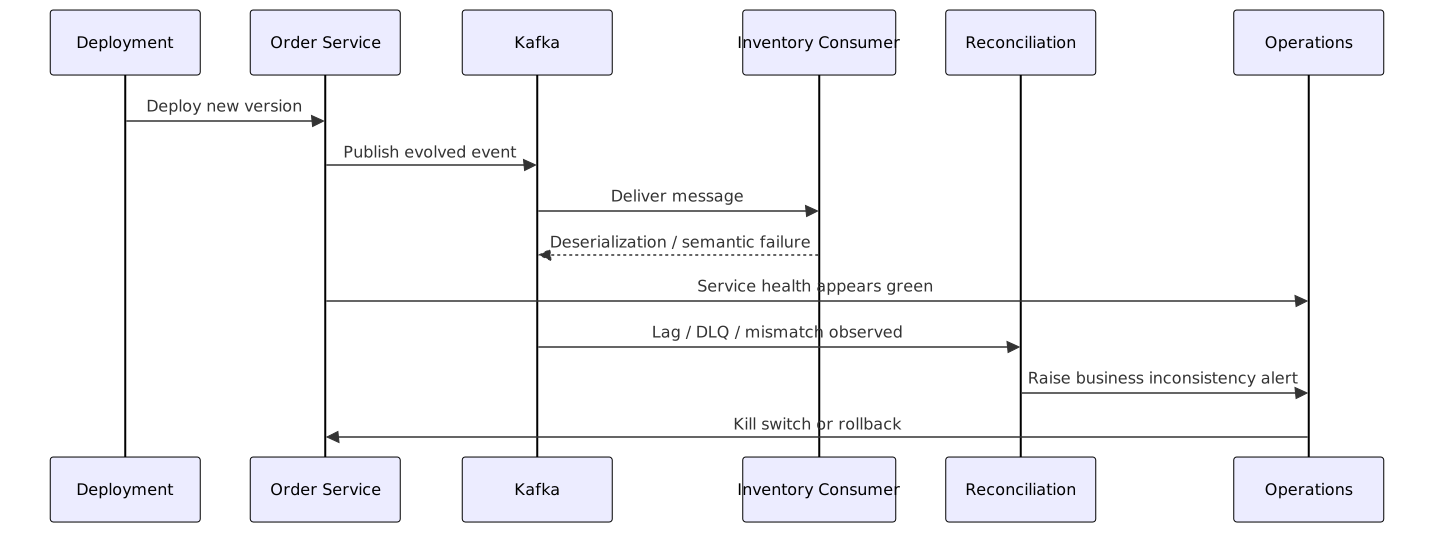
The line I would underline is this: many deployment failures are first discovered by reconciliation, not by the service that caused them. Architect for that reality.
When Not To Use
Not every system needs an elaborate deployment safety net architecture.
If you have a small system with a handful of services, low business criticality, little asynchronous processing, and a tightly coordinated team, then heavyweight governance may be overkill. You may not need schema registries, multi-stage canaries, dedicated reconciliation platforms, or sophisticated strangler migration. Simpler release practices and sound engineering may be enough. ArchiMate for governance
Likewise, if your problem domain demands strict ACID consistency within a narrow scope and there is no meaningful organizational reason to split into autonomous services, a well-modularized monolith may be safer and cheaper. There is no prize for distributing a system merely to install safety nets for problems distribution created.
And if your teams do not have the operational maturity to monitor, triage, and act on the signals these safety nets produce, adding them can become theater. A dead-letter queue no one reads is not a safety net. It is a digital attic.
Use these patterns where the complexity of the business and organization justifies them. Otherwise, prefer simpler structures.
Related Patterns
Deployment safety nets sit among a family of related enterprise patterns.
- Strangler Fig Pattern
For progressive replacement of legacy capabilities.
- Anti-Corruption Layer
To isolate new bounded contexts from legacy models and semantics.
- Outbox Pattern
For reliable event publication alongside transactional state changes.
- Saga / Process Manager
For orchestrating long-running workflows across services.
- Consumer-Driven Contracts
To validate compatibility from the perspective of real consumers.
- Circuit Breaker and Bulkhead
To contain runtime failure and isolate blast radius.
- Blue-Green and Canary Deployment
To progressively release code with rollback options.
- Event Versioning and Upcasting
To sustain mixed-version ecosystems over time.
- Reconciliation Pattern
To detect and correct divergence in eventually consistent systems.
- Cell-Based Architecture
To reduce the blast radius of bad changes across tenants or regions.
These patterns work best when guided by bounded contexts and clear ownership. Without domain boundaries, they become technical ornaments.
Summary
Deployment safety in microservices is not a switch you turn on in the pipeline. It is an architectural posture.
It begins with domain-driven design: clear bounded contexts, explicit semantics, and contracts that preserve business meaning rather than merely field structure. It extends into delivery with compatibility checks, canaries, feature flags, and rollback controls. It grows up operationally through business telemetry, idempotent consumers, reliable event publication, and reconciliation. And in legacy modernization, it becomes inseparable from progressive strangler migration, because old and new systems must coexist without lying to each other.
If there is one principle to keep, let it be this: design every deployment as though the rest of the enterprise will temporarily misunderstand you. Because in distributed systems, it often will.
The good architects I have seen do not chase zero-risk releases. That is fantasy. They build systems where mistakes are constrained, inconsistencies are visible, recovery is routine, and the business keeps moving.
That is what a deployment safety net is for.
Not to make microservices safe.
To make change survivable.
Frequently Asked Questions
What is a service mesh?
A service mesh is an infrastructure layer managing service-to-service communication. It provides mutual TLS, load balancing, circuit breaking, retries, and observability without each service implementing these capabilities. Istio and Linkerd are common implementations.
How do you document microservices architecture for governance?
Use ArchiMate Application Cooperation diagrams for the service landscape, UML Component diagrams for internal structure, UML Sequence diagrams for key flows, and UML Deployment diagrams for Kubernetes topology. All views can coexist in Sparx EA with full traceability.
What is the difference between choreography and orchestration in microservices?
Choreography has services react to events independently — no central coordinator. Orchestration uses a central workflow engine that calls services in sequence. Choreography scales better but is harder to debug; orchestration is easier to reason about but creates a central coupling point.