⏱ 21 min read
Distributed systems have a talent for moving complexity rather than removing it. We split a monolith into microservices, celebrate the new autonomy, and then discover an awkward truth: the user interface still wants one coherent screen, not six half-truths from six bounded contexts. The business does not care that customer profile lives in one service, pricing in another, loyalty status somewhere else, and shipment tracking in a Kafka-fed read model. It wants a page. It wants an answer. It wants it now. event-driven architecture patterns
That is where client-side aggregation enters the story.
This pattern is often treated as a tactical convenience: “Let the frontend call a few services and stitch the data together.” That description is technically correct and architecturally incomplete. Client-side aggregation is not just a wiring choice. It is a decision about where composition belongs, how much domain knowledge the client may own, and how much distributed systems pain you are willing to expose at the edge.
Used well, client-side aggregation can be a sharp tool. It lets teams move quickly, avoids premature middleware, and aligns with early-stage microservice decomposition where the seams are still being discovered. Used badly, it turns the client into a traveling circus of orchestration logic, retries, reconciliation, and semantic leakage. The browser becomes an accidental integration layer. Mobile apps turn into fossil records of backend indecision. microservices architecture diagrams
The central question is not whether clients can aggregate. They can. The question is whether they should, for which use cases, and for how long.
This article takes the pattern seriously. We will look at the forces that produce it, the architecture behind it, the domain-driven design implications, migration paths from monolith to microservices, operational realities, and the tradeoffs that separate a sensible design from a slow-motion incident report.
Context
Microservices changed the shape of enterprise systems, but not the shape of business requests. A customer still opens an account summary expecting balances, transactions, offers, account status, support messages, and maybe fraud alerts in one view. A claims agent still expects claim details, policy data, risk notes, and payment history in one workflow. The business interaction is cohesive even when the technology is not.
In a monolith, aggregation was mostly hidden. One transaction boundary, one schema, one call stack, one response. The UI asked for a page and the server assembled it from local modules. Once we distribute the system, those old local calls become network hops with latency, partial failure, independent versioning, and different consistency guarantees.
Client-side aggregation is one response to this mismatch. The client application — web SPA, mobile app, desktop client, even a partner-facing portal — calls multiple backend services and composes the results locally into a user experience.
At first glance, this feels natural. Modern clients are capable. Browsers can call REST or GraphQL endpoints, mobile apps routinely orchestrate APIs, and frontend teams often move faster than central platform teams. If each service exposes data independently, why not let the client combine it?
Because domain semantics matter.
A page that shows “customer status” may look like simple composition, but status can mean different things in different bounded contexts. Billing status, account status, KYC status, and support standing are not interchangeable. Client-side aggregation works best when the client is composing views, not inventing business meaning. Once the client starts reconciling domain concepts that properly belong inside a service boundary, the architecture has begun to lie.
This is the heart of the matter: aggregation is easy; coherent semantics are hard.
Problem
A microservice landscape naturally fragments data and behavior by bounded context. That is healthy. Order Management should not share a schema with Inventory. Customer Profile should not quietly reach into Billing tables. But the user journey cuts across those boundaries.
Suppose a retail banking application needs to render a “Customer 360” page. To do that, it must obtain:
- customer identity and preferences from Customer Profile
- account balances from Account Service
- recent transactions from Ledger or Transaction History
- rewards from Loyalty
- pending disputes from Case Management
- fraud alerts from a near-real-time Kafka-backed alerting service
No single service owns that view. Nor should it.
If we force one backend service to own the entire composition, we risk creating a coarse-grained god service. If we push all integration into an API gateway, the gateway becomes a business logic landfill. If we let every UI team invent its own backend-for-frontend too early, we proliferate orchestration layers before the domain has settled.
So teams often start with the most direct move: let the client fetch what it needs.
That solves one problem and introduces several more:
- Multiple network calls increase latency.
- Partial failure becomes visible to the user.
- Clients must manage sequencing, parallelism, retries, and fallbacks.
- Domain semantics can leak into presentation code.
- Different clients may aggregate differently and drift in behavior.
- Authentication and authorization get trickier across many downstream calls.
- Eventual consistency surfaces in the user experience: one panel says “active,” another says “pending.”
The pattern emerges from a real need. The danger comes when people pretend it has no architectural consequences.
Forces
Architecture is usually the art of balancing forces that refuse to disappear. Client-side aggregation sits in the middle of several.
1. User journeys are cross-domain
Business users think in outcomes, not services. “Show me the order” spans pricing, inventory, shipping, payments, and returns. The screen is a composition, even if the architecture is decomposed.
2. Bounded contexts should stay bounded
Domain-driven design gives us a useful discipline: each service should own its model, language, and invariants. Aggregation must not become a back door for rebuilding a shared enterprise data model in JavaScript.
3. Teams want autonomy
Frontend teams often do not want to wait for a central aggregation service to be built for every new screen. Client-side aggregation can preserve delivery speed, especially in early decomposition.
4. Latency compounds
What was once a local call becomes five network requests. Even with parallelism, tail latency matters. One slow dependency can make the whole page feel broken.
5. Consistency is no longer free
Services may update through asynchronous messaging, often using Kafka or similar event streaming platforms. One service may be strongly consistent within its boundary while another is fed by an event-driven read model that lags by seconds. Clients become the place where inconsistency is observed.
6. Security gets wider, not simpler
Calling many services from a client can mean broader token scopes, more exposed endpoints, more CORS rules, more rate limiting complexity, and a larger attack surface.
7. Different channels have different needs
Web, iOS, Android, partner APIs, and call-center desktops rarely need the exact same representation. A one-size-fits-all aggregation layer can become either too generic or too rigid. Client-side aggregation can be an efficient response to channel-specific composition.
These forces do not point to one universal answer. They explain why this pattern keeps appearing, even in organizations that know better than to use it everywhere.
Solution
Client-side aggregation means the client invokes multiple microservices directly, usually in parallel where possible, then merges the responses into a composite view model.
It is often best applied when:
- the composition is mostly presentation-oriented
- domain rules remain inside backend services
- consistency needs are tolerant of short-lived divergence
- the client channel has unique representation needs
- the system is in an early migration phase and central composition would be premature
A sensible implementation follows a few rules.
First, keep the client as a view composer, not a business policy engine. It can combine customerProfile, accountSummary, and rewardBalance into one page model. It should not decide whether a customer is eligible for a regulated product based on fragmented backend facts.
Second, distinguish join semantics from domain semantics. Joining two payloads by customer ID is technical composition. Defining what “customer health” means across collections, debt, open complaints, and compliance checks is domain logic. The former may live in the client. The latter belongs in a domain service or dedicated composition service with an explicit model.
Third, design for absence. In distributed systems, some part of the screen will eventually fail. The architecture should allow partial rendering, skeleton states, stale-but-useful data, and clear user messaging.
Fourth, be honest about temporality. If one panel is sourced from a Kafka materialized view updated every few seconds, say so in metadata or UX. Reconciliation is not a bug fix; it is part of the design.
Here is the basic shape.
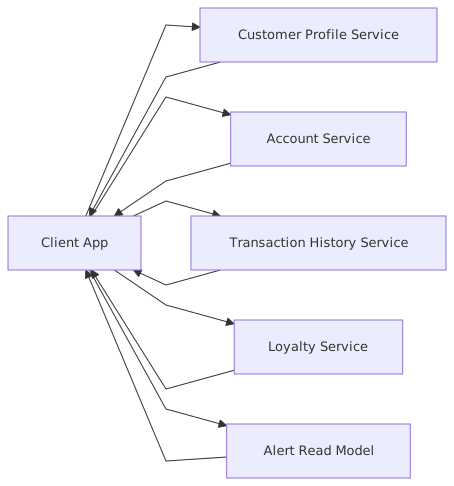
That is the simple form. It works. It is also where many teams stop thinking, which is a mistake.
Architecture
A good architecture for client-side aggregation has more discipline than “the frontend calls stuff.”
Client composition model
The client usually builds a local view model. That model should be explicit, versioned, and channel-specific.
For example, a customer dashboard page might define:
customerCardfinancialSnapshotalertsPanelactionsdataFreshness
That matters because raw service payloads should not leak straight into UI components. If they do, every service contract change ripples through the UI and your presentation layer becomes a museum of backend structure.
Parallel retrieval with dependency awareness
Some calls can execute in parallel. Others depend on identifiers returned by an initial call. You want a small orchestration graph, not a bowl of asynchronous spaghetti.
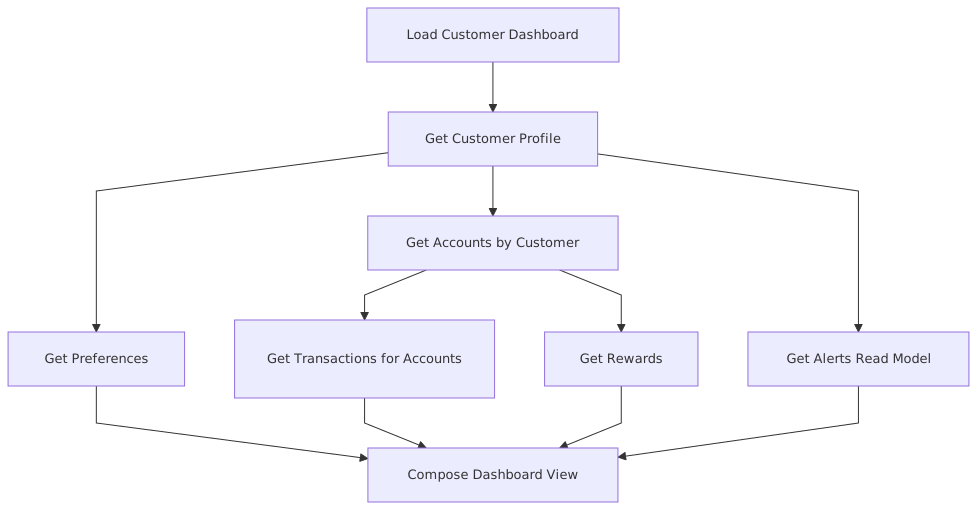
The pattern is manageable when dependencies are shallow. Once the client starts coordinating long chains of dependent calls, it is usually a sign that composition should move server-side.
Domain-driven design implications
This is where many articles get vague. They talk about composition but ignore the model. In DDD terms, client-side aggregation must respect bounded contexts and ubiquitous language.
If Order Service says “order status” and Fulfillment Service says “shipment status,” the client should present both as distinct concepts unless some domain service has explicitly defined a unified semantic such as “delivery progress.” Without that discipline, the client invents a pseudo-domain of convenience.
A useful rule is this:
If aggregation requires resolving semantic conflicts between bounded contexts, it no longer belongs purely in the client.
That does not mean the client cannot map labels or arrange display. It means it should not become the referee for enterprise meaning.
Event-driven read models and Kafka
Kafka often enters the picture for a good reason. Some cross-domain views are expensive to build live from multiple transactional services. Instead, teams publish domain events and maintain denormalized read models optimized for queries. The client may then aggregate a mix of live service calls and read-model calls.
This can be elegant. It can also be treacherous.
A fraud alert panel backed by Kafka might lag behind the account service by a few seconds. A shipment summary built from a materialized view might not yet reflect a just-completed warehouse event. The client must handle this without implying false precision.
In practice, the best designs expose freshness metadata and correlation identifiers. A response that says “last updated 12:04:17 UTC” is more trustworthy than one that pretends to be perfectly current.
Security architecture
Direct client-to-service calls mean each service may become internet- or edge-exposed through a gateway. This is not free.
You need:
- token propagation or token exchange
- fine-grained scopes
- rate limits by client and user
- consistent authorization semantics
- zero trust assumptions at service boundaries
- careful handling of personally identifiable information in browser memory and logs
The more services the client calls, the more these concerns multiply.
Observability architecture
Client-side aggregation complicates tracing. One user action can fan out into five service calls from the browser or mobile app. Without correlation IDs and end-to-end distributed tracing, diagnosis becomes guesswork.
If you use this pattern in an enterprise, invest early in:
- request correlation from client through gateway to services
- frontend performance telemetry
- service-level latency histograms
- dependency maps
- synthetic journeys for critical pages
Otherwise every “dashboard is slow” ticket becomes a political debate instead of an engineering exercise.
Migration Strategy
Client-side aggregation often appears during migration from a monolith, and frankly, that is one of the places it makes the most sense.
You have a monolithic application. You begin extracting capabilities into microservices using a strangler pattern. Some functions still live in the monolith; others are now externalized. The UI still needs a coherent page. Building a sophisticated aggregation layer too early can lock in assumptions before your bounded contexts are stable. In that phase, client-side aggregation can be a pragmatic bridge.
Here is a common progression.
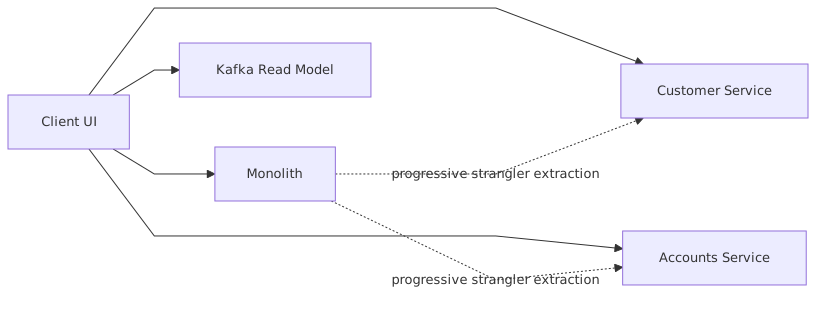
At first, the client calls the monolith for most data and one or two new services for extracted capabilities. Over time, more use cases shift out. Eventually, some compositions justify a backend-for-frontend, GraphQL layer, or dedicated experience API once the seams are proven.
This is migration by evidence rather than ideology.
Phase 1: Tactical composition
The client aggregates data from monolith endpoints and newly extracted services. The goal is speed and learning.
Good for:
- early decomposition
- low-risk screens
- internal users
- proving service boundaries
Bad if:
- domain semantics are still deeply intertwined
- the UI is customer-critical and latency-sensitive
- strong consistency is non-negotiable
Phase 2: Stabilize semantics
As the new services mature, identify repeated client-side composition logic across channels. If web and mobile both compute the same “account health” indicator, that is no longer just presentation logic. Promote it into a proper backend component.
Phase 3: Introduce experience-specific aggregation where justified
Not every composite view deserves a new service. But high-value, high-traffic, semantically rich experiences often do. By then, you know the domain better. You are not guessing.
Reconciliation during migration
This deserves special attention.
During strangler migration, the same business concept may exist in both monolith and microservices for a period. Data may diverge. Event propagation may lag. A client aggregating across old and new worlds will expose those cracks unless you design for reconciliation.
Typical reconciliation tactics include:
- source-of-truth declarations per field
- freshness timestamps
- temporary precedence rules
- background compare-and-repair jobs
- event replay from Kafka to rebuild read models
- operational dashboards showing divergence rates
One of the uglier failure modes in migration is silent semantic drift: the monolith still defines “active customer” one way, while the extracted service defines it another. The UI happily displays whichever response arrives first. That is not architecture. That is roulette.
Enterprise Example
Consider a global insurer modernizing its claims platform.
The original claims portal was backed by a monolithic policy administration system. Agents used a single screen showing claimant details, policy coverage, claim status, payment history, fraud flags, and recent correspondence. During modernization, the company extracted several services:
- Policy Service
- Claims Service
- Payments Service
- Correspondence Service
- Fraud Insights Service
Fraud Insights was fed from Kafka topics published by claims events, payment anomalies, and external scoring updates. It maintained a read-optimized store because live joins against operational systems were too slow and too brittle.
The architecture team faced a familiar temptation: build an enterprise aggregation service for the agent portal. They resisted. Correctly.
Why? Because the decomposition was still in flux. Policy and claims were stable bounded contexts, but payments and correspondence were still being carved out. The portal itself had rapidly changing UX requirements driven by operations teams. A heavy central composition layer would have frozen uncertainty into code.
So they used client-side aggregation for the first migration wave.
The agent portal loaded:
- claimant and policy summary from Policy Service
- claim details from Claims Service
- payment timeline from Payments Service
- recent letters and emails from Correspondence Service
- risk indicators from Fraud Insights read model
The UI rendered each area independently with freshness indicators. Fraud flags included “updated 30s ago.” Payments showed “temporarily unavailable” without blocking claim review. The portal had a typed local composition model so backend contracts did not leak directly into components.
This worked well for six months. Then patterns emerged.
Three different channels — agent portal, supervisor dashboard, and partner adjuster app — all needed the same “claim exposure summary,” a derived concept combining claim reserve, payment history, policy coverage, and fraud hold state. The calculation had business significance. Auditors cared about it. Different clients had begun to implement slightly different rules.
That was the moment to stop using client-side aggregation for that concept.
The team created a dedicated Claims Experience API that owned the composition for exposure summary and a few adjacent business concepts. It consumed live service APIs and Kafka-fed read models, encapsulated reconciliation rules, and exposed a clear domain language. The rest of the less critical page composition remained client-side.
That is how grown-up architecture usually looks: not pattern purity, but selective movement of responsibility to the right place as the system learns what it is.
Operational Considerations
If you adopt client-side aggregation, operations cannot be an afterthought.
Latency budgets
Every aggregated page needs a latency budget. Define target response times per component and for the whole experience. Otherwise, one service team optimizes for p95 while another quietly destroys p99 and the client pays the bill.
Parallelize wherever sensible, but remember that parallel fan-out can amplify backend load. A homepage viewed by 50,000 users can turn into 250,000 downstream requests if the client calls five services.
Caching
Caching helps, but it must align with semantics.
Good candidates:
- static reference data
- user preferences
- low-volatility summaries
- read models with explicit freshness guarantees
Bad candidates:
- highly sensitive authorization-derived data
- volatile balances without freshness indicators
- anything users may act on immediately if stale data would cause harm
Use ETags, short TTLs, and explicit invalidation where possible. On mobile, local caching can dramatically improve perceived performance, but stale composite views need careful messaging.
Resilience and graceful degradation
A composite experience should degrade in slices, not collapse wholesale. If Loyalty is down, the customer dashboard should still show accounts and transactions. This sounds obvious until somebody builds a promise chain that fails the whole page on one rejected call.
Monitoring and tracing
Measure:
- per-component latency
- aggregate page render time
- partial failure rate
- stale data rate
- reconciliation mismatches
- fan-out volume by client version
And please version your clients. An old mobile app with inefficient aggregation can become a long-tail operational tax for years.
API governance
When many clients call many services directly, API sprawl arrives quickly. Standardize pagination, error handling, auth headers, idempotency expectations, and deprecation policies. The client side is where inconsistency becomes expensive.
Tradeoffs
Client-side aggregation is a compromise. Good architecture admits that plainly.
Benefits
Fast to implement. Especially useful in early migration or for new channels.
Preserves service autonomy. No immediate need for a central orchestration layer.
Channel-specific flexibility. Each client can compose what it needs without waiting on backend changes.
Reduces premature abstraction. You avoid building a heavyweight aggregation service before the domain relationships are clear.
Costs
Higher client complexity. The client now manages orchestration, retries, timeouts, loading states, and fallbacks.
Semantic leakage. Domain concepts can drift into UI code.
Performance risk. More network hops, more tail latency, more chatty interactions.
Inconsistent behavior across channels. Different clients may compose the same concepts differently.
Security exposure. More direct API access means broader edge concerns.
Harder reconciliation. Eventual consistency and mixed-source truth become visible to users.
The pattern is often right precisely because it is imperfect but economical. It buys time. The danger is treating a time-buying move as a permanent design principle.
Failure Modes
This pattern has a few classic ways to fail, and they are worth naming because enterprises repeat them with almost ceremonial regularity.
The smart client trap
The client starts as a composer and ends as a business rules engine. Soon eligibility, reconciliation, state transitions, and exception handling all live in frontend code. Web and mobile diverge. Nobody can explain which implementation is authoritative.
The semantic soup problem
Clients merge similarly named fields from different services as though they mean the same thing. status, state, active, open — all mashed into one badge. Users get a clean screen built on dirty meaning.
The latency cliff
Each service call looks acceptable alone. Together they create miserable p99 page times. Add mobile networks, TLS setup, and cold caches and the user experience falls off a cliff.
The partial failure scandal
One backend is intermittently failing, but the client architecture was built for all-or-nothing rendering. The screen goes blank. A non-critical dependency becomes a business outage.
The migration dead end
Client-side aggregation, introduced as a temporary bridge during strangler migration, becomes permanent because nobody budgets time to extract repeated semantics into proper backend composition services.
The reconciliation mirage
Teams use Kafka read models without surfacing freshness or divergence. Users act on stale information believing it is current. Operations then invent manual workarounds for a problem architecture should have exposed honestly.
When Not To Use
There are clear cases where client-side aggregation is the wrong move.
Do not use it when the composition requires strong transactional consistency across domains. If the user is making a commitment based on combined data — approving a loan, releasing a payment, finalizing a regulated trade — the system should not rely on a client stitching together eventually consistent fragments.
Do not use it when aggregation embodies real domain policy. If the logic defines a business concept with audit, compliance, or cross-channel importance, it belongs behind a backend contract.
Do not use it for highly latency-sensitive consumer experiences where every round trip matters and channels need consistent behavior.
Do not use it when security boundaries become too broad. If exposing multiple downstream services to client access complicates authorization or data protection materially, that is a serious architectural smell.
And do not use it if your organization lacks frontend engineering maturity. A weak client architecture plus direct service fan-out is not empowerment. It is distributed chaos with a CSS layer.
Related Patterns
Client-side aggregation sits among several adjacent patterns.
API Gateway
Useful for cross-cutting concerns like auth, throttling, routing, and observability. Sometimes abused as an orchestration engine. Resist that urge unless the logic is truly edge-related.
Backend for Frontend (BFF)
A strong option when a specific channel has stable, repeated aggregation needs. It keeps composition out of the browser while preserving channel specificity.
GraphQL
A query-oriented aggregation approach that can be excellent for client flexibility. But GraphQL does not make semantic boundaries disappear. It can centralize query composition while still hiding a messy backend if not designed carefully.
CQRS Read Models
Often complementary. Kafka-fed materialized views can make cross-domain queries efficient, especially for dashboards and summaries.
Strangler Fig Migration
One of the best contexts for tactical client-side aggregation. It helps bridge monolith and microservices while the target architecture is still forming.
The trick is not to pick one pattern and become religious about it. Real systems often use several at once, with different responsibilities.
Summary
Client-side aggregation in microservices is one of those patterns that looks simple until you use it in anger. Then it reveals what it always was: a decision about boundaries, semantics, latency, resilience, and migration timing.
It works well when the client is assembling a view rather than defining the business. It is especially effective during progressive strangler migration, when bounded contexts are still settling and a heavyweight composition layer would be guesswork in expensive clothing. It also fits channel-specific experiences where autonomy matters and consistency needs are pragmatic rather than absolute.
But it comes with a bill. The client gets more complex. Failure becomes visible. Reconciliation stops being a back-office concern and becomes part of user experience design. Kafka read models, freshness metadata, partial rendering, and observability all become first-class concerns. Most importantly, domain semantics must remain disciplined. The client may compose facts; it should not manufacture enterprise meaning.
The mature enterprise answer is rarely “always aggregate in the client” or “never do it.” The mature answer is to use client-side aggregation tactically, watch where semantics and duplication accumulate, and then promote stable, business-significant composition into backend services or experience APIs when the evidence is clear.
That is the real architecture lesson here. Not every temporary pattern is a mistake. Some are bridges. The craft lies in knowing when you are crossing one — and when you have accidentally started living on it.
Frequently Asked Questions
What is a service mesh?
A service mesh is an infrastructure layer managing service-to-service communication. It provides mutual TLS, load balancing, circuit breaking, retries, and observability without each service implementing these capabilities. Istio and Linkerd are common implementations.
How do you document microservices architecture for governance?
Use ArchiMate Application Cooperation diagrams for the service landscape, UML Component diagrams for internal structure, UML Sequence diagrams for key flows, and UML Deployment diagrams for Kubernetes topology. All views can coexist in Sparx EA with full traceability.
What is the difference between choreography and orchestration in microservices?
Choreography has services react to events independently — no central coordinator. Orchestration uses a central workflow engine that calls services in sequence. Choreography scales better but is harder to debug; orchestration is easier to reason about but creates a central coupling point.