⏱ 21 min read
Most microservice failures do not begin with networking. They begin with drawing the wrong line.
Teams like to talk about service decomposition as if it were cartography: split by capability, draw a few boxes, put Kafka in the middle, and call it architecture. But the hard part is not drawing boxes. The hard part is deciding where truth must stay together and where truth can safely drift apart for a while. That is the real work. Every serious microservices program eventually discovers the same thing: the architecture is only as good as its consistency boundaries. microservices architecture diagrams
A consistency boundary is the place where the business says, with a straight face, “these facts must change together or the world breaks.” That sounds abstract until the invoices are wrong, the inventory is oversold, or the regulator asks why customer consent was updated in one system but not another. At that moment, what looked like a technical partition becomes a business liability.
This is why consistency boundary discovery matters. It sits at the center of domain-driven design, service decomposition, event-driven architecture, and migration strategy. If you miss the domain semantics, you end up with distributed transactions where you should not have them, eventual consistency where you cannot tolerate it, and reconciliation jobs quietly becoming the most important system in the estate.
The modern enterprise has a habit of over-romanticizing autonomy. Autonomy is useful. It is not free. Every split introduces a debt: delayed visibility, duplicate models, message ordering issues, idempotency concerns, replay behavior, versioning friction, and plain old human misunderstanding. In a monolith, a transaction manager hides some sins. In microservices, the business process itself becomes the transaction manager. The choreography of state change is now part of your architecture whether you designed it or not.
So the question is not “how many microservices should we have?” That question has ruined many roadmaps. The real question is: where are the natural consistency boundaries in the domain, and what are we willing to reconcile later rather than enforce now?
That is a much better question. It leads to architecture grounded in business meaning instead of middleware fashion.
Context
Microservices emerged as a reaction against large coupled systems that made change slow and hazardous. The promise was compelling: independent deployability, team autonomy, bounded context alignment, better scalability, and cleaner ownership. In many organizations, that promise was real. In many others, it turned a big ball of mud into a distributed big ball of mud with more dashboards.
The distinction often comes down to boundaries.
Domain-driven design gives us a useful lens. A bounded context is not merely a module or a namespace. It is a boundary around a particular model and language. “Customer” in Sales is not “Customer” in Billing is not “Customer” in Identity. Those models overlap in data but differ in semantics, lifecycle, and invariants. When architects forget this, they create shared schemas, canonical models, or “master data services” that become political compromises rather than coherent domain designs.
Consistency boundaries sit inside this picture. They are the places where invariants live. If an invariant spans multiple concepts, those concepts probably belong together. If the business process can tolerate temporary divergence, the concepts may be separated and coordinated through events, commands, or sagas.
In practical terms, enterprises usually encounter consistency boundary questions in a few recurring areas:
- order capture and fulfillment
- inventory reservation
- payment authorization and settlement
- customer profile and consent
- pricing and promotions
- entitlement and subscription management
- claims and policy administration
- trade capture and settlement in financial services
In all of them, domain semantics matter more than technical purity. “Order submitted” is not just a row insert. It may imply stock reservation, fraud review, credit check, tax calculation, and downstream commitments. If those behaviors are split thoughtlessly across services, one business action becomes a chain of fragile asynchronous side effects.
That is where boundary discovery stops being theory and becomes enterprise architecture.
Problem
The common mistake is to identify services from nouns instead of invariants.
A workshop produces a list like Customer Service, Product Service, Order Service, Payment Service, Inventory Service. It looks clean on a slide. It often behaves badly in production. Why? Because nouns are cheap. Business guarantees are expensive.
Suppose an order is accepted only if inventory is reserved and payment is authorized. If Order, Inventory, and Payment are separate services, then what exactly does “order accepted” mean? Has stock definitely been held? Has payment definitely been secured? If one succeeds and the other fails, which status is visible to the customer? Who compensates? What happens on duplicate messages, retries, or Kafka partition rebalancing? event-driven architecture patterns
These are not edge cases. They are the architecture.
The problem becomes worse during migration from a monolith. In the monolith, many invariants are enforced in a single ACID transaction, often without anyone explicitly naming them. Once you begin decomposition, those hidden transactional assumptions leak out. Teams discover, usually late, that “simple extraction” is not simple at all because the database transaction was doing business work.
This is the typical trap:
- Extract a service around a table set.
- Keep synchronous calls for convenience.
- Discover latency and availability coupling.
- Introduce Kafka for decoupling.
- Encounter duplicates, reordering, and missing correlation.
- Add reconciliation jobs.
- Realize reconciliation is now a first-class business process.
That sequence is so common it might as well be a pattern.
The root issue is not Kafka. It is not REST. It is not eventual consistency. The root issue is that the enterprise did not explicitly discover the consistency boundary before splitting the system.
Forces
Good architecture is usually the management of competing truths. Consistency boundaries are shaped by several forces, and they pull in different directions.
1. Business invariants
Some facts must change together.
An airline seat cannot be sold twice. A payment cannot be captured for a cancelled order. A regulated consent status must be auditable and current at the point of use. These are not implementation details. They are business laws. If violating them causes financial loss, customer harm, or regulatory exposure, they belong at the center of boundary decisions.
2. Team autonomy
Teams need to deliver independently. Shared transactional coupling kills flow. If every feature crosses four services and three approvals, “microservices” are just an expensive way to recreate a coordination monolith. Boundaries should support cohesive ownership and local reasoning.
3. Change frequency
Concepts that change together often belong together. If pricing rules and promotion eligibility evolve weekly as one body of logic, splitting them because they are different nouns is a mistake. High co-change is a strong signal of a single consistency boundary.
4. Scale and throughput
Some workloads justify separation even when the domain is tangled. Read-heavy product catalog browsing and write-sensitive inventory reservation are often separated for scalability reasons. But if you split for scale, you inherit coordination complexity. There is no discount.
5. User experience tolerance
Not every delay matters equally. A user may tolerate seeing loyalty points update a few seconds later. They will not tolerate being charged twice. Tolerance for staleness is a domain decision disguised as UX.
6. Operational reality
Kafka is durable, but not magical. Consumers fail. Partitions lag. Events arrive out of order across topics. Schemas evolve. Replay can trigger old business logic in surprising ways. The architecture must survive these realities without turning operators into archaeologists.
7. Regulatory and audit needs
Financial services, healthcare, telecom, and public sector systems often need strong traceability. Event streams can help, but only if event semantics are explicit and immutable. If your service boundaries obscure who was authoritative for what decision at what time, the audit trail becomes theater.
These forces never align perfectly. The job is not to eliminate tension. The job is to decide where to pay.
Solution
The central idea is simple: discover consistency boundaries by identifying domain invariants, decision points, and semantic authority before choosing service boundaries.
That sounds obvious. It is rarely practiced with enough rigor.
Start with domain-driven design. Not the lightweight version where everyone says “bounded context” and then shares the same customer table. The real version: identify domain language, policies, lifecycle transitions, and invariants. Ask uncomfortable questions.
- What business facts must be atomically true together?
- Which decisions require current authoritative state?
- What does each status actually mean in business terms?
- Where can the business tolerate drift, delay, or reversal?
- Who owns the meaning of an event?
- What happens when messages are duplicated, late, missing, or replayed?
These questions reveal whether a boundary is real or cosmetic.
A useful technique is to classify operations into three categories:
- Must be strongly consistent
- Can be eventually consistent
- Can be reconciled later
- reservation, authorization, legal consent capture, balance movement
- search indexing, recommendations, CRM enrichment, analytics projections
- non-critical read models, notifications, low-value replication
This classification should drive architecture.
If multiple concepts participate in the same critical invariant, keep them within the same consistency boundary, often the same service and data store. If a process spans multiple bounded contexts but can tolerate coordination over time, use asynchronous messaging, saga orchestration or choreography, and explicit compensations. If information is merely copied for convenience, use projections and reconciliation, not fake “source of truth” arguments.
A consistency boundary diagram helps expose this visually.
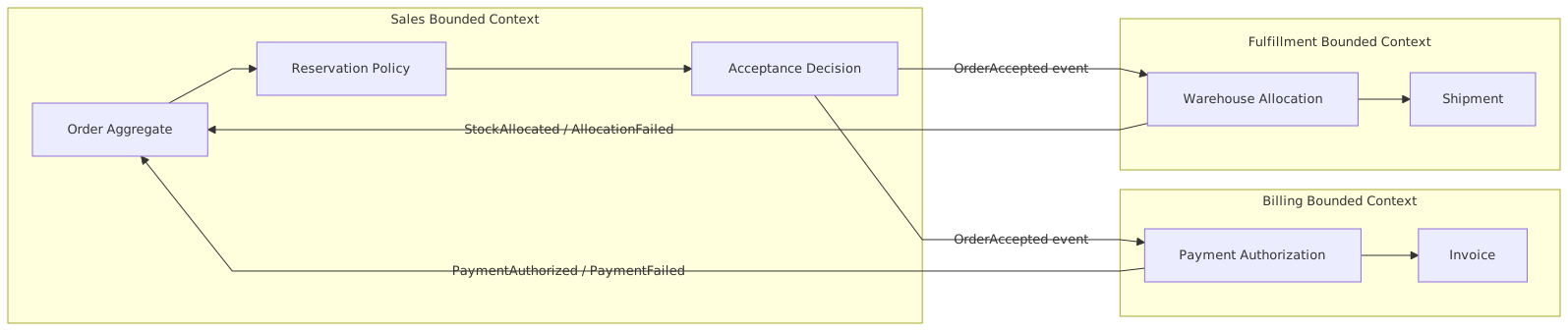
The key is not the arrows. The key is the meaning behind them. If “acceptance” requires stock and payment to be guaranteed first, then the diagram is wrong. If “acceptance” merely means “customer request recorded and process started,” then it may be right. The semantics determine the boundary.
This is why naming matters. Weak naming creates strong confusion. “OrderCreated” is usually useless. Created in what sense? Persisted? Validated? Committed? Accepted for fulfillment? Submitted for review? Event names should encode business fact, not technical occurrence.
Discovering the boundary
In practice, I recommend four steps.
1. Find invariants
Write down the rules that must never be violated. Not system rules. Business rules.
Examples:
- A unit of inventory can be reserved for at most one active order.
- A payment capture must reference a valid authorization.
- A policy cannot be bound without risk approval.
- A consent revocation must be effective immediately for outbound marketing.
Each invariant suggests a consistency need.
2. Find decision points
Where does the business make an irreversible or externally visible decision?
Examples:
- order accepted
- funds transferred
- claim approved
- shipment released
- entitlement granted
Decision points are dangerous places to be vague. They often deserve strong consistency around the decisive facts.
3. Map authority
For each important fact, identify the semantic authority.
Examples:
- Billing is authoritative for payment authorization status
- Fulfillment is authoritative for shipment status
- Identity is authoritative for credential state
- Consent service is authoritative for communication permission
Authority avoids the classic enterprise disease where five systems all claim to be right.
4. Decide drift tolerance
How long can downstream systems be wrong without material harm?
Seconds, minutes, hours, or never. Be explicit. Drift tolerance informs whether Kafka-driven asynchronous propagation is appropriate or whether a synchronous query or colocated model is necessary.
Architecture
A sound microservices architecture treats consistency boundaries as first-class design objects, not accidental outcomes.
Aggregate and service alignment
Within a bounded context, aggregates are a useful tool for guarding invariants. They are not a religion, but they are very good at exposing where transactional guarantees are needed. If two objects always need to be updated together to preserve a rule, they probably belong in the same aggregate or at least the same local transaction boundary.
At the service level, this often means fewer, fatter services than teams first expect. That is healthy. A service should be cohesive around business decisions, not artificially thin. Enterprises that decompose too early end up with chatty request chains and faux autonomy.
Events for propagation, not shared truth
Kafka is excellent for propagating domain events and building decoupled projections. It is poor as a substitute for clear ownership. Publish events from authoritative boundaries. Let downstream services build local read models, process workflows, or trigger secondary actions.
Use the outbox pattern when publishing from transactional state change. Otherwise, teams eventually discover the “updated database, crashed before publish” failure mode the hard way.
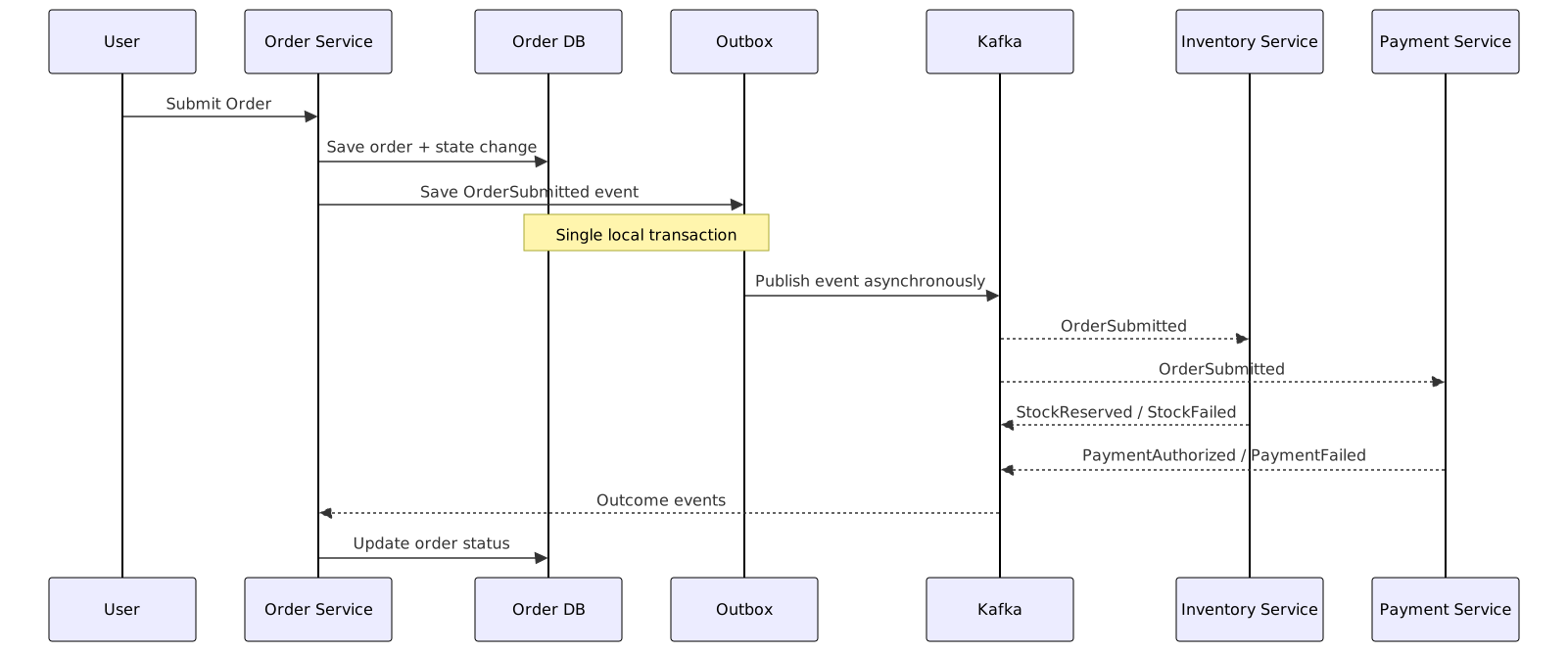
This pattern is common because it works. It gives you reliable event publication without pretending distributed transactions are free. But it also introduces a truth many organizations resist: business completion now happens over time. Your UI, reporting, and support tooling must reflect that.
Sagas and process managers
When a business process spans multiple consistency boundaries, coordination is unavoidable. Use sagas, either choreographed through events or orchestrated through a process manager, when the process can tolerate eventual consistency and compensating actions.
A practical rule:
- Use choreography when the process is simple, participants are stable, and event semantics are strong.
- Use orchestration when the process needs clear visibility, timeout management, compensation logic, or enterprise auditability.
Choreography looks elegant early and mysterious later. For critical enterprise processes, a visible orchestrator often pays for itself by making operational reality legible.
Reconciliation as a designed capability
Reconciliation is not a shameful batch job hidden in the basement. In event-driven enterprises, reconciliation is a core control mechanism. If one service missed a message, consumed a malformed event, or applied an outdated schema, reconciliation restores alignment.
Design for it explicitly:
- immutable event log where possible
- replay-safe consumers
- idempotent handlers
- business keys and correlation IDs
- discrepancy reports and repair workflows
- deadlines for convergence
- human-operable exception queues
The architects who ignore reconciliation are usually the ones who end up rebuilding it during the first major incident.
Migration Strategy
The right consistency boundary is often easiest to see during migration, because the monolith reveals where transactions and semantics were accidentally co-located.
A progressive strangler migration works well here, provided you do not start by slicing tables blindly.
Step 1: Expose business seams, not technical seams
Begin by identifying cohesive business capabilities and invariant clusters inside the monolith. Trace the transactions that matter:
- what updates occur together
- what validations rely on current state
- what decisions are externally visible
- where rollback semantics are assumed
Do not ask “which tables can we move first?” Ask “which decisions can stand alone?”
Step 2: Extract read models before write authority
A low-risk starting move is to create downstream projections from the monolith into Kafka-fed read models for search, reporting, customer dashboards, and notifications. This proves event semantics, schema governance, and operational plumbing before moving transactional authority. EA governance checklist
Step 3: Carve out a bounded context with clear authority
Pick a domain where semantic ownership is clear and invariant coupling to the rest of the monolith is manageable. Pricing, notification, customer preferences, or shipment tracking often work better than order acceptance or inventory reservation as first cuts.
Step 4: Introduce anti-corruption layers
The monolith and new service will use different models. That is good. Protect each side with an anti-corruption layer. Do not let old schema structures leak into the new bounded context. Migration is the moment when enterprises are most tempted to preserve legacy concepts forever.
Step 5: Shift decisions, not just data
Only when a new service owns a business decision should it be called a real service boundary. If all it does is hold copied data while the monolith still decides, you have built a cache with aspirations.
Step 6: Add reconciliation before go-live scale
Before traffic grows, prove:
- duplicate event handling
- replay behavior
- offset reset procedures
- late-arriving events
- poison message handling
- cross-system discrepancy repair
If you do not rehearse these, production will do the rehearsal for you.
Here is a typical strangler path:
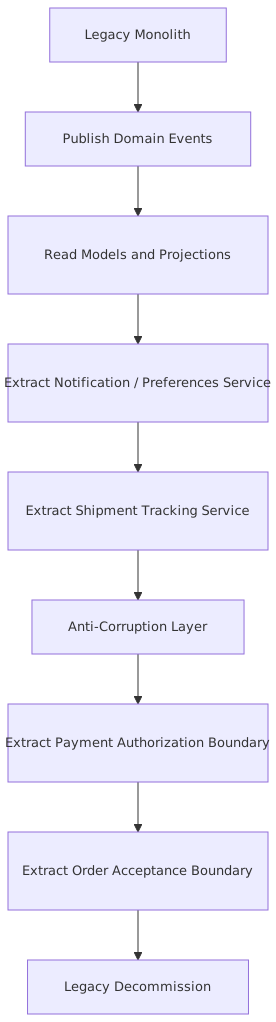
Notice what comes late: order acceptance. That is deliberate. The closer a capability is to core invariants, the more careful the extraction should be.
Enterprise Example
Consider a global retailer modernizing an e-commerce platform. The legacy stack is a large Java monolith backed by Oracle. It handles catalog, pricing, cart, ordering, payment integration, inventory, shipment, and customer accounts. The executive goal is familiar: move to microservices, improve deployment speed, scale for peak events, and support regional teams independently.
The first decomposition proposal is equally familiar:
- Catalog Service
- Cart Service
- Order Service
- Payment Service
- Inventory Service
- Customer Service
Reasonable on paper. Wrong in practice.
A closer domain analysis reveals the real issue. The business promise is not “we record orders quickly.” The promise is “we accept orders only when we can fulfill them or explicitly place them in a backorder path with customer visibility.” That means order acceptance, inventory reservation policy, and certain payment decisions are tightly coupled in semantics.
The original monolith handled this in one transaction plus a mess of legacy rules. Nobody liked the code, but the business guarantee was there.
If the retailer naively separates Order, Inventory, and Payment with pure asynchronous choreography, several ugly things happen:
- customers see “order confirmed” before stock allocation fails
- duplicate payment authorization retries occur during consumer restarts
- inventory events arrive late during Kafka lag, causing oversell perception
- call center tooling has no single status it can trust
- finance and fulfillment build independent exception spreadsheets
The architecture appears modern while the business gets less reliable.
So the retailer redraws the boundary.
They keep Order Acceptance as a single consistency boundary responsible for:
- validating order structure
- applying reservation policy
- deciding acceptance status
- owning the order lifecycle state relevant to commitment
Payment Authorization remains separate because it integrates with external providers and has its own failure semantics, but the acceptance boundary does not declare the customer order “confirmed” until the required payment state is received or a clear pending state is presented.
Inventory availability for browsing remains a projection, eventually consistent and Kafka-fed. Reservation for committed acceptance is part of the acceptance boundary’s decision flow, backed by a local reservation model built for correctness rather than catalog-read scale.
Fulfillment, invoicing, recommendation engines, CRM, and analytics consume events asynchronously.
The result is not a textbook split by noun. It is a business-aligned split by guarantee. Fewer surprises. Better supportability. Cleaner language.
This is the sort of design that survives Black Friday.
Operational Considerations
Architects often stop at the logical diagram. Operations is where consistency boundaries prove whether they were real or decorative.
Observability by business process
Trace technical calls, yes. But also trace business transitions:
- order submitted
- order accepted
- payment authorized
- reservation expired
- shipment released
Metrics should reveal convergence time between boundaries, not just CPU and latency. A healthy event-driven architecture needs process observability.
Idempotency
Kafka consumers will reprocess. Networks will retry. Producers will duplicate during uncertain acknowledgement windows. Every state transition crossing a service boundary should have an idempotency strategy based on stable business identifiers.
Ordering assumptions
Ordering is only guaranteed within a partition for a given key, and even that does not save you from broader causal ambiguity across topics and services. If correctness relies on total ordering across the enterprise, the design is wrong. Make handlers resilient to late and out-of-order facts.
Schema and semantic evolution
Versioning is not only structural. The dangerous changes are semantic. If “OrderAccepted” used to mean “payment captured” and now means “pending payment verification,” no Avro schema compatibility rule will save you. Semantic contracts need governance. ArchiMate for governance
Timeouts and dead letters
Not every process completes cleanly. Define timeout behavior in business terms. After 15 minutes without payment authorization, is the order cancelled, pending review, or released from reservation? Dead-letter queues are not business decisions. They are storage locations for unresolved ones.
Security and compliance
Consistency boundaries often overlap with data classification boundaries. Customer identity, consent, and financial transactions may need stricter controls, narrower access, and more explicit retention rules than adjacent services.
Tradeoffs
There is no free architecture here. Every choice costs something.
Keeping a larger consistency boundary:
- improves invariant protection
- simplifies local reasoning
- reduces cross-service coordination
- but limits independent scaling and deployability
- and may create larger codebases than teams want
Splitting aggressively:
- improves team autonomy in theory
- enables targeted scaling
- can reduce local complexity
- but pushes complexity into workflows, events, reconciliation, and operations
Using synchronous APIs:
- gives immediate answers
- simplifies some user interactions
- but couples availability and latency
Using Kafka and asynchronous flows:
- decouples execution
- smooths throughput
- enables replay and projection
- but requires explicit handling for duplicates, delays, and eventual visibility
Using orchestration:
- gives clarity and control
- simplifies audit and timeout management
- but introduces a central coordinator and process logic concentration
Using choreography:
- reduces centralized control
- fits loosely coupled domains
- but can become hard to reason about as participants and branching logic grow
The right answer depends on business risk, not ideology. Architects who declare one style universally superior usually have not operated enough systems.
Failure Modes
Consistency boundaries fail in predictable ways.
Semantic split-brain
Two services both believe they own the same fact. Support teams cannot tell which status is authoritative.
False eventual consistency
A process was modeled as asynchronous even though the business required immediate certainty. Reconciliation cannot fix a guarantee that was never acceptable to violate.
Event naming without meaning
Technical events like RowUpdated or vague events like OrderChanged force consumers to infer business intent. They will infer differently.
Reconciliation by spreadsheet
When the designed control mechanism is absent, operations invent one. It usually involves CSV exports, email, and escalating anger.
Hidden distributed transactions
Teams chain synchronous calls across services to preserve old monolith semantics. The result is temporal coupling, cascading failure, and poor resilience.
Over-factored services
The domain is decomposed into tiny services around entities rather than decisions. Every business process becomes a network problem.
Replay disasters
Consumers are not idempotent, so event replay creates duplicate charges, duplicate shipments, or repeated notifications.
These are not implementation glitches. They are architectural consequences.
When Not To Use
Not every system needs explicit consistency boundary discovery at microservice granularity because not every system should be microservices in the first place.
Do not use this style when:
- the domain is simple and team size is small
- invariants are dense and span most of the model
- operational maturity for messaging, observability, and reconciliation is low
- the organization cannot support strong domain ownership
- deployment independence is not a real business constraint
- a modular monolith would solve the problem faster and safer
That last point deserves emphasis. A modular monolith is often the better first architecture. It lets you discover domain boundaries and consistency needs without paying the full distributed systems tax. Many enterprises would save years by getting the boundaries right in-process before putting them on the network.
Microservices are a commitment to explicit coordination. If you are not ready to make state transitions, event semantics, and failure handling first-class concerns, stay monolithic a bit longer.
Related Patterns
Several patterns sit naturally around consistency boundary discovery.
- Bounded Context: separates models and language by domain meaning.
- Aggregate: enforces local invariants and transactional consistency.
- Outbox Pattern: reliably publishes events from local state changes.
- Saga: coordinates long-running business processes across services.
- Process Manager: centralizes workflow state and compensation decisions.
- CQRS: separates write authority from read projections where useful.
- Anti-Corruption Layer: protects new services from legacy models during migration.
- Event Sourcing: useful in some domains with strong audit needs, but not required.
- Reconciliation Pattern: detects and repairs divergence across boundaries.
These patterns are tools, not trophies. Use them to make business guarantees explicit.
Summary
Consistency boundary discovery is the quiet center of successful microservices architecture. It is where domain-driven design becomes practical and where migration plans stop being optimistic diagrams and start becoming executable strategy.
The key lesson is brutally simple: do not split systems by nouns, teams, or database tables alone. Split them by business meaning. Find the invariants. Name the decisions. Assign authority. Decide where drift is acceptable and where it is not. Then build messaging, sagas, Kafka streams, projections, and reconciliation around those choices.
A boundary is good when the business can explain it, teams can own it, and operations can survive it.
Everything else is just boxes and arrows.
Frequently Asked Questions
What is a service mesh?
A service mesh is an infrastructure layer managing service-to-service communication. It provides mutual TLS, load balancing, circuit breaking, retries, and observability without each service implementing these capabilities. Istio and Linkerd are common implementations.
How do you document microservices architecture for governance?
Use ArchiMate Application Cooperation diagrams for the service landscape, UML Component diagrams for internal structure, UML Sequence diagrams for key flows, and UML Deployment diagrams for Kubernetes topology. All views can coexist in Sparx EA with full traceability.
What is the difference between choreography and orchestration in microservices?
Choreography has services react to events independently — no central coordinator. Orchestration uses a central workflow engine that calls services in sequence. Choreography scales better but is harder to debug; orchestration is easier to reason about but creates a central coupling point.