⏱ 20 min read
Most distributed systems don’t fail because the engineers forgot how to code. They fail because the architecture told a comforting lie.
The lie is simple: reads and writes are just two sides of the same service. Put them behind one API, one database, one deployment unit, and call it a bounded context. It looks tidy on a slide. It feels efficient in sprint planning. And then the business grows teeth. Traffic patterns diverge. Reporting workloads bully transaction processing. Integration teams demand new views of data that the operational model was never meant to provide. The system starts acting like a city that insisted trucks, ambulances, bicycles, and parade floats should all use the same lane.
That is where read vs write isolation becomes serious architecture, not just pattern collecting.
In microservices, isolating reads from writes is often described with CQRS-like language, but the useful discussion is less about slogans and more about semantics, failure, and migration. This is not merely “split commands and queries.” It is about deciding which model protects business invariants, which model serves consumption at scale, and how to let them evolve without corrupting each other. Done well, it gives a system room to breathe. Done badly, it creates two sources of truth, a Kafka-shaped debugging hobby, and a permanent reconciliation backlog. event-driven architecture patterns
The core point is this: write models exist to preserve meaning; read models exist to provide access. They are related, but they are not the same thing.
This article walks through the architectural reasoning behind service read vs write isolation in microservices, where it works, where it hurts, how to migrate toward it progressively, and why domain-driven design matters more than diagram aesthetics. microservices architecture diagrams
Context
Enterprise systems begin life with a practical bias. One service owns customer accounts. Another owns orders. Another owns inventory. Each service exposes CRUD-style endpoints and stores data in one database optimized for the team’s immediate needs. That gets software shipped.
Then the organization scales and the shape of demand changes.
Writes are usually sparse, precious, and rule-heavy. They carry domain intent: approve loan, place order, reserve stock, issue policy. Each write has invariants, validation rules, authorization checks, and side effects. The write path must be correct before it is fast.
Reads are different. They are often numerous, broad, and impatient. Users want filtered dashboards, mobile summaries, exported histories, search views, partner APIs, near-real-time analytics, and compliance extracts. Reads favor denormalized structures, precomputed projections, search indexes, cache-friendly responses, and low latency. They are judged harshly by user experience, not by elegance of normalization.
Treating both concerns as one model eventually becomes a tax on both. The write side gets polluted by reporting joins and query-specific fields. The read side gets constrained by transaction schemas that mirror aggregate boundaries rather than consumer needs.
This is why read vs write isolation appears again and again in mature microservice estates. Not because architects like cleverness. Because the runtime economics and domain semantics diverge.
Problem
The basic problem is contention, but not only database contention.
There is semantic contention. The model that is best for enforcing a business invariant is often a poor shape for answering end-user questions. A payment aggregate may be exactly right for ensuring “capture cannot exceed authorization,” yet terribly wrong for serving “show me all customer payment activity across channels in the last 18 months.”
There is operational contention. Read traffic can dwarf write traffic by orders of magnitude. If both paths share the same service runtime and datastore, query spikes can degrade transaction processing. A quarterly reporting run should not slow checkout.
There is organizational contention too. Different consumers want different read shapes. Internal operations wants event timelines. Customer mobile wants compact summaries. Finance wants auditable states. Search wants indexable text. If every read concern must negotiate with the write model, one of two things happens: either the write domain is compromised, or the service becomes a dumping ground for every projection anyone ever imagined.
A typical “all-in-one” microservice starts to show familiar symptoms:
- bloated endpoints with query parameters that look like a custom reporting DSL
- read-specific columns added to transactional tables
- replica databases used as architectural deodorant rather than design
- direct database access by downstream teams because APIs are too slow or too rigid
- Kafka events added late, inconsistently, and without clear semantic contracts
- synchronization bugs after schema changes
- impossible conversations about whether a field is “really part of the domain”
When that happens, the issue is not simply technical debt. It is model confusion.
Forces
A good architecture article needs to respect the forces. This pattern is useful because the forces are real and they pull hard in opposite directions.
1. Domain integrity vs consumer convenience
In domain-driven design, the write side belongs to the bounded context that owns the business decision. Its model should reflect domain language and invariants, not reporting convenience. Aggregates, commands, and transactional boundaries exist to protect meaning.
Read consumers, however, live in many contexts. They care about views, not invariants. They ask for “open claims by region with policy holder contact details and fraud flags.” That is not a write model. It is a projection.
If you optimize one model for both purposes, you typically weaken the domain.
2. Transactional consistency vs scalable distribution
Writes often need ACID guarantees within a service boundary. Reads often tolerate eventual consistency if latency is low and scale is high. These are different optimization targets.
This is where Kafka and event-driven microservices enter the story. Kafka is not magic glue; it is a distribution mechanism for state changes. It allows the write side to publish facts and the read side to consume and project them. But that introduces asynchronous lag, replay behavior, duplicate handling, ordering constraints, and schema evolution concerns. Isolation buys independence at the cost of synchronization complexity.
3. Stable semantics vs evolving access patterns
The write model should evolve carefully because it encodes business rules. Read models should evolve quickly because business users continuously invent new questions.
If the same data model serves both, every dashboard request becomes a domain design negotiation. This is a miserable way to run a platform.
4. Team autonomy vs cross-service reporting
Microservices promise autonomous teams, but enterprise reporting does not respect service boundaries. Executives want customer, order, payment, fulfillment, and support data on one screen. That pressure often causes accidental distributed monoliths.
Read isolation offers a compromise: keep ownership of writes inside bounded contexts, but create explicit read-side composition through events, projections, materialized views, or dedicated query services.
5. Freshness vs resilience
Consumers often say they need “real-time.” Usually they mean “fast enough that users don’t complain.” Sometimes they truly need up-to-the-second accuracy. Those are different systems.
Write isolation with asynchronous reads accepts data staleness as a trade. In return, it reduces coupling and protects transaction processing. The key is not pretending eventual consistency is free. It must be designed, explained, monitored, and reconciled.
Solution
The solution is to isolate the write model from the read model at the service architecture level.
Opinionated version: the write side should own business intent and state transitions. The read side should own projections optimized for access. They may live in the same codebase initially, but they should not share the same design obligations. In more mature systems, they are often deployed and scaled separately, backed by different storage technologies, and connected through domain events or change streams.
This does not require dogmatic CQRS everywhere. It requires clarity about what each side is for.
A practical shape looks like this:
- Write service
- exposes commands, not generic updates where possible
- validates business rules
- persists authoritative state
- emits domain events after successful state changes
- remains small in semantic scope
- Read service or projection layer
- consumes events from Kafka or another event backbone
- builds one or more denormalized views
- serves query patterns optimized for users and integrations
- may combine data from multiple bounded contexts
- can use databases chosen for retrieval patterns: relational read replicas, document stores, Elasticsearch, caches, columnar stores
The relationship is asymmetrical. The write side is the source of truth for decisions. The read side is the source of convenience for access.
Here is the high-level pattern.
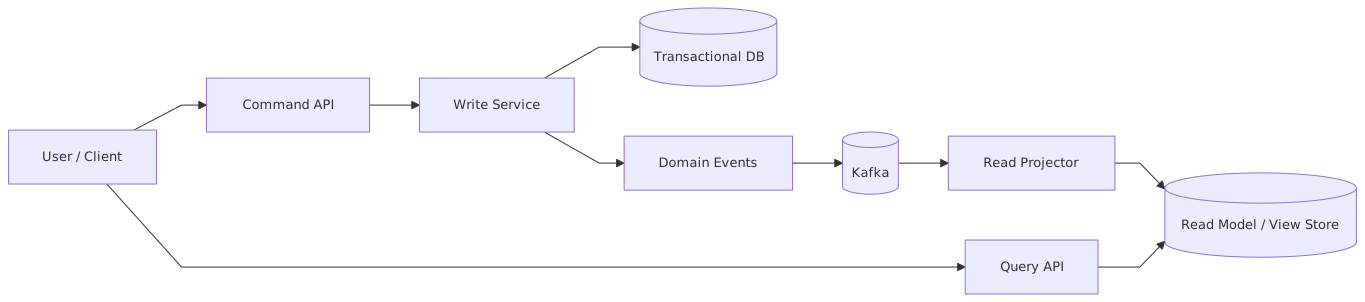
This architecture lets you scale reads independently, tailor views for consumers, and preserve domain semantics on the write side. But it only works if the events are meaningful. “RowUpdated” is not a domain event. “OrderPlaced,” “PaymentCaptured,” and “InventoryReserved” are.
That distinction is pure domain-driven design. Events should reflect business facts, not table churn.
Architecture
Read vs write isolation is not one topology. It is a family of topologies.
Pattern 1: Isolated models within one service boundary
This is the least disruptive form. One service owns both command and query endpoints, but the code paths and data stores are separated. Commands go to the transactional schema. Queries hit projections or replicas built for retrieval.
Useful when:
- one team owns both paths
- domain complexity is significant
- operational scale is moderate
- you want semantic separation before organizational separation
This is often the right first step because it proves the model split without multiplying services too early.
Pattern 2: Dedicated read microservice fed by events
The write microservice publishes domain events to Kafka. A separate read service consumes and builds query views. This is common in enterprises where many channels need specialized read APIs.
Useful when:
- read traffic is heavy
- query requirements evolve rapidly
- multiple consumers need independent read contracts
- write service must be protected from read spikes
Pattern 3: Enterprise projection platform
Large organizations create a projection layer or data product platform where events from multiple microservices feed customer 360 views, operational dashboards, search indexes, and partner APIs.
Useful when:
- cross-domain read composition is unavoidable
- there are many teams and many channels
- governance, lineage, and reconciliation matter as much as performance
The trap, of course, is building a shadow monolith of projections with no domain ownership. Architecture has a dark sense of humor.
Here is a more detailed view with reconciliation.
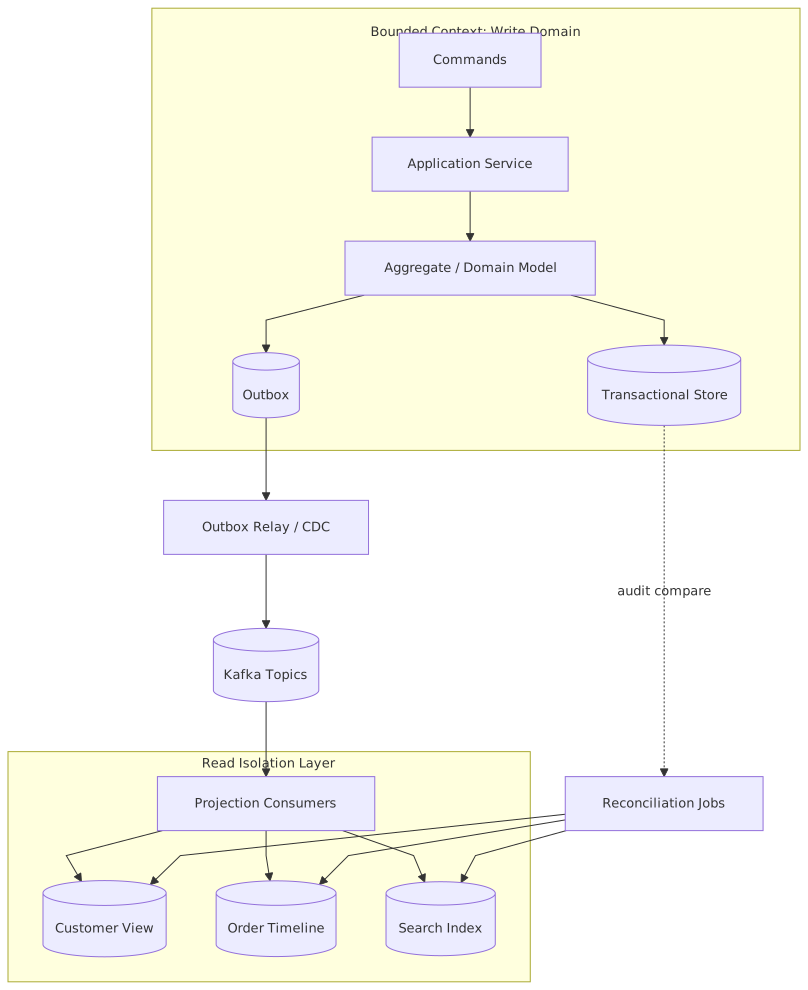
A few architectural rules matter here.
Use the outbox pattern for write-event reliability
If the write service updates its database and publishes to Kafka in separate steps, you will eventually lose events or publish ghosts. The outbox pattern exists because production systems are cruel to wishful thinking. Persist the business change and the outbound event in the same transaction, then relay the event reliably.
Design events for consumers without surrendering domain ownership
Events need enough semantic richness for projection builders, but they should not become unstable snapshots of your internal schema. A domain event is a contract around a business fact, not a serialized ORM entity.
Allow multiple read models
One event stream can feed several projections. That is the point. Search, dashboard, audit timeline, and partner API often want different shapes. Trying to force one universal read model usually ends in disappointment.
Keep query composition away from the write domain
If a screen needs data from five bounded contexts, resist pushing that composition into one of the write services. Build a read composition layer. The service that owns orders should not become the accidental reporting owner for customer support.
Migration Strategy
The best migration strategy is almost never “stop the world and implement CQRS.” Enterprises do not reward architectural purity ceremonies. They reward reductions in risk, latency, and change friction.
Use a progressive strangler migration.
Start from the pain, not from the pattern.
Step 1: Identify where reads are harming writes
Look for hotspots:
- expensive queries on transactional tables
- read traffic causing lock contention or resource saturation
- query-specific schema drift in the write database
- direct DB access by external teams
- frequent changes for reporting needs that destabilize command logic
Pick one bounded context where the economics are obvious. Order history is a classic candidate. It is query-heavy, user-visible, and often semantically broader than the core order aggregate.
Step 2: Separate command semantics first
Refactor APIs so write operations express intent. Replace generic update endpoints with commands such as PlaceOrder, CancelOrder, ApproveRefund. This matters because migration without semantic clarity just moves confusion to Kafka.
Step 3: Emit trustworthy domain events
Introduce an outbox and publish domain events from successful writes. Version them carefully. Add metadata such as event ID, aggregate ID, occurred-at time, version, and correlation ID.
Step 4: Build one projection
Create a single read model for the highest-value query path. Keep it narrow. Don’t build a “universal read platform” in sprint one. Use Kafka consumers to populate a denormalized store.
Step 5: Route selected queries to the read model
Expose a dedicated query endpoint or read service. Let old and new coexist. This is the strangler move: new reads are gradually peeled away from the legacy operational model.
Step 6: Add reconciliation
This is where many migrations become theater. Event-driven projections can drift due to bugs, skipped messages, replay defects, schema mismatches, or bad assumptions about ordering. Reconciliation is not optional. Compare authoritative write state with read projections on a schedule. Detect divergence. Repair projections by replay or rebuild.
Step 7: Expand by query domain, not by enthusiasm
Move more read use cases only when the benefits justify the extra complexity. Some services do not need full isolation. Architecture should solve current and likely problems, not cosplay future scale.
Here is a typical strangler path.
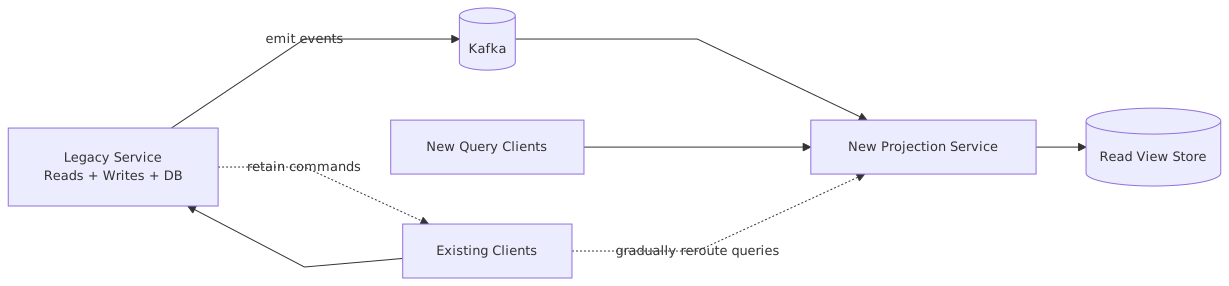
This migration style preserves business continuity while shifting the center of gravity. It is less glamorous than a rewrite and far more likely to survive budget review.
Enterprise Example
Consider a global insurance company modernizing its claims platform.
The original claims service owned claim intake, status changes, adjuster assignments, payout decisions, and customer inquiry screens. One Oracle schema. One service cluster. One API that had become a museum of compromises. Call-center screens needed a claim timeline with documents, payment summaries, fraud flags, and policy coverage snippets. Adjusters needed operational state and task queues. Finance needed payout exports. Compliance needed immutable audit views. Every new read requirement landed in the claims service because “it owns claims.”
Predictably, the transactional model was under siege.
Heavy query workloads from support peaks caused latency on claim update operations. Teams added indexes that helped some screens and hurt write performance. Materialized views appeared in the same database. Then replica reads were introduced, which solved a little and confused a lot. Different channels saw different freshness. Some teams bypassed the API and queried replica tables directly. Nobody could answer, with confidence, which view represented the official business state at any given instant.
The migration began with domain clarification.
The write bounded context for claims was narrowed to the true decisioning lifecycle: open claim, assign adjuster, request documents, approve payout, reject claim, close claim. Commands were made explicit. The service persisted authoritative state in a transactional store and published domain events through an outbox to Kafka: ClaimOpened, DocumentRequested, AdjusterAssigned, PayoutApproved, ClaimClosed.
A separate read isolation layer was created with three projections:
- Customer claim summary view for mobile and web
Denormalized, small payloads, latest state, document checklist, payout summary.
- Claim operations timeline for call center and adjusters
Event-oriented history with actor, timestamp, note summaries, SLA indicators.
- Compliance audit view
Immutable append-friendly projection with retention and lineage metadata.
These projections also consumed related events from policy, customer, and payment services. Not for transaction control. For read composition. That distinction mattered. The claims write service did not become dependent on customer and payment availability to process claims. But the read side could enrich screens with policy holder details and payment milestones.
The result was not perfect freshness, and that was fine. Customer inquiry screens tolerated seconds of delay. Claim approval did not.
Reconciliation was crucial. A nightly compare job sampled write-side claims against read-side summaries, checking claim status, payout totals, and required document flags. Drift was found early: duplicate event handling in one projector inflated payout totals in edge cases during replay. Because the architecture had explicit reconciliation, the issue was discovered as a controlled defect, not a regulatory incident.
This is the part architecture diagrams often skip: real systems are not judged by whether they can project. They are judged by whether they can recover when projections go wrong.
Operational Considerations
Read vs write isolation changes operational life. It buys flexibility and scale, but it demands discipline.
Observability
You need end-to-end tracing across command handling, event publication, Kafka transport, projection updates, and query serving. Correlation IDs are not optional. Without them, support teams will spend afternoons proving whether “missing data” is a write bug, a projection lag issue, or a consumer offset problem.
Track:
- event publication success and delay
- consumer lag by topic and partition
- projection rebuild duration
- reconciliation drift rates
- read freshness SLA
- duplicate event processing counts
- dead-letter queue volume
Data contracts and schema evolution
Events are long-lived contracts. Version them deliberately. Backward compatibility matters because read consumers evolve at different speeds. A write service team that changes event shape casually is exporting instability into the enterprise.
Partitioning and ordering in Kafka
Ordering is local, not universal. If a projection depends on strict sequence for a given aggregate, ensure partitioning by aggregate key. If you need global order across entities, you probably need a different design or a much stronger explanation.
Projection rebuilds
Every serious read-isolation design needs a rebuild story. Can you replay all events from Kafka? For how long is retention available? Do you snapshot? Can a projection be rebuilt without downtime? If the answer is “we haven’t thought about that,” you have not finished the architecture.
Security and data minimization
Read models often aggregate data across contexts. That creates convenience and risk in equal measure. Minimize copied sensitive data. Apply field-level access where needed. A denormalized customer view can quietly become the company’s least-governed data breach.
Tradeoffs
This pattern is powerful because it accepts that one model cannot serve every purpose. But let’s not pretend it is free.
Benefits
- protects write-path integrity and performance
- enables read models tailored to specific consumers
- allows independent scaling of reads and writes
- supports cross-context query composition without corrupting bounded contexts
- improves team autonomy on query evolution
- creates a path for search, analytics, and operational dashboards
Costs
- eventual consistency
- more moving parts
- event contract governance
- replay and reconciliation complexity
- operational overhead in Kafka consumers and projection stores
- harder debugging across asynchronous boundaries
There is a social tradeoff too. Teams must become comfortable with the idea that the read side is not instantly identical to the write side. Some businesses can absorb that easily. Some cannot. A trader staring at stale positions is not merely annoyed.
Failure Modes
Architectures reveal themselves in failure. This one has several classic ways to disappoint you.
1. Fake isolation
You create separate read and write services, but both still depend on the same normalized database schema. Congratulations, you added complexity without changing the force field.
2. Event soup
Teams publish low-level technical events with no domain meaning. Consumers infer business state from row changes. Over time, every projection becomes tightly coupled to internal persistence details.
3. No reconciliation
The read side drifts and nobody notices until a customer, auditor, or executive does. This is the most common sin. If a projection matters, reconcile it.
4. Over-centralized read platform
A shared query platform starts as enablement and becomes a bottleneck. Every team must negotiate schema and release timing with a central projection group. You replaced one monolith with a bureaucratic one.
5. Freshness mismatch
The business needed strongly consistent reads after writes, but the architecture supplied eventual consistency and wishful language. Users call support because “my order disappeared.” This is not a technical bug. It is a semantic mismatch.
6. Replay disasters
A bug in consumer idempotency or event version handling causes duplicated or malformed projections during replay. If your rebuild process is not tested, your architecture has an unlit stairwell.
When Not To Use
Not every microservice deserves read vs write isolation.
Do not use it when:
- the domain is simple CRUD with modest scale
- read and write access patterns are similar
- the team is small and operational maturity is low
- the business requires immediate read-after-write consistency everywhere
- there are too few events or too little change volume to justify asynchronous infrastructure
- the likely future does not include multiple query shapes or heavy read growth
A good rule: if your primary problem is not contention, semantic divergence, or consumer-specific query evolution, this pattern may be architecture inflation.
There is no prize for introducing Kafka so a three-person team can avoid writing a JOIN.
Related Patterns
Several patterns sit adjacent to read vs write isolation.
CQRS
This is the obvious relative. But in practice, enterprise teams should treat CQRS as a spectrum, not a religion. You can isolate models without building an elaborate event-sourced universe.
Event-driven architecture
Events are the connective tissue for asynchronous read updates. Useful, but only when events are domain facts and consumers are designed for replay, duplication, and versioning.
Outbox pattern
Essential for reliable write-event publication. Without it, your architecture rests on timing luck.
Strangler Fig pattern
The sensible migration approach. Replace query paths gradually, one use case at a time, while preserving the old system until confidence grows.
Materialized views
A practical implementation technique for read models. Not every projection needs a separate microservice. Sometimes a materialized read store is enough.
Saga
Relevant when writes across multiple services require coordinated business processes. Important caveat: sagas handle long-running consistency of business workflows, not query optimization. Don’t confuse workflow orchestration with read isolation.
Summary
Service read vs write isolation in microservices is not about drawing two boxes instead of one. It is about respecting the fact that business decisions and information access live under different forces.
The write side should protect invariants, enforce domain semantics, and remain the authoritative place where meaning is decided. The read side should serve consumers efficiently, denormalize shamelessly when useful, and evolve with query needs. Kafka, projections, materialized views, and separate read microservices are means, not ends.
The wise path is progressive. Start where reads are hurting writes. Clarify command semantics. Publish trustworthy domain events. Build one projection. Route one query path. Add reconciliation before you congratulate yourself. Then expand only where the economics justify the complexity.
There is a memorable line worth keeping: the write model tells the business what is true; the read model tells people what is useful.
Confuse those two, and your microservices estate becomes a polite mess. Separate them with care, and the system gains scale, clarity, and a fighting chance at long-term change.
Frequently Asked Questions
What is a service mesh?
A service mesh is an infrastructure layer managing service-to-service communication. It provides mutual TLS, load balancing, circuit breaking, retries, and observability without each service implementing these capabilities. Istio and Linkerd are common implementations.
How do you document microservices architecture for governance?
Use ArchiMate Application Cooperation diagrams for the service landscape, UML Component diagrams for internal structure, UML Sequence diagrams for key flows, and UML Deployment diagrams for Kubernetes topology. All views can coexist in Sparx EA with full traceability.
What is the difference between choreography and orchestration in microservices?
Choreography has services react to events independently — no central coordinator. Orchestration uses a central workflow engine that calls services in sequence. Choreography scales better but is harder to debug; orchestration is easier to reason about but creates a central coupling point.