⏱ 19 min read
There’s a particular kind of pain that only appears after a microservices program has been declared a success. microservices architecture diagrams
The teams are autonomous. Deployments are independent. Bounded contexts have been named, documented, and celebrated in architecture review decks. Kafka is humming in the middle like a great corporate nervous system. And yet, somehow, change still feels expensive. event-driven architecture patterns
A pricing rule changes in Sales, and Billing needs a release. Customer onboarding evolves in CRM, and Identity suddenly needs a new API field. Fulfillment introduces a new order status, and half the estate scrambles to catch up. The services are physically separate, but the coupling has simply moved up a level. Instead of shared code, we get shared assumptions. Instead of direct database access, we get semantic dependency spread across HTTP contracts, event schemas, and process timing.
This is where dependency inversion across services becomes useful—not as a textbook principle awkwardly stretched over distributed systems, but as a practical architectural move. A way to stop downstream services from orbiting the internal models of upstream ones. A way to let domain boundaries mean something.
In code, dependency inversion says high-level policy should not depend on low-level details. In service architecture, the equivalent insight is sharper: core business capabilities should not be forced to model themselves around the data shape, workflow timing, or implementation decisions of neighboring services. If they are, your “microservices” are just a distributed monolith with better branding.
And distributed monoliths are expensive theater.
This article looks at how to apply dependency inversion across services in a way that actually survives enterprise reality: Kafka, legacy systems, bounded contexts, migrations, reconciliation, failure handling, and the political fact that not every service team moves at the same speed.
Context
Most microservice estates begin with a sensible intent: split a large system into independently owned business capabilities. The language usually includes domain-driven design, bounded contexts, autonomous teams, and event-driven architecture. All good.
Then reality arrives.
One team exposes an API that looks suspiciously like its internal data model. Another publishes Kafka events named after table changes. A third service consumes those events directly and enriches them with synchronous calls because “the event doesn’t contain enough data.” Over time, consumers start depending not just on contracts, but on the producer’s semantics, sequencing, and release behavior.
That is the real issue. Dependency in distributed systems is rarely just technical. It is semantic and temporal.
- Semantic dependency: one service must understand another service’s internal meaning, statuses, validation rules, or lifecycle transitions.
- Temporal dependency: one service must be available now, in this order, with this consistency expectation, for another service to do its work.
The result is brittle coordination.
A healthy architecture lets each bounded context speak in its own language while collaborating through carefully designed seams. An unhealthy one makes every service bilingual in everyone else’s private jargon.
Dependency inversion across services is about improving those seams.
Problem
A common failure pattern looks like this:
- The Order Service owns order capture.
- The Pricing Service owns pricing rules.
- The Billing Service generates invoices.
- The Fulfillment Service handles shipment.
At first glance, this seems fine. But then Billing starts consuming OrderCreated events whose payload contains pricing breakdowns, discount categories, tax classifications, channel metadata, and fulfillment hints. Fulfillment also consumes the same event and interprets order statuses according to its own rules. Over time, the order event becomes a cargo ship carrying everybody’s assumptions.
Now change one thing in the producer. Not the availability contract. Not the endpoint path. The meaning.
Maybe “confirmed” no longer means financially approved; it only means commercially accepted pending fraud review. Suddenly, consumers are wrong in different ways. Billing may invoice too early. Fulfillment may allocate stock prematurely. Nobody violated the JSON schema. Yet the system breaks.
That is service coupling at the domain level.
The deeper issue is this: downstream capabilities are depending on upstream representations rather than on stable business abstractions relevant to their own context. They are bound to someone else’s model. Inversion means turning that around so dependencies point toward stable policies and interaction contracts, not toward producer internals.
A simple slogan helps:
> Services should depend on published business intent, not on another team’s data exhaust.
That distinction matters.
A database change event is data exhaust.
A carefully designed domain event is business intent.
An RPC call demanding a producer-shaped DTO is dependency.
A consumer-defined anti-corruption contract is inversion.
Forces
This problem exists because several forces pull in opposite directions.
1. Teams want speed
The fastest path is usually to expose what already exists. Return the internal object. Publish the current state change. Let consumers figure it out. It works in sprint demos.
It also bakes in accidental semantics.
2. Producers control interfaces by default
In most enterprises, the service that owns the data also owns the API or event. That sounds reasonable but creates an asymmetry: consumers become followers of the producer’s language. If one producer serves five consumers, all five often inherit the producer’s vocabulary whether it fits or not.
That is not domain-driven design. It is organizational gravity.
3. Consumers need different views
Billing does not need an Order Service’s entire aggregate. It needs billable facts. Fulfillment needs allocatable facts. Customer Support needs explainable state. Fraud needs risk signals. A single producer-shaped contract cannot serve all these needs cleanly without becoming bloated or vague.
4. Consistency is never free
If services stop making synchronous calls and instead depend on events or replicated views, they gain autonomy but take on eventual consistency and reconciliation complexity. Enterprises often underestimate this. They replace request coupling with state divergence and then act surprised.
5. Legacy estates don’t disappear politely
Most real organizations still have ERP, CRM, policy admin, mainframes, package applications, and old integration layers. New services often sit alongside old systems for years. Dependency inversion must work in the mixed economy, not just in greenfield architecture diagrams.
6. Governance often optimizes for standardization over semantics
This produces APIs that are consistent in style but weak in meaning. You get beautiful standards documents and terrible business contracts. A uniform REST wrapper does not solve semantic coupling.
Solution
The core move is simple to describe and harder to practice:
Define service dependencies around stable business capabilities and consumer-relevant contracts, while isolating producer internals behind anti-corruption and translation layers.
In other words, invert dependency from “consumer depends on producer model” to “interaction depends on an explicit collaboration contract aligned to the domain.”
This usually shows up in four architectural tactics.
1. Publish intent, not internals
Events and APIs should express business facts meaningful outside the producing service. For Kafka, that means avoiding raw CDC-style streams as cross-domain contracts unless the consumers are explicitly analytics or replication use cases.
Bad:
order_status = CONFIRMED- dozens of fields copied from internal tables
- sequence assumptions hidden in topic ordering
Better:
OrderAcceptedForFulfillmentInvoiceRequestedPaymentAuthorizedCustomerEligibilityChanged
The names matter because names carry semantics. Domain-driven design starts with language, not payloads.
2. Let consumers shape their own dependency boundary
A consumer should not have to ingest a producer’s entire model. Instead, introduce:
- an anti-corruption layer
- a consumer-specific read model
- a translation topic or integration service
- sometimes a published language shared across contexts
This is dependency inversion in distributed form. The consumer depends on a contract it can live with; translation absorbs the mismatch.
3. Separate source-of-truth ownership from collaboration contracts
A service can own canonical data without forcing every other service to consume it in canonical form. Ownership and interface design are related, but they are not identical. A well-designed ecosystem lets one service own customer records while other contexts depend on narrower, context-relevant facts such as credit eligibility, contactability, or account standing.
4. Embrace asynchronous collaboration where autonomy matters
Kafka is especially useful here because it allows producers and consumers to decouple in time. But asynchronous messaging only helps if the event contracts are designed around domain semantics and if consumers maintain their own state for decision-making. Otherwise Kafka simply becomes a distributed dependency amplifier.
Here is the basic inversion shape.

The point is not just “add a layer.” The point is to place the dependency on a stable contract and local translation boundary rather than on the producer’s inner shape.
Architecture
A practical architecture for dependency inversion across services has a few recurring elements.
Published language and bounded contexts
In domain-driven design, bounded contexts are not just organizational boxes. They are meaning boundaries. Terms may overlap across contexts but differ in intent. “Customer,” “Order,” “Policy,” “Account,” and “Active” are famous traps because they look universal and are not.
Dependency inversion works best when collaboration contracts use a published language: terms intentionally designed for cross-context communication. Not lowest-common-denominator jargon. Not table names. A deliberate language.
For example:
- Sales says “Quote Accepted”
- Billing says “Billable Commitment Created”
- Fulfillment says “Ready for Allocation”
Those are not synonyms. They are different domain events and should remain so.
Consumer-owned projections
One of the strongest patterns is to let each service maintain its own projection or read model from upstream events. This avoids repeated synchronous calls and allows local decision-making.
For example:
- Billing keeps a
BillableOrderView - Fulfillment keeps an
AllocatableOrderView - Support keeps a
CustomerOrderTimelineView
Each projection is built from published events, translated into local semantics, and reconciled as needed.
This creates duplication. Good. In distributed systems, some duplication is the price of autonomy.
Integration service or translation layer
When domains are far apart, direct service-to-service contract consumption can become messy. In that case, place an explicit integration layer between them. This layer is not a generic ESB reborn. It has a narrow purpose: semantic translation, policy isolation, and protocol adaptation.
Use it sparingly. If every interaction goes through a central mediator, you have simply rebuilt coupling in one place.
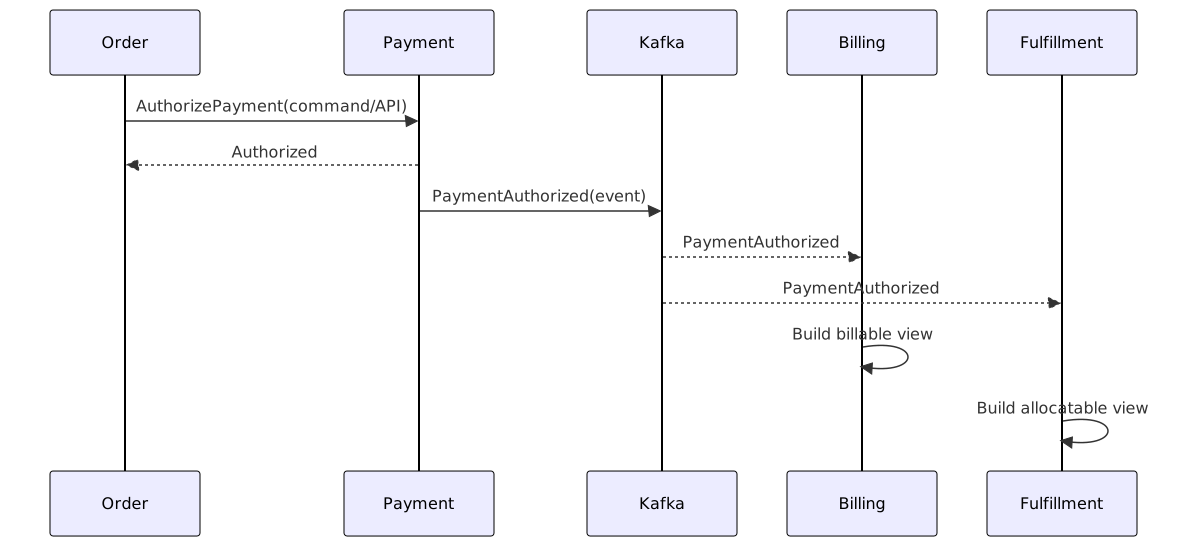
Event choreography with command boundaries
A useful enterprise balance is:
- use commands or synchronous APIs where a capability must explicitly authorize or validate an action now
- use events where downstream reactions should happen independently
For instance:
- Order asks Payment to authorize now
- Payment emits
PaymentAuthorized - Billing and Fulfillment react independently
This reduces temporal coupling while preserving strong control where needed.
Reconciliation as a first-class capability
This is where many elegant diagrams die. Once you decouple services, you must handle:
- missed events
- duplicate events
- out-of-order delivery
- late upstream corrections
- drift between projections and source systems
So architecture must include reconciliation, not as a support script, but as a designed mechanism:
- replayable event streams
- periodic snapshot comparison
- idempotent consumers
- compensating workflows
- exception queues
- operational dashboards showing semantic lag, not just broker lag
A mature service architecture assumes divergence will happen and makes recovery boring.
Migration Strategy
Nobody gets to dependency inversion across services by declaration. They get there by careful migration, usually under business pressure, with old and new semantics coexisting for longer than anyone wants.
The right migration shape is usually progressive strangler.
Start by identifying the worst semantic dependencies, not just the highest traffic APIs. The systems that hurt most are often the ones where downstream services depend on unstable upstream states or internal fields.
Step 1: Identify unstable producer-shaped contracts
Look for:
- events named after CRUD operations
- APIs returning full aggregates to many consumers
- consumers making repeated lookups to derive local decisions
- shared enum values copied across services
- topic consumers broken by producer business changes even when schemas are valid
These are signs of semantic leakage.
Step 2: Introduce a published business contract alongside the old one
Do not break everyone at once. Publish new domain events or collaboration APIs in parallel:
- old:
OrderUpdated - new:
OrderAcceptedForBilling,OrderReadyForAllocation
This feels redundant because it is redundant. Migration is often a period of intentional duplication.
Step 3: Build consumer anti-corruption layers
Each consuming service should translate either the old contract, the new contract, or both into its local model. This allows consumers to migrate at different speeds and keeps producer changes from cascading directly.
Step 4: Add reconciliation paths
For every new projection:
- define replay strategy
- define correction event handling
- define source-of-truth comparison process
- define what happens when local and upstream states disagree
If you skip this step, your migration will look successful until month-end close or regulatory reporting.
Step 5: Cut over by capability, not by technology
Do not migrate because “all services now read from Kafka.” Migrate when a business capability can make its decisions using local, inverted dependencies. The milestone is semantic independence, not infrastructure adoption.
Step 6: Decommission producer-shaped dependencies gradually
Retire broad DTO APIs, internal-field events, and direct interpretation of producer statuses. Leave telemetry in place during the overlap to verify the new contracts produce the same—or intentionally improved—business outcomes.
A migration view often looks like this:
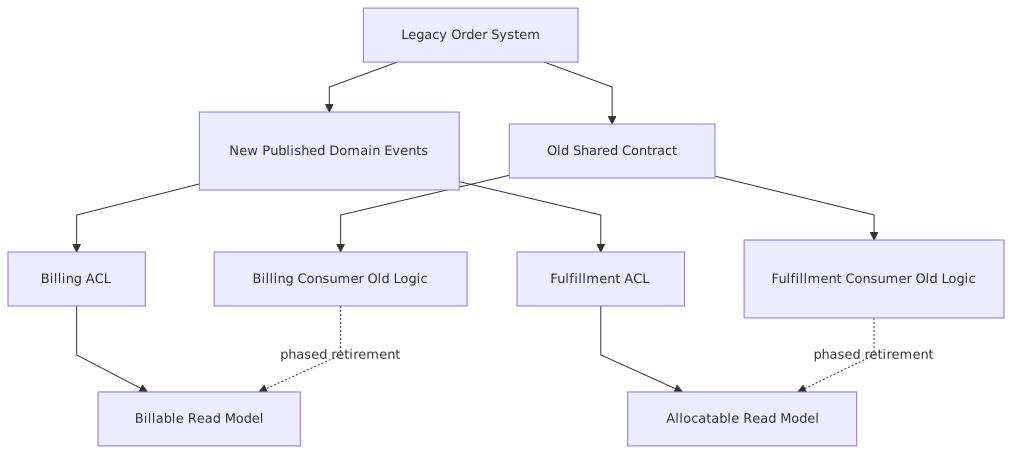
The strangler idea matters here: wrap, translate, redirect, and retire. Don’t attempt semantic big bangs. Enterprises are graveyards of big-bang integration plans.
Enterprise Example
Consider a global insurer modernizing policy administration.
The legacy core system owns policies, endorsements, renewals, billing triggers, and claims references. Over the years, every adjacent system learned to consume the policy system’s statuses. “Bound,” “Issued,” “Active,” “Cancelled,” “Rewritten,” “Endorsed”—all looked stable until different business units interpreted them differently. Billing used “Issued” as invoice-ready. Claims used “Active” as coverage-effective. Customer Service used both as display states. Kafka was introduced, but the initial event streams mirrored legacy transaction codes.
So the organization had modern transport and old coupling.
The architecture team changed the approach.
Instead of exposing policy transaction internals as universal truth, they introduced a published language for cross-context collaboration:
CoverageActivatedPremiumAdjustmentPostedInvoiceObligationCreatedPolicyTerminationEffectiveCustomerContactPreferenceUpdated
The Policy domain still owned the canonical policy aggregate. But Billing no longer depended on raw policy status transitions. It consumed InvoiceObligationCreated and built its own billable obligations model. Claims no longer inferred coverage from generic “active” status. It consumed CoverageActivated and PolicyTerminationEffective with effective dates relevant to claims adjudication. Customer Service built a customer timeline projection optimized for explanation, not policy calculation.
This reduced a surprising amount of friction.
When underwriting introduced a pre-bind review state, Billing did not care because invoice obligation semantics were unchanged. Claims did not care because coverage activation still occurred at the same domain boundary. Customer Service updated its projection logic for display. One upstream change, one affected consumer, not seven.
But the real lesson came from failure handling.
The insurer discovered delayed delivery and occasional replay during regional outages. Because each consumer projection was idempotent and reconciliation jobs compared policy snapshots with local views nightly, drift was detectable and fixable. Month-end billing no longer relied on every event path being perfect in real time. The system was designed for distributed imperfection rather than pretending it would not happen.
That is what enterprise architecture should do: make correctness survivable, not magical.
Operational Considerations
Dependency inversion across services is not just a design exercise. It changes how you operate the estate.
Contract governance
Schema registries help, but schema compatibility is not enough. You also need semantic governance: EA governance checklist
- what business fact does this event assert?
- who may rely on it?
- what are ordering guarantees, if any?
- can it be corrected later?
- what is the deprecation policy?
A valid Avro schema can still encode terrible architecture.
Observability
Track more than API latency and Kafka lag. You need:
- projection freshness by consumer
- reconciliation mismatch counts
- event dead-letter rates
- business process completion lag
- semantic error indicators, such as “invoice generated without coverage activation”
Distributed systems fail in business terms before they fail in infrastructure terms.
Idempotency and replay
Every consumer building local state from Kafka should be able to replay safely. That means:
- deterministic handlers where possible
- deduplication keys
- version-aware event processing
- clear handling for correction events versus original events
If replay is dangerous, your architecture is brittle.
Data retention and recovery
If consumer projections are important, decide whether they are rebuildable from event history, snapshots, or source APIs. This is a serious enterprise decision with cost implications. Infinite retention is not free. Neither is rebuilding ten years of business state from scratch during an audit.
Security and privacy
Published business events are often copied more widely than intended. Dependency inversion should not become data sprawl. Publish the least data needed for collaboration. Sensitive fields should be omitted, tokenized, or fetched through controlled access paths when truly necessary.
Tradeoffs
This pattern buys autonomy, but not cheaply.
Benefits
- reduced semantic coupling
- fewer cascading changes from producer internals
- improved team autonomy
- better fit with bounded contexts
- support for asynchronous scaling and resilience
- clearer migration path from legacy systems
Costs
- more translation code
- more duplicated data in projections
- reconciliation complexity
- higher conceptual overhead
- risk of over-modeling events and contracts
- more operational burden around replay, drift, and observability
There is no free lunch here. The trade is simple:
> You swap hidden coupling for explicit complexity.
That is usually a good trade in enterprises, because hidden coupling grows in silence and explodes during change. Explicit complexity can at least be governed.
Still, many teams underestimate the discipline required. A Kafka topic is easy to create. A stable cross-domain contract is not.
Failure Modes
Dependency inversion across services can fail in several predictable ways.
1. Event theater
Teams rename CRUD events to sound domain-driven, but the payload and semantics remain producer-internal. CustomerUpdated becomes CustomerChangedEvent, and nothing really improves.
2. Generic integration hub relapse
An integration service becomes the central place where all transformations, routing, and coordination happen. Soon every team depends on it. Congratulations: you have rebuilt the ESB with cloud-native fonts. cloud architecture guide
3. Consumer read models become shadow masters
Consumers start enriching and correcting replicated data until they effectively become alternate sources of truth. This creates governance confusion and reconciliation nightmares.
4. Ignoring correction flows
The architecture assumes events are immutable facts and never plans for reversals, effective-date changes, rescinds, or late-arriving decisions. Real businesses do all of these.
5. Overusing synchronous APIs
Teams claim event-driven architecture but still chain runtime calls for every decision. This preserves temporal coupling while adding event complexity on top.
6. Shared taxonomy tyranny
Enterprise governance imposes one universal vocabulary for all services. The result is language that is broad enough to be accepted and vague enough to be useless. Domain semantics disappear into committee-approved mush.
When Not To Use
This pattern is powerful, but not universal.
Do not reach for dependency inversion across services when:
The domain is simple and stable
If a small number of services collaborate around straightforward CRUD-style information with little semantic variation, adding published language, ACLs, and projections may be over-engineering.
Team boundaries are immature
If the same small team owns all collaborating services and deploys them together, local modular monolith patterns may deliver better results. Service-level inversion helps most when organizational and release independence matter.
Strong consistency is essential at every step
If the workflow requires strict, immediate consistency across capabilities—rare but real in some financial trading or industrial control scenarios—local projections and asynchronous coordination may create unacceptable risk.
Consumers truly need canonical detail
Some reporting, audit, or master data scenarios legitimately depend on canonical records. Even then, treat that as a specific use case, not a reason to leak canonical form everywhere.
You cannot support reconciliation operationally
If the organization lacks discipline for replay, drift detection, and correction handling, asynchronous dependency inversion may fail in production despite looking elegant on diagrams.
Sometimes the right answer is embarrassingly simple: one service, one database, clean modules, fewer distributed seams. Architects should say that more often.
Related Patterns
Dependency inversion across services sits alongside several established patterns.
- Anti-Corruption Layer: protects a bounded context from another model’s semantics.
- Published Language: enables explicit shared meaning between contexts.
- Strangler Fig Pattern: supports progressive migration from legacy contracts to inverted ones.
- CQRS Read Models: give consumers local, purpose-built views.
- Event-Carried State Transfer: useful, but dangerous when overused without semantic discipline.
- Transactional Outbox: improves reliable event publication from service changes.
- Saga / Process Manager: coordinates multi-step workflows when events alone are insufficient.
- Data Mesh-style product thinking: helpful when event streams are treated as governed data products, though operationally heavier than many teams expect.
These patterns are companions, not substitutes. The core question remains: who is allowed to shape the meaning of collaboration?
My answer is opinionated: not just the producer.
Summary
Dependency inversion across services is the practice of preventing one service’s internal model from becoming another service’s operating reality.
That sounds abstract. In practice, it means designing APIs and Kafka events around business intent, using bounded-context thinking to preserve domain semantics, introducing anti-corruption and translation layers, giving consumers local read models, and treating reconciliation as part of the architecture rather than cleanup after the fact.
This is especially important in enterprise microservices because the real source of coupling is not technology. It is meaning. Shared meanings, mistaken meanings, half-shared meanings. The dangerous thing is not that services call each other. It is that they quietly start thinking in each other’s language.
Good architecture interrupts that drift.
Use progressive strangler migration, not heroic rewrites. Publish new business contracts beside old producer-shaped ones. Move consumers one capability at a time. Add observability for semantic lag and reconciliation mismatch. Expect duplicates, delays, replays, and corrections. Design so they are annoying, not catastrophic.
And be honest about the tradeoff. This style creates more moving parts. More translation. More projections. More operational discipline. But it also buys something precious in large organizations: the ability to change one important part of the business without asking the rest of the estate for permission.
That is the real inversion.
Not just a reversal of dependency arrows on a diagram.
A reversal of control over meaning.
Frequently Asked Questions
What is a service mesh?
A service mesh is an infrastructure layer managing service-to-service communication. It provides mutual TLS, load balancing, circuit breaking, retries, and observability without each service implementing these capabilities. Istio and Linkerd are common implementations.
How do you document microservices architecture for governance?
Use ArchiMate Application Cooperation diagrams for the service landscape, UML Component diagrams for internal structure, UML Sequence diagrams for key flows, and UML Deployment diagrams for Kubernetes topology. All views can coexist in Sparx EA with full traceability.
What is the difference between choreography and orchestration in microservices?
Choreography has services react to events independently — no central coordinator. Orchestration uses a central workflow engine that calls services in sequence. Choreography scales better but is harder to debug; orchestration is easier to reason about but creates a central coupling point.