⏱ 21 min read
Most deployment diagrams lie.
They present a clean little world: services in neat boxes, arrows flowing left to right, databases tucked politely behind the applications that own them. The picture suggests order. It suggests that if we just wire enough containers together in Kubernetes, the system will behave. But any architect who has lived through a real cloud migration knows the ugly truth: production systems are shaped less by diagrams than by topology—latency boundaries, failure zones, data gravity, jurisdictional constraints, message paths, team ownership, and the stubborn semantics of the business itself. cloud architecture guide
That is why topology-driven deployment matters.
In cloud microservices, deployment should not begin with “How do we package the service?” It should begin with “Where does this capability belong, what does it need to be close to, and what can it afford to be far from?” A payment authorization service deployed in the wrong region is not just a technical inconvenience; it is a business defect. A customer profile service stretched across zones without reconciliation logic is not resilient; it is a distributed argument waiting to happen. A Kafka-centric event platform deployed without respect to bounded contexts becomes a gossip network that spreads inconsistency faster than truth. event-driven architecture patterns
Topology is the shape of the battlefield. Ignore it, and the system will teach you architecture the hard way.
This article looks at topology-driven deployment in cloud microservices from an enterprise architecture perspective: why it matters, how to design for it, how to migrate toward it, where Kafka fits, how reconciliation keeps the edges honest, and when the whole approach is the wrong move. I’ll take a domain-driven design view because deployment topology is not merely an infrastructure concern. It is a reflection of business boundaries. If your deployment shape and your domain shape diverge too far, operations turns into archaeology.
Context
The early microservices story was intoxicating: split the monolith into independently deployable services, put them in containers, add an API gateway, and let teams move fast. In practice, many enterprises created a distributed monolith with better marketing.
Why? Because they decomposed code before they understood operational geography.
Cloud platforms made it easy to instantiate compute almost anywhere. Multi-region, multi-account, multi-cluster, edge nodes, service meshes, managed Kafka, managed databases—an endless palette of deployment choices. But freedom without topology discipline creates accidental complexity. Services end up deployed according to organizational convenience or platform defaults rather than business semantics.
A topology-driven deployment model starts from the reality that cloud systems inhabit a landscape:
- Regions with different latency and compliance characteristics
- Availability zones with fault isolation boundaries
- Network segments with varying trust levels
- Data stores with locality and replication constraints
- Event brokers with partitioning and ordering behavior
- Teams aligned to bounded contexts and operating models
In a mature enterprise, topology is also shaped by acquisitions, legacy estates, shared services, sovereign hosting requirements, and plain old politics.
So this is not just a deployment diagram exercise. It is the act of making physical deployment match logical domain intent as closely as possible.
Problem
Microservices fail in surprisingly repetitive ways.
A team designs a clean Order Service, Inventory Service, Pricing Service, and Customer Service. They deploy them all into one Kubernetes cluster in one region. Traffic grows internationally. Latency spikes. So they replicate some services to more regions but leave a shared database centralized. Now reads are fast, writes are painful, and failover becomes theater.
Another organization adopts Kafka and starts publishing every state change as an event. It sounds modern. But because the event streams were not aligned to domain boundaries, services consume each other’s internals. Local autonomy disappears. A topology that should have reduced coupling instead industrializes it.
A third team tries active-active across regions without thinking through domain semantics. Orders are created in two places; customer addresses race to update; inventory counts drift; compensations proliferate. The system is “highly available” in the same way a rumor is highly available.
The core problem is this: most microservice deployments are designed from the inside out. Engineers think in terms of service packaging, cluster configuration, or CI/CD pipelines first. They think about topology later, usually after incidents.
That sequence is backwards.
Deployment topology influences:
- service interaction patterns
- consistency choices
- ownership boundaries
- resiliency strategy
- observability model
- cost profile
- compliance posture
- migration feasibility
Once services are deployed with the wrong topological assumptions, fixing them is expensive. Data contracts harden. Cross-region calls creep into critical paths. Kafka topics become de facto shared databases. Teams build brittle workarounds. You can still recover, but now you are migrating not just software but habits.
Forces
Topology-driven deployment exists because several forces pull in opposite directions. Architecture lives in these tensions.
1. Domain proximity vs infrastructure efficiency
A domain capability often wants to be close to the user, close to a source system, or close to a regulated data boundary. Infrastructure teams, meanwhile, want consolidation: fewer clusters, fewer regions, fewer moving parts. Both instincts are rational. They just optimize for different pain.
2. Local autonomy vs global consistency
Bounded contexts in domain-driven design thrive on local control. But enterprises also need a coherent customer, product, and financial picture. The more you distribute deployment, the more reconciliation becomes a first-class concern. There is no free lunch here. “Single source of truth” in a distributed enterprise often means “the place we reconcile to after the fact.”
3. Synchronous convenience vs asynchronous survivability
A direct API call is easy to reason about. Kafka introduces eventual consistency, replay, consumer lag, schema evolution, and dead-letter topics. Yet synchronous chains across topological boundaries are notorious failure multipliers. You pick your poison: temporal coupling now, reconciliation complexity later.
4. Resilience vs cost
Multi-region active-active sounds heroic until you pay for duplicate infrastructure, data replication, traffic egress, observability overhead, and operational complexity. A topology that survives every disaster may bankrupt the ordinary day.
5. Team alignment vs platform standardization
Teams should own bounded contexts end-to-end. But central platform teams need enough standardization to secure and operate the fleet. Too much freedom and topology becomes chaos. Too much standardization and domain needs are flattened into generic hosting templates.
6. Legacy gravity vs greenfield purity
No enterprise starts from a blank sheet. The mainframe still settles accounts. The ERP still owns product masters. The CRM still drives customer identity. Topology-driven deployment has to account for gravity wells that cannot be moved quickly. Migration is therefore part of the architecture, not an implementation footnote.
Solution
The essence of topology-driven deployment is simple:
Deploy services according to domain interaction patterns, data gravity, and failure boundaries—not merely according to technical convenience.
That sounds obvious. It rarely is.
A practical topology-driven model works through five design steps.
1. Identify bounded contexts before deployment units
This is the domain-driven design anchor. A service is not just a container image. It is an operational expression of a bounded context or part of one. If the domain model is muddled, deployment topology will be muddled too.
For example:
Order Managementmay be regional because customer promise and fulfillment capacity are region-specific.Product Catalogmay be globally replicated for low-latency reads but centrally mastered.Payment Authorizationmay be deployed by jurisdiction because PSP integrations and data regulations vary.Identity and Accessmay remain centralized or partially regionalized depending on trust and regulatory needs.
You do not deploy nouns. You deploy semantic responsibilities.
2. Classify interactions by topological sensitivity
Every service interaction is not equal. Ask:
- Does it require low latency?
- Does it need strong consistency?
- Is it legally constrained to a geography?
- Can it be asynchronous?
- Can stale reads be tolerated?
- Is it read-heavy, write-heavy, or event-heavy?
This determines placement.
A read-mostly pricing projection can be replicated widely. An authoritative ledger cannot be casually scattered across regions and prayed into consistency.
3. Make topology explicit in the architecture
Many teams bury topology inside platform config. That is a mistake. Region, zone, cluster, trust boundary, broker placement, storage locality, and replication paths belong in architecture artifacts. The topology deployment diagram is not cosmetic. It is where business semantics meet runtime behavior.
4. Prefer asynchronous propagation across topological boundaries
When services span regions, accounts, or major trust boundaries, event-driven integration is usually safer than synchronous RPC. Kafka is especially useful where ordered domain events, stream replay, consumer independence, and large-scale fan-out matter.
But use Kafka for domain events, not for leaking internal persistence changes. “Database row changed” is not a domain event. It is a cry for modeling help.
5. Design reconciliation as a product feature
In distributed topology, reconciliation is not a failure of architecture. It is how architecture admits reality. If inventory counts differ between a regional fulfillment context and a global supply planning context, you need deterministic ways to compare, repair, and explain. Reconciliation workflows, compensating actions, audit trails, and replay capabilities should be designed from the start.
That last point separates seasoned enterprise design from conference-slide architecture.
Architecture
A topology-driven microservices architecture usually has three layers of concern: microservices architecture diagrams
- Domain-aligned services
- Topology-aware runtime placement
- Cross-topology integration and reconciliation
Here is a representative shape.
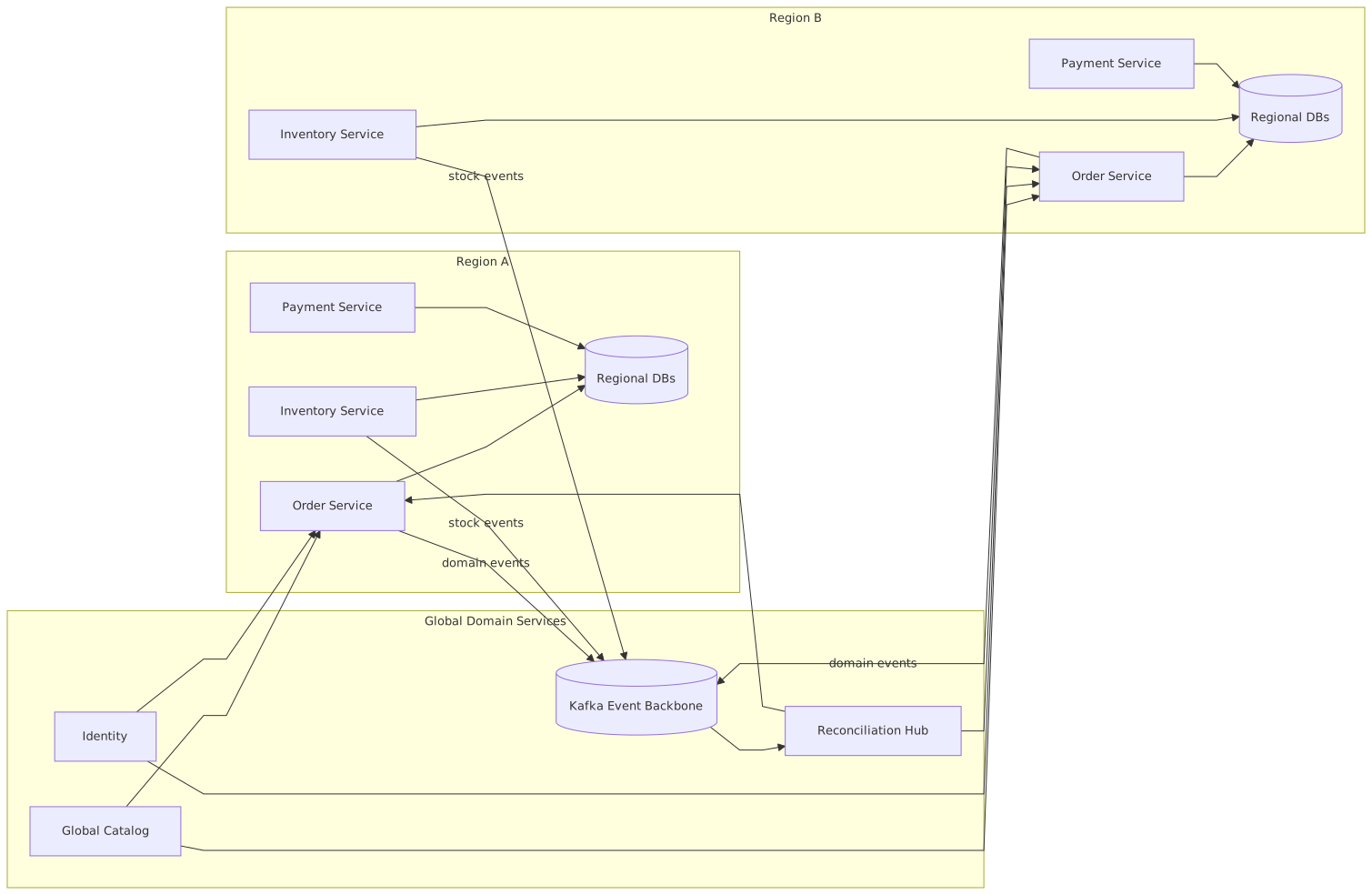
This is not a universal pattern, but it captures the idea. Some bounded contexts are regionalized because they depend on locality, market behavior, or operational separation. Some remain global because they are read-mostly or centrally governed. Kafka forms the backbone for domain event propagation, while a reconciliation hub—or a set of reconciliation services—compares and repairs state drift across contexts.
A few architectural principles matter here.
Keep authority local and projections distributed
A service should own authoritative state where the domain says it owns authority. Other locations can host projections, caches, or read models. This is one of the cleanest ways to avoid accidental dual-write nightmares.
For instance, the Order Service in Region A is authoritative for orders initiated and fulfilled under Region A’s operational model. A global reporting service may maintain projections of all orders, but it should not become an informal write path back into regional orders.
Distinguish command topology from query topology
Commands need to go to the authoritative place. Queries often do not.
This is a useful architectural split. You might route writes for inventory reservation to the regional inventory authority while serving read queries from replicated materialized views closer to consumers. CQRS is often overused as ideology, but in topology-driven deployment it can be profoundly practical.
Model event streams by domain semantics
Kafka topics should align to domain language:
OrderPlacedPaymentAuthorizedInventoryReservedShipmentDispatched
Not:
orders_table_updatedinventory_row_changed
The former allows bounded contexts to integrate intentionally. The latter invites consumers to couple to implementation details and undermines autonomous deployment.
Build anti-corruption layers at topological seams
When a modern regional service depends on an old centralized ERP, do not let the ERP’s data model leak directly into your new domain services. Put an anti-corruption layer in place. This is classic DDD, but in migration it becomes topological armor. It protects the shape of the target architecture while the legacy estate remains in play.
Use service meshes carefully
Service meshes can be useful for mTLS, observability, and traffic shaping. But they can also encourage architects to believe all service-to-service communication is equally acceptable because “the mesh handles it.” It doesn’t. It merely makes cross-topology coupling easier to create. A bad synchronous dependency remains bad, only now it has prettier telemetry.
Migration Strategy
No enterprise rewires topology in one glorious release. You get there by strangling the old world while preserving business continuity.
Progressive strangler migration is the right instinct here, especially when legacy systems are centralized and target microservices need regional deployment.
The migration usually unfolds in phases.
Phase 1: Expose and observe the current topology
Before changing anything, map what actually talks to what, where data is stored, where latency hurts, and where failures propagate. Most organizations discover hidden dependencies during this step.
Create deployment and interaction maps. Measure:
- call chains crossing regions or data centers
- synchronous dependencies in critical business flows
- data ownership ambiguity
- event duplication or ordering issues
- recovery times by topology boundary
This is less glamorous than target-state design. It is more valuable.
Phase 2: Carve bounded contexts and establish seams
Choose a domain slice that has a meaningful business boundary and manageable legacy entanglement. Introduce an anti-corruption layer around the legacy capability. Begin publishing domain events from the seam.
At this stage, Kafka is often introduced as an event bridge rather than a full event-driven utopia. That is healthy. The goal is controlled decoupling.
Phase 3: Build regionalized services beside the monolith
Create the new service in the target topology without immediately taking full authority. Feed it from legacy via events or CDC where necessary, but translate those feeds into domain semantics. Let the new service build its own read model and operational footprint.
This is where people get impatient. They want to switch writes immediately. Usually that is a mistake.
Phase 4: Shift reads, then selective commands
Move read traffic first where possible. Once confidence grows, move a constrained set of commands to the new service for a subset of regions, products, or channels. Keep reconciliation running aggressively.
Phase 5: Reassign authority and shrink legacy scope
When the new bounded context can own its commands, state, and recovery procedures, make it authoritative for that slice. Legacy becomes a consumer or archive, not the source of truth.
Phase 6: Repeat by topology cell
Migrate region by region, business unit by business unit, or channel by channel. Topology-driven migration benefits from cell-based rollout because each cell becomes an operational learning loop.
Here is a migration view.

The important thing is not merely strangling endpoints. It is strangling topological dependence. If a new regional service still synchronously calls back to the central monolith for every meaningful decision, then you have migrated code, not architecture.
Reconciliation during migration
Reconciliation deserves its own paragraph because migrations die here.
During coexistence, state will diverge. It always does. The issue is whether divergence is bounded, observable, and repairable. Good reconciliation design includes:
- stable business identifiers across old and new worlds
- idempotent event processing
- audit history with causation and correlation IDs
- deterministic comparison rules
- clear conflict resolution ownership
- replay capability from Kafka or persisted event logs
- operator tooling for exception handling
If you cannot explain how an order in Region B became “paid but not reservable,” you do not have a migration strategy. You have a suspense novel.
Enterprise Example
Consider a global retailer modernizing its commerce platform.
The legacy setup is familiar: a central ERP manages product, stock, and order settlement; a monolithic commerce application handles web checkout globally; regional warehouses use separate fulfillment tools; payment providers differ by country. Everything important eventually funnels back to a central data center.
The company wants to support low-latency regional shopping experiences, local payment methods, and partial independence during regional outages. Leadership asks for microservices and multi-region cloud deployment. Predictably, the first proposal is a flat list of services deployed identically everywhere.
That would have been a mistake.
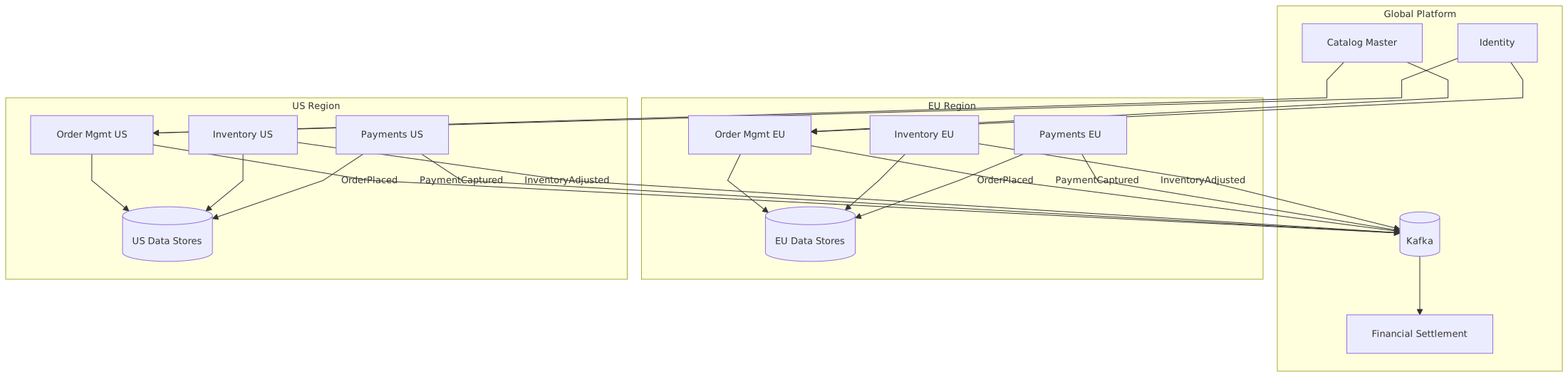
A topology-driven analysis reveals different domain needs:
- Catalog: globally governed but read-heavy, suitable for broad replication with central mastering.
- Pricing: partly global, partly market-specific; regional projections required.
- Order Management: regional authority due to fulfillment commitments, tax rules, and operational ownership.
- Inventory Reservation: regional near fulfillment operations, with global supply planning receiving asynchronous updates.
- Payment Authorization: regionalized due to PSP integrations and regulatory differences.
- Customer Identity: globally coordinated but with regional privacy handling.
- Financial Settlement: centrally consolidated, but fed asynchronously from regional events.
The resulting topology looks more like a federation than a clone army.
What happened in practice?
The retailer first extracted catalog distribution and payment orchestration. Those had clean enough seams. Order management took longer because legacy order IDs, tax calculation rules, and warehouse workflows were deeply entangled. The team used a strangler approach: EU orders from the new storefront were first mirrored into a new regional order service while the monolith still remained authoritative. Kafka carried translated domain events, not raw database changes.
For six months, reconciliation reports ran daily, then hourly. Mismatches appeared in cancellation timing, split shipments, and payment reversals. Good. That is what reconciliation is for. The team discovered that the biggest issue was not technology but domain ambiguity: what exactly counts as “order confirmed” when payment is authorized but inventory allocation is pending? Once that semantic definition was clarified, event contracts improved and reconciliation rates dropped.
This is the point many architecture discussions miss: topology problems often expose domain misunderstandings. Geography becomes a forcing function for sharper semantics.
In the final state, regional order services became authoritative for local channels. The ERP still received settlement and accounting feeds, but it stopped being the synchronous heart of every purchase. During one regional cloud incident, EU order capture degraded gracefully while US operations continued. Not perfect. But survivable. In enterprise architecture, survivable beats elegant.
Operational Considerations
Topology-driven deployment shifts operational concerns from “keep the cluster alive” to “keep the distributed business coherent.”
Observability by topology boundary
Dashboards should be organized around domain flows and topological seams:
- cross-region latency
- Kafka consumer lag by domain topic
- reconciliation backlog
- replication freshness
- command routing failures
- regional failover behavior
A generic service health dashboard is not enough. The business needs to see where semantics are drifting, not just where pods are green.
Data governance and sovereignty
Regional deployment often exists because data cannot move freely. That means architecture decisions need explicit policies for:
- PII residency
- encrypted event payloads
- tokenization and pseudonymization
- cross-border replication controls
- retention and audit obligations
A Kafka topic spanning multiple jurisdictions without clear data classification is an audit finding waiting to happen.
Release management
Independent deployment is only valuable if contracts are stable. This means:
- backward-compatible event schemas
- consumer-driven contract validation
- API version discipline
- migration-safe topic evolution
Schema registries help. They do not replace governance. EA governance checklist
Capacity and partitioning strategy
Kafka partitioning deserves care in topology-driven systems. Partition by the business key that preserves domain ordering where needed—often orderId, customerId, or inventoryLocationId. Bad partition strategy creates hidden hotspots or breaks semantic ordering.
Runbooks and operator tooling
Operators need tools to replay events, inspect correlation chains, compare authoritative vs projected state, and quarantine toxic messages. If the only operational move is “restart the service,” your topology is more sophisticated than your operations.
Tradeoffs
Topology-driven deployment is powerful, but it is not free.
It improves locality, but increases design discipline required
You gain lower latency, better fault isolation, and alignment to business boundaries. You also inherit more explicit work around authority, replication, and reconciliation.
It reduces some forms of coupling, while introducing integration complexity
Asynchronous propagation across Kafka breaks temporal dependency. It introduces event contract management, replay logic, and eventual consistency. The system breathes easier, but the bookkeeping gets harder.
It supports team autonomy, but demands stronger architecture governance
Regional or domain teams can move faster within their context. But someone still needs to govern identity, event taxonomy, data policy, and cross-context semantics. Federated architecture is not the absence of standards. It is standards with better boundaries.
It increases resilience, but not uniformly
Some capabilities benefit enormously from regional isolation. Others, especially centralized financial or identity services, may remain strategic single points requiring different hardening measures. Topology-driven deployment is a selective tool, not a magic shield.
Failure Modes
There are recurring ways this goes wrong.
1. Topology mirrors org chart, not domain reality
Teams often deploy services where the owning department sits, regardless of domain interactions. That leads to arbitrary boundaries and expensive cross-context chatter.
2. Kafka becomes a shared database with better branding
If every service consumes every topic and builds logic from low-level data change events, you have not decoupled the system. You have diffused coupling everywhere.
3. Active-active without semantic conflict handling
Multi-region writes are seductive. Unless the domain has clear merge rules, conflict ownership, and reconciliation workflows, active-active becomes active-confused.
4. Reconciliation is postponed
Teams assume they will “monitor consistency later.” Later arrives as finance discrepancies, phantom inventory, and executive escalations.
5. Legacy dependencies remain synchronously embedded
A regional service that still calls the central monolith for core decisions is topologically dependent, no matter how modern the codebase looks.
6. Over-standardization kills domain fit
Some platform teams force all services into identical deployment shapes—same region pattern, same data pattern, same communication pattern. This produces compliance theater rather than architecture. Domains differ. Topology should reflect that.
When Not To Use
This approach is not always the right answer.
Do not reach for topology-driven deployment if:
Your domain is simple and centralized
If you have a modest internal application used in one geography with no strong latency, sovereignty, or resilience requirements, a well-structured modular monolith is often superior. Better one clean building than a village of sheds.
Your team lacks operational maturity
If you cannot yet manage contracts, observability, automated recovery, and event operations, distributing topology will amplify pain. Start simpler.
The business does not benefit from locality
Some systems do not need regional authority or distributed deployment. Forcing topology complexity into them creates cost without value.
Your domain semantics are still unstable
If you do not yet agree on what a customer, order, case, or policy means across the organization, broad topological distribution is premature. First clarify bounded contexts. Then distribute.
Compliance or risk policy forbids the necessary data movement patterns
Sometimes the legal and governance environment is so restrictive that broad event propagation or distributed data ownership is impractical. In that case, keep architecture more centralized and design carefully around those constraints.
Related Patterns
Topology-driven deployment intersects with several established patterns:
- Bounded Contexts: the core DDD mechanism for separating models and ownership.
- Strangler Fig Pattern: ideal for progressive migration from monoliths and centralized platforms.
- CQRS: helpful for separating authoritative command paths from distributed query projections.
- Event-Driven Architecture: especially relevant with Kafka for cross-topology propagation.
- Saga Pattern: useful for coordinating long-running distributed workflows, though easy to overcomplicate.
- Anti-Corruption Layer: essential at seams between legacy and modern contexts.
- Cell-Based Architecture: a strong complement when you want isolated operational units by region or tenant.
- Bulkhead and Circuit Breaker: still relevant, but not substitutes for proper topological separation.
- Data Mesh: adjacent in spirit when domain-aligned ownership extends into analytical data products, though operational microservices and analytical platforms should not be casually conflated.
The trap is to collect these patterns like trading cards. They matter only insofar as they clarify authority, reduce harmful coupling, and support real operational behavior.
Summary
Topology-driven deployment in cloud microservices is the discipline of placing services according to domain semantics, data gravity, and failure boundaries rather than technical convenience.
That sounds almost too sensible. Yet many enterprises still do the opposite.
The useful mental shift is this: deployment topology is not downstream of architecture. It is architecture. Region placement, event routing, replication, authority boundaries, reconciliation, and migration sequencing are not implementation details. They are how the business behaves under stress.
Start with bounded contexts. Make topology explicit. Use Kafka where asynchronous domain propagation reduces harmful coupling. Design reconciliation early, especially during strangler migration. Keep authority local, distribute projections with intent, and be honest about tradeoffs. Most of all, remember that the shape of the runtime should reflect the shape of the business, not the shape of the org chart or the default settings of your cloud platform.
A good topology deployment diagram does not just show where software runs.
It shows where the enterprise has chosen to put truth, trust, and failure.
Frequently Asked Questions
What is a service mesh?
A service mesh is an infrastructure layer managing service-to-service communication. It provides mutual TLS, load balancing, circuit breaking, retries, and observability without each service implementing these capabilities. Istio and Linkerd are common implementations.
How do you document microservices architecture for governance?
Use ArchiMate Application Cooperation diagrams for the service landscape, UML Component diagrams for internal structure, UML Sequence diagrams for key flows, and UML Deployment diagrams for Kubernetes topology. All views can coexist in Sparx EA with full traceability.
What is the difference between choreography and orchestration in microservices?
Choreography has services react to events independently — no central coordinator. Orchestration uses a central workflow engine that calls services in sequence. Choreography scales better but is harder to debug; orchestration is easier to reason about but creates a central coupling point.