⏱ 20 min read
Most microservice failures do not begin with Kubernetes, Kafka, or observability. They begin much earlier, in a quieter room, with a confident whiteboard and a bad boundary. event-driven architecture patterns
That is the dirty secret of service decomposition. Teams talk about deployment independence, scaling, and event-driven architecture, but the real game is semantic separation. If you split a system along technical layers, reporting lines, or whatever happened to be in the old codebase, you do not get microservices. You get a distributed monolith with better branding. microservices architecture diagrams
Service boundary discovery is the act of finding the seams in a business system that can survive distribution. Not merely compile. Survive. Because once a boundary becomes a network hop, all the soft mistakes in the model harden into operational pain: chatty calls, inconsistent data, endless retries, duplicate workflows, and a support team that learns to fear the month-end close.
One of the most useful but dangerously misunderstood tools in this work is the call graph clustering diagram. It can show where parts of a system naturally move together. It can reveal hidden dependency hubs, accidental coordinators, and clusters of behavior that might deserve to become services. But call graphs are not domain models. They are symptoms, not truth. If you use them without domain-driven design thinking, you will carve services around code gravity rather than business meaning.
This article is about doing the job properly. We will look at how to discover service boundaries using runtime and static call patterns, domain semantics, bounded contexts, and migration constraints. We will also look at why many apparently clean decompositions fail in production, what reconciliation has to do with all of this, and when the whole exercise is simply the wrong move.
Context
Every large enterprise system carries history in its architecture.
A retail platform that began as a catalog engine now also runs promotions, loyalty, fulfillment, customer service, tax, and marketplace onboarding. A bank’s customer system started as account management and ended up owning onboarding, fraud checks, card issuance, communication preferences, and half the compliance workflow. Over time, all roads lead through the monolith because the monolith is where decisions were easiest to add.
Then the pressure changes. Teams need faster release cycles. Different capabilities scale at different rates. Regulatory features need isolation. Data products want cleaner ownership. Integration demand explodes. Suddenly “split the monolith” appears in a strategy deck as if it were one project rather than ten years of organizational archaeology.
This is where service boundary discovery matters. The question is not “how do we create more deployables?” The question is “what business capability deserves autonomous evolution, and what technical evidence supports that separation?”
The best architecture work sits between business semantics and implementation reality. Domain-driven design gives us bounded contexts, ubiquitous language, and aggregate consistency boundaries. System analysis gives us call graphs, database usage, runtime traces, change frequency, and dependency patterns. Migration strategy gives us a path that the organization can actually survive.
Ignore any one of those, and the decomposition becomes decorative.
Problem
The problem sounds simple: identify the right microservices.
In practice, it is a three-body problem:
- The domain is messy.
Business terms are overloaded, ownership is contested, and workflows cross departments. “Customer” means one thing to onboarding, another to billing, and another to support.
- The code lies.
Existing module structure often reflects old team boundaries, framework conventions, or expedient shortcuts rather than meaningful capability separation.
- Operations punish bad guesses.
A poor split creates latency, coupling, coordination overhead, data inconsistency, and brittle recovery behavior.
Many organizations try to solve this with one-dimensional heuristics.
- “One service per database table.”
- “One service per UI page.”
- “One service per team.”
- “Just use event-driven architecture.”
- “Cluster by call graph and we’re done.”
All of these are incomplete. A call graph may reveal strong runtime affinity between functions handling order pricing and inventory reservation, but that does not prove they belong in one service. It may simply prove the current system couples them too tightly. Equally, two modules with limited direct calls may still belong in the same bounded context because they enforce a shared business invariant.
This is the central tension: code proximity is not the same as domain cohesion.
Forces
Service boundary discovery is shaped by competing forces. Good architecture does not eliminate them. It makes the tradeoffs explicit.
Domain cohesion vs technical coupling
A service should represent a business capability with a coherent model and language. Yet the code often couples unrelated concerns through shared utilities, transaction scripts, or a single data access layer. If you follow technical coupling too literally, you preserve old accidents.
Autonomy vs consistency
The tighter the consistency requirement, the more likely logic belongs in the same service or aggregate. Once you split, synchronous coordination and distributed transactions creep in. Some consistency can become eventual. Some cannot.
There is no glory in a microservice boundary that turns a simple invariant into a Kafka-backed apology.
Team ownership vs platform efficiency
A service is partly a software unit and partly a social contract. Teams need clear ownership. But too many tiny services create platform sprawl, operational noise, and dependency management chaos.
Change frequency vs stability
Components that change together often belong together. This is one of the strongest practical signals in decomposition. But sometimes they change together because of poor modularity or regulatory workflow coupling, not because they should remain coupled.
Transaction flow vs lifecycle separation
An end-to-end user journey can span many capabilities. A naïve decomposition around the journey creates orchestration-heavy services. Better boundaries often align with capability lifecycles rather than screens or process steps.
Existing data gravity vs desired future state
Databases hold systems hostage. Shared schemas, triggers, reporting extracts, and ETL jobs create hidden coupling. The architecture may want separation, but migration must reckon with data gravity, especially in enterprises with decades of integration debt.
Solution
The practical solution is a layered discovery approach:
- Start with domain-driven design to identify candidate bounded contexts.
- Use call graph clustering to validate, challenge, and prioritize those candidates.
- Overlay data ownership, change patterns, and operational flows.
- Choose migration slices that reduce risk rather than chasing an ideal target too early.
This is not a one-shot modeling workshop. It is iterative discovery.
Step 1: Discover bounded contexts first
Begin with the business language and decision points. Event storming, domain interviews, process mapping, and policy analysis are useful here. Ask:
- Where does the language change?
- Where do business rules differ?
- Which capabilities require independent evolution?
- Where are the consistency boundaries?
- What decisions must be made atomically?
This leads to candidate bounded contexts such as Pricing, Inventory, Order Management, Customer Identity, Billing, Fulfillment, or Loyalty. These are not yet services, but they are the right starting vocabulary.
A bounded context is not “everything related to orders.” It is a semantic boundary where terms have precise meaning and rules are coherent. That distinction matters. “Customer” in Identity is an authenticated party with verification state. “Customer” in Marketing is a segmentable target. Forcing one model across both is how enterprises end up with giant canonical disasters.
Step 2: Build the call graph
Now examine reality.
A call graph can be assembled from static dependency analysis, runtime traces, service mesh telemetry, APM spans, logs, and code-level invocation graphs. In a monolith, this means module-to-module or package-to-package calls. In a partially distributed estate, it includes service-to-service interactions.
What matters is not only who calls whom, but:
- call frequency
- latency sensitivity
- synchronous vs asynchronous usage
- fan-in and fan-out
- cyclic dependency patterns
- transactional adjacency
- change coupling
- error propagation paths
Then apply clustering techniques. Communities in the graph often reveal cohesive execution neighborhoods. These can suggest candidate services, hidden subdomains, or anti-patterns like orchestration hubs.
Here is a simplified view.
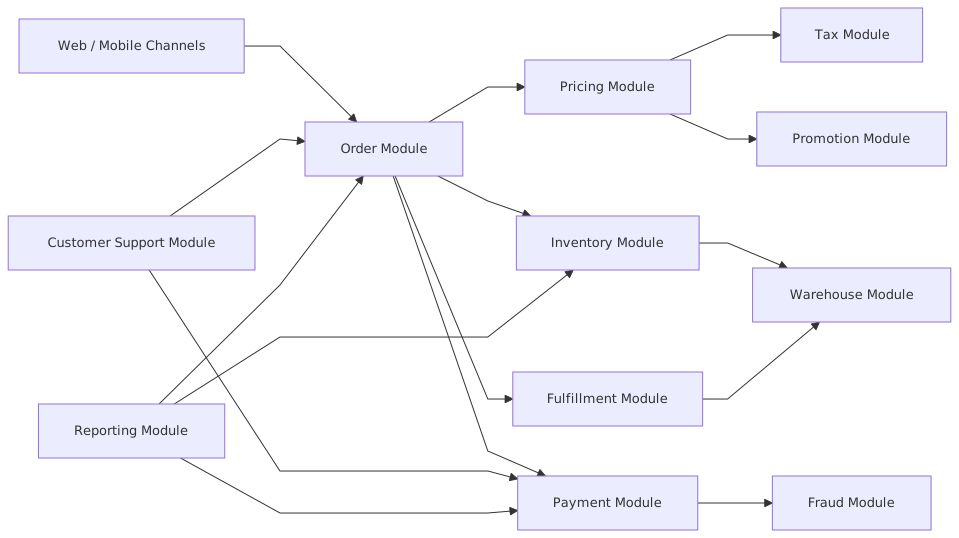
That graph alone is not enough. The interesting work starts when you detect clusters, centrality, and cycles. For example:
- Pricing, Promotion, and Tax may cluster strongly around commercial decisioning.
- Inventory and Warehouse may form an operational stock context.
- Payment and Fraud may deserve tight consistency or low-latency collaboration.
- Reporting may be a pure read-model consumer and should not own transactional logic at all.
Step 3: Compare graph clusters to domain contexts
This is where architects earn their keep.
Sometimes the graph and the domain align beautifully. More often they do not. When they conflict, investigate why.
- If call graph clusters cut across multiple bounded contexts, the existing code may be tangled.
- If a bounded context has low call density but high semantic coherence, do not discard it just because the graph looks sparse.
- If a module appears central to everything, it may be a shared service, or more likely, a ball of mud wearing a utility costume.
The right move is usually to create a matrix:
That table is more useful than architecture theater. It gives a basis for migration ordering and design choices.
Step 4: Define service boundaries around capability and decision ownership
A good service boundary usually has these traits:
- a coherent business capability
- clear ownership of decisions and rules
- owned data, not borrowed tables
- minimal need for cross-service synchronous chatter
- recoverable workflows when downstream dependencies fail
- a model the team can explain in plain business language
This is why domain semantics matter so much. A service is not “the thing behind an API.” It is a decision-making unit.
Step 5: Design for reconciliation from day one
The moment you split services, some workflows become eventually consistent. Orders may be accepted before inventory confirmation. Payments may authorize while fulfillment lags. Customer profile updates may propagate across channels asynchronously.
Reconciliation is not an afterthought. It is the operating system of distributed business processes.
You need:
- immutable event records where appropriate
- idempotent consumers
- compensation logic for failed steps
- periodic reconciliation jobs
- discrepancy dashboards
- clear source-of-truth definitions
- business-approved tolerance for lag and conflict
If this is missing, your architecture is not distributed. It is merely delayed.
Architecture
A practical target architecture combines bounded contexts, service boundaries, asynchronous integration, and explicit read/write ownership.
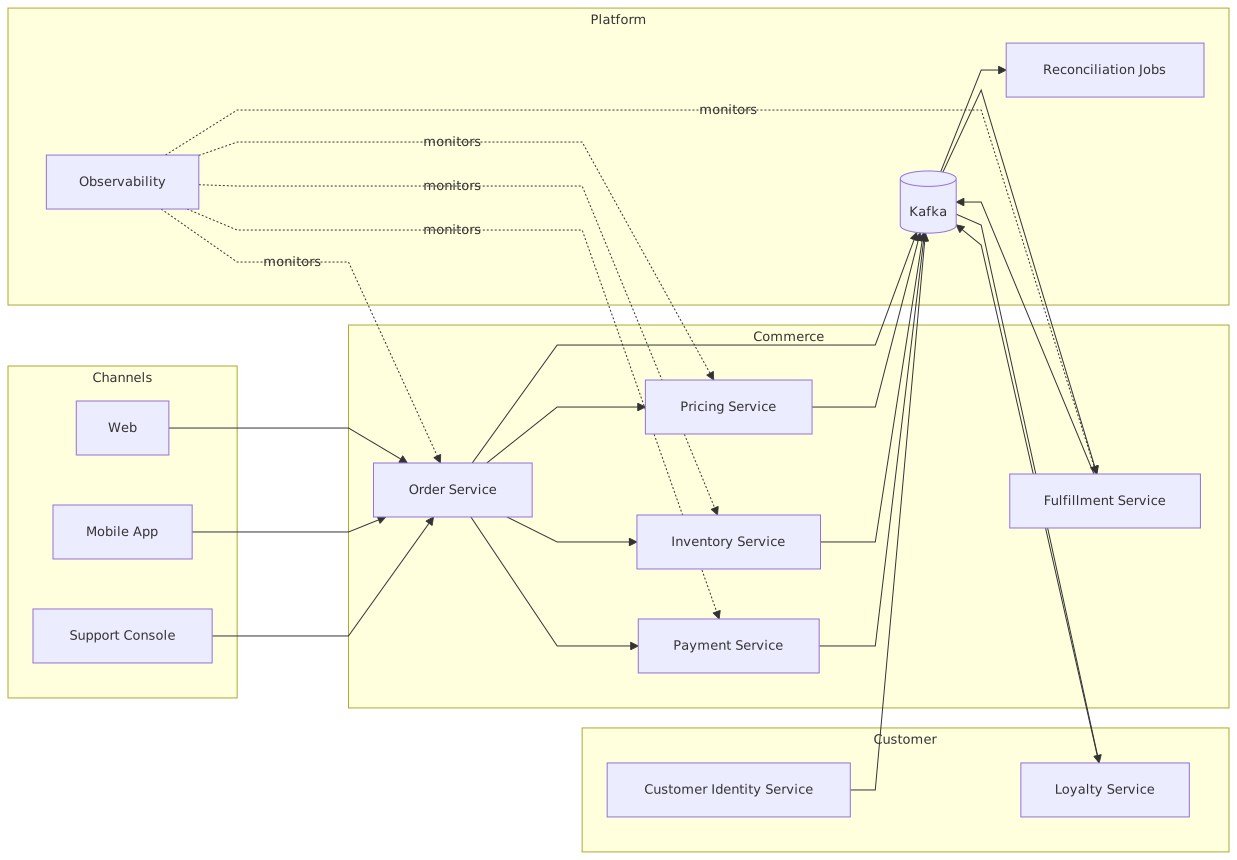
A few opinions here.
Keep synchronous calls for immediate decisions, not broad workflow control
Order placement may need synchronous pricing and payment authorization because the user is waiting. But if the Order Service synchronously calls six downstream services for every request, you have just rebuilt the monolith with timeouts.
Use synchronous calls where the business truly needs immediate confirmation. Use Kafka or another event backbone for state propagation, downstream reactions, and secondary workflows.
Avoid shared databases, even if migration tempts you
Shared database access is the architectural equivalent of lending everyone your house keys because changing the locks feels inconvenient. It saves time until it destroys trust.
Services should own their persistence. During migration, you may temporarily tolerate replicated data or anti-corruption layers. But if multiple services update the same tables, the boundary is fake.
Separate command models from read models
Many cross-service calls are really read concerns. Reporting, customer support views, and dashboards often do not need transactional ownership. Materialized views, event-driven projections, or query services can reduce coupling dramatically.
Watch out for orchestration monopolies
Teams often create one “process service” to coordinate everything. In moderation, orchestration is useful. In excess, it becomes the new monolith. A giant Order Orchestrator that contains every commercial rule, compensation decision, and fulfillment dependency is simply centralization with REST.
A better pattern is to keep domain decisions in owning services and reserve orchestration for explicit workflow state.
Migration Strategy
The cleanest target architecture can still fail if the migration path is reckless.
The right migration is progressive, asymmetrical, and brutally pragmatic. This is where the strangler pattern earns its reputation.
Start with seams, not dreams
Do not begin with the most central, tangled core just because it is important. Begin where you can establish a real service boundary with manageable blast radius. Good early candidates often include:
- customer identity
- product catalog
- pricing reference components
- notification
- document generation
- read-heavy support capabilities
Then tackle harder domains once you have operational patterns, event contracts, and team muscle.
Use progressive strangler migration
The strangler approach works by intercepting traffic or use cases and gradually shifting responsibility from monolith to services.
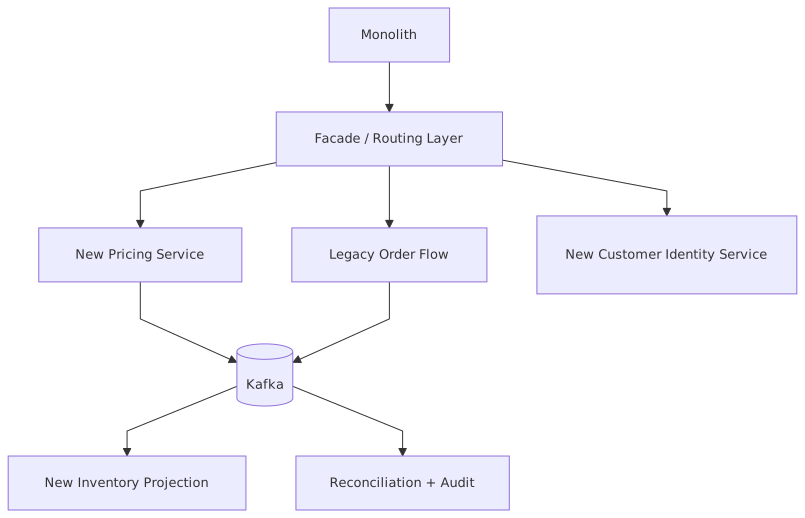
This pattern is powerful because it lets you migrate by business slice rather than by internal module. For example:
- Route customer login and profile updates to a new Identity Service.
- Keep order placement in the monolith, but consume identity events from the new service.
- Extract pricing calculation behind an API while the monolith remains system of record for orders.
- Introduce event publication from order lifecycle changes.
- Build inventory projections and later move stock reservation.
- Finally, carve out order management once upstream and downstream semantics are stable.
That is not glamorous. It is how serious migrations survive contact with quarter-end reporting.
Migrate data with intention
Data migration is where architecture plans usually discover who was lying.
A useful progression is:
- Encapsulate access in the monolith before extraction.
- Publish domain events from core state changes.
- Build replicated read models in new services.
- Shift writes for a narrow business capability.
- Backfill and validate data.
- Cut over ownership and retire legacy writes.
Dual writes should be treated like radioactive material: occasionally necessary, always dangerous. If you must use them, wrap them with outbox patterns, retry rules, idempotency, and operational visibility.
Reconciliation is the migration safety net
During migration, state will diverge. Assume it. Plan for it.
Examples:
- Orders accepted in the monolith but not projected downstream.
- Inventory reservations created twice due to replay.
- Customer profile updates arriving out of order.
- Payment status mismatches between ledger and transaction service.
Reconciliation mechanisms should compare authoritative sources, identify gaps, and either auto-correct or escalate. In many enterprises, reconciliation is what allows gradual decomposition without betting the company on every event pipeline.
Enterprise Example
Consider a global retailer with e-commerce, stores, and marketplace partners. The legacy platform is a Java monolith backed by a large relational database. It handles catalog, pricing, checkout, payment orchestration, inventory visibility, order management, returns, and customer service tooling. Traffic peaks heavily during promotions. Release cadence is slow. Every major change requires cross-team coordination.
The executive story says: “Move to microservices and Kafka.” The real story is more interesting.
What the team found
An initial call graph analysis showed:
- heavy coupling between checkout, pricing, promotion, and tax
- moderate but latency-sensitive interaction between checkout and payment authorization
- surprisingly tangled dependencies between order management and customer support tooling
- inventory logic spread across order allocation, warehouse feeds, and store pickup workflows
- reporting jobs directly querying core operational tables
A naïve graph clustering would have produced a giant Commerce service, a giant Inventory service, and a giant Support service. But domain analysis changed the picture.
Event storming revealed distinct bounded contexts:
- Pricing: price lists, markdowns, tax inclusion rules, campaign logic
- Order Management: order state, cancellation, split shipment, returns lifecycle
- Inventory Availability: available-to-promise, reservation, stock adjustments
- Payment Processing: authorization, capture, refund, fraud signal integration
- Customer Identity: account, login, consent, verification
- Customer Support Casework: service interactions and exception handling, not ownership of core order rules
This was the critical insight: customer support touched many flows, but semantically it did not own them. It needed read access and controlled interventions, not ownership of order state. Without domain semantics, support tooling would have become a service boundary by accident.
Migration sequence
The retailer adopted a progressive strangler strategy.
- Customer Identity was extracted first.
It had strong domain cohesion and relatively low operational coupling. This established event publication patterns and API gateway routing.
- Pricing was extracted next.
The team introduced a synchronous pricing API for checkout and published pricing change events to Kafka for downstream consumers. Caching was essential because promotion periods caused burst traffic.
- Operational read models were built.
Customer support and reporting were moved off direct operational table queries onto event-driven projections. This removed a large amount of hidden coupling.
- Inventory availability was introduced as a separate capability.
Initially it consumed monolith order events and warehouse feeds to maintain availability projections. Reservation remained in the monolith for a period, then moved once confidence grew.
- Order Management was split later, not first.
This is worth underlining. Many teams start with orders because it seems central. This retailer delayed it until upstream and downstream contexts had clean contracts.
Kafka’s role
Kafka was useful, but not magical.
It worked well for:
- propagating order lifecycle events
- distributing pricing updates
- feeding inventory and support projections
- audit and replay support
- decoupling warehouse and marketplace integrations
It was not used to replace every synchronous interaction. Checkout still required immediate responses for pricing and payment authorization. The team kept those synchronous, with local resilience patterns and strict latency budgets.
Reconciliation in practice
The retailer ran daily and intraday reconciliation for:
- order status across monolith and new order projections
- captured payments vs shipped orders
- inventory reservations vs fulfillment allocations
- returns state vs refund completion
These jobs were not signs of failure. They were part of the architecture. In real commerce, especially during migration, eventual consistency is tolerable only when paired with disciplined reconciliation.
The result was not architectural purity. It was better: independent releases for several capabilities, reduced blast radius, clearer ownership, and support/reporting decoupled from the core transaction path.
Operational Considerations
A service boundary that looks good on a slide can still collapse under production load.
Observability must expose boundary health
Track:
- request chains across services
- Kafka consumer lag
- event replay rates
- reconciliation discrepancies
- timeout and retry amplification
- high-cardinality business identifiers like order ID, payment ID, customer ID
Without business-aware tracing, teams can see latency but not business damage.
Idempotency is table stakes
In event-driven microservices, duplicates happen. Retries happen. Replays happen. If consumers are not idempotent, your architecture is one broker hiccup away from duplicate reservations or double notifications.
Backpressure matters
A service extracted from the monolith often discovers a new problem: demand variability. Pricing or inventory can become hot paths. Rate limits, caches, queues, and graceful degradation are part of the boundary design, not operational garnish.
Governance should focus on contracts, not committees
Enterprises love architecture review boards. They are often a tax on momentum. Better governance is lightweight but strict where it matters: EA governance checklist
- event naming and evolution rules
- service ownership
- source-of-truth declarations
- API compatibility policy
- data retention and privacy controls
Tradeoffs
There is no decomposition without compromise.
Larger services reduce coordination but limit autonomy
A broader Commerce service may be easier to reason about transactionally. It may also slow team independence and make scaling uneven.
Finer-grained services improve ownership but raise operational complexity
More services mean more contracts, more observability burden, more versioning concerns, more network failure modes.
Event-driven integration improves decoupling but increases temporal uncertainty
You gain resilience and loose coupling. You lose immediate certainty. The business must accept delay windows and occasional reconciliation.
Domain purity may conflict with migration practicality
A perfect bounded context split on paper may require impossible data surgery. Sometimes an interim service boundary is strategically impure but operationally survivable. That is acceptable if treated as a step, not a destination.
Failure Modes
Most service boundary programs fail in predictable ways.
1. Technical decomposition without domain meaning
Teams split by packages, tables, or frameworks and end up with services that nobody in the business can describe. These services become thin wrappers over old coupling.
2. Shared database after “extraction”
The API says microservices. The DBA says otherwise. Shared writes erase autonomy and create hidden breaking changes.
3. Chatty service mesh of doom
A request path that crosses pricing, promotions, tax, customer, loyalty, inventory, fraud, and shipping for every click is not elegant. It is fragile.
4. Event-driven wishful thinking
Events are introduced without ownership semantics, versioning discipline, or reconciliation. The result is asynchronous confusion.
5. Central orchestrator becomes the new monolith
All workflow logic migrates into one process coordinator. You removed the old monolith only to crown a new one.
6. Migration freezes under integration debt
Reporting jobs, batch interfaces, partner feeds, and compliance extracts are ignored in planning. Cutover arrives and the team discovers the old schema was the real platform.
When Not To Use
Microservices are not a moral improvement over a well-structured monolith.
Do not pursue service boundary discovery for microservices if:
- the domain is still rapidly changing and poorly understood
- your team cannot support distributed operations
- the system does not need independent scaling or release cadence
- transactional consistency across the proposed split is non-negotiable
- organizational ownership is unclear
- your current monolith is modular enough and not causing delivery pain
A modular monolith with explicit domain modules, clean interfaces, and disciplined ownership is often the better choice. In fact, it is frequently the best precursor to microservices. If you cannot define boundaries inside one process, you have no business defining them across a network.
Related Patterns
Several patterns work naturally with service boundary discovery.
Bounded Context
The primary DDD lens for semantic separation.
Strangler Fig
The migration pattern for progressive extraction and traffic redirection.
Anti-Corruption Layer
Useful when a new service must protect its model from legacy semantics.
Outbox Pattern
Critical when publishing domain events reliably from transactional updates.
Saga
Helpful for long-running business workflows, but dangerous if used to paper over bad boundaries.
CQRS and Read Models
Very effective for reducing cross-service read dependencies, especially in support and reporting.
Modular Monolith
Often the right staging architecture before full distribution.
Summary
Service boundary discovery is not an exercise in drawing boxes. It is the discipline of finding business seams that can bear the weight of distribution.
Call graph clustering diagrams are useful because they expose runtime affinity, dependency hubs, and latent coupling. But they are not enough. They must be interpreted through domain-driven design, consistency needs, data ownership, and migration practicality. The map is not the territory, and the call graph is certainly not the domain.
The best boundaries are where semantics, ownership, and operational reality line up closely enough to be survivable. Not perfect. Survivable.
If you remember one thing, let it be this: microservices are not discovered in the network; they are discovered in the business, then tested against the code. Use call graphs to challenge your assumptions, not replace them. Migrate progressively with the strangler pattern. Design reconciliation before you need it. Keep Kafka as a tool, not a religion. And when the right answer is a modular monolith, say so without embarrassment.
Because in enterprise architecture, the bravest move is sometimes not to split faster, but to split where the language gets clean.
Frequently Asked Questions
What is a service mesh?
A service mesh is an infrastructure layer managing service-to-service communication. It provides mutual TLS, load balancing, circuit breaking, retries, and observability without each service implementing these capabilities. Istio and Linkerd are common implementations.
How do you document microservices architecture for governance?
Use ArchiMate Application Cooperation diagrams for the service landscape, UML Component diagrams for internal structure, UML Sequence diagrams for key flows, and UML Deployment diagrams for Kubernetes topology. All views can coexist in Sparx EA with full traceability.
What is the difference between choreography and orchestration in microservices?
Choreography has services react to events independently — no central coordinator. Orchestration uses a central workflow engine that calls services in sequence. Choreography scales better but is harder to debug; orchestration is easier to reason about but creates a central coupling point.