⏱ 19 min read
There’s a particular kind of enterprise pain that doesn’t arrive with a bang. It creeps in quietly, disguised as progress.
A team splits a service because the deployment pipeline is too slow. Another adds a Kafka topic to decouple a call path that kept timing out. Platform engineering introduces a service mesh because observability is a mess. Six months later, the architecture diagram in Confluence is fiction, the runbook reads like archaeology, and nobody can say with confidence which service is still authoritative for customer status. The topology has drifted.
This is one of the least glamorous and most expensive problems in cloud microservices. Not because the individual changes are bad. Most of them are reasonable. Some are necessary. But over time, the shape of the system diverges from the domain model, from the intended operating model, and from the reality people believe they are running. The result is what I call topology drift: the slow mutation of service boundaries, runtime dependencies, event flows, ownership lines, and operational assumptions until the architecture becomes harder to change than the monolith it replaced.
And that’s the sting. Microservices were supposed to buy speed. Drift quietly taxes it away. microservices architecture diagrams
The remedy is not more diagrams. It is not a purity crusade around bounded contexts. And it is certainly not another platform layer sold as “governance.” The remedy is to treat topology as a first-class architectural concern, grounded in domain semantics, continuously reconciled against reality, and migrated deliberately when the system has already started to wander. EA governance checklist
This article lays out the problem, the forces that create it, a practical architecture for controlling it, and the migration strategy to get there without stopping the business. It includes the awkward bits too: reconciliation jobs, Kafka duplication, ownership arguments, and the unpleasant truth that some organizations should not use this approach at all. event-driven architecture patterns
Context
In a healthy distributed system, topology is not merely a network map. It is the living arrangement of domain responsibilities, communication paths, data ownership, and operational control. It answers questions that matter far more than “what calls what?”
- Which service is the system of record for an order’s fulfillment state?
- Which event stream expresses a business fact versus an integration convenience?
- Which teams are allowed to change a contract without cross-domain negotiation?
- Which dependencies are runtime critical, and which are merely asynchronous observers?
- Which read models are projections, and which have accidentally become shadow masters?
These are architecture questions, but they are also business questions. Domain-driven design matters here because topology drift is usually a symptom of semantic decay before it becomes technical decay. When boundaries stop reflecting the language of the business, the runtime graph starts compensating in ugly ways.
A customer profile service starts owning preferences, identity proofing, notification consent, and pricing segments. That looks efficient on a slide. In reality, it has become a junk drawer bounded context: technically centralized, semantically incoherent, politically impossible to change.
The cloud makes this easier to create. Provisioning is cheap. Event brokers are cheap. Managed databases are cheap. Spinning up another service to solve today’s pain is cheap. What is not cheap is preserving architectural intent under continuous delivery, team churn, acquisitions, compliance changes, and local optimization.
The old monolith had gravity. It resisted fragmentation. Cloud microservices have the opposite problem: they permit endless re-wiring, so systems evolve into whatever the last fifty urgent decisions happened to produce.
Problem
Topology drift is the divergence between intended architecture and actual architecture across four dimensions:
- Domain drift: service boundaries no longer align to business capabilities or bounded contexts.
- Dependency drift: runtime call chains and event subscriptions expand beyond the original design.
- Data drift: replicas, projections, caches, and local stores begin to act like independent sources of truth.
- Operational drift: ownership, SLO assumptions, failure handling, and deployment dependencies no longer match reality.
People usually notice drift through symptoms, not causes.
A supposedly independent service cannot deploy because five other teams must validate contract changes. A Kafka topic has thirty consumers, half undocumented, so changing event structure becomes a political exercise. Incident responders discover that a “non-critical” recommendation service is synchronously called on the checkout path through a sidecar adapter nobody remembers adding. A compliance request for data deletion turns into a forensic hunt across operational stores, search indexes, lakehouse copies, and event replay archives.
That is topology drift in the wild.
The worst version appears when architecture diagrams become ceremonial. The system in production is one thing. The model in architecture governance is another. The shared understanding in teams is a third. Once those diverge, every migration gets more expensive because nobody trusts the map. ArchiMate for governance
Forces
Several forces push systems toward drift, and they often pull in opposite directions.
Team autonomy versus semantic cohesion
Autonomous teams need freedom to deliver. That often translates into local databases, local topics, local APIs, and local decisions. Good. But autonomy without domain discipline creates accidental ownership. A team that merely needed a copy of shipment status for a dashboard gradually becomes the de facto authority because everyone else starts consuming their enriched model.
The lesson is simple: local convenience hardens into enterprise truth faster than anybody expects.
Runtime resilience versus dependency sprawl
Synchronous APIs are easy to reason about at first and miserable under load. So teams introduce Kafka, queues, CDC pipelines, and materialized views. Again, reasonable. Yet every decoupling move adds new paths for data propagation and more places for business state to become stale, transformed, or semantically distorted.
Resilience gained at the transport layer can be lost at the business meaning layer.
Speed of change versus architectural visibility
Cloud-native delivery rewards small changes. But topology changes are often implicit side effects of those small changes. A new consumer group here, a sidecar policy there, an emergency retry topic over the weekend. The deployment is visible. The architectural consequence is not.
Platform standardization versus domain reality
Platform teams want consistency: one ingress pattern, one event envelope, one policy engine, one observability stack. Also reasonable. But when infrastructure patterns are allowed to dictate domain boundaries, services begin to form around delivery mechanics instead of business capabilities. That is architecture upside down.
Mergers, regulation, and product expansion
Enterprise systems rarely enjoy the luxury of clean-sheet design. Acquisitions bring overlapping domains. Regulation introduces retention and consent rules. New channels require customer, pricing, and order semantics to evolve. Existing topologies absorb these pressures unevenly, and drift accelerates where ownership is weakest.
Solution
The answer is not to freeze topology. That would be absurd. The answer is to make topology explicit, observable, and reconcilable.
I recommend a topology control approach built on five ideas:
- Model topology through domain semantics first.
- Separate authoritative flows from derivative flows.
- Use reconciliation as a normal design tool, not an embarrassing afterthought.
- Continuously compare declared topology against discovered runtime topology.
- Migrate with a progressive strangler strategy, because drift is already in production before anybody budgets to fix it.
The key architectural move is this: stop treating all connections as equal. In enterprise microservices, some links express core business authority, others are convenience integration. If your diagrams do not distinguish them, your runtime eventually won’t either.
A customer service publishing CustomerRegistered is different from an analytics consumer deriving engagement scores. An order service calling inventory reservation synchronously on the booking path is different from marketing subscribing to order completion asynchronously. Those distinctions need to show up in contracts, SLOs, ownership, and dependency policy.
That requires DDD thinking. Bounded contexts are not an ivory-tower artifact here; they are how you decide what should be coupled and what should merely react. The model gives you a test: if two services share vocabulary but not invariants, event integration may be appropriate. If they share invariants, you probably have a split boundary or a missing aggregate design. Drift often enters where this distinction is ignored.
A reference view
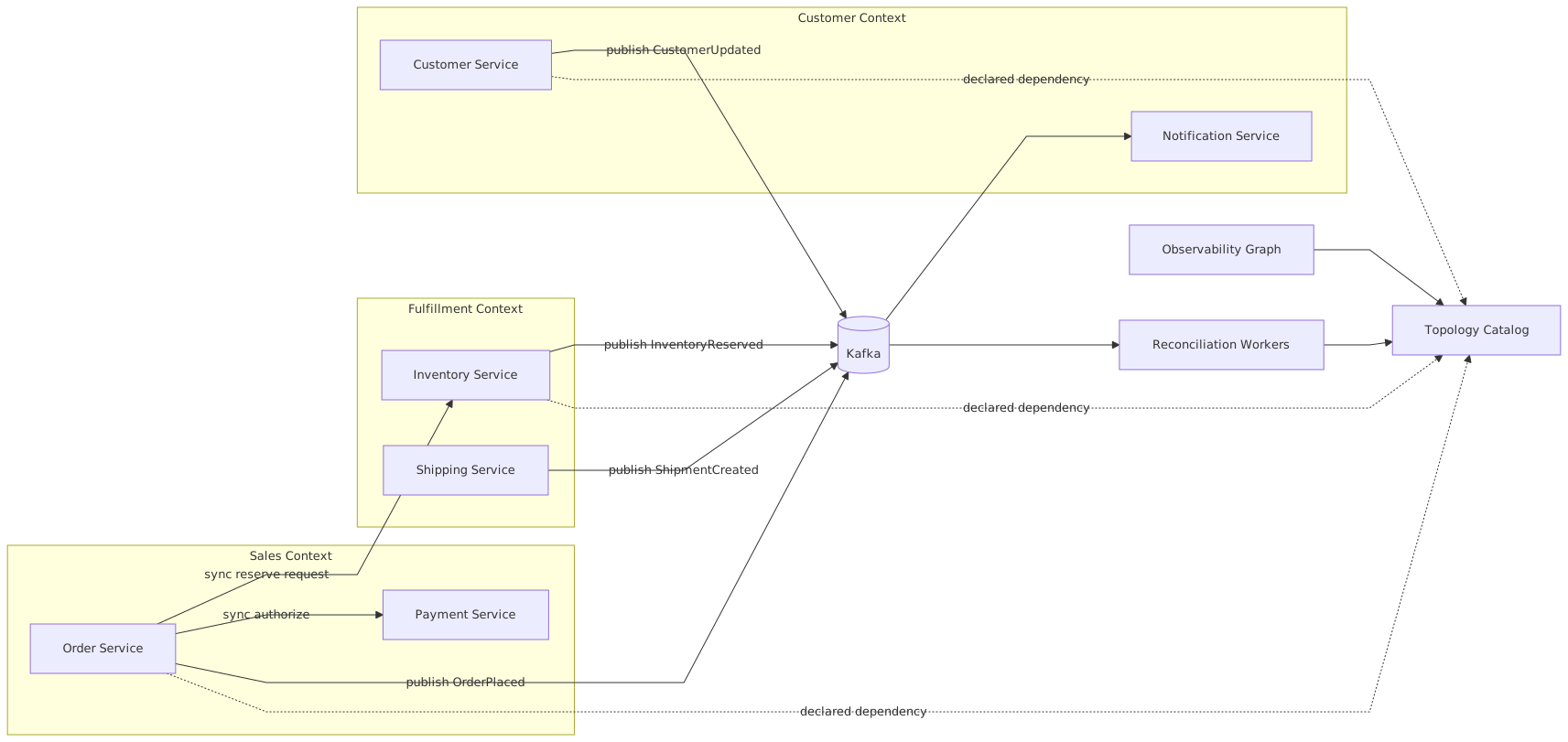
In this model, the topology catalog is not a vanity CMDB. It is a live architectural registry containing declared ownership, bounded context mapping, contract metadata, authoritative data designation, and expected dependency type. Observability and reconciliation feed it. The point is not bureaucracy. The point is to know when reality has diverged from intent before the divergence becomes a governance crisis.
Architecture
A practical topology drift architecture has four layers.
1. Domain topology model
Start with bounded contexts, aggregates, and authoritative business facts. This is where domain semantics lead.
For each service or stream, record:
- bounded context
- owning team
- authoritative entities and fields
- upstream dependencies
- dependency type: synchronous command/query, event subscription, replication, cache fill, batch import
- criticality and SLO relationship
- data retention and compliance obligations
- reconciliation owner
This sounds pedestrian, and that is exactly why architects avoid it. They prefer elegant principles. Enterprises need ledgers of responsibility.
One useful distinction is between:
- source-of-truth services
- projection services
- process/orchestration services
- experience composition services
- integration adapters
A great many pathologies come from projection or adapter services being mistaken for authoritative domain services.
2. Runtime topology discovery
You need evidence. Service mesh telemetry, API gateway logs, Kafka consumer groups, schema registry usage, OpenTelemetry traces, and data pipeline lineage should all contribute to a discovered dependency graph.
This is where many firms stop. They build a beautiful dependency map. Useful, but incomplete. Discovery tells you what exists, not whether it is acceptable.
3. Drift detection and policy
Now compare declared topology and discovered topology.
Typical drift rules include:
- undeclared synchronous dependency on a critical path
- new event consumer attached to a regulated topic without ownership registration
- projection store queried by external services as if it were authoritative
- bounded context crossing through shared database access
- emergency retry topics that have become permanent business flows
- a service with more inbound dependencies than its domain role justifies
- event fields consumed as commands in disguise
This is where architecture becomes operational, not ceremonial.
4. Reconciliation plane
Reconciliation deserves a place in the architecture, not hidden in utility jobs. Distributed systems lie by default. Events arrive late. Consumers fail. schemas evolve. Snapshots lag. Human operators replay streams twice at 2 a.m. Reconciliation is how you restore semantic truth after transport-level imperfections.
A robust design includes:
- replayable event logs where possible
- periodic state comparison between authoritative service and projections
- compensating workflows for missing or duplicated effects
- idempotency keys and dedupe stores
- semantic conflict rules, not just record-level checksum comparisons
The idea is not to guarantee perfect consistency. It is to guarantee recoverable correctness.
Drift control loop
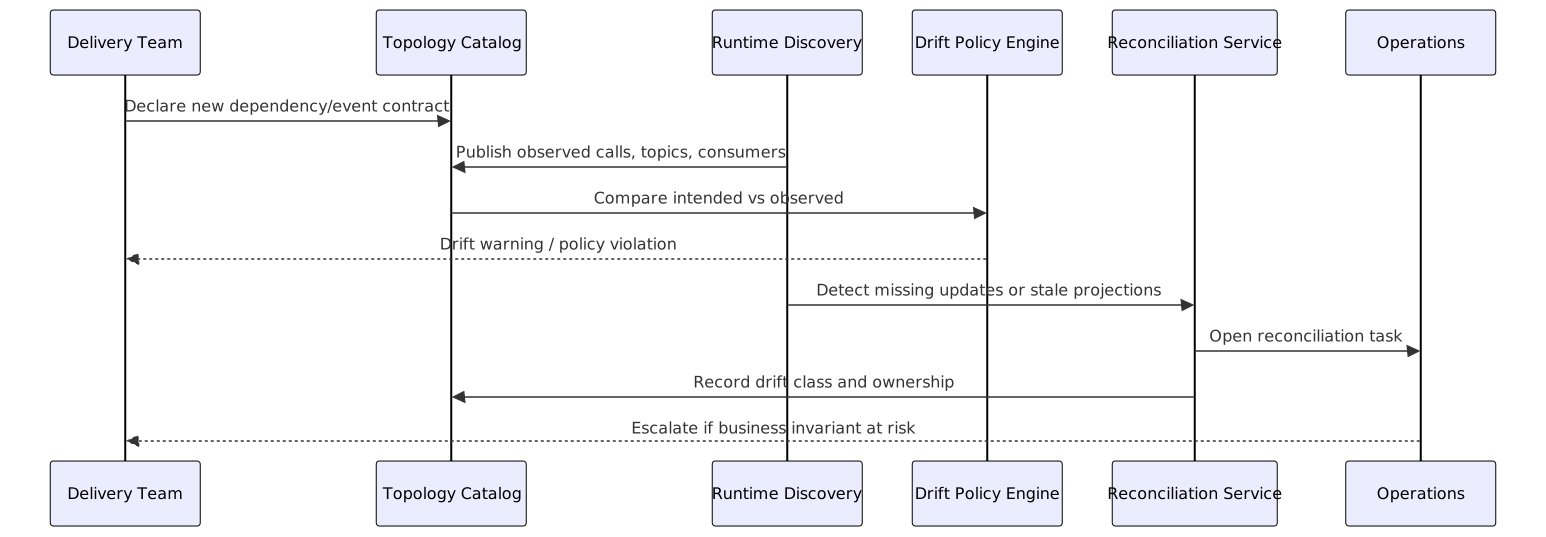
This loop matters because drift is not a design-time problem. It is a continuous one.
Migration Strategy
Most enterprises asking about topology drift already have it. So the migration question is not “how do we design a perfect target state?” It is “how do we recover control while the business keeps shipping?”
This is why the progressive strangler pattern is the right move.
Step 1: Identify semantic fault lines
Do not start with service count or call graphs. Start with places where domain meaning has become ambiguous.
Look for:
- two or more services claiming the same business status
- read models being updated manually
- Kafka events that mix multiple bounded contexts
- APIs exposing another service’s internal lifecycle
- integration layers holding domain rules
- “shared” services with suspiciously broad names like profile, master-data, orchestration, core
These are the fractures that matter.
Step 2: Classify dependencies
For each critical domain flow, separate:
- invariants requiring tight consistency
- eventual consistency that is acceptable
- operational dependencies that can tolerate stale data
- reporting or analytical consumers that should never shape operational contracts
This often reveals where asynchronous messaging is helping and where it is merely hiding poor boundary choices.
Step 3: Introduce a topology catalog and discovery feed
Don’t boil the ocean. Register the top twenty business-critical services and Kafka topics first. The first win is visibility around critical path truth, not enterprise completeness.
Step 4: Establish authoritative ownership
You need explicit declarations such as:
- Order Service owns order lifecycle state.
- Inventory Service owns allocatable stock.
- Customer Service owns legal identity attributes.
- Fulfillment projections may cache order details but cannot become order truth.
- CRM adapters can enrich but not overwrite customer legal identity.
If that sounds political, good. Architecture in enterprises is political because ownership is power.
Step 5: Strangle one drifted path at a time
A typical pattern is to put an anti-corruption or mediation layer in front of a drifted service while gradually redirecting consumers to the newly clarified boundary. Sometimes this means publishing cleaner domain events alongside old integration events, then retiring the latter after consumers move.
Step 6: Add reconciliation before full cutover
This is the part teams skip because it delays the heroic launch. Then they spend the next year explaining data mismatches. Reconciliation must exist before you switch authority or duplicate event publication. During migration, both old and new topologies will be active. Drift gets worse before it gets better unless you deliberately monitor and repair divergence.
Progressive strangler view
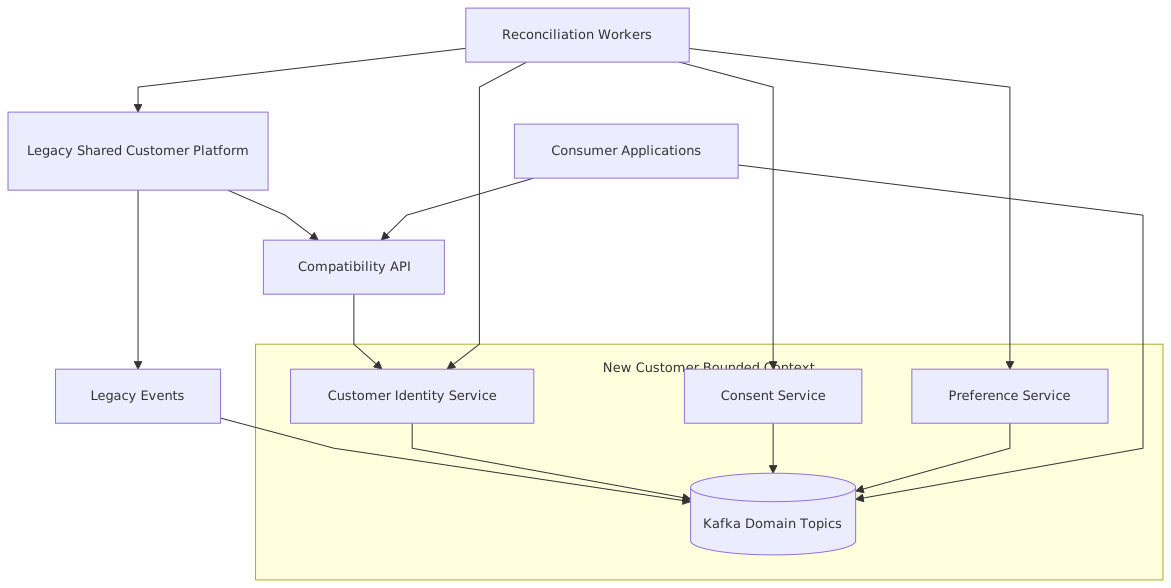
This is progressive strangling in practice: preserve business continuity, narrow old ingress paths, publish cleaner domain-aligned contracts, and use reconciliation to keep the old and new worlds coherent while traffic shifts.
Enterprise Example
Consider a multinational retailer modernizing order-to-fulfillment across e-commerce, stores, and marketplace partners.
They began with what looked like a sensible microservices estate: order, customer, payment, inventory, shipping, promotions, notifications, and a Kafka backbone. After three years, the architecture had drifted badly.
The order service emitted OrderUpdated for almost everything. Inventory subscribed and derived reservation state. Shipping subscribed and inferred pack readiness. Customer care built a case-management view by subscribing to order and shipment events, then exposed an API that downstream teams started calling because it had the “most complete” order summary. Promotions consumed checkout activity and began storing customer eligibility snapshots that the website later queried directly during peak events to avoid latency. None of this was insane. All of it was understandable.
The problems surfaced at Christmas.
A spike in checkout load caused delayed event processing in Kafka consumers. The website showed orders as confirmed before inventory reservations settled. Customer care displayed shipment statuses derived from stale projections. Marketplace feeds replayed duplicate events after a consumer group rebalance, causing duplicate shipment notifications. Meanwhile, legal requested deletion verification for customer consent data, only to discover consent attributes had been copied into three operational stores and two analytics pipelines.
The company did not have a coding problem. It had a topology truth problem.
The recovery started with domain semantics, not middleware tuning. Architects and domain leads re-mapped bounded contexts:
- Order Management owned commercial order lifecycle.
- Inventory Allocation owned reservation and stock commitment.
- Fulfillment Execution owned pick-pack-ship progression.
- Customer Identity owned legal customer identity.
- Customer Consent became its own bounded context, not a field set in customer profile.
- Customer Care View was explicitly designated a projection, never authoritative.
That one distinction—projection versus authority—changed everything.
They created a topology catalog for only the critical flows first: checkout, reservation, shipment creation, consent update, and customer deletion. Kafka topics were classified as domain events, integration events, or transitional migration events. The policy engine flagged direct reads from customer care projection stores. New APIs were introduced for canonical order and consent queries. The old broad OrderUpdated event was strangled into narrower domain events such as OrderPlaced, OrderCancelled, ReservationConfirmed, and ShipmentDispatched.
A reconciliation service compared order state, inventory reservation state, and fulfillment milestones every fifteen minutes for in-flight orders. It generated compensating workflows for mismatches and exposed drift metrics by bounded context. This was not elegant. It was effective.
Within two quarters, incident volume on order visibility dropped materially. More importantly, change conversations improved. Teams could now say, with precision, what was authoritative, what was projected, and what was transitional. That is architecture earning its keep.
Operational Considerations
If topology drift is a runtime problem, operations cannot be an afterthought.
Observability must understand semantics
Traces and metrics are necessary but not sufficient. You need dashboards that show:
- critical business flows by bounded context
- lag on Kafka consumers for authoritative versus derivative topics
- projection freshness windows
- reconciliation backlog and mismatch rates
- undeclared dependencies discovered this week
- contract change blast radius
A red CPU graph does not tell you whether customer consent is semantically stale. The business cares about stale truth, not just slow pods.
Contract governance for Kafka matters
Kafka is wonderful at decoupling and equally wonderful at letting architectural entropy scale horizontally. Use schema registry. Version intentionally. Distinguish domain events from integration wrappers. Track who consumes which fields, not just which topics. Most event contract disasters begin with field-level semantic coupling nobody documented.
Reconciliation needs ownership and budget
Reconciliation jobs are often treated like janitorial work. That is a mistake. They protect trust in distributed state. Staff them properly. Give them productized observability. A mature enterprise will know its reconciliation SLOs the same way it knows API latency SLOs.
Security and compliance affect topology shape
Data minimization, residency, retention, and deletion requirements all influence whether a projection is permissible, how long an event log can retain payloads, and whether derived stores can hold regulated fields. Drift frequently bypasses these controls because convenience stores and side topics appear outside formal review.
Topology change should enter delivery pipelines
If a service introduces a new external synchronous dependency or subscribes to a regulated topic, that should trigger a topology review automatically. Not a committee meeting. A pipeline check with policy exceptions when justified.
Tradeoffs
This approach has costs.
First, it adds architectural metadata and governance. If you implement it with heavyweight process, teams will route around it. The catalog must be lightweight, API-driven, and integrated into delivery tooling.
Second, reconciliation adds operational complexity. There are more jobs, more storage concerns, more alerts, more “why is this item mismatched?” moments. But pretending eventual consistency doesn’t need repair is cheaper only on PowerPoint.
Third, domain-driven topology discipline can expose organizational flaws. Teams may resist losing accidental ownership. Shared service groups may dislike being reclassified as adapters or projections. Architects need backbone here.
Fourth, too much drift policy can create false positives and review fatigue. Focus on business-critical paths and regulated data first. Nobody needs a constitutional crisis over an internal metrics consumer.
The deeper tradeoff is this: you are exchanging local freedom for global clarity. In large enterprises, that is usually a good deal. In small product teams, maybe not.
Failure Modes
Several things can go wrong even with good intentions.
Catalog becomes shelfware
If the topology catalog is manually maintained and disconnected from telemetry, it dies. Fast. People stop trusting it, and drift governance becomes theater.
Reconciliation becomes permanent architecture glue
Sometimes reconciliation hides a boundary mistake that should be redesigned. If two domains require constant repair to stay coherent, you may have split a model that should not have been split.
Kafka turns every problem into an event problem
Teams often respond to drift by publishing more events. That can make things worse. Event streams should express business facts, not compensate for unclear ownership.
Projection stores become shadow masters again
Even after reclassification, teams under delivery pressure will read the fastest convenient store. If the platform does not make authoritative access easy enough, shadow truth returns.
Strangler migrations stall in the middle
The enterprise tolerates dual paths longer than planned. Transitional topics become permanent. Compatibility APIs become the new monolith. This is common. Put retirement dates and executive accountability on migration phases.
When Not To Use
There are situations where a full topology drift control architecture is overkill.
Do not use this approach for a small system with a handful of services, one team, and low regulatory burden. A simple context map and basic tracing are enough.
Do not use it if your real problem is that the domain should still be a modular monolith. Many organizations split too early. If your invariants are dense and your team topology is simple, reining in a monolith may be far easier than governing twenty services.
Do not start here if you lack basic engineering hygiene: no tracing, no schema control, no ownership model, no incident discipline. Topology governance cannot rescue undisciplined delivery.
And do not confuse this with a call to centralize all decision-making in enterprise architecture. That would simply create a different kind of drift: official diagrams that lag reality by six months.
Related Patterns
Several related patterns support this approach.
- Bounded Contexts from domain-driven design provide the semantic basis for topology.
- Context Mapping helps identify upstream/downstream relationships and anti-corruption needs.
- Strangler Fig Pattern supports progressive migration from drifted or legacy boundaries.
- Anti-Corruption Layer protects a new domain model from old semantics.
- Event Sourcing can help with replay and reconciliation, though it is not required.
- CQRS is useful when separating authoritative write models from read projections, but it often gets abused; use it where read/write semantics truly differ.
- Outbox Pattern improves event publication reliability from authoritative services.
- Saga or Process Manager helps coordinate long-running business processes, though overusing orchestration can itself create topology concentration and drift.
One strong opinion here: not every distributed workflow needs a saga. Some just need clearer ownership and better reconciliation.
Summary
Topology drift is what happens when microservices keep changing but architecture stops keeping score.
It is not just dependency sprawl. It is semantic erosion across service boundaries, event contracts, data ownership, and operational assumptions. The visible symptoms are outages, stale views, painful migrations, and governance arguments. The root cause is usually deeper: the topology no longer reflects the domain, and nobody has a reliable mechanism to reconcile intended design with runtime reality.
The way out is practical, not mystical.
Model service boundaries using domain-driven design. Distinguish authority from projection. Classify dependencies by business meaning, not transport. Discover runtime topology continuously. Detect drift through policy tied to business-critical paths. Treat reconciliation as a core architectural capability. And migrate using a progressive strangler strategy, because real enterprises must fix systems while those systems are still making money.
A good architecture diagram is not a portrait. It is a contract with reality.
When that contract breaks, drift wins. When you restore it—through semantics, visibility, and disciplined migration—microservices become changeable again. And in enterprise architecture, changeability is the only victory that lasts.
Frequently Asked Questions
What is a service mesh?
A service mesh is an infrastructure layer managing service-to-service communication. It provides mutual TLS, load balancing, circuit breaking, retries, and observability without each service implementing these capabilities. Istio and Linkerd are common implementations.
How do you document microservices architecture for governance?
Use ArchiMate Application Cooperation diagrams for the service landscape, UML Component diagrams for internal structure, UML Sequence diagrams for key flows, and UML Deployment diagrams for Kubernetes topology. All views can coexist in Sparx EA with full traceability.
What is the difference between choreography and orchestration in microservices?
Choreography has services react to events independently — no central coordinator. Orchestration uses a central workflow engine that calls services in sequence. Choreography scales better but is harder to debug; orchestration is easier to reason about but creates a central coupling point.