⏱ 21 min read
There is a particular kind of enterprise pain that never shows up in vendor brochures.
It starts innocently. A mobile app needs customer profile data, order history, loyalty points, shipment tracking, recommendations, and maybe one suspiciously “small” compliance flag. None of these live together. They are scattered across a CRM, a commerce platform, an order service, a warehouse system, a recommendation engine, and whatever survived the last acquisition. The frontend team asks for “just one API” because the alternative is a chatty mess of calls over unreliable networks. The backend teams respond with a familiar shrug: the data exists, but not in one place, not with one meaning, and certainly not with one owner.
This is where API aggregation at the edge enters the story.
Done well, edge aggregation is not a fancy reverse proxy trick. It is a deliberate architectural move: pull composition closer to the consumer, reduce network chatter, protect domain boundaries, and create a seam for migration. Done badly, it becomes a distributed ball of mud with prettier YAML.
The difference is whether you treat aggregation as a domain concern or just a plumbing concern.
That distinction matters. A lot.
In modern edge architecture, the edge is no longer just where traffic terminates. It is where identity gets checked, rate limits get enforced, versions get negotiated, channels get adapted, and increasingly, where data from multiple downstream services is composed into a client-shaped response. This is especially attractive in mobile, partner APIs, omnichannel commerce, and B2B platforms where latency and experience matter more than backend purity.
But there is a trap here. Aggregating APIs at the edge can either simplify the enterprise or conceal deeper fragmentation. It can give consumers a coherent experience while preserving bounded contexts underneath. Or it can become a secret monolith that quietly centralizes business logic without owning the business meaning.
This article takes the opinionated view: edge aggregation is powerful when it is thin in policy, explicit in semantics, and honest about tradeoffs. It is not a universal answer. It is not your domain model. And it is not an excuse to avoid fixing your service landscape.
Context
Most large enterprises arrive at edge aggregation by accident before they adopt it by design.
They start with channels: web, mobile, partner integrations, store systems, internal portals. Each channel needs a different view of the business. The mobile app wants a compact customer snapshot. The web experience wants richer product information. Partners need stable contract-driven APIs and can tolerate some delay. Internal staff may need deeply operational detail.
Meanwhile, the backend estate evolves independently. Domain-driven design encourages bounded contexts, and rightly so. Customer, Order, Inventory, Pricing, Loyalty, Billing, and Fulfillment each have their own models, language, cadence, and storage. If those teams are healthy, they protect their autonomy. If they are unhealthy, they protect their silos. To the client, both look the same: too many calls, inconsistent shapes, and ambiguous semantics.
So architects create an edge layer: API gateway, backend-for-frontend, GraphQL federation layer, or custom aggregation service. Sometimes all of them, because enterprise architecture enjoys redundancy disguised as strategy.
The edge now becomes the first coherent face of the platform. It mediates between consumer intent and domain reality.
That phrase matters: consumer intent and domain reality. The consumer asks for “customer dashboard.” The enterprise does not have a “customer dashboard” domain. It has a customer account, active orders, reward points ledger, open invoices, shipment events, product affinities, and fraud indicators. Aggregation exists to map intent to the right set of domain capabilities without making the client understand the internal estate.
This is why edge aggregation is deeply tied to domain semantics. If you aggregate without respecting bounded contexts, you will eventually create a fake master model that nobody can maintain. If you aggregate with clear semantic translation, you can preserve service autonomy while presenting an experience-oriented contract.
That is the sweet spot.
Problem
The problem edge aggregation solves is not merely “too many API calls.” That is the symptom. The deeper problems are these:
- Client chattiness over high-latency networks
Mobile and global consumer channels suffer when one page load requires ten sequential calls.
- Mismatched API granularity
Domain services are shaped around business capabilities, not screens or partner workflows.
- Inconsistent contracts across domains
Different services expose different conventions, identifiers, pagination styles, timestamps, and error models.
- Coupling channels directly to internal topology
Clients should not know that “shipment ETA” comes from one service and “shipment exceptions” from another.
- Migration complexity
Enterprises replacing legacy systems need a façade that can route some fields to old systems and others to new services.
- Cross-domain composition
Useful experiences often span multiple bounded contexts, but no single domain should absorb all that logic.
A customer app is a good example. “Show me my account home” sounds like one thing. It is not one thing. It is an orchestration problem across identity, customer profile, subscriptions, orders, billing, notifications, maybe even marketing preferences. If every client assembles that itself, you duplicate logic and push domain confusion outward. If a central backend assembles all of it without care, you build another monolith.
Edge aggregation is the middle path.
Forces
Architecture is mostly the art of choosing which problem you want to have.
Edge aggregation lives in tension among several competing forces.
User experience vs domain purity
Consumers want one fast response. Domain services want to expose focused capabilities. If you optimize only for frontend simplicity, you often end up leaking business logic into the edge. If you optimize only for backend purity, clients become orchestration engines. Neither is acceptable at scale.
Latency vs freshness
Aggregated responses often require data from multiple systems with different response times and consistency models. The fastest design is usually cached and slightly stale. The freshest design is often slower and more fragile.
Reuse vs channel specificity
A single generic aggregation layer sounds efficient. In practice, channels differ. Mobile, web, partner, and internal workflows have different needs. Over-generalize and you build a bloated abstraction. Over-specialize and you duplicate composition logic everywhere.
Governance vs team autonomy
Security, observability, quotas, schema governance, and traffic policy are sensible edge concerns. But as soon as the edge team starts owning business decisions for every domain, autonomy collapses. EA governance checklist
Migration speed vs architectural cleanliness
During a legacy modernization, edge aggregation is often the fastest way to hide backend complexity. It can also become permanent camouflage for unresolved core problems.
Event-driven truth vs request-time assembly
In a Kafka-heavy landscape, some views are better built asynchronously into read models rather than composed synchronously at request time. Architects who ignore this end up paying for latency, retries, and partial failures on every user interaction.
In other words: edge aggregation is attractive precisely because it sits where all the messy tradeoffs converge.
Solution
The basic solution is straightforward: place an aggregation capability at the edge that exposes consumer-oriented APIs and composes responses from multiple downstream services or read models.
The implementation details vary:
- API Gateway with aggregation plugins
- Backend-for-Frontend (BFF)
- GraphQL gateway or federated graph
- Custom edge composition service
- API composition plus event-driven materialized views
But the architectural move is the same: separate external experience contracts from internal service boundaries.
The crucial design principle is this:
Aggregate data, not ownership.
The edge may assemble a “Customer Overview” response from customer, order, loyalty, and shipment services. It should not become the owner of customer, order, loyalty, or shipment rules. It may translate, filter, normalize, and compose. It should be very careful before deciding.
A good edge aggregation design typically includes:
- consumer-oriented contracts
- explicit mapping to bounded contexts
- orchestration of downstream calls
- partial response handling
- caching where semantics allow
- resilience controls like timeouts, circuit breakers, and bulkheads
- observability with correlation IDs and distributed tracing
- clear versioning and deprecation strategy
It often also includes a reconciliation story. Why? Because some aggregated data is built from asynchronous sources, and some is fetched live. There will be moments when “customer points” and “customer recent purchase” disagree by a few seconds or a few minutes. Mature systems do not pretend this cannot happen. They define freshness expectations, confidence levels, and corrective workflows.
That is architecture behaving like an adult.
Architecture
The most common shape is edge API -> aggregation layer -> domain services and read models.
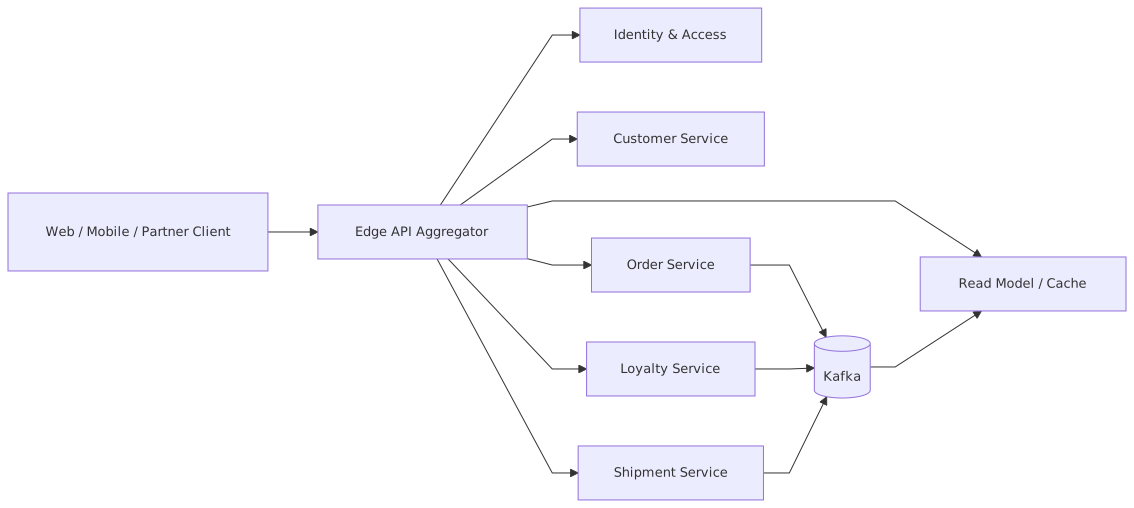
This looks simple, which is dangerous, because simple diagrams often hide expensive behavior.
The edge aggregator can fetch profile details live, retrieve recent orders from an order service, and query a materialized read model for shipment summaries built from Kafka events. That combination is often superior to calling every source synchronously. Some data deserves request-time freshness. Some data deserves precomputation. event-driven architecture patterns
Domain semantics at the edge
This is the part many teams skip, and then regret.
Suppose the client asks for customerStatus. That sounds harmless. But what does it mean?
- CRM may define status as account lifecycle: Prospect, Active, Suspended.
- Billing may define status as payment standing: Current, Delinquent.
- Loyalty may define status as tier: Silver, Gold, Platinum.
- Fraud may define status as risk band.
If the edge API simply exposes status, it has created ambiguity. Ambiguity is technical debt in business clothing.
A better design is explicit:
accountLifecycleStatuspaymentStandingloyaltyTierriskIndicator
Or, if the consumer truly needs one summary field, the edge contract must define its semantics clearly and document the derivation. That derivation is not trivial. It is business meaning. If it grows complicated, it probably belongs in a domain or policy service, not ad hoc in the gateway.
This is where domain-driven design earns its keep. The edge should speak a published language suitable for consumers, but it must remain anchored to bounded contexts. The customer overview is a composition of domain facts, not a new all-knowing domain.
BFF versus shared aggregator
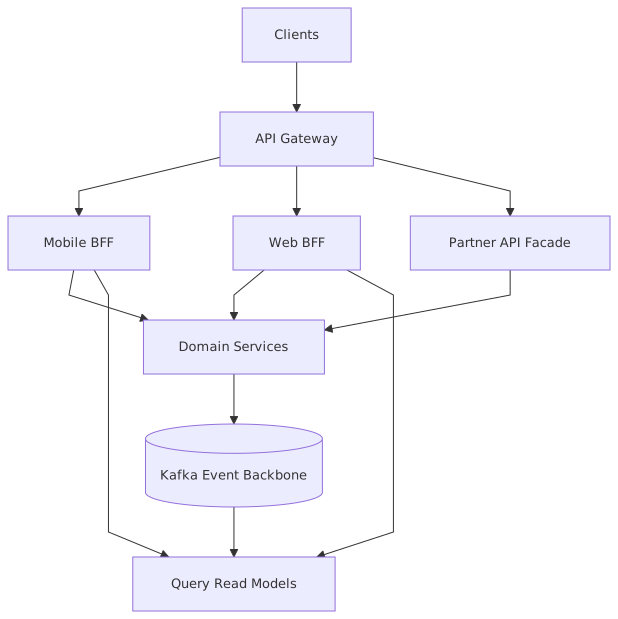
I lean toward BFFs when channels differ materially in needs. Mobile optimization is not the same as partner API design. Internal portal needs are different again. Shared edge capabilities for auth, routing, quotas, logging, and common transformations make sense. Shared business composition often does not. API architecture lessons
A useful split is:
- Gateway layer: cross-cutting concerns
- Channel-specific aggregation/BFF layer: experience shaping
- Domain services/read models: business capabilities and truth
That keeps the edge from turning into a committee.
Synchronous aggregation and asynchronous enrichment
Not all aggregation should happen at request time.
If a homepage needs:
- customer name
- account balance
- last three orders
- current shipments
- loyalty points
Then perhaps:
- customer name and balance are live
- last three orders are live
- shipment summary comes from a read model updated from events
- loyalty points come from a cached ledger projection refreshed every few seconds
This mixed strategy is usually better than ideological purity. Enterprises do not need perfect elegance. They need systems that survive traffic spikes, partial outages, and regulatory audits.
Reconciliation
Reconciliation is what separates production architecture from conference slides.
When you aggregate from both synchronous and asynchronous sources, mismatches happen:
- order service says order confirmed
- shipment read model has not yet caught up
- loyalty points projection lags by one event
- profile update is accepted, but old cache still serves previous preference
You need a reconciliation approach:
- define freshness windows
- expose timestamps like
asOf - tag partial or delayed sections
- replay events into read models when corruption is detected
- run periodic data consistency checks between source services and projections
- provide support tooling for correction
If you cannot explain how the system reconciles disagreement, you do not have an architecture. You have a hope.
Migration Strategy
This is where edge aggregation becomes genuinely useful.
In a progressive strangler migration, the edge provides a stable contract while the backend estate changes behind it. Clients keep calling /customer-overview. Underneath, one field may still come from a mainframe adapter, another from a newly extracted customer microservice, and a third from a Kafka-fed read model.
The edge becomes the migration seam.
Progressive strangler approach
- Freeze the consumer contract
Define the external API the channel needs.
- Map fields to current systems
Some fields will come from legacy systems, some from newer services.
- Introduce aggregation at the edge
Clients shift to the new façade.
- Replace backend sources incrementally
Route selected portions to new services as they become available.
- Measure semantic equivalence
Compare legacy and new outputs before cutover.
- Retire adapters gradually
Once confidence is high, remove the legacy path.
This is classic strangler fig thinking, but with a practical twist: the edge can combine old and new in one response. That reduces migration coordination and protects channels from backend churn.
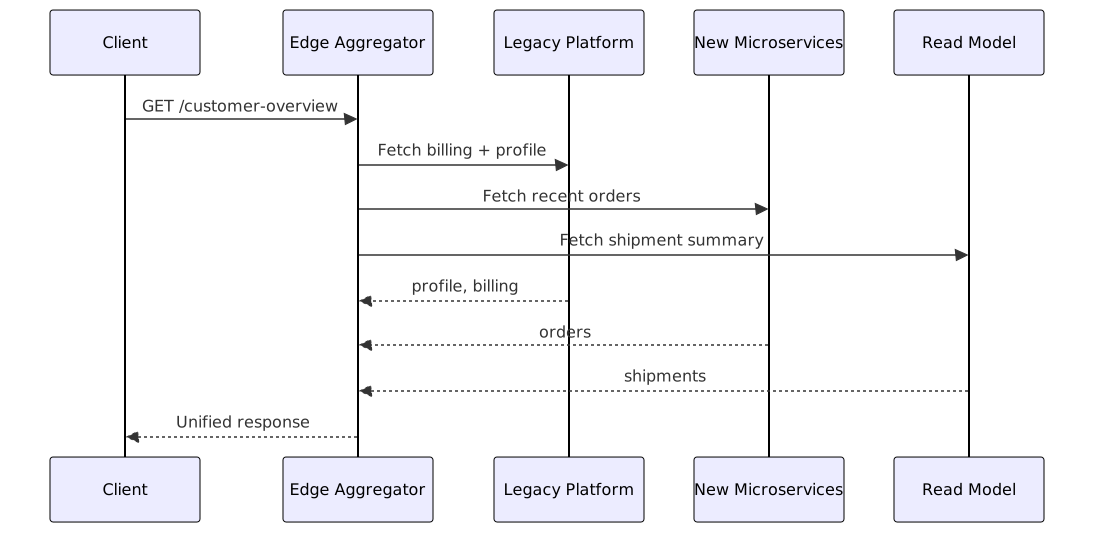
Migration reasoning
This pattern is especially helpful when the old estate is organized around systems and the new estate around domains.
Legacy systems often expose coarse and awkward service boundaries: “customer account inquiry” may include billing fragments, profile details, communication preferences, and obsolete flags nobody understands. In the new world, those concerns should be separated into bounded contexts. The edge lets you decouple client needs from that migration path.
But be careful. The edge should not become a permanent compatibility museum. Every field routed through old and new worlds should have a retirement plan. Otherwise, migration stalls, and the façade becomes the only place where the business still understands itself.
Semantic comparison during cutover
One practical technique is shadow reads:
- edge calls both legacy and new source for a field or subdocument
- returns one source to the client
- logs or analyzes divergence between old and new
- cuts over only when divergence falls within acceptable tolerances
This is especially useful for billing, entitlements, pricing, and loyalty balances where tiny differences can become large incidents.
Enterprise Example
Consider a global retailer with ecommerce, stores, marketplace partners, and a loyalty program. The company has:
- SAP for core customer and billing records
- a commerce platform for product and cart
- microservices for order management and inventory
- a Kafka event backbone for order, shipment, and loyalty events
- separate mobile and web channels
- partner APIs for delivery providers and marketplace sellers
The mobile app needs a “My Account” page with:
- profile summary
- loyalty tier and points
- open orders
- package status
- saved payment methods
- promotion eligibility
Originally, the app made 11 backend calls. Average page render in poor network conditions was awful. Worse, different channels implemented slightly different business rules for “active order” and “eligible promotion.”
The architecture team introduced:
- a shared API gateway
- a mobile BFF
- event-driven read models for shipment and loyalty summaries
- a strangler plan to pull profile and payment methods away from SAP-backed services over time
The mobile BFF exposed one account endpoint. It composed:
- profile and payment methods from a legacy adapter initially
- orders from the order service
- shipment status from a Kafka-fed projection
- loyalty summary from a dedicated read model
- promotion eligibility from a policy service
Performance improved because the app made one edge call, not 11. Backend resilience improved because not every section was fetched live. Semantics improved because “open order” and “promotion eligibility” were defined in one place for that channel.
But there were hard lessons too.
First, the team initially put too much logic into the BFF. Promotion rules, fallback shipment logic, and loyalty exception handling all accumulated there. Release cadence slowed. Domain teams began depending on the BFF to “fix things.” That was a warning sign. The architects pulled promotion logic into a dedicated policy service and pushed loyalty exception handling back into the loyalty domain.
Second, reconciliation became unavoidable. Customers sometimes saw an order confirmed but no points yet awarded. Rather than hiding this, the BFF included timestamps and a “pending rewards update” indicator driven by event lag thresholds. Support calls dropped because the system told the truth instead of faking consistency.
Third, partner APIs were different enough from mobile that reusing the same aggregation contracts caused damage. Marketplace partners wanted stable coarse-grained APIs with contractual versioning. Mobile wanted frequent optimization. Splitting them was the right move.
This is what real enterprise architecture looks like: not clean victory, but controlled compromise.
Operational Considerations
Edge aggregation changes your runtime characteristics, not just your diagrams.
Latency budgets
An aggregator only feels fast if it enforces time budgets on downstream calls. If the client SLA is 500 ms, and the edge spends 450 ms waiting on one service, then “aggregation” is just concentrated disappointment.
Use:
- per-call timeouts
- parallel fetch where sensible
- hedged requests only when justified
- partial response strategies
- strict limits on fan-out
The silent killer is uncontrolled fan-out. One edge request calling eight services is manageable. One edge request calling eight services that each call three more is how outages become folklore.
Caching
Caching at the edge is useful, but only if the semantics are clear.
Good candidates:
- reference data
- product snippets
- static preferences
- slowly changing customer profile summaries
Poor candidates:
- balances
- entitlements
- anything with legal or financial consequences unless freshness guarantees are explicit
Remember: cached lies are still lies, just faster.
Observability
Without distributed tracing, correlation IDs, and per-section latency metrics, an edge aggregator becomes the place where troubleshooting goes to die.
Track:
- total request latency
- latency per downstream dependency
- cache hit ratio
- partial response frequency
- error rate per field group or backend
- event lag for read models
- semantic divergence during migration
Security
The edge is a natural control point for:
- authentication and authorization
- token exchange
- request validation
- throttling
- schema validation
- data masking by audience
But authorization deserves care. Coarse auth at the gateway is not enough if field-level access differs by role or region. Aggregation layers often expose mixed-sensitivity data. You need a deliberate model for what can be composed for whom.
Schema governance
Consumer-oriented APIs evolve. New fields appear. Old fields linger forever if nobody enforces retirement.
Use:
- explicit versioning when needed
- additive changes by default
- deprecation policies with telemetry
- contract tests against consumers
- schema review tied to domain ownership
Tradeoffs
Let’s be blunt. Edge aggregation is not free.
Advantages
- reduces client chattiness
- decouples channels from internal topology
- creates a stable seam for migration
- centralizes channel-specific composition
- can improve latency when paired with caching and read models
- supports progressive modernization
Costs
- introduces another moving part
- can centralize too much logic
- risks creating a hidden monolith
- adds operational complexity
- can mask poor domain design
- makes failure handling more subtle
There is no magic here. You are trading distributed complexity in clients for concentrated complexity at the edge. That is often a good trade. It is still a trade.
Failure Modes
Architectures fail in recognizable ways. Edge aggregation has its own greatest hits.
1. The edge becomes the real monolith
Everything gets added there because it is “easy.” Soon the edge owns business rules, entitlement logic, pricing exceptions, and migration hacks. Domain services become data providers. Congratulations: you reinvented a monolith with worse deployment topology.
2. Semantic mush
Fields from different domains are merged under vague names. Nobody knows what status, type, or available actually means. Integrations drift. Reporting conflicts emerge. Consumers hardcode assumptions.
3. Fan-out explosion
One request triggers dozens of downstream calls. Tail latency climbs. Small backend incidents ripple into major edge incidents.
4. No reconciliation model
Read models lag, caches stale, and clients receive contradictory views with no timestamps or recovery path. Support teams get blamed for architecture denial.
5. Migration façade becomes permanent
Legacy dependencies remain hidden behind the edge for years. Nobody can retire them because the edge contract now depends on undocumented quirks.
6. Shared aggregator for everything
Mobile, web, partners, and internal systems all use one giant composition layer. Change slows to a crawl because every change is a negotiation among unlike consumers.
When Not To Use
There are situations where edge aggregation is the wrong answer.
Do not use it when a single domain service already fits the need
If one service can serve the use case cleanly, avoid aggregation. Every extra hop should justify itself.
Do not use it to compensate for bad domain boundaries forever
If every consumer endpoint requires stitching five “microservices” together just to perform one basic business interaction, your domain decomposition may be wrong. microservices architecture diagrams
Do not use request-time aggregation for highly volatile composite views at massive scale
If the same expensive composition is requested constantly, build a read model instead. Event-driven materialization is often superior to real-time fan-out.
Do not use it where strict transactional consistency is required across domains
If the use case depends on atomic multi-domain state, aggregation will not rescue you. You may need a different domain design, a process manager, or a carefully bounded transactional model.
Do not use a generic edge layer as your core business platform
Gateways are not domain engines. A little orchestration is healthy. Heavy policy and decisioning should live where the business can own it.
Related Patterns
Edge aggregation sits among several neighboring patterns. Knowing the differences matters.
Backend for Frontend (BFF)
A channel-specific layer that shapes APIs for a particular client type. Often the best fit for edge aggregation when mobile and web needs differ significantly.
API Gateway
Handles cross-cutting concerns such as routing, auth, quotas, and protocol translation. Some gateways can aggregate, but business-heavy composition should be treated carefully.
GraphQL Federation
Useful when clients need flexible query composition and teams can govern schemas well. Dangerous when it encourages accidental coupling or hides expensive resolver chains.
API Composition
The general pattern of combining responses from multiple services. Edge aggregation is a specific placement of this pattern.
CQRS and Materialized Views
Excellent companions to edge aggregation. Precompute query-friendly views from Kafka events to reduce synchronous fan-out.
Strangler Fig Pattern
A migration approach where new capabilities gradually replace legacy ones behind a stable façade. Edge aggregation is a natural place to implement this façade.
Anti-Corruption Layer
Useful when the edge must shield consumers from ugly legacy models or inconsistent source semantics during migration.
Summary
API aggregation at the edge is one of those patterns that looks tactical but has strategic consequences.
At its best, it gives clients a coherent, fast, consumer-oriented API while preserving the integrity of backend bounded contexts. It reduces chattiness, creates a migration seam, and lets you combine synchronous service calls with event-driven read models in a sensible way. It can be the difference between a modern platform and a frontend archaeology project.
At its worst, it becomes a secret monolith sitting in front of your microservices, swallowing business logic, hiding semantic confusion, and postponing proper modernization.
The discipline is simple to say and hard to practice:
- keep the edge strong in policy and light in business ownership
- respect domain semantics explicitly
- use progressive strangler migration deliberately
- prefer read models where request-time fan-out is too costly
- design reconciliation instead of pretending consistency is free
- split by channel when consumer needs genuinely differ
- measure everything, especially latency, partial responses, and semantic divergence
A good edge aggregator is like a skilled concierge in a chaotic hotel. It knows where everything is, speaks clearly to guests, and makes the place feel coherent without secretly running housekeeping, finance, and security from the lobby.
That is the line to hold.
Cross it, and the edge stops being architecture.
It becomes camouflage.
Frequently Asked Questions
What is API-first design?
API-first means designing the API contract before writing implementation code. The API becomes the source of truth for how services interact, enabling parallel development, better governance, and stable consumer contracts even as implementations evolve.
When should you use gRPC instead of REST?
Use gRPC for internal service-to-service communication where you need high throughput, strict typing, bidirectional streaming, or low latency. Use REST for public APIs, browser clients, or when broad tooling compatibility matters more than performance.
How do you govern APIs at enterprise scale?
Enterprise API governance requires a portal/catalogue, design standards (naming, versioning, error handling), runtime controls (gateway policies, rate limiting, observability), and ownership accountability. Automated linting and compliance checking is essential beyond ~20 APIs.