⏱ 20 min read
There is a particular kind of lie that distributed systems tell very well.
It starts innocently: a user clicks a button, an API receives a request, and somewhere in a meeting room someone says, “This just triggers a few downstream calls.” On a whiteboard it looks clean. Service A calls Service B, which calls Service C, and perhaps D for good measure. The arrows are straight, the boxes are tidy, and everybody goes home believing the system is understandable.
Then production arrives.
A single customer action now wakes up five bounded contexts, three teams, a message broker, a retry policy no one fully remembers, and a reporting pipeline that was “temporary” two years ago. A tax calculation comes in late. Inventory confirms after payment timed out. Customer notifications are sent from stale state. Support opens a ticket because the order says placed, billing says pending, and fulfillment says unknown. The business does not care whether the fault came from asynchronous semantics, event ordering, or an over-enthusiastic API gateway. It cares that the thing it sold is now trapped in organizational and technical limbo.
That is the real backdrop for async request chaining in microservices. It is not a fashionable messaging trick. It is an architectural response to a hard truth: many business processes are inherently multi-step, cross-domain, slow, failure-prone, and not safely expressible as a single synchronous transaction. If you treat them like local method calls with better branding, the system will eventually embarrass you.
The right way to think about async chaining is through domain-driven design, not transport mechanics. The chain is not “Service A calling Service B later.” It is a business process progressing through meaningful domain states across multiple bounded contexts. Once you see that, the architecture becomes less about plumbing and more about preserving business intent under delay, failure, duplication, and change.
Context
Microservices invite decomposition. That is their point. Payment, inventory, shipping, customer profile, fraud screening, pricing, and notifications each become their own service because they evolve at different rates, belong to different teams, and carry different business rules.
But decomposition creates a new problem: business outcomes rarely stay inside one bounded context.
An order is not just an Order domain concern. It touches stock allocation in Inventory, authorization in Payments, routing in Fulfillment, and status communication in Customer Engagement. In a monolith, this might have been one transaction or at least one in-process orchestration flow. In microservices, every boundary turns a local step into a distributed interaction. microservices architecture diagrams
Synchronous request chains are the first temptation. They feel controllable. The caller waits, the callee returns, and the entire operation appears linear. That can work for query composition or genuinely immediate, low-latency checks. It is a poor fit for workflows involving external systems, long-running validation, human review, unpredictable latency, or domain ownership spread across multiple teams.
This is where asynchronous request chaining enters.
By async request chaining, I mean a business request that progresses through a sequence of service interactions primarily via events, commands, queued work, or broker-mediated handoffs rather than direct blocking calls. Kafka is often central here, not because Kafka is magical, but because it gives us durable logs, replayability, decoupled consumers, and a practical backbone for event-driven microservices at enterprise scale. event-driven architecture patterns
Still, a chain is a dangerous metaphor if it encourages us to think only in temporal sequence. Good enterprise architecture treats the chain as a state transition system with explicit domain semantics.
Problem
The core problem is simple to state and awkward to solve:
How do you execute a multi-step business request across multiple microservices without pretending the network is reliable, the world is synchronous, or distributed transactions are free?
Most teams hit this problem in one of three ways.
First, they build a synchronous chain. The API gateway calls an orchestration service, which calls payment, then inventory, then shipping, then notification. This works beautifully in demos and poorly under latency, partial failure, and organizational change. The chain becomes a brittle procession of dependencies. Every service is coupled to the immediate availability and response shape of the next.
Second, they “go async” too casually. They emit events, wire consumers, and assume eventual consistency will sort things out. But without domain semantics, correlation, idempotency, and reconciliation, they merely replace visible coupling with invisible chaos.
Third, they overcorrect with a workflow engine for everything. Every simple interaction becomes a grand saga. The result is operational complexity that outweighs the business value.
Async request chaining matters because it sits between those extremes. It gives us a way to model long-running business flows while respecting service autonomy. But it only works when we are explicit about what the request means, what state it is in, who owns each transition, and how to recover when the process falls off the rails.
Forces
This problem is shaped by several forces, and architecture is largely the art of refusing to ignore them.
1. Business processes outlive HTTP requests
Many business actions take longer than a user session or API timeout. Fraud checks, partner confirmations, warehouse reservation, and settlement are not polite enough to finish in 200 milliseconds. If the business process is long-running, the architecture must admit that fact.
2. Bounded contexts have distinct models
In domain-driven design, payment authorization is not the same thing as order acceptance, and neither is the same thing as shipment release. They may all concern one customer purchase, but each bounded context owns different rules and vocabulary. Async chaining works only if these contexts are integrated through explicit contracts, not shared nouns with vague meanings.
3. Failure is normal, not exceptional
Messages arrive twice. Consumers lag. Brokers are available while downstream databases are not. Services deploy out of order. A chain that has no story for duplication, delay, poison messages, and missing events is not architecture. It is optimism.
4. The enterprise needs auditability
A surprising amount of architectural advice forgets that regulated businesses exist. Banks, insurers, retailers, healthcare providers, and manufacturers often need to explain why a request is in its current state, which event caused that state, and how to reconstruct the path later. Async chains need a traceable lifecycle.
5. Teams need autonomy without semantic drift
If each service can evolve independently, that is good. If that independence leads to five interpretations of “confirmed,” that is a governance failure dressed up as decentralization. EA governance checklist
6. Users still need coherence
No customer wants to hear that the architecture is eventually consistent. They want to know whether their order went through. Async chaining must therefore separate internal progression from externally understandable status. That often means introducing a process-level status model rather than leaking every internal service transition to the UI.
Solution
The solution is to model async request chaining as a domain-level process with explicit states, correlated messages, idempotent handlers, and compensating or reconciling actions when the ideal path breaks.
That sentence contains the whole game.
A client submits a request. A service that owns the initiating domain concept records the request durably and emits an event or command carrying a correlation identifier. Downstream services consume the message, perform their work within their own transactional boundary, persist their outcome, and emit the next domain-significant event. The chain progresses as a series of state transitions, not a stack of remote calls.
This sounds obvious. It is not. The crucial distinction is this: the chain should be driven by business meaning, not merely technical sequencing.
For example, in an order process:
OrderSubmittedPaymentAuthorizedInventoryReservedOrderReleasedForFulfillmentShipmentScheduled
These are domain events. They express what happened in the business. Compare that with events like:
PaymentServiceProcessedMessageInventoryConsumerCompletedShippingAPIResponded
Those are implementation details pretending to be architecture.
When Kafka is involved, it commonly plays two roles:
- Transport and durability layer for commands and events.
- Source of truth for process history, or at least a reconstructable trail of transitions.
In practice, many enterprises use a blend of orchestration and choreography.
- Choreography lets each service react to events it cares about.
- Orchestration introduces a process manager or saga coordinator when sequencing, timeout handling, or cross-step visibility becomes too important to leave implicit.
The wise move is not to be doctrinaire. Pure choreography becomes opaque at scale. Pure orchestration becomes a centralized brain that teams resent and overdepend on. Most real systems need a little of both.
Architecture
Let us make this concrete.
At the center is a business request lifecycle. One service owns the initial aggregate, often something like Order, Claim, Application, or Case. That aggregate captures the intent and emits the first event.
Downstream bounded contexts subscribe or receive commands relevant to their responsibilities. Each service maintains its own persistence, handles messages idempotently, and publishes its own outcome.
A process-level view can look like this:

This diagram hides a crucial implementation detail: every service should update local state and publish outbound events atomically from its own perspective. In many enterprises, that means the transactional outbox pattern. Without it, teams will eventually discover the classic split-brain bug where the database commits but the event publish fails, or vice versa.
A more domain-oriented state flow looks like this:
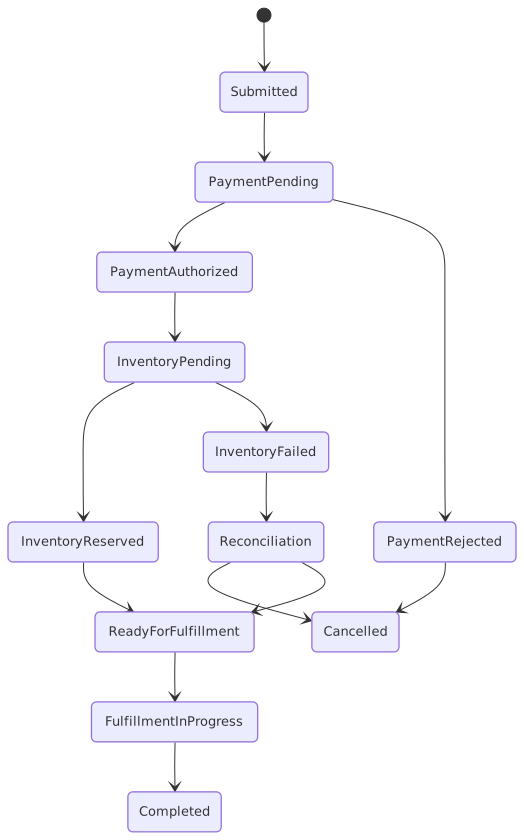
That Reconciliation state matters more than most teams admit. In enterprise systems, not every inconsistency should trigger immediate compensation. Sometimes the correct answer is to pause, inspect, retry, compare records, and decide. Architecture that only knows “happy path” and “rollback” is too naive for the real world.
Domain semantics first
Async chaining succeeds when each message means something clear in the ubiquitous language of the domain.
A command says: please do this responsibility-bearing action.
An event says: this business fact has happened.
If you blur those, the chain gets sloppy. Teams start emitting events that are really remote procedure calls in disguise. Or they send commands that imply facts not yet established. The result is semantic debt, and semantic debt is worse than technical debt because it makes every integration discussion longer and more political.
Correlation and causation
Each chain needs a correlation ID that follows the request end to end. Better still, keep both:
- Correlation ID: ties all messages to the same business request.
- Causation ID: identifies which prior message caused this new one.
This is invaluable for audit, tracing, replay analysis, and post-incident reconstruction.
Partitioning and ordering
Kafka gives ordering within a partition, not across the whole topic. That is usually enough if you key by aggregate or process identifier. If teams assume broader ordering guarantees, they will create race conditions that are painful to diagnose.
API layer and customer status
Externally, the initiating API should usually return an acknowledgment and a process reference rather than pretending the full workflow is complete. Then a query model or status endpoint can tell the customer whether the request is pending, accepted, rejected, or completed. This is a classic CQRS-friendly shape: commands start the process; read models surface the latest coherent view.
Migration Strategy
Most enterprises do not get to design this from a blank page. They inherit a monolith, a stack of synchronous service calls, or both.
The right migration is usually progressive strangler migration, not theatrical replacement.
Begin by identifying a business flow whose current synchronous behavior is causing operational pain: timeout chains, fragile integration, batch compensation, or release bottlenecks across teams. That flow becomes your migration seam.
Then move in stages.
Stage 1: expose the domain event at the boundary
Keep the existing system of record, but emit a trustworthy event when a meaningful business action occurs. Not every table update deserves an event. Emit only those changes that other bounded contexts can safely consume as business facts.
Stage 2: introduce one async downstream capability
Take a step such as notifications, fraud evaluation, or inventory reservation and make it react asynchronously. Do not migrate the entire chain at once. One reliable async step teaches the enterprise more than twenty architecture slides.
Stage 3: add process tracking
As soon as the chain spans multiple async steps, introduce explicit process state. This may be a saga store, a process manager, or a read model built from events. Without this, support teams will have no idea where requests are stuck.
Stage 4: strangle synchronous dependencies
Replace direct calls one by one with event-driven handoffs or command topics. Preserve compatibility at the edges while shifting the core process model internally.
Stage 5: reconcile and retire legacy paths
For a period, old and new flows may coexist. This is where reconciliation is not optional. Compare outcomes between old and new systems, detect divergence, and use dashboards plus replay capability to close gaps before cutting over fully.
A migration view often looks like this:
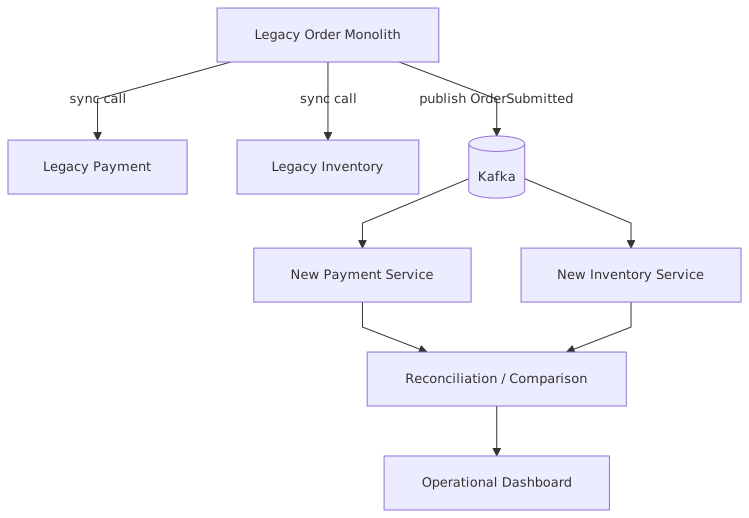
This progressive approach does two things that matter enormously in enterprises.
First, it reduces migration blast radius.
Second, it creates empirical learning. Architects love target states. Operations teams love evidence. Strangler migration gives you both.
Enterprise Example
Consider a global retailer modernizing its order management platform.
The legacy estate is predictable: a large ERP-backed order module, a homegrown payment adapter, warehouse software in two regions, and a customer website that expects immediate order confirmation. The original architecture used a synchronous orchestration service. During peak events, one slow warehouse reservation call caused thread exhaustion upstream, cascading failures in the checkout path, and a charming incident pattern where customers retried payment while the original order was still half-alive.
The retailer moved to async request chaining around the order lifecycle.
The Order Service became the initial bounded context and system of intent. When checkout completed, it persisted the order in Submitted status and published OrderSubmitted to Kafka.
The Payment Service consumed that event, performed authorization, updated its own payment aggregate, and emitted either PaymentAuthorized or PaymentRejected.
The Inventory Service did not act on OrderSubmitted; it acted on PaymentAuthorized. That was an important domain decision. The retailer did not want to reserve stock for orders that had not cleared payment. This seems obvious until you see how many systems reserve too early and create phantom stock shortages.
A lightweight Process Manager subscribed to payment and inventory outcomes, tracked process state, and issued the next command when prerequisites were satisfied. Once payment was authorized and inventory reserved, it emitted ReleaseForFulfillment.
The Fulfillment Service then coordinated with regional warehouse systems. Some warehouses were modern enough to consume Kafka-driven commands; others required adapter services that translated commands into legacy APIs.
What changed in the business?
Not merely latency behavior. The business gained a durable, inspectable request lifecycle. Support staff could now see whether an order was waiting on payment, stock, warehouse routing, or reconciliation. During Black Friday, if a warehouse adapter lagged, checkout did not collapse. Orders accumulated in a known pending state instead of detonating synchronous capacity.
There were tradeoffs. Customers no longer received a false sense of “instant completion.” Instead, the website acknowledged the order and surfaced a status like Order received, confirming payment and stock. That was actually more honest and reduced duplicate submissions.
The retailer also discovered an unpleasant but useful truth: inventory events occasionally arrived late due to a regional integration issue, and some orders sat in inconsistent states. Because process state and correlation IDs existed, the team built a reconciliation job that compared process manager state, inventory reservation records, and fulfillment releases. A messy problem became a manageable one.
That is the value of architecture with semantic clarity. It does not eliminate disorder. It makes disorder diagnosable.
Operational Considerations
Async chaining shifts complexity from request/response code into system behavior. Operations therefore become part of the architecture, not an afterthought.
Observability
You need end-to-end tracing across async hops. Logs alone are not enough. Metrics alone are not enough. Traces, correlated event history, consumer lag monitoring, dead-letter analysis, and process-state dashboards are table stakes.
At minimum, operators should be able to answer:
- How many requests are in each business state?
- How long do requests stay there?
- Which consumer group is lagging?
- Which messages are being retried repeatedly?
- Which chains are incomplete past their expected SLA?
Idempotency
Every message handler must assume duplicates happen. This is not optional with Kafka-based systems. Idempotent consumers typically track processed message IDs or enforce uniqueness via aggregate versioning or business keys. If your payment authorization consumer is not idempotent, retries become a direct route to financial embarrassment.
Timeouts and stale chains
Not every chain completes. Some should expire. Introduce timeout semantics explicitly. If PaymentAuthorized arrives but InventoryReserved does not appear within a defined business window, the process may move to reconciliation or cancellation. Silent waiting is not a strategy.
Dead-letter queues and poison messages
Dead-letter queues are useful, but they are not a garbage bin for unresolved design flaws. If the same message type repeatedly lands in dead-letter due to schema mismatch or semantic drift, the issue is governance, not just operations. ArchiMate for governance
Schema evolution
Event contracts change. They always do. Use versioning discipline, consumer tolerance, and compatibility checks. The worst async incidents often come not from outages but from schema changes that technically deserialize yet semantically mislead consumers.
Reconciliation
This deserves repetition. Reconciliation is the grown-up answer to eventual consistency. It means periodically or continuously comparing expected state across services and correcting divergence. In finance, commerce, and supply chain systems, reconciliation is not a concession. It is good architecture.
Tradeoffs
Async request chaining is powerful, but it charges rent.
What you gain
- Better resilience to latency and temporary downstream failures
- Looser runtime coupling between services
- Support for long-running business processes
- Clearer domain state progression when modeled well
- Better scalability under uneven workloads through buffering and consumer groups
- Auditability via durable event history
What you pay
- More moving parts
- More complex debugging
- Eventual consistency instead of immediate global agreement
- Higher demand for observability and operational discipline
- Greater need for semantic governance across teams
- More subtle failure modes than synchronous request chains
That last point matters. Async systems often fail quietly. The request does not crash dramatically; it simply stops progressing. In a synchronous system, the caller sees an error. In an async system, the business sees ambiguity. Ambiguity is expensive.
Failure Modes
Architects should speak plainly about how systems break.
Lost publish after local commit
A service updates its database but fails to publish the event. Downstream never sees the state transition. Use the transactional outbox pattern to avoid this.
Duplicate delivery
Kafka redelivers after consumer restart or offset replay. Without idempotency, side effects execute twice. Payments charged twice are an excellent way to lose architectural debates.
Out-of-order processing
Events for the same business entity are processed in the wrong order due to poor partition strategy or concurrent consumers. Domain invariants then appear to “randomly” break.
Semantic drift
One team changes the meaning of Approved from “risk approved” to “business approved,” and another consumer keeps assuming the old semantics. The bug is not in code; it is in language.
Orphaned process state
The process manager thinks the request is waiting for inventory, but inventory already reserved stock and emitted an event that was malformed or routed incorrectly. Without reconciliation, the request remains stuck indefinitely.
Retry storms
A downstream dependency slows, consumers retry aggressively, queue depth grows, and the system amplifies load precisely where it is already weakest.
Compensations that are not compensations
Teams love to say “just compensate.” In reality, many business actions are not cleanly reversible. You can void a payment authorization; you cannot un-send a customer email or erase a warehouse pick already started. Compensation is often a new business action with its own consequences, not a time machine.
When Not To Use
Async request chaining is not the answer to every integration problem.
Do not use it for simple, low-latency, strongly consistent interactions inside one bounded context. If one service truly owns the operation and can complete it synchronously within acceptable SLA, adding Kafka and a saga because it looks modern is architecture by mood board.
Do not use it when the business requires immediate all-or-nothing consistency across participants and you cannot redesign the domain to tolerate eventual consistency. Be careful here: many teams claim this requirement when they actually mean “the UI wants a simple answer.” But sometimes the requirement is real.
Do not use elaborate async chains for basic read composition. If the need is to assemble a view from several services in real time, query-side aggregation or a read model is often better.
Do not use a central process orchestrator for every tiny workflow. You will create a distributed monolith with prettier diagrams.
And do not use event-driven chaining when the organization lacks the operational maturity for schema governance, monitoring, and support tooling. Event-driven architecture punishes careless teams slowly at first, then all at once.
Related Patterns
Async request chaining sits among several adjacent patterns.
Saga
Probably the closest relative. A saga coordinates a long-running business transaction through local transactions and compensating actions. Async chaining is often implemented as a saga, though not every chain needs full-blown compensation logic.
Process Manager
Useful when flow logic should be explicit and centralized enough to monitor, while still leaving business execution in individual services.
Choreography
Good for decoupled reactions to domain events. Risky when the end-to-end flow becomes too implicit.
Transactional Outbox
Essential for reliable event publication tied to local state change.
CQRS
Very helpful for separating process initiation from customer-facing status and reporting models.
Event Sourcing
Sometimes paired with async chaining, though far from required. Event sourcing can enhance auditability and replay, but it increases conceptual load. Use it when the domain benefits from event-first persistence, not because you already have Kafka.
Strangler Fig Pattern
The practical migration pattern for introducing async chains into legacy estates gradually.
Summary
Async request chaining in microservices is not about replacing REST with Kafka. It is about acknowledging that enterprise business processes are long-running, cross-boundary, failure-prone, and semantically rich.
The architecture works when you model the request as a domain process, not a technical callback chain. That means explicit states, bounded-context ownership, meaningful events, correlation, idempotency, reconciliation, and a migration path that respects the existing estate. It means being honest about eventual consistency and building coherent customer-facing status instead of fake immediacy.
The biggest mistake is to treat asynchronous chaining as mere plumbing.
It is not plumbing. It is process architecture.
Done badly, it creates invisible failure, semantic drift, and support nightmares. Done well, it gives enterprises something precious: the ability to let complex business requests travel through many systems without losing their meaning.
And in distributed systems, meaning is the first thing that gets dropped.
Frequently Asked Questions
What is a service mesh?
A service mesh is an infrastructure layer managing service-to-service communication. It provides mutual TLS, load balancing, circuit breaking, retries, and observability without each service implementing these capabilities. Istio and Linkerd are common implementations.
How do you document microservices architecture for governance?
Use ArchiMate Application Cooperation diagrams for the service landscape, UML Component diagrams for internal structure, UML Sequence diagrams for key flows, and UML Deployment diagrams for Kubernetes topology. All views can coexist in Sparx EA with full traceability.
What is the difference between choreography and orchestration in microservices?
Choreography has services react to events independently — no central coordinator. Orchestration uses a central workflow engine that calls services in sequence. Choreography scales better but is harder to debug; orchestration is easier to reason about but creates a central coupling point.