⏱ 19 min read
Microservices rarely fail because teams cannot draw boxes and arrows. They fail because the boxes start lying.
At first, the system diagram looks clean: tidy services, crisp boundaries, a message broker in the middle, perhaps Kafka humming away like the enterprise equivalent of central heating. Then the organization grows. One product becomes five. One team becomes fifteen. A few tactical integrations appear. A legacy system is “temporarily” left in place. A customer domain is split for speed, then split again for reporting, then mirrored into a new platform for analytics. Before long, the architecture is not a landscape. It is a shattered mirror. Every shard reflects part of the business, but none reflects the whole.
That is topology fragmentation in microservices: the shape of the runtime landscape no longer matches the shape of the business domain, and the mismatch leaks into delivery, operations, data consistency, and decision-making. It is one of those problems that does not announce itself dramatically. It arrives as friction. Duplicate events. Conflicting truths. Services that cannot change without three coordination meetings and a reconciliation batch job at 2 a.m.
This article is about that fracture line: what topology fragmentation is, why it happens, how to recognize it, and what to do when the microservice estate starts to resemble a city built by competing cartographers. We will look at domain-driven design, migration strategy, Kafka-based eventing, reconciliation, and the blunt tradeoffs architects have to make in real enterprises. event-driven architecture patterns
Context
Microservices were supposed to buy autonomy. That promise was never wrong, but it was dangerously incomplete.
Autonomy in a distributed system comes from aligned boundaries, not merely smaller deployables. Domain-driven design understood this long before cloud-native fashion caught up. A bounded context is not a packaging trick. It is a semantic commitment. It says: inside this boundary, words mean one thing, workflows obey one model, and the team can evolve its language and rules without negotiating every change across the enterprise. cloud architecture guide
Topology fragmentation appears when those semantic commitments degrade faster than the infrastructure evolves. The technical topology—services, topics, APIs, caches, schedulers, ETL pipelines, read models—multiplies. Meanwhile the domain topology—the real map of orders, customers, policies, claims, payments, inventory, entitlements, shipments—gets copied, sliced, and reinterpreted in too many places.
This often happens in organizations that are doing many sensible things at once:
- breaking apart a monolith
- introducing event streaming with Kafka
- creating product-aligned teams
- supporting legacy systems during migration
- building specialized read models for performance
- integrating acquired business units
- enabling regional autonomy
Individually, these moves are rational. Collectively, they can produce a distributed estate whose runtime connectivity is more complex than its business model. That is the point where topology becomes fragmented.
A healthy microservice architecture has complexity, but it is purposeful complexity. A fragmented one has accidental complexity masquerading as flexibility.
Problem
Topology fragmentation is the condition where business capabilities and domain semantics are scattered across multiple services, stores, integration paths, and event streams in ways that create ambiguity, duplication, and coordination drag.
This is not simply “too many services.” Plenty of architectures have many services and remain coherent. Fragmentation is about misalignment. The domain says one thing; the topology says another.
Common symptoms look familiar:
- the same customer exists in five services with slightly different lifecycle states
- “order created” means different things depending on which topic produced it
- multiple services own overlapping rules for pricing, eligibility, or fulfillment
- teams depend on replicated local copies of core entities but lack clear freshness or authority rules
- business workflows cross too many technical boundaries for their value stream
- batch reconciliation becomes a permanent safety net rather than an exception tool
- incidents are diagnosed through data archaeology rather than service ownership
In practice, topology fragmentation often emerges from one of four patterns.
First, functional decomposition without domain semantics. Teams split systems by technology layer or use-case endpoint rather than business capability. You get customer-api, customer-reporting, customer-cache, customer-search, and customer-sync, each holding slivers of meaning.
Second, migration scars that never heal. During a strangler migration, a new service mirrors legacy data, then gains a bit of write logic, then coexists indefinitely with the old system. The temporary bridge becomes the production architecture.
Third, event proliferation without an event model. Kafka topics are cheap to create. Semantic discipline is not. Soon the estate has order-created, order-submitted, order-booked, order-persisted, and order-v2, each published by different teams for different reasons.
Fourth, local optimization. Read models, caches, anti-corruption layers, and regional replicas are all useful. But if nobody keeps the global semantics in view, the local fixes become a fragmented topology of partial truths.
Forces
Architects do not create fragmentation because they are careless. They create it because they are balancing legitimate forces.
Team autonomy vs semantic coherence
The organization wants teams that can move independently. Good. But every replicated concept threatens semantic drift. A team should own its model, yet not redefine core business truth casually.
Performance vs authority
A service often wants local data for latency, resilience, and reduced coupling. That is also good. But copies have consequences. The moment you replicate customer, product, or policy state, you need explicit rules for staleness, authority, and repair.
Migration speed vs architectural cleanliness
A progressive strangler migration often requires coexistence between old and new worlds. Dual writes, event mirroring, translation layers, and shadow reads can be justified temporarily. Temporarily is the dangerous word in enterprise architecture.
Product boundaries vs end-to-end workflows
Organizations split by domain, but customer journeys cut across domains. The architecture must preserve local ownership without turning every cross-domain workflow into a distributed committee.
Event-driven flexibility vs observability and governance
Kafka enables loose coupling and replayable event streams. It also enables uncontrolled event sprawl. If no one curates the event taxonomy, the broker becomes a semantic junk drawer.
Regional, legal, and business variation
Enterprises often need country-specific processes, acquired business unit differences, or line-of-business specialization. Variation is real. Fragmentation starts when local variations mutate core concepts beyond recognition.
These are not theoretical tensions. They are the daily weather of enterprise architecture.
Solution
The answer is not “fewer microservices,” though sometimes that is the right local move. The answer is to treat topology as a manifestation of domain design. microservices architecture diagrams
My opinion is simple: if you are not managing topology through domain semantics, ownership, and migration intent, the topology will manage you through incident queues and reconciliation jobs.
A practical solution has five parts.
1. Re-establish bounded contexts
Start with domain-driven design, not service inventory. Identify bounded contexts where language, invariants, and decisions genuinely belong together. Ask hard questions:
- Where is customer identity authoritative?
- Where is pricing calculated versus merely consumed?
- What does “order confirmed” mean, exactly?
- Which lifecycle states are core domain states versus local processing states?
This does not necessarily reduce the number of deployables. It clarifies which deployables are part of the same semantic boundary and which ones should not own overlapping rules.
2. Separate authority from replication
A fragmented topology often confuses “has the data” with “owns the meaning.” Fix that explicitly.
For each critical entity or event family, define:
- system of record: where authoritative change is decided
- systems of reference: who consumes and caches the truth
- derived models: read-optimized or analytical projections
- reconciliation path: how divergence is detected and repaired
This simple distinction prevents half the enterprise arguments that get disguised as technical debates.
3. Design an event model, not just topics
In a Kafka-based architecture, event streams should follow domain boundaries, not random implementation milestones. A domain event is not “row inserted” wearing a nicer hat. It communicates business fact with stable meaning.
Good event design means:
- one business fact expressed consistently
- versioning discipline
- separation of domain events from integration events when needed
- explicit ownership of schemas and topic lifecycle
- documented causality and idempotency expectations
If OrderPlaced is published, every consumer should understand whether the order is committed, payable, fulfillable, or merely accepted for validation. If the answer is “it depends,” fragmentation is already in the room.
4. Introduce reconciliation as a first-class capability
Reconciliation is not an admission of defeat in distributed systems. It is the cost of honesty.
Any architecture with replicated state, asynchronous messaging, and progressive migration needs reconciliation. But it must be designed, not improvised. Reconciliation means:
- comparing authoritative and derived records
- detecting missing or duplicate events
- repairing projections
- surfacing semantic conflicts, not just data mismatches
- supporting replay with traceability
A mature enterprise architecture does not pretend asynchronous systems never diverge. It builds muscle to bring them back together.
5. Make migration paths part of the topology design
The migration route matters as much as the target state. If you cannot explain how temporary bridges will be removed, then they are not temporary. They are tomorrow’s fragmentation.
This is especially true in strangler migrations. You need explicit sunset criteria for compatibility layers, mirrored data stores, translation services, and duplicate event publication.
Architecture
A coherent response to topology fragmentation usually leads to a topology with clear domain hubs, explicit replication, and controlled cross-context integration.
Here is a simplified target shape.
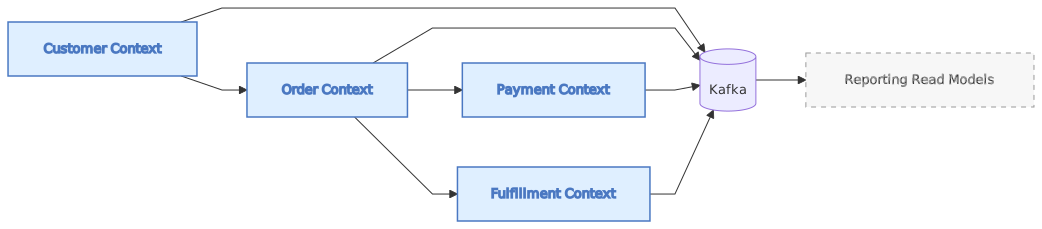
The point of this diagram is not that every domain should talk directly. Quite the opposite. The point is that core bounded contexts own decisions, Kafka carries events with clear semantics, and reporting sits where it belongs: downstream, derived, and non-authoritative.
Now compare this to a fragmented topology.
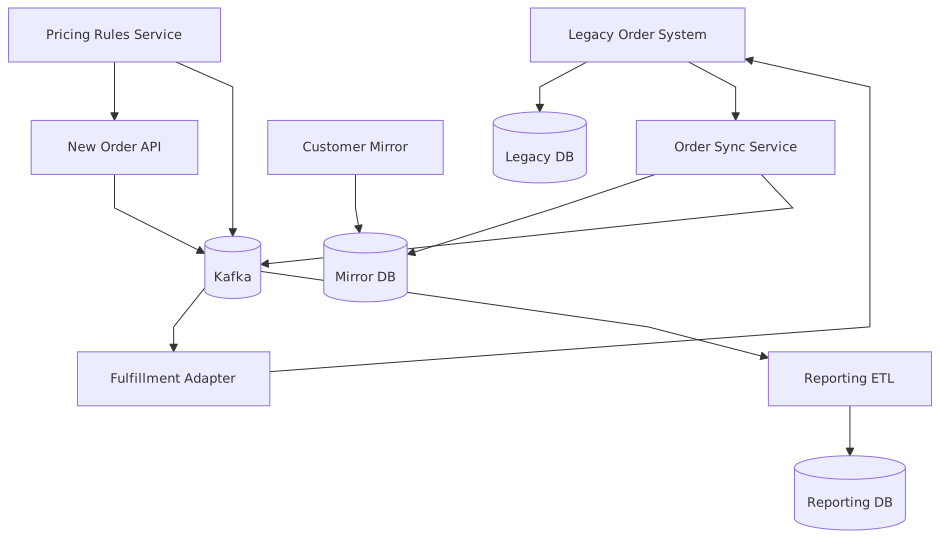
This is a familiar enterprise shape. Not evil. Just dangerous if left ungoverned. The trouble is not the number of arrows. It is the ambiguity:
- Does the new order API own order creation, or merely front it?
- Is pricing authoritative in a separate service, or copied from legacy?
- Does the fulfillment adapter consume domain events or implementation events?
- Is the customer mirror a cache, a transition store, or a hidden system of record?
When topology fragmentation is severe, I recommend documenting architecture with three overlays, not one:
- runtime topology
- authority topology
- migration topology
Those are different maps. Conflating them creates costly confusion.
Authority topology
This is the map most teams skip, then regret skipping.
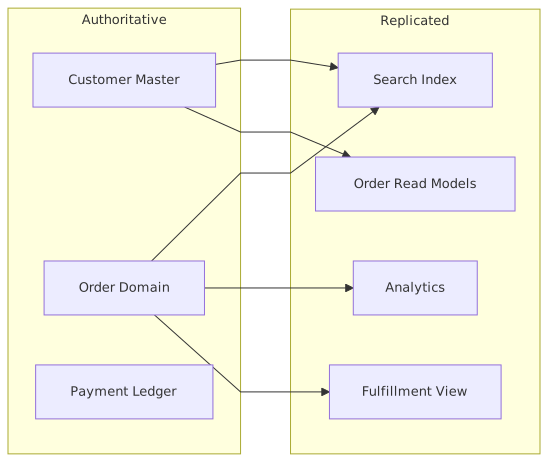
This view answers a simple but vital question: when data conflicts, who wins? If you cannot answer that in one sentence per core concept, the topology is already fragmented at the semantic level.
Migration Strategy
Most enterprises do not get to redraw the map from scratch. They inherit. They negotiate. They migrate while the business keeps moving.
That is why topology fragmentation should be approached through progressive strangler migration rather than revolution.
A practical migration strategy has stages.
Stage 1: Identify semantic fractures
Do not start by counting services. Start by tracing business capabilities that suffer from fragmented ownership. Typical hotspots are:
- customer master and profile
- order lifecycle
- pricing and promotions
- payment state
- inventory availability
- entitlement and policy rules
Map where each capability is created, changed, copied, interpreted, and reconciled. This quickly reveals where bounded contexts have blurred into each other.
Stage 2: Define target authority and integration contracts
For each hotspot, define:
- authoritative owner
- inbound commands or APIs
- outbound domain events
- replicated views allowed
- decommissioned interfaces
- reconciliation responsibility
This is where many migrations go off the rails. Teams define the new service but not the fate of the old pathways.
Stage 3: Introduce anti-corruption and translation carefully
When legacy models differ from target domain models, use anti-corruption layers. But keep them thin and temporary. Their job is to protect the new bounded context from legacy semantics, not to become a permanent translation bureaucracy.
Stage 4: Run dual-read before dual-write where possible
Dual writes are seductive and treacherous. If possible, prefer:
- write in one place
- publish an event or change feed
- build downstream projections
- compare outputs through dual-read and reconciliation
Dual-write across legacy and new systems should be a last resort, tightly bounded in duration, and wrapped with compensation plans.
Stage 5: Add reconciliation before cutover
Do not wait for production incidents to discover divergence modes. Build reconciliation tooling while both systems are live. Compare records, event counts, state transitions, and timing windows. Reconciliation is not cleanup after migration. It is the migration safety rail.
Stage 6: Cut by capability, not by technical component
Move ownership of a business capability end to end. For example, migrate “order capture” or “payment authorization” as coherent slices. Avoid partial moves where validation lives in one world, persistence in another, and notifications in a third. That is how fragmentation becomes institutionalized.
Stage 7: Remove the bridge
This sounds obvious. It is not common enough.
Every migration artifact should have:
- an owner
- a removal criterion
- an end date or review checkpoint
- a metric that proves it is still needed
Otherwise the bridge becomes part of the city.
Enterprise Example
Consider a global retailer modernizing its commerce platform.
The legacy estate had a monolithic order management system, a customer MDM hub, regional pricing engines, nightly reporting ETL, and a growing set of microservices for checkout, promotions, fulfillment, and digital channels. Kafka had been introduced as the backbone for event streaming. On paper, this looked modern enough. In reality, order topology was fragmented.
An order was:
- initiated in a web checkout service
- enriched with customer data from a replicated profile store
- priced via a promotions service that also copied regional pricing rules
- persisted in the legacy order system
- emitted as one of several events to Kafka
- transformed by downstream services into fulfillment tasks, customer notifications, and reporting records
The architecture had three practical truths for the same order:
- the legacy order system for financial settlement
- the checkout service for customer-visible status
- the reporting warehouse for operational KPIs
None matched perfectly. Status semantics drifted. Submitted, Confirmed, Booked, and Accepted were treated as near synonyms by different teams. Reconciliation was nightly and manual for high-value failures. Incident bridges frequently became debates about vocabulary.
The fix was not a heroic rewrite. It was a domain correction.
The retailer re-established bounded contexts around:
- Customer Identity
- Order Capture
- Payment
- Fulfillment
- Pricing
- Reporting and Analytics
Then it made three hard calls.
First, Order Capture became authoritative for commercial order acceptance. Legacy OMS remained authoritative for downstream settlement until migration completed, but not for customer-facing order semantics.
Second, event taxonomy was redesigned. Kafka topics were aligned to domain event families with explicit meanings: OrderPlaced, OrderAccepted, PaymentAuthorized, OrderReleasedForFulfillment, OrderCancelled. Implementation-level events stayed internal or were published as separate integration topics.
Third, reconciliation became productized. A reconciliation service compared accepted orders across Order Capture, OMS, and fulfillment projections, with replay tooling and exception workflows.
The migration used a strangler pattern:
- checkout wrote to the new Order Capture context
- Order Capture published canonical events to Kafka
- a legacy adapter translated accepted orders into OMS commands
- downstream services were moved gradually from OMS-derived events to Order Capture events
- dual-read dashboards compared customer-visible order timelines across old and new paths
- once confidence thresholds were met, OMS-originated order status publication was retired
The result was not fewer systems. It was less ambiguity. That matters more.
Lead time for order changes dropped because teams stopped negotiating hidden semantic conflicts. Incident diagnosis improved because authoritative ownership was clearer. Reporting became more trustworthy because the warehouse consumed stable domain events rather than reverse-engineered database changes.
That is what good enterprise architecture looks like in practice: not elegance for its own sake, but reduced confusion at scale.
Operational Considerations
A coherent topology still needs hard operational discipline.
Observability must follow business flow
Tracing at HTTP or Kafka level is useful, but insufficient. You need observability tied to domain identifiers and lifecycle milestones. For example:
- order ID across capture, payment, fulfillment, and notification
- customer ID across profile, consent, and service interactions
- reconciliation status for replicated entities
- event lag by bounded context, not just by topic
When topology is fragmented, technical metrics often look healthy while business flow is sick.
Schema governance matters
Kafka without schema governance is a fast road to semantic entropy. Use schema registry, compatibility rules, ownership, and deprecation practices. More importantly, review events as part of domain architecture, not only as serialization artifacts. EA governance checklist
Replay is a capability, not a trick
If you rely on event streaming, you will replay. The question is whether replay is safe and understood. Design for:
- idempotent consumers
- replay boundaries
- side-effect isolation
- auditability
- projection rebuild times
Replay without clear semantics can amplify fragmentation rather than repair it.
Reconciliation needs SLOs
If reconciliation exists only as a support script, it will fail at the worst moment. Define service levels for:
- divergence detection latency
- repair completion time
- acceptable mismatch thresholds
- manual exception workflow
Topology reviews should include domain owners
Infrastructure teams alone cannot judge whether topology is coherent. Architects need domain leaders and product owners in the room. If the language is wrong, the wiring is wrong, even if the cluster is healthy.
Tradeoffs
There is no free architecture. Anyone selling one is usually selling a future outage.
A topology optimized for semantic coherence may reduce local team freedom. Strong bounded contexts and controlled event taxonomies create governance overhead. Good. Some constraints are the price of staying sane.
Likewise, centralized authority for core domains can become a bottleneck if overdone. Not every concept needs a grand canonical model. The enterprise should be opinionated about true business cores and relaxed elsewhere.
Reconciliation improves safety but adds operational machinery. Read models boost performance but introduce staleness. Kafka supports decoupling but can create event sprawl. Strangler migration reduces rewrite risk but prolongs coexistence complexity.
The real tradeoff is between visible design effort now and invisible coordination cost later. Enterprises too often choose the latter because it does not show up on the roadmap until it shows up in production.
Failure Modes
Topology fragmentation has recurring failure modes. They are predictable enough to name.
The duplicate authority trap
A new service is introduced but legacy remains partially authoritative. Both accept writes. Teams rely on “eventual convergence.” They get eventual confusion.
The semantic drift topic
Different publishers use similar event names for different business moments. Consumers hard-code assumptions. New downstream uses become unsafe.
The immortal adapter
An anti-corruption layer or sync service survives long past migration. It quietly accumulates business rules and becomes an unowned core dependency.
The reconciliation black hole
Data mismatches are detected but not classified. Teams can see divergence but cannot determine whether the issue is delay, duplication, missing events, or semantic mismatch.
The reporting takeover
Because analytical stores are easier to query, they become operational truth by accident. Support teams and even applications start relying on stale or derived data for customer-facing decisions.
The context collapse
To avoid coordination, teams push too many capabilities into a “platform” or “shared” service. Fragmentation is reduced temporarily, but at the cost of a new distributed monolith.
When Not To Use
Not every architecture problem needs a topology fragmentation strategy. Sometimes the simplest answer is to stop pretending you need microservices.
Do not lean into this style of architecture if:
- the domain is small and cohesive enough for a modular monolith
- the organization lacks the operational maturity for event streaming, schema governance, and reconciliation
- team boundaries are unstable and product ownership is unclear
- the business does not benefit from independent release cadence across bounded contexts
- latency and consistency demands strongly favor a single transactional boundary
- Kafka is being introduced because it is fashionable rather than because asynchronous integration is genuinely needed
A modular monolith with strong domain modules often beats a fragmented microservice estate. That is not a step backward. It is architecture with self-respect.
Also, avoid over-canonicalization. Some architects respond to fragmentation by creating an enterprise-wide “golden” model for everything. That way lies another kind of dysfunction. DDD teaches us that meaning is contextual. The goal is not one universal truth model. The goal is clear authority and explicit translation where contexts differ.
Related Patterns
Several architecture patterns are closely connected to topology fragmentation.
Bounded Context
The core DDD pattern for semantic boundaries. Without it, service boundaries are mostly decorative.
Strangler Fig Pattern
Ideal for progressive migration from legacy systems. Powerful, but only if the strangling is real and the temporary bridges are retired.
Anti-Corruption Layer
Useful when integrating legacy or external models. Dangerous when allowed to absorb business logic indefinitely.
CQRS
Helpful when separating write authority from read optimization. Can reduce pressure for shared databases, but increases need for reconciliation and event clarity.
Event Sourcing
Can provide strong auditability and replay capabilities in the right domains. Not a cure-all. It can amplify complexity if introduced into an already fragmented topology without clear semantics.
Saga / Process Manager
Useful for cross-context workflows. But if every business action requires a saga because the domain is over-fragmented, that is a smell, not sophistication.
Data Mesh
Relevant in large enterprises for analytical domain ownership. But operational bounded contexts should not be confused with analytical products. Mixing the two is another route to topology confusion.
Summary
Topology fragmentation in microservices is what happens when the runtime map drifts away from the business map.
The outward signs are familiar: duplicated truths, event sprawl, permanent migration bridges, brittle cross-service workflows, and reconciliation as a desperate afterthought. The inward cause is almost always the same: service topology evolved faster than domain semantics and ownership discipline.
The remedy is not dogma. It is deliberate design.
Re-establish bounded contexts. Separate authority from replication. Treat Kafka topics as semantic contracts, not plumbing shortcuts. Build reconciliation as a normal capability. Use progressive strangler migration with explicit end states. And keep asking the question too many architectures avoid: who owns the meaning of this concept?
That question is architecture in its most practical form.
Because when the boxes start lying, no amount of infrastructure polish will save you. The only way out is to make the topology tell the truth again.
Frequently Asked Questions
What is a service mesh?
A service mesh is an infrastructure layer managing service-to-service communication. It provides mutual TLS, load balancing, circuit breaking, retries, and observability without each service implementing these capabilities. Istio and Linkerd are common implementations.
How do you document microservices architecture for governance?
Use ArchiMate Application Cooperation diagrams for the service landscape, UML Component diagrams for internal structure, UML Sequence diagrams for key flows, and UML Deployment diagrams for Kubernetes topology. All views can coexist in Sparx EA with full traceability.
What is the difference between choreography and orchestration in microservices?
Choreography has services react to events independently — no central coordinator. Orchestration uses a central workflow engine that calls services in sequence. Choreography scales better but is harder to debug; orchestration is easier to reason about but creates a central coupling point.