⏱ 21 min read
Feature flags look harmless at first. A boolean in a config file. A switch in an admin screen. A tidy little escape hatch for teams who want to ship code before they are ready to expose behavior.
Then the system grows up.
Now the “little switch” decides whether payments route through a new fraud engine, whether order pricing uses a revised discount policy, whether identity verification is mandatory in Germany but optional in Canada, whether a premium feature is enabled only for gold-tier customers, and whether a broken downstream integration should be bypassed before it takes the call center down with it. In a microservices estate, feature flags stop being a convenience and become a distributed control plane. microservices architecture diagrams
That is the point where architecture matters.
The naive view says feature flags are just application configuration with a nicer UI. That view is expensive. In a distributed system, flags are not merely data. They are decisions with domain semantics, propagation latency, consistency implications, audit requirements, operational blast radius, and failure modes that are often uglier than the code they were supposed to protect. A stale flag can be worse than a bad deploy because it creates a split-brain business process: one service thinks the new world has arrived, another still behaves as if the old world is in force.
So the real design question is not “how do we store flags?” It is “how do we govern distributed decisions across bounded contexts without turning release management into a bowl of spaghetti?”
This is where domain-driven design earns its keep. Not every flag is the same. A UI experiment is not equivalent to a policy decision. A kill switch is not equivalent to a migration toggle. A tenant entitlement is not equivalent to a region-specific compliance rule. Treating them all as generic key-value pairs is the architectural equivalent of storing every enterprise concept in a VARCHAR and hoping reporting will sort it out later.
It won’t.
What follows is a practical architecture for distributed feature flags in microservices, especially where Kafka, event-driven integration, and progressive strangler migration are in play. It is opinionated because this topic punishes vagueness. event-driven architecture patterns
Context
Microservices encourage local autonomy. Each service owns its model, persistence, and release cadence. That is good engineering and good organizational design. But autonomy has a side effect: behavior becomes fragmented. The customer journey spans many services, each making local decisions. Introduce feature flags and that fragmentation becomes dynamic.
A single business capability might involve:
- API gateway routing
- pricing rules in a pricing service
- eligibility checks in a policy service
- orchestration in an order service
- asynchronous enrichment via Kafka
- UI rendering in a frontend BFF
- analytics side effects in downstream consumers
If a feature flag controls that capability, multiple services need to interpret it consistently enough for the business process to make sense.
There are three common enterprise pressures behind distributed flags:
- Progressive delivery
Teams want canary rollout, tenant-specific release, dark launch, and quick rollback.
- Migration control
During decomposition of a monolith, flags decide whether requests go to legacy or new services, whether writes are dual-written, and when reads switch over.
- Operational safety
Kill switches disable expensive integrations, unstable paths, or optional enrichments under incident pressure.
These pressures are legitimate. The trouble starts when one mechanism is asked to solve all three without a clear model.
Problem
In a monolith, a feature toggle is mostly local. In microservices, flag evaluation becomes distributed, and distributed systems are where innocent assumptions go to die.
The hard problems are not in creating a flag. They are in answering questions like:
- Who owns the meaning of a flag?
- Which services evaluate it, and at what point in the request or event flow?
- Is the decision made centrally once, or repeatedly by each service?
- How fast must a change propagate?
- What happens if one service sees the new value and another sees the old one?
- How do we audit who changed a flag and why?
- How do we retire flags before they fossilize into accidental architecture?
Many teams discover too late that they have built an ungoverned distributed rules engine. The UI team names a flag newCheckout. The order service has checkout_v2_enabled. The pricing service has useNewPromotionLogic. The fraud service has routingProfileBeta. Everyone believes they are talking about the same rollout. They aren’t. They are shadowing one business change with several technical toggles that drift over time.
This is not just messy. It is dangerous.
Imagine enabling a “same-day dispatch” feature for a retailer. The storefront exposes the promise, the inventory service reserves stock, the fulfillment service prioritizes handling, and customer notification sends upgraded messaging. If propagation lags or semantics diverge, customers see promises the warehouse cannot honor. Architecture mistakes become operational shame.
Forces
A good flag architecture balances several forces that pull in opposite directions.
Local autonomy vs global coherence
Microservices should not all call a central brain on every request. That creates coupling and latency. But entirely local evaluation can lead to inconsistent behavior across a workflow.
Dynamic control vs predictable behavior
Business wants runtime changes without deployment. Operations wants safety. Developers want deterministic execution. These desires are not naturally aligned.
Domain semantics vs generic tooling
Vendors sell generic flag platforms. They are useful. But enterprise systems need more than “if user in segment then on.” They need domain meaning: policy activation, entitlement assignment, migration phase, jurisdiction rule, operational circuit.
Fast propagation vs resilience
Polling every 30 seconds might be fine for experimentation. It is not fine for kill switches during an outage. Streaming updates is faster, but more operationally involved.
Central governance vs team ownership
Compliance, audit, and platform consistency push toward central governance. Product teams need local control to move quickly. A platform that becomes a bottleneck will be bypassed. And teams are inventive when bypassing governance. EA governance checklist
Consistency vs availability
If a service cannot fetch the latest flags, should it fail closed, fail open, use a cache, or pause processing? The answer depends on the flag type. One size fits nobody.
Solution
My preferred pattern is simple to describe and annoyingly hard to implement well:
Treat distributed feature flags as a domain-aware decision system with event-driven propagation, local evaluation where possible, and explicit ownership of semantics.
There are four core ideas.
1. Classify flags by domain intent
Stop pretending all flags are the same. Start with a taxonomy:
- Release flags: hide incomplete code paths
- Experiment flags: support A/B and cohort testing
- Ops flags: kill switches, throttles, degradation controls
- Migration flags: route between legacy and new systems, control dual-write/read phases
- Policy flags: express business policy activation, regional rules, product entitlements
This classification matters because it determines propagation needs, audit depth, lifecycle, and who owns the meaning.
A release flag may be short-lived and team-owned.
A policy flag may be long-lived, legally sensitive, and require business approval.
A migration flag may need reconciliation support and a retirement plan.
2. Separate flag definition from flag decision
A central platform should manage definitions, targeting rules, audit, and propagation. But not every service should outsource every runtime decision back to that platform.
A healthier split is:
- Control plane: define flags, govern changes, publish updates
- Data plane: services evaluate locally from propagated state, or consume a precomputed decision context when consistency across a workflow matters
That distinction avoids synchronous dependency on a flag service while preserving governance. ArchiMate for governance
3. Decide once per workflow when semantics demand it
For some capabilities, local evaluation in every service is fine. For others, it creates nonsense.
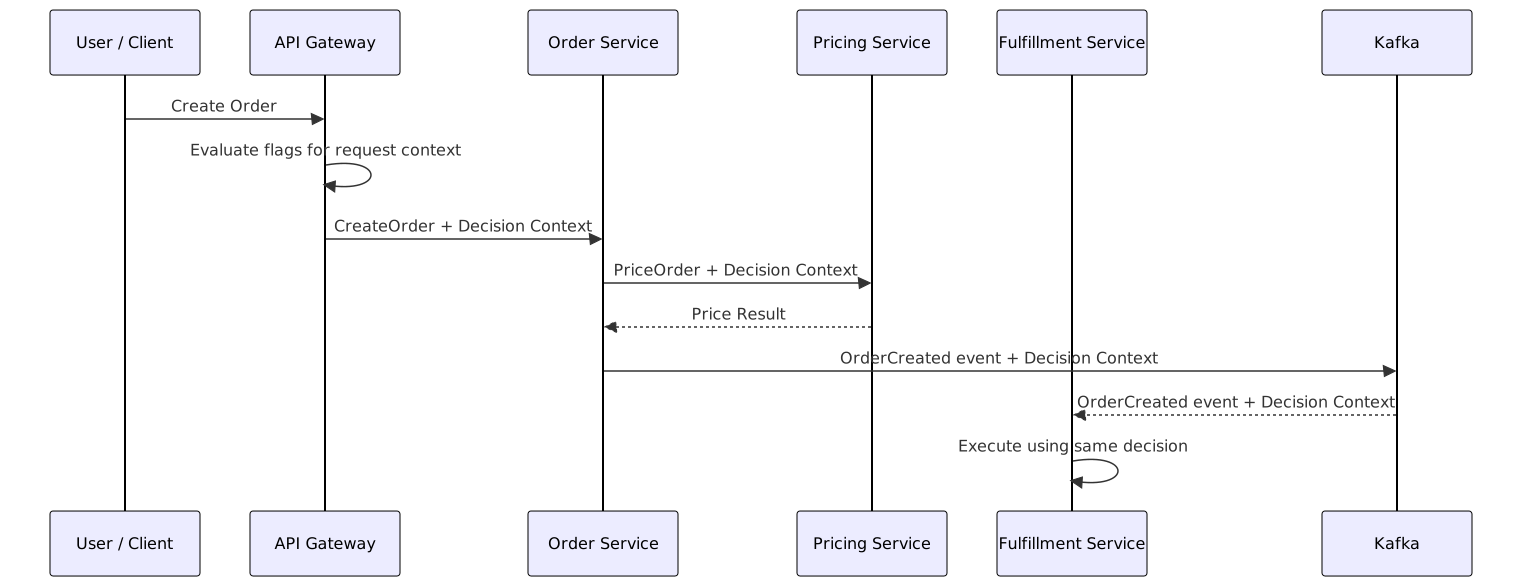
If a customer request starts a business process, and the flag affects the whole process, decide once near the edge or in the orchestration layer and carry that decision forward in headers, commands, or events. This is especially important for long-running workflows and saga-style coordination.
Do not let five services independently reinterpret a migration flag halfway through order processing. That is how you get ghost orders and reconciliation teams.
4. Use event-driven propagation with durable local caches
Polling is acceptable for low-stakes flags. It is weak tea for enterprise control. For most microservice estates, a better model is:
- Authoritative flag store
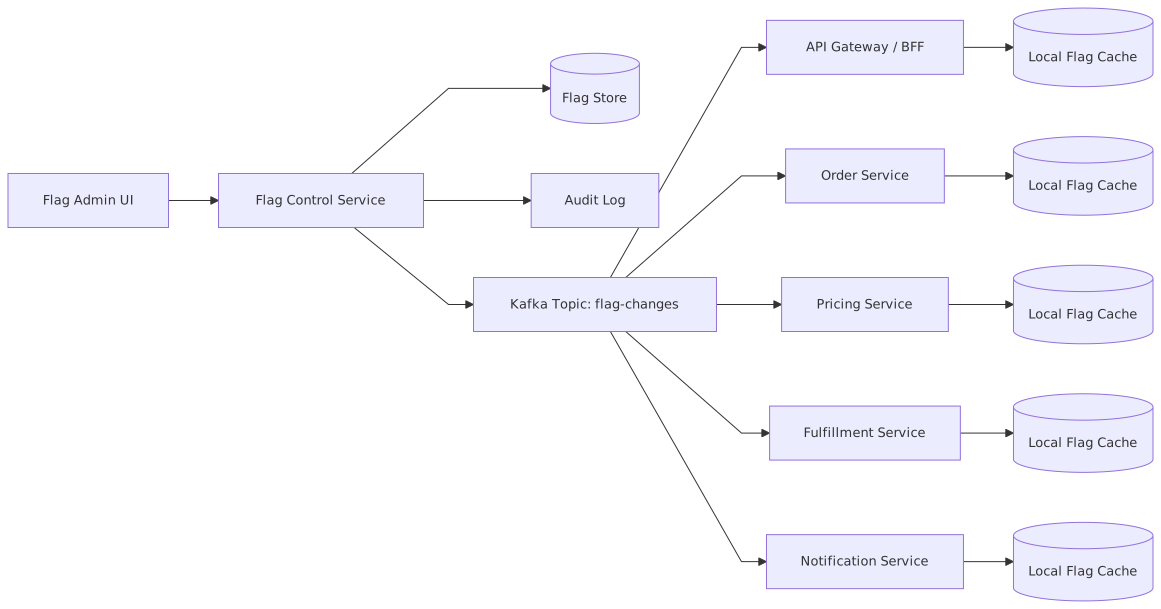
- Change events published to Kafka
- Service-local subscribers maintain in-memory and persisted caches
- Services evaluate against local cache
- Request-scoped decision context used for workflow consistency where needed
This gives low latency, decoupling, and survivability during temporary control-plane outages.
Architecture
At the center sits a Flag Control Service. It stores definitions, targeting rules, metadata, ownership, approval workflow, and audit history. Changes emit domain events such as FlagDefined, FlagRulesChanged, FlagEnabledForTenant, FlagRetired.
Kafka is a good fit here because feature changes are naturally event-like and many services need the update. More importantly, Kafka gives durability and replay. If a service falls behind or restarts, it can rebuild cache state from the event log or from compacted topics carrying the latest value per flag.
But the control service should not become a mandatory synchronous hop in the request path. That is how a release mechanism turns into a new single point of failure.
Domain semantics and bounded contexts
This is where many implementations go soft. They model flags as generic toggles and lose the business meaning. I would rather expose a domain model like:
DiscountPolicyActivationSameDayDispatchEligibilityFraudEngineRoutingModeLegacyCustomerWriteModePremiumEntitlementRule
Those may still be implemented on a common platform, but they should not be discussed as random keys. Bounded contexts need a ubiquitous language for what the flag means. If pricing says “policy activation” and fulfillment says “dispatch mode,” they are at least naming business concepts instead of muttering flag_x17.
This also helps ownership. A policy flag belongs to a policy-owning domain, not “the platform team.” Platform supplies machinery; domains own semantics.
Central evaluation versus local evaluation
There are three viable patterns.
Pattern A: Central decision API
A service asks a central engine whether a flag applies.
Good for:
- simple web apps
- low-scale internal tools
- when targeting logic is very complex and changes frequently
Bad for:
- latency-sensitive paths
- resilient microservices
- large estates
I rarely recommend this as the default in enterprises. It is too easy to create hidden runtime coupling.
Pattern B: Local evaluation from propagated rules
Services receive flag definitions and targeting rules, then evaluate locally.
Good for:
- autonomy
- low latency
- resilience
Bad for:
- duplicated evaluation logic across stacks
- risk of divergent implementations if SDKs are inconsistent
This is often the best default if the platform team provides robust SDKs and governance.
Pattern C: Workflow-scoped decision context
A gateway, orchestrator, or process manager computes decisions once and passes them downstream.
Good for:
- end-to-end consistency in business workflows
- migration routing
- reducing mid-flight drift
Bad for:
- extra complexity in propagation
- downstream services must trust the supplied decision context
- less flexibility for truly local choices
In practice, enterprises use B and C together. Local evaluation for local concerns; workflow decision context for process-wide concerns.
Request context and event context
Once a decision is made for a workflow, carry it with the work. Put it in headers for synchronous calls and event metadata for asynchronous flows. Include:
- decision timestamp
- flag version or ruleset version
- evaluated outcomes relevant to the process
- correlation ID
This gives observability and supports forensic analysis later. When an order behaved oddly, you want to know not just that a flag existed, but which version of the decision logic was applied to that specific transaction.
Reconciliation
Reconciliation is the unsung hero of migration and distributed control.
Flags often coordinate partial transitions: dual writes, new-read/old-read splits, selective routing. During those periods, inconsistencies are expected. The architecture must provide a way to detect and repair them.
If LegacyCustomerWriteMode enables dual writes from the customer service to both monolith and new profile service, there will be drift. Messages fail. retries duplicate. schemas mismatch. one side is down. This is normal. What matters is whether you planned for reconciliation.
That means:
- persistent event log of write attempts
- idempotent consumers
- comparison jobs to detect divergence
- repair workflows
- explicit transition states, not just boolean on/off
A migration flag should rarely be boolean. It should look more like a state machine.
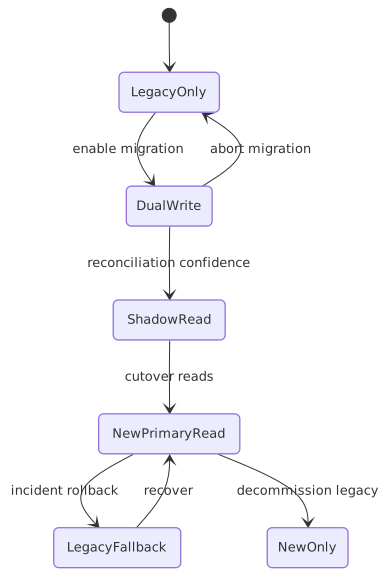
That is a healthier mental model. Migrations are journeys, not light switches.
Migration Strategy
Feature flags become most valuable during migration, and most abused there too.
The progressive strangler pattern works because it accepts reality: old and new systems will coexist for longer than anyone promised in the steering committee. Flags are useful as the routing and behavior controls that let you move piece by piece.
A sensible migration strategy goes like this.
Phase 1: Encapsulate legacy behavior
Do not spray legacy routing decisions everywhere. Introduce a stable facade or anti-corruption layer. Put migration flags near this seam. This localizes the old-world/new-world choice.
For example, a CustomerProfileFacade may route reads to the monolith or the new profile service based on migration state. Upstream consumers do not need to know the details.
Phase 2: Introduce dual write behind explicit migration states
When moving writes, use a multi-state migration flag, not a boolean. Typical states:
LEGACY_ONLYDUAL_WRITESHADOW_READNEW_PRIMARYNEW_ONLY
This matters because each state implies different reconciliation and observability requirements.
Phase 3: Reconcile before cutover
A strangler migration fails when teams treat dual write as proof of correctness. It is not. It is a data divergence factory with better branding.
Run reconciliation reports. Measure mismatch rates. Compare semantic equivalence, not just record counts. An address normalized differently in the new model may be technically different but semantically fine. This is why domain thinking matters.
Phase 4: Decide once for each business transaction
During migration, split-brain decisions are poison. If order creation starts on the old pricing path, downstream services should not independently switch to the new fulfillment path unless that combination has been explicitly designed. Carry migration context through the workflow.
Phase 5: Retire the flag aggressively
A migration flag is scaffolding. Leave it up too long and it becomes load-bearing architecture. Then nobody dares remove it.
Retirement criteria should be defined when the flag is created:
- what metrics prove confidence
- what reconciliation threshold is acceptable
- what date or event triggers cleanup
- who owns code removal
Flags should expire, or they become sediment.
Enterprise Example
Consider a global retailer modernizing its checkout platform.
The legacy monolith handled product eligibility, promotion pricing, tax, order orchestration, and warehouse routing. The company wanted to carve out pricing and fulfillment into separate microservices while preserving daily deployment and limiting operational risk. At the same time, different markets had different legal rules around promotions and delivery promises.
The first attempt used ad hoc service-local flags:
- frontend flag for “new checkout”
- pricing flag for “promo engine v2”
- order flag for “service fulfillment”
- warehouse flag for “priority dispatch”
This looked agile for three months and then collapsed under its own ambiguity. A customer in France would see one promotion, checkout against another, and receive shipping estimates from a third rule set. Support blamed inventory. Inventory blamed pricing. Pricing blamed stale config. Everyone was right.
The second design was better.
They established a Flag Control Service with business-oriented definitions. Instead of newCheckout, they modeled:
PromotionPolicyActivationTaxCalculationModeFulfillmentRoutingModeCheckoutExperienceVariantLegacyOrderWriteMode
Promotion and tax were classified as policy flags, requiring audit and market-owner approval. Checkout variant was an experiment flag, managed by digital product teams. Fulfillment routing and legacy write mode were migration/ops flags with strict runbooks.
Kafka distributed updates to the API gateway, checkout BFF, pricing service, order service, and fulfillment service. For customer requests, the gateway evaluated relevant policy and migration decisions once per transaction and stamped them into a decision context. Asynchronous events carried the same context.
The migration of fulfillment followed a strangler sequence:
- legacy-only warehouse routing
- dual publish to new fulfillment service
- shadow comparison of routing outcomes
- market-by-market cutover
- rollback path retained for two weeks
- full retirement
The big win was not technical elegance. It was business coherence. When France enabled a new promotion policy, pricing, tax, and checkout all agreed on the same version of truth for a transaction. When a warehouse incident hit, an ops flag disabled new routing in one market without breaking others. And when finance asked which orders had been priced under which policy version, the data existed.
That is what enterprise architecture should do: make change survivable.
Operational Considerations
This topic is often treated as if it ends with rollout rules. It does not. A distributed flag system is production infrastructure.
Audit and governance
For policy, entitlement, and migration flags, store:
- who changed it
- when
- why
- approval chain
- affected tenants, regions, or segments
- associated incident, release, or change request
If auditors or legal teams care, screenshots of a flag UI will not save you.
Propagation SLAs
Not every flag needs the same freshness. Define classes:
- immediate: kill switch, incident controls
- near real-time: migration routing
- eventual: experiments, non-critical release toggles
Tie architecture to these needs. Do not pay for streaming complexity where polling is enough. Do not use polling where seconds matter.
Local cache design
A local cache should be:
- warm on startup from persisted snapshot or compacted topic
- updated by event stream
- version-aware
- observable
- able to answer “how old is my config?”
Cold-start behavior matters. A service with no flag state is not a neutral condition.
Observability
Emit metrics and traces for:
- flag evaluation counts
- cache age
- propagation lag
- event consumer lag
- decision version by transaction
- fallback path usage
- mismatched decisions across services
If flags influence revenue or compliance, they belong in dashboards and traces, not hidden in debug logs.
Security
Flag administration is power. Treat it like power.
- strong RBAC
- separation of duties for sensitive flags
- approval workflows
- immutable audit trails
- signed change events if needed in highly regulated environments
Lifecycle management
Flags should have metadata:
- type
- owner
- expiry date
- retirement criteria
- dependent services
- documentation link
A feature flag without an owner is not a feature flag. It is future archaeology.
Tradeoffs
No architecture here is free.
Event-driven propagation with local evaluation improves resilience and latency, but introduces complexity in SDKs, cache coherence, and version management.
Workflow-scoped decision context improves consistency, but can create a form of semantic coupling between services. Teams must agree on decision metadata and trust boundaries.
Central governance improves audit and clarity, but can slow teams if the platform becomes bureaucratic. The cure for chaos should not be a committee.
Strong domain semantics improve business coherence, but require more upfront modeling. Generic platforms are easier to start and harder to live with.
Kafka gives durability and fan-out, but also operational overhead. If your estate is small and your flags are mostly UI experiments, this may be overkill.
The right answer depends on what kind of decisions the flags are making. That is the theme throughout. Architecture should follow semantics.
Failure Modes
This is where the scars show.
Stale caches causing split behavior
One service receives the update, another lags behind. A customer journey spans both. Result: inconsistent process behavior.
Mitigation:
- propagation lag monitoring
- workflow-scoped decisions for process-wide flags
- version-stamped events and requests
Flag service becomes a runtime dependency
Every request calls home to evaluate a flag. During an outage, your release machinery becomes your outage multiplier.
Mitigation:
- local evaluation
- cached state
- fail-safe defaults by flag type
Boolean migration flags
Teams use useNewService=true and discover they needed dual-write, shadow-read, reconciliation, and rollback modes.
Mitigation:
- explicit migration state machines
- transition runbooks
Semantic drift across services
The same “feature” is represented by different technical flags with no common domain meaning.
Mitigation:
- domain-owned definitions
- ubiquitous language
- platform catalog and governance
Forgotten flags
Temporary flags remain for years. Nobody remembers the safe value. Refactoring becomes dangerous.
Mitigation:
- expiry metadata
- automated reporting
- cleanup embedded in definition of done
Poor default behavior during outages
A payment fraud flag fails open and lets risky transactions through. A customer entitlement flag fails closed and blocks premium users globally.
Mitigation:
- classify flags by business criticality
- define failure policy per flag type, not globally
When Not To Use
Distributed feature flag architecture is not always the right move.
Do not build this machinery if:
- you have a small monolith with a handful of low-risk release toggles
- your flags are mostly frontend experiments with no cross-service consequences
- your team cannot support event infrastructure and operational governance
- your domain decisions should really be modeled as stable business rules, not temporary toggles
That last one matters. Some “flags” are actually enduring policy. If a rule is core to how the business operates, it may belong in a policy engine, pricing model, or entitlement domain service rather than in feature flag infrastructure. Flags are good at controlling change. They are poor substitutes for real domain modeling.
Also, if your architecture is immature, introducing a sophisticated distributed flag system can become theater. I have seen organizations with weak observability, no event versioning, and no ownership model proudly install a feature flag platform. They did not gain control. They gained a prettier dashboard for confusion.
Related Patterns
Several adjacent patterns work well with distributed flags.
Strangler Fig Pattern
Use migration flags to control routing between legacy and new capabilities as you progressively replace the monolith.
Anti-Corruption Layer
Place migration decisions behind a facade so upstream contexts are insulated from legacy concepts.
Saga / Process Manager
For long-running workflows, carry decision context consistently across services and events.
Outbox Pattern
When flag changes or migration state changes must be published reliably, pair control-plane updates with transactional outbox publication.
Circuit Breaker and Bulkhead
Ops flags should complement resilience patterns, not replace them. A kill switch is useful, but not a substitute for engineering discipline.
Policy Decision / Policy Enforcement split
A close cousin of flag architecture: centralize policy definition, decentralize enforcement where practical.
Summary
Distributed feature flags in microservices are not a UI convenience. They are a control system for change across bounded contexts.
Treat them carelessly and they create semantic drift, split-brain workflows, brittle migrations, and operational surprises at the worst possible time. Treat them seriously and they become one of the most useful pieces of enterprise architecture you can build: a disciplined way to release safely, migrate progressively, and operate under pressure.
The winning design is usually not a single flag service that everybody calls synchronously. It is a domain-aware control plane, event-driven propagation through Kafka or similar infrastructure, local evaluation for resilience, and workflow-scoped decision context when business consistency matters. Add reconciliation for migration, audit for governance, and aggressive flag retirement for sanity.
Most importantly, model the meaning, not just the mechanism.
A flag that controls button color is a toggle.
A flag that controls order routing, fraud policy, tax behavior, or legacy cutover is architecture.
And architecture, unlike configuration, remembers your mistakes for a very long time.
Frequently Asked Questions
What is a service mesh?
A service mesh is an infrastructure layer managing service-to-service communication. It provides mutual TLS, load balancing, circuit breaking, retries, and observability without each service implementing these capabilities. Istio and Linkerd are common implementations.
How do you document microservices architecture for governance?
Use ArchiMate Application Cooperation diagrams for the service landscape, UML Component diagrams for internal structure, UML Sequence diagrams for key flows, and UML Deployment diagrams for Kubernetes topology. All views can coexist in Sparx EA with full traceability.
What is the difference between choreography and orchestration in microservices?
Choreography has services react to events independently — no central coordinator. Orchestration uses a central workflow engine that calls services in sequence. Choreography scales better but is harder to debug; orchestration is easier to reason about but creates a central coupling point.